Lifestyle
Altadena’s Christmas Tree Lane survives. Volunteers hope to turn the lights on again

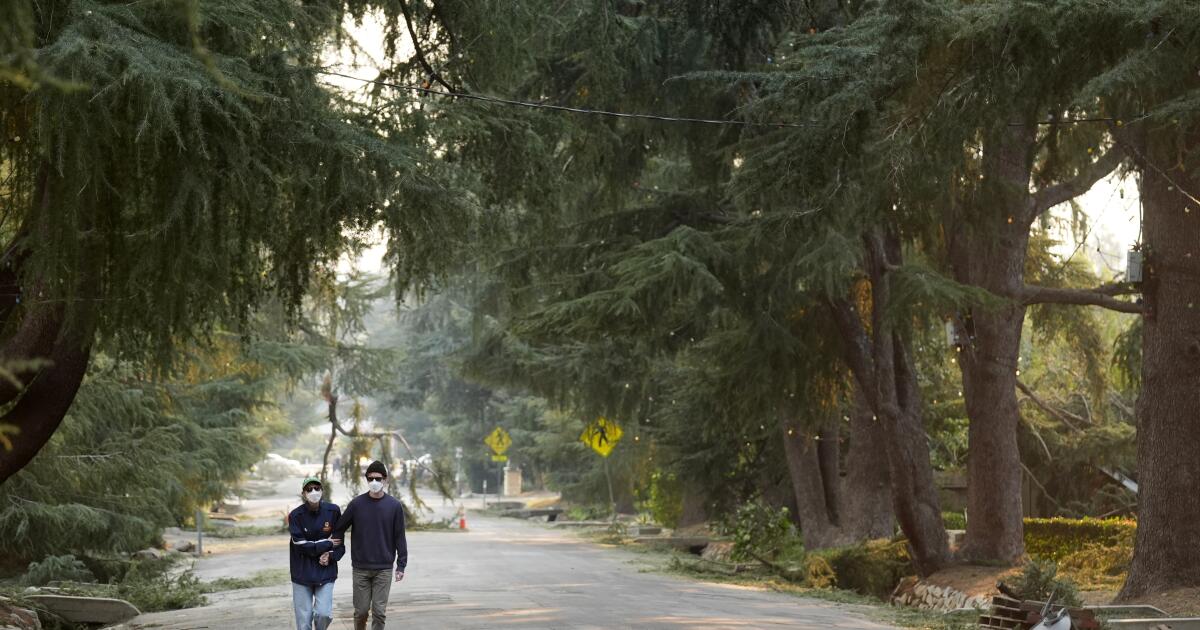
• Altadena’s 104-year holiday lighting tradition known as Christmas Tree Lane escaped damage from the fire despite a torrent of embers coming down on its historic deodar cedars.
• Fierce Santa Ana winds did break branches from some of the trees, but most on Santa Rosa Avenue — the real name of the street — appear unscathed.
• The lights are usually taken down every February, but the head of the volunteer association hopes they can be turned on again “to show we’re still here.”
The people who tend Altadena’s venerable deodar cedars have suffered incomprehensible community losses this week, but Santa Rosa Avenue, a.k.a. Christmas Tree Lane, is a tiny bright spot among the wreckage wrought by the Eaton fire.
Despite what residents described as a fiery rain of embers propelled by hurricane force winds, the street’s 135 cedars seemed unfazed by the fire. The raging Santa Ana winds have broken a few branches, but overall, the massive trees with their graceful drapey limbs seem fine, which means the community’s 104-year holiday light tradition can continue.
Tony Ward and his wife, Maureen, longtime residents of Santa Rosa Avenue and past presidents of the Christmas Tree Lane Assn., went out for dinner in Hastings Ranch on Jan. 7, after the power went out at their home.
Thousands of people turn out every year to drive under a nearly mile-long canopy of sparkly lights strung on 135 deodar cedars on Santa Rosa Avenue in Altadena, a 104-year, volunteer-led tradition known as Christmas Tree Lane.
(Los Angeles Times)
The wind was intense when they left “but there wasn’t any discussion on the media about a fire,” Ward said.
Their dinner outing was short. Before their meal was served, Ward said, “the waiter came up and apologized. He said, ‘We have to give you the meal to go because we have an evacuation order.’ ”
The Wards’ home of nearly 50 years is at the southern end of Santa Rosa Avenue, near Woodbury Road, about six miles west of Hastings Ranch. As the couple returned home and looked to the north, “we could see Eaton Canyon was totally involved in fire, from top to bottom, and we were flabbergasted. It happened so fast,” Ward said.
Once they got home, they began packing “all the things we could think of, photos and business records, into our car and van,” in case they had to evacuate, Ward said. “The wind was intense, and the smoke was just heavy, heavy, heavy.”

The gusting Santa Ana winds blew fiery embers throughout Altadena, including on Woodlyn Road, on Jan. 8 during the Eaton fire.
(Gina Ferazzi / Los Angeles Times)
The Wards have lived in their home for 50 years and never experienced this kind of fire event. Between the constant roar of the wind and the advancing flames, sleep was impossible that night.
They joined their neighbor standing watch outside “to see if anything flared up so we could run and stamp it out,” Ward said.
By 2:30 a.m. last Wednesday, “we noticed embers flying all the way down from way up in the [Angeles National] forest. They would strike the trees [the deodar cedars] and burst into little sparklers. And most of the embers went out, but this was something we’d never experienced before,” he said.
“And in addition to the wind roaring, there were very loud reports we could hear in the background, which we surmised to be exploding canisters of fuel for barbecues and outdoor space heater,” he added. “It was pretty scary because the wind was so intense, and the dust and ashes, everything was right in your eyes. And who thinks of wearing safety goggles? We had no idea that anything like this could happen so far away from the canyons and the national forest.”
When the evacuation order came at 5 a.m., the Wards finally left. They were able to return briefly last Thursday and found their home still standing. It turns out that most of the houses on Santa Rosa Avenue south of Mariposa Street escaped fire damage, although houses on adjoining streets were burned.
And the cedars, most of which were planted in the late 1880s, seemed fine.

A large broken branch from a deodar cedar hangs precariously from a string of lights on Santa Rosa Avenue the day after massive winds and the Eaton fire tore through Altadena.
(Jeanette Marantos / Los Angeles Times)
However, there is wind damage. A few large branches broken in the heavy winds dragged strings of lights with them to the street. But the trees didn’t burn, and it’s not clear why.
“They are pretty lusciously green,” said Cristhian Mace, a natural areas biologist for Los Angeles County Parks and Recreation, “which makes me think they were well irrigated, and that’s probably one of the factors that saved them. They weren’t dry and brittle, and when you look at cedar bark, it’s thick and somewhat fire resistant. … I don’t know how else to account for their resiliency.”
The trees are well tended by the Christmas Tree Lane Assn., but they are largely cared for by the homeowners on whose property the trees reside, said Assn. President Scott Wardlaw. During drought years, the association has taken steps to give the trees extra water, but usually, Wardlaw said, it has to warn homeowners against overwatering the deodar cedars. Too much water can lead to Armillaria root disease, a deadly form of root rot.
Preserving the trees is critical, because without the cedars, there is no Christmas Tree Lane.

In November 2024, volunteers use ropes and pulleys to hang long strings of holiday lights on Christmas Tree Lane’s deodar cedars. Casty Fortich, far left, and Temple City High School student Patience Cam, pull as Scott Wardlaw, president of the Altadena Christmas Tree Lane Assn., and Feli Hernandez, right, look on.
(Genaro Molina / Los Angeles Times)
It takes 10 weekends and more than a 100 volunteers to string those lights every year; volunteers begin their work in September to be ready for Altadena’s free winter festival and tree lighting event in early December. The same volunteers usually start taking the lights down for the year in February to avoid winter rains.
The festival is traditionally held in the parking area of the Altadena Public Library at the corner of Mariposa Street and Santa Rosa Avenue. Last week, several buildings at the intersection burned, including the Altadena Senior Center next door, but the library was saved.
The area lighting event that began in 1920 still has a small-town, old-fashioned feel, with booths and hot chocolate, local leaders making speeches and attendees walking the route once the lights are turned on. The Christmas Tree Lane display itself is pretty low-tech, with no music or special effects. But it still draws thousands of people every year for the simple pleasure of driving slowly for a near mile under a canopy of sparkly lights.
Wardlaw said at least 13 of the Christmas Tree Lane volunteers lost homes in the fire. Also, the local school that had let the association park its truck and store its container of equipment for free was destroyed in the fire.
Now the association is grappling with where it will store its truck and equipment, which didn’t burn in the fire.
The trick will be finding a new storage place the cash-strapped nonprofit can afford. “The cheapest storage units charge around $5 a day for a truck, nearly $1,900 a year, which we can’t afford for just parking,” Wardlaw said.
The association relies on annual $35 memberships and sponsors to cover its expenses, and several of its sponsors, including Altadena Hardware, St. Mark’s School, Pasadena Waldorf School and Western Fence Co., lost buildings in the fire.
Those losses have weighed heavy on Wardlaw, who, like most displaced Altadena residents, is chafing to get into the burned areas, presently closed to the public, to see what has been lost, and what, if anything, can be saved. The broken tree branches on the street will have to be cleared away, he said, and the strings of lights, many of which are likely broken, will have to be repaired or replaced.
The work will require volunteers, many of whom will be preoccupied by their own losses, Wardlaw acknowledged, but he sees the work ahead as a tiny act of defiance against all the fire’s terrible destruction.
“Something I want to do, if it’s feasible, is turn the lights on again as soon as possible,” he said, “Just so we can say, ‘We’re still here.’ ”



The art industry is increasingly shaped by artists’ and art businesses’ shared realization that they are locked in a fierce struggle for sustained attention — against each other, and against the rest of the overstimulated, always-online world. A major New York art fair aims to win this competition next month by knocking down the increasingly shaky walls between contemporary art and fashion.
When visitors enter the Independent art fair on May 14, they will almost immediately encounter its open-plan centerpiece: an installation of recent couture looks from Comme des Garçons. It will be the first New York solo presentation of works by Rei Kawakubo, the brand’s founder and mastermind, since a lauded 2017 survey exhibition at the Metropolitan Museum of Art’s Costume Institute.
Art fairs have often been front and center in the industry’s 21st-century quest to capture mindshare. But too many displays have pierced the zeitgeist with six-figure spectacles, like Maurizio Cattelan’s duct-taped banana and Beeple’s robot dogs. Curating Independent around Comme des Garçons comes from the conviction that a different kind of iconoclasm can rise to the top of New York’s spring art scrum.
Elizabeth Dee, the founder and creative director of Independent, said that making Kawakubo’s work the “nerve center” of this year’s edition was a “statement of purpose” for the fair’s evolution. After several years at the compact Spring Studios in TriBeCa, Independent will more than double its square footage by moving to Pier 36 at South Street, on the East River. Dee has narrowed the fair’s exhibitor list, to 76, from 83 dealers in 2025, and reduced booth fees to encourage a focus on single artists making bold propositions.
“Rei’s work has been pivotal to thinking about how my work as a curator, gallerist and art fair can push boundaries, especially during this extraordinary move toward corporatization and monoculture in the art world in the last 20 years,” Dee said.
Kawakubo’s designs have been challenging norms since her brand’s first Paris runway show in 1981, but her work over the last 13 years on what she calls “objects for the body” has blurred borders between high fashion and wearable sculpture.
The Comme des Garçons presentation at Independent will feature 20 looks from autumn-winter 2020 to spring-summer 2025. Forgoing the runway, Kawakubo is installing her non-clothing inside structures made from rebar and colored plastic joinery.
Adrian Joffe, the president of both Comme des Garçons International and the curated retailer Dover Street Market International (and who is also Kawakubo’s husband), said in an interview that Kawakubo’s intention was to create a sculptural installation divorced from chronology and fashion — “a thing made new again.”
Every look at Independent was made in an edition of three or fewer, but only one of each will be for sale on-site. Prices will be about $9,000 to $30,000. Comme des Garçons will retain 100 percent of the sales.
Asked why she was interested in exhibiting at Independent, the famously elusive Kawakubo said via email, “The body of work has never been shown together, and this is the first presentation in New York in almost 10 years.” Joffe added a broader philosophical motivation. “We’ve never done it before; it was new,” he said. Also essential was the fair’s willingness to embrace Kawakubo’s vision for the installation rather than a standard fair booth.
Kawakubo began consistently engaging with fine art decades before such crossovers became commonplace. Since 1989, she has invited a steady stream of contemporary artists to create installations in Comme des Garçons’s Tokyo flagship store. The ’90s brought collaborations with the artist Cindy Sherman and performance pioneer Merce Cunningham, among others.
More cross-disciplinary projects followed, including limited-release direct mailers for Comme des Garçons. Kawakubo designs each from documentation of works provided by an artist or art collective.
The display at Independent reopens the debate about Kawakubo’s proper place on the continuum between artist and designer. But the issue is already settled for celebrated artists who have collaborated with her.
“I totally think of Rei as an artist in the truest sense,” Sherman said by email. “Her work questions what everyone else takes for granted as being flattering to a body, questions what female bodies are expected to look like and who they’re catering to.”
Ai Weiwei, the subject of a 2010 Comme des Garçons direct mailer, agreed that Kawakubo “is, in essence, an artist.” Unlike designers who “pursue a sense of form,” he added, “her design and creation are oriented toward attitude” — specifically, an attitude of “rebellion.”
Also taking this position is “Costume Art,” the spring exhibition at the Costume Institute. Opening May 10, the show pairs individual works from multiple designers — including Comme des Garçons — with artworks from the Met’s holdings to advance the argument made by the dress code for this year’s Met gala: “Fashion is art.”
True to form, Kawakubo sometimes opts for a third way.
“Rei has often said she’s not a designer, she’s not an artist,” Joffe said. “She is a storyteller.”
Now to find out whether an art fair sparks the drama, dialogue and attention its authors want.
Lifestyle
They set out to elevate karaoke in L.A. — and opened a glamorous lounge that pulls out all the stops

Brothers Leo and Oliver Kremer visited karaoke spots around the globe and almost always had the same impression.
“The drinks weren’t always great, the aesthetics weren’t always so glamorous, the sound wasn’t always awesome and the lights were often generic,” says Leo, a former bassist of the band Third Eye Blind.
As devout karaoke fans, they wanted to level up the experience. So they dreamed up Mic Drop, an upscale karaoke lounge in West Hollywood that opens Thursday. It’s located inside the original Larrabee Studios, a historic 1920s building formerly owned by Carole King and her ex-husband, Gerry Goffin — and the spot where King recorded some of her biggest hits. Third Eye Blind band members Stephan Jenkins and Brad Hargreaves are investors of the new venue.
Inside the two-story, 6,300-square-foot venue with 13 private karaoke rooms and an electrifying main stage, you can feel like a rock star in front of a cheering audience. Want to check it out? Here are six things to know.
The Kremer brothers hired sculptor Shawn HibmaCronan to create an 8-foot-tall disco-themed microphone for their karaoke lounge.
1. Take your pick between a private karaoke experience or the main stage
A unique element of Mic Drop is that it offers both private karaoke rooms and a main stage experience for those who wish to sing in front of a crowd. The 13 private rooms range from six- to 45-person capacity. Each of the karaoke rooms are named after a famous recording studio such as Electric Lady, Abbey Road, Shangri La and of course, Larrabee Studios. There is a two-hour minimum on all rentals and hourly rates depend on the room size and day of the week.
But if you’re ready to take the center stage, it’s free to sing — at least technically. All you have to do is pay a $10 fee at the door, which is essentially a token that goes toward your first drink. Then you can put your name on the list with the KJ (karaoke jockey) who keeps the crowd energized throughout the night and even hits the stage at times.

Harrison Baum, left, of Santa Monica, and Amanda Stagner, 27, of Los Angeles, sing in one of the 13 private karaoke rooms.
2. Thumping, high sound quality was a top priority
As someone who toured the world playing bass for Third Eye Blind, top-tier sound was a nonnegotiable for Leo. “Typically with karaoke, the sound is kind of teeny, there’s not a lot of bass and the vocal is super hot and sitting on top too much,” he says. To combat this, he and his brother teamed up with Pineapple Audio, an audio visual company based in Chicago, to design their crisp sound system. They also installed concert-grade speakers and custom subwoofers from a European audio equipment manufacturer called Celto, and bought gold-plated Sennheiser wireless microphones, which they loved so much that they had an 8-foot-tall replica made for their main room. Designed by artist Shawn HibmaCronan, the “macrophone,” as they call it, has roughly 30,000 mirror tiles. “It spins and throws incredible disco light everywhere,” says Leo.

Karaoke jockeys Sophie St. John, 27, second from left, and Cameron Armstrong, 30, right, get the crowd involved with their song picks at Mic Drop.
3. A concert-level performance isn’t complete without good stage lighting and a haze machine
Each karaoke room features a disco ball and dynamic lighting that syncs up with whatever song you’re singing, which makes you feel like you are a professional performer. There’s also a haze machine hidden under the leather seats. Meanwhile, the main stage is concert-ready with additional dancing lasers and spotlights.

Brett Adams, left, of Sherman Oaks, and Patrick Riley of Studio City sing karaoke together inside a private lounge at Mic Drop.
4. The song selection is vast, offering classics and new hits
One of the worst things that can happen when you go to karaoke is not being able to find the song you want to sing. At Mic Drop, the odds of this happening are slim to none. The venue uses a popular karaoke service called KaraFun, which has a catalog of more than 600,000 songs (and adds 400 new tracks every month), according to its website. Take your pick from country, R&B, jazz, rap, pop, love duets and more. (Two newish selections I spotted were Raye’s “Where Is my Husband” and Olivia Dean’s “Man I Need,” which both released late last year.) In the private karaoke rooms, there’s also a fun feature on Karafun called “battle mode,” which allows you and your crew of up to 20 people to compete in real time. KaraFun also has an entertaining music trivia game, which I tested out with the founders and came in second place.

The design inspiration for Mic Drop was 1920s music lounges and 1970s disco culture, says designer Amy Morris.
5. The interiors are inspired by 1920s music lounges mixed with ‘70s disco vibes

A disco ball hangs from the ceiling.
If you took the sophisticated aesthetic of 1920s music lounges and mixed it with the vibrant and playful era of 1970s disco culture, you’d find Mic Drop.
When you walk into the lounge, the first thing you’ll see is a bright red check-in desk that resembles a performer’s dressing room with vanity lights, several mirrors and a range of wigs. “So much of karaoke is about getting into character and letting go of the day, so we had the idea to sell the wigs,” says Oliver. As you continue into the lounge, the focal point is the stage, which is adorned with zebra-printed carpet and dramatic, red velvet curtains. For seating, slide into the red velvet banquettes or plop onto a gold tiger velvet stool. Upstairs, you’ll find the intimate karaoke studios, which are decorated with red velvet walls and brass, curved doorways that echo the building’s deco arches, says Mic Drop’s interior designer, Amy Morris of the Morris Project.

Sarah Rothman, center, of Oakland, and friend Rachel Bernstein, left, of Los Angeles, wait at the bar.
6. You can order nontraditional karaoke bites as you wait for your turn to sing
While Mic Drop offers some of the food you’d typically find at a karaoke lounge such as tater tots, truffle popcorn and pizza, the venue has some surprising options as well. For example, a 57 gram caviar service (served with chips, crème fraîche and chives) and shrimp cocktail from Santa Monica Seafood. For their pizza program, the Kremer brothers teamed up with Avalou’s Italian Pizza Company, which is run by Louis Lombardi who starred in “The Sopranos.” He’s the brainchild behind my favorite dish, the Fuhgeddaboudit pizza, which is made with pastrami, pickles and mustard. It might sound repulsive, but trust me.
As for the cheeky cocktails, they are all named after famous musicians and songs such as the Pink Pony Club (a tart cherry pomegranate drink with vodka named after Chappell Roan), Green Eyes (a sake sour with kiwi and melon named after Green Day) and Megroni Thee Stallion (an elevated negroni named after Megan Thee Stallion).

When John Lantigua, a retired journalist in Miami Beach, checked his email one recent morning, he was glad to see an invitation.
“It was like, ‘Come and share an evening with me. Click here for details,’” Mr. Lantigua said.
It appeared to be a Paperless Post invitation from someone he once worked with at The Palm Beach Post, a man who had left Florida for Mississippi and liked to arrange dinners when he was back in town.
Mr. Lantigua, 78, clicked the link. It didn’t open.
He clicked a second time. Still nothing.
He didn’t realize what was going on until a mutual friend who had received the same email told him it wasn’t an invitation at all. It was a scam.
Phishing scams have long tried to frighten people into clicking on links with emails claiming that their bank accounts have been hacked, or that they owe thousands of dollars in fines, or that their pornography viewing habits have been tracked.
The invitation scam is a little more subtle: It preys on the all-too-human desire to be included in social gatherings.
The phishy invitations mimic emails from Paperless Post, Evite and Punchbowl. What appears to be a friendly overture from someone you know is really a digital Trojan horse that gives scammers access to your personal information.
“I thought it was diabolical that they would choose somebody who has sent me a legitimate invitation before,” Mr. Lantigua said. “He’s a friend of mine. If he’s coming to town, I want to see him.”
Rachel Tobac, the chief executive of SocialProof Security, a cybersecurity firm, said she noticed the scam last holiday season.
“Phishing emails are not a new thing,” Ms. Tobac said, “but every six months, we get a new lure that hijacks our amygdala in new ways. There’s such a desire for folks to get together that this lure is interesting to people. They want to go to a party.”
Phishing scams involve “two distinct paths,” Ms. Tobac added. In one, the recipient is served a link that turns out to be dead, or so it seems. A click activates malware that runs silently as it gleans passwords and other bits of personal information. In all likelihood, this is what happened when Mr. Lantigua clicked on the ersatz invitation link.
Another scam offers a working link. Potential victims who click on it are asked to provide a password. Those who take that next step are a boon to hackers.
“They have complete control of your email and, in turn, your entire digital life,” Ms. Tobac said. “They can reset your password for your dog’s Instagram account. They can take over your bank account. Change your health insurance.”
Digital invitation platforms are trying to combat the scam by publishing guides on how to spot fake invitations. Paperless Post has also set up an email account — phishing@paperlesspost.com — for users to submit messages for verification. The company sends suspicious links to the Anti-Phishing Working Group, a nonprofit that maintains a database monitored by cybersecurity firms. Flagged links are rendered ineffective.
The scammers’ new strategy of exploiting the desire for connection is infuriating, said Alexa Hirschfeld, a founder of Paperless Post. “Life can be isolating,” Ms. Hirschfeld said. “When it looks like you’re getting an invitation from someone you know, your first instinct is excitement, not skepticism.”
Olivia Pollock, the vice president of brand for Evite, said that fake invitations tended to be generic, promising a birthday party or a celebration of life. Most invitations these days tend to have a specific focus — mahjong gatherings or book club talks, for instance. “The devil is in the details,” Ms. Pollock said.
Because scammers don’t know how close you are with the people in your contact list, fake invitations may also seem random. “They could be from your business school roommate you haven’t spoken to in 10 years,” Ms. Hirschfeld said.
Alyssa Williamson, who works in public relations in New York, was leaving a yoga class recently when she checked her phone and saw an invitation from a college classmate.
“I assumed it was an alumni event,” Ms. Williamson, 30, said. “I clicked on it, and it was like, ‘Enter your email.’ I didn’t even think about it.”
Later that day, she received texts from friends asking her about the party invitation she had just sent out. Her response: What party?
“The thing is, I host a lot of events,” she said. “Some knew it was fake. Others were like, ‘What’s this? I can’t open it.’”
Andrew Smith, a graduate student in finance who lives in Manhattan, received what looked like a Punchbowl invitation to “a memory making celebration.” It appeared to have come from a woman he had dated in college. He received it when he was having drinks at a bar on a Friday night — “a pretty insidious piece of timing,” he said.
“The choice of sender was super clever,” Mr. Smith, 29, noted. “This was somebody that would probably get a reaction from me.”
Mr. Smith seized on the phrase “memory making celebration” and filled in the blanks. He imagined that someone in his ex-girlfriend’s immediate family had died. Perhaps she wanted to restart contact at this difficult moment.
Something saved him when he clicked a link and tried to tap out his personal information — his inability to remember the password to his email account. The next day, he reached out to his ex, who confirmed that the invitation was fake.
“It didn’t trigger any alarm bells,” Mr. Smith said. “I went right for the click. I went completely animal brain.”
The new scam comes with an unfortunate side effect, a suspicion of invitations altogether. It’s enough to make a person antisocial.
“Don’t invite me to anything,” Mr. Lantigua, the retired journalist, said, only half-joking. “I’m not coming.”
-

 New York1 hour ago
Should a Straight Person Represent Stonewall’s City Council District?
-

 Detroit, MI2 hours ago
Blake Miller has high floor, big upside, says Lions GM Brad Holmes
-

 San Francisco, CA2 hours ago
Highway 1 closure in San Francisco expected to snarl Sunset traffic all weekend
-

 Dallas, TX2 hours ago
How UCF EDGE Malachi Lawrence Fits With The Dallas Cowboys
-
Miami, FL2 hours ago
Dolphins Select Two Players in The First Round of The 2026 NFL Draft
-

 Boston, MA2 hours ago
In-Store Only
-

 Denver, CO2 hours ago
Wolves Back Up the Big Talk With Blowout Win Over Denver in Game 3
-

 Seattle, WA3 hours ago
‘Rare’ Tiny-Home Compound Featuring 3 Adorable Abodes Hits the Market in Seattle for Just $900K