Lifestyle
Altadena’s Christmas Tree Lane survives. Volunteers hope to turn the lights on again

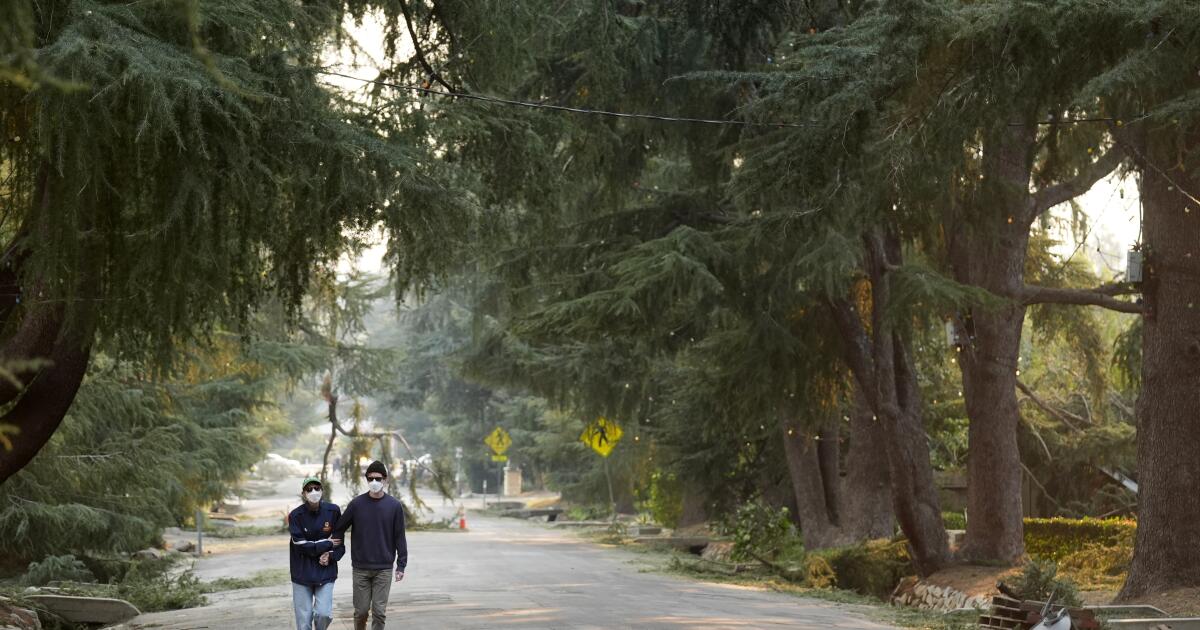
• Altadena’s 104-year holiday lighting tradition known as Christmas Tree Lane escaped damage from the fire despite a torrent of embers coming down on its historic deodar cedars.
• Fierce Santa Ana winds did break branches from some of the trees, but most on Santa Rosa Avenue — the real name of the street — appear unscathed.
• The lights are usually taken down every February, but the head of the volunteer association hopes they can be turned on again “to show we’re still here.”
The people who tend Altadena’s venerable deodar cedars have suffered incomprehensible community losses this week, but Santa Rosa Avenue, a.k.a. Christmas Tree Lane, is a tiny bright spot among the wreckage wrought by the Eaton fire.
Despite what residents described as a fiery rain of embers propelled by hurricane force winds, the street’s 135 cedars seemed unfazed by the fire. The raging Santa Ana winds have broken a few branches, but overall, the massive trees with their graceful drapey limbs seem fine, which means the community’s 104-year holiday light tradition can continue.
Tony Ward and his wife, Maureen, longtime residents of Santa Rosa Avenue and past presidents of the Christmas Tree Lane Assn., went out for dinner in Hastings Ranch on Jan. 7, after the power went out at their home.
Thousands of people turn out every year to drive under a nearly mile-long canopy of sparkly lights strung on 135 deodar cedars on Santa Rosa Avenue in Altadena, a 104-year, volunteer-led tradition known as Christmas Tree Lane.
(Los Angeles Times)
The wind was intense when they left “but there wasn’t any discussion on the media about a fire,” Ward said.
Their dinner outing was short. Before their meal was served, Ward said, “the waiter came up and apologized. He said, ‘We have to give you the meal to go because we have an evacuation order.’ ”
The Wards’ home of nearly 50 years is at the southern end of Santa Rosa Avenue, near Woodbury Road, about six miles west of Hastings Ranch. As the couple returned home and looked to the north, “we could see Eaton Canyon was totally involved in fire, from top to bottom, and we were flabbergasted. It happened so fast,” Ward said.
Once they got home, they began packing “all the things we could think of, photos and business records, into our car and van,” in case they had to evacuate, Ward said. “The wind was intense, and the smoke was just heavy, heavy, heavy.”

The gusting Santa Ana winds blew fiery embers throughout Altadena, including on Woodlyn Road, on Jan. 8 during the Eaton fire.
(Gina Ferazzi / Los Angeles Times)
The Wards have lived in their home for 50 years and never experienced this kind of fire event. Between the constant roar of the wind and the advancing flames, sleep was impossible that night.
They joined their neighbor standing watch outside “to see if anything flared up so we could run and stamp it out,” Ward said.
By 2:30 a.m. last Wednesday, “we noticed embers flying all the way down from way up in the [Angeles National] forest. They would strike the trees [the deodar cedars] and burst into little sparklers. And most of the embers went out, but this was something we’d never experienced before,” he said.
“And in addition to the wind roaring, there were very loud reports we could hear in the background, which we surmised to be exploding canisters of fuel for barbecues and outdoor space heater,” he added. “It was pretty scary because the wind was so intense, and the dust and ashes, everything was right in your eyes. And who thinks of wearing safety goggles? We had no idea that anything like this could happen so far away from the canyons and the national forest.”
When the evacuation order came at 5 a.m., the Wards finally left. They were able to return briefly last Thursday and found their home still standing. It turns out that most of the houses on Santa Rosa Avenue south of Mariposa Street escaped fire damage, although houses on adjoining streets were burned.
And the cedars, most of which were planted in the late 1880s, seemed fine.

A large broken branch from a deodar cedar hangs precariously from a string of lights on Santa Rosa Avenue the day after massive winds and the Eaton fire tore through Altadena.
(Jeanette Marantos / Los Angeles Times)
However, there is wind damage. A few large branches broken in the heavy winds dragged strings of lights with them to the street. But the trees didn’t burn, and it’s not clear why.
“They are pretty lusciously green,” said Cristhian Mace, a natural areas biologist for Los Angeles County Parks and Recreation, “which makes me think they were well irrigated, and that’s probably one of the factors that saved them. They weren’t dry and brittle, and when you look at cedar bark, it’s thick and somewhat fire resistant. … I don’t know how else to account for their resiliency.”
The trees are well tended by the Christmas Tree Lane Assn., but they are largely cared for by the homeowners on whose property the trees reside, said Assn. President Scott Wardlaw. During drought years, the association has taken steps to give the trees extra water, but usually, Wardlaw said, it has to warn homeowners against overwatering the deodar cedars. Too much water can lead to Armillaria root disease, a deadly form of root rot.
Preserving the trees is critical, because without the cedars, there is no Christmas Tree Lane.

In November 2024, volunteers use ropes and pulleys to hang long strings of holiday lights on Christmas Tree Lane’s deodar cedars. Casty Fortich, far left, and Temple City High School student Patience Cam, pull as Scott Wardlaw, president of the Altadena Christmas Tree Lane Assn., and Feli Hernandez, right, look on.
(Genaro Molina / Los Angeles Times)
It takes 10 weekends and more than a 100 volunteers to string those lights every year; volunteers begin their work in September to be ready for Altadena’s free winter festival and tree lighting event in early December. The same volunteers usually start taking the lights down for the year in February to avoid winter rains.
The festival is traditionally held in the parking area of the Altadena Public Library at the corner of Mariposa Street and Santa Rosa Avenue. Last week, several buildings at the intersection burned, including the Altadena Senior Center next door, but the library was saved.
The area lighting event that began in 1920 still has a small-town, old-fashioned feel, with booths and hot chocolate, local leaders making speeches and attendees walking the route once the lights are turned on. The Christmas Tree Lane display itself is pretty low-tech, with no music or special effects. But it still draws thousands of people every year for the simple pleasure of driving slowly for a near mile under a canopy of sparkly lights.
Wardlaw said at least 13 of the Christmas Tree Lane volunteers lost homes in the fire. Also, the local school that had let the association park its truck and store its container of equipment for free was destroyed in the fire.
Now the association is grappling with where it will store its truck and equipment, which didn’t burn in the fire.
The trick will be finding a new storage place the cash-strapped nonprofit can afford. “The cheapest storage units charge around $5 a day for a truck, nearly $1,900 a year, which we can’t afford for just parking,” Wardlaw said.
The association relies on annual $35 memberships and sponsors to cover its expenses, and several of its sponsors, including Altadena Hardware, St. Mark’s School, Pasadena Waldorf School and Western Fence Co., lost buildings in the fire.
Those losses have weighed heavy on Wardlaw, who, like most displaced Altadena residents, is chafing to get into the burned areas, presently closed to the public, to see what has been lost, and what, if anything, can be saved. The broken tree branches on the street will have to be cleared away, he said, and the strings of lights, many of which are likely broken, will have to be repaired or replaced.
The work will require volunteers, many of whom will be preoccupied by their own losses, Wardlaw acknowledged, but he sees the work ahead as a tiny act of defiance against all the fire’s terrible destruction.
“Something I want to do, if it’s feasible, is turn the lights on again as soon as possible,” he said, “Just so we can say, ‘We’re still here.’ ”


Students walk on the Stanford University campus on March 14, 2019, in Stanford, Calif.
Ben Margot/AP
hide caption
toggle caption
Ben Margot/AP
When Theo Baker arrived at Stanford University a few years ago, he joined the student newspaper, following the path of his journalist parents, Peter Baker, a White House correspondent for The New York Times, and Susan Glasser, a writer for The New Yorker.
Through his reporting as a student journalist, he eventually broke a story about manipulated data in Stanford President Marc Tessier-Lavigne’s neuroscience research that helped lead to the university president’s resignation.
Theo Baker’s book, How to Rule the World: An Education in Power at Stanford University was released May 19. In it, Baker describes Stanford as a place where proximity to Silicon Valley gives rise to a parallel system of influence, recruitment and money, with investors looking to identify promising students almost as soon as they arrive on campus.
He told Morning Edition host Steve Inskeep there was “a sort of Stanford inside Stanford,” where elite students are drawn into an “alternate reality” of excess and access to cut corners.
In the interview, he discusses how Stanford is not just a university but also a pipeline where status and power can matter as much as ideas.
We reached out to Stanford University for comment and have not heard back.
Listen to the interview by clicking play on the blue box above.


The scoreboard shows the results of the women’s singles final match between Iga Swiatek of Poland and Amanda Anisimova of the U.S. at the Wimbledon Tennis Championships in London, Saturday, July 12, 2025.
Kirsty Wigglesworth/AP
hide caption
toggle caption
Kirsty Wigglesworth/AP
Fifteen points in tennis? Nice. Thirty, 40 — even better. Advantage — that sounds good. “Love” — that also must be great, right? Well, not quite.
As the French Open rolls on and Serena Williams has announced her return to the sport, maybe you’ve been paying a little more attention to tennis. The sport’s scoring system is notably distinct, and can sometimes be hard to grasp for newcomers. But even tennis aficionados might not know why, or how, “love” became the unmistakable callout for zero points. For this installment of NPR’s Word of the Week, we’re exploring how a word that signifies trailing behind got such a sweet name.
“Love” comes from the heart — or an egg?
It’s hard to pinpoint when the first tennis ball went over the net. Tennis is a derivative of lots of other sports, such as “jeu de paume,” a handball game played in France, said JT Buzanga, the collections manager at the International Tennis Hall of Fame museum.

But tennis became a patented, official sport in 1874, said Steve Flink, a journalist whose tennis coverage got him inducted into the International Tennis Hall of Fame. It has retained its unique, mysterious scoring system ever since.
“By and large, the original system has held up almost entirely,” Flink said.
The use of “love” goes back to the late 18th century, said Jesse Sheidlower, a lexicographer. But it was used earlier than that in card games such as whist and bridge. Before the term made its way to tennis, the sport favored plain old “nothing,” or “nil,” he said.
Why love in the first place, though? Historians don’t really know for sure, but there are a few theories.
The French could have something to do with it. Some historians believe “love” derives from “l’oeuf,” which means “the egg” in French. Because eggs are shaped like zeros, terms such as “goose egg” and “duck’s egg” have been used in other contexts to mean zero, Sheidlower said.
It’s also possible English speakers mispronounced l’oeuf as “love.” But Sheidlower isn’t convinced that’s the answer.
“It’s the French equivalent of an English expression. But since that expression doesn’t appear in French, the French word wouldn’t have been used,” he said.
To be sure, France has had a lot of influence on tennis culture, Buzanga said. For example, “deuce” or a game tied at 40 points, comes from the French word for “two”: “deux.” But he prefers another prominent theory: that “love” comes from the idiom “for the love of the game.” Even if a player hasn’t scored, it doesn’t matter, because their heart is in it. It’s the theory Sheidlower said is the most plausible, because the idiom was used by the English before tennis was popularized.

Another variation of the “love of the game” theory is that the word could have come from the Dutch “lof,” or “honor” — or the Latin “amare,” meaning “to love,” Flink said.
But if tennis’ “love” doesn’t come from a French word, the theory at least has a French sensibility.
“I think the ‘for the love of the game’ is kind of romantic,” Buzanga said.
“Love” probably isn’t going anywhere
Tennis used to be a sport of leisure. The style of play has changed a lot over the years; players are more athletic and competitive, for instance, Flink said. But the rules of the sport are more steadfast, he said.
“There’s this incredible, enduring respect for tradition in tennis,” he said. “Changes are not made easily.”
There has been one major change in modern history: the tie-break. Matches can go on and on because players have to score two consecutive points to break a deuce, or by two games to break a tied set. But the onset of television meant matches would have to get shorter if the sport wanted to capture a larger audience, Flink said.

Change even came for “love.” An alternative sprouted up in the 1970s, and is still used today: “bagel,” named for its zero shape, Sheidlower said. Novices may say “zero,” and insiders will understand what they mean, but they “will needle them about it,” Flink said.
But “love” still prevails.
“People kind of like it,” Flink said. “It’s different. Why say zero when you can say love?”
-

 West Virginia1 minute ago
CTC Council approves presidential appointments at BridgeValley, Pierpont, and West Virginia Northern – WV MetroNews
-

 Wyoming4 minutes ago
Wyoming lawmakers reject upfront bonding for industrial projects, advance state fund alternative
-

 Crypto9 minutes ago
Pred Opens to Public as $5M Beta Volume Fuels World Cup Sports Trading Push
-

 Fitness19 minutes ago
It works up a sweat: At 79, Susan Sarandon swears by this one surprising exercise for toned arms
-

 Movie Reviews31 minutes ago
Bandar Movie Review: Bobby Deol roars in Anurag Kashyap’s unsettling legal thriller that refuses to spoon-feed
-

 World39 minutes ago
Taormina Film Festival Head Tiziana Rocca Says She Wants to Deliver a ‘Human Festival’ Amidst AI Boom, Asks Stars to Be ‘Generous’ to Local Audiences
-

 Politics49 minutes ago
Video: Jan. 6 Rioter Hired by Pentagon
-
Lifestyle1 hour ago
‘How to Rule the World’ explores education and power at Stanford University

