Business
Column: California employers wrap themselves in the 1st Amendment to kill a pro-worker law

It’s always heartening to see the business establishment stand up for constitutional principles.
Well, almost always. Among the exceptions is when business leaders wrap themselves in the Constitution to secure their own privileges at the expense of the public interest.
That’s the case with a curious little lawsuit the California Chamber of Commerce and California Restaurant Assn. dropped in Sacramento federal court on New Year’s Eve. Their target is Senate Bill 399, otherwise known as the California Worker Freedom from Employer Intimidation Act, which was signed by Gov. Newsom on Sept. 27 and took effect on New Year’s Day.
It should be clear…that a captive-audience meeting is an extraordinary exercise and demonstration of employer power over employees.
— National Labor Relations Board
The law is straightforward. It bans “captive audience meetings,” which are those scheduled by employers to ply workers with religious, political and (especially) anti-union propaganda. Nothing in the law bars employers from holding such meetings when worker attendance is voluntary. The “captive” part, the law specifies, is when employees face “discharge, discrimination, retaliation, or any other adverse action” for failing to attend.
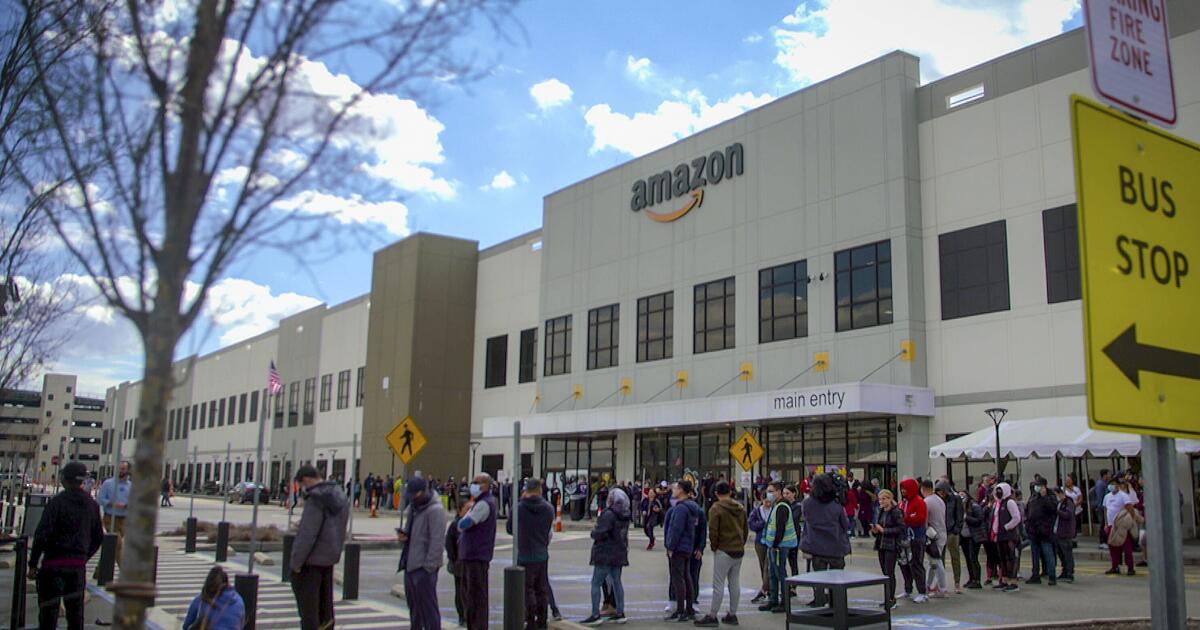
As my colleague Suhauna Hussain has reported, 10 other states have implemented similar bans. So far, they’ve survived legal challenges. Bans on captive meetings are under consideration in at least five other states. They also were outlawed by the National Labor Relations Board with a ruling on Nov. 13, overturning an anti-union policy dating from 1948. The 3-1 ruling, with the board’s Democratic members in the majority and its sole Republican in dissent, involved Amazon.com’s campaign against a union organizing drive at New York-area facilities. Amazon has said it will appeal the ruling.
Captive audience meetings are among “the most pernicious and coercive tactics an employer can use to browbeat and intimidate workers into voting against a union,” says William B. Gould IV, an emeritus professor of law at Stanford and a former chairman of the NLRB and the California Agricultural Labor Relations Board.
The NLRB’s November ruling applied to captive meetings involving unionization drives, which fall within the board’s jurisdiction. The California law goes further by bringing meetings involving political and religious matters into the mix. But the state laws and the NLRB’s ruling make the same distinctions between meetings at which attendance is voluntary, and those that workers are required to attend on pain of discipline. The first are legal, the second illegal.
Since they were seemingly blessed by the NLRB in 1948, captive audience meetings have become “a common feature” of corporate anti-union campaigns, the board observed in the Amazon case. A 2009 study of 1,004 NLRB-supervised union representation elections cited in its ruling found that captive audience meetings had been held in 89% of cases; more than half of the employers had held more than five “in the runup to an election.”
The Amazon campaign is a good example. In opposing the unionization drive, which was ultimately successful, Amazon scheduled mandatory meetings every 45 minutes, six days a week at the Staten Island, N.Y., warehouse where the drive originated. At these meetings, company representatives delivered speeches attacking unions in general and the Amazon union drive specifically.
The NLRB found that “managers personally notified employees that they were scheduled to attend, escorted them to the meetings, and scanned their ID badges to digitally record attendance.”
Amazon’s activities prompted the board to reconsider the 1948 policy, which was set forth in a case involving the boiler company Babcock & Wilcox. The board noted that the 1948 finding that captive audience meetings didn’t violate labor law was “largely unexplained” and “flawed” under the law. So it was bound to be overturned.
In its detailed analysis of the topic, the board cited numerous past board rulings and Supreme Court decisions that say that employers have the right to express their opinions about unions and unionization, but not to compel employees to listen.
“It should be clear,” the board found, “that a captive-audience meeting is an extraordinary exercise and demonstration of employer power over employees,” especially when the employees’ decisions on whether to join the union is at issue.
That brings us back to the lawsuit the Chamber and Restaurant Assn. filed in Sacramento federal court. The lawsuit asserts that any ban on mandatory meetings infringes the employers’ free-speech rights as enshrined in the 1st Amendment. (State officials haven’t yet filed a response.)
“Because of SB 399,” the plaintiffs say, “employers in California are now subject to liability, penalties, and other administrative action when they exercise their federal constitutional and statutory rights to talk to employees.”
We think the plaintiffs do protest too much, to quote Shakespeare. The California law does nothing of the kind.
“Under the bill, employers are not prevented from speaking to employees in any way on any subject, including about religious and political matters,” the AFL-CIO stated in a legal memo for the California Labor Federation, which supports the law.
It’s worth remembering that employers — notably restaurant owners — aren’t above using dubious claims to attack pro-worker initiatives. Back in June, I reported that fast food franchise owners asserted that California’s $20 minimum wage for fast food workers had cost the state 10,000 jobs in that sector, going back to September 2023, when Newsom signed the law.
I documented that the statistic was false; it was the product of a misinterpretation of government employment statistics that appeared initially in the Wall Street Journal and was repeated by UCLA economics professor Lee Ohanian for an essay on the Hoover Institution website. (Hoover subsequently retracted Ohanian’s essay, which had been specifically cited by the fast food camp for a newspaper ad.)
The plaintiffs may have a stronger argument in their assertion that California’s law governing employer rights in unionization cases is preempted by federal law, namely the 1935 National Labor Relations Act.
The AFL-CIO memo argues that California, like any state, has the right to set “minimum employment standards” for workers in the state. The examples it cites, however, are matters such as child labor laws, minimum wages and occupational safety and health standards, though it also maintains that since states can bar the firing of workers for improper reasons such as race, it can bar discharges for failing to attend a mandatory meeting.
Gould, for one, thinks the plaintiffs may have a point, based on a 1959 Supreme Court ruling that gave the NLRB exclusive jurisdiction over unionization issues unless the board disavows an interest. The issue might well be headed for the Supreme Court for another look.
That might not matter if the NLRB’s decision in the Amazon case stands. But a Trump-dominated labor board, which appears to be preordained, could overturn the Amazon ruling, just as the Biden board overturned Babcock & Wilcox. That might not be the worst change in labor policy for workers as Trump succeeds Biden, who may have been the most pro-union president in history. But it won’t be good.




The luxury shopping center in Pacific Palisades will reopen next month after more than $100 million in renovations forced by the January 2025 wildfire that devastated the Los Angeles neighborhood.
Palisades Village will reopen Aug. 15, owner Rick Caruso announced Wednesday. The outdoor center survived the blaze that destroyed homes and other businesses but needed refurbishment to eliminate contaminants that the fire could have spread.
Crews are putting finishing touches on mall buildings after tearing them down to the studs, treating the wood and rebuilding the walls, Caruso said.
“Everybody’s working, and stores are moving their products in,” he said. “It’s a really cool feeling that people have really locked arms and are working together.”
An electrician installs lighting for a restaurant at Rick Caruso’s Palisades Village on Thursday. The shopping center is scheduled to reopen mid-August.
(Myung J. Chun / Los Angeles Times)
Pacific Palisades resident Allison Polhill, who is rebuilding the home of 30 years that her family lost in the blaze, said she is “thrilled” at the prospect of returning to the mall she used to frequent. Its comeback is a boost for the community, she said.
“Every single step that we make to reopen our commercial corridors is going to bring more people back into the Palisades,” said Polhill, who expects to move back into her home at the end of August.
A total of 6,822 structures were destroyed in the Palisades fire, including more than 5,500 residences and 100 commercial businesses, according to the California Department of Forestry and Fire Protection.
Caruso previously attributed the mall’s survival to the hard work of private firefighters and the fire-resistant materials used in the mall’s construction.
The $200-million shopping and dining center opened in 2018 with a movie theater and a roster of upmarket tenants, including Erewhon, which may be the only grocer in the heart of the fire-ravaged neighborhood when it opens.
Caruso’s company was able to fill the mall with tenants despite the long shutdown.
Palisades Village is 99% leased, with the majority of tenants returning, said Jackie Levy, chief financial and revenue officer. Nearly one-third of the shops and restaurants are new to the property.
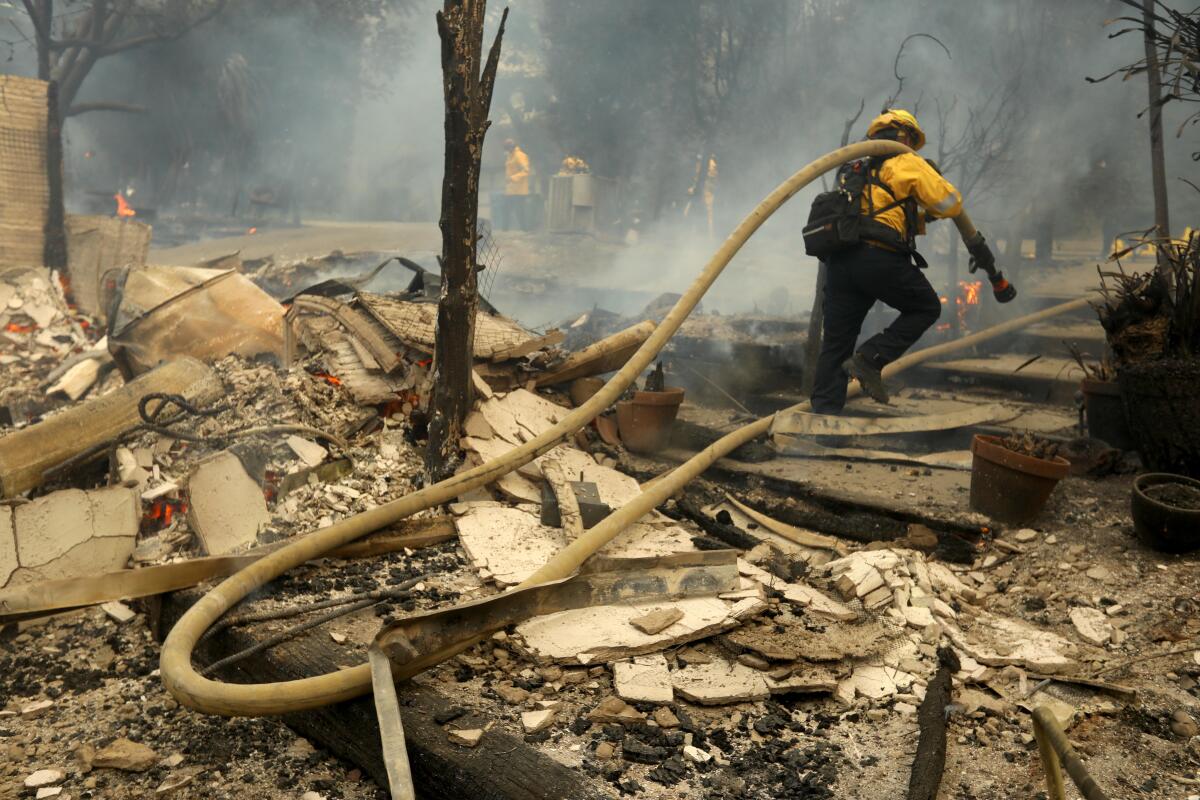
A firefighter carries a hose back to his rig while walking through a destroyed home from the Palisades fire in Pacific Palisades on Jan. 7, 2025.
(Genaro Molina / Los Angeles Times)
Last year, Pacific Palisades-based fashion designer Elyse Walker said she would reopen her eponymous store in Palisades Village after losing her 25-year flagship location on Antioch Street to the inferno.
Other neighborhood shops destroyed in the fire that are reopening at the mall include K Bakery and Loomey’s Toys, which caters to children up to age 12 and used to be across the street from Palisades Elementary Charter School.
“It’s been a journey and I’m excited because I wasn’t sure that there was going to be a place to come back to,” said toy store owner Amanda Rastegar. “Hopefully we can bring some of that magic back.”
Rastegar’s home in the Palisades survived but was damaged by the fire. The family returned about eight weeks ago. Her last memory of the fire was a burning supermarket.
“I just couldn’t wrap my brain around what was happening,” she said. “By the time I left, Gelson’s was on fire.”
Among the returning tenants is Angelini Ristorante & Bar. Well-known Los Angeles chef Gino Angelini said he will be in the kitchen next month for a return of the Italian restaurant.
“We won’t do a big celebrity open,” he said. “We want to have a very soft opening and see our customers come back.”

Construction takes place at Rick Caruso’s Palisades Village on Thursday. The shopping center is scheduled to reopen mid-August.
(Myung J. Chun / Los Angeles Times)
An elaborate celebration would not feel “correct for me,” Angelini said, because the devastation has been “very sad” for so many.
Other new tenants include local chef Nancy Silverton, who has agreed to move in with a new Italian steakhouse called Spacca Tutto. Women’s activewear retailer LESET will open its first West Coast location.
Caruso said he is optimistic that customers will return to the center, even though many Pacific Palisades residents are still dispersed. One tracking system estimated that about 30% of the Village’s customer base was impacted by the fire, he said.
“That means 70% did not get impacted, so there’s a lot of customers still left out there,” Caruso said. Historically, the center drew customers from as far away as Beverly Hills and Calabasas, as well as Malibu, Brentwood and Santa Monica.
He also hopes many will be inspired to visit the revived mall.
“I believe in the goodness of people and I believe that people are going to want to support the Palisades,” he said. “They’re going to want to be there and support the businesses that have had the courage and the heart to reopen.”

Walmart is rapidly expanding its network of electric vehicle chargers designed for customers to use while they shop.
The network could help fill gaps in EV infrastructure in states with greater need for chargers. Walmart, which has more than 5,000 locations in the U.S. and hundreds in California, says more than 90% of Americans live within 10 miles of one of its stores.
The chargers also offer an incentive for customers to choose Walmart — Walmart Plus members will receive a 10% discount off an average price of $0.46 per kilowatt-hour of energy at the company’s chargers.
Walmart chargers are already available at more than 75 locations in 17 states, with Texas boasting the most charging stations, followed by Florida and Arizona.
Matthew Nelson, Walmart’s director of energy policy, said last week on LinkedIn that the network will soon reach 29 states, including California.
“We are delivering on the promise of affordable, reliable and convenient charging,” Nelson said in his post.
According to Walmart’s website, six charging stations are coming to California soon, though the company did not offer a specific timeline.
The chargers will be installed at stores in Antelope, Brea, Fresno, Stockton, Suisun City and Vallejo.
Most charging sites in California will include eight to 16 fast-charging stalls, said Walmart spokesperson Kelsey Bohl.
The company first announced plans in April 2023 to install its own EV chargers at Walmart and Sam’s Club stores, with a goal of installing thousands of chargers by 2030. Partnering with ABB E-Mobility and Alpitronic, it added 25 new charging sites this past May and six more in June.
“Walmart is building a leading retail-integrated EV fast-charging network, focused on delivering an affordable, reliable and convenient charging experience where customers already shop,” Bohl said in an emailed statement. “Customers can charge while they shop, access stations through the Walmart app they already use, and benefit from affordable pricing.”
The charging stations already available include 612 individual charging stalls using 400-kilowatt chargers. Each stall has a dual charging cord with both Combined Charging System and North American Charging Standard connectors. The standard connectors, designed by Tesla, are smaller and lighter than the combined systems.
The primary way to pay for the chargers is through the Walmart app, but the company is also experimenting with built-in credit card readers to allow those without the app to use the stations.
Customers can check charger availability on the Walmart app. The company said the chargers will be available 24 hours a day.

Robotaxis could be turning into robocops.
A self-driving Waymo reported two teens to San Mateo, Calif., police on Monday after they were found drinking alcohol and shooting toy guns in the back of the vehicle.
According to a social media post from the San Mateo Police Department, officers detained two 15-year-olds after the Waymo they were riding in contacted the department and stopped in a parking lot until law enforcement arrived.
“Parents do you know where your teens are?” the San Mateo Police Department wrote on Facebook following the incident. “Waymo does!”
Officers removed both teens from the vehicle and determined they were using toy guns to shoot Orbeez out the windows. Orbeez are small, water-absorbing beads sold at toy stores.
“Toy guns, water guns, and BB guns all pose real dangers, especially to an untrained eye,” the Police Department said. “The simple handling of them can cause fear in [passersby].” “
A video posted on Facebook shows at least five officers and a police dog responding to the scene and approaching the Waymo with their weapons raised.
Waymo did not immediately respond to a request for comment.
Waymo vehicles have internal cameras and microphones that may be used in an emergency or to “promote safety and security,” according to Waymo’s online support page.
The cameras are also used to ensure the vehicles are clean and to help find lost items, according to the support page.
The company said it does not use facial recognition or other biometric identification technologies to identify individuals.
“In more urgent circumstances, support may access live video during a trip,” the Waymo page said.
The San Mateo Police Department’s Facebook post has garnered nearly 60 comments, with one user accusing Waymo of “snitching.”
“At least they got a designated driver?!” one user commented.
-

 Seattle, WA6 minutes ago
Study finds dangerous chemicals in the breast milk of Seattle moms
-

 San Diego, CA8 minutes ago
Tom Krasovic: Justin Verlander’s announcement recalls Padres’ 2004 draft blunder
-
 Milwaukee, WI13 minutes ago
‘Peace on Every Block’ brings Milwaukee community together to fight gun violence
-

 Atlanta, GA21 minutes ago
Atlanta smash-and-grab: Masked men ram U-Haul into clothing store
-

 Minneapolis, MN24 minutes ago
Minneapolis police drone debate sparks privacy concerns
-
Indianapolis, IN28 minutes ago
Adam Vinatieri will celebrate on the field in Indianapolis again as Colts’ Ring of Honor member
-

 Pittsburg, PA36 minutes ago
U.S. launches more strikes against Iran
-

 Augusta, GA39 minutes ago
Augusta groups work to keep veterans housed through SSVF program

