Business
Amazon Prime Will Release a Melania Trump Documentary


Amazon said on Sunday that its Prime Video streaming service would release a “behind the scenes” documentary about Melania Trump’s life.
The film will head to movie theaters and stream on Amazon Prime in the second half of this year, the company said in a statement. Mrs. Trump will be an executive producer of the documentary, which started filming in December, the month after her husband, Donald J. Trump, won the presidential election.
Amazon said it was “excited to share this truly unique story.”
The company and its founder, Jeff Bezos, who also owns The Washington Post, had a rocky relationship with Mr. Trump during Mr. Trump’s first presidential term. But in recent months, Amazon and Mr. Bezos have taken steps to repair it. The tech giant said last month that it would donate $1 million to the president-elect’s inaugural fund, joining Meta and executives of some other Silicon Valley companies in writing checks to the inaugural committee. Mr. Bezos has said he is “very optimistic” about Mr. Trump’s new term in office and is eager to work with his administration on reducing regulation.
During his first presidential term, Mr. Trump criticized Mr. Bezos because of his newspaper’s political coverage and questioned whether the U.S. Postal Service was charging Amazon too little for shipping. Amazon, in turn, accused Mr. Trump of using “improper pressure” on the Pentagon to deny the company a cloud-computing contract.
Amazon now appears to be eager to turn the page.
In October, The Post said it would stop endorsing presidential candidates, a decision made by Mr. Bezos, and did not publish an endorsement of Vice President Kamala Harris that had already been drafted. Mr. Bezos defended his decision, saying newspaper endorsements “create a perception of bias.”
Last week, Ann Telnaes, a Post cartoonist, said she was resigning after the paper’s opinion section rejected a cartoon that showed Mr. Bezos and three other technology executives bending the knee to a statue of Mr. Trump while offering the president-elect bags of money. David Shipley, The Post’s opinion editor, said the cartoon was rejected because the section had published a column on the same subject and had already scheduled another one for publication. He said he had asked Ms. Telnaes to rescind her resignation, saying, “The only bias was against repetition.”
Amazon did not immediately respond to a request for comment on the efforts by the company and Mr. Bezos to forge closer ties to Mr. Trump. The Trump transition team also did not immediately respond to a request for comment.
Mrs. Trump has recently shown more willingness to share details about her life with the public. Last year, she published a memoir that described her career as a model, marriage to Mr. Trump and time in the White House. It became a No. 1 New York Times best seller. Her role as executive producer of the documentary suggests that she will have some influence over how it depicts her life.
Brett Ratner, a director and producer behind movies like “Rush Hour” and “The Revenant,” will direct the documentary. Mr. Ratner has kept a lower profile in recent years after questions were raised about his behavior. In 2011, he resigned as co-producer of the Oscars broadcast after he used an anti-gay slur at a public event. In 2017, Mr. Ratner was accused of sexual misconduct by six women in an article published by The Los Angeles Times, claims that he denied.
Amazon, which will have exclusive rights to the movie about Mrs. Trump, said it would reveal more details on the project as filming progressed and it completed release plans.



Social media company Snap showcased a pair of its $2,195 augmented reality glasses Tuesday, staking a claim in a race to reshape how people interact with computers.
The Santa Monica tech company faces fierce competition as it takes on bigger rivals such as Meta that are dominating the sale of smart glasses and needs to convince more people to buy another gadget. Google is planning to release smart glasses in the fall and Apple is reportedly working on a pair as well.
The announcement also shows how the rising popularity of artificial intelligence-powered tools is fueling the release of hardware beyond the smartphone. While Snap and Google have failed to get consumers to buy smart glasses in the past, tech companies have been doubling down on the idea.
In a speech at the AWE conference in Long Beach, Snap’s chief executive and co-founder Evan Spiegel highlighted how people could do more with its AR glasses, Specs, than with rival products. He views the glasses as the next “major leap in computing.”
People can learn to play the drums, figure out how to fix their car, watch videos and more with the glasses, which are now available for preorder and are expected to ship in the fall. Augmented reality involves overlaying digital objects onto a person’s view of the physical world.
“The smartphone put our lives in our pockets, but augmented reality puts computing into the world where life actually happens, and that is the shift from phones to Specs,” Spiegel said.
Meta sells a variety of AI glasses, including a more expensive pair with a display and wristband that lets people ask questions to an AI assistant and answer calls and texts, along with other tasks. It’s also worked on a prototype of AR glasses called Orion.
Meta has a reputation of incorporating features released by Snap, the parent company of disappearing messaging app Snapchat. That has included a popular feature where photos and videos vanish in 24 hours.
“Those copycats up north aren’t going to be stealing this one,” said Spiegel, as the crowd erupted into applause and laughter.
While smart glasses aren’t as popular as smartphones, sales have grown.
Meta, which has a partnership with Ray-Ban, is leading in the sale of smart glasses without displays, according to the International Data Corporation. Roughly 2.25 million units of these glasses shipped in the first quarter of this year, a 167% jump year-over-year.
“Dethroning the giant that is Meta won’t come easy,” wrote Jitesh Ubrani, an IDC research manager in a post this week about smart glasses. “Meta’s core advantage isn’t just market share; it’s distribution.”
Meta has been expanding its retail footprint, opening up new stores in California.
But Snap will have to convince people that it’s worth paying $2,195 for a pair of AR glasses with more tech features. Spiegel pointed to the hefty price tags of the Mac in 1984 and Apple’s $3,500 mixed-reality headset.
“New computers almost always begin as something that just a few people can really afford,” he said.
On Tuesday, Snap’s share price dropped about 10%, closing at roughly $5.16.
Snap’s big bet on AR glasses comes at a crucial point for the company, which slashed 16% of its full-time workforce, or 1,000 workers, in April to cut costs. Snap this year also ended a deal with AI company Perplexity that was expected to bring the social media company $400 million.

Los Angeles fund manager Capital Group has completed its $210-million purchase of the Bunker Hill skyscraper it already occupied as a renter and vows to continue expanding its downtown presence.
Capital Group was an anchor tenant at Bank of America Plaza, which it will now operate as a landlord. The 55-story tower at 333 S. Hope St. was completed in 1974 and has long ranked as one downtown’s most prominent office addresses. Capital Group has been headquartered there since 1978.
Bank of America Plaza at 333 S. Hope St. was purchased by investment firm Capital Group. The building also houses the firm’s headquarters.
(Robert Gauthier / Los Angeles Times)
The move to buy the building at a substantial discount to its previous value is part of a pattern of well-heeled tenants deciding to become owners instead of renters in recent years as office property values plunged due to the pandemic and a shift to remote work for many companies.
“We knew the best landlord we could possibly have would be ourselves,” said Capital Group Chief Executive Mike Gitlin when the sale was first announced in April.
Bank of America Plaza’s previous owner, Brookfield Properties, defaulted on a $400 million loan and put the building on the market instead of facing foreclosure.
It was the largest office sale in Los Angeles in 2026 and the largest in Los Angeles County since 2023, according to real estate brokerage Colliers, which marketed the property on behalf of the court-appointed receiver.
Potential buyers competing for Bank of America Plaza included both private and institutional investors from the U.S. and overseas, said Mark Schuessler, a broker at Colliers.
Capital Group has been headquartered in downtown Los Angeles since it was founded in 1931, according to Chief Operating Officer Rob Klausner . “We view it as the ideal location to invest in as we bring our Los Angeles based teams together,” he said.
Capital Group is the largest occupant in the building, taking up 350,000 square feet on 14 floors. It plans to gradually take over another five floors as it consolidates employees from other offices downtown and in Santa Monica.
“The best way to ensure a great environment in downtown L.A. is to create what we’re calling a vertical campus” with 2,100 employees, Gitlin said. “It was just this unique opportunity where the price was much lower than it had been historically, and it was for sale.”
Bank of America is also a large tenant in the building and will continue to have its name on top. Other occupants include economic consulting firm Analysis Group Inc., law firm Musick Peeler & Garrett and Alliant Insurance Services.
Capital Group has more than 9,000 employees in 34 offices in multiple countries. It manages $3.4 trillion in assets for millions of wealth management and institutional clients, a representative said.
Owner-users have surged as key players in L.A.’s office market, now accounting for nearly half of all deals, according to real estate data provider CoStar , while institutional investors’ share of purchases has fallen from 45% to 26%.
Office users from the public sector are among the buyers. The city of Los Angeles plans to buy a 35-story tower downtown for use by the Department of Water and Power.
Manulife U.S. Real Estate Investment Trust said in April that it would sell its high-rise at 865 S. Figueroa St. for $92.5 million pending approval from Los Angeles officials. It has an assessed value of $248 million.
Another major public buyer of a downtown office building was Los Angeles County, which in 2024 bought Gas Co. Tower for $200 million, a steep drop from its $632-million valuation in 2020. County officials said at the time that the foreclosure sale was too good a deal to pass up.
The county is gradually moving workers into the 55-story skyscraper at the base of Bunker Hill that was widely considered one of the city’s most desirable office buildings when it was completed in 1991.
Business
Commentary: Small investors have powered SpaceX higher, but they’ll shoulder much of the risk when reality bites
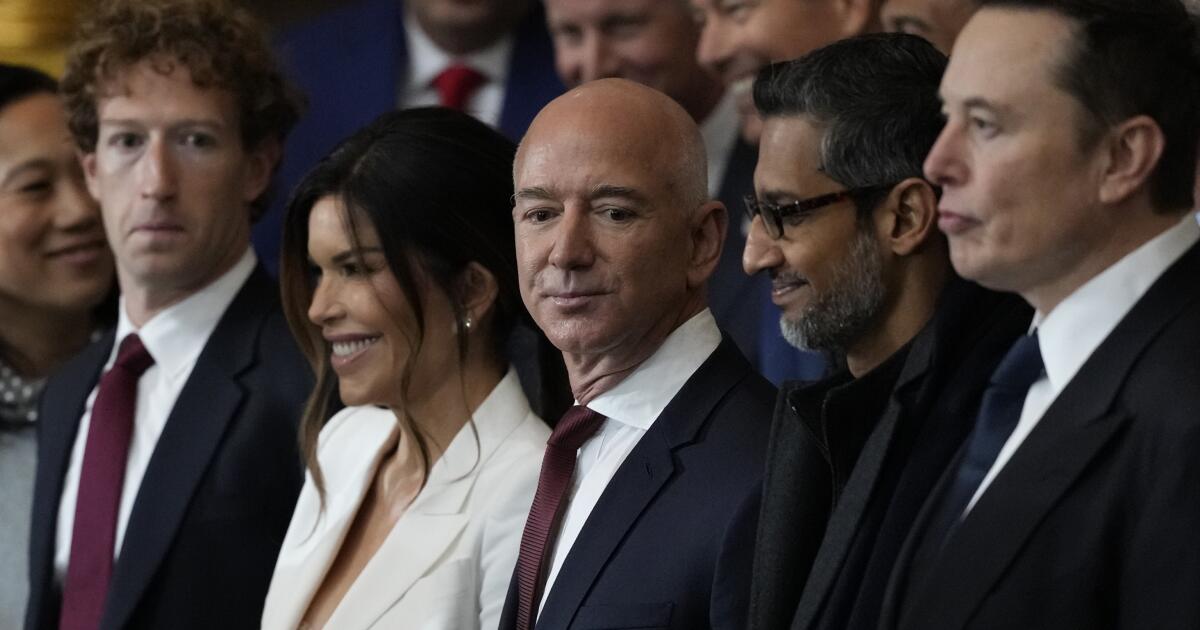
Who will pay the price when the SpaceX hype ebbs? History says it will be the little guy.
In the second trading day as a public company, SpaceX’s initial public offering still was being treated as an extraordinary event in Wall Street history:
The largest IPO ever, creating the first trillionaire in Elon Musk, its boss, and bringing the company’s market value to $2.28 trillion.
On Monday, the stock gained 19.6% on top of its first-day gain of 19%, closing at $192.50. But the IPO is extraordinary in other ways that are becoming more clear as the pre-IPO frenzy yields to the company’s post-IPO reality.
The SpaceX IPO raises unprecedented questions about Wall Street’s role in future mega-IPOs, what this event means for the current bull market in stocks, the wisdom of concentrating so much wealth in so few hands and the rise of wealth inequality. The answers to these questions may not be pretty.
The fact that Wall Street designed a deal that needed $20 billion of retail money to get it across the line tells you something about who they wanted in the building.
— Financial commentator Patrick Boyle
Last week, I pointed to some issues connected to the SpaceX IPO, including the utterly fantastical rationale for the company’s outsized market valuation and the prospect that billions of dollars of shares may be shoved into the retirement accounts of investors who don’t want them, thanks to the willingness of Nasdaq and other stock index sponsors to accept the shares into their indices well ahead of the customary “seasoning” delay.
But there’s more to think about. Start with the paucity of control that shareholders will get for their investments.
Law professor Ann Lipton, who monitors shareholder rights from the University of Colorado, reminds us of the traditional observation that “shareholders have three powers with respect to the corporations in which they invest: to vote, to sell, and to sue,” enabling them to “protect their investment and discipline management.”
Investors in SpaceX have none of those options.
The single votes that they acquire for every SpaceX Class A share offered in the IPO is swamped by the 10 votes per share of the company’s class B stock. As I reported last week, Musk will own a mere 12.3% of the Class A shares, but 93.6% of the Class B shares, which have 10 votes each. That gives him 85.1% of all shareholder votes.
As a result, the prospectus says, “Mr. Musk will be able to control the outcome of matters requiring shareholder approval,” including the selection of directors and even whether he himself should step down.
Wall Street firms have enticed retail investors into buying into the IPO — Fidelity, for example, reduced the minimum account balance allowing clients to buy into an IPO from $100,000-$500,000 to $2,000.
But although those buyers can sell at any time, they will be punished for selling within the first 15 days after the IPO: The “first flip,” Fidelity warns, will result in their being blocked from future IPOs for six months; a second flip blocks them for a year and a third blocks them permanently.
On the other hand, insiders can sell a lot sooner than is customary. Typically, insiders of newly public companies have to wait at least six months before selling their shares, a period known as the lockup.
SpaceX insiders, however, can start selling their shares as soon as the second trading day after the company issues its second-quarter financial disclosure, expected around Aug. 11. (Musk and some other highly placed insiders have committed to holding their shares for at least 366 days.)
SpaceX reserved an unusually large tranche of its IPO for retail investors — 20% or more of the $75 billion raised. “The fact that Wall Street designed a deal that needed $20 billion of retail money to get it across the line tells you something about who they wanted in the building,” notes the former hedge fund operator and YouTube financial commentator Patrick Boyle.
Why did the company and its underwriters do that? It’s because, compared with institutions, retail investors are credulous, vulnerable to hype, and given to hanging on to a stock long after institutions have done the math on an underperforming investment and exited.
Shareholder lawsuits? Nope. The SpaceX bylaws require that any shareholder actions be brought not in court, but in arbitration — traditionally a management-favoring venue.
So no vote, no sales, no lawsuits. That might not matter as much if shareholders could count on the SpaceX board to protect their interests, but your old Magic 8 Ball, if it’s on the ball, might counsel: “Don’t count on it.”
Of the six board members listed in the IPO prospectus (not counting Musk and Gwynne Shotwell, who basically runs SpaceX as its chief operating officer), four are old cronies of Musk’s. They’re Ira Ehrenpreis, a longtime director of Tesla, which Musk controls; Antonio Gracias, a director of Musk’s private firms Neuralink and the Boring Co. and a former Tesla director; Steve Jurvetson, another former Tesla director; and Luke Nosek, a co-founder of PayPal, which was the original source of Musk’s wealth.
The boards of Musk’s companies have generally indulged his desires. Gracias and Jurvetson were on the board of SolarCity, which Musk merged into Tesla when the former was looking financially impaired in 2016. Ehrenpreis was on the Tesla board when it gifted Musk with a $1-trillion pay package last year.
That brings us to the question of whether it’s healthy for society to have so much wealth concentrated in the hands of mega-plutocrats such as Jeff Bezos, Mark Zuckerberg and Musk. These are people who are not at all shy about wielding their wealth to get their way, devil take the hindmost. Herman Melville put his finger on the issue in Moby-Dick, through Father Mapple’s sermon, in which he thunders, “Sin that pays its way can travel freely, and without a passport; whereas Virtue, if a pauper, is stopped at all frontiers.”
Melville wrote that in 1851, but it echoes in Musk’s DOGE service, where his henchpersons ran roughshod through federal programs, stripping them of personnel and funds in what turned out to be a vastly overstated claim of budgetary savings. The wreckage included the U.S. Agency for International Development, or USAID, which could have played an important role in addressing the ongoing Ebola virus outbreak, the cause of illness and death for hundreds of victims in Africa.
But DOGE helped the Trump administration reduce USAID to an empty shell. “About two weeks into the Trump administration, Musk tweeted that he just spent the weekend feeding USAID into the wood chipper,” recalls former USAID health official Nicholas Enrich, who was present at the destruction.
The siren song of Musk’s wealth and the prospect that investors would buy in despite the fantastical claims being made for SpaceX’s future allowed Musk to bully the biggest Wall Street investment banks into capitulating to his vision, and to his personal IPO design. (The IPO prospectus lists 32 banks as underwriters.)
In a normal IPO, the banks’ role is to test the waters for an upcoming issue, determining the right opening price. In this case, Musk decreed an opening price of $135 per share and the banks went along. They also accepted what may be record-low fees for what turned out to be their order-taking role.
Traditional IPO fees run as high at 7% of the issue, though fees have been trending toward 1% on mega-deals. For SpaceX, the fee was 0.7%; that number is small but it still came to about $500 million, to be doled out by Goldman Sachs and Morgan Stanley, the lead banks.
This may be the right moment to consider that even the most high-flying investment crazes generally end in tears. AI is beginning to have that acrid smell. It’s proper to note that the driver of SpaceX’s valuation isn’t its space launches or its Starlink orbital wifi satellites, but its commitment to AI.
(Part of what may be driving the SpaceX frenzy my be the gains collected by early investors in Tesla, which have lent Musk a visionary’s halo. That said, however, Tesla wasn’t added to the Standard & Poor’s 500 index and therefore into large-cap index funds until 10 years after its 2010 IPO.)
That’s what accounts for almost all of the $28.5 trillion “total addressable market” the company claims for its services, never mind that it’s a distant also-ran in the AI business. Never mind that for SpaceX, AI does little but burn money, accounting for $12.7 billion of its $20.7 billion in capital expenditures last year while losing $6.36 billion on $3.2 billion in revenue.
Does the SpaceX IPO signal a bull-market top? That question was raised Sunday by Michelle Celarier, one of the nation’s most percipient financial market reporters. “The laws of economics say there has to be a break someday,” she wrote. “How brutal it will be and how effective governments and central banks will be in controlling the fallout is the unknown.”
Celarier quotes Erica Payne, the founder and president of Patriotic Millionaires, observing that “86 percent of Americans are worried about the price of food. Elon Musk is a trillionaire. These two things are deeply, inherently connected.”
The SpaceX IPO may eventually stand in retrospect as a monument to this moment.
-

 Kentucky4 minutes ago
Kentucky fans can enjoy games at new Walk-On’s, KSR sports bar site
-

 Louisiana6 minutes ago
Emancipation Jubilee: Louisiana’s Road to Freedom
-
Maine12 minutes ago
Maine DOT announces new upgrades for Route 1 in Biddeford
-

 Maryland19 minutes ago
Federal Disaster Declaration Issued Following April Freeze: New Resources Available for Maryland Agricultural Producers – Washington County
-

 Michigan21 minutes ago
Detroit Bar Misses James Beard Award, Leaving MI Without Any Winners
-

 Massachusetts26 minutes ago
Massachusetts takes action to prevent wrong-way driving tragedies
-

 Minnesota34 minutes ago
Minnesota college professor pleads guilty to stealing gun parts, ammunition
-

 Mississippi36 minutes ago
Mississippi police shooting: How Walmart shoplifting call ended in baby’s death


