Entertainment
Mystery writers reveal their go-to books for holiday gift-giving


Dying to Know
4 mystery writers answer burning questions
If you buy books linked on our site, The Times may earn a commission from Bookshop.org, whose fees support independent bookstores.
Ring out the old year and bring in the new with four outstanding mysteries and discover each author’s lists of surefire, gift-worthy books.
Pip Drysdale, author of “The Close-Up.”
(Katie Kaars / Gallery Books)
The Close-Up
By Pip Drysdale
Gallery Books: 352 pages; $29
Out now
Sydney-based Pip Drysdale nails novelists, actors and other fame-hungry strivers perfectly in this dark thriller, her fifth, centered on a young author desperate for a second bite of the apple. Londoner Zoe Ann Weiss has spent the advance from her first failed thriller — about a woman being stalked by a virtual stranger — and is now working at a Venice florist shop to make ends meet while she dodges emails from her agent and struggles to write that second book in order to avoid repaying a $250,000 advance. On her 30th birthday, she is delivering flowers for a Hollywood talent manager’s party when she unexpectedly runs into blue-eyed charmer Zach Hamilton, a former bartender-actor and fling from three years before. Now People magazine’s Sexiest Man Alive, Zach is still humble enough to recognize Zoe and cop to his bad behavior in ghosting her. He convinces her to drive him to a party, where he promises to connect her with a producer friend, but not before signing a nondisclosure agreement sent en route by Zach’s manager, standard procedure for the scandal-averse breakout star of the first entry of a planned action trilogy. Soon, Zoe’s breathing the rare air of L.A. dreamers — with their “designer jeans, stilettos and injectables” — and Zach’s familiar musk and earth scent, experienced up close during an after-party skinny dip and more at his Hollywood Hills home. Though painfully aware of how far her reality is from his, Zoe thrills to secretly dating Zach, stirring old feelings and an insidious idea: why not base her next thriller on Zach and his world, NDA be damned? When aerial photos are leaked of the couple in Zach’s pool and a stalker takes aim at Zoe, re-creating creepy scenes from her first novel, her idea has a plot that presents both legal and romantic dilemmas. References to F. Scott Fitzgerald’s “The Great Gatsby,” Joan Didion’s “Play It as It Lays” and other classics lend literary resonance to Drysdale’s warped tale of fame and revenge that manages to deliver some real surprises as it answers the question posed by Zoe’s stalker: “R U willing to die for him?”
What parts of Zoe Ann Weiss resonated most deeply for you?
Zoe and I both experienced failure and had to come back from it. We’ve both experienced writer’s block, staring at the blank page, and have both read and reread the classics in case we learn tricks via osmosis. And, unfortunately, we’ve both had stalkers. In writing “The Close-Up,” I especially wanted to follow a character’s emotional journey through being a victim of stalking in a way that felt true to me — with all the illogical choices, feelings and thoughts one might not expect but which are nonetheless true.
You write with a gimlet-eyed love of L.A. locations. Given you were writing from a distance, how did you capture L.A. so faithfully?
I love L.A.! Spending time with people who live there over the years, I picked up this sense of hope in the air that clung to me, that told me dreams could come true in L.A. That energy got me halfway through the first draft of this book. But then I took a research trip specifically for “The Close-Up” that allowed me to gather more specific sensory information. I walked Zoe’s route to her local grocery store (and saw the fabled Chateau Marmont right there, taunting her). And wandered around in the alleyway behind her florist job in Venice.
What books are you giving this holiday season?
I have two: “Red River Road” by Anna Downes, a twisty and unexpected missing-sister thriller set in the Australian outback. The other is “When Cicadas Cry” by Caroline Cleveland. I loved the Southern Gothic vibe in this legal whodunit set in a small community outside Charleston, S.C.

Christopher Bollen, author of “Havoc.”
(Jack Pierson / Harper)
Havoc
By Christopher Bollen
Harper: 256 pages, $30
Out now
In Christopher Bollen’s accomplished sixth novel, Maggie Burkhardt is an 81-year-old widow whose peripatetic travels to Europe’s grand hotels come to an abrupt end when COVID sidelines her in Egypt at Luxor’s less-than-regal Royal Karnak Palace Hotel. As she gossips poolside with a gay couple, one of whom is an Egyptologist studying the museum’s ancient artifacts, and insinuates herself into the hotel’s daily rituals, there are hints that Maggie is not as nice, nor as well-intentioned, as her first-person patter would suggest. Meddling in the affairs of a married couple she decides need to be broken up — part of her mission to “change people’s lives for the better” — Maggie’s caught outside their room after planting incriminating evidence of the husband’s nonexistent affair by Otto, a precocious 8-year-old who’s mysteriously arrived at the hotel from Paris with his mother. When Otto boldly blackmails Maggie into paying for a room upgrade in exchange for his silence, it’s not just a matter of game recognizing game. Soon the two are involved in a tit-for-tat escalation that has dire consequences for everyone in their orbit and reveals Otto as Maggie’s formidable “Bad Seed” foe. Using the sultry Egyptian climate and locales to great effect, L.A. Times Book Prize nominee Bollen (for “A Beautiful Crime”) has pulled out all the stops in delivering a sinister thriller with resonances to classic literature such as Henry James’ “Turn of the Screw,” Helene Tursten’s “An Elderly Lady” series or the best of Patricia Highsmith.
How did you create Maggie Burkhardt?
I slipped into the shoes of a maniacal 81-year-old widow so effortlessly it was almost frightening. I just managed to get the voice of Maggie down from the start. We hear so often, “write what you know,” but it was actually diving into a character who was, on the surface, so unlike me that really gave me a sense of freedom to explore.
Some of my favorites among your novels are those set in foreign countries. What’s the appeal of foreign versus U.S. settings, and why Egypt for “Havoc”?
Since I love to travel, I fall in love with locations, and they seem to burst with opportunities for interesting plots. I didn’t intend to revisit Egypt, but before I set sail up the Nile in April 2021, I stayed at an old grand hotel in Luxor and Maggie’s story just jumped out of me — and went for the throat.
What books are you giving this holiday season?
I’m giving myself the Javier Marías novel “The Infatuations,” since I’ve never read the late, great Spanish literary crime writer. For friends, I’m giving Lucy Foley’s “The Midnight Feast” and I’m also giving pre-order gifts for Katy Hays’ upcoming thriller “Saltwater,” set on Capri.

Alex Segura, author of “Alter Ego.”
(Irina Peschan / Flatiron)
Alter Ego
By Alex Segura
Flatiron Books: 320 pages, $29
Out now
Alex Segura brought all of his passion and knowledge of mystery and comic book writing to 2022’s “Secret Identity,” a fictional story set in the mid-1970s about a Cuban American finding her voice as both comic book artist and a queer woman. The L.A. Times Book Prize winner broke barriers by including panels from “The Legendary Lynx” series created by Carmen Valdez for Triumph Comics before her withdrawal from the industry after a murder and the theft of her intellectual property. Now, “Alter Ego” surpasses the achievements of “Secret Identity” by deepening the themes of artistic freedom and control and reclaiming women’s voices in comics. Annie Bustamante is a single mother and acclaimed filmmaker whose roots as a comic book artist include a childhood passion for fellow Cubana Valdez’s work. After a shelved movie project stalls her career, Annie is presented with an opportunity to use the secret cache of Lynx illustrations she’s been drawing (sprinkled throughout the novel) to reboot the almost-forgotten series. Her partners are a shady trio of collaborators — including the Triumph Comics’ heir, his shady business partner and an aging, #MeToo-exiled film director. The result is a deadly battle — Art versus Commerce — that threatens Annie’s life, her quest to find Carmen Valdez and reinvigorate her dynamic hero: “I wanted her to thrive and to remind the world why they needed someone like the Lynx,” Annie writes of the Lynx’s alter ego, Claudia Calla. “A woman who realized her power and potential and used it to help others like her. Especially these days — as our power, our own bodily autonomy, was being systematically stripped away and chipped at by those in power.”
Why did you frame the story around Annie Bustamante?
When I realized there was another story to tell in the universe established in “Secret Identity,” I knew I wanted it to be different — a companion piece more than a sequel. Both Carmen and Annie are presented with dream projects at different points in comic book history. Through Annie, I wanted to show how the comic book and entertainment industry have evolved over the intervening years, which then poses the question: How far will Annie go to protect the character that pulled her into comics, and then the person responsible for creating that story?
When Annie writes about her hopes for the Lynx’s alter ego, is she talking about Claudia Calla, Carmen Valdez or herself?
I think it’s relevant to all of them. In these times, where reproductive rights, LGBTQ rights and many of our freedoms are being threatened, it’s important to speak up and not sit idly by. I think for Annie, the quest to reclaim the Lynx and elevate Carmen’s legacy wove into those deeper feelings of rage and frustration, which fueled her journey to uncover the truth.
The Legendary Lynx artwork included in “Alter Ego,” is a beautiful extension of the mythic story begun in “Secret Identify.” It makes me wistful for a real Lynx comic book.
Well, there is a series now: “The Legendary Lynx,” just published by Mad Cave and featuring the art of Sandy Jarrell. Sandy is the artist behind the comic book sequences in “Secret Identity” and “Alter Ego” and is really the unsung hero of this saga. A true craftsman with a love for the medium and flexibility that’s truly unmatched in comics. He breathes life into Carmen and Annie’s ideas in ways I could only imagine.

Jonathan Ames, author of “Karma Doll.”
(Mulholland Books)
Karma Doll
By Jonathan Ames
Mulholland Books: 240 pages, $27
Jan. 14
L.A.-based writer Jonathan Ames (novels and HBO’s excellent “Bored to Death”) has been delighting readers of California noir with the darkly comic, bloody adventures of ex-cop and PI Happy Doll since his debut in 2021’s “A Man Named Doll.” A 21st century reimagining of Raymond Chandler’s iconic Philip Marlowe, Doll pursues thugs, organ harvesters and other miscreants down the mean streets of Southern California and other points West “in search of a hidden truth,” as Chandler describes the Marlowe stories in “The Simple Art of Murder.” For Doll, that hidden truth is Buddhism, which he begins to study in “The Wheel of Doll”; by “Karma Doll,” which follows directly after, he’s applying the principles of karma to his own violent actions and trying to find an enlightened solution. The novel opens with Doll decamped to Mexico with George, his half-Chihuahua, half-terrier sidekick, to get his shoulder patched up and a new face at an illegal hospital after injuries suffered at the hands of a criminal he kills after stealing $60,000 in cash from a Jalisco drug cartel’s bagman. But trouble seems to follow the PI wherever he goes; in Mexico, it’s a drugged-out gangster patient who attacks the doctor and his nurses, and whom Doll kills, with great regret: “Diablo was the eighth man I had killed,” the investigator reflects later, “and it was always in self-defense, in situations in which I could have also been killed, but each time I had done it I had felt the sickening pull of the abyss, of becoming a shadow human impervious to the suffering of others.” Doll’s action unleashes a cascade of karmic consequences, most of them violent and some perpetrated by him, that culminate in the investigator being set up to take the fall for the killing of a young female tourist and being pursued by bounty hunters sent by that cartel bagman. Set on exacting retribution, Doll hightails it back to his home in Los Angeles to even the score with the real murderer and the cartel’s bagman, all while keeping nominally true to Buddhist principles. While the setup may seem a bit different for noir fiction, Ames’ expert plotting and spot-on descriptions of Mexican and stateside environs and denizens makes “Karma Doll” another excellent installment of what is, happily, proving to be a long-running series.
Were iconic Southern California PIs like Philip Marlowe and Lew Archer on your mind when you first started writing Happy Doll?
They weren’t directly on my mind, but both characters are deeply embedded in my literary muscle memory, as it were. I’ve happily read every Marlowe and Archer story there is, and, unconsciously, Doll may have some of Marlowe’s penchant for comedy and some of Archer’s love of nature (Ross MacDonald writes beautifully about the sea). I will say that Doll is not quite as accomplished as those two sleuths — he may have a touch of a hard-boiled Clouseau in him — but he does get the bad guy in the end.
Why was Doll’s deepening study of Buddhism and imperfect practice of the religion important?
As the series has progressed, Doll grapples ever more with the violence he has perpetrated in the pursuit of justice. He’s very disturbed by what he has done, and so he turns to Buddhism to understand his suffering and he comes to see that he is the main cause of his “bad karma.” He learns that he must take responsibility for his actions and change his behavior if he wants to lessen his suffering and the suffering he causes others. But he’s in a tough profession for this. As he says in the fourth Doll novel, which I’m currently writing: “Bad karma is my business model.”
What books are you giving as gifts this holiday season?
I always give Pema Chödrön’s books as gifts. She’s a Buddhist nun who writes with great clarity and wisdom about life, and I have found her books incredibly helpful over the years. Two of my favorites are “The Compassion Book: Teachings for Awakening the Heart,” which contain slogans with interpretations you can read every day, and “Living Beautifully: With Uncertainty and Change.”
A member of the National Book Critics Circle, Woods is the editor of several anthologies and author of four novels in the “Charlotte Justice” mystery series.



Chunky platform sandals, fitted baby tees, butterfly clips on perfectly crimped hair, brightly patterned skirts and tons of sparkles. Pure Y2K-fueled nostalgia filled the Kia Forum on Wednesday night in celebration of all things Hilary Duff.
-
Share via
Duff graced the stage at the Inglewood venue as part of her Lucky Me tour, her first global headlining tour in nearly two decades. And her fans couldn’t have been more thrilled. The pop singer and actor, who released her sixth studio album “Luck… or Something” in February, performed two back-to-back sold-out shows.
Before the final L.A. show, we caught up with fans to talk about their outfits (many of which were inspired by Duff’s most famous roles such as Sam in “A Cinderella Story” and the title role in “The Lizzie McGuire Movie”), the memories her music brings up for them and why her work still resonates with them. Here’s what they had to say.

(Kayla Bartkowski/Los Angeles Times)
Tristan Hallam, 36, of Chicago
Tell us about your outfit.
This is my wedding dress that I had stuffed in a suitcase. She’s been in a suitcase for 10 years, and I still fit into her, which is nice. People ask me why I keep stuff and this is exactly why: You might get divorced and use it as a costume. My outfit is inspired by “A Cinderella Story.” It’s my favorite Hilary Duff movie. She plays diner girl Cinderella. She disguises herself with a mask and a L.A. Dodgers cap. I did have a tiara, but I didn’t bring it because I didn’t want to be too much. So I figured, you know what, why not buy an apron and a little black crop top, and rep L.A.
I have a tattoo of her signature. It’s a little faded because it’s like 10 years old, maybe older than that now. It was at a book signing at Barnes and Noble at like the Grove or something. I asked her if she would initial my wrist, and I got it tattooed the same night. I literally drove to the tattoo shop on Hollywood Boulevard with my arm out the window because I’m so clumsy and I didn’t want to smudge it. Then the next time I saw her, she asked me, what did your parents say? I said, “My mom asked me how long I kept the Sharpie on so long.”
How long have you been a fan?
I think I was like 8 or 9 years old when I saw “Casper Meets Wendy” for the first time. My grandma took me to like a K-Mart or something, and told me that I could get any movie that I wanted. Then I was into “Lizzie McGuire,” but as soon as Hilary started doing all her like movies and independent work, obviously the music is great. I used to live in L.A., so I went to a bunch of her book signings. I’ve done a lot of meet and greets for her concerts, and right now I’m traveling around. I’m going to 18, technically 19 shows now, and I’m gonna see her in New Zealand, Australia and some other places. I’m actually really excited because one of my friends, I met her in a Hilary Duff fan club chat room in 2005 on MSN Messenger, and we are still friends, so we are going to a ton of shows together.
Why does her work still resonate with you today?
The fact that we’re around the same age, there’s been a lot of relationship similarities. I don’t have any kids, but the struggles with family, with your dad, with your siblings. She’s got some songs that are more mature and relatable for people our age. People who have gone through ups and downs in relationships, struggles with family and figuring out who your real family is, not just by blood but who your chosen family is. I think that’s really important.

(Kayla Bartkowski / Los Angeles Times)
Leilanie Martinez, 30, of South Gate
Tell us about your outfit and the inspiration behind it?
It’s my quinceañera dress. It’s supposedly very traditional to wear a white dress, like young women coming of age. For mine, I wanted to wear something that I didn’t see a lot of people wearing and I was very firm that if I didn’t find the love of my life, I was going to wear a white dress and this was my moment. My quinceañera was such a precious time. It really was a labor of love, and I think it’s one those memories I hold very near and dear. I think it’s an ode to her history, her legacy.
How long have you been a fan?
I remember I was 5 and I was running around in my neighborhood, playing with Barbies and watching “Lizzie McGuire.” I’m here today with my neighborhood and childhood friends. We used to watch it together and now we’re reliving our nostalgia and childhood.
Thinking back on when you first fell in love with her work, why does it still resonate with you today?
There’s a lot of power in her being a woman and she’s going through so many milestones that a lot of people my age are going through like having children and growing her career. Sometimes I think people “wash out” and I think it’s wonderful how she’s combating that narrative in so many ways, and that people are out here supporting her. I think there’s a lot of beauty in being able to be together as young women and relive some of these memories, but also cheer her on as she continues developing further.

(Kayla Bartkowski / Los Angeles Times)
Crystal Chesher, 33, of Mar Vista and Isabella Sanchez, 33, of Culver City
Tell us about your outfit.
Sanchez: We’re channeling “The Lizzie McGuire Movie.” My actual name is Isabella. She gives more Lizzie vibes and I give more Isabella vibes. It’s funny because I’ve literally saved [looks] of Isabella and Lizzie on my Pinterest board and I’ve always wanted to dress up like this. It’s not 100% of what I wanted, but it’s giving what it’s supposed to.
How long have you been a fan?
Chesher: Since I was little. I remember watching “Lizzie McGuire” since the age of 10 at the very least so I’ve been growing up with her movies and shows. She’s definitely my idol.
Sanchez: Same. Growing up, I was bullied so she was a very big part of me being more positive about myself. I can relate to her and she really helped me. It just feels full circle to be able to see her at 33 when I wanted to see her when I was like 10.
Thinking back on when you first fell in love with her work, why does it still resonate with you today?
Chesher: She has a heavy influence in the LGBT community as well especially with the [anti-gay speech campaign]. I loved that. With her movies and her music, it’s all relatable and it resonates with you, the lyrics, the storyline and even her new album that just came out.
Sanchez: She’s just that girl. I’ve never even met her, but I feel like she’s so genuine and real and she’s always stayed consistent with who she is. She’s not like your typical celebrity. She’s just awesome. I’m literally probably going to tear up seeing her on stage.

(Kayla Bartkowski / Los Angeles Times)
Lucca Petrucci, 33, of Santa Monica
Tell us about your outfit.
This is a last-minute choice. It’s very like ’70s or retro. I feel like I’ve seen her wear something like this. I’m wearing wide-legged pants, Doc Martens, platform, new haircut, facial. The inspiration for this fit was elegant pop star like confidence, grounded, a baddie. I’m a baddie who knows my worth and that’s what I wanted to embrace. I feel like she’s like doing that. She has a lyric that’s like ‘I look in the mirror, like I’m a bad b—.”
How long have you been a fan?
Since third grade. I thought she was my crush, but I think I just wanted to be her. So many of my core childhood memories are with her.
Why was tonight a non-negotiable for you?
I wanted to experience with my bestie and her sister. I feel like as a kid I didn’t allow myself to fully embrace it because it would be too girly, too much, too gay. So I feel like as a 33-year-old, I’m reclaiming that experience. I’m so excited just to hear everybody in the Forum sing “So Yesterday” and “Come Clean.” She has always been my number one pop star, to this day, and I’ve never seen her perform.
Why does her work still resonate with you today?
I feel like, especially when she was on “Lizzie McGuire,” she was figuring out who she was, but was open to being her authentic self. So I think that just like hit me when I was like in third and fourth grade, like figuring out myself. I felt so seen by her, and her music just brings back like such good feelings. Younger version of me, life wasn’t always great, but, I don’t know, she made things better.

(Kayla Bartkowski/Los Angeles Times)
Liv Guardado, 8, Priscilla Cruz, 38, Ava Guardado, 10 and Jezelle Velasco of Costa Mesa
Tell us about your outfit.
Cruz: We went thrifting for the first time for this. I’m plus-size, so thrifting is not easy in my size, so we did what we could. We got some overalls from Goodwill. And then we got some cowboy boots because we just wanted to be comfy.
Velasco: I probably stressed the most. I ordered so many pieces and it just kind of came together. I think the nails took the longest. One of my friends did my nails. It took some time but we got it done.
How long have you been a fan?
Velasco: Probably since I was their age. I never got to go to a concert, so this is my first time seeing her live.
Cruz: I definitely got inspired around middle school. I had a friend who was like Lizzie, and I was the best friend, Miranda. People would always say I was Miranda. I was a little older than [my girls], but I definitely have kept tabs on her life, and we love her.
Why does her work still resonate with you today?
Cruz: It definitely feels like memories and home when you think of her music from back then. And now she’s obviously stepped into a different phase of her life, and it matches where we’re at in our phase too so it’s nice.
Velasco: It just brings back the nostalgia from back when we were younger and now being parents, and being able to relate to her and her new music.

(Kayla Bartkowski/Los Angeles Times)
Paige Beard, 34, and Tayler Nelson, 27, of Bakersfield
Tell us about your outfits.
Beard: I was supposed to be wearing purple and she was going to wear green, and we were going to do the Isabella and Lizzie look at the end of “The Lizzie McGuire Movie.” It turned out more pink, but we ran with it.
Nelson: I was all about that performance, so I was like green. Gotta go green. We’ve been planning for a while, like two months.
How long have you been a fan?
Beard: I’ve been a fan for a long, long time, probably since “Casper Meets Wendy.” I was also a really big “Lizzie McGuire” fan, so I got into her acting as well as her music.
Nelson: Same. I was all about the Cinderella movie though, so it’s probably been 10 years for me.
Why does her work still resonate with you today?
Beard: I was telling my sister that I really liked “Lizzie McGuire” because it was one of the first times I saw somebody’s inner dialogue acted out in cartoon form. It showed me that I’m not too much. She’s a little bit older than me and I see her crying on stage and I’m like “OK, it’s OK.”
Nelson: “The Lizzie McGuire Movie” was a big turning point for me. I just loved how she expressed herself with what she wore and how she acted. I feel like I understood her in different ways. I enjoyed the dancing and the singing for sure. She felt free and I’m like, “Dang, I want that.”

(Kayla Bartkowski/Los Angeles Times)
Freddy Lopez, 38, and Raymond Lockwood, 36, of San Bernardino
Tell us about your outfits.
Lopez: Just a ’90s vibe. I guess a little old-school.
Lockwood: The outfits are a little last-minute because we were like we should’ve done diner girl [from “A Cinderella Story”] or one of her other movies, but we chose the little cartoon character from the show.
How long have you been a fan?
Lopez: I’ve been a fan since “Lizzie McGuire” and her movies.
Lockwood: For the past 20 something years. We grew up watching “Lizzie McGuire” and got introduced to Hilary Duff when she started singing.
Why was tonight a non-negotiable for you?
Lopez: We don’t know if she’s going to come back after this, so you’ve gotta take every opportunity. There’s other artists who cannot come back to perform right now. So when she said I’m coming back, we had to.
Lockwood: We’re healing our inner child. As a kid, we didn’t know she was having tours or we couldn’t afford to come out. Now, we’re like we don’t have to ask our mom and dad for anything.
Why does her work still resonate with you today?
Lockwood: For me, it’s being a teenager, watching the “Lizzie McGuire” show and watching the movie and then learning her songs. My favorite song is from the movie, “What Dreams Are Made Of.” It’s just us getting to live back in the past and kind of understanding it a little bit more. As a kid, our dreams are not what they realistically are today. I ended up becoming a nurse. As a kid, I didn’t sit on the couch like “Oh, I’m going to be a nurse,” but that’s what my dream ended up being.
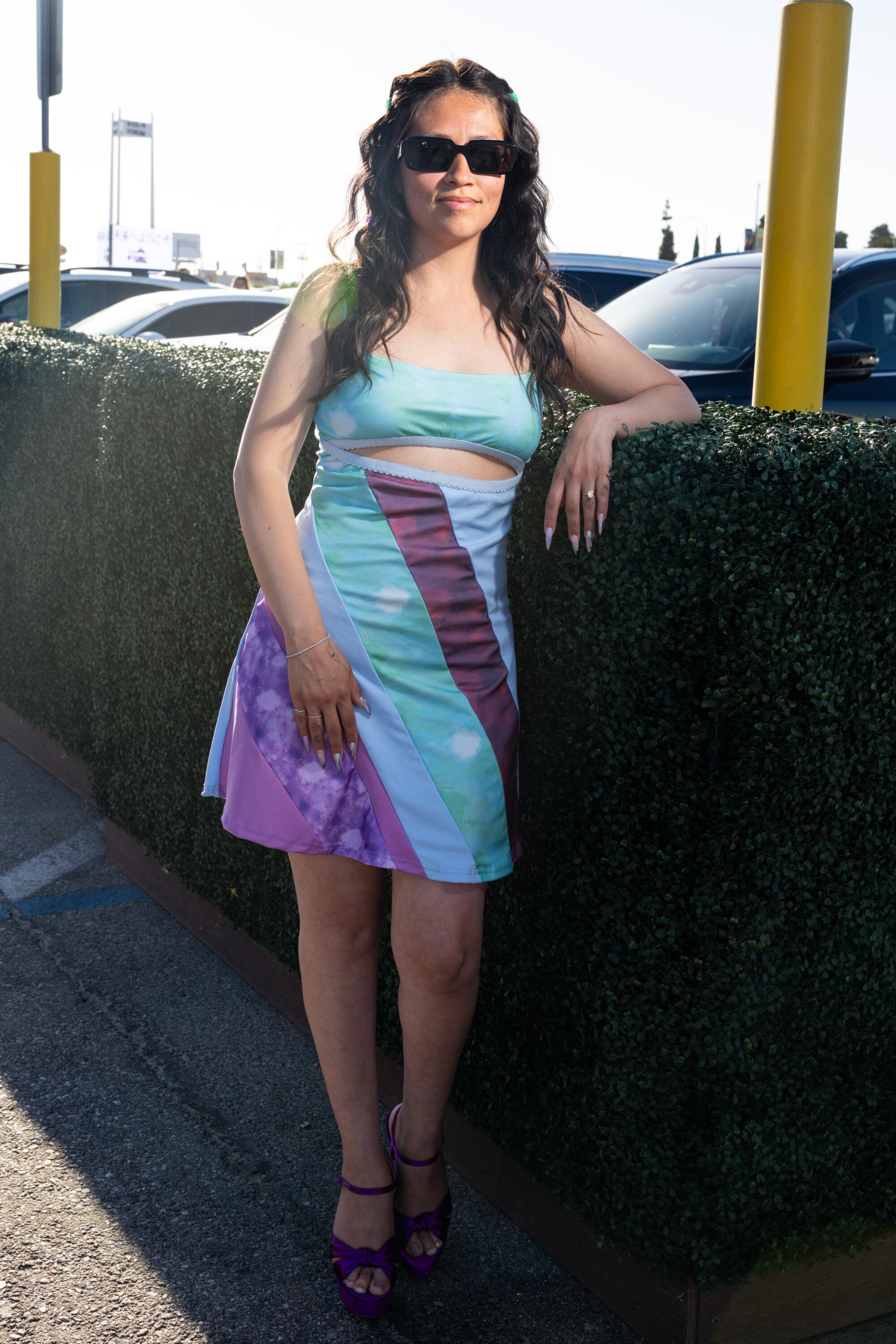
(Kayla Bartkowski/Los Angeles Times)
Stephanie Rodriguez, 32, High Desert
Tell us about your outfit.
If you ask my fiancé, I was hunting for outfits and last-minute I was like, “I’m just gonna order something on Amazon.” When I saw this, I was like, “That’s it.” Total nostalgia with “13 Going on 30.” We went shoe shopping at the South Coast Plaza over the weekend. The metallic is pulling it all together and the butterfly clips.
How long have you been a fan?
Probably since I was like 8 or younger, pretty much very much obsessed. All of my holiday gifts were Hilary Duff. I had her K-Mart home products. Any magazines she was in, I got. Any outfits that I could try and replicate, I would. My first Hilary show was either Wango Tango or a Jingle Ball with KIIS-FM, so it was just a festival with a bunch of different artists but I went specifically for her.
Why does her work still resonate with you today?
I think a lot of us feel like we grew up with Hilary, so all of her music resonated with us then, and now, now that we’re older, through relationships or divorces or motherhood. It’s pretty cool to see just how we’re all kind of growing up together. The first time I think I found out about her was at the Glendale Galleria. I was recently telling my fiancé that my dad had me on his shoulders because she did a meet and greet and the entire mall was packed.

(Kayla Bartkowski/Los Angeles Times)
Kelsie Wagner, 35, of Temecula and Tyler Walsh, 35, of Long Beach
Tell us about your outfit.
Wagner: I’m channeling Lizzie McGuire. My favorite part is the butterfly clips.
Walsh: This is from Company D, which is a discount store for Disneyland. I was like let me get the biggest shirt and make it into a dress, but I’m wearing shorts — it’s still appropriate. I have like six authentic Disney pins here. This is about $200 on my hat. I was like I have to do something that represents. It’s a big hobby, pin trading, that I picked up in 2023. Then I wore my Lisa Franks. I figured I would channel everything from the ’90s and 2000s.
How long have you been a fan?
Wagner: Whenever the “Lizzie McGuire” show came out.
Walsh: I remember going to sleepovers with all of my friends and we would do Lizzie nights. I was on a soccer team and on Saturday nights, we’d go watch the newest episode. It was just so fun because I feel like I had a little clan that loved Lizzie. We went to her concert at the Grove together and it was back when you paid $50 to get in. We were front row and we like smelled her. It was wonderful.
Why does her work still resonate with you today?
Wagner: For me, especially her new album, she talks about marriage, relationships, motherhood, so it’s still relatable in that sense of that stage of life that we’re in.
Walsh: For me, it’s just nostalgia, because I’m not married, I have no kids, like I’m that fun aunt. And I will say, like, because she goes to Disneyland a lot, so I luckily got to meet her too. I asked her for a picture, and she’s like “Yeah, of course, honey.” It’s the most embarrassing photo of me ever though.
Wagner: I told her she should get it printed and wear it to the concert.
Walsh: I should have.

Sam Raimi‘s Evil Dead films and TV series are a fine example of creativity within constraints, playfulness, self-awareness and outright slapstick comedy. The Evil Dead series after Raimi is very, very different. Starting with 2013’s Evil Dead by Fede Álvarez, followed by Evil Dead Rise by Lee Cronin, the new series takes itself more seriously and emphasises pure horror, violence and gore. Some have considered this praiseworthy as it avoids being a mere retread of the old films, but the reception has been mixed.
In Sébastien Vanicek’s Evil Dead Burn, Alice (Souheila Yacoub) loses her abusive husband (George Pullar) to a motor accident. When she goes home to stay with his family, the consequences of the work of their dead grandfather researching the Necronomicon and the Deadites manifest in terrible ways. One by one, the family are turned into the Evil Dead.
Horror is a genre that depends on you relating to the protagonists so you care what happens to them. In the case of Evil Dead Burn, Yacoub does a decent job with the character she’s given, but the gonzo horror elements manifest so early in the film that she may as well be collateral damage in the onslaught, especially as the film’s early point of view is that of her brother-in-law (Hunter Doohan).
Fans of gory violence will get their money’s worth here, but there’s not a lot going on besides that. The film is a descent into madness and carnage that is so resolutely unpleasant that, after some of the early kills, it becomes numbing. It’s hard to gather what the tone is supposed to be, with lots of callbacks to the early films’ style by setting up inevitable kills with Chekhov’s weed trimmer, Chekhov’s fork and every other potentially dangerous prop the camera lingers on. The family are all deeply unpleasant at some level and so their deaths register as meaningless. Yes, the film has the obligatory something to say about how our tendency to ignore domestic abuse creates demons that destroy families, but then absolutely panders to bloodlust by absolutely revelling in some of the most extreme violence imaginable between family members (and a pet). To say this is not a film for the sensitive is to understate things considerably. This is a film that absolutely earns its content guidance warnings.
Is there any comedy? Some, but it feels out of place given the absolute brutality inflicted on the cast. While most of the other films were self-aware about setting up a ludicrously grisly end for a villain as a payoff, in Evil Dead Burn,the kills have very little flair. It’s also hard to know what the rules for getting rid of a Deadite are, as some of them are still upright and chatty after losing most of the contents of their skull and some are dispatched by the repeated application of a blunt object to the head. Towards the end, a McGuffin is added to make the kills final, but before that, who knows?
Should you watch Evil Dead Burn,? It certainly gets vocal reactions from audiences in a cinema, and if you’re a gorehound you’ll be in for a ride. If you’re a horror fan, it’s certainly a horror film, but violent instead of scary. If you’re just a fan of cinema who likes good films whether or not they’re horror films, then this will be an alienating watch. In Evil Dead Rise the decay of the family was more than background noise and factored into the circumstances of the individual deaths, but not here. It has slight pretences of being a film with Themes and Ideas, but in the end it just feels like an excuse to serve up limbs being mutilated, skulls being crushed and any number of stabbings, slicings and gougings rendered with psychopathic visual fidelity. If that’s what you’re after, that’s what it’s got.
Entertainment
‘Children of Blood and Bone’ author won’t see film after feud with star Amandla Stenberg

Tomi Adeyemi, the author of the bestselling fantasy “Children of Blood and Bone,” isn’t planning to see the forthcoming film adaptation — even though she co-wrote it.
Over the weekend, the Nigerian American author posted a video on TikTok addressing fans who have been asking her the same question, “Why don’t you post about the adaptation of your first film adaptation anymore?”
“There is a reason I will not post anything about the adaptation of my work,” the author wrote in what appear to be screenshots of a group chat. “I have not seen the film, and I will not watch it.”
The adaptation of the first installment of Adeyemi’s “Legacy of Orïsha” fantasy trilogy is slated to hit theaters in January 2027. Gina Prince-Bythewood — who wrote and directed “Love & Basketball” and helmed “The Woman King” — is directing. The film stars Amandla Stenberg, Thuso Mbedu, Tosin Cole, Damson Idris, Cynthia Erivo, Lashana Lynch, Regina King, Idris Elba, Chiwetel Ejiofor and Viola Davis.
Alongside the screenshots of her comments in the group chat, she shared a February 2025 exchange with Stenberg that shows the author severing ties with the actor.
Adeyemi shared only her final message to Stenberg, which reads, “Do not ever use my name in an interview or video again. Do not text me. Do not call me.” That exchange is followed by a notification that she blocked Stenberg, who plays Princess Amari in the upcoming fantasy flick.
The message from Stenberg that preceded Adeyemi’s reply is not shown in full.
Stenberg, who played Rue in “Hunger Games,” Starr Carter in “The Hate U Give” and, recently, Verosha “Osha” Aniseya and Mae-ho “Mae” Aniseya in Disney’s “Star Wars” series “The Acolyte,” had been getting flack from readers of the series, who claimed colorism was an issue while casting the movie.
In February 2025, Stenberg posted a since-deleted nine-minute TikTok addressing the controversy and told followers that Adeyemi had given the actor her blessing when cast as the series’ princess.
“I am four months into training for ‘Children of Blood and Bone’ and I am getting my ass whooped,” Stenberg joked in the video, per BET.
“This year was mostly defined for me, honestly, by contending with what it felt like to receive racist death threats just for existing in the ‘Star Wars’ universe, and that was a really difficult thing for me to move through,” she continued. “But honestly, it feels so much more painful for me to feel like I’m at odds with my own community.”
Stenberg said that she considers her skin tone when navigating her career choices and would “never go after a role” she didn’t feel well suited for. “I know that colorism is an insidious system that relentlessly impacts every facet of entertainment.”
The actor continued that it was actually a meeting with the “Children of Blood and Bone” author that gave her the confidence to pursue the role.
“I had the opportunity to meet Tomi, the novelist, for the first time. … And she goes, ‘Amandla, I want you to know that when you were a little girl and you were cast as Rue in “The Hunger Games,” and people said that Rue’s death wouldn’t be as sad because you’re a Black girl — that inspired me to write this series so that Black girls like you and Black girls of all shades could have a story written about them,’” Stenberg said in the video. “We started crying, and I said to myself, ‘God wants me here.’”
Representatives for Stenberg, Adeyemi and Prince-Bythewood did not immediately respond to The Times’ request for comment.
-

 Health1 minute ago
Coffee may have powerful effect on liver health, major study suggests
-

 Sports4 minutes ago
Oba Femi vs Brock Lesnar at SummerSlam is a ‘generational matchup,’ WWE legend JBL says
-
 Business16 minutes ago
Billionaire exodus? California drew 10 times more venture capital than any other state this year
-
Entertainment19 minutes ago
Disney Channel maximalism to pop-star glam: What fans wore to Hilary Duff’s L.A. show
-
 Lifestyle24 minutes ago
L.A. Affairs: It’s hot when a man drives to me. But would this new guy make the trek from the Valley?
-
Politics31 minutes ago
Black mold and $1 wages: Settlement forces immigrant detention centers to protect workers
-
 Science34 minutes ago
Trump administration seeks to limit federal funding that doesn’t ‘advance’ presidential policies
-
 Sports39 minutes ago
Commentary: ‘I don’t want any handouts.’ Amid the Angels’ drought, a starry homecoming for Mike Trout

