California
10 of 15 Southern California industries slow their hiring pace

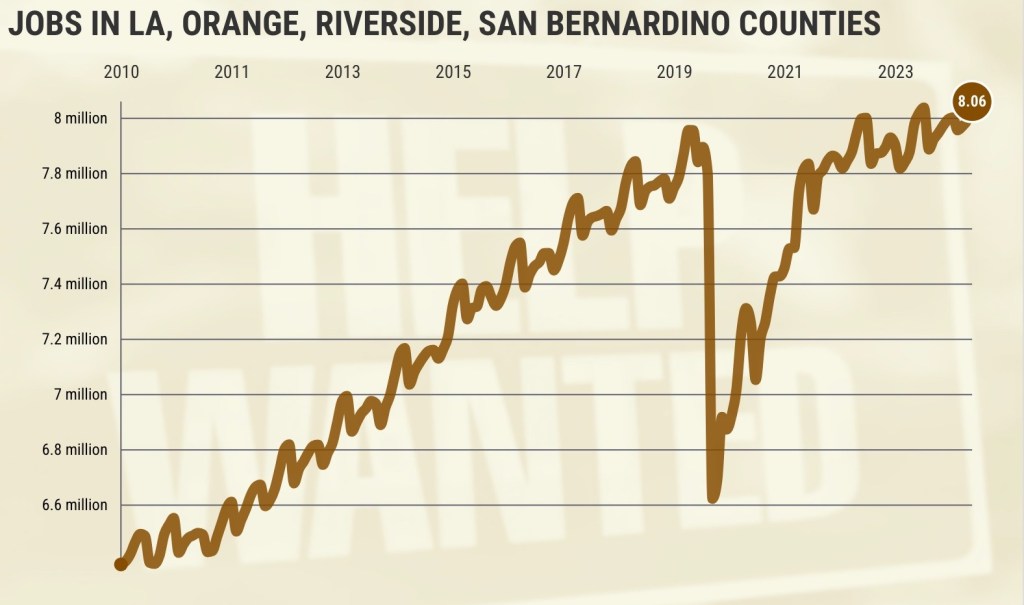
Southern California’s bosses added 80,700 workers in the past year to a record 8.06 million jobs – but that hiring pace is roughly half of the pre-pandemic job market’s gains.
My trusty spreadsheet – filled with state job figures for Los Angeles, Orange, Riverside, and San Bernardino counties – compared employment changes for the region and 15 industries in the year ended in October with the average yearly hiring pace before coronavirus upended the economy.
Yes, there have never been more Southern Californians employed. However, the recent hirings that created the all-time high staffing are far below the average job creation of 159,600 a year in 2015-19.
This is one of many signals of cooler business trends. It’s a chill significantly tied to the Federal Reserve’s attempts to slow what was once an overheated economy.
But Southern California bosses have another challenge – a shortage of workers. The region’s workforce, a measure of labor supply, is basically flat comparing 2024 to 2015-19. Fewer choices of workers have added difficulty for local businesses trying to meet their staffing needs.
Think of that when you learn that among the 15 Southern California business sectors tracked – hiring in 10 industries is below pre-pandemic years compared with five industries with improvements.
The downs
First, contemplate the 10 industries where the hiring pace has weakened, ranked by the size of the decline …
Professional-business services: 1.14 million workers in October – down 4,600 in a year vs. 24,100 annual gains in 2015-19. This net downturn of 28,700 jobs is unnerving because this white-collar work typically pays above-average salaries.
Construction: 378,700 workers – down 3,100 in a year vs. 16,200 annual gains in 2015-19. A building slowdown due to lofty mortgage rates created this 19,300 reversal.
Logistics-utilities: 820,800 workers – up 6,800 in a year vs. 25,800 annual gains in 2015-19. What’s at least a temporary oversupply of warehouses in the region may be behind this 19,000 slowdown.
Manufacturing: 558,400 workers – down 15,300 in a year vs. 4,100 annual cuts in 2015-19. This 11,200 drop is continued losses of local factory work tied to high cost of doing business in the region.
Fast-food restaurants: 359,400 workers – up 3,400 in a year vs. 12,400 annual gains in 2015-19. Weaker consumer spending and a hike in the industry’s minimum wage contribute to this 9,000 drop.
Hotels/entertainment/recreation: 268,300 workers – up 3,400 in a year vs. 9,600 annual gains in 2015-19. This 6,200 cooling reflects worker shortages.
Full-service eateries/food service: 339,100 workers – up 1,600 in a year vs. 6,600 annual gains in 2015-19. Inflation making shoppers pickier is part of this 5,000 cooling.
Information: 214,200 workers – down 100 in a year vs. 3,700 annual gains in 2015-19. Weakness in tech businesses and Hollywood productions created the 3,800 net downturn.
Personal services: 266,600 workers – up 500 in a year vs. 3,200 annual gains in 2015-19. Again, it is hard to find people to do this work. Thus, a 2,700 cooling.
Government: 1.03 million workers – up 11,600 in a year vs. 12,500 annual gains in 2015-19. This 900 dip is status quo.
The ups
Ponder the five industries where the hiring pace rose in the past year, ranked by the size of the gains …
Social assistance: 512,300 workers – up 28,200 in a year vs. 18,300 annual gains in 2015-19. The 9,900 addition comes as more folks need help at home for healthcare and child care.
Healthcare: 836,700 workers – up 30,100 in a year vs. 20,900 annual gains in 2015-19. The 9,200 growth parallels the region’s aging population and its need for medical services.
Retailing: 748,300 workers – up 8,300 in a year vs. 300 annual cuts in 2015-19. This somewhat surprising 8,600 improvement may be consumers tiring of online commerce and wanting to get out to shop.
Financial: 364,100 workers – up 4,400 in a year vs. 3,900 annual gains in 2015-19. The minor 500 improvement is a return to normalcy. Super-heated hiring came in the pandemic days thanks to a brief drop in mortgage rates to historic lows.
Private education: 215,700 workers – up 5,500 in a year vs. 5,100 annual gains in 2015-19. This 400 uptick reflects the growing interest in alternatives to public schooling.
Bottom line
While it’s rare for all industries to be growing at the same time – minus, say, just after an economic downturn – this 2024 edition of the winners vs. losers list raises an important issue.
It appears much of the past year’s job creation is coming from industries that historically pay meager wages. That’s an especially worrisome trend in high-cost Southern California.
Jonathan Lansner is the business columnist for the Southern California News Group. He can be reached at jlansner@scng.com



The most significant seismic event in California’s history – an earthquake of 7.9 magnitude – occurred in 1857 and ruptured about 225 miles on the San Andreas Fault. That earthquake, dubbed the last “Big One,” killed two people and produced shaking that lasted between one and three minutes.
Since then, California has exploded in population and been has been rattled by many major earthquakes. But Californians have also grown familiar with the existential dread of another “Big One” looming.
Researchers have long warned there will be another massive earthquake in Southern California. They just don’t know when.
A recent study says warning signs continue to grow in 2026. The San Andreas and San Jacinto fault systems have reached the highest stress levels seen in the past 1,000 years, according to a study conducted at the University of Hawaiʻi at Mānoa.
The San Andreas fault runs throughout the state, passing through San Francisco and San Bernardino, while the San Jacinto fault is in Southern California and runs through Riverside, San Diego and Imperial Counties.
Unable to view our graphics? Click here to see them.
Why the San Andreas Fault is so risky
Faults rupture on the San Andreas Fault approximately every 150 years, according to UCLA professor Jonathan Stewart, who studies earthquake engineering.
But it’s been over 300 years since the last “large rupture” occurred south of the 1857 Fort Tejon earthquake, Stewart said. “As far we know it didn’t produce a large rupture since around 1690. To the present that’s a lot more than 150 years, so there’s a lot of build-up. That doesn’t mean it’s going to happen immediately, it just means there is more stress built-up.”
When the earthquake happens, it is likely to cause a lot of damage. One major concern is the state’s water systems.
“An earthquake like this would rupture most, if not all of the major aqueducts bringing water into Southern California,” Stewart said. “Most people will not be in a collapsed structure after this earthquake, but everybody’s going to be affected by water problems.”
Study highlights longstanding risk
To investigate the probability of an earthquake occurring, researchers built a physics-based simulation and fed it the earthquake history from the region. By doing so, they were able to estimate how much stress has built up along the southern San Andreas and San Jacinto fault systems.
The results suggest that catastrophe may be near.
“Right now, with stress at historically high levels across the region and more than 160 years elapsed since the last major rupture, the system is in a critically loaded state,” lead author Liliane Burkhard said.
Most importantly, the Cajon Pass, at the junction of the San Andreas and San Jacinto faults, could facilitate a joint rupture of the two faults. This scenario, according to the study, would probably be “significantly more damaging” than a single-fault event.
How is earthquake safety considered?
Seismic hazard assessments are critical for the safety of the millions of residents in California’s densely-populated and earthquake-prone areas.
Seismic Hazard maps show the relative hazard associated with earthquakes using information on past faults, the behavior of seismic waves and the near-surface conditions of specific locations, according to the U.S. Geological Survey.
Larger values indicate a stronger level of earthquake shaking. A peak ground velocity of 269 cm/sec would correspond to extreme shaking and heavy damage. For reference, the largest ground velocity recorded in Taiwan’s 1999 Chi-Chi earthquake reached 318 cm/sec and had a magnitude of 6.7.
That earthquake killed more than 2,000 people and incurred approximately $14 billion in damage.
How do the fault lines rupture?
The San Andreas and San Jacinto faults are strike-slip faults, which typically cause horizontal displacement. Both faults comprise the geologic boundary between the Pacific Plate and the North American Plate.
If a major earthquake occurs on the San Andreas fault, it is likely to produce surface rupture, which occurs when a fault breaks through to the surface. Most earthquakes, however, do not produce surface rupture, according to USGS.
In a major rupture, strong shaking could cause severe damage near the fault and in areas built on soft or water-saturated soils, which can amplify shaking. Rupture can directly offset roads, buildings, and other structures that span the fault trace.
Although the study helps explain the risk associated with the California fault lines, Burkhard emphasized that it shouldn’t serve as a forecast.
“This is not a prediction of when an earthquake will happen,” Burkhard said. “However, studies like this are important contributions to national and global earthquake hazard research in that we are using rigorous, quantitative science to better understand the risk facing millions of people.”
Contributing: Brandi D. Addison, USA TODAY NETWORK
California
California lawmakers seek $32M to combat invasive pest found on grapevines sold at Costco

FRESNO COUNTY, Calif. (FOX26) — California lawmakers are now asking the federal government for more than $32 million in emergency funding to stop the spread of an invasive insect that was recently discovered on grapevines sold at Costco stores across the state.
The request comes about a month after Fresno County agricultural officials discovered grapevine plants infested with the glassy-winged sharpshooter, a pest capable of spreading Pierce’s Disease, a deadly infection that can kill grapevines.
In a letter sent to U.S. Agriculture Secretary Brooke Rollins, Sens. Adam Schiff and Alex Padilla joined Reps. Mike Thompson, David Valadao and other members of California’s congressional delegation in requesting $32.2 million in emergency funding to contain and eradicate the pest.
[RELATED] Fresno County grapevine plants shipped to Costco were infested with bugs
Lawmakers say the infected nursery stock was identified Mat 19 by the California Department of Food and Agriculture and the Fresno County Agricultural Commissioner’s Office.
The plants had been distributed to Costco stores in more than two dozen California counties before being sold to customers.
Officials believe some of the infested plants have since been transported to homes in at least 38 counties across the state.
The movement of infested nursery stock into and near key grape-producing regions, including areas critical to California’s winegrape and fresh table grape production, significantly elevates the urgency of this response.
The glassy-winged sharpshooter feeds on grapevines and spreads Pierce’s Disease, an incurable bacterial infection that can destroy vineyards by preventing vines from transporting water.
Lawmakers warned that the pest poses a serious threat to California’s wine and table grape industries.
According to the Wine Institute, California’s wine industry supports 1.1 million jobs nationwide and generates an economic impact of more than $170 billion.
California also produces 99% of the nation’s table grapes, with an annual crop value estimated at $2.59 billion.
If the pest spreads unchecked, the California Department of Food and Agriculture estimates losses associated with Pierce’s Disease and the glassy-winged sharpshooter could exceed $104 million annually.
The requested funding would support emergency response efforts, including tracing the movement of infested plants, surveying affected areas and expanding trapping programs.
Additional funding would also be used for long-term monitoring and eradication efforts over the next several years.
The lawmakers are asking the U.S. Department of Agriculture to immediately release the funding through the Commodity Credit Corporation, arguing that the outbreak meets the federal definition of an agricultural emergency.
Growers have already contributed more than $62 million toward research and mitigation efforts over the past 25 years through industry assessments, according to the letter.
Federal officials have not yet announced whether the funding request will be approved.
California
California Now Offers Free Passes to State Historic Parks (Just Don’t Miss the Deadline) | KQED

An annual pass that’s usually $50 is free in honor of Juneteenth — and to mark the 250th anniversary of the signing of the Declaration of Independence.
Historical buildings are visible at Sonoma State Historic Park, Sonoma, California, May 31, 2026. Until July 6, Californians can download the state historic park pass for free and use it as many times as they want through the end of 2026. (Smith Collection/Gado via Getty Images)
“California doesn’t hide from hard truths and uncomfortable history – in fact, we embrace it and learn from it,” Newsom wrote.
Until July 6, Californians can download the state historic park pass for free and use it as many times as they want through the end of 2026. The pass gives free entry to state historic parks for up to four people.
Jump to:
The Historian Passport grants entry to more than 30 state historic parks, including parks like Olompali and Malakoff Diggins which, rather than just providing outdoor recreation, also have an educational emphasis on the state’s history.

Many of these parks tell the story of the state’s cultural or indigenous history, from missions and museums to temples and the site that sparked the California Gold Rush.
Newsom made a similar move to make state parks free for Martin Luther King Jr. Day this year, in response to Trump’s decision to eliminate the holiday from the list of fee-free days at national parks across the country, replacing it with his birthday on Flag Day.
How to get your free Historian Passport for up to four people
You must make an account with the state’s reservation site ReserveCalifornia.com to obtain a Historian Pass. Then, visit the site’s Advance Passes page and select “Special Edition Historian Passport” from the dropdown menu, which will show as costing $0. No payment information is required.
After checking out, you’ll receive an email with an attached PDF version of your Historian Passport.
The state recommends you print off this PDF to present at any California state historic park for free entry, although you may just be able to show the image on your phone too.
Bear in mind that cellphone service may be poor at many state historic parks, so it’s worth screenshotting the PDF to save it as an image on your phone in case you’re unable to search your email.
Looking for free entry to other state parks that aren’t included in the Historian Passport? Consider checking out a parks pass from your local library, which provides these passes as part of the California State Library Parks Pass program.
Northern California State Historic Parks to visit for free this year with a Historian Passport
Bay Area
Sacramento area
Sierra foothills
KQED’s Carly Severn contributed to this report.
-

 World4 minutes ago
British Prime Minister Keir Starmer faces potential leadership challenge from newly-elected Andy Burnham
-

 Politics7 minutes ago
Reporter’s Notebook: How Trump’s surprise move on DNI confirmation upended key Senate deal on FISA
-

 Health19 minutes ago
Weight-loss drugs linked to ‘Ozempic ears’ and other cosmetic complaints, surgeons say
-

 Sports22 minutes ago
Florida AG launches civil rights investigation into MLB’s warning to Christian pitchers over Pride Night caps
-

 Technology27 minutes ago
Fox News AI Newsletter: Bezos predicts labor shortage
-
 Business34 minutes ago
Landmark downtown apartment tower faces foreclosure
-
 Entertainment37 minutes ago
Bob Dylan is absolutely cooking on the road right now
-
 Lifestyle42 minutes ago
L.A. Affairs: Would taking a trip with this new guy finally push us out of the ‘polite’ phase?

