California
White House announces first California marine sanctuary managed by Indigenous peoples


The Biden administration, members of Congress and native tribes will commemorate the designation of the Chumash Heritage National Marine Sanctuary on Monday — the first such preserve in California to be managed in cooperation with Indigenous peoples.
The 4,543-square-mile sanctuary, located off California’s rugged Central Coast, would prohibit oil drilling and offer other protections to an area that encompasses numerous cultural resources, including the suspected remains of ancient, submerged villages.
The preserve could one day serve as the final puzzle piece of an effort to protect virtually all of California’s coast from the Channel Islands to Point Arena, north of the Bay Area.
“I am overwhelmed with pride for our community and just how much, how far we’ve been able to come in such a short time,” said Kenneth Kahn, chairman of the Santa Ynez Band of Chumash Indians. “We’ve got a lot to celebrate.”
The National Oceanic and Atmospheric Administration is responsible for managing the preserve, but Indigenous tribes will directly advise the agency. The Santa Ynez Band of Chumash Indians, which has territory overlapping with the sanctuary and is the only federally recognized Chumash tribe, has been designated as NOAA’s key Indigenous partner.
Some Indigenous leaders say NOAA’s tribal consultation process fell short, but most agree the sanctuary is a step forward for conservation of the ocean, which provides Californians food, a temperate climate and recreation. Humans, they say, have a responsibility to protect it.
“We’re accomplishing a lot of things here,” said Rep. Salud Carbajal (D-Santa Barbara), who represents the swath of coast adjacent to the sanctuary and has championed the project since he was elected in 2017.
“It’s good for the environment, good for biodiversity, the ecosystem, the cultural resources, the marine life, but also protecting our region and coast from future offshore oil drilling.”

Aggressive and impactful reporting on climate change, the environment, health and science.
NOAA announced the designation last week, starting a 45-day countdown on the congressional calendar until it takes effect, during which Gov. Gavin Newsom has the power to veto it. Officials have no expectation he will do so, however.
Newsom’s administration have been involved in the designation process, and the sanctuary aligns with both Biden’s America the Beautiful initiative and Newsom’s 30×30 goal — both of which aim to conserve 30% of land and waters by 2030.
“There are still a lot of questions about how its going to work … I don’t have all the answers but we’re going to figure this out together,” said Paul Michel, regional policy coordinator for the West Coast at NOAA. “We need to get together, roll up our sleeves and get busy learning from each other.”
The proposal was first submitted in 2015 by the Northern Chumash Tribal Council, a nonprofit organization focused on rekindling Chumash culture and heritage and raising public awareness. The proposal was submitted not long after the Obama administration started allowing the public to propose sanctuaries for the first time in decades.
In 2021 — after years of sitting on the shelf during the Trump administration — the Biden administration made the proposal a top priority.
But after NOAA publicly posted its initial detailed plan in 2023, progress hit a wall.
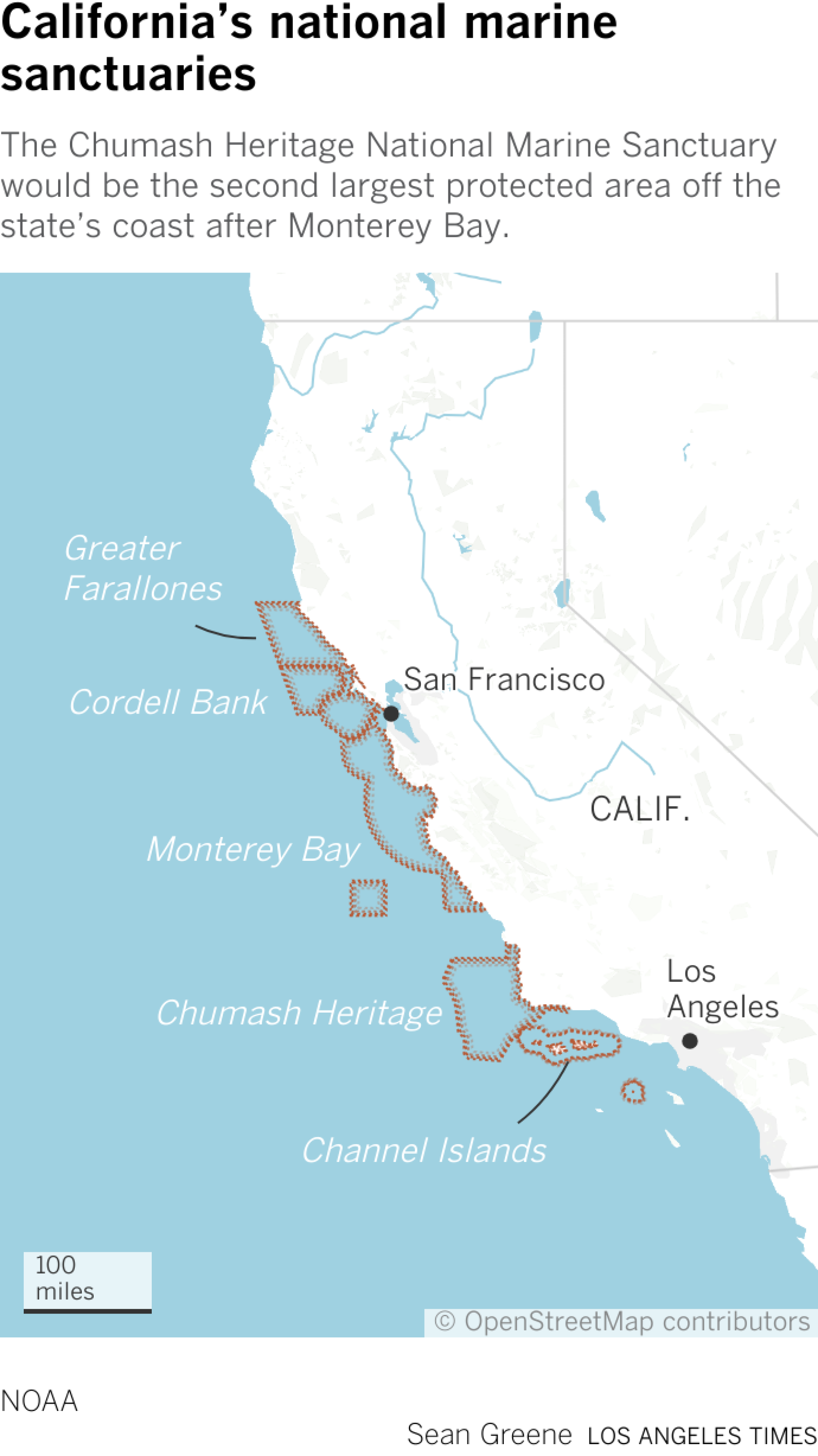
Many Indigenous and environmental leaders wanted the sanctuary to extend up to the Monterey Bay sanctuary, past the Diablo Canyon nuclear power plant.
But offshore wind companies had long planned developing near the power plant, which provides an easy connection to the electrical grid since Diablo Canyon already sends 6% of the state’s power from the coast inland.
Eventually NOAA proposed a reduced sanctuary with the promise of considering expansions every five years during its required management plan review process, potentially absorbing the offshore wind waters once construction finishes.
The compromise, which the White House helped broker, aims to establish the sanctuary before the presidential election — allowing officials to work out the complex details later without jeopardizing the whole sanctuary.
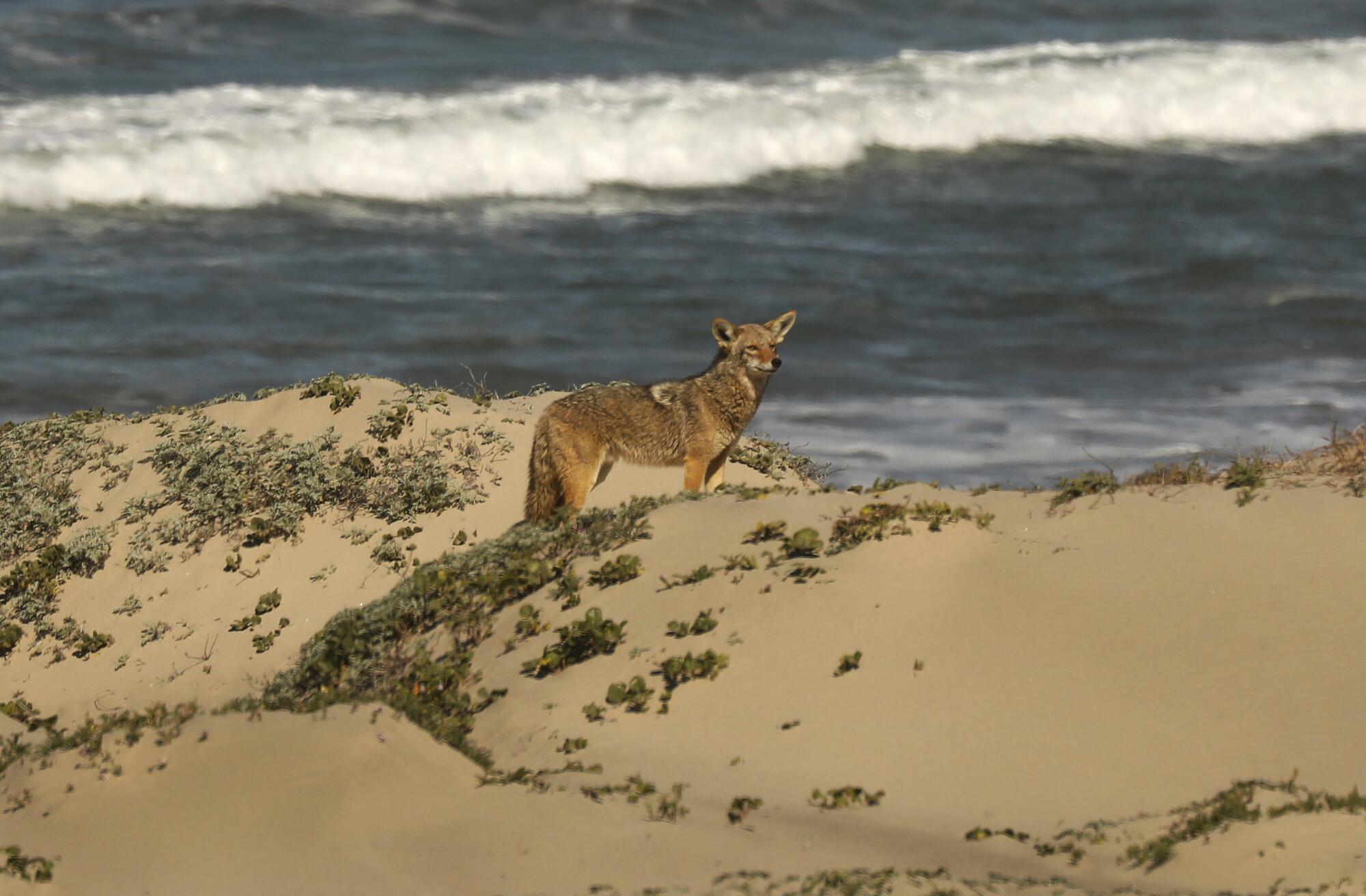
A coyote runs through the sandy dunes of Surf Beach in Lompoc, which overlooks the newly designated Chumash Heritage Marine Sanctuary.
(Al Seib / For The Times)
Yet some say the government’s efforts to work side-by-side with Indigenous tribes has fallen short.
Haylee Bautista, ocean advocate with the yak titʸu titʸu yak tiłhini Northern Chumash Tribe of San Luis Obispo County and Region — whose tribal territory overlaps with the sanctuary — said her tribe wasn’t made aware of the proposal until after an initial plan was already submitted to NOAA.
“We’ve voiced our concerns multiple times and submitted letters and the reciprocation hasn’t been great,” Bautista said.
“The ocean is a very sacred and important place to us, so the fact that they’re so quick to dismiss what we have to say about it … is just really disheartening.”
While the government has come a long way in recognizing the importance of Indigenous voices, they are often still an afterthought, she said.
Both the federal government and tribal leaders acknowledge that many lessons were learned during the first-of-its-kind process.
“We will continue to learn,” said Michel. “We’re in that process of developing relationships, hopefully some trust along the way. But we’re really at a starting point here with what we’ve heard so far and big hopes for where we could go.”
The Chumash Heritage National Marine Sanctuary is lined with sandy beaches and rocky shores and is home to a multitude of seabirds and sea lions. Kelp forests — one of the most biodiverse ocean ecosystems on the planet and great at absorbing carbon — sit off the coast.
On the deep seafloor, rough volcanic terrain harbors corals, sponges and fish. The open ocean is home to whales, turtles and jellyfish.
Yet these vibrant ecosystems are facing threats from all sides.
Seawater along California’s Central Coast is becoming increasingly unlivable. The Santa Maria and Santa Ynez rivers — neither of which meet state water quality standards — discharge a mix of toxic chemicals, fertilizer, grease and dangerous bacteria.
Large cruise ships and industrial cargo vessels dump pollutants — including human sewage — directly into the waters. Passengers and crew on a single cruise ship can generate millions of gallons of waste per day.
Seven offshore drilling rigs stand in the vicinity, with three permanently shuttered, and four temporarily out of operation. They are each connected to shore by miles of oil-carrying pipeline, and spills have fouled the sea multiple times since the area was first developed in the 1970s.
In 1997, a Freeport-McMoRan pipeline ruptured, releasing thousands of gallons of oil, killing hundreds of seabirds. In 2015, an ExxonMobil pipeline spilled over a hundred thousands gallons of crude oil into the ocean.
As greenhouse gas emissions warm the sea, ocean oxygen levels decrease, suffocating wildlife. The sea also absorbs carbon dioxide, acidifying the water, which breaks down essential minerals that organisms need to grow their shells and skeletons.
“It is our responsibility to protect the ocean and to give back to it and to keep it healthy and keep it clean,” said Bautista, to provide “the people of the water — so all of the animals and plants that live under the water … a space where they can thrive.”
Cal Poly and UC Santa Barbara will help study the ecosystem, checking in on its vital signs and getting to know it better. Chumash groups will also monitor the area and provide NOAA with advice on how to best care for it.
The agency can then use its might, vested by the National Marine Sanctuaries Act, to put regulations into action.
They’ll all work to create educational programs to engage the public. The Santa Inez Band of Chumash Indians is even opening their own museum as early as the end of the year, in which they hope to eventually incorporate lessons from the sanctuary.
“It is a bit of an experiment,” Michel said. “It will adapt and grow and evolve over time through collaborative co-stewardship.”

California
Mother, daughter found ‘alive and well’ after going missing on Southern California hiking trail

A mother and daughter who went missing after going for a hike on a difficult trail in San Bernardino County’s San Gorgonio Wilderness have been found “alive and well,” the sheriff’s department announced Friday.
The San Bernardino County Sheriff’s Department told KTLA they were uninjured and “walked out on their own.”
Krystal Meyers, 41, and her daughter Alexis Meyers Martinez, 21, were hiking on the Vivian Creek Trail Thursday but didn’t return, according to the San Bernardino County Sheriff’s Department.
They were last known to be at the 10,300-foot elevation mark above the High Creek switchbacks at 11 a.m., according to the San Gorgonio Search and Rescue team.
The Vivian Creek Trail is widely considered one of the more strenuous and hazardous routes in the San Gorgonio Wilderness.
The U.S. Forest Service says it’s the shortest and steepest route to the summit of Mount San Gorgonio and requires experienced mountaineering skills.
Officials did not provide any further details about the circumstances surrounding their disappearance.

BAKERSFIELD, Calif. (KBAK/KBFX) — The California Highway Patrol is urging drivers to stay focused on the road as they head out for Fourth of July celebrations.
The holiday weekend can be a dangerous time on our roads as millions of drivers are expected to travel.
CHP Officer Jorge Toro joined Eyewitness News Mornings to share how drivers can stay safe behind the wheel.
Officer Toro also highlighted the importance of sober driving over the holiday.
BE THE FIRST TO COMMENT
He says anyone hosting a party should make sure all of their guests get home safely, ensuring anyone who may be impaired doesn’t drive.

California is returning a stretch of rugged Mendocino County coast to the Indigenous nations whose ancestors once stewarded its shores.
State transportation officials recently approved the transfer of Blues Beach and the surrounding bluffs to Kai Poma, a nonprofit founded by representatives of the Sherwood Valley Band of Pomo Indians, Round Valley Indian Tribes and Coyote Valley Band of Pomo Indians.
The transfer of 136 acres just south of the community of Westport will mark the first time land managed by the California Department of Transportation has been returned to Indigenous tribes.
“This is beyond huge,” said J. Carlos Rivera, tribal chairman of the Sherwood Valley Band of Pomo Indians. “It’s enormous from our tribal perspective that we are basically obtaining the land that our people once lived on before colonization.”
California purchased the swath of rocky cliffs and windswept shoreline in the 1960s to expand the construction of Highway 1 and create a scenic viewpoint for highway travelers, according to a California Coastal Commission report.
More recently, public access has been largely unregulated, and summer weekends and holidays have drawn large groups who camp and party on the beach, at times driving through sensitive areas, damaging cultural sites and leaving behind trash, the report states.
Kai Poma plans to conduct cultural and archaeological resource studies and environmental surveys and then prepare a resource management plan for the property, according to planning documents. The nonprofit and the Coastal Commission have drafted a public access management plan that states the land will be open from sunrise to sunset.
Rivera described the entire property as a sacred site. The coastal waters are used by tribal people for seaweed and abalone gathering, and the shores host youth cultural camps, he said. “Protecting the land, it has a deeper meaning for us because we’re connected to the land,” he said.
The effort to acquire the land took years — and required a change in state law. Caltrans lacked the ability to transfer land to tribal governments until 2021, when Gov. Gavin Newsom signed a bill sponsored by state Sen. Mike McGuire (D-Healdsburg) that enabled the transfer, according to a news release issued at the time. The law also bars commercial activity on the property and requires public access be maintained.
“With 136 acres now officially transferred into tribal stewardship, one of the most spectacular stretches of the Mendocino Coast will be forever protected,” McGuire said in a statement.
“This agreement, the first of its kind in California, gives these three dynamic Native American tribes the rightful opportunity to reclaim sacred lands and cultural traditions on this special piece of earth. And it’s about damn time.”
The land transfer cleared its last regulatory hurdle June 26 with the approval by the California Transportation Commission, said Neil Thapar, an attorney who works as an advisor and legal consultant to Kai Poma. Caltrans staff will next record the deed transferring the title from the state of California to Kai Poma, which is expected to happen any day, he said.
-

 Hawaii6 minutes ago
Man accused of trying to run over police officers in Kalihi arrested
-

 Idaho9 minutes ago
Fire burning near Ammon foothills – East Idaho News
-
 Illinois14 minutes ago
Illinois Launches Holiday DUI Crackdown
-

 Indiana21 minutes ago
Storm chance late on the Fourth, then heat tones down early next week | July 4, 2026
-

 Iowa23 minutes ago
Storm puts a pause to Savannah Bananas game at Kinnick Stadium
-
 Kansas29 minutes ago
Colombia fans in Kansas City celebrated victory Friday over Ghana in the Round of 32 World Cup match
-

 Kentucky36 minutes ago
Kentucky Democratic Senate candidate says voters deserve ‘honest answer’ about McConnell’s health
-

 Louisiana36 minutes ago
Louisiana Supreme Court recalls Liz Murrill’s arrest warrant in late-night emergency ruling

