Politics
A 'Locally hated/Dyslexic Hairstylist' battles the Christian right in a Texas town

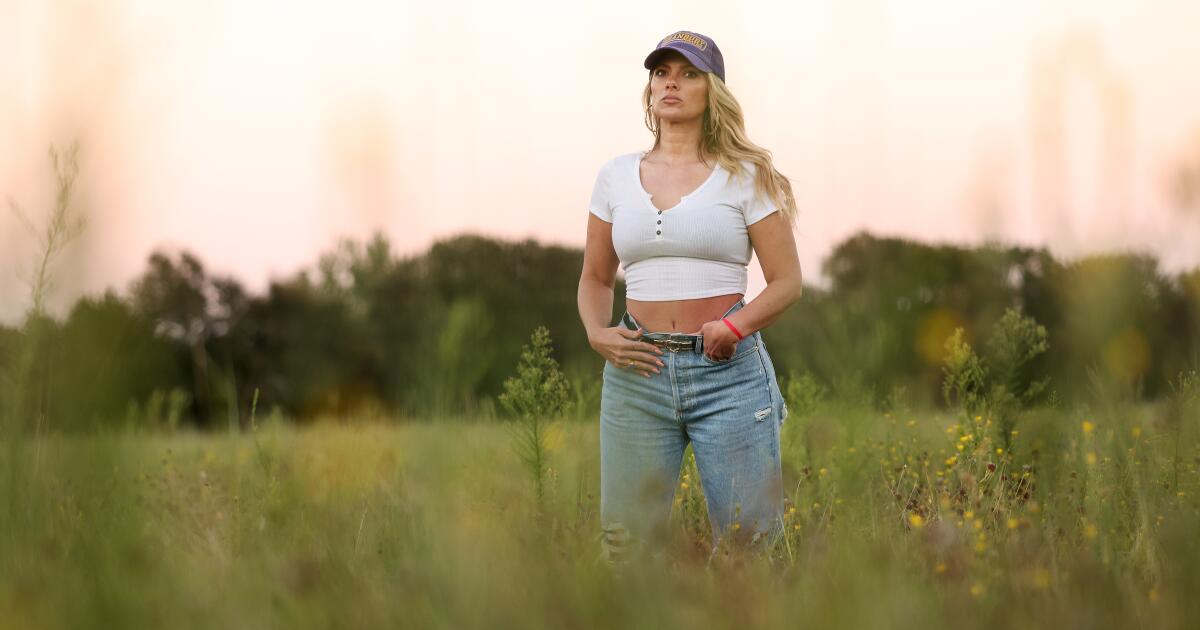
One might wonder how Adrienne Quinn Martin, a hairdresser, former belly dancer, mother of two and long-ago brand girl for a liquor distributor, a woman who celebrated her husband’s birthday on TikTok by swaying against him while listening to Al Green, became the lone-elected Democrat in one of the reddest towns in Texas.
“Oh,” Martin says, “I’ve had lives.”
Fluent in social media, she is an array of personas: a hard to quantify free-spirit, who in one instant can offer fashion tips (“I’m having a Britney moment”) and, in another, analyze voter registration data. She is a fierce political operative, a guileless influencer and a relentless voice against the far right in this Christian, white, cattle-talking town of about 12,600.
Martin washes Rose Simpson’s hair at Four Thirteen Salon in Granbury, Texas.
“Wait,” she said, when asked to call up a Twitter post about a constable who once had ties to the militant Proud Boys. “I have that.”
Click, scroll, click.
“Here it is,” she said. “I have, like, 33,000 screenshots.”
She smiled and swiped through more images on her phone.
To the dismay of many here, Martin helped organize a Black Lives Matter protest and welcomed drag queens to town for an HBO series. She caused a stir two years ago when she attended a meeting of the Granbury Independent School Board and condemned conservatives who “rant and rave” about banning books on sexuality and LGBTQ+ themes. Her subsequent video post has been viewed millions of times.
Once underestimated by her enemies, Martin, a self-appointed watchdog tuned into the plots and players in a small, gossipy community, has found that her message is radiating beyond the fields and steeples of Hood County.
“I get furious about an injustice that happens to someone else,” said Martin, 46. “It’s a kind of a curse, to be honest.”

Martin, right, speaks during a Texas Democratic Women of Hood County meeting at Spring Creek Barbecue in Granbury.
(Christina House / Los Angeles Times)
::
Martin was born and raised in Texas. She is intimate with its maps and vernaculars, and the way summer settles hard on the north-central plains along the Brazos River south of Horseshoe Bend near Granbury. But even a provocateur with polished nails and the best intentions — “I want to make this town a more friendly and inclusive place” — has to navigate the fissures and divisions in a time of cultural unease, religious fervor and battles over the nation’s identity.
She marshals the allure and immediacy of Instagram and TikTok with ease. She often appears in videos wearing big earrings, blond hair brushed to the side and falling long, inviting her followers into the confidences of a politically astute beautician. She offers advice on cropped-flair jeans, secrets about evangelical wives who hate their husbands, and warnings against the antiabortion movement. Her following — 50,000 on TikTok, 11,000 on X and 4,169 on Instagram — is not huge, but she knows the back roads and the fairways and has a widening degree of influence.
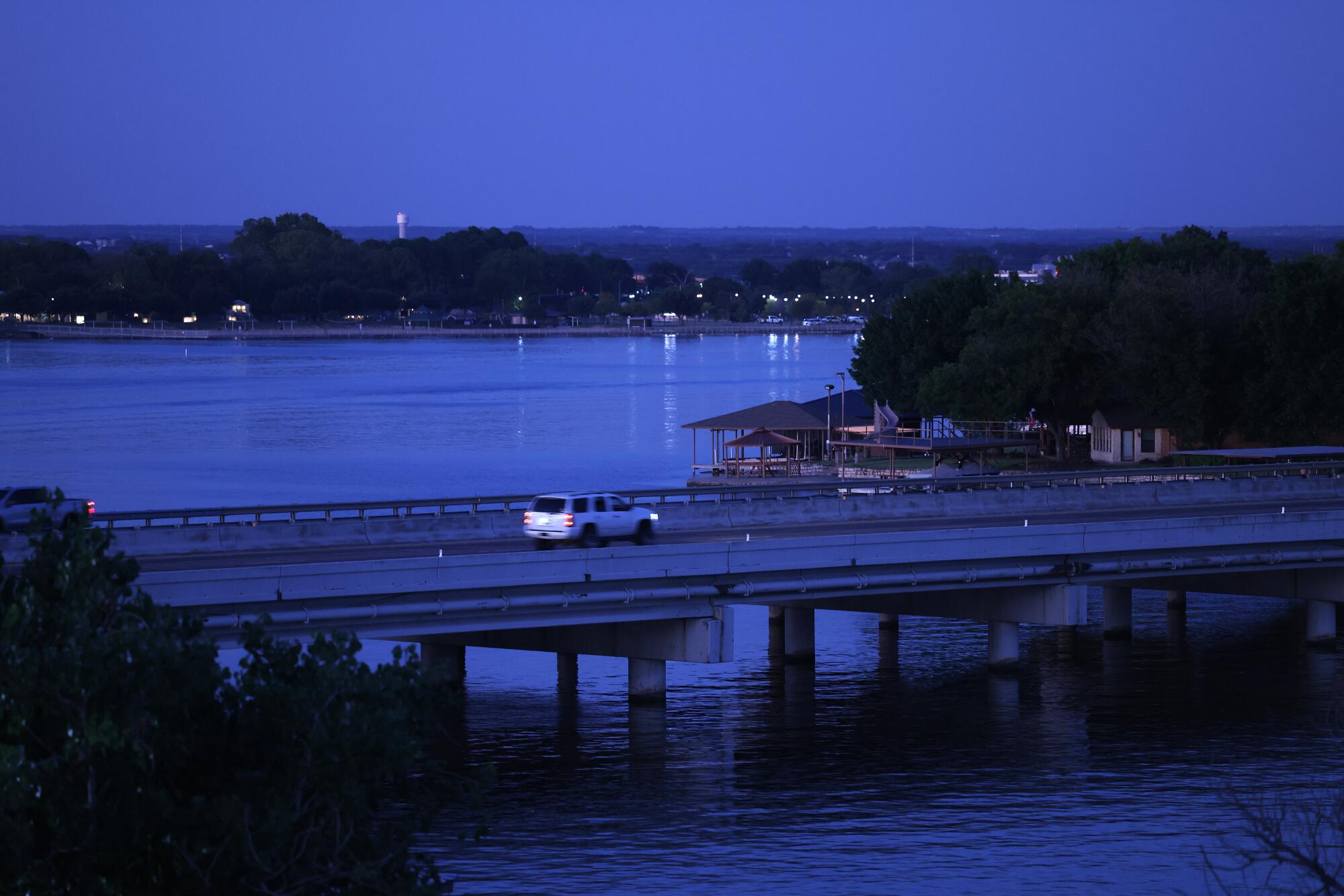
Dusk over the Brazos River in Granbury, Texas. “I want to make this town a more friendly and inclusive place,” Martin says.
“You can change society if you have a message, even if you’re part of a small community. But you have to watch your politics. Watch what you say,” said Martin, the elected chair of the Democratic Party of Hood County, who once described herself on X as a “Locally hated/Dyslexic Hairstylist.”
“This is Texas,” she aded. “Everybody is armed, so there’s always that in your mind. We have relatives we have conflicts with. Friendships have ended. ‘Oh,’ people will say, ‘She’s that Democrat bitch.’ My husband gets anxious when I go places.”
“I support everything Adrienne does,” said her husband, a native of Granbury who asked not to be named. The couple met more than 18 years ago on MySpace. “My head’s on a swivel whenever she goes out. I’m looking here, looking there, to protect her. You never know when someone will do something stupid.”
Martin has two children, six cats and a dog. She drives around in a golf cart to neighborhood garage sales. Her playlist ranges from Elvis to the Beastie Boys. Her social media posts, even those that nod to fashion and accessories, are authentic takes on life by a woman who is at once unabashed and earnest, a progressive who understands her gravity in the scheme of things. She hopes her 14-year-old son makes the basketball team and has posted angrily about a woman abandoning cats in a parking lot.
“I have everything in my phone,” she said the other day over coffee while scrolling for the town’s latest transgression, sitting in a cafe where eyes take notice when she enters. Even amid political furies, Martin, who looks like she stepped off the set of “The Real Housewives of Beverly Hills,” appears more amused than startled, speaking in the low, accented voice of a woman paging through a family scrapbook, pointing out histories and disappointments. “It’s amazing what I’ve been able to get away with.”

Martin made the news after her Instagram posts on Texas’ confusing voter registration process went viral.
(Christina House / Los Angeles Times)
Martin became active in politics years ago when a family member was denied medical insurance for a pre-existing condition. Many here see her as the embodiment of an America undergoing a cultural shift that threatens the heritage and political sensibilities of an old frontier town disquieted by changing times and suspicious of alternative lifestyles. A confidant to her gay friends since high school, Martin started Granbury for All, an LGBTQ+ support group that has about 300 members.
When even the most hardened political observers are becoming jaded, Martin, who does have her cynical days, is fascinated by the intricacies of power. She’s become an expert on the maneuverings in the state capitol, and she made the TV news in Austin recently after her Instagram posts on Texas’ confusing voter registration process went viral. Martin criticized the Texas secretary of state’s office, which suggested that prospective voters who had filled out an electronic form and hit submit were successfully registered. They were not. The form had to be printed and mailed into a registrar’s office.
“This is a voter suppression trick,” Martin posted on Instagram, noting that Republican lawmakers have long opposed online registration. Days later, the state updated its website to make the process clearer. It was a rare win and Martin was ecstatic. She posted a follow-up video, saying, “Oh, my God look at this. . .Victory.”

Austin Odgers fishes with his sons Liam, 3, and Wyatt, 6, right, in Granbury.
Much of Martin’s furor has been directed at the Granbury Independent School District, which was investigated by the U.S. Department of Education after it removed LGBTQ+-themed books from its shelves. The board had targeted more than 100 books to be purged but only about eight were eliminated. Martin criticized Christian right-wing residents, some of whom have no children in school, for pressuring the district to limit access to gender and racial topics. At a 2023 school board meeting, she used the word “weird” to describe MAGA Republicans before vice presidential candidate Tim Walz turned it into a meme.
“Some community members have developed an unhealthy obsession with book banning,” she said at the meeting, suggesting that those calling for bans wanted to “prove [their] righteousness so that [they] can bring down the school district. Is that for the kids? Why the obsession with finding these books? Why is that your fantasy? It’s weird.”
::
Martin grew up in the Dallas suburb of Grand Prairie. The daughter of a business manager and a teacher, she has been a belly dancer at a hookah bar and a “promo-girl” for a liquor distributor. She moved to Los Angeles when she was 18 to study at the Joe Blasco Makeup Artist Training Center. She returned to Texas months later and worked on TV commercials and independent movies before moving to Granbury, which she describes as “a little place” with a racist tinge (”the N-word is rampant”) where the far-right Republicans have become “chaos agents. Deconstructionists. They’re so friggin negative it’s exhausting.”
Conservatives either get riled by Martin or pay her no mind. She is harassed online. She’s been called a “whore” and a groomer; someone threatened to burn down her house. Steve Biggers, former chair of the Hood County Republican Party, said, “God bless Adrienne, although we disagree on just about everything.” Another former Republican official said: “She can be very radical, but she’s in such a vast minority that people ignore her.”
“Republicans don’t like Adrienne at all. She gets in their face,” said Sherry Johnson, a retired teacher and president of the Texas Democratic Women of Hood County, which has about 70 members. “Adrienne has come into her own. She’s a force that got Democrats involved again. I remember when she became party chair. She was a young woman. Inexperienced. She was nervous about public speaking. That’s all changed. She’s a rock star.”

Linda Peacock checks in for a Texas Democratic Women of Hood County meeting in Granbury.
A vastly outnumbered Democrat, whose progressiveness confounds even some in her own party, Martin keeps her gaze on the infighting between far-right and traditional Republicans. Her phone often glows with backbiting messages from Republican factions going after one another, notably in a recent intraparty skirmish over the appointment of a district clerk, which led to name-calling and a lawsuit. She follows the social media pages of both wings and occasionally supports traditional Republicans in key races.
“It’s more effective for Democrats and moderate Republicans to work together,” said Martin, who recently attended a local campaign kickoff for traditional Republican candidates, including a school board member who betrayed the far-right by opposing wide-scale book banning. “This is Granbury. You have to take a small win over nothing at all. The far-right wins on low-information voters. Just like Trump.”

Martin carries Harris-Walz signs for others to post.
Her adopted home has a rural charm with a well-swept downtown visited on weekends by people from Dallas and Fort Worth. Granbury, which is overwhelmingly white, has become a popular retirement community with gated neighborhoods and second homes on the lake. It is the seat of Hood County, where rodeos and “cowboy tourism” are popular and preachers conflate Bible parables and politics. Jesus and Trump — who carried the county by 81% of the vote in 2020 — are often spoken in the same breath.
The town has a reverence for the past and a fascination for the slightly odd, including a museum with more than 6,000 dolls dating back to 1868. Banners with photos of veterans and dead soldiers peer over sidewalks and legend has it that Jesse James lived here in an age of stagecoaches and outlaws. A frontier attitude brims among older folks, some of whose grandchildren are homeschooled and whose enmity toward the government runs deep. Many here want to keep Granbury as it was, as if nostalgia, both real and invented, lay claim to the future.
“It was once a small town and now it’s one of the fastest growing counties in the U.S.,” said Jim Cato, who works with Martin on Granbury for All. In 2015, he and his partner were denied a license for a same-sex marriage by an ultraconservative county clerk, resulting in a lawsuit and settlement that ultimately granted the license. “The Hispanic population is increasing. People here are threatened by anyone who is not white, straight and Christian,” said Cato, adding, “diversity is coming.”

The sun sets behind a set of three crosses outside a church in Granbury.
Martin challenged that sensibility two years ago. On July 4, the same week her Democratic Party parade float was decorated with rainbow banners, which received boos and jeers from some, the cast from the HBO drag queen series “We’re Here” appeared in town. The series is a gender-fluid travelog that visits American communities and stages drag shows. It landed in Granbury after the school district made national news over book banning.
Much of the town’s reaction was predictable: “Big city evil has been slithering into Granbury,” said one post on social media. Martin saw an opportunity to educate. Her politics and support of the LGBTQ+ community led to her being featured on the show, including the drag queen performance in which she dressed like Barbie and slipped on a plumed-out pink wig. She was in tears at the end. In a town less accepting than many, she had stood with those at the edges and found, for a moment, while her husband clapped, couples danced and a disco ball glittered, righteous exhilaration in a billiard hall.

Martin takes a break at the Four Thirteen Salon in Granbury.
“Things like racism and transphobia piss me off,” said Martin, who has a biracial nephew. “My mom said I was always like that. I didn’t go to college and it took me awhile — years — to build up confidence. But you don’t have to be educated to get people to listen to you. I followed a need. I started thinking, ‘I’m good at this. I can help people.’ ” She added: “I know I’m privileged too. I’m a white, blond mom.”
That comes with its own liabilities. She said she has grown accustomed to sexism, including from men in her own party, one of whom refused to give her a key to the Democrats’ headquarters. A joke about oral sex was once told in her company by a fellow party member. Men have critiqued her videos on production and grammar, and one party man decided to write a newspaper column for her, believing she wasn’t up to the task. She turned him down and composed her own. “It was impacting how I did my job at the beginning,” she said. “Now, it’s just a nuisance.”
The county, she said, can be confounding. She drove the curved road the other day to the DeCordova Bend Country Club, which overlooks Lake Granbury. The air was calm and boats glimmered far off. “People think we’re ass-backward rednecks, but that’s not true,” said Martin, who ordered a salad and kissed her husband before his round of golf. “There’s good people here.” She added, though, that conservative agendas like the county clerk denying a marriage license to a gay couple in 2015, “start in Granbury and then spread.”
She looked across the dining room. Big windows shone in the noon light. A few men in from the fairways drank beer at a nearby table. Her phone hummed with messages. She has learned when to respond and when not; she knows the eccentricities and calibrations at play. “Two extremist candidates for the school board lost in the last election,” she said. “The Democrats helped make that happen by joining with the moderate Republicans for a common cause. That’s a win, no matter whether we’re in power or not. I like the fight. It gets me passionate.”
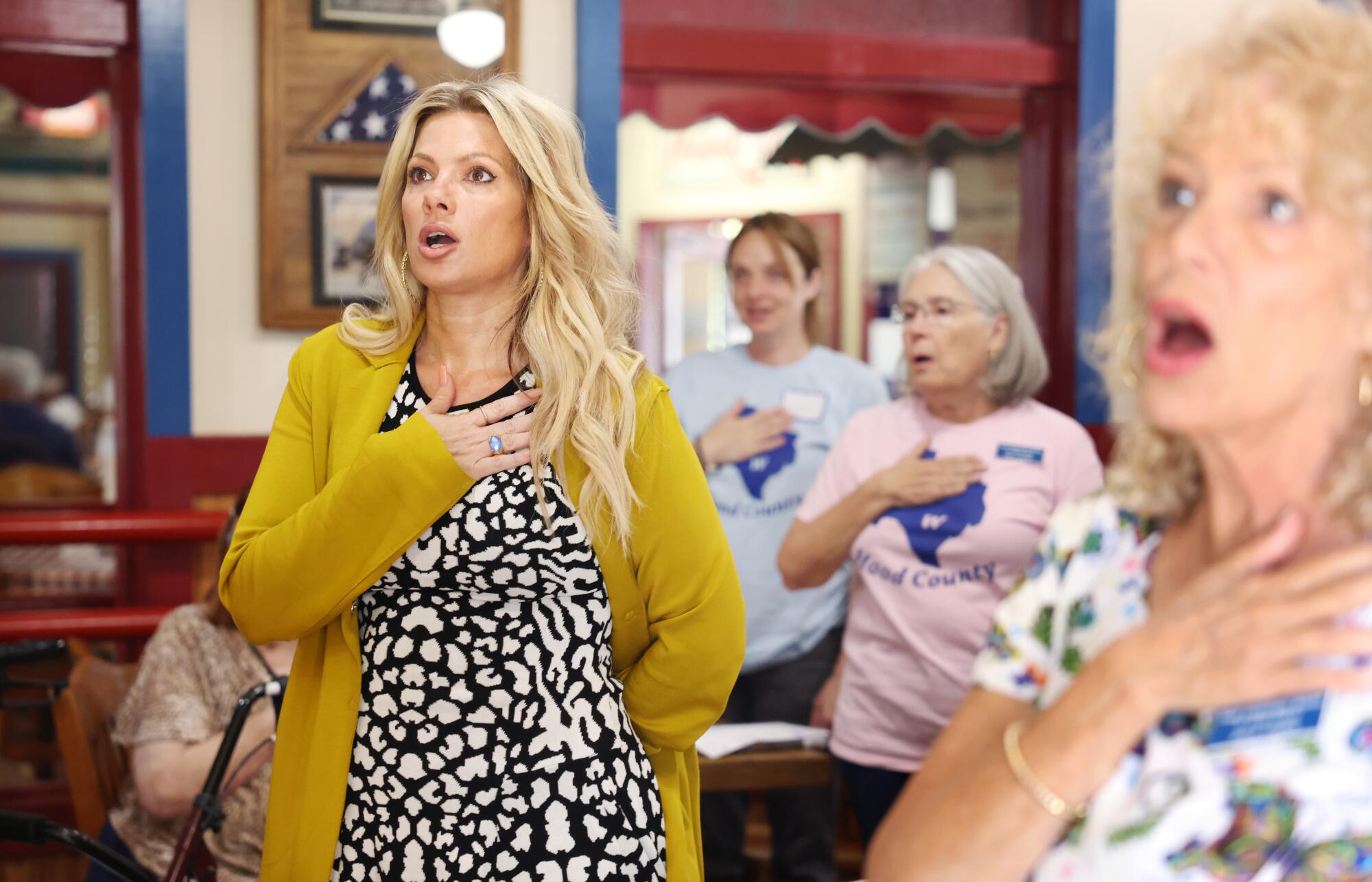
Adrienne Martin, left, recites the Pledge of Allegiance.
(Christina House / Los Angeles Times)
Martin doesn’t mind silences, where a glance will often reveal more about a person’s politics than a raft of chatter, but she’s busy and likes to keep things moving. She recalled the most recent Fourth of July town parade when she waved from the Democrats’ float. She watched the cheerleaders and the veterans, the posse of sheriff’s deputies and the firetrucks, the passing faces in the crowd. A kid stood among them. The kid didn’t clap or yell, but she saw a shudder of recognition across his face, a slight smile of solidarity for LGBTQ+ rights, perhaps, she said, on the road to a town’s acceptance.

Politics
Trump takes unusual step, lets bipartisan housing bill become law unsigned amid SAVE pressure campaign

NEWYou can now listen to Fox News articles!
A bipartisan housing bill became law Saturday at midnight after President Donald Trump declined to sign it, capping a weeks-long saga over whether the president would veto the measure amid frustrations with Congress over his stalled agenda.
Trump refused to sign the 21st Century ROAD to Housing Act — legislation aimed at expanding the nation’s housing stock and lowering costs — in an attempt to pressure Congress to pass the SAVE America Act, despite the housing bill clearing both chambers with overwhelming majorities.
“I will not sign the Housing Bill, which has been fully approved by Congress and sent to the White House, in PROTEST over the fact that the United States Senate is not capable of passing THE SAVE AMERICA ACT, which is polling at 97% with the Republican Party, and very high with the non-politician Dumocrats,” he declared on Truth Social Friday morning.
The Trump-backed election measure, which would require proof of citizenship to vote in federal elections and impose voter ID requirements, has struggled to overcome the Senate’s 60-vote threshold.
Meanwhile, the House has not passed a version of the bill that includes the president’s proposed crackdown on mail-in voting and banning men from women’s sports.
President Donald Trump speaks in the Oval Office of the White House, Wednesday, June 3, 2026, in Washington. (Alex Brandon/AP)
HOUSE CONSERVATIVES DERAIL GOP AGENDA IN SAVE AMERICA ACT SHOWDOWN
Under the U.S. Constitution, Trump had 10 days, not including Sundays, to sign or veto the housing measure after the House formally transmitted the legislation to the White House in late June. The president ultimately chose neither option, allowing the measure to become law without his signature.
Though Trump declined to veto the legislation, he sharply criticized elements of the bill and argued it should not have been a legislative priority in recent weeks.
“It’s so unimportant … compared to the SAVE America Act,” Trump told reporters in the Oval Office in late June. “I think the SAVE America Act is exactly what it says. It’s saving America from crooked elections.”
Trump went on to call the housing bill “a yawn,” adding, “compared to the SAVE America Act, just about everything is a big yawn.”
It would have taken a two-thirds majority in both chambers to override a veto — a margin the House and Senate exceeded when they passed the legislation. However, it remains unclear whether so many Republicans would have defied the president had he vetoed the bill.
Trump also appeared to criticize the bill over a provision restricting Wall Street investors from purchasing single-family homes — a policy he first proposed during his January State of the Union address and later urged Congress to pass. Trump previously argued the investor ban would give individual homebuyers a leg up against private equity firms in the housing market.
“I don’t want to hurt people that own houses, too,” Trump later told reporters, appearing to reference the provision. “These people, for the first time in their lives, they have valuable houses. They’ve become rich. I don’t want to hurt them either. What you want to do is what’s good for everyone, get the interest rates down.”
The law also aims to boost housing supply by streamlining federal environmental reviews, loosening rules around the construction of factory-built homes, and incentivizing local governments to modify their zoning laws to allow more housing, among roughly 60 provisions.
Trump’s souring on the legislation created headaches for Republicans, who touted the bill as an affordability win as voters grapple with high housing costs.
“It’s irresponsible to postpone signing the Housing bill due to the SAVE Act,” Sen. Bill Cassidy, R-La., a retiring lawmaker who lost re-election to a Trump-backed challenger, wrote on social media. “We need to start delivering relief to people for the high cost of housing ASAP!!”
Construction workers stand on the roof of homes under construction at a new housing development on June 24, 2026, in Valencia, Calif. (Justin Sullivan/Getty Images)
WARREN TELLS TRUMP TO ‘SIGN THE DAMN BILL’ AS BIPARTISAN HOUSING PACKAGE REMAINS STALLED IN WASHINGTON
Trump abruptly canceled a signing ceremony for the legislation at the U.S. Capitol in June with GOP leaders. The stage had already been set, with at least one senior Republican arriving unaware the president had called off the event shortly before it was scheduled to begin.
The president then declared he would not sign the legislation until Congress passed the SAVE America Act, despite Senate GOP leaders insisting the votes do not exist to advance the measure.
Trump has also expressed frustration with the Republican-controlled Senate for declining to weaken the legislative filibuster, which requires 60 votes to advance most legislation in the upper chamber.
“GET SMART REPUBLICANS, IF YOU DON’T, YOU WON’T BE IN OFFICE FOR LONG!” Trump wrote in a Truth Social post on Sunday.
Before Trump came out against the bill, White House Press Secretary Karoline Leavitt called it “one of the most significant pieces of housing affordability legislation in American history” and said it included an array of policies “long championed” by Trump.
House Speaker Mike Johnson, a Republican from Louisiana, speaks during a news conference at the U.S. Capitol in Washington, D.C., on Oct. 15, 2025. (Eric Lee/Bloomberg via Getty Images)
Meanwhile, Trump political operative James Blair touted the legislation for including the president’s Wall Street investor ban, which he referred to as a “signature commitment.”
House Speaker Mike Johnson, R-La., has argued that Republicans will still promote the landmark housing bill ahead of November.
CLICK HERE TO DOWNLOAD THE FOX NEWS APP
“We’ll still celebrate it, but he’s trying to make a point, and I think he’s making it very effectively,” the speaker recently told reporters, referring to Trump. “And the fact that you all ask me every three steps down the hallway illustrates that he has achieved the desired objective, and that is to make SAVE America the number one thing, because if we don’t get that right, everybody’s concerned about what happens next.”

The Trump administration has signed off on a company’s plan to convert an oil and gas pipeline to pump groundwater from the Mojave Desert to thirsty California cities for the first time, a lucrative venture that critics say threatens natural springs and wildlife.
The federal Bureau of Land Management released documents Thursday saying that Cadiz Inc.’s plan to repurpose 162 miles of the pipeline to transport water “will not significantly affect” the environment.
“We’re excited to achieve this pivotal milestone. After many years of planning and environmental review, the project has now reached the construction stage,” said Susan Kennedy, chair and chief executive of Cadiz.
Environmental advocates and leaders of Native tribes, who have been fighting the project, criticized the decision.
“This groundwater mining proposal would drain the desert and rob the Mojave of its rare springs and wildlife habitat,” said Chance Wilcox, California desert associate director of the National Parks Conservation Assn. “It’s indefensible that the Trump administration would once again try to revive the pointless Cadiz project, by defying decades of scientific warnings and refusing to conduct an environmental review of the groundwater mining.”
The application for the federal authorization was filed by the Fenner Gap Mutual Water Co. The documents say the company plans to build seven pump stations, three of them located on federal land managed by the agency.
The 30-inch steel pipeline runs underground from Cadiz’s desert property, near the town of Amboy, northward to the town of Mojave.
The BLM said in its authorization that repurposing the pipeline for water “would comply with all applicable statutes and regulations.” The agency said it has “reasonably determined that the impacts of groundwater withdrawal associated with Cadiz’s groundwater extraction project are outside the scope of analysis.”
Cadiz’s attempts to export water from its property 200 miles east of Los Angeles have drawn controversy for decades.
In 2019, Gov. Gavin Newsom signed legislation that requires the project to undergo scientific study and gain approval from the State Lands Commission before it can take water from the Mojave and sell it to California cities.
Activists opposing the company’s plans include civil rights leader Dolores Huerta.
“Cadiz spells destruction for water, sacred lands, and the desert economy,” Huerta said in a statement. “It is exactly this type of greed and injustice that I have dedicated my life to oppose.”
Leaders of nearby tribes have also objected to Cadiz’s plans to pump from the desert aquifer near the Mojave Trails National Monument and Mojave National Preserve.
“It is the living heart of the desert,” said Daniel Leivas, chairman of the Chemehuevi Indian Tribe. “To drain it would be to drain the life out of the entire desert. No profit is worth such desecration.”
Chairman Timothy Williams of the Fort Mojave Indian Tribe said the company’s plan “to pump and sell 25 times more groundwater each year than the aquifer can replenish would desecrate our traditional territories.”
“Pumping more groundwater than is sustainably replenished is not only negligent, but dangerous to the American Desert Southwest,” he said in the joint statement with other opponents of the project.
For years, while pursuing its plan to sell water far away, the company has been using wells on its property to irrigate nearly 2,000 acres of farmland growing lemons, grapes and other crops. It has drilled more wells in anticipation of being able to export water once the government approved its pipeline.
The company intends to pipe water to communities in San Bernardino County and says it’s “expected to provide one of the lowest-cost sources of new water in the drought-plagued Southwest.” It says the federal permit “marks a key milestone as we finalize project financing with prospective investors.”
Cadiz bought the 220-mile pipeline from El Paso Natural Gas in 2020. Once construction is completed, the company says the pipeline will be able to transport up to 25,000 acre-feet of water per year — about 5% of what Los Angeles uses each year.
The Los Angeles-based corporation is also seeking to build a new pipeline along a railroad right-of-way to transport water to the south.
Environmental groups have repeatedly filed lawsuits challenging the project.
Ileene Anderson, a senior scientist at the Center for Biological Diversity, called the Trump administration’s decision “a green light for environmental destruction.”
She said six of the proposed pumping stations slated to be built are in the habitat of desert tortoises, a species in decline.
“We’ve successfully fended off this project before and we’ll continue to fight to stop this zombie from coming back,” Anderson said.
In 2021, the Biden administration reversed a Trump administration decision that had cleared the way for Cadiz to pipe water across public land. In 2022, a federal judge scrapped the pipeline permit that the Trump administration had issued.
But during President Trump’s second term, the company has again made headway on its plans. In February, Cadiz announced that the federal Environmental Protection Agency had invited it to submit an application for a $194-million low-interest loan for the northern pipeline project.
The company said in May that it reached an agreement with the federal Bureau of Reclamation to provide funding for a review of its potential role in “augmenting water supplies” along the shrinking Colorado River.
The company has also been lobbying the Trump administration. The group Public Citizen said in a recent report that Cadiz, through its nonprofit Fenner Gap Mutual Water Co., enlisted former Interior Secretary David Bernhardt’s new lobbying firm, the Bernhardt Group, and has spent at least $330,000 on lobbying in 2025 and 2026.
Records show lobbyist Luke Johnson has repeatedly accompanied Kennedy at meetings with Interior Department officials.
“The extensive influence of David Bernhardt’s boutique lobbying firm on the agency he formerly led highlights how insider firms staffed with former Trump officials have grown in recent years,” said Alan Zibel, a research director with Public Citizen. He said Bernhardt and his lobbyists “have learned how to master influence-peddling in the anything-goes era of Trump 2.0.”
Earlier this month, an Arizona water agency announced it signed an initial “memorandum of understanding” agreement to buy up to 10,000 acre-feet of water per year from Cadiz’s Mojave Groundwater Bank. The Central Arizona Irrigation and Drainage District provides water to farmlands in Pinal County, where growers are dealing with water cutbacks.
The company said that for this to happen, it would need to build pipelines and reach deals to exchange water across state lines.
Members of California’s congressional delegation have raised concerns. In a recent letter to Interior Secretary Doug Burgum, California Sens. Adam Schiff and Alex Padilla called for a thorough environmental review, saying that federal agencies and peer-reviewed scientific analyses have “warned of the significant and irreversible impacts that Cadiz’s project could have on federal lands and surrounding communities.”
Rep. Raul Ruiz (D-Indio) said in a letter to Burgum that he is concerned about the company’s long-standing effort to extract and export groundwater.
“The area I represent cannot afford to absorb the long-term costs of a commercially driven groundwater export scheme,” Ruiz said.
President Trump has promoted a chain of newly rebranded gas stations across the Philadelphia area with lower gas prices. The New York Times has not been able to get detailed information about who is behind the stations. The Trump administration says it did not fund or subsidize the company.
-

 Los Angeles, Ca26 minutes ago
New details emerge in fatal stabbing of boy in El Monte
-

 Detroit, MI53 minutes ago
1 dead, 1 injured after two-vehicle crash at Collingwood and Belleterre in Detroit
-

 San Francisco, CA60 minutes ago
4 arrested, 3 cited after brawl following Giants vs. Rockies game at Oracle Park
-

 Dallas, TX1 hour ago
Mark Cuban takes legal action against Dallas Mavericks ownership over potential new arena deal
-

 Miami, FL1 hour ago
South Florida Dirt: A timeline of the Vacchi vs. Stern legal battle
-

 Boston, MA1 hour ago
Tall Ships begin historic Boston parade of sails
-

 Denver, CO1 hour ago
Lakers Proposed to Land Peyton Watson in Massive 9-Player Blockbuster Trade
-

 Seattle, WA1 hour ago
Cyclists fill backroads for annual summer Seattle-to-Portland ride

