Vermont’s hospitals are in trouble. A new analysis found that the state’s hospitals would need as much as $3 billion in subsidies — from commercial insurance increases or taxpayers — to remain solvent over the next five years, if immediate steps aren’t taken.
That figure comes from a 142-page report outlining a plan to radically transform the state’s health care delivery system to bring down costs while continuing to provide access to care.
The report was mandated by statute and put together by the consulting firm Oliver Wyman, whose team conducted a series of meetings with thousands of patients, health care workers, hospital leaders and advocates over the past year.
“There is no hospital in Vermont that is not in jeopardy,” stressed Dr. Bruce Hamory, a consultant who specializes in redesigning health delivery and former infectious disease physician who led work on the report.
Advertisement
“You just can’t afford inaction,” he said at a presentation Wednesday to Vermont’s health care regulators, the Green Mountain Care Board.
Some of the headwinds facing the state’s costly health care system:
Commercial insurance rates are some of the highest in the country, and have increased by double digits for three years in a row, far outpacing the national average.
Most of the state’s 14 hospitals are operating at a loss, and those losses are expected to worsen in the coming years.
Vermont’s population is aging and shrinking, which will put further strain on the health care system and workforce.
Patients face long wait times for primary care and specialty care and have inadequate access to community based services, leading to expensive, sometimes unnecessary hospital visits.
Low-income households in rural areas face some of the greatest barriers to accessing care, stemming from a lack of affordable housing, transportation, and culturally competent care.
The report outlines a litany of recommendations to change the trajectory of health care finances in the state. Even with immediate action, experts caution it will take time to bring down commercial insurance rates.
“Probably two years minimum, if things really move,” Hamory said.
Restructure hospitals in the most dire financial straits
Four of Vermont’s hospitals — Grace Cottage Hospital in Townshend, Gifford Medical Center in Randolph, North Country Hospital in Newport and Springfield Hospital — have the most untenable finances based on the population they serve, according to the report.
Over the next three years, Oliver Wyman consultants say hospitals will need to close or reconfigure inpatient units to stay viable.
Advertisement
“Every prediction I can make, with every trick I know to pull, says that within three to five years, your bank will call the bill and close you,” Hamory said. “You need to be prepared.”
Some hospitals admit just one or two patients a day.
“The number of people really affected by not having in-patient acute care services is very small,” Hamory said.
That space and staff could be repurposed to provide other services, like mental health care, memory care, or skilled nursing facilities.
Advertisement
The report also suggests emergency departments could be converted to urgent care centers or shifted to a non-physician model.
Elodie Reed
/
Vermont Public
Advertisement
North Country Hospital, in a file photo from 2020. The report says that for the four hospitals it recommends suspending inpatient operations, nearby facilities are available to care for those patients at other hospitals, besides at North Country Hospital.
Closing inpatient services is a major concern for Mike Del Trecco, the head of the Vermont Association of Hospitals and Health Systems.
“For a hospital in the Northeast Kingdom, where are people going to go?” he said during a phone interview.
“This work is predicated on having out-patient community services available, and those don’t exist.”
The outgoing and incoming leaders of one of these hospitals, Gifford Medical Center, said they were also disappointed by many of the recommendations.
“While we knew this report to the state was coming, its contents are, frankly, shocking,” outgoing president and CEO Dan Bennett wrote in an emailed statement. “We will continue to advocate strongly for Gifford, for our patients, for our team members, for our future—to ensure Gifford is here to provide care in our region for generations to come.”
Advertisement
Michael Costa, who will lead Gifford starting in mid-October, added that the suggestions “have the potential to harm rural communities and some of the most vulnerable Vermonters.”
“I am particularly concerned that the report could reduce health care choices for Vermont’s women,” Costa wrote in an emailed statement.
In the report, Gifford Medical Center is cited as having a low volume of births attended by an obstetrician — though Gifford contends that the quality of that perinatal care is “exceptional” when compared against statewide data.
Joia Putnoi
Advertisement
/
Vermont Public
Specialized equipment for a newborn baby at Gifford Medical Center in December 2022.
Springfield Hospital CEO Robert Adcock echoed Gifford Medical Center’s concerns.
“We do not support a path that reduces access to care and requires our patients to travel great distances for critical health care needs,” Adcock wrote in an emailed statement. He added that hospital leadership is “open to any recommendations that improve access to care for patients, help grow our workforce, and support a thriving Springfield community.”
For other hospitals in the state, the report calls for expanding certain specialties and discontinuing low-volume procedures.
Advertisement
Del Trecco, with the Vermont Association of Hospitals and Health Systems, questioned the practicality of that idea. “These organizations that would be looked to to enhance or increase their capacity, they don’t have the physical plant, they don’t have the staffing,” he said.
“The savings of these recommendations have to be clearly studied, and frankly, the resources necessary to implement these recommendations also have to be studied,” he added.
Carly Berlin
/
Advertisement
Vermont Public and VTDigger
Copley Hospital in Morrisville on Oct. 19, 2023.
And rearranging where health care services are offered can have drawbacks for both patients and the people working in health care.
“We don’t want to pretend that health care professionals are interchangeable or easily moved or retrained,” Jessa Barnard, the executive director of the Vermont Medical Society, which advocates for physicians and PAs, said during a phone interview. “I do worry about the fear factor.”
Move care out of hospitals
Providing health care in a hospital setting is far more expensive than at a doctor’s office or at home. As many as a third of emergency department visits are avoidable at some hospitals if adequate community care was accessible, according to the report.
Shifting care away from hospitals, however, has already been a major focus of health care reform efforts.
Advertisement
“That’s been what we’ve been trying to do for a decade,” Owen Foster, the chair of the Green Mountain Care Board said at the meeting Wednesday.
“Yeah, and not very well,” Hamory responded.
Foster said the state needs to change its regulatory requirements to make it easier to build new health care projects like free-standing surgery centers, imaging centers, and birthing centers (Vermont is one of eight states that does not have a free-standing birthing center).
The report also calls for growing telehealth and home-based care, and expanding the roles of pharmacists in providing vaccines, refilling chronic medications, and treating common illnesses.
Advertisement
Amy Kolb Noyes
/
Vermont Public File
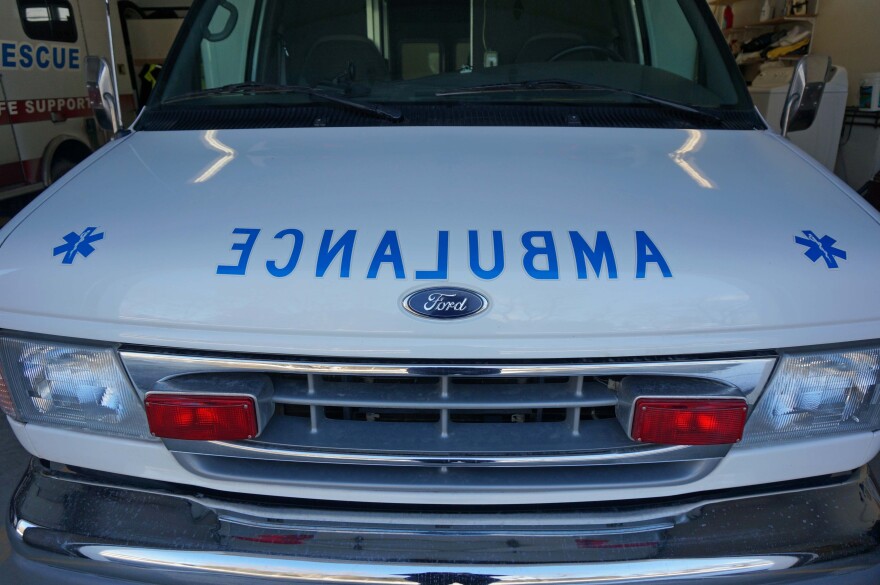
The report calls for reforms to EMS operations in Vermont.
Emergency medical technicians could also provide an expanded role in health care delivery, but funding mechanisms needs to change, according to the report. Now, EMS crews are only paid if they transport a patient to the hospital; they don’t get money for a return trip or for transferring patients between hospitals, and their work needs to be regionalized.
“I know it is running into many of the same discussions about consolidating schools — Vermont has 79 or so different EMS crews,” Hamory said.
Advertisement
Invest in housing, transportation, broadband and out-patient services
To address issues of health equity, the report recommends increasing efforts to recruit and retain health care providers from diverse ethnic, language and religious backgrounds, and suggests investing in primary care, mental health facilities and substance misuse treatment that all populations can access.
That’s on top of addressing inadequate housing and transportation, which the report says should help Vermonters receive more regular care and avoid costly inpatient stays and emergency department visits.
“Many of those things are underway and have been underway for years,” state Sen. Ruth Hardy, a Democrat from East Middlebury, said at the Wednesday meeting, referencing legislation related to broadband, developing housing, and an ongoing EMS study committee.
But the current housing and transportation landscape is not adequate to support the recommended changes, said Del Trecco, with the Vermont Association of Hospitals and Health Systems.
“A key to this work, and it’s predicated on fixing housing, fixing transportation and having community outpatient services. We have none of those things in the four communities [where hospitals are recommended to close inpatient units], and very little in Vermont to begin with,” he said.
Advertisement
Rein in costs at Vermont’s largest hospital
The University of Vermont Medical Center drives more than half of the state’s commercial insurance spending on hospitals but does not provide adequate access to specialty services, according to the report.
It recommends the hospital hire external consultants to help it reduce administrative costs, eliminate specialty programs that don’t see enough patients, and improve physician productivity to be more in line with national standards.
It also says UVM Health Network should reevaluate whether its medical education and research programs are contributing to better health outcomes for Vermonters.
“The funds used for both these purposes come largely from clinical dollars generated from patient care, and most of those dollars are from commercial insurance premiums,” Hamory said.
Advertisement
Zoe McDonald
/
Vermont Public
The University of Vermont Medical Center drives 56% of the state’s commercial insurance spending on hospitals, according to the Oliver Wyman report. Its physicians are spending about a third of their time on administrative roles and research duties, rather than seeing patients.
In an email Wednesday, UVM Medical Center spokesperson Annie Mackin wrote that upon initial review, the hospital agrees with a number of the Oliver Wyman report’s recommendations, including the focus on housing.
“So many challenges we are facing in health care, which are mirrored in other complex systems in our state, come back to our inability to attract and retain working Vermonters,” she wrote.
Advertisement
She added that the hospital disagrees with the portion of the report that cites high administrative costs, saying that it was “based on a flawed analysis of data.”
Mackin also wrote that UVM Medical Center is “proud to be an academic medical center, teaching the next generation of physicians here in Vermont, and conducting cutting-edge medical research.”
Next steps
Some are anticipating strong pushback to many of the details in the report.
“This is scary,” Mike Fisher, the state’s health care advocate, acknowledged at the meeting Wednesday.
“In the world of policy, it is easier to kill an idea than it is to pass a good idea,” he said. “I’m sure that is playing out today in messages to legislators and others.”
Advertisement
Howard Weiss-Tisman
/
Vermont Public File
Springfield Hospital in 2019.
Hamory stressed the need for immediate action.
Advertisement
“Starting tomorrow, the convening of communities and hospitals to plan for and implement the needed changes in health care delivery must begin,” he said.
That includes specific actions items for Vermont lawmakers, the Agency of Human Services (AHS) and the Green Mountain Care Board (GMCB):
In the Legislature, the consultants recommend lawmakers continue actions like:
Remove barriers for new housing.
Expand broadband coverage to rural areas for EMS transport.
Fund an overhaul of EMS services so they are regionalized.
Expand professional licensure for nurses, EMTs and pharmacists.
At the Agency of Human Services, the report says:
Specialty care and EMS services should be regionalized.
Care management should be better coordinated, including through statewide electronic medical records.
And for the Green Mountain Care Board, the report instructs:
Streamline its regulatory processes.
Do not license any more hospital-based outpatient units.
Encourage free-standing diagnostic, heart disease and birthing centers.
Start to move toward pricing that’s 200% of Medicare levels, or less.
Have questions, comments or tips? Send us a message.
ARLINGTON — The Preservation Trust of Vermont has officially presented The Arlington Common and Nick Albert of Albert Construction with a 2026 Preservation Award at the annual Downtown and Historic Preservation Conference.
The Preservation Awards recognize outstanding contributions to the preservation and revitalization of Vermont’s historic buildings and community spaces. The Arlington Common was selected for its “exceptional impact on community gathering and historic stewardship.”
The success of The Arlington Common relies heavily on the dedication of local partners who brought the vision to life. Among the key honorees was Albert Construction, led by Nick Albert, whose exceptional craftsmanship and dedication to historic integrity were vital to the project’s completion.
Advertisement
“Preserving historic structures requires more than just standard construction; it demands a deep respect for original materials, architecture, and community legacy,” said Don Trachte, Head of the Buildings and Grounds Committee and Arlington Common Board Member. “Nick Albert and the team at Albert Construction went above and beyond to ensure that every detail honored the past while engineering a space that will serve Arlington for generations to come.”
Powerball, Mega Millions jackpots: What to know in case you win
Here’s what to know in case you win the Powerball or Mega Millions jackpot.
Just the FAQs, USA TODAY
The Vermont Lottery offers several draw games for those willing to make a bet to win big.
Advertisement
Those who want to play can enter the MegaBucks and Lucky for Life games as well as the national Powerball and Mega Millions games. Vermont also partners with New Hampshire and Maine for the Tri-State Lottery, which includes the Mega Bucks, Gimme 5 as well as the Pick 3 and Pick 4.
Drawings are held at regular days and times, check the end of this story to see the schedule.
Here’s a look at June 25, 2026, results for each game:
Winning Gimme 5 numbers from June 25 drawing
13-14-18-21-22
Check Gimme 5 payouts and previous drawings here.
Advertisement
Winning Pick 3 numbers from June 25 drawing
Day: 2-1-4
Evening: 0-7-1
Check Pick 3 payouts and previous drawings here.
Winning Pick 4 numbers from June 25 drawing
Day: 5-4-4-9
Evening: 5-5-1-1
Advertisement
Check Pick 4 payouts and previous drawings here.
Winning Millionaire for Life numbers from June 25 drawing
03-13-14-34-45, Bonus: 01
Check Millionaire for Life payouts and previous drawings here.
Feeling lucky? Explore the latest lottery news & results
Are you a winner? Here’s how to claim your lottery prize
For Vermont Lottery prizes up to $499, winners can claim their prize at any authorized Vermont Lottery retailer or at the Vermont Lottery Headquarters by presenting the signed winning ticket for validation. Prizes between $500 and $5,000 can be claimed at any M&T Bank location in Vermont during the Vermont Lottery Office’s business hours, which are 8a.m.-4p.m. Monday through Friday, except state holidays.
Advertisement
For prizes over $5,000, claims must be made in person at the Vermont Lottery headquarters. In addition to signing your ticket, you will need to bring a government-issued photo ID, and a completed claim form.
All prize claims must be submitted within one year of the drawing date. For more information on prize claims or to download a Vermont Lottery Claim Form, visit the Vermont Lottery’s FAQ page or contact their customer service line at (802) 479-5686.
Vermont Lottery Headquarters
1311 US Route 302, Suite 100
Barre, VT
Advertisement
05641
When are the Vermont Lottery drawings held?
Powerball: 10:59 p.m. Monday, Wednesday, and Saturday.
Mega Millions: 11 p.m. Tuesday and Friday.
Gimme 5: 6:55 p.m. Monday through Friday.
Lucky for Life: 10:38 p.m. daily.
Pick 3 Day: 1:10 p.m. daily.
Pick 4 Day: 1:10 p.m. daily.
Pick 3 Evening: 6:55 p.m. daily.
Pick 4 Evening: 6:55 p.m. daily.
Megabucks: 7:59 p.m. Monday, Wednesday and Saturday.
Millionaire for Life: 11:15 p.m. daily
What is Vermont Lottery Second Chance?
Vermont’s 2nd Chance lottery lets players enter eligible non-winning instant scratch tickets into a drawing to win cash and/or other prizes. Players must register through the state’s official Lottery website or app. The drawings are held quarterly or are part of an additional promotion, and are done at Pollard Banknote Limited in Winnipeg, MB, Canada.
This results page was generated automatically using information from TinBu and a template written and reviewed by a Vermont editor. You can send feedback using this form.
Champlain Valley senior Zoey McNabb has been named the Vermont high school girls track and field athlete for the 2026 season, Gatorade announced Thursday, June 25.
The Gatorade award recognizes athletes for their on-field success, high academic achievement and exemplary character.
In her first year as a competitive runner, the 5-foot-7 McNabb broke long-held state records in the 1500- and 3000-meter races this past spring with times of 4 minutes, 28.59 seconds and 9:24.58, respectively. At the Division I state meet, she swept both events to help the Redhawks claim a team championship three-peat.
Advertisement
More: Why Vermont track and field officials reversed decision on 1,500 state record
Her 3,000 time ranked fourth nationally; her 1,500 performance was good for 12th. At the New England championship meet, McNabb took second in the 3,200 and third in the 1,600. She also ran in five events at New Balance Nationals, where she set the state record in the two mile.
An all-state basketball player for CVU, she has volunteered locally at the Green Mountain Montessori School in Essex in addition to donating her time as a youth basketball coach, according to the news release.
“Zoey was fearless this spring, attacking decades-old records and destroying them,” BFA-St. Albans coach Mike Mashtare said in a statement. “What made her special was how effortless she made it look with her smooth stride and relaxed running style.”
Advertisement
McNabb has maintained an unweighted 4.27 GPA in the classroom. She has signed a written letter of athletic aid to compete on scholarship at the University of Vermont this fall.
As part of Gatorade’s commitment to breaking down barriers in sport, every player of the year also receives a grant to donate to a social impact partner.
To learn more about the Gatorade Player of the Year program, visit playeroftheyear.gatorade.com.
ContactAlex Abrami at aabrami@freepressmedia.com. Follow him on X, formerly known as Twitter: @aabrami5.