Connect with us

Midwest

Illinois woman allegedly fights elementary school principal after dropping baggies of cocaine: report

Published

on

Illinois woman allegedly fights elementary school principal after dropping baggies of cocaine: report

A woman has been arrested in Illinois after allegedly fighting with the principal of an elementary school who had told her during a meeting that police would be called because she dropped baggies of cocaine, reports say. 

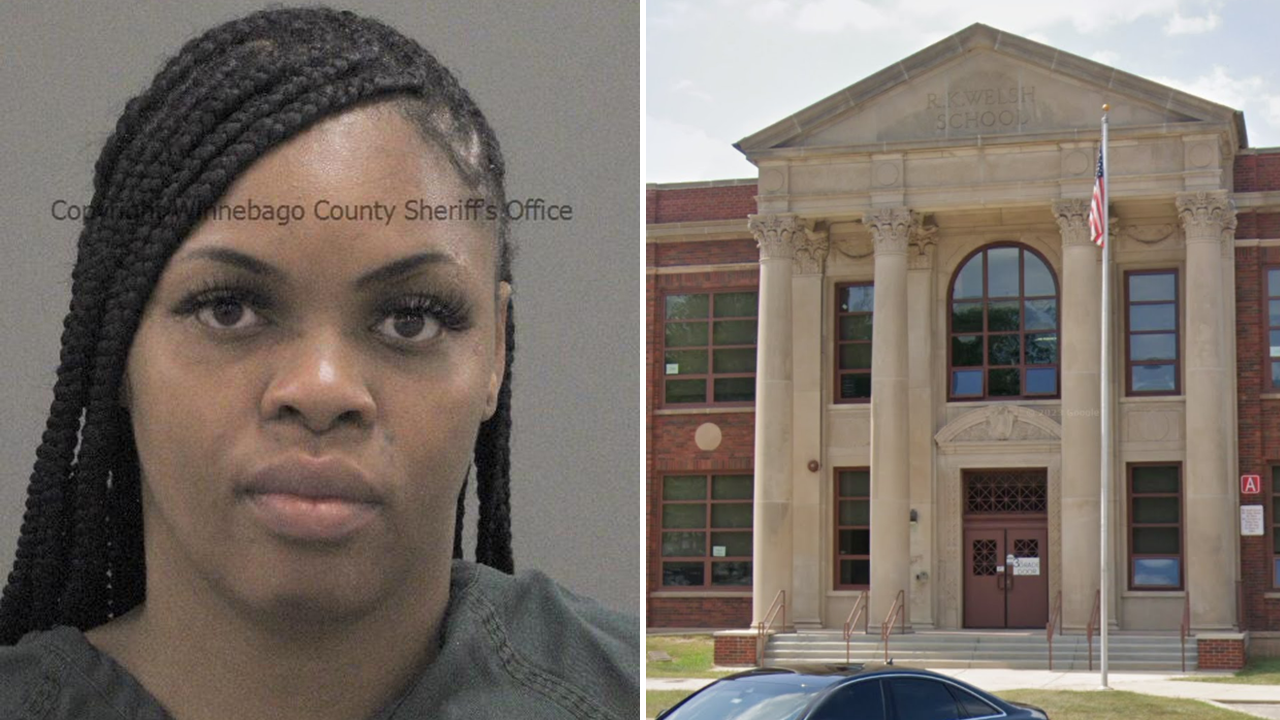
The incident involving Shakeda Barfield happened on Wednesday morning at Welsh Elementary School in Rockford, according to WIFR.  

The station, citing police, says Barfield was at the school for a meeting with the principal when she allegedly dropped baggies of suspected cocaine. When the principal picked the baggies up, Barfield reportedly became upset when she was told that police would be called to the scene. 

The 33-year-old is accused of punching the principal several times in the face, scratching his face and arms, biting him and using his tie to strangle him, WIFR reports. 

UNIVERSITIES OF WISCONSIN INTRODUCE POLICY REQUIRING COLLEGE LEADERS TO STAY NEUTRAL ON CONTROVERSIAL ISSUES 

Advertisement

Shakeda Barfield has been arrested following the alleged fight at Welsh Elementary School on Wednesday, Sept. 11. (Winnebago County Sheriff’s Office)

She is now facing charges including possession of a controlled substance, aggravated battery to a school employee and disorderly conduct, according to media reports.  

As of Saturday, Barfield is being held without bond at the Winnebago County Jail, records show. 

NEBRASKA MAN WHO POSED AS HIGH SCHOOLER AND COMMITTED SEX CRIMES IS DESCRIBED AS ‘PREDATOR OF THE WORST KIND’ 

Welsh Elementary School is located in Rockford, Ill., a city west of Chicago. (Google Maps)

Advertisement

It’s not immediately clear what the meeting was about. 

As the brawl was unfolding, the school was temporarily placed on lockdown, according to WIFR. 

The principal reportedly suffered non-life-threatening injuries during the incident. 

Barfield is being held at the Winnebago County Jail. (Winnebago County Sheriff’s Office)


Advertisement

The Winnebago County Sheriff’s Office did not immediately respond to a request for comment Saturday by Fox News Digital. 

Read the full article from Here

Advertisement
Continue Reading
Click to comment

Leave a Reply

Your email address will not be published. Required fields are marked *

This site uses Akismet to reduce spam. Learn how your comment data is processed.

Milwaukee, WI

Snow, icy road conditions prompt winter weather advisory Jan. 14 for the Milwaukee area

Published

on

Snow, icy road conditions prompt winter weather advisory Jan. 14 for the Milwaukee area


play

A steep drop in temperatures overnight and snow has caused icy road conditions for much of southeastern Wisconsin for the morning commute Wednesday, Jan. 14.

The National Weather Service issued a winter weather advisory Jan. 14 across most of southern and southeast Wisconsin, as far north as Sheboygan County in the east and Sauk and Adams counties in the west. The advisory remains in effect until 10 a.m.

Advertisement

Cameron Miller, a meteorologist with the National Weather Service in Milwaukee/Sullivan, said there have been multiple reports of accidents around the area.

“It was kind of a perfect storm, honestly. The combination of the snow that we had in the roads, warm pavement temperature and then air temperatures quickly falling from the 30s into the low 20s, basically caused conditions that were conducive to icing on the road,” he said.

The Wisconsin Department of Transportation’s traveler information website, 511wi.gov, showed several reports of accidents in Milwaukee and surrounding areas as of 8 a.m. Jan. 14.

The snow should let up around mid-morning, Miller said. Snow accumulation in the Milwaukee area Wednesday, Jan. 14 is not expected to be more than a few tenths of an inch – just a dusting, Miller said.

Advertisement

Another round of snow is forecast to move in the night of Thursday, Jan. 15, and continue through Saturday, Jan. 17.

“It’s going to be a long-duration snow event. So it’s going to be basically white snow throughout that entire time, and really only going to be a couple of inches of accumulation,” Miller said.

Miller said the precipitation later in the week will likely not bring any more winter weather advisories. Icing should be less of a problem, as temperatures are expected to stay below freezing in the coming days.

Wisconsin weather radar

Contact Kelli Arseneau at (920) 213-3721 or karseneau@gannett.com. Follow her on X at @ArseneauKelli.

Advertisement


Source link

Continue Reading

Minneapolis, MN

Minneapolis live updates: ICE protesters face tear gas as Trump administration promises tough response

Published

on

Minneapolis live updates: ICE protesters face tear gas as Trump administration promises tough response


From high school students to elected officials, residents in Minnesota are pushing back against the growing deployment of federal immigration officers in their neighborhoods, leading to days of confrontations and protests.

Resident Neph Sudduth stopped to choke back tears as she witnessed immigration officers roaming around her neighborhood, just a few blocks from the site where an ICE officer fatally shot Renee Nicole Good last week, and clashing with protesters.

Advertisement

“They will hurt you for real! They will hurt you for real!” she shouted at anti-ICE demonstrators, urging them to move away from the officers’ vehicles. Just then, an immigration officer rolled down his window, extended his arm and sprayed a protester point-blank in the face with a chemical agent.

Federal agents use pepper spray against a protester Sunday in Minneapolis. Kerem Yucel / AFP via Getty Images

Advertisement

Read the full story here.


Source link

Continue Reading

Indianapolis, IN

Slew of bills could tighten state’s grip on Indianapolis law enforcement

Published

on

Slew of bills could tighten state’s grip on Indianapolis law enforcement


play

  • While Republican lawmakers tighten their grip on local policing, critics say they could further erode trust between police and communities.
  • One proposal would give some National Guard members full authority to police cities and make arrests during emergencies.
  • Other bills target county prosecutors and hot-button issues like civilian-led police oversight boards and homelessness.

From granting some Indiana National Guard members full policing power to creating a state-appointed special prosecutor to oversee part of downtown Indianapolis, Republican lawmakers are proposing changes that would tighten the state’s grip on law enforcement in the capital city and beyond.

Multiple bills filed this legislative session aim to impose the Indiana General Assembly’s will on local governments like Indianapolis that Republicans perceive to be too lax on crime. Major changes would allow elected county prosecutors to be impeached and grant a governor-appointed special prosecutor authority over Indy’s Mile Square. Subtler proposals would strip power from some civilian-led police oversight boards — a George Floyd–era reform passed by many cities including Indianapolis to increase accountability — and criminalize street homelessness.

Advertisement

Republicans who back such state intervention say that Democrats who run cities like Indianapolis fail to take violent crime as seriously as they should, in favor of more progressive stances on criminal justice issues.

“Their ‘reform’ agenda has meant weaker enforcement, dangerous plea deals and fewer consequences for repeat offenders,” State Rep. Andrew Ireland, R-Indianapolis, said of Indianapolis elected officials ahead of the 2026 session. “The result is predictable: Indianapolis families live in fear while violent criminals walk free.”

Critics say that collectively, the bills align with a recurrent problem: state leaders trying to intervene in cities to score political wins rather than to improve communities. If passed, they say the policies could undermine law enforcement agencies that report to local elected officials and can be readily held accountable, unlike forces sent in by the governor.

“I don’t like the anti-democratic — and that’s with a small d — I don’t like the anti-democratic tendencies of this legislation,” Mark Russell, director of advocacy for the Indianapolis Urban League, told IndyStar.

Advertisement

Giving some National Guard members full police powers

One such proposal that’s moving forward, House Bill 1343, would give select National Guard members full authority to police cities and make arrests during emergencies declared by the Indiana governor. Indiana law currently limits guardsmen’s ability to make arrests to specific situations, like when participants in an “unlawful assembly” refuse to leave.

The goal is to ensure guardsmen are ready to support local law enforcement during extreme situations such as riots or terrorist attacks like the 2013 Boston Marathon bombing, Indiana National Guard Adjutant General Larry Muennich said during a Jan. 8 hearing on the bill. Guard spokeswoman Lauren Houck previously told IndyStar that the legislation was partially inspired by periods of “civil unrest, similar to what occurred in Indianapolis and Louisville during the 2020 pandemic” in the wake of Floyd’s killing by Minneapolis police.

The enhanced policing power would apply to roughly 500 military police who make up less than 5% of the total force of Indiana’s guardsmen, Muennich said. Military police, who already do training on topics like managing civil disturbances and use of force, will be required to do an abridged version of Indiana law enforcement training as part of this change, he said.

“What this is is a tool in our toolkit,” Muennich told the House Veterans and Public Affairs Committee. “It allows us the capabilities when we need those capabilities the most, and it allows us to do it quickly and it allows us to do it responsibly. Because if I can do it now and I can set those authorities now … I don’t have to worry about it when I’m needed.”

Advertisement

The bill moved forward with a 9-3 committee vote, mostly along party lines, and must still be voted on by the full state House and Senate. Indiana Gov. Mike Braun supports the change because “law enforcement deserves every tool and partners they need to keep Hoosiers safe,” he previously told IndyStar.

But multiple Democrats objected to the broad authority this policy would grant the governor to decide when an emergency warrants military police’s involvement. Indiana law allows the governor to summon the guard to active duty for reasons including invasions, public disasters, breach of the peace and, most sweepingly, “any other time the governor considers necessary.”

Amid President Donald Trump’s controversial National Guard deployments nationwide, critics worry a governor could abuse this power in the name of being tough on crime, potentially setting off dangerous encounters with residents. In Tennessee, for instance, where the Republican governor deployed guardsmen to Democrat-ruled Memphis to fight crime, a judge later ruled that crime rates there did not warrant an emergency response under the state’s constitution.

“It’s so subjective: What does [the governor] find to be an emergency for which he could call up the Guard? Even though violent crime has fallen precipitously in Indianapolis, for political reasons, does he think the state of public safety in Indianapolis constitutes an emergency?” State Rep. Mitch Gore, an Indianapolis Democrat and captain at the Marion County Sheriff’s Office who voted against the bill, told IndyStar.

Gore and other critics also said that National Guard members haven’t worked to build community trust the way that local police departments have. In diverse cities like Indianapolis, residents are likely to feel safer interacting with the Indianapolis Metropolitan Police Department than guardsmen who may not share their experiences and don’t report to local elected officials.

Advertisement

“I think everybody wants to be safe, but there’s also just the respect for rights and individual liberties, even in a chaotic situation such as an emergency or a riot,” said Marshawn Wolley, policy director for the African American Coalition of Indianapolis, an advocacy organization made up of local civic groups. “I think the concern would be whether or not the National Guard would have that same level of both training and understanding of policing expectations in this community or any other community for that matter.”

Other bills target prosecutors, civilian-led police oversight

A handful of other bills aim to reshape aspects of criminal justice in Indianapolis more directly.

The most significant examples target Marion County Prosecutor Ryan Mears, whom Republican critics frequently decry as too lenient on crime. Ireland is pushing a constitutional amendment that would allow the General Assembly to impeach elected judges and prosecutors for “crime, incapacity or negligence.”

Another proposal, Senate Bill 145, would require the governor to appoint a special prosecutor who would have primary authority to prosecute crimes committed in the Mile Square area of downtown Indianapolis, starting in 2027. The bill would also force Indianapolis Mayor Joe Hogsett to form a power-sharing agreement between state police and IMPD, or else cede all control over law enforcement in the special district come 2027.

Advertisement

The bill says the state must step in to combat public safety challenges that “negatively impact tourism and economic development” downtown. The author, State Sen. Michael Young, a Republican who represents parts of Marion and Hancock counties, was not made available for an interview.

Calling the proposal “extreme,” Hogsett spokeswoman Aliya Wishner said “the notion that the state would take over public safety responsibilities downtown is a step too far.” Overall, Indianapolis crime in 2025 fell significantly from the previous year, according to IMPD data, with murders and non-fatal shooting investigations both down about 20%.

Meanwhile, Republican lawmakers are also proposing tweaks on hot-button topics like police reform and homelessness.

Senate Bill 284 would weaken certain civilian-led police oversight boards like one in Indianapolis, making them strictly advisory and stripping away their power to pass binding rules. Senate Bill 285, which will be discussed in committee on Jan. 14, would make street homelessness a misdemeanor punishable with a $500 fine or up to 60 days in jail.

Critics like Wolley worry how such bills could further erode trust between police and vulnerable communities.

Advertisement

“The community has worked hard with IMPD to arrive at a consensus standard on what policing should be,” Wolley said. “I think that’s important for any community, so that they are not being policed but rather being served by the police and actually protected.”

Email Indianapolis City Hall Reporter Jordan Smith at JTSmith@usatodayco.com. Follow him on X @jordantsmith09 and Bluesky @jordanaccidentally.bsky.social.


Source link

Continue Reading
Advertisement

Trending
