Entertainment
The 5 biggest 'Gilmore Girls' revelations from Kelly Bishop's memoir

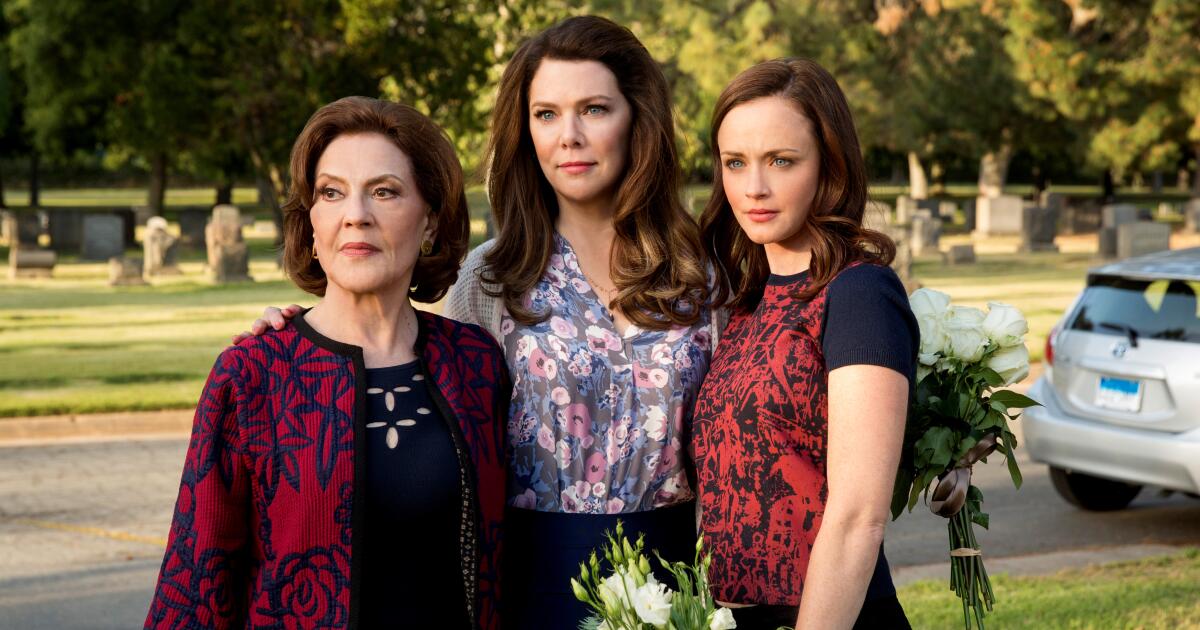
On the Shelf
The Third Gilmore Girl
By Kelly Bishop
Gallery Books: 256 pages, $29
If you buy books linked on our site, The Times may earn a commission from Bookshop.org, whose fees support independent bookstores.
Long before she ever took on the now-iconic role of Emily Gilmore in Amy Sherman-Palladino’s beloved comedy-drama “Gilmore Girls,” Kelly Bishop had a stunning résumé. From the mid-1960s and on, Bishop appeared in numerous Broadway shows, earning a Tony Award for her performance as Sheila in the first iteration of “A Chorus Line.” In the ’80s, she appeared as Frances “Baby” Houseman’s mother in “Dirty Dancing” and in subsequent years lit up daytime television on “One Life to Live” and “All My Children.”
For all her career highs, however, Bishop likely will remain best known for her cutting and complex performance as the moneyed New England matriarch in “Gilmore Girls” from 2000 to 2007 — a period she chronicles beautifully in her new memoir, “The Third Gilmore Girl.”
In candid and down-to-earth prose, Bishop, 80, looks back at her early years as a trained ballet dancer, moving to New York and entering the Broadway scene (then under her birth name Carole Bishop), auditioning for Woody Allen’s one-act play “Central Park West,” transitioning to film in Paul Mazursky’s 1978 Oscar-nominated drama “An Unmarried Woman” and meeting Sherman-Palladino, with whom she continued to work on “Bunheads” and “The Marvelous Mrs. Maisel.”
“There was no pretense about [Sherman-Palladino], no slickness, no political glad-handing or equivocating,” Bishop writes in her book. “Just a woman who knew the value of her work and the quality of her project and was crystal clear on how it should be done.”
Here are a few more “Gilmore”-themed revelations from Bishop’s memoir — out now.
Sorry, Jess and Dean fans — Bishop is Team Logan
For as long as “Gilmore Girls” has been a part of the cultural conversation, viewers have been split over which of Rory Gilmore’s (Alexis Bledel) beaus was the best — an argument that extended into Netflix’s 2016 “Gilmore Girls” revival. Typically, the fight boils down to Team Jess (Milo Ventimiglia), an emotionally avoidant but well-read “bad boy” who becomes a self-actualized published author, and Logan Huntzberger (Matt Czuchry), Rory’s classmate at Yale who is being groomed to take over the family publishing empire. Then there’s Dean (Jared Padalecki), Rory’s first boyfriend, who is kind, stable and communicative but periodically acts threatened by Rory’s Ivy League aspirations. Not to mention he cheats on his wife with Rory.
“I was always Team Logan,” Bishop writes in her memoir. “All the young actors on ‘Gilmore Girls’ were terrific, on- and off-screen, but while several of them seemed boyish, Logan took a more manly approach that I thought worked perfectly as a partner for Rory.”
As for Lorelai’s romance arc, Bishop is Team Luke
Fans also have squabbled over the question of which love interest was best for Lorelai Gilmore (Lauren Graham), who started the series dating one of Rory’s prep school teachers, Max Medina (Scott Cohen). Later, she pinballs between Rory’s unreliable yet charming father, Christopher (David Sutcliffe), and Luke (Scott Patterson), the local diner owner with a gruff exterior and unextinguishable torch for Lorelai.
“I was definitely Team Luke,” Bishop says. “It wasn’t just that Luke genuinely loved her. He also understood that he was dealing with a very quirky, specific woman, and he ‘got’ her. I loved watching them together.”
Bishop’s favorite Emily insult was aimed at Logan’s mom
One of Emily’s defining characteristics was her seemingly endless supply of scathing insults. Though the bulk of Emily’s barbs were reserved for her mother-in-law, husband and daughter, in the Season 6 episode “We’ve Got Magic to Do,” she unleashed in grand fashion on Logan’s mother, Shira (Leann Hunley), upon learning that the Huntzbergers told Rory she wasn’t “properly bred” to date Logan.
Bishop writes: “I kept a smile on Emily’s face so that, from a distance, it could have appeared that she was complimenting Shira on her dress and asking who designed it, while she was actually delivering lines like, ‘You were a two-bit gold digger fresh off the bus from Hicksville when you met [Logan’s father] Mitchum at whatever bar you stumbled into. … Now, enjoy the event.’
“It was an absolute masterpiece by Amy and a joy to deliver, not only because it was Emily at her force-of-nature best but also because it was another display of her fierce love for her granddaughter.”
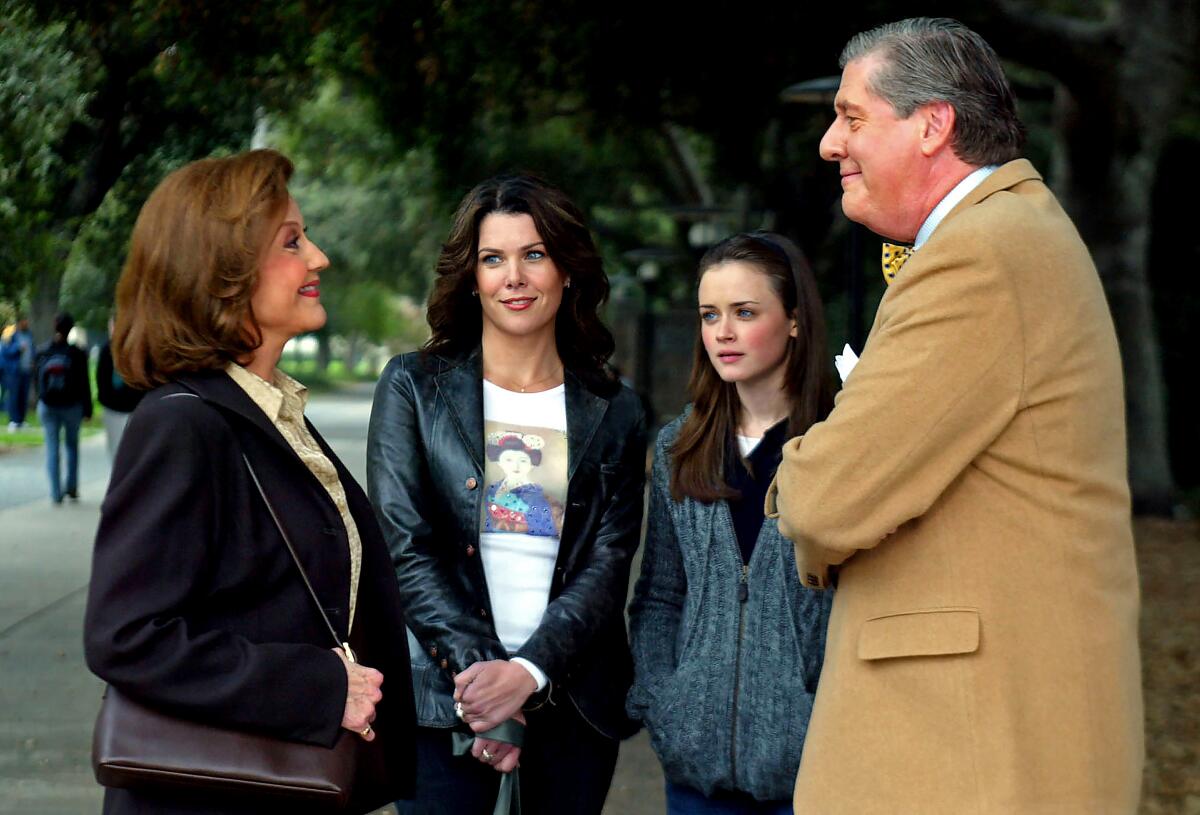
Kelly Bishop as Emily, left, Lauren Graham as Lorelai, Alexis Bledel as Rory and Edward Herrmann as Richard in a scene from the WB’s “Gilmore Girls” in 2002.
(Mitchell Haddad / The WB)
Bishop didn’t like the final season of ‘Gilmore Girls’
Very few “Gilmore Girls” fans think highly of its seventh and final season, which ran from 2006 to 2007. Due to a breakdown in contract negotiations, Amy and husband/co-writer/producer Dan Palladino exited the show after Season 6. Though Warner Bros. brought in a new writing team, Bishop recalls that “Gilmore Girls” “seemed to get kind of sleepy and tired from one week to the next, as if the air was being slowly let out of a big, sparkly balloon, and we could sense that the party might be ending, even though no one wanted to say it out loud.”
Bishop also says, “To the best of my knowledge, Amy still hasn’t watched a single episode of [Season 7].”
She did, however, love Netflix’s divisive ‘A Year in the Life’
When “Gilmore Girls” hit Netflix in 2014, it experienced an extraordinary bump in popularity. “Not only did its original viewers jump right in to enjoy it all over again, but whole new generations were introduced to it and fell in love with it too,” Bishop recalls.
The renewed interest led to a 15-year reunion panel at the ATX TV Festival in 2015 and, one year later, a Netflix revival. Though the four-episode “A Year in the Life” brought the Palladinos back, reception was decidedly mixed. Critics overall favored the miniseries, but fans “were frustrated by the loose ends they felt they were left with,” as Bishop writes.
One of those loose ends was Rory’s infamous “last four words” to Lorelai: “Mom?” “Yeah?” “I’m pregnant.” Cut to black.
“Those mysterious ‘last four words’ … struck me as more interesting than infuriating, since it opened debates among viewers to decide who Rory was pregnant by, and what the repercussions would be. I personally think it was Logan, by the way.”


Film Reviews
Soy Frankelda
Director: Arturo Ambriz, Roy Ambriz
Cinema Fantasma, Netflix
Streaming on Netflix: 06.12.2026
People have given their diatribes and waxed poetic about the dread of AI in creative fields. The ever-increasing push to implement it into our lives is disheartening to say the least, but even more so, it kills a piece of our soul by encouraging us to replace imagination and artistry with prompts.Why go through all the time and effort of bringing your vision to life when a program can do it in less than a fraction of a second? It disconnects us from the aspects that enrich our inner worlds. Still, people are fighting back by showcasing their creativity. Soy Frankelda is one such ode to human capability and imagination.
The film takes place between our world in 1866 Montevideo, México, and the parallel dream world of Topus Terrenus, where fantastical creatures reside and feed upon our fears. Francisca Imelda, aka Frankelda (Mireya Mendoza), is an aspiring horror writer. Unbeknownst to her, her writing exists and affects Topus Terrenus. However, the parallel dimension is deteriorating due to a lack of fear in the human world. Enamoured by her writing, Prince Herneval (Arturo Mercado Jr.) invites Frankelda to his world in the hopes that she can become the new nightmare-teller and reinvigorate fear in humans through hert stories. This does not go well with the current nightmare-teller, Procustes (Luis Leonardo Suarez), who plots to overthrow the royal family and establish himself as the new ruler of Topus Terrenus by stealing Frankelda’s work and passing it off as his own. What ensues is a dazzling musical journey of stop -motion charm and spooks.
To be honest, I am very biased when it comes to talking about this movie. Animation, to me, has always been one of the most versatile and passion-driven mediums for storytelling, so of course I hold it in such high regard. However, Mexican animation has never truly taken the main stage. Sure, there are American-based animated projects that center Mexican narratives like Coco and The Book of Life, but it wouldn’t be a stretch to say that Mexico’s animation industry has been precariously held up by the Huevos franchise and the Leyendas series. While both these series have their merits (I love to rewatch many of the Leyenda movies around Halloween), neither captures a sense of grandeur or is as engaging as Soy Frankelda. Furthermore, I can’t help but feel a sense of pride in knowing that this is the very first stop -motion project produced entirely in Mexico.
To say Soy Frankelda is a work of art would be an understatement. The character models are incredibly detailed and unique, and the settings which they inhabit are ornate and depict a grand sense of scale. The film also isn’t afraid to dip into mixed media. In moments where the characters’ emotions are heightened, other mediums like oil painting or charcoal are used. The film is also acutely aware of its limitations and finds creative workarounds. These little decisions give the film a sense of earnestness and not only bring liveliness to the world, but also tangibility. Guillermo Del Toro was the directors’ mentor during the production of this film and his fingerprints can be seen throughout. The level of craftsmanship is akin to the work he does with all his creature designs. Still, it’s obvious that the stop -motion in this film hasn’t reached the same level of smoothness as a Laika production, but the roughness and jerkiness of the movements remind you that human hands worked on it and there is a charm to that.
The film’s worldbuilding is also noteworthy, blending fantastical and macabre elements to create a landscape that is equal parts whimsical and spooky. It feels like a true successor to the art style of The Nightmare Before Christmas, just with more color and a variety of textures. The lore is also presented intentionally and connects to the theme of fiction being as real as reality. It all hinges on the sentiment that our ideas have life and that as long as we keep creating, the world will continue to be filled with inspiration and therefore beget more creation. Soy Frankelda encourages the act of creating, the idea that we live to create and to create is to live.
While I have a deep appreciation for this film, it is far from perfect. Namely, the narrative is lacking at some points, especially when it comes to the interpersonal conflict at the climax of the story hinged on a miscommunication. It’s disappointing, to say the least, that a story with this much thought and effort in the presentation of the film would falter when it comes to the script. This also bleeds into the film feeling rather melodramatic at some points. I liken it to watching an animated fantasy telenovela. Frankelda’s extreme emotional shifts are testament to that. Also, while the story does conclude, it still feels unfinished by the end. Obviously this is because Soy Frankelda is actually a prequel movie to Frankelda’s Book of Spooks, an animated anthology series that explores Frankelda’s stories. Nevertheless, the movie still leaves you wanting more.
Soy Frankelda is a landmark film for Mexican animation. In a time when pillars of the industry are encouraging the use of generative AI, it is refreshing to see a film that so succinctly makes a case for human originality and celebrates the art of creating one’s own stories and worlds. —Angela Garcia
Read more film reviews from Angela Garcia below:
Film Review: I Love Boosters
Film Review: You, Me & Tuscany
To help SLUG continue covering upcoming films, consider becoming one of our donors!

Madonna is just a material girl, living in a material world.
The “Vogue” hitmaker graced the cover of Interview magazine for the Summer 2026 issue and in the accompanying chat, the singer revealed the reason the ultra-hyped biopic with “Ozark” star Julia Garner was scrapped: not enough cold hard cash.
Turns out, Universal Studios was not Madonna’s Mr. Right. According to the pop star, the studio didn’t share her vision for a budget for the film.
“I worked on my script for two years and spent two years at Universal Studios with the line producers doing budgeting and casting,” she told the magazine. “We had a falling out, me and Universal, regarding budget because I needed — I’ve had an extraordinary life. I’ve had a huge life, so I needed a big budget. You know what I mean?”
The film had been in the works for years, and in 2021 Universal Pictures won a multi-studio auction to helm the biopic. According to Variety, the script followed Madonna from her upbringing in the suburbs of Detroit, her artistic awakening in 1980s New York City, and concluded around the 1998 release of “Ray of Light.”
“I found a way to make it for less money in Serbia, but I don’t think they were into the idea of — I don’t know,” she said. “Maybe they just didn’t believe in me.”
Madonna said the studio couldn’t wrap its head around what she was suggesting and countered that she wouldn’t “stay in Serbia more than four days.”
“I said, ‘Did you read the script?’ My whole life has been survival. I’m not going there for a holiday.’”
Madonna said that she was in “limbo” when the movie plans fell apart, and she considered telling her life story through a Netflix series when the streamer came knocking. But she wouldn’t be able to use the script she had penned for Universal without buying it from the studio for “an extortionist’s price,” even though she wrote it.
“That’s just the way it goes,” she continued. “I started trying to understand how making a series would work. It’s a very, very different process. You have to meet a lot of writers and find the right showrunner, and I couldn’t find one. This went on for another eight or nine months. I was like, ‘Good thing I have another job because I need to work, I need to create. I need to do what I was put on this earth to do.’”
Representatives for Universal Pictures, Netflix and Garner did not immediately respond to The Times’ request for comment.
Through the process of writing the script, Madonna was bitten by the memoir bug, but she channeled that confessional energy into her forthcoming album, “Confessions on a Dance Floor: Part II,” which drops July 3. A 13-minute music video weaving together six tracks from the new album was released earlier this month and featured A-list cameos by Sabrina Carpenter, Kate Moss, Lourdes Leon, Benedict Cumberbatch and more.
While the biopic and buzz around Garner’s portrayal of the “Like a Virgin” star had fans of the two blondes chomping at the bit, all is not lost: Art captures life. Garner and Madonna were spotted filming scenes in Venice two weeks ago for the second season of “The Studio,” in which Madonna plays herself struggling to get her biopic made.

Mr. Reset and The Society of Turnbuckle and Bone is a gripping sci fi horror/comedy featuring Vinny Pacifico, who is an ex-Ring of Honor Wrestler. What’s it about? What did we think about it? Read on for our spoiler free review!
But first? Take a look at the trailer!
Synopsis
Former Ring of Honor talent Vinny Pacifico stars as a rising indie wrestler lured by the promise of fame and fortune into a dark world of intense trials and sacrifice.
Rob Ryzin (ex-AEW), Bobby Fish (ex-NXT), Nick “Percy Watson” McNeil (ex-NXT), and Nick “Jamie Stanley” Stuible also star alongside writer-director Jedi Koszewski.
From The Press Release
The spectacle of professional wrestling grapples with psychological dread in Mr. Reset and The Society of Turnbuckle & Bone.
Full of gauzy, gorgeous imagery, a kaleidoscope palette, and themes that blend science fiction, body horror, and dark comedy, the surreal horror film explores a secret society that manipulates the wrestling industry from behind the scenes under the enigmatic Mr. Reset’s watchful eye.
Produced by Audacity Complex Studios, the film strips away the glitz of sports entertainment to reveal its psychological toll, while never shying away from the darkly comic moments that lurk in the industry’s shadows.
“This project holds special meaning for me because it brings together two of my greatest passions: horror and professional wrestling,” Pacifico commented. “Through this story, I’ve had the privilege of exploring authentic experiences within a fictional framework and shedding light on growing up in the entertainment industry.”
Here’s a look at the poster art!
My Thoughts
If you like movies that have a horror/conspiracy feel to them with a hint of creepy, this is the movie for you. The cast did a phenomenal job, and the storytelling was spot on. It also had a touch of breaking the 4th wall in there. This is a great film with a lot of drama, horror, and bad decisions. I will give a PSA to anyone who is sensitive to lights as it switches back and forth a lot. I like the news element to the movie and how it goes from 1st person to 4th person.
Final Thoughts
I wouldn’t recommend this movie to anyone under 13 because of the nature of the film and the tricks it can play on your mind. Also, it has body horror which younger viewers might not be able to handle. The gore and the trauma in the movie play on your mind and is not for the faint of heart. Excellent storytelling and the director did a phenomenal job. I highly recommend this B-list movie with a 9/10 for me based on the bizarreness of it and the great storytelling. Sometimes you need a reset.
Mr. Reset and The Society of Turnbuckle and Bone on VOD now!
-

 Los Angeles, Ca1 hour ago
‘What’s going on with our society?’ Elderly L.A. street vendor violently beaten
-

 Detroit, MI2 hours ago
Trailblaze Detroit: Blazing New Trails while Backpacking Metro Detroit | Visit Detroit | Visit Detroit
-

 San Francisco, CA2 hours ago
Giants open to moving big names before Trade Deadline
-

 Dallas, TX2 hours ago
Reports: Mavericks acquire Sergio De Larrea in four-team Draft night trade
-

 Miami, FL2 hours ago
Miami Gardens police make arrest in cold case murder from 2019
-

 Boston, MA2 hours ago
Woman killed in Mattapan carjacking crash honored at vigil
-

 Denver, CO2 hours ago
Nuggets trade 26th pick in NBA Draft to Spurs, moving out of first round
-

 Seattle, WA2 hours ago
NBA Commissioner says Las Vegas, Seattle remain expansion targets for 2028-29 season

