News
In Portland, thousands gather to marvel at migrating birds’ nighttime routine


Thousands of Vaux’s Swifts gather overhead as they prepare to roost for the night at Chapaman Elementary in Portland, Oregon. During the month of September, migrating swifts often use chimneys as roosts and are likely to return to the same roost year after year.
Celeste Noche/for NPR
hide caption
toggle caption
Celeste Noche/for NPR
The Vaux’s Swift is a tiny bird – some people call it “a cigar with wings.” But every fall these little birds make a big trip, from summer breeding grounds in the Pacific Northwest down to their winter home in Central and South America. Along the way, many of them roost as a big flock in chimneys up and down the west coast. And their murmurations in the air – and simultaneously dive together into chimneys – are so spectacular that they draw crowds.
There have been watch parties in Los Angeles, and Eugene – and in Portland the past couple weeks, crowds turned out night after night to see these little birds go to bed. It’s part of an annual tradition known locally as “Swift Watch.”
A bird that doesn’t perch

Spectators see the first sighting of Vaux’s swifts for the evening at Chapman Elementary in Portland, Oregon on September 8, 2024.
Celeste Noche/for NPR
hide caption
toggle caption
Celeste Noche/for NPR
Vaux’s swifts are about the size of a sparrow, but their closest relatives are actually hummingbirds.
“They’re so aerodynamic, and they have these swept-back wings — kind of like these fancy military jets,” says Joe Leibezeit, the assistant conservation director at Bird Alliance of Oregon.
These sleek birds do everything on the wing — eating, drinking, even mating. And, says Liebezeit, they’ve adapted to staying in the air. They’re not known to walk, hop or perch on a branch. “They’re a different kind of bird than a perching bird,” explains Liebezeit. “They don’t have the same muscle structure to do what a songbird does, to securely land on the branch and grab onto it.”
The only time they stop flying is at night when they roost. During the summer, swifts sleep in their own nests in small, residential chimneys, or the occasional hollow tree. But during the fall migration they form flocks of thousands, and huddle up in bigger smokestacks to share body heat.

Crowds gather to see migrating Vaux’s swifts roosting in the chimney at Chapman Elementary in Portland, Oregon.
Celeste Noche/for NPR
hide caption
toggle caption
Celeste Noche/for NPR

Georgiana Cassell’s Vaux’s Swifts memorabilia in Portland, Oregon.
Celeste Noche/for NPR
hide caption
toggle caption
Celeste Noche/for NPR
While their sharp little toes aren’t great for wrapping around a branch, they’re perfect for clinging to the rough stone of a chimney. And they have even developed little barbs on their short, stubby tails to help. “Kind of like a tripod,” laughs Liebezeit.
Chain of chimneys
Historically as they migrated, Vaux’s Swifts would roost in hollow trees. But Larry Schwitters – a retired science teacher who runs a website called Vaux Happening – says they have come to prefer chimneys, because the masonry soaks up the heat of the day.
“The swifts are not good at insulating themselves,” explains Schwitters. “So they press themselves against the bricks that are releasing heat. And it can be as much as 25 degrees warmer inside a chimney.”
On the Vaux Happening website, Schwitters gathers swift counts from bird groups and citizen scientists up and down the west coast. All together, it’s tens of thousands of birds, roosting at about a dozen major sites, about a day’s flight apart.

The Bird Alliance of Oregon has a volunteer information table at Chapman Elementary for visitors coming to watch Vaux’s swifts roosting in Portland, Oregon.
Celeste Noche/for NPR
hide caption
toggle caption
Celeste Noche/for NPR

Hester Van Heemstra watches Vaux’s swifts swirl in the sky at Chapman Elementary in Portland, Oregon.
Celeste Noche/for NPR
hide caption
toggle caption
Celeste Noche/for NPR
Once the swifts get to a site, they’ll stay and feed for a day or two before moving on to the next one, says Joe Liebezeit.
“They’re gathering energy, they’re gathering fat stores on their body because they have to migrate hundreds of miles to the next stopover point.”
Although humans have provided these cozy brick hotels for the swifts, it hasn’t always been a seamless relationship. Some of the old smokestacks have been torn down because of development. Some old chimneys have been capped, because people don’t want to deal with the birds (or their poop). And newer chimneys have metal liners, which the birds can’t cling to.
Flocks of birds, flocks of people

The birds’ murmuration in the air, and simultaneous dive into the chimney, attracts onlookers every year in Portland, Oregon.
Celeste Noche/for NPR
hide caption
toggle caption
Celeste Noche/for NPR
In Portland, a chimney at Chapman Elementary School has hosted a flock of swifts since the 1980s. The Portland swift count tends to peak in mid-September – this year, the first birds were counted August 26th, and the most birds were counted September 2nd (over 5,000).
When it’s swift time, Portlanders grab picnic blankets and lawn chairs, and stake out swift-watching sites on the lawn surrounding the school. Groups share takeout and potluck picnics, while kids slide down the hill on sheets of cardboard.

The tradition is known in Portland as “Swift Watch,” and people turn out for days on end with friends, food, and pets to cheer on the birds.
Celeste Noche/for NPR
hide caption
toggle caption
Celeste Noche/for NPR
“This is a very Portland thing, that there’s hundreds of people gathered on a school lawn to watch birds fly into a chimney,” jokes Jeremy Lui, as he settles in to watch. (That night Bird Alliance of Oregon counted 1,500 people there.)
About an hour before sunset, the birds begin to gather in the sky, and the crowd gasps and claps as the formation swirls around.
Suzi Asmus, who is out celebrating her birthday, says “I love when everybody starts oohing and aahing together – it just feels like a community event.”
Asmus is one of five people out celebrating a birthday on this particular September night. But really, everyone seems to be having a party. People are running into friends, sharing pizza with strangers, complimenting dogs and babies.

Georgiana Cassell drove down from Seattle with friends to watch Vaux’s Swifts roosting at Chapman Elementary in Portland, Oregon.
Celeste Noche/for NPR
hide caption
toggle caption
Celeste Noche/for NPR

Kids slide down a grassy hill on scraps of cardboard while waiting for the Vaux’s Swifts to gather at sunset in Portland, Oregon.
Celeste Noche/for NPR
hide caption
toggle caption
Celeste Noche/for NPR
“The vibes, the family-centricness of it all is really sweet,” says Dylan Winkler. “That people just come and sit on a hill for hours to watch birds is so wholesome.”
But this wholesome night is not without its drama. At one point, a juvenile Cooper’s Hawk flies up to perch on the chimney, aiming to pick off a meal from the flock. The crowd collectively boos as the hawk grabs his prey. Cameron Trost, a volunteer with Bird Alliance of Oregon, isn’t one of them. He says the hawk “is indigenous to the area, so we support his efforts.”
A short time after sunset, the flock’s circles start dipping closer and closer to the chimney, their loose swirl starts to funnel, and the excitement of the crowd picks up. The amount of time it takes for the swifts to actually enter the chimney can vary – depending on the size of the flock, whether they’re interrupted by a hawk, and if they do it all in one pass. But on this night, the flock of about two thousand birds pours into the chimney continuously in the space of about a minute. It’s like a magic trick. And the crowd cheers.

At sunset, Portlanders watch migrating Vaux’s swifts as they prepare to roost in the Chapman Elementary chimney in Portland, Oregon.
Celeste Noche/for NPR
hide caption
toggle caption
Celeste Noche/for NPR

According to Vaux Happening, tens of thousands of birds roost at about a dozen major sites up and down the west coast, about a day’s flight apart.
Celeste Noche/for NPR
hide caption
toggle caption
Celeste Noche/for NPR
“It’s a great connection between people all gathered together on a lawn,” says Joe Liebezeit, “and then this flock of birds that are all kind of in synchronicity, flying in a murmuration… And it’s a cool connection between two species.”

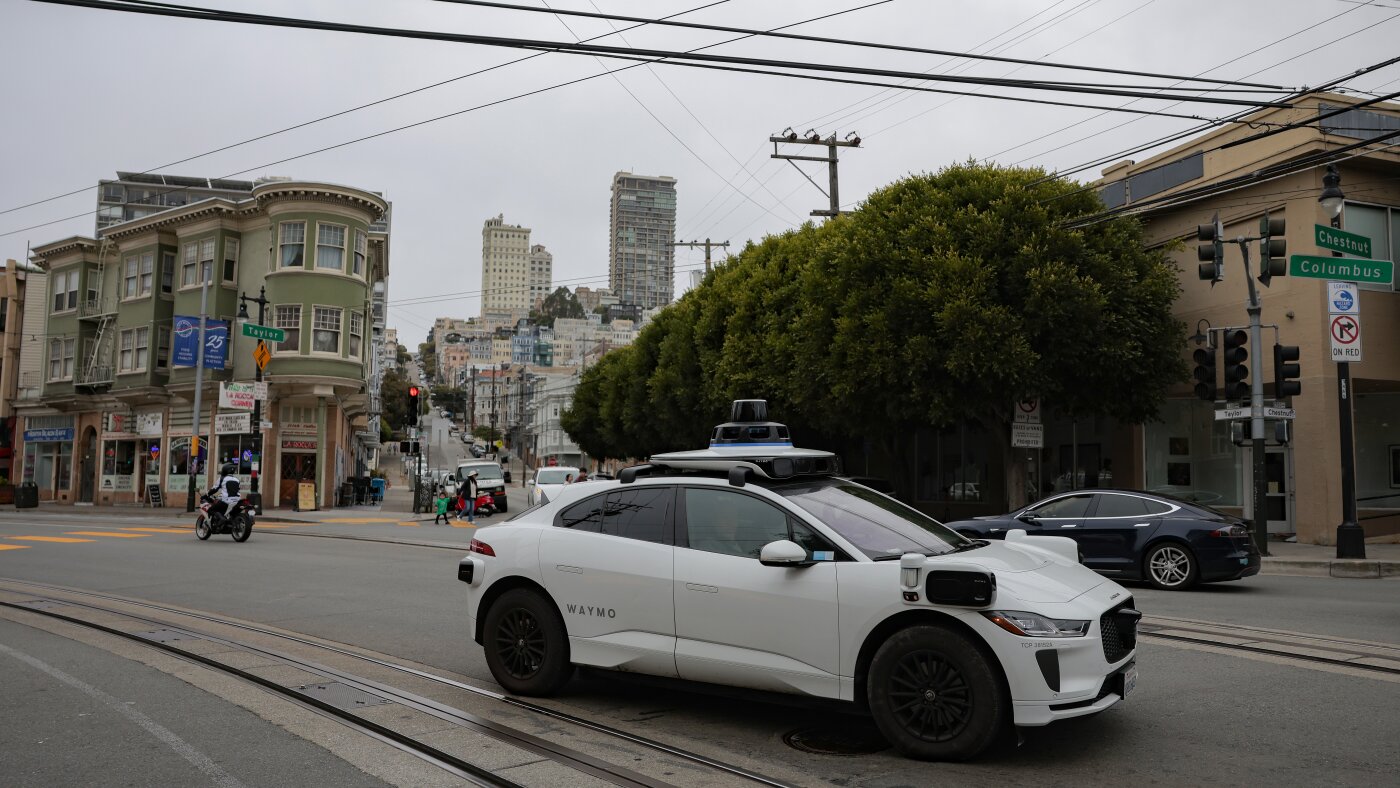
A Waymo robotaxi drives in San Francisco’s North Beach neighborhood this week.
Heather Diehl/Getty Images
hide caption
toggle caption
Heather Diehl/Getty Images
Police in San Mateo, Calif., posted Monday on social media that they had apprehended a pair of teenagers from a Waymo driverless robotaxi after the company alerted authorities to suspected criminal activity. It’s the latest incident involving video surveillance of passengers and others by autonomous vehicles — raising questions about the limits of privacy in such vehicles.

The Facebook post by the San Mateo County Police said: “Parents do you know where your teens are? @waymo does!”
The 15-year-olds were allegedly drinking alcohol and shooting toy guns from the car, according to the police. They said Waymo’s systems detected behavior that then triggered a safety response, after which the company disabled the vehicle and contacted police.
Waymo’s cars, equipped with an array of cameras, microphones and other sensors to monitor passengers and other nearby vehicles, are becoming more common in cities across the United States. Experts say the detention of the two teens in San Mateo highlights a potential — but not inevitable — trade-off between privacy and convenience. It also questions the extent to which companies similar to Waymo are required to hand over private data, including audio and video of passengers, in situations where a crime is suspected.
NPR reached out to Waymo, which is owned by Alphabet, the parent company of Google, for comment on the details of the San Mateo incident and how the company responded, but did not hear back. But on its website, the company says that as many as 29 cameras in its autonomous cars provide an all-around view and “are designed with high dynamic range and thermal stability, to see in both daylight and low-light conditions, and tackle more complex environments.”
“There already exist laws that govern duty to report or even duty to protect” for carriers such as Waymo, according to Alessandro Acquisti, a professor of information technology at the MIT Sloan School of Management. “The privacy problems arise when and if driverless carrier companies used such laws or ethical obligations as a pretext for blanket, indiscriminate accumulation of identifiable data for unspecified future purposes.”
That includes not just monitoring people inside the cars, but outside too. Take, for example, a hit-and-run investigation last year in Los Angeles. Media reported that the police inquiry was aided by video captured by a Waymo taxi that had a clear view of the crime. Critics suggested at the time that authorities were using the company’s vehicles as a mobile surveillance platform. And during 2025 protests in Los Angeles against Immigration and Customs Enforcement crackdowns, demonstrators vandalized Waymos, apparently angry that video recorded by the vehicles could be used by police, although there is no evidence that happened.
In a transparency report, Google says it received nearly 290,000 requests from governments worldwide in the first six months of 2025 for disclosure of user information across all its platforms, including Waymo. The company says that in more than 80% of the requests in those six months, some information was disclosed. “Google carefully reviews each request to make sure it satisfies applicable laws. If a request asks for too much information, we try to narrow it, and in some cases we object to producing any information at all,” the company says.
In an email to NPR, San Mateo Police Department spokesperson Jeanine Luna said that detaining the teens in the Waymo on Monday was “wholly appropriate” under the circumstances. “We received the call of a ‘firearm’ being shot from a moving vehicle,” she said. “Furthermore, the occupants were described as being possibly ‘intoxicated.’” she said.
“Being that the vehicle was disabled (the occupants had every right to exit the vehicle before police arrival, but they did not), a high-risk traffic stop was conducted to ensure the safety of all involved,” Luna added. “They were not arrested and were released to their parents, however, potential charges are still pending dependent on what the video from inside the vehicle shows.”
Autonomous taxis represent an ethical gray area
Robotaxis began to roll out across the U.S. in December 2018, when Waymo launched in Phoenix. These services have been used for less than a decade — so the norms surrounding them aren’t settled, experts agree.
The Facebook post may make Waymo passengers wonder what triggers a police intervention, says Irina Raicu, director of the Internet Ethics program at Santa Clara University. She has used Waymo’s driverless taxis and says ethically, the privacy issues surrounding them sit in a gray area. “There’s something about being in a car without another person that makes you think it’s private.”
“With all these recording devices, we don’t see them, [and] they’re not these obvious things being stuck in our faces,” Raicu adds.
That brings up a key issue: informed consent, Acquisti says.
“It is not clear the extent to which passengers … are reminded that when they step into the car, that they are being monitored, and most likely they are not told in its entirety how the data will be used,” he says.
Bruce Schneier, a cybersecurity and privacy expert and professor at the Munk School at the University of Toronto, believes that Waymo does have a compelling interest in protecting its vehicles. He compares monitoring a robotaxi via cameras to a human taxi driver keeping an eye on passengers in the rearview mirror.
“Maybe the driverless car comes back … and it has all of its cushions slashed, and it’s like, ‘Who the hell did that? Let’s go and look at the tape,’” Schneier suggests. “You can’t have sex in the back of a taxi, right? Someone would say, ‘Stop it.’”
He concludes that some supervision makes sense. In an Uber rideshare, he notes, “most of the time there’s a camera recording the back seat.” (Uber says on its website that it allows drivers to install such cameras for the purpose of “fulfilling transportation services.”)

Waymo robotaxis, while a fairly common sight in the San Francisco Bay Area, are still a novelty in much of the country. And many people are hesitant to ride in one, according to a Pew Research Center poll published this month. The survey found that only 5% of Americans had ever ridden in a driverless car. Meanwhile, 71% of those polled said they would feel uncomfortable in one, with only 7% saying they would be “extremely or very comfortable” riding in one.
For that reason, experts who spoke with NPR said they were optimistic that it’s not too late to shift gears on privacy norms and policies surrounding these vehicles.
Acquisti doesn’t see why privacy measures can’t be built into driverless vehicles.
“I would immediately challenge the notion that people have to be monitored,” he says, noting that privacy-preserving technologies exist and can be installed.
“Driverless cars are coming, but they don’t have to come in this particular incarnation,” Raicu says. “They’re still being designed and redesigned. It’s early days.”

Donald Trump has terminated the remaining members of the independent, federal commission that assists election administration officials nationwide just a few months before the midterm elections, multiple outlets reported Thursday.
The remaining three commissioners of the four-member bipartisan commission were forced out on Thursday in different ways. The one Republican appointee resigned and the other two, Democratic appointees were notified of their terminations via email from the White House presidential personnel office.
“On behalf of President Donald J Trump, I am writing to inform you that your position as Commissioner of the Election Assistance Commission is terminated, effective immediately. Thank you for your service,” the email, seen by Reuters, said.
The White House did not immediately respond to a request for comment.
The Election Assistance Commission serves as a “national clearinghouse of information on election administration”, accredits testing laboratories and certifies voting systems, and maintains the national mail-voter registration form developed by the National Voter Registration Act of 1993, according to the commission’s website. The terminations follow Trump and top administration officials’ advocacy to change vote-by-mail requirements and investigations into the 2020 election outcome, which Trump lost to Democrat Joe Biden.
“It is irresponsible and dangerous that this Administration remains dead set on causing chaos for our election officials across this country,” Arizona secretary of state Adrian Fontes said in a Thursday statement. “This move undermines the integrity of nonpartisan election administration.”
The 2002 law that established the commission, the Help America Vote Act, states the president can appoint replacements to the commission.
It is unclear how Trump will move ahead with the commission.
Reuters contributed reporting

Former U.S. Olympian David Hearn (left) walks with his attorney Norman Eisen to speak to reporters and protesters gathered after his arraignment at the Superior Court of the District of Columbia in Washington, D.C. on Thursday.
Finn Gomez/Getty Images
hide caption
toggle caption
Finn Gomez/Getty Images
Former U.S. Olympic canoeist David Hearn pleaded not guilty to damaging the Lincoln Memorial Reflecting Pool in D.C. Superior Court Thursday morning.
Federal prosecutors charged Hearn with a single count of destruction of property causing more than $1,000 in damage to the pool.

Hearn has previously claimed, which his attorneys repeated during a short press conference outside the court, that he simply touched the water in the pool out of curiosity.
The Trump administration had just completed a $14 million renovation of the pool.
But shortly after the work finished, peeling paint and algae gathered in the water. The remodel has been largely criticized as a massive failure and waste of taxpayer dollars.

Superior Court Judge Carmen McLean released Hearn on his own recognizance. His next hearing is scheduled for Aug. 5.
Norm Eisen, one of Hearn’s attorneys, spoke to reporters outside of court following the hearing. He said the administration is using Hearn as a “scapegoat … for their own failures.”
“It is not a crime to touch the reflecting pool, to touch water in the United States of America,” he said.
Prosecutors say there is a host of evidence against Hearn.
This is a developing story.
-

 Alabama5 minutes ago
Final 2026 MLB mock draft projections for Alabama’s Justin Lebron
-
 Alaska7 minutes ago
Watch My Buddy Matt Not Get Eaten by Bears in Alaska
-

 Arizona13 minutes ago
Roller derby still has a home in Arizona despite myriad obstacles
-

 Arkansas20 minutes ago
Freshman OL Tucker Young never wavered through Arkansas football coaching changes | Whole Hog Sports
-

 California22 minutes ago
Northern California high school graduation shooting suspect arrested in Texas
-

 Colorado28 minutes ago
Colorado to weigh daily hunting limits, ban on fur sales for wildlife hunted for fur
-

 Connecticut35 minutes ago
Woman arrested, accused of murdering man in Farmington in March
-

 Delaware38 minutes ago
Rehab center, denied in Montchanin, buys Fort DuPont site | Exclusive

