Entertainment
The week’s bestselling books, Sept. 15


Hardcover fiction
1. The Life Impossible by Matt Haig (Viking: $30) A retired math teacher comes to terms with her past after she’s gifted a run-down house on a Mediterranean island.
2. Creation Lake by Rachel Kushner (Scribner: $30) A seductive and cunning American woman infiltrates an anarchist collective in France.
3. All Fours by Miranda July (Riverhead Books: $29) A woman upends her domestic life in this irreverent and tender novel.
4. Colored Television by Danzy Senna (Riverhead Books: $29) A novelist in L.A. gets the opportunity to cash in on her biracial background in this sharply funny Hollywood takedown.
5. James by Percival Everett (Doubleday: $28) An action-packed reimagining of “The Adventures of Huckleberry Finn.”
6. Blue Sisters by Coco Mellors (Ballantine Books: $30) Three estranged siblings return to their family home in New York after their beloved sister’s death.
7. Death at the Sign of the Rook by Kate Atkinson (Doubleday: $30) Private eye Jackson Brodie is back in the newest installment of the bestselling mystery series.
8. Long Island Compromise by Taffy Brodesser-Akner (Random House: $30) A social satire on the wild legacy of trauma and inheritance.
9. We’ll Prescribe You a Cat by Syou Ishida, E. Madison Shimoda (Transl.) (Berkley: $25) A bestselling celebration of the healing power of cats.
10. The Women by Kristin Hannah (St. Martin’s Press: $30) An intimate portrait of coming of age in a dangerous time and an epic tale of a nation divided.
…
Hardcover nonfiction
1. The Creative Act by Rick Rubin (Penguin Press: $32) The music producer’s guidance on how to be a creative person.
2. Dynamic Drive by Molly Fletcher (Hachette Go: $30) The keynote speaker and podcast host offers a guide to unlocking your true potential.
3. The Friday Afternoon Club by Griffin Dunne (Penguin Press: $30) The actor-director’s memoir of growing up in Hollywood and Manhattan.
4. The Demon of Unrest by Erik Larson (Crown: $35) An exploration of the pivotal five months between Abraham Lincoln’s election and the start of the Civil War.
5. The Wager by David Grann (Doubleday: $30) The story of the shipwreck of an 18th century British warship and a mutiny among the survivors.
6. The Art of Power by Nancy Pelosi (Simon & Schuster: $30) The most powerful woman in U.S. political history tells the story of how she became a master legislator.
7. The Reset Mindset by Penny Zenker (Amplify Publishing: $20) The productivity expert’s guide to achieving work, relationship and leadership goals.
8. Lovely One by Ketanji Brown Jackson (Random House: $35) The first Black woman to ever be appointed to the U.S. Supreme Court chronicles her life story.
9. On the Edge by Nate Silver (Penguin Press: $35) A deep investigation of the hidden world of power brokers and risk takers.
10. Somehow by Anne Lamott (Riverhead Books: $22) A joyful celebration of love from the bestselling author.
…
Paperback fiction
1. Demon Copperhead by Barbara Kingsolver (Harper Perennial: $22)
2. Tomorrow, and Tomorrow, and Tomorrow by Gabrielle Zevin (Vintage: $19)
3. My Brilliant Friend by Elena Ferrante (Europa Editions: $17)
4. The Midnight Library by Matt Haig (Penguin: $18)
5. Babel by R.F. Kuang (Harper Voyager: $20)
6. The Seven Husbands of Evelyn Hugo by Taylor Jenkins Reid (Atria: $17)
7. A Little Life by Hanya Yanagihara (Anchor: $18)
8. The Alchemist by Paulo Coelho (HarperOne: $18)
9. Pachinko by Min Jin Lee (Grand Central: $20)
10. Slow Days, Fast Company by Eve Babitz (NYRB Classics: $17)
…
Paperback nonfiction
1. The Backyard Bird Chronicles by Amy Tan (Knopf: $35)
2. The Art Thief by Michael Finkel (Vintage: $18)
3. The Hundred Years’ War on Palestine by Rashid Khalidi (Metropolitan Books: $20)
4. All About Love by bell hooks (Morrow: $17)
5. Going Infinite by Michael Lewis (W.W. Norton & Co.: $20)
6. The Truths We Hold by Kamala Harris (Penguin: $20)
7. Everything I Know About Love by Dolly Alderton (Harper Perennial: $19)
8. Slouching Towards Bethlehem by Joan Didion (Farrar, Straus & Giroux: $18)
9. The Artist’s Way by Julia Cameron (TarcherPerigee: $20)
10. Crying in H Mart by Michelle Zauner (Vintage: $17)


It’s a good year when we get movies like Remarkably Bright Creatures and The Sheep Detectives at the same time. If there’s one type of emotional draw we’ll never say no to when it comes to the fiction we consume, it’s wholesome. The kind of movies and TV shows that leave you with a bit more hope than you expected. The kind of stories that make you believe that humanity isn’t as broken as it really is.
The Sheep Detectives is essentially tailor-made for anyone who loves a good whodunnit that’s rich with nuance and humor. The clever decision to shift the genre into something both kids and adults could appreciate together is no small feat, and that’s largely where its mass appeal lies. Murder is a heavy subject to deal with—as is grief—yet this story makes sitting with the weight of both a little easier. It could kickstart a number of thoughtful conversations while it simultaneously delivers plenty of laughs along the way.
For adults, there’s also a huge appeal in the casting—the voice actors especially. Anyone who knows me knows that Ted Lasso is the kind of show I’ll always put first, so hearing Brett Goldstein voice a sheep is the kind of A+ decision that’s effortless to appreciate. Hugh Jackman, Nicholas Galitzine, Molly Gordon, Nicholas Braun, Emma Thompson, Julia Louis-Dreyfus, Bryan Cranston, Bella Ramsey, Regina Hall, Rhys Darby, Patrick Stewart, Hong Chau, and the whole cast do an exceptional job as well, making every moment of The Sheep Detectives thoroughly entertaining.

It’s hard to imagine anyone coming out of the movie not thinking it’s one of the best things we’ll watch all year, and that’s a high compliment considering 2026 is full of gems like Project Hail Mary and the upcoming The Odyssey. It’s the exact kind of movie we could all use, but more than anything, the kind of story we could use more of. If there’s any sort of sequel, sign me up. Let’s make it a trilogy. Give us more of the sheep.
The cinematography is gorgeous, the writing is sharp, the performances are thrilling, and the message is a gem worth holding onto. The Sheep Detectives is the kind of feel-good treasure that does an excellent job of reminding us why movies like this will always matter. There’s a thoughtful message about how grief is meant to be shared and why it’s so important to carry those who’ve passed with us. Yes, it’d be convenient to forget our pain by sheer mental willpower, but we aren’t meant to do that. As humans and as animals, I imagine that the good, bad, and ugly are all part of what makes life beautiful, and that’s a comforting message to sit with.
The concept of a whodunnit featuring sheep solving a murder sounds so wild on paper, yet everything about it results in the kind of movie that should signal to Hollywood we want more creative approaches to what’s familiar. There’s a reason The Muppets are so popular, and we shouldn’t be afraid of making things that sound a bit too whimsical on paper. In other words, The Sheep Detectives embraces the whimsy, and it’s exactly what makes it so delightful.
The Sheep Detectives is now streaming on Prime Video.
First Featured Image Credit: ©Amazon MGM Studios
Related
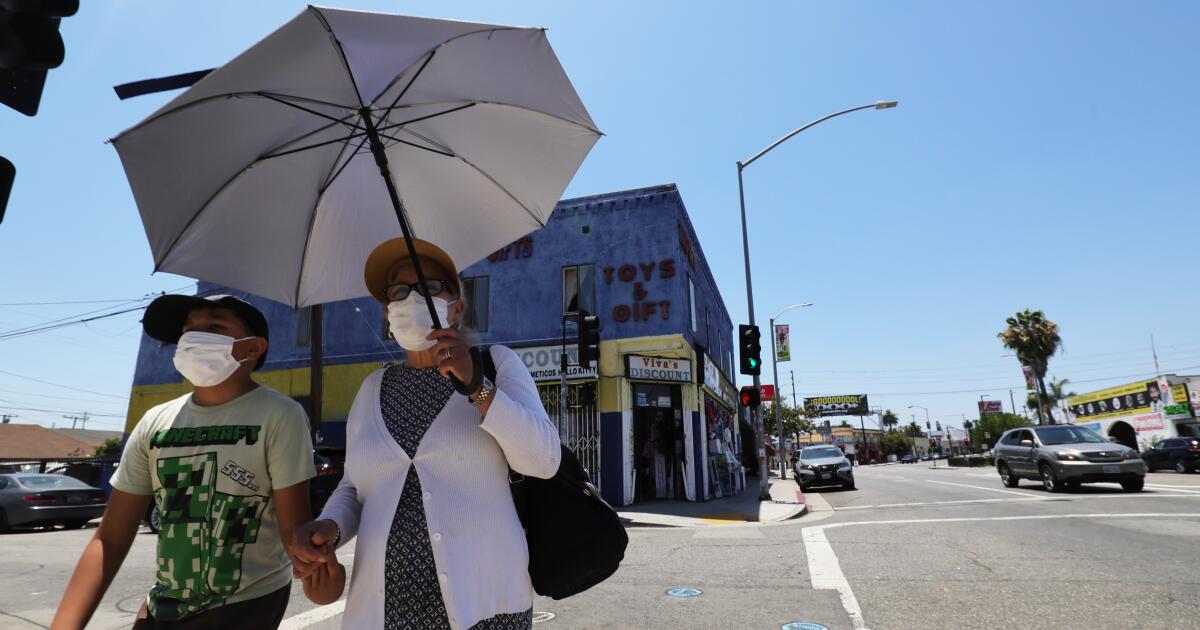
The National Weather Service has issued a heat advisory for this week that includes Los Angeles County and other parts of the Southland, especially in valleys and away from the coast.
Temperatures are expected to rise in the Santa Clarita Valley, the east and west San Fernando Valley, as well as parts of the San Gabriel Valley and northwest L.A. County mountains beginning Tuesday and lasting through Thursday, with warm, seasonably elevated fire weather conditions, according to the National Weather Service.
Forecasts indicate the mercury will reach 90 to 105 degrees in the interior, 80 to 90 degrees in the inland coastal plain — including downtown L.A. — with highs in the 80s and lower 90s in the foothills and canyons of southwest Santa Barbara County.
Rose Schoenfeld, meteorologist with the National Weather Service in Oxnard, said temperatures should be five to 10 degrees above normal for this time of year thanks to a high-pressure system building up over the region.
Though temperatures are expected to drop after Thursday, don’t expect that cooling to last.
“Looking ahead, you might be seeing some outlooks that look pretty favorable, but that heat will linger and redevelop with a pretty impressive heat wave for much of the west, that would be starting next weekend or so,” Schoenfeld said. “It doesn’t seem like we’re out of the woods, even if temperatures start to drop after Thursday.”
The rising mercury coincides a with major marine heat wave across the Pacific Ocean that has the potential to affect weather events around the world, bringing months of warmer oceans, which trigger thunderstorms and extreme heat thousands of miles away.
In recent weeks, record heat waves have baked parts of Europe, with temperatures hitting 104 degrees in some countries. France has reported more than 1,000 heat-related deaths.
In the U.S., record heat has gripped much of the Midwest and East Coast, with temperatures between 110 and 115 degrees in major metropolitan areas, with the National Weather Service issuing an extreme heat warning for much of the Midwest, Mid-Atlantic and Northeast.
The sweltering temperatures have disrupted travel and led to a number of cancellations planned for celebrations over the Fourth of July weekend, including Philadelphia’s Salute to Independence parade. The Great American State Fair, on the National Mall in Washington, was forced to shut down for a few hours.
Amtrak canceled some trains in the Northeast because of excessive heat that could affect the tracks.

The Isolate Thief, 2026.
Directed by John Suits.
Starring Mackenzie Foy, Odeya Rush, Joe Pantoliano, Sean Bean, Jack Kesy, Ty Simpkins, Bryan Martin, and Martin Sensmeier.
SYNOPSIS:
A young woman struggles to conceal the gold she stole from violent outlaws who have seized control of her remote outpost, outwitting them amid a deadly winter where survival becomes a game of cunning and betrayal.

Set at a Union outpost in frigid temperatures, John Suits’ The Isolate Thief transcends what was likely a small budget with a fittingly chilly, oppressive look, and an ensemble that sneaks up on you as not only packed but smartly cast. Front and center is Mackenzie Foy shedding her Twilight and Disney-oriented roots for gritty period-piece work that she handles capably and convincingly, whether it be fending off wolves at the outpost, bandaging a wound, playing a deceitful game for survival, or wielding a firearm.
That’s only the start, though, as Joe Pantoliano shows up as a harmless graverobber only to re-enter the picture as the hostage of a group of Union soldiers led by Sean Bean on a search for gold thought to be discovered by him, which in reality has been hidden away by Mackenzie Foy’s parentless (her father recently died in the war, meaning she is all alone at the outpost), grieving, underestimated caretaker waiting for the right moment to make a break with the gold for San Francisco. The merciless candor with which the Union soldiers are comfortable torturing the drifting graverobber should also be enough to signal that something is off about the group and that our hero probably shouldn’t trust them.

Without giving too much away, Ada (Mackenzie Foy) is up against a violent group of outlaws posing as Union soldiers under orders from Sean Bean’s Fiddler, who will stop at nothing for this gold (accompanied by fellow evildoers played by a range of underappreciated names such as Ty Simpkins and Jack Kesy). In the forest, she also stumbles across a badly injured Emily (Odeya Rush), who has a connection to these outlaws, reduced to being treated as a sex object (they refer to her as an unflattering term for a prostitute, which feels inaccurate given that such a term would imply she has a choice rather than having her agency regularly taken as it is here), so broken by her experiences with them that she advises Ada to give in to their demands as defying them typically results more horrifying outcomes.
Even if the screenplay from Kevin Lefler doesn’t necessarily crackle the way a pressure-cooker story like this should (there’s a lot of The Hateful Eight in the film’s DNA, but without anywhere near that level of character and thematic complexity), the cast elevates the material and provides a quiet intensity simmering underneath the casual conversations and deceptions that we know will eventually blow up in Ada’s face. It’s also a story that isn’t afraid to go to some fairly bleak places and put these women through the wringer as they fight back and try to make it out alive.

What it boils down to is a simplistic cautionary tale of ruthless, misogynistic outlaws underestimating the women they are up against. That is also desperately felt when the women turn the tables in the third act. Effectively accomplishing what it sets out to do. A freezing locale is used for atmospheric advantage (the ground is frozen solid, meaning graves can’t be dug, to give an idea of just how cold it is) while allowing Mackenzie Foy to tap into some new acting tools demonstrating resourcefulness, alongside Sean Bean believably going from calm to terrifying on a dime. The Isolate Thief is a feminist period-piece Western that organically empowers through familiar, albeit competent and engaging, storytelling, culminating in some tense battle-of-the-sexes action.
Flickering Myth Rating – Film: ★ ★ ★ / Movie: ★ ★ ★
Robert Kojder
https://www.youtube.com/watch?v=embed/playlist
-

 Delaware2 minutes ago
Body of missing 19-year-old tuber recovered from Delaware River in Hunterdon County – WRNJ Radio
-

 Florida9 minutes ago
Why the Red Sox are sending Roman Anthony to Florida (and to another doctor) – The Boston Globe
-

 Georgia10 minutes ago
324 impaired drivers arrested in Georgia during holiday weekend
-

 Hawaii16 minutes ago
PHOTOS: 4 ways locals celebrated July 4 this year
-
 Idaho24 minutes ago
Residents displaced after Boise home found fully engulfed in flames, fire officials say
-

 Illinois26 minutes ago
26-Year-Old Woman Killed In I-55 Crash, Coroner Says
-

 Indiana31 minutes ago
Fever take down Aces 84-68, led by Kelsey Mitchell’s 27 points
-

 Iowa39 minutes ago
14-year-old Dyersville girl dies in July 4 Clear Lake watercraft crash

