Entertainment
Review: With his first ‘Missa Solemnis,’ Gustavo Dudamel takes on Beethoven’s ultimate spiritual challenge

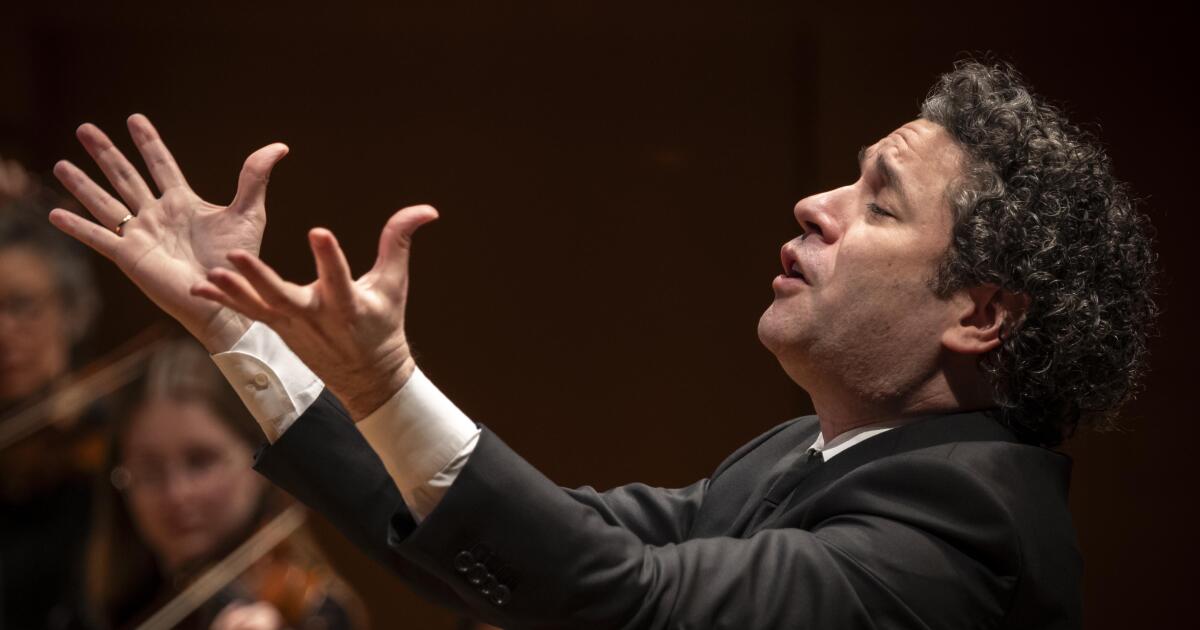
Beethoven’s “Missa Solemnis” is a grand mass for large orchestra, chorus and four vocal soloists that lasts around 80 minutes. It was written near the end of Beethoven’s life and is his most ambitious work musically and spiritually. “Coming from the heart, may it go to the heart,” he wrote on the first page of the score.
The Beethoven biographer Jan Swafford put it this way: “ ‘Missa Solemnis’ is Beethoven talking to God, man to man. And what they talked about is peace. Creation was for Beethoven’s the magnificence in the world which we inhabit; ‘Missa Solemnis’ is meant to keep it thus.”
Yet among Beethoven’s major works, “Missa Solemnis” is, by far, the least performed, and not merely because of the need for large forces. Conductors struggle to get a handle on its mysteries and intricacies. Upon turning 70 last year, Simon Rattle contended “Missa Solemnis” remains beyond him. Upon his reaching 70, Michael Tilson Thomas made a momentous meal of “Missa Solemnis” 11 years ago with a staged performance with the Los Angeles Philharmonic at Walt Disney Concert Hall.
Gustavo Dudamel, who has been conducting Beethoven since he was a teen, waited until he passed his 45th birthday last month. His first “Missa Solemnis” performances over the weekend at Disney were the centerpiece of his month-long L.A. Phil focus on Beethoven.
That venture began a week earlier with a political statement. Beethoven’s incidental music to Goethe’s drama of liberation, “Egmont,” was updated with a new text that served as an urgent call for protest in our own era of authoritarianism and militarism. Here, Beethoven exerts a compulsion for triumphant glory.
The glory in “Missa Solemnis” is that of stupefaction. By this point in his life, Beethoven has had it with weapons, the drumbeat of soldiers, the addictive emotion of trumpet calls to action. His man-to-man with God is celestial diplomacy. There is no compromise. We either care, at all costs, for our magnificent world or nothing matters.
Dudamel clearly cares. He conducted the massive mass from memory. And costs be damned. He imported from Spain two spectacular choruses — Orfeó Català and Cor de Cambra del Palau de la Música Catalana — a total of some 130 singers who sounded like they had rehearsed for months under their impressive director, Xavier Puig. The four soloists — soprano Pretty Yende, mezzo-soprano Sarah Saturnino, tenor SeokJong Baek and bass Nicholas Brownlee — were needfully robust and powerful. They were placed mid-orchestra, behind the violas and bravely in front of the timpani.
“Missa Solemnis” follows the standard mass text but doesn’t necessarily follow the liturgical narrative. It is a work of theater, dramatizing feelings, as the earlier Disney staging attempted. Director Peter Sellars and conductor Teodor Currentzis have also been promising a major staged “Missa Solemnis” for many years.
The Kyrie opens with a strong D-major chord in the large orchestra that seems an obvious downbeat but turns out to be an upbeat. Down is up. Eighty or more minutes later at the end of the Agnus Dei, when the great plea for peace reaches its ultimate transcendence, up becomes, in one of the most profoundly unsettling moments in all music, down again. We never fully know where we stand in “Missa Solemnis.” Every expectation is thwarted. Beethovenian peace is a nearly superhuman endeavor.
Gustavo Dudamel conducts L.A. Phil, vocal soloists and Catalan choruses in Beethoven’s ‘Missa Solemnis’ at Walt Disney Concert Hall.
(David Butow / For The Times)
Dudamel‘s approach is to attempt the all-encompassing. He conducted without a baton but with his body. His arms were often open and wide as if embracing the musician masses on the stage, holding the whole world in his hands. Tidiness wasn’t necessarily the issue. Grandeur was. Molding sound was. And, of course, awe.
Throughout his career, Beethoven was the overwhelming master of awe. In “Missa Solemnis,” he out-glories the Gloria. His fugues are a draftsman’s rendering of heavenly splendor. Such awe asks for the superhuman from singers, especially in this ensemble from their ravishing high notes.
But Beethoven also questions every sentiment in the Mass. Grandeur can so suddenly turn solemn that it feels almost a ceremonial sleight of hand. In the Sanctus, a solo violin sails in from nowhere (“descending like a dove from heaven,” Hugh MacDonald nicely puts it in the program note), and suddenly we’re in a violin concerto with vocal soloists of transcendent allure.
The Agnus Dei begins in glum realization that there may be no compensation for humanity’s great sins when, again astonishingly without expectation, one of Beethoven’s uniquely wondrous melodies takes over. Saber-rattling trumpet and timpani intrude and are shushed away as worthless. Peace returns but just as it is about to climax it weakens. There is no grand Beethoven ending. “Missa Solemnis” just stops.
Dudamel’s approach was not, as his Beethoven has generally become, filled with fervent intensity in the moment. That may happen as he gains more experience with Beethoven’s most exigent score. The big moments were still huge, especially with the help of his fabulous chorus. The somber moments were well of the heart. There was eloquent solo playing in the orchestra, and extravagance from the solo singers.
Most unusual was the violin solo. The L.A. Phil is in a concertmaster search, and Alan Snow, the associate concertmaster of the Minnesota Symphony, sat in. He brought silken “descending dove” tone to his solo playing, but at low tone becoming more a voice from afar than soloist. Whether that is simply his sound or what Dudamel was after is, like so much in the “Missa Solemnis,” up to question. Still, its quiet exemplified the elusive essence of peace.
When Dudamel first walked on stage, he got, as he always does and especially in his last season as music director, a strong ovation. At the end of “Missa Solemnis,” the reaction was a respectful standing ovation, unlike the de rigueur rapturous reception he always earns with Beethoven.
Dudamel earned something far more rewarding. It wasn’t a moment for cheering but reflection. True peace in “Missa Solemnis” comes not from winning but from ending conflict, be it between nations, nature or among ourselves. We have as yet too little to celebrate.


In Sender, writer-director Russell Goldman’s high-anxiety debut, the filmmaker expands on his 2022 short Return to Sender, in which Allison Tolman starred as a woman who receives packages she didn’t order. That may not sound like a premise that would result in a paranoid, darkly comedic thriller, much less a feature. But in extending his story from 18 minutes to just over 90, Goldman follows a maddening scenario involving an online retailer called Smirk, a fictionalized Amazon counterpart. More significantly, he captures the frenzied mindset of his protagonist, who grapples with staying sober and several other major life changes—all compounded by a layer of justifiable paranoia brought on by the endless packages. Goldman’s tweaky style and elusive scripting create a peculiar, out-of-whack presentation that destabilizes the viewer, firmly placing us in his main character’s perspective. However, by the end, the journey through this cine-manic headspace doesn’t add up to much, and the potential character study at the center feels somewhat lost in the mechanics of the conspiracy.
Britt Lower (AppleTV’s Severance) stars as Julia, who has just lost her job and moved into a rental home to get her life on track. She is backed financially by her overbearing sister Tatiana (Anna Baryshnikov), who occasionally comes nosing around to verify that Julia doesn’t backslide. And she doesn’t. Julia attends regular Alcoholics Anonymous meetings, where she meets the steely Whitney (Rhea Seehorn), who isn’t interested in being her sponsor. But at home, Julia receives a Smirk package with her brand of lipstick. The problem? She didn’t order it. She calls customer service, and the representative doesn’t help much before telling her, “Be sure to stay alert and aware.” Wait, what? Sender is loaded with nagging, unplaceable details like this. They’re often amusing, intriguing, and exasperating in the same moment. But these pieces don’t complete a whole picture, at least not a narratively satisfying one.
The Smirk packages, delivered by the outwardly helpful, nice-guy driver Charlie (David Dastmalchian), contain a random assortment of objects, from drum kits to protein powder. The squirrelly Julia, already coming apart at the seams from her recent drama, doesn’t know what to make of it. She’s convinced there’s some plot against her, perhaps by someone at Smirk. To what end, she doesn’t know. But Goldman gives us a glimpse of the long-term consequences of her ordeal in the prologue, which features Jamie Lee Curtis (also a producer) as Lisa, a woman in circumstances similar to Julia’s. Lisa’s response to receiving a box of soil with a broken shin pad (with “Can’t Can’t Can” scrawled on it) entails an attempt to suffocate herself with the bubble wrap, only to do far worse with a sharp edge of the shin pad. To show Lisa’s fate, Goldman’s imagery becomes twisted and surreal but also cryptic.
Sender’s disorienting mood is matched by a skewed formal presentation. Cinematographer Gemma Doll-Grossman’s wide-angle lenses and arch angles might feel at home in a Ken Russell or Terry Gilliam feature such as The Devils (1971) or 12 Monkeys (1996). Julia’s half-remembered drinking binges, accented by blurry close-ups, suggest she may have slept with any number of coworkers. She can’t remember, and it embarrasses her. Her rental is dressed in simple if shabby décor, which gives way to Julia’s erratic collage-like overhaul. Melisa Myers’ stuffed production design makes the most of heightened colors and banal, cluttered rooms that lend a normality to the bizarre, ever more disturbing predicament. Nathan Ruyle’s erratic music delivers what must be described as a soundscape rather than a traditional score, with collusive sound effects and tones driving our certainty that Julia is onto something. Along with Marco Rosas’ discordant editing, Goldman’s technical approach effectively reflects Julia’s fragmented, sleep-deprived mind. But his work as a writer hasn’t done enough to justify this level of technique.
After Julia makes a revelatory discovery that small cameras have been embedded in the products from those mysterious packages, the eventual explanation about what has been happening and why strains logic and underwhelms. It also raises even more unanswered questions. Although well-made and acted—Lower and Seehorn should be on track to movie stardom—Goldman’s script could have used another draft to better work through what unfolds. Sender doesn’t give us enough of its characters’ inner lives beyond the situation at hand, so Julia, Charlie, Tatiana, and Whitney feel like devices in a scenario rather than well-drawn human beings. Even so, Goldman fills his film with deeply broken people who try to gain control of their lives by controlling others, exposing and preying on their weaknesses. Despite the material’s potential resonance, Goldman’s style is overpowering. Still, his kernel of an idea and the way he explores it demonstrate his clear skill, and for much of Sender, its sheer oddball energy earns admiration.

“Lethal Weapon” star Danny Glover has revealed he has been living with Alzheimer’s disease for years.
In an interview with NBC’s Lester Holt that aired on the “Today” show on Wednesday, the 79-year-old actor and activist opened up about living with the disease. According to People, he received his diagnosis in 2023, which was not long after he was awarded an honorary Oscar in 2022.
“I could live with it, in a sense,” Glover says of his condition, which has been affecting his movement, speech and memory. “I’m sure as it advances, things are going to be different and changing.”
A neurodegenerative disease, Alzheimer’s is a type of dementia that affects memory, thinking and behavior and worsens over time, according to the Alzheimer’s Assn. Holt reports that more than 7 million Americans over 65 are living with Alzheimer’s, with Black men suffering at a rate double the national average.
Glover and his family say the Hollywood icon is sharing his story now to “have ownership of his life” and to help remove the stigma around the disease.
“They’ve got my back,” Glover says of his family’s support.
Besides his portrayal of L.A. police Det. Roger Murtaugh in the “Lethal Weapon” film series, Glover is known for roles in movies including “Places in the Heart” (1984), “The Color Purple” (1985), “To Sleep With Anger” (1990), “Angels in the Outfield” (1994), “Dreamgirls” (2006) and “The Last Black Man in San Francisco” (2019). He’s also been a vocal advocate for social justice and humanitarian causes both in the U.S. and abroad.
He was the recipient of the Academy of Motion Picture Arts and Sciences’ Jean Hersholt Humanitarian Award in 2022.
“I don’t feel like it’s the end of my life,” he said in his interview with People about living with Alzheimer’s. “There’s work to do.”

Enter your email and we’ll send a secure one-click link to sign in.
WKRN is provided by Nexstar Media Inc., and uses the My Nexstar sign-in, which works across our media network.
Nexstar Media Inc. is a leading, diversified media company that produces and distributes engaging local and national news, sports, and entertainment content across its television and digital platforms. The My Nexstar sign-in works across the Nexstar network—including The CW, NewsNation, The Hill, and more. Learn more at nexstar.tv/privacy-policy.
-
 Arizona1 minute ago
Records: Toddler found alive in hospital morgue after being pronounced dead by Arizona doctor
-

 Arkansas8 minutes ago
Get to know: Arkansas QB commitment Cason Myers | Arkansas Democrat Gazette
-

 California10 minutes ago
California gets Bruce Lee Day in a first for US state’s Chinese Americans
-

 Colorado16 minutes ago
Colorado governor fires two clemency board members who spoke out about Tina Peters’ commutation | CNN Politics
-

 Connecticut23 minutes ago
Police investigating double homicide in Hartford
-

 Delaware26 minutes ago
65-year-old Delaware man killed after camel falls on him, police say
-

 Florida31 minutes ago
New Florida domestic violence laws take effect, adding tougher penalties and new victim protections
-

 Georgia38 minutes ago
Georgia launches address protection program for violence, trafficking survivors

