Lifestyle
What happens when a leather mama and a latex daddy fall in love?

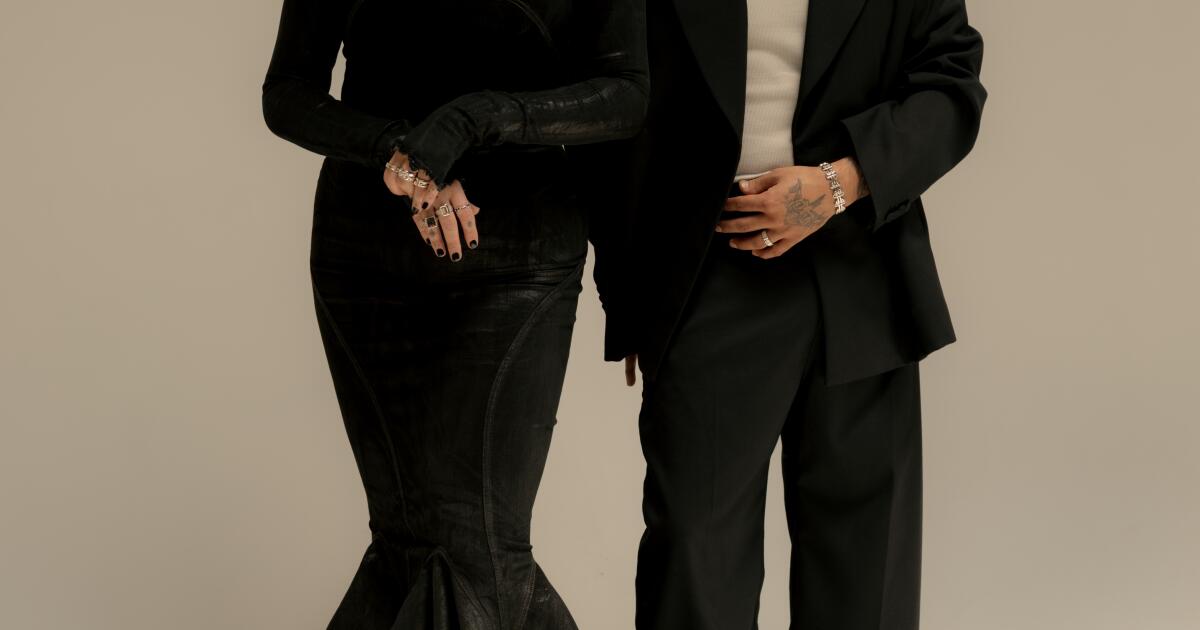
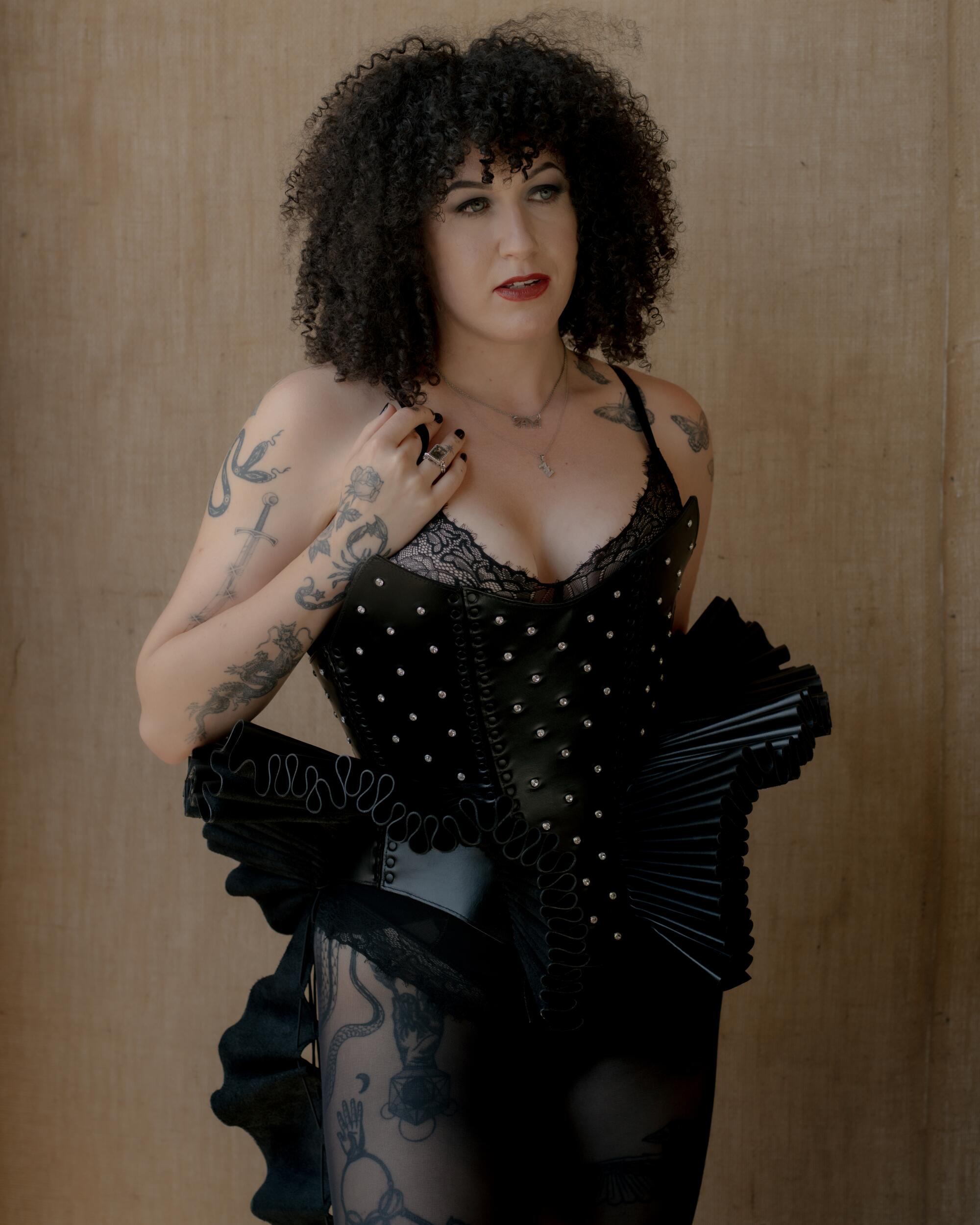
Zana Bayne and Mariano Cortez are two of the most low-key yet cultishly-loved designers in L.A. dealing in leather and latex, respectively. They also happen to be a couple. Zana wears Zana Bayne corset, Black Suede Studio boots, Calzedonia tights, Pinsy bodysuit. Mariano wears BustedBrand shirt and pants, Ugo Cacciatori bracelet, Other People’s Property rings.

In a lofty space streaming with hot light on Los Angeles Street, there is a dressing room with heavy red curtains and a door in the shape of a butt plug. A mirror inside captures your reflection in its familiar curvature, and, of course, you pull out your phone to take a picture — because when have you ever seen a butt plug-shaped dressing room before? Across the room, a Wassily-style chair sunbathes in the corner, with a handmade burgundy leather base and back, studs running along the seams. The chair has straps on its armchairs — made for wrists to slip into — with custom silver buckles in the shape of an outstretched woman’s physique. Vintage fetish magazines line the glass table in the center of the room, which smells of fresh paint, leather and latex. On a warm afternoon in August, this space is still under construction, but soon it will be a store: the shared world of Zana Bayne and Mariano Cortez, a physical manifestation of their creative partnership and personal relationship.
Bayne and Cortez are two of the most low-key yet cultishly-loved designers in L.A. dealing in leather and latex, respectively. What people come to Bayne for is her specific style, where all details are meticulously done by hand, and where hardware reigns supreme. (She made the aforementioned chair.) A Zana Bayne piece feels structural to the point of sculptural — a leather crystal-studded corset flaring with hip ruffles that unfold like an accordion; a lace-up corset eyelet skirt that creates a soft, voluptuous curve line away from the body. The pieces are instantly recognizable as hers: hand-laced rivets holding together a bustier in the shape of a broken heart, the way one of her spiked choker handbags seems to defy gravity. Cortez is the Latex King of Los Angeles, known for developing new techniques with the material, or imagining it in completely new contexts. In Cortez’s hands, latex becomes printed as leopard and cowhide, it becomes evening wear, sportswear or business casual — from a football tank to a floor-length dress to a blazer.
And they happen to be in a relationship. Sitting in the room with Cortez and Bayne, there is a gravitational pull that can be felt when in the presence of opposites who speak the same language. Leather and latex being their shared dialect. Fashion is a small world, fashion inspired by fetish wear is even smaller. There is a mutual understanding between the two designers, both about the practical things — like impossible schedules or the kind of obsessive nature you must have to be successful — and the big things, like living a life in dedication to your practice, or what it means to blend the realms of subculture, art and fashion. “What we do is so blood, sweat and tears — every iota of your being at times — and if you aren’t in it, it’s really hard to understand for certain people,” Bayne says.
In February, Bayne posted an image of a photo strip of her and Cortez and captioned it: “Leather mama & latex daddy.” The store, called FETISH and launching in October, is somehow the culmination of this exact description. Which takes us back to the beginning: What happens when a leather mama and a latex daddy fall in love?

Walking into Cortez’s studio in the fashion district, you are first hit by the distinct smell of rubber, filling your nostrils, washing over your brain in a haze of strangely intimate comfort. Cortez and Bayne are wearing all black in 90-degree heat while sipping on green juices. She is in a Nine Inch Nails 2008 tour T-shirt, thrown over a slip dress with fishnets on, and Cortez is in a T-shirt, cargo shorts and boots. They tell me that earlier that day, Chappell Roan wore a custom Bustedbrand X Zana Bayne look on stage at Lollapalooza for what was said to be the festival’s biggest audience ever. Roan jumped around in a hot pink and electric blue lucha libre wrestler’s outfit made of latex, with iridescent leather accessories including a belt, mask, shin guards and wrist and upper arm cuffs. Bayne started with accessories early in her career — first creating a single harness — back when she was an obsessive fashion documentarian with the blog Garbage Dress, and was enamored by the transformative qualities a small piece could have on an outfit, an aura. “There’s something about a strap of leather and a buckle that can really make people go wild,” she says. “I’m still not sick of exploring that.”
Cortez and Bayne started their brands at different times, both literally and culturally speaking. In 2011, when Zana Bayne was formed, there were fewer people making harnesses intended to wear at a concert or party, or in broad daylight. Bayne was one of the designers to open that world up for designers like Cortez, who would officially start his brand in 2018. Back then, anything that was made of leather with some rivets would be pigeonholed as strictly fetish wear, Bayne remembers, and there was little focus on the actual quality or design of the garment, which is what her brand was driven by. The term “post-fetish” was something her brand created to describe the kind of clothing she was making (mostly as a diversion for press, which in the 2010s loved to throw “BDSM” in a headline when covering the brand). Her work was rooted in and inspired by bondage, but she decidedly did not position itself as a bondage brand. “That term didn’t exist,” Bayne says. “The term post-fetish was, like, apres ski, like, postmodernism. It was a word play thing, and it worked. Now, there’s hundreds of brands. There isn’t a void to be filled anymore, because it’s its own monster.”
Cortez likes to think of his work as a bridge between fetish and ready-to-wear. “It still comes from a fashion standpoint — my interest was in latex material and what it could be,” says Cortez. “Respecting the roots of what people created this for, and then turning it into a more practical [garment].” One of the many iterations of designer Vivienne Westwood’s iconic boutique, Worlds End which she opened with then-partner Malcom McLaren in the ’70s, was famously dubbed “SEX,” with a huge sign in pink squeaky letters at the top. The store sold fetish wear and had whips and chains on display. Their slogan was: “rubberwear for the office.”
For both Cortez’s and Bayne’s designs, something special happens when they are seen, when they are out in the world. This is when they come to life, when the natural tension of wearing fetish-inspired wear — like one of Bayne’s spiked triangle bras, or Cortez’s latex cat suits — in a new context rises to the surface and you can see it in action. For the wearer, there is also an obvious dedication necessary to wear the pieces — both leather and latex, specifically latex, require a particular care process, and getting a piece by Bayne or Cortez on is an entire process on its own. There’s an intensity to the materials that, no matter the context, remains. There is a satisfaction to seeing Beyoncé wearing a full latex outfit on the cover of “Cowboy Carter,” which Cortez designed, or Ariana Grande wearing a full custom lavender leather look in the video for “Rain on Me,” which Bayne made. While on some level it feels as if they are positioning themselves towards the subversive through the code of fabric, it is also a straightforward appreciation of the designs themselves.
Bayne is mostly self-taught. She grew up in San Francisco, where she attended the San Francisco Art Institute and got a degree in conceptual art. “The first corsets I made came out of nightlife and subculture,” she says. “In San Francisco at that time, everyone was doing everything all at once. You go from a leather bar to a drag show to a punk show to a noise show. We’d go to soul night and then some rave off the train tracks. It was just this mix of subcultures and fashion.” Then she moved to New York, which is when her brand got its legs. Slowly and organically, stylists were pulling pieces for their clients, custom celebrity requests started coming in and eventually she became a highlight at New York Fashion Week. “All of a sudden I was making things out of my bedroom for Lady Gaga,” Bayne says.
Cortez is from Temecula, where he grew up in punk scenes, going to the desert, skating and doing BMX — which people still recognize him from, Bayne adds. He got injured at one point from BMX, and wasn’t able to walk for a year, which is when he put all his energy into learning about fashion on Tumblr. He moved to L.A. as a teenager, where he got an internship-turned-job at L.A. Roxx, a custom design house specializing in leather. They’d get calls from people constantly, inquiring if they worked with latex, which piqued Cortez’s interest. “It was curiosity,” he says. “People not knowing, also me not knowing, just made me dive deeper.” He’d go on to learn the craft under an L.A. fetish latex designer before starting Bustedbrand on his own terms.
Cortez knew of Bayne’s brand long before he started his own, and says that a lot of her designs were a big inspiration when he started out, and still are. Bayne quips in response: “I thought that some things looked slightly familiar. However, I always maintained the opinion that Busted had the coolest latex designs, the most relevant designs, and that their branding was better than anyone else’s who was in the game. I was both somewhat annoyed and appreciative. I couldn’t help but be like, ‘Yeah, you’re doing a great job.’”
Bayne is a Virgo, Cortez is a Pisces — sister signs that, in theory, are on opposite sides of the spectrum, but, in practice, serve as each other’s balance. It checks: Cortez is quiet and stoic, with a subtle warmth that reveals itself as he gets comfortable, while Bayne’s dark humor, sharp intellect and charisma serve as a magnet. Cortez regularly giggles at her dry jokes. It’s clear they share a shorthand, inside things that they don’t care to explain. They seem to complement each other in ways beyond just a shared aesthetic. “I think we’re both very stubborn people,” Bayne says. “An interesting thing to learn was how we’re saying the same thing, but in totally different ways.”
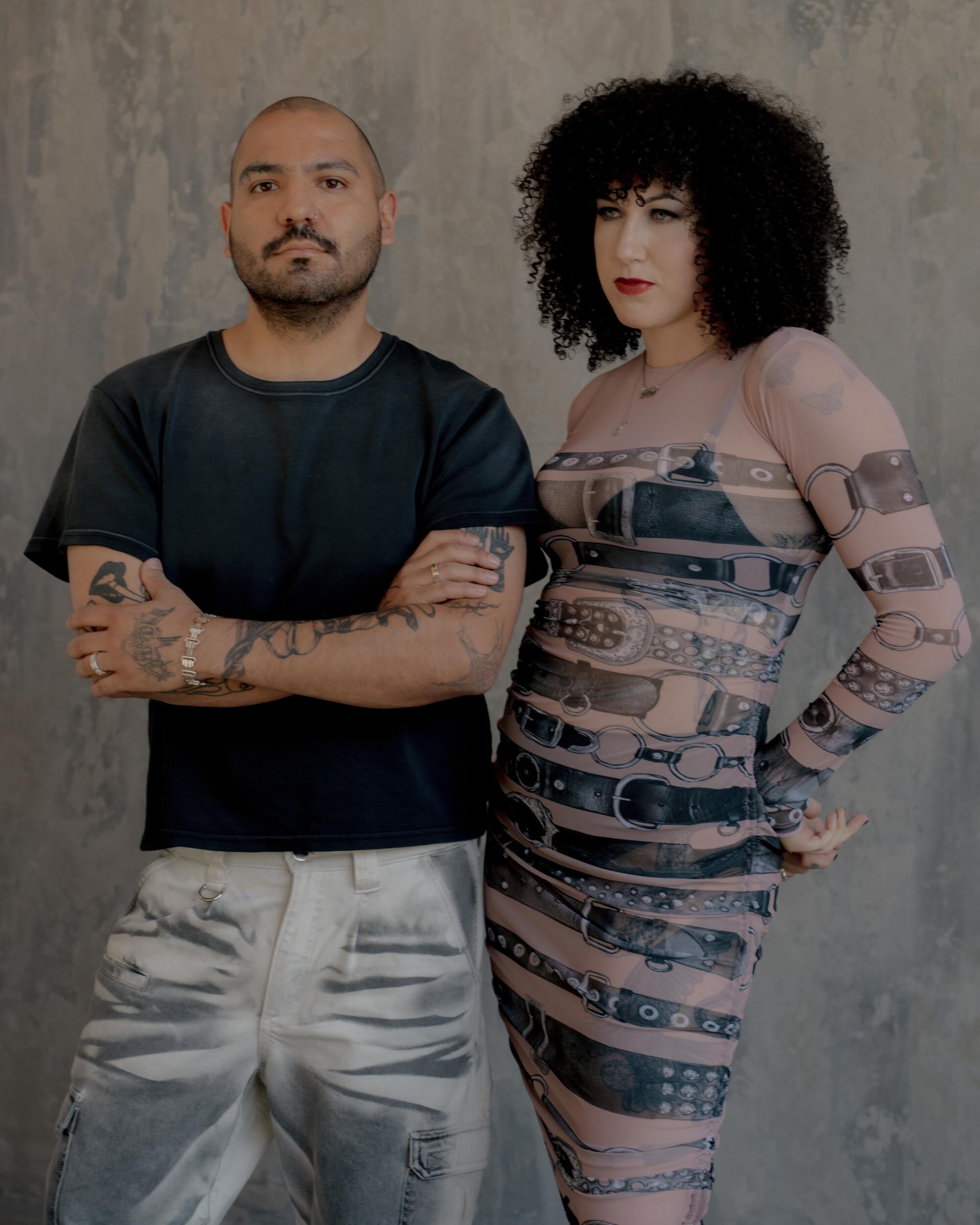
Zana wears Zana Bayne dress, Bustedbrand bra and underwear, Givenchy shoes, The Great Frog and Other People’s Property rings. Mariano wears BustedBrand T-shirt and jeans, Other People’s Property bracelet and rings.
Their work kept being featured in the same editorials, on the same artists for years — Beyoncé, being one. People would come into Bayne’s studio carrying a Bustedbrand bag. And she’d think: “There it is again.” They’d physically been in the same room many times as well, and were cordial to each other, but hadn’t communicated beyond a head nod. “I’m mean,” Bayne jokes.
“She made a personal [Instagram] account and I had followed [it],” Cortez remembers. “Then I saw she started hanging out with my friend, Britton [Litow], and I asked, ‘What’s up with Zana?’ I told her I was interested.” Litow texted Cortez a couple days later and said that Bayne was interested. “I was like, ‘He can ask me out,’” Bayne says. No moves were made until Litow’s birthday dinner a couple months later at Mr. Chow, when she sat Cortez and Bayne next to each other. “He was wearing sunglasses,” Bayne remembers. “At night.” Their first date was at a bar where Bayne wore a “really intense outfit,” which was one of her own pieces.
Being in a relationship with another designer has been a comfort for Cortez. He’d never been able to share the highs and lows of the business with anyone else like this. “Zana definitely helps me be a little less one-track mind and enjoy what just happened,” he says. “That’s been pretty leveling, grounding. It’s been really nice that we share these experiences.”
“It’s really cliche for people to say, ‘I want to be with someone who challenges me.’ And I’ve never felt that way before. That’s never something I’ve looked for, but I think we definitely challenge each other,” Bayne says. “You remind me of what I love about what we do and where it can possibly go.”
Bayne says Cortez is constantly curious, with a brain full of “a million question marks at all times.” “I think curiosity has brought me to a lot of really interesting new techniques,” he responds. There is a spaceship-looking machine behind him that takes up an entire corner of the massive studio space, a laser cutter that he uses for his latex work. This is part of a production system Cortez developed for himself, which has further allowed him to think of latex in new ways, including using traditional garment techniques like sewing — something you usually don’t do with latex — which makes it possible to create some of his silhouettes, like a voluminous bomber jacket or a boxer short.
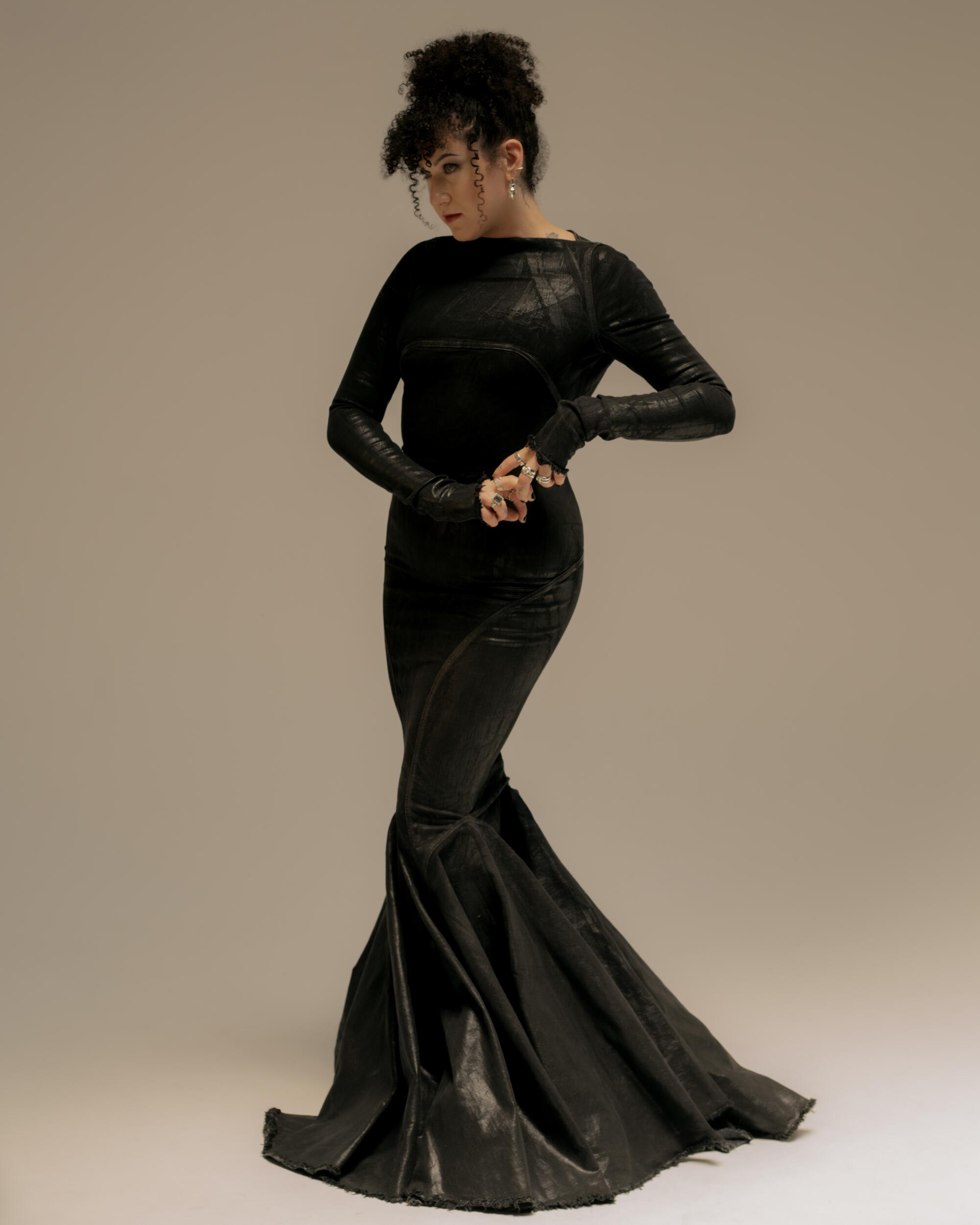
Zana wears Rick Owens gown, JW PEI shoes, Other People’s Property rings, The Great Frog rings, Alighieri earrings.

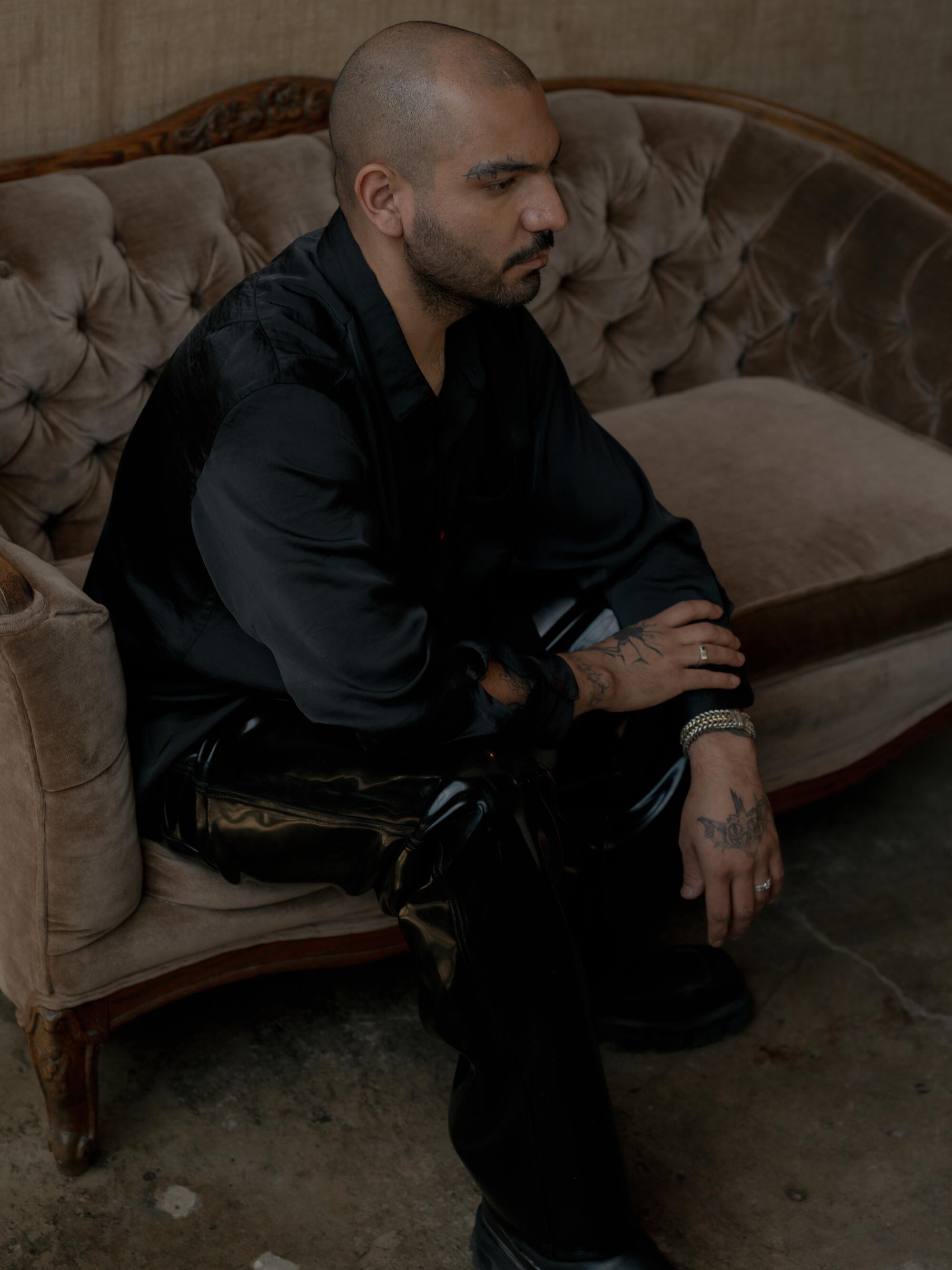
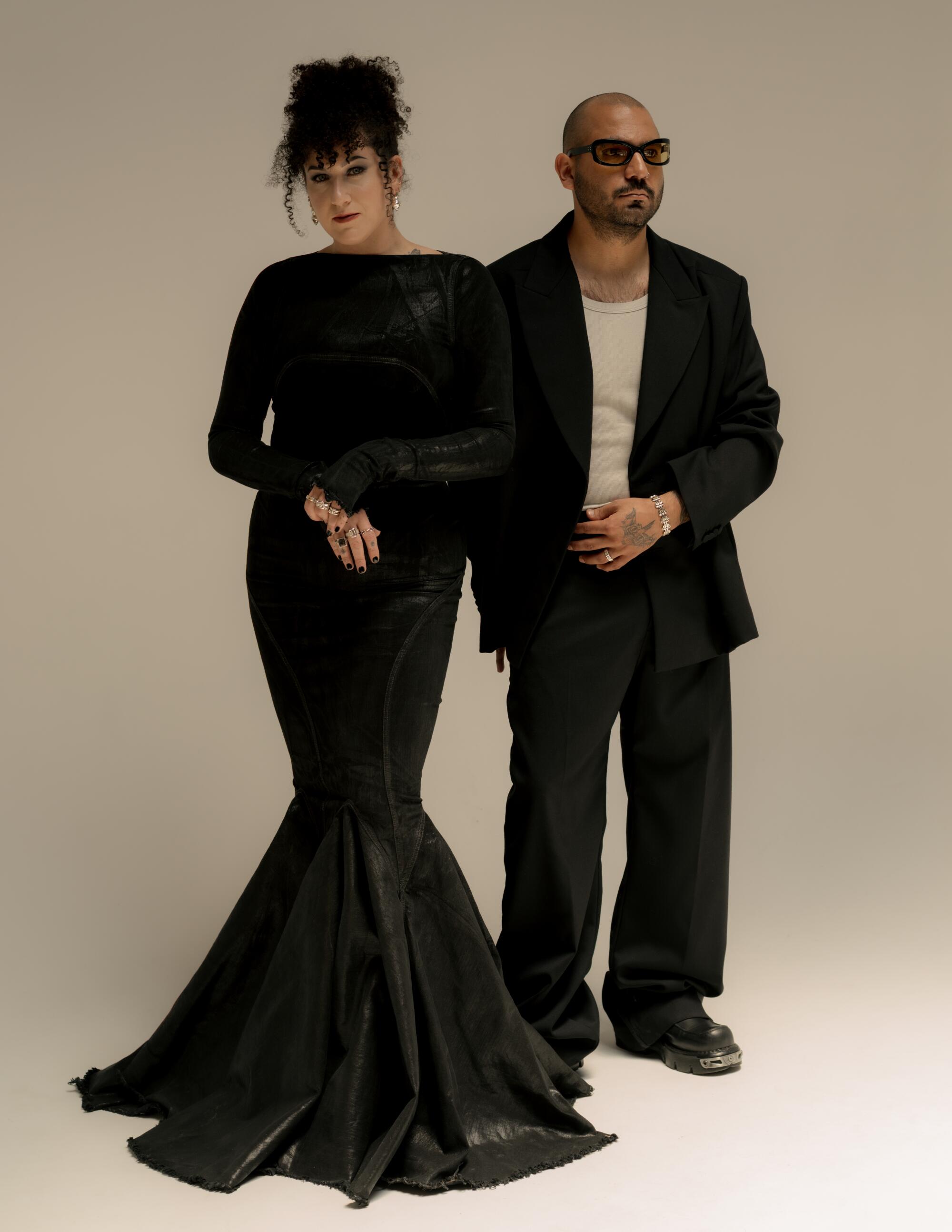
Mariano wears Entire Studios suit and tank top, Akila sunglasses, Other People’s Property bracelet and rings.
(Natalia Mantini / For The Times)
It’s a moment of expansion for Bayne as well, who is in the process of releasing a run of non-leather items for the first time inspired by the visual language she’s built over the last 13 years.
Charli XCX starts bumping on the speaker that is connected to Cortez’s phone — “maybe we go like one notch down?” Bayne asks, laughing. Charli wore one of Bayne’s skirts for a recent spread in British GQ. A non-exhaustive list of Bayne’s clients — mostly custom — include Rei Kawakubo, Kim Petras, Eartheater, Kim Kardashian, Brooke Candy, Doja Cat, Debbie Harry and she’s in the process of making some pieces for L.A. billboard icon Angelyne. For Cortez, that list includes 2 Chainz, Rico Nasty, Hailey Bieber, Ye, among others. They’ve collaborated on custom looks for artists, including Roan. And earlier this year, they collaborated on an exclusive collection, featuring micro triangle bras and belts in classic Bayne construction with a Bustedbrand flair through the leopard print and star appliques. “We have brands that work seamlessly together,” Bayne says. “It’s a no brainer.”
The ultimate collaboration will be the new store opening. Cortez’s father built the butt plug cut-out for the fitting room. “I told him it was a spike,” Cortez says, laughing. “The next day after I sent him the photo and the dimensions he was like, ‘That’s a butt plug.’”
Cortez and Bayne want the space to feel “clean and sexy.” “We’re building our universe,” Bayne says, which means the store will feature their pieces and exclusive collaborations, but it will also be a home to their musical inspirations, beloved objects and design references. They want the experience to be one of discovery. “There’s beauty, there’s severity with what we do, but there’s going to be playful elements,” Bayne says. The store is also an opportunity to continue presenting leather and latex in the contexts in which Cortez and Bayne imagine them in. Spending time in the space itself feels like sitting in on a conversation between Bayne and Cortez, which is a rarity, given the intentional mysteriousness around them as a couple.
“It’s really special what we get to do, and what we do [is] really f—ing hard,” Bayne says. “It takes a chunk of your soul constantly, but there’s got to be a part of us that loves what we do.”
“I told myself that the other day,” Cortez says. “I love what I do. And I’m glad I get to share it with Zana.”
Makeup Selena Ruiz
Hair Adrian Arredondo
Lighting Nick Shamblott


Sunday Puzzle
NPR
hide caption
toggle caption
NPR

On-air challenge
I’m going to give you two five-letter words. Add the same two letters at the end of the first one and the start of the second one, in each case to complete a familiar seven-letter word.
Ex. Later Ready –> LATERAL/ALREADY
1. Habit Tempt
2. Laten Press
3. Blank Ching
4. Since Venue
5. Shack Groom
6. Surge Stage
Last week’s challenge
Last week’s challenge came from Rawson Sheinberg. of Plymouth, Mich. Think of a U.S. city with a two-word name. Add a letter to the first word, without rearranging letters, to name a country. Then, without adding a letter, rearrange the letters of the second word to name another country. What places are these?
Answer: Los Angeles –> Laos, Senegal
Winner
Elaine Neel of Derby, Kansas.
This week’s challenge
Next weekend will be the 186th convention of the National Puzzler League, in Bloomington, Ind., which I’ll be attending as always. Two other people who will be there are Henri Picciotto and Joshua Kosman, who created this week’s challenge. Name two words that are opposites. They share a single letter. Remove that shared letter from each word, put a hyphen between the two starting words, and you’ll get a term you sometimes see in food ads. What are the two words?
If you know the answer to the challenge, submit it here by Thursday, July 9 at 3 p.m. ET. Listeners whose answers are selected win a chance to play the on-air puzzle. Important: include a phone number where we can reach you.
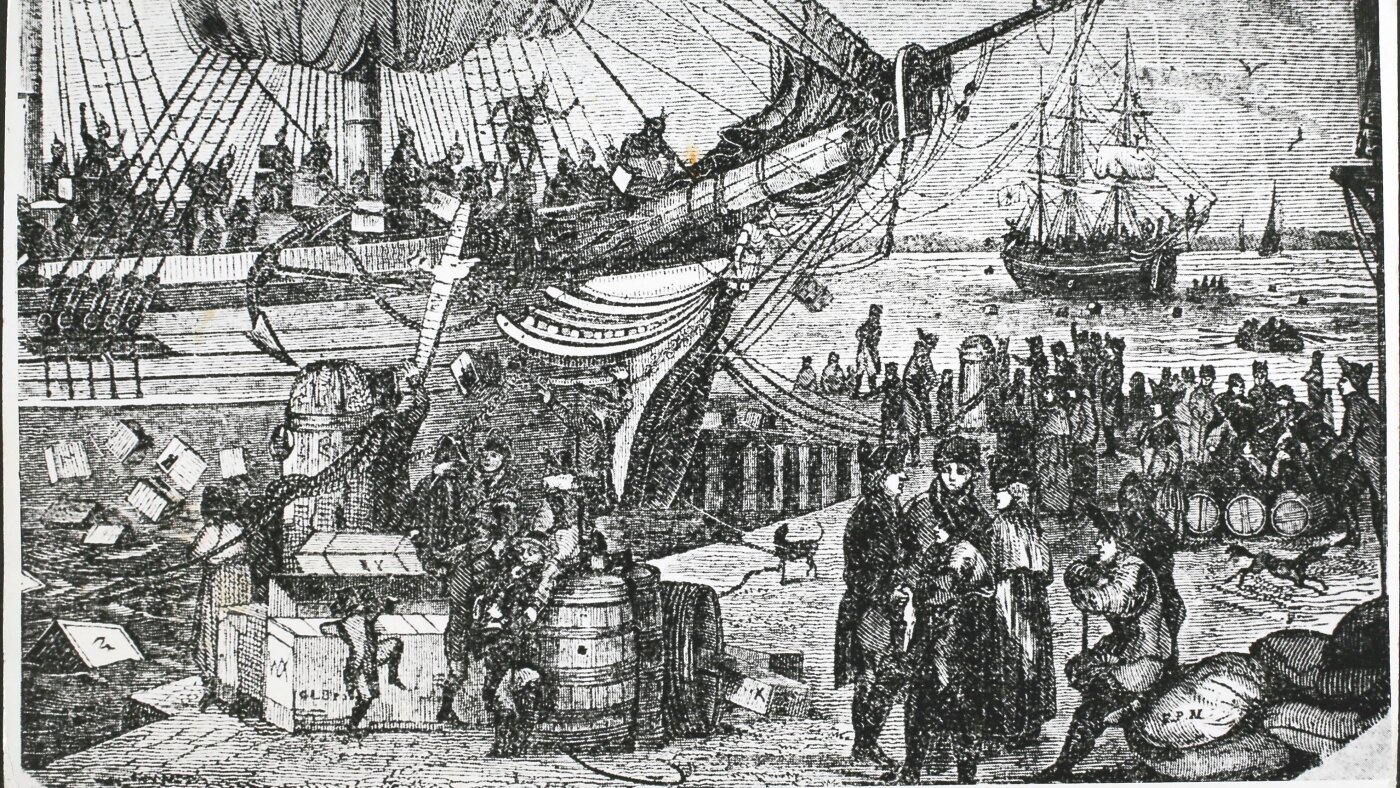
An illustration of the Boston Tea Party, when colonists dumped British East India Company tea into the harbor on Dec. 16, 1773. Some accounts say this marked a pivotal moment when Americans started loving coffee. But one historian says Americans were drinking lots of coffee before then.
Hulton Archive/Getty Images
hide caption
toggle caption
Hulton Archive/Getty Images
A consequential act of defiance secured tea’s place as perhaps the most iconic beverage of America’s colonial era.
The Boston Tea Party became an essential ingredient in the recipe for revolution in the following years.
But tea wasn’t the only hot beverage with a prominent role in America’s fight for independence.
Coffee was an important part of American culture from the start. And coffeehouses were essential, too — serving as hubs for brewing ideas of independence.
As the United States celebrates 250 years, here’s what to know about America’s early history of coffee.

Colonists were drinking coffee long before the United States existed
Europeans brought coffee with them when they came to America.
“The first documented example of a mortar and pestle used to grind coffee beans was on the Mayflower” in 1620, says historian Michelle Craig McDonald, the author of Coffee Nation: How One Commodity Transformed the Early United States.
“The fact that coffee was present so early is not surprising if you think about it,” McDonald says. “A number of those who were on the Mayflower came to North America from Amsterdam, which was a major coffee trading center in Western Europe by the 17th century.”
The first coffeehouse in the colonies opened in 1676 in Boston, a century before the U.S. declared independence, she says. Some taverns sold coffee even earlier.
The Boston Tea Party probably wasn’t the dramatic turning point toward coffee that some claim
On the night of Dec. 16, 1773, disgruntled colonists boarded three ships moored in Boston Harbor and threw overboard more than 92,000 pounds of tea owned by the British East India Company.
Tensions had been building between the Crown and the colonies over the previous decade, as Britain tried to levy taxes on its colonies to recoup war debts.
The Boston Tea Party protest was targeted at the British government’s passing of the Tea Act in 1773, which granted the East India Company a monopoly over tea sales in the colonies. While the British had removed some unpopular taxes in the preceding years, they left tea taxes in place. Colonial merchants were especially upset that the act allowed the East India Company to undercut their tea business.
To build solidarity for their cause of sovereignty, some patriots called on colonialists to swear off tea in favor of coffee. It’s why many histories point to the Boston Tea Party as a turning point when Americans switched from mostly drinking tea to mostly coffee. The anti-tea sentiment was immortalized in a founding father’s now-famous letter.
In July 1774, John Adams (before he became the second U.S. president) wrote to his wife Abigail, recounting an incident during his travels. After a long day, he asked the proprietor of the house where he was lodging for a cup of tea, provided it was smuggled and free of British taxes.
” ‘No sir, said she, we have renounced all Tea in this Place. I cant make Tea, but I’le make you Coffee.’ Accordingly I have drank Coffee every Afternoon since, and have borne it very well. Tea must be universally renounced. I must be weaned, and the sooner, the better,” Adams wrote.
Despite John Adams claiming a newfound patriotic duty to appreciate coffee, McDonald says colonists had been drinking lots of coffee all along.
She studied advertisements from the 1760s and ’70s to estimate how many shops sold coffee versus tea. Even before the Boston Tea Party, she says, “coffee is definitely more broadly available than tea is.”
A big reason? It was cheaper. “Its price again per pound is significantly less, which tells you about its availability, its accessibility to drinkers.”
Historians say it’s hard to definitively compare tea with coffee consumption, though, as official records from before America gained independence were inconsistent.
And smuggling was rampant, making official records even less reliable.
“There is a vast amount of smuggling,” says Joyce Chaplin, a professor of early American history at Harvard University. “So they’re not paying formal duties on tea that they get from the Dutch. They’re probably not paying formal duties on coffee from the French Caribbean.”
And Chaplin notes that people who loudly proclaimed a new appreciation for coffee over tea weren’t always doing what they said. It could have been political pandering. “I do not drink tea that comes via the East India Company,” she posits someone of the era saying. “But, you know, other sources are fine. Ditto for the coffee.”
Coffeehouses were a hub for revolutionary ideas
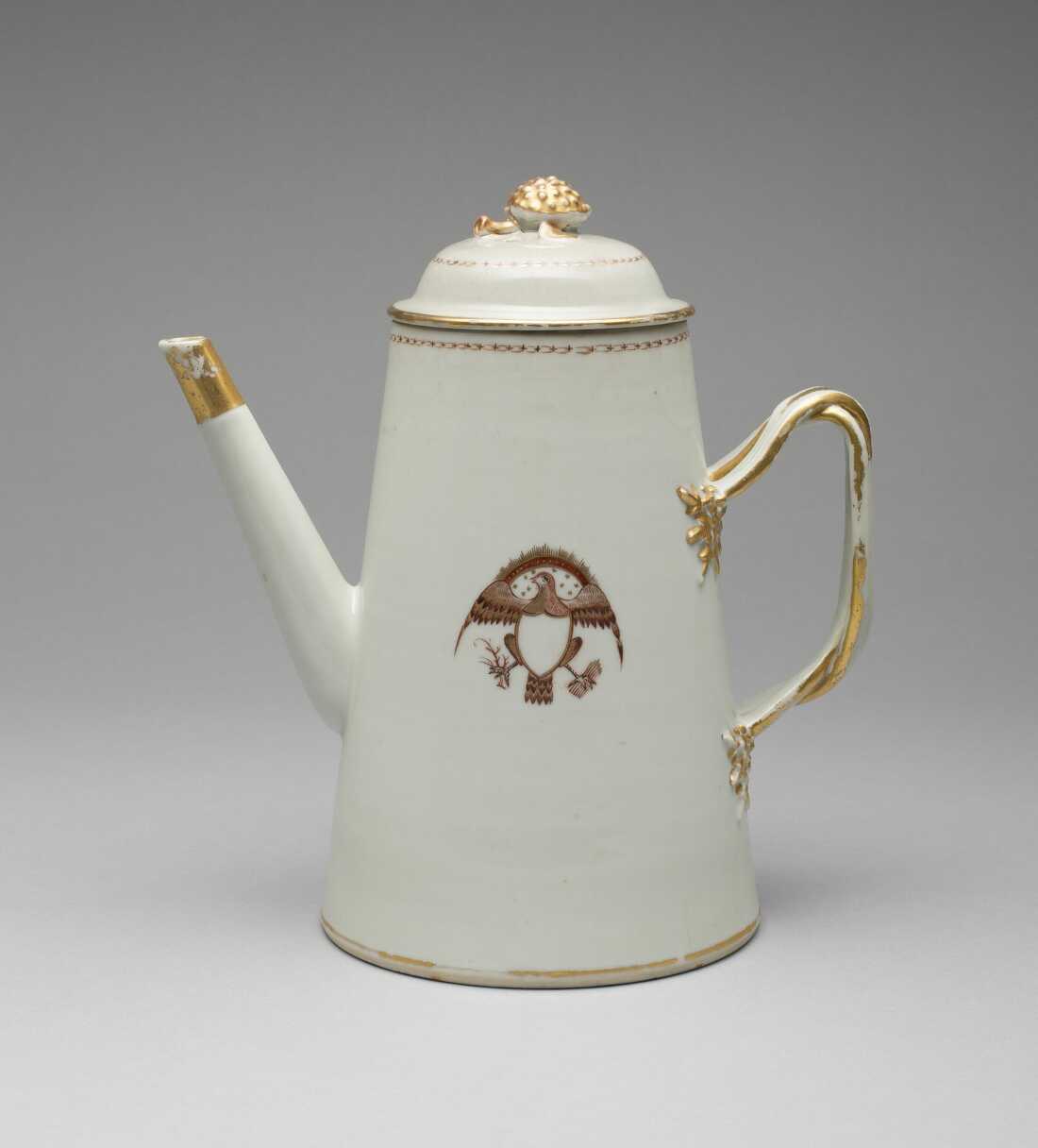
A coffeepot with cover, circa 1795. It has an American eagle motif, made in China for the American market. Coffee was part of a growing trend of globalization in the colonial era.
Heritage Art/Heritage Images via Getty Images
hide caption
toggle caption
Heritage Art/Heritage Images via Getty Images
In the colonial era, coffeehouses were hotbeds for seditious thought — where people planned acts of revolution.
“Coffeehouses are kind of famous for being places where people think and plot things,” says Mark Pendergrast, author of Uncommon Grounds: The History of Coffee and How It Transformed Our World.
A coffeehouse called the Green Dragon served as one of the locations for planning the Boston Tea Party. Years earlier, the Old London Coffeehouse in Philadelphia was a meeting place for strategizing responses to another British tax, the Stamp Act of 1765.
In Britain, coffeehouses were nicknamed “penny universities,” Pendergrast says: “because for a penny you could go and learn a whole lot by sitting around in a coffeehouse and discussing everything.” The same attitude traveled across the Atlantic.
Early American coffeehouses would commonly have city business directories, libraries of newspapers and currency exchange information. People could get maritime insurance there or buy things at auction.

“There’s a reason why coffeehouses become places of colonial protest … in the 1760s, in the 1770s, and it’s because it is the place where traders and merchants tended to gather,” historian McDonald says. “That’s where they heard about the economics of the day.”
Taverns were more likely than coffeehouses to have rooms for rent and stables for travelers’ horses. They were also more likely to have food.
Interestingly enough, coffeehouses could serve alcohol and taverns could serve coffee.
But the vibes at each were different. While women and men could “riotously drink together” in taverns, coffeehouses often didn’t allow women, according to Chaplin of Harvard.
“The sense was the coffeehouse was the place where you had a clear head — to argue about politics, to find out what was going on in the business world, to cut a business deal,” she says. “Whereas taverns were places where, in a sense, you refueled.”
Still, she says, the lines between the two “weren’t completely clear.”
The cost of America’s revolutionary drink
Coffee (and tea for that matter) was part of a growing globalization of trade around this time.
Much of the coffee in the colonies was grown in the Caribbean, while tea came from China.

Supply was up and coffee was easier than ever to drink. “Trade and frankly, imperialism, are making it possible for … colonial products to be produced and transferred to other parts of the world in greater and greater quantities,” says Chaplin.
As a result, by the time of the American Revolution, both coffee and tea were in reach for many common people. “They’re both becoming affordable luxuries,” Chaplin says.
Fancy coffee and tea paraphernalia were also part of this increasingly global market. Middle and upper-class people would have wanted special implements for drinking these beverages and a place to drink it. That meant they needed wood for coffee tables, silver for coffeepots, and porcelain for teapots.
“These two beverages are encouraging people to consume all kinds of new stuff,” says Chaplin. “The mahogany that comes out of the Caribbean, the china coming out of China, silver that is mined principally in South and Central America and processed in a lot of the parts of the world.”
There’s a dark side to coffee’s history, too. The plantations that supplied the crop ran on the labor of enslaved people. By 1790, half of the world’s coffee was being grown in the French colony of Saint-Domingue, in what is today Haiti, Pendergrast says, where slaves were routinely mistreated, raped and murdered.

The Declaration of Independence, signed in 1776, is infamous for a contradiction. It proclaimed that “all men are created equal,” but failed to acknowledge the hundreds of thousands of enslaved people living in America at the time.
Coffee carried a similar contradiction. The beverage that fueled conversations that inspired America’s fight for independence — centered on the ideals of life, liberty and the pursuit of happiness — depended on enslavement.
“Coffee had this paradoxical effect, that it did promote revolutionary thought,” Pendergrast says. “But it was also grown by slaves.”
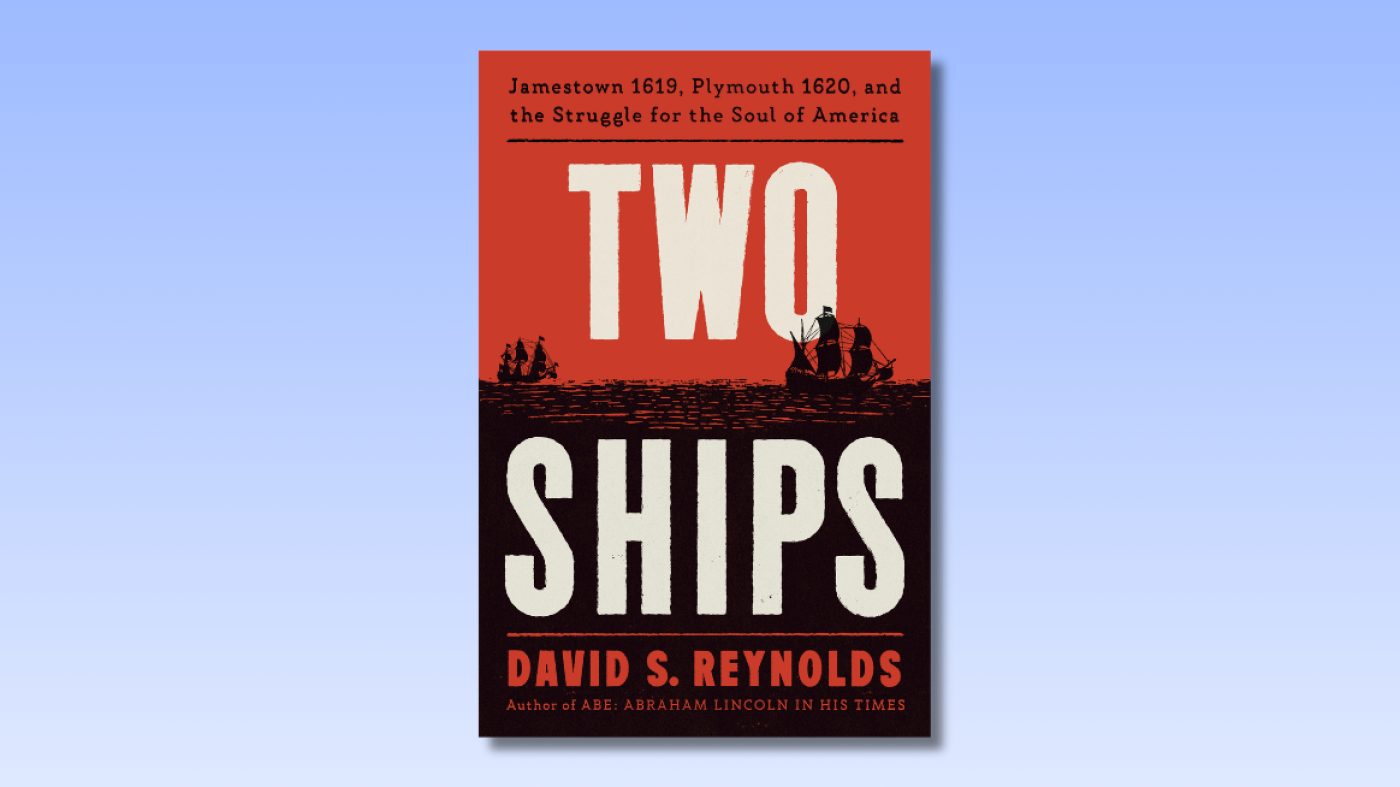
Just in time for a contentious 250th anniversary of the United States of America, historian David S. Reynolds’ latest book, Two Ships, helps us realize that any country that couldn’t agree on its own origin story is destined for divisive times.
Two Ships is about the complicated, conjoined legacy of the landings of the Mayflower, which carried the Pilgrims to Plymouth, Mass., in 1620, and the White Lion, which arrived in Jamestown a year earlier, bringing the first enslaved Africans to Virginia.
As Reynolds demonstrates, it’s not so much the facts of these two voyages, as it is the meanings ascribed to them, that made them such a powerful metaphor for two conflicting visions of American identity.
To simplify, the Mayflower’s passengers were separatist Puritans, dissenters to the reign of the English king, James I. As the United States developed, the Mayflower was credited with carrying the seeds of a radical democracy to the New World, one in which all men (in theory, at least) were equal before God.
In contrast, the European settlers of Jamestown were Royalists, also known as Cavaliers. Loyal to the monarchy, they believed in a strict hierarchy.
But the meaning of the images of the two ships shifted depended on who was invoking them and when. Not surprisingly, the metaphor was deployed most vigorously during the Civil War. In abolitionist speeches and writings, the White Lion or the “Slave-Ship,” as it was commonly called, was condemned for infecting America with the “plague-spot” of slavery.
Reynolds says that Frederick Douglass resorted to the “two ships” metaphor frequently, while Lincoln avoided it, hoping to preserve a unified ship of state. Meanwhile, Southern descendants of Cavaliers invoked the Mayflower to emphasize the intolerance and “cruel, persecuting” character of the Puritans. In a comment that resonates for our own times, Reynolds says:
It didn’t matter to the South that … by the mid-nineteenth century, the North had become a kaleidoscope of religious denominations, …, few of which resembled the faith of the Plymouth colonists. Distortion is intrinsic to cultural memory, especially when amplified by sectional or political bias. For Southerners, the Mayflower had brought Puritanism, which had yielded fanatical movements like abolitionism, now a dire threat to the Union.
In a brief-but-fascinating digression into the unpredictable power of literary fiction, Reynolds observes that the South’s fondness for Nathaniel Hawthorne’s anti-Puritan novel, The Scarlet Letter, and, even more, for the medieval historical romances of Sir Walter Scott, bolstered its nostalgia for a largely-imagined feudal society.

Reynolds quotes the always-quotable Mark Twain, no fan of Scott’s, as saying that Scott “did measureless harm; more real and lasting harm, perhaps, than any other individual that ever wrote …”
Two Ships is a dazzling survey of some three centuries of American history through a close reading of a metaphor. By the 1890s, Reynolds says, the interpretive tide had turned again: “Southern and Northern whites, feeling threatened by people of color and by an array of European immigrants, were retreating to a cocoon of racial solidarity that Mayflower celebrations helped reinforce.”
By the later-20th century, the image of the Mayflower was depoliticized and commercialized into Pilgrim hats and Black Friday sales. The powerful metaphor of the two ships receded into the mist.
Seven years ago, however, the 1619 Project piloted the White Lion — “The Slave-Ship” — back into view and anchored it at the center of debates about slavery’s place in the national story. The 1619 Project has been faulted for its historiography, and it does lie outside of the chronological boundaries of Reynolds’ book; still, it seems too momentous a reappearance of the White Lion not to at least acknowledge in this book.
That criticism noted, I think reading Two Ships would be an excellent way to observe this particular Fourth of July. It’s wise for all of us to have a more informed awareness of how Americans have understood, misunderstood and, often, flattened each other into stereotypes. Or, as Ernest Hemingway, one of the Mayflower Pilgrims’ more cynical descendants, might say in response to that sentiment: “Isn’t it pretty to think so?”

-
 Sports7 minutes ago
‘It just feels right.’ Folarin Balogun can play in World Cup round of 16 after red card suspended
-

 World15 minutes ago
Thousands gather in Tirana in major ‘Pink Flamingo’ protests
-

 News40 minutes ago
At least 25 people die in US as record heatwave scorches swaths of country
-

 Los Angeles, Ca2 hours ago
Huntington Park announces street closures ahead of Mexico World Cup match
-

 Detroit, MI2 hours ago
Mallory McMorrow drops out of Michigan’s US Senate race
-

 San Francisco, CA2 hours ago
Waymo Vehicle Catches Fire in San Francisco
-

 Dallas, TX3 hours ago
Dallas police and fire teams seize of nearly a ton of illegal fireworks
-

 Miami, FL3 hours ago
Triple shooting, crash sends adults to hospital, Miramar police say

