Mississippi
As Climate Threats to Agriculture Mount, Could the Mississippi River Delta Be the Next California? – Inside Climate News


This story was originally published by The Tennessee Lookout.
A smorgasbord of bright red tomatoes and vibrant vegetables line the walls of Michael Katrutsa’s produce shop in rural Camden, Tennessee. What began a decade ago as a roadside farm stand is now an air-conditioned outbuilding packed with crates of watermelon, cantaloupe and his locally renowned sweet corn — all picked fresh by a handful of local employees each morning.
The roughly 20-acre farm west of the Tennessee River sells about half of its produce through his shop, with the rest going to the wholesale market.
Farms like Katrutsa’s make up just a sliver of roughly 10.7 million acres of Tennessee farmland largely dominated by hay, soybeans, corn and cotton. Specialized machines help farmers harvest vast quantities of these commodity “row crops,” but Katrutsa said the startup cost was too steep for him. While specialty crops like produce are more labor-intensive, requiring near-constant attention from early July up until the first frost in October, Katrutsa said he takes pride in feeding his neighbors.
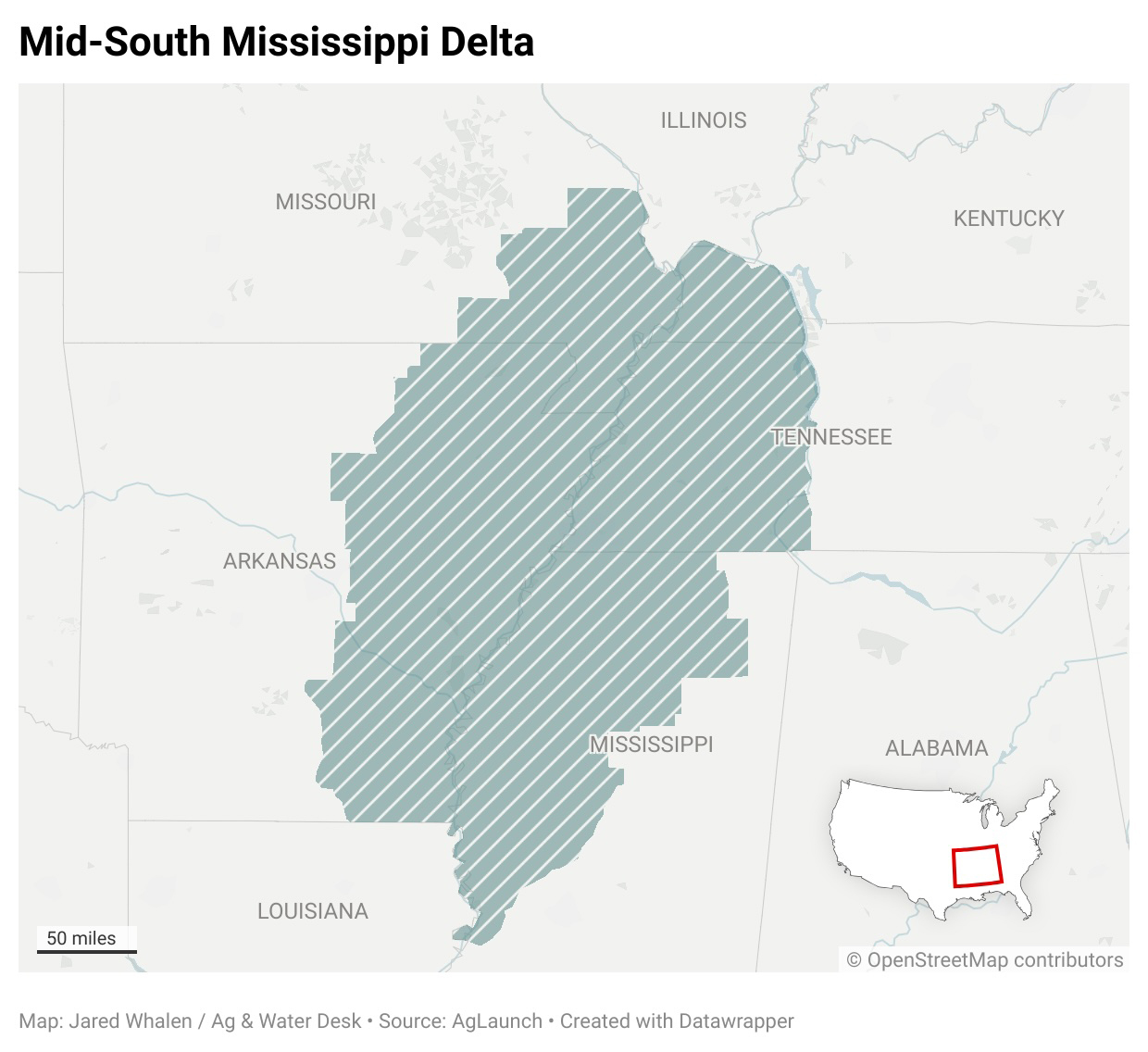
The World Wildlife Fund sees farms in the mid-Mississippi delta as ripe with opportunity to become a new mecca for commercial-scale American produce. California currently grows nearly three-quarters of the nation’s fruits and nuts and more than a third of its vegetables.

Explore the latest news about what’s at stake for the climate during this election season.
But as climate change compounds the threats of water scarcity, extreme weather and wildfires on California’s resources, WWF’s Markets Institute is exploring what it would take for farmers in West Tennessee, Mississippi and Arkansas to embrace — and equitably profit from — specialty crop production like strawberries, lettuce or walnuts.
Specialty crops make up only 0.19% of the region’s farm acreage, but their higher sale value allows them to generate 1.08% of the region’s agriculture revenue, according to WWF’s May report, called The Next California, spearheaded by Markets Institute Senior Director Julia Kurnik. She argues that there’s an opportunity to proactively create more inclusive, higher-yield business models on existing farms, preventing natural ecosystems from being unnecessarily transformed into farmland.
But shifting produce growth to the Mid-Delta comes with hurdles: it requires buyers willing to try new markets, understanding of new crops’ diseases and needs, specialized equipment like cold storage and lots of expensive hands-on labor.
“It is not as simple as a farmer simply putting new crops in the ground,” Kurnik said.
Early Adopters Put Idea to the Test
Sixth-generation Arkansas farmer Hallie Shoffner is putting WWF’s models to the test through a nonprofit called the Delta Harvest Food Hub. The hub works with Black and women farmers to pilot the scalability of growing specialty crops in the Delta region, starting with specialty rice.
Shoffner grows basmati, jasmine, sushi rice, sake rice seeds and more on her 2,000-acre, century-old farm located in an unincorporated town outside Newport, Arkansas. She’s skeptical about a full switch to produce, but sees specialty rice products as “low-hanging fruit” easily adopted in the mid-Delta, where commodity rice is already widely grown.
The United States is the fifth-largest rice exporter in the world, and Arkansas is the country’s top producer, with other Mississippi River valley states not far behind. But the majority of specialty rice is grown in California or imported from East Asian countries.


“We are forward-thinking farmers who want to change, who want to do something different,” Shoffner said. “We want to make more money, because we know we cannot make as much money as small farms in the current agricultural economy.”
The commodity farming that dominates Delta agriculture makes the economic success of farmers largely dependent on the market prices of rice, corn, soybeans, wheat and other crops, Shoffner said. This incentivizes farms to grow larger to ensure they turn a profit even when prices are low, like they are now. But smaller farms struggle to stay afloat.
Shoffner said her vision for developing specialty crop markets in Arkansas will be through more collaboration between many smaller farms to diversify crop production and produce for large contracts together. She’s also exploring possibilities for expanding chickpea, sunflower, sesame and pea production in Arkansas.
And while she’s at it, Shoffner is working to make agriculture more equitable.
“As a white farmer who is a sixth generation farmer, I realize that I have inherited a large amount of land that systematically disenfranchised Black farmers,” Shoffner said. “And it is my responsibility to acknowledge that, and leverage what I’ve been given to help others.”
Her project, Delta Harvest, has a contract to grow specialty rice with a large company and she’s working with several Black farmers. She was too small to do it by herself, so they are doing it cooperatively.
Finding the Right Markets
In Mississippi, efforts to shift some of California’s sprawling specialty crop industry to the Mid-Delta drew skepticism from some farmers—even those with established specialty crop operations.
For the past 20 years, Don van de Werken has co-owned a 120-acre blueberry and tea farm in Poplarville, Mississippi, distributing much of its crops to buyers in his county and nearby cities.
Van de Werken questioned whether there would be enough regional demand to sustain a scaled-up specialty crop industry in Mississippi, noting that the success of his own enterprise hinges on targeting hyper-local markets like New Orleans. Shipping vegetables, fruits and other produce to buyers outside the Delta region would quickly become cost prohibitive for local farmers, van de Werken said.
“The problem we have, not just in Mississippi but the mid South in general, is we just don’t have the population base,” said van de Werken, who is also president of the Gulf South Blueberry Growers Association. “We don’t want our blueberries to go to Maine or Seattle. We want to focus our produce in a regional market.”

To make growing specialty crops worthwhile, Mississippi farmers would need to identify nearby buyers willing to purchase the new products on a consistent basis, van de Werken said. While selling goods directly to retail grocery chains like Kroger is often difficult, farmers could reduce financial risks by signing purchasing agreements with regional brokers like Louisiana-based Capitol City Produce.
“Anybody that puts anything in the ground is already taking a risk, but you want to minimize that risk,” he explained. “If you can prove to the brokers and the buyers that they can make money doing this, then the farming will come.”
The WWF report investigates ways to distribute risk across the supply chain to make selling to new markets easier on farmers, and works to connect buyers with Mid-Delta farmers.
AgLaunch, a Memphis-based nonprofit that guides farmers in innovation, estimates that adding specialty crops to the Mid-Delta region could spur $4.6 billion in added revenue and 33,000 jobs. But while commodity crop prices are readily available on the Chicago Board of Trade, the specialty crop market is generally not so transparent. Large, vertically integrated companies usually dictate contract terms, AgLaunch President and farmer Pete Nelson said.
AgLaunch helps build “smart contracts” that allow multiple farmers to produce on a contract, helping them secure higher quantity deals with proper compensation as a collective.
This story is funded by readers like you.
Our nonprofit newsroom provides award-winning climate coverage free of charge and advertising. We rely on donations from readers like you to keep going. Please donate now to support our work.
Donate Now
Purdue College of Agriculture professor Fred Whitford said the idea of farming cooperatives that help smaller farmers carve out space in a large-quantity market is more than 100 years old. Whitford compared commodity producers to retail giants like Walmart, which make money by selling in bulk. Small producers are more like Ace Hardware, he said.
“Maybe the smaller folks have an ability to make more off their land by going to a specialty crop,” he said.
New Challenges Need New Solutions
Farmers who embrace specialty crops will face hurdles before they make it to the market.
Growing produce can be more profitable but “easier said than done,” Whitford said. “It’s nice on paper … but boy, in reality, you’re going to have to keep an eye on this crop, whatever you’re growing, because one slip up … then you have lost a lot of money.”
In Tennessee, Katrutsa grew strawberries in addition to his other crops for 10 years, but last April, a hail storm pulverized his entire field, leaving him with nothing. He’s not growing strawberries this year, and he might not plant them again — he’s not sure if he can find enough labor to make it work.
He grows many types of produce so if one fails, it’s less catastrophic. He sources seedlings from a neighboring state (it’s cheaper than growing from seed) and plants five times each season to maximize yield.
He works with a consultant to help identify diseases and how to treat them. Tomatoes are the most challenging, Katrutsa said. Some of his tomato plants withered this year due to bacterial wilt that flourishes in wet soil and high temperatures and has few effective chemical remedies.
Carolyn Preble helps out farmer Michael Katrutsa at the farm shop, which stocks the more than 20 acres of produce Katrutsa grows in rural Camden, Tennessee. Credit: John Partipilo/Tennessee Lookout
Chemical treatments pose other challenges. In Shaw, Mississippi, Michael Muzzi relies on a range of herbicides to grow soybeans and other feed grains on his 2,000-acre farm. Once sprayed, herbicides like Liberty and Dicamba remain in the ground and can drift in the air, which is hazardous to specialty crops, like tomatoes, that aren’t resistant.
“You’re not going to be able to spray [those herbicides] on specialty crops,” Muzzi said. “You’d have to have something that’s chemically tolerant.”
Growing fruits and vegetables on a farm with previous heavy herbicide use would require insulating those crops from chemical runoff — a feat that could only be reliably achieved by leaving whole acres of land unused for years, he said.
AgLaunch is exploring innovative ways to address these problems. For some farmers, this means helping make their existing row crops more efficient using farmer-incubated technology, adding local value by growing specialty crops or taking on processing, Nelson said.
Then there’s disruption with higher risk: farmers can partner with agriculture automation technology startups, allowing them to field test their products and collect data in exchange for farmer equity in the startup companies. If the startup succeeds, the farmer shares in the benefits.
“It’s not as simple as, ‘Hey, we should grow tomatoes,’” Nelson said. “It’s how you think about the whole value chain and make sure the farmer is protected. Make sure it’s not an opportunity just to grow a crop, but it’s an opportunity to own part of the processing or to build new products.”
Kurnik said WWF isn’t trying to recruit farmers to start growing specialty crops – they just want Mid-Delta farmers to have the information they need to make informed decisions. In terms of acreage, row crops “dwarf” specialty crops in the United States. A small percentage shift would mean a significant change in the level of specialty crops in the Delta.
“We don’t need everyone to want to jump on board tomorrow,” she said. “They would flood the market if they did.”
This story is a product of the Mississippi River Basin Ag & Water Desk, an independent reporting network based at the University of Missouri in partnership with Report for America, with major funding from the Walton Family Foundation. Disclosure: The Next California report was also funded by Walton.
About This Story
Perhaps you noticed: This story, like all the news we publish, is free to read. That’s because Inside Climate News is a 501c3 nonprofit organization. We do not charge a subscription fee, lock our news behind a paywall, or clutter our website with ads. We make our news on climate and the environment freely available to you and anyone who wants it.
That’s not all. We also share our news for free with scores of other media organizations around the country. Many of them can’t afford to do environmental journalism of their own. We’ve built bureaus from coast to coast to report local stories, collaborate with local newsrooms and co-publish articles so that this vital work is shared as widely as possible.
Two of us launched ICN in 2007. Six years later we earned a Pulitzer Prize for National Reporting, and now we run the oldest and largest dedicated climate newsroom in the nation. We tell the story in all its complexity. We hold polluters accountable. We expose environmental injustice. We debunk misinformation. We scrutinize solutions and inspire action.
Donations from readers like you fund every aspect of what we do. If you don’t already, will you support our ongoing work, our reporting on the biggest crisis facing our planet, and help us reach even more readers in more places?
Please take a moment to make a tax-deductible donation. Every one of them makes a difference.
Thank you,


MISSISSIPPI COUNTY, Mo. (KFVS) – A 10-year-old girl is seriously injured following a UTV crash on Friday, June 26.
According to the Missouri State Highway Patrol’s crash report, a 10-year-old girl from Sikeston was driving a UTV southbound on Levee Road, 11 miles east of East Prairie.
MSHP said the crash occurred around 11 a.m. as the vehicle travelled off the left side of the roadway, returned to the road and then overturned.
The girl was taken by ambulance to a hospital in Cape Girardeau for serious injuries.
Copyright 2026 KFVS. All rights reserved.


IRS raises 401(k) contribution limits for 2026
IRS increases 401(k) and catch-up contribution limits for 2026, allowing workers to save up to $32,500 for retirement.
Many Americans worry their retirement savings won’t last — and a new report suggests that fear may be justified in Mississippi.
Surveys have shown that Americans fear running out of money in retirement more than they fear death itself. People are living longer, which means retirement lasts longer, and retirement costs are rising.
A new report from CareScout, the long-term care network, finds that the average American at age 65 faces a retirement shortfall of $109,000. That’s the difference between how much income they can expect, from Social Security, savings and other sources, and how much they should plan to spend on the expenses of daily life.
American retirees are likely to outlive their savings in 41 states, according to the data.
The report draws on state-level estimates of life expectancy at age 65 (16 to 20 years, more or less, depending on the state), average retirement benefits, median net worth and expected retirement expenses.
How likely are you to outlive your retirement savings in Mississippi? Here’s what we know about life expectancy, expenses and how much retiring here costs.
Mississippi retirees face a $160K savings gap
The average Mississippi senior can expect about $682,000 in expenses and $521,000 in income in retirement. Projected shortfall: $160,000.
It’s the 13th-largest shortfall in the U.S.
The state has some of the most affordable food costs and home prices in the country, but overall wages are also much lower than the national average.
What’s a realistic retirement age in Mississippi?
Nasdaq studied realistic retirement numbers for each state. For Mississippi, they determined that a realistic retirement age is 61 and recommend having at least $764,676 saved.
Mississippi residents aren’t taxed on income from:
- Social Security benefits
- IRAs
- 401(k)s
- Pensions
- Military benefits
The state income tax is also being phased out.
How long Mississippians live after age 65
Mississippi ranked next-to-last for life expectancy in a CDC list of all 50 states and the District of Columbia. Data from 2022 is the newest available.
The Magnolia State had an average life expectancy of 72.6 years.
For men, Mississippi ranked 51st at 69.5 years. Women ranked 50th with an average life expectancy of 75.7.
At age 65, people in Mississippi are expected to live another 16.7 years, on average. It’s about 15.3 years for men and 17.9 years for women.
Retirement may last longer than you think
American life expectancy is about 79 years. By the time you reach retirement, however, you can expect to live longer than the overall life expectancy figure suggests. A woman of 70, for example, can expect to live to 87.
Many older Americans don’t know how long their own retirement is going to last: in other words, how long they are going to live.
Longevity literacy matters in retirement planning. If your retirement budget assumes you will live to 75, and you make it to 95, you will probably run out of money.
How to make your retirement savings last
Don’t want to outlive your savings? Here are some tips from the experts.
Ways to grow your retirement account faster
One surefire way to build retirement savings is to make aggressive contributions to a workplace retirement account.
The most successful retirement savers typically start saving early, contribute at least 10% of their income to a 401(k)-type account, and save continuously until they retire.
And try not to raid your retirement savings for a household expense. Instead, open an emergency savings account.
How timing Social Security affects your monthly check
The longer you wait to claim Social Security, the larger your monthly benefit checks will be.
Based on the longevity figures above, you’re generally better off claiming Social Security later in life, if you can afford to wait. Ideally, wait until age 70, when your monthly benefit maxes out.
In a 2025 story, USA TODAY explained the math behind that rule of thumb.
Mississippi cities certified for retirement living
There are 13 cities and towns in the Mississippi Hometown Retirement Program, also known as Welcome Home Mississippi.
The program encourages more people to retire in the Magnolia State. It uses no state income tax on retirement income, a tax exemption on the first $75,000 of a home’s true value and no state gift or inheritance taxes as selling points.
Certified cities “maintain high standards and boast many of the qualities and amenities retirees often seek when choosing a retirement destination,” according to the Welcome Home website.
Cities in the program include:
Daniel de Visé covers personal finance for USA Today and writes the Daily Money newsletter.
Bonnie Bolden is the Deep South Connect reporter for Mississippi with USA TODAY Network. Email her at bbolden@usatodayco.com.

Odds of winning the Powerball and Mega Millions are NOT in your favor
Odds of hitting the jackpot in Mega Millions or Powerball are around 1-in-292 million. Here are things that you’re more likely to land than big bucks.
The Mississippi Lottery offers several draw games for those aiming to win big.
Here’s a look at June 25, 2026, results for each game:
Winning Mississippi Match 5 numbers from June 25 drawing
01-06-09-13-23
Check Mississippi Match 5 payouts and previous drawings here.
Winning Cash 3 numbers from June 25 drawing
Midday: 3-3-8, FB: 5
Evening: 4-0-8, FB: 7
Check Cash 3 payouts and previous drawings here.
Winning Cash 4 numbers from June 25 drawing
Midday: 2-8-3-2, FB: 5
Evening: 5-0-3-2, FB: 7
Check Cash 4 payouts and previous drawings here.
Winning Cash Pop numbers from June 25 drawing
Midday: 01
Evening: 07
Check Cash Pop payouts and previous drawings here.
Feeling lucky? Explore the latest lottery news & results
Story continues below gallery.
Are you a winner? Here’s how to claim your lottery prize
Winnings of $599 or less can be claimed at any authorized Mississippi Lottery retailer.
Prizes between $600 and $99,999, may be claimed at the Mississippi Lottery Headquarters or by mail. Mississippi Lottery Winner Claim form, proper identification (ID) and the original ticket must be provided for all claims of $600 or more. If mailing, send required documentation to:
Mississippi Lottery Corporation
P.O. Box 321462
Flowood, MS
39232
If your prize is $100,000 or more, the claim must be made in person at the Mississippi Lottery headquarters. Please bring identification, such as a government-issued photo ID and a Social Security card to verify your identity. Winners of large prizes may also have the option of setting up electronic funds transfer (EFT) for direct deposits into a bank account.
Mississippi Lottery Headquarters
1080 River Oaks Drive, Bldg. B-100
Flowood, MS
39232
Mississippi Lottery prizes must be claimed within 180 days of the drawing date. For detailed instructions and necessary forms, please visit the Mississippi Lottery claim page.
When are the Mississippi Lottery drawings held?
- Cash 3: Daily at 2:30 p.m. (Midday) and 9:30 p.m. (Evening).
- Cash 4: Daily at 2:30 p.m. (Midday) and 9:30 p.m. (Evening).
- Match 5: Daily at 9:30 p.m. CT.
- Cash Pop: Daily at 2:30 p.m. (Midday) and 9:30 p.m. (Evening).
This results page was generated automatically using information from TinBu and a template written and reviewed by a Mississippi editor. You can send feedback using this form.
-

 Michigan2 minutes ago
Michigan Lottery Daily 3, Daily 4 results for June 26, 2026
-

 Massachusetts9 minutes ago
As Mass. ballot initiatives multiply, critics want to limit them
-

 Minnesota12 minutes ago
Minnesota man accused in a $250M fraud scheme taken into custody in Somalia | CNN
-

 Mississippi17 minutes ago
10-year-old seriously injured in Mississippi County UTV crash
-

 Missouri24 minutes ago
First-generation-American students remind Missouri politicians why unity, freedom of speech are so important ahead of the nation’s 250th anniversary
-
Montana27 minutes ago
Montana Lottery Mega Millions, Big Sky Bonus results for June 26, 2026
-

 Nebraska32 minutes ago
Nebraska QB commit Trae Taylor wins Elite 11 MVP
-

 Nevada39 minutes ago
After transgender sports ballot initiative dropped, proposal introduced for ‘27 Nevada Legislature

