Mississippi
As Climate Threats to Agriculture Mount, Could the Mississippi River Delta Be the Next California? – Inside Climate News


This story was originally published by The Tennessee Lookout.
A smorgasbord of bright red tomatoes and vibrant vegetables line the walls of Michael Katrutsa’s produce shop in rural Camden, Tennessee. What began a decade ago as a roadside farm stand is now an air-conditioned outbuilding packed with crates of watermelon, cantaloupe and his locally renowned sweet corn — all picked fresh by a handful of local employees each morning.
The roughly 20-acre farm west of the Tennessee River sells about half of its produce through his shop, with the rest going to the wholesale market.
Farms like Katrutsa’s make up just a sliver of roughly 10.7 million acres of Tennessee farmland largely dominated by hay, soybeans, corn and cotton. Specialized machines help farmers harvest vast quantities of these commodity “row crops,” but Katrutsa said the startup cost was too steep for him. While specialty crops like produce are more labor-intensive, requiring near-constant attention from early July up until the first frost in October, Katrutsa said he takes pride in feeding his neighbors.
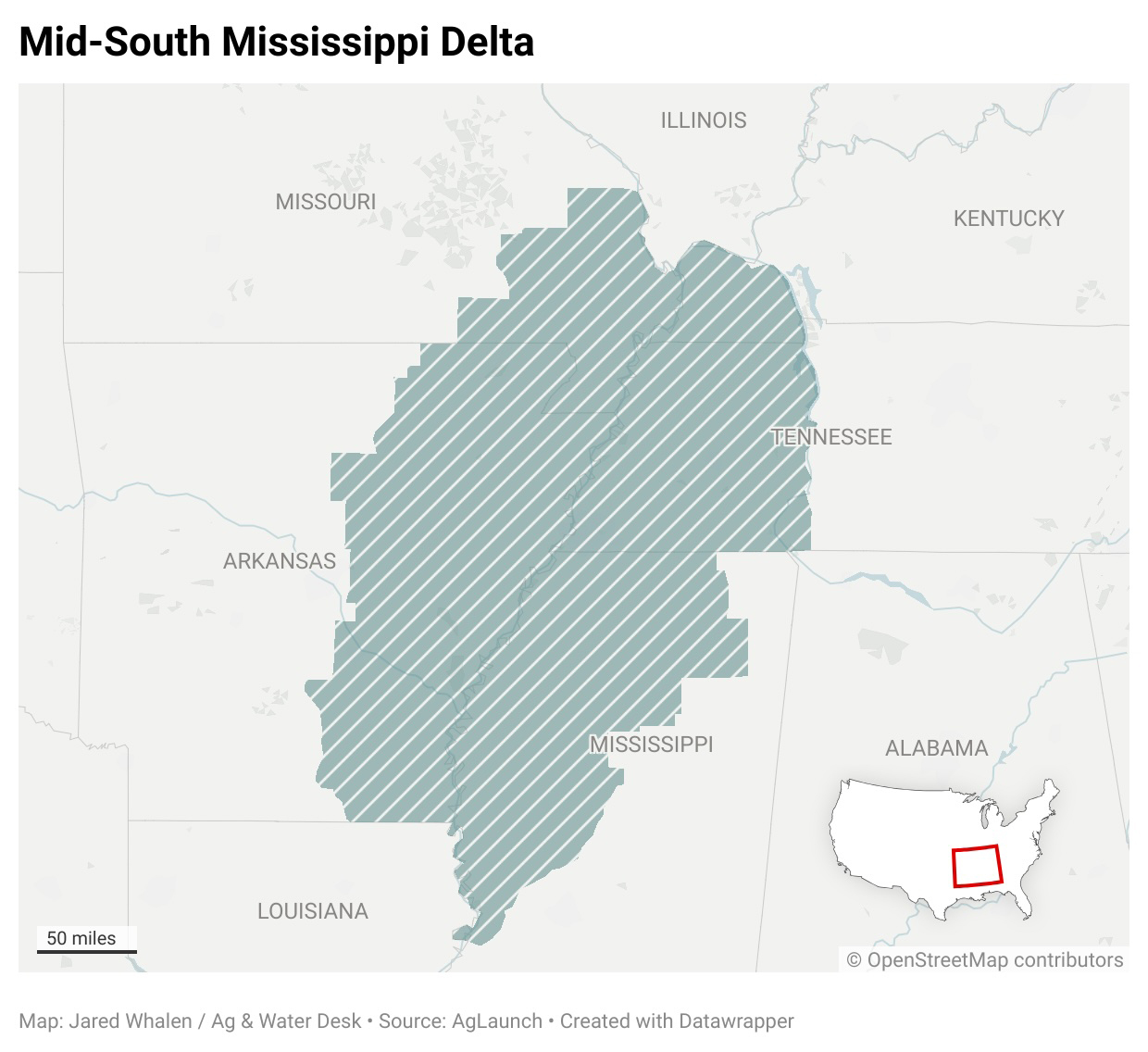
The World Wildlife Fund sees farms in the mid-Mississippi delta as ripe with opportunity to become a new mecca for commercial-scale American produce. California currently grows nearly three-quarters of the nation’s fruits and nuts and more than a third of its vegetables.

Explore the latest news about what’s at stake for the climate during this election season.
But as climate change compounds the threats of water scarcity, extreme weather and wildfires on California’s resources, WWF’s Markets Institute is exploring what it would take for farmers in West Tennessee, Mississippi and Arkansas to embrace — and equitably profit from — specialty crop production like strawberries, lettuce or walnuts.
Specialty crops make up only 0.19% of the region’s farm acreage, but their higher sale value allows them to generate 1.08% of the region’s agriculture revenue, according to WWF’s May report, called The Next California, spearheaded by Markets Institute Senior Director Julia Kurnik. She argues that there’s an opportunity to proactively create more inclusive, higher-yield business models on existing farms, preventing natural ecosystems from being unnecessarily transformed into farmland.
But shifting produce growth to the Mid-Delta comes with hurdles: it requires buyers willing to try new markets, understanding of new crops’ diseases and needs, specialized equipment like cold storage and lots of expensive hands-on labor.
“It is not as simple as a farmer simply putting new crops in the ground,” Kurnik said.
Early Adopters Put Idea to the Test
Sixth-generation Arkansas farmer Hallie Shoffner is putting WWF’s models to the test through a nonprofit called the Delta Harvest Food Hub. The hub works with Black and women farmers to pilot the scalability of growing specialty crops in the Delta region, starting with specialty rice.
Shoffner grows basmati, jasmine, sushi rice, sake rice seeds and more on her 2,000-acre, century-old farm located in an unincorporated town outside Newport, Arkansas. She’s skeptical about a full switch to produce, but sees specialty rice products as “low-hanging fruit” easily adopted in the mid-Delta, where commodity rice is already widely grown.
The United States is the fifth-largest rice exporter in the world, and Arkansas is the country’s top producer, with other Mississippi River valley states not far behind. But the majority of specialty rice is grown in California or imported from East Asian countries.


“We are forward-thinking farmers who want to change, who want to do something different,” Shoffner said. “We want to make more money, because we know we cannot make as much money as small farms in the current agricultural economy.”
The commodity farming that dominates Delta agriculture makes the economic success of farmers largely dependent on the market prices of rice, corn, soybeans, wheat and other crops, Shoffner said. This incentivizes farms to grow larger to ensure they turn a profit even when prices are low, like they are now. But smaller farms struggle to stay afloat.
Shoffner said her vision for developing specialty crop markets in Arkansas will be through more collaboration between many smaller farms to diversify crop production and produce for large contracts together. She’s also exploring possibilities for expanding chickpea, sunflower, sesame and pea production in Arkansas.
And while she’s at it, Shoffner is working to make agriculture more equitable.
“As a white farmer who is a sixth generation farmer, I realize that I have inherited a large amount of land that systematically disenfranchised Black farmers,” Shoffner said. “And it is my responsibility to acknowledge that, and leverage what I’ve been given to help others.”
Her project, Delta Harvest, has a contract to grow specialty rice with a large company and she’s working with several Black farmers. She was too small to do it by herself, so they are doing it cooperatively.
Finding the Right Markets
In Mississippi, efforts to shift some of California’s sprawling specialty crop industry to the Mid-Delta drew skepticism from some farmers—even those with established specialty crop operations.
For the past 20 years, Don van de Werken has co-owned a 120-acre blueberry and tea farm in Poplarville, Mississippi, distributing much of its crops to buyers in his county and nearby cities.
Van de Werken questioned whether there would be enough regional demand to sustain a scaled-up specialty crop industry in Mississippi, noting that the success of his own enterprise hinges on targeting hyper-local markets like New Orleans. Shipping vegetables, fruits and other produce to buyers outside the Delta region would quickly become cost prohibitive for local farmers, van de Werken said.
“The problem we have, not just in Mississippi but the mid South in general, is we just don’t have the population base,” said van de Werken, who is also president of the Gulf South Blueberry Growers Association. “We don’t want our blueberries to go to Maine or Seattle. We want to focus our produce in a regional market.”

To make growing specialty crops worthwhile, Mississippi farmers would need to identify nearby buyers willing to purchase the new products on a consistent basis, van de Werken said. While selling goods directly to retail grocery chains like Kroger is often difficult, farmers could reduce financial risks by signing purchasing agreements with regional brokers like Louisiana-based Capitol City Produce.
“Anybody that puts anything in the ground is already taking a risk, but you want to minimize that risk,” he explained. “If you can prove to the brokers and the buyers that they can make money doing this, then the farming will come.”
The WWF report investigates ways to distribute risk across the supply chain to make selling to new markets easier on farmers, and works to connect buyers with Mid-Delta farmers.
AgLaunch, a Memphis-based nonprofit that guides farmers in innovation, estimates that adding specialty crops to the Mid-Delta region could spur $4.6 billion in added revenue and 33,000 jobs. But while commodity crop prices are readily available on the Chicago Board of Trade, the specialty crop market is generally not so transparent. Large, vertically integrated companies usually dictate contract terms, AgLaunch President and farmer Pete Nelson said.
AgLaunch helps build “smart contracts” that allow multiple farmers to produce on a contract, helping them secure higher quantity deals with proper compensation as a collective.
This story is funded by readers like you.
Our nonprofit newsroom provides award-winning climate coverage free of charge and advertising. We rely on donations from readers like you to keep going. Please donate now to support our work.
Donate Now
Purdue College of Agriculture professor Fred Whitford said the idea of farming cooperatives that help smaller farmers carve out space in a large-quantity market is more than 100 years old. Whitford compared commodity producers to retail giants like Walmart, which make money by selling in bulk. Small producers are more like Ace Hardware, he said.
“Maybe the smaller folks have an ability to make more off their land by going to a specialty crop,” he said.
New Challenges Need New Solutions
Farmers who embrace specialty crops will face hurdles before they make it to the market.
Growing produce can be more profitable but “easier said than done,” Whitford said. “It’s nice on paper … but boy, in reality, you’re going to have to keep an eye on this crop, whatever you’re growing, because one slip up … then you have lost a lot of money.”
In Tennessee, Katrutsa grew strawberries in addition to his other crops for 10 years, but last April, a hail storm pulverized his entire field, leaving him with nothing. He’s not growing strawberries this year, and he might not plant them again — he’s not sure if he can find enough labor to make it work.
He grows many types of produce so if one fails, it’s less catastrophic. He sources seedlings from a neighboring state (it’s cheaper than growing from seed) and plants five times each season to maximize yield.
He works with a consultant to help identify diseases and how to treat them. Tomatoes are the most challenging, Katrutsa said. Some of his tomato plants withered this year due to bacterial wilt that flourishes in wet soil and high temperatures and has few effective chemical remedies.
Carolyn Preble helps out farmer Michael Katrutsa at the farm shop, which stocks the more than 20 acres of produce Katrutsa grows in rural Camden, Tennessee. Credit: John Partipilo/Tennessee Lookout
Chemical treatments pose other challenges. In Shaw, Mississippi, Michael Muzzi relies on a range of herbicides to grow soybeans and other feed grains on his 2,000-acre farm. Once sprayed, herbicides like Liberty and Dicamba remain in the ground and can drift in the air, which is hazardous to specialty crops, like tomatoes, that aren’t resistant.
“You’re not going to be able to spray [those herbicides] on specialty crops,” Muzzi said. “You’d have to have something that’s chemically tolerant.”
Growing fruits and vegetables on a farm with previous heavy herbicide use would require insulating those crops from chemical runoff — a feat that could only be reliably achieved by leaving whole acres of land unused for years, he said.
AgLaunch is exploring innovative ways to address these problems. For some farmers, this means helping make their existing row crops more efficient using farmer-incubated technology, adding local value by growing specialty crops or taking on processing, Nelson said.
Then there’s disruption with higher risk: farmers can partner with agriculture automation technology startups, allowing them to field test their products and collect data in exchange for farmer equity in the startup companies. If the startup succeeds, the farmer shares in the benefits.
“It’s not as simple as, ‘Hey, we should grow tomatoes,’” Nelson said. “It’s how you think about the whole value chain and make sure the farmer is protected. Make sure it’s not an opportunity just to grow a crop, but it’s an opportunity to own part of the processing or to build new products.”
Kurnik said WWF isn’t trying to recruit farmers to start growing specialty crops – they just want Mid-Delta farmers to have the information they need to make informed decisions. In terms of acreage, row crops “dwarf” specialty crops in the United States. A small percentage shift would mean a significant change in the level of specialty crops in the Delta.
“We don’t need everyone to want to jump on board tomorrow,” she said. “They would flood the market if they did.”
This story is a product of the Mississippi River Basin Ag & Water Desk, an independent reporting network based at the University of Missouri in partnership with Report for America, with major funding from the Walton Family Foundation. Disclosure: The Next California report was also funded by Walton.
About This Story
Perhaps you noticed: This story, like all the news we publish, is free to read. That’s because Inside Climate News is a 501c3 nonprofit organization. We do not charge a subscription fee, lock our news behind a paywall, or clutter our website with ads. We make our news on climate and the environment freely available to you and anyone who wants it.
That’s not all. We also share our news for free with scores of other media organizations around the country. Many of them can’t afford to do environmental journalism of their own. We’ve built bureaus from coast to coast to report local stories, collaborate with local newsrooms and co-publish articles so that this vital work is shared as widely as possible.
Two of us launched ICN in 2007. Six years later we earned a Pulitzer Prize for National Reporting, and now we run the oldest and largest dedicated climate newsroom in the nation. We tell the story in all its complexity. We hold polluters accountable. We expose environmental injustice. We debunk misinformation. We scrutinize solutions and inspire action.
Donations from readers like you fund every aspect of what we do. If you don’t already, will you support our ongoing work, our reporting on the biggest crisis facing our planet, and help us reach even more readers in more places?
Please take a moment to make a tax-deductible donation. Every one of them makes a difference.
Thank you,



Odds of winning the Powerball and Mega Millions are NOT in your favor
Odds of hitting the jackpot in Mega Millions or Powerball are around 1-in-292 million. Here are things that you’re more likely to land than big bucks.
The Mississippi Lottery offers several draw games for those aiming to win big.
Here’s a look at July 16, 2026, results for each game:
Winning Mississippi Match 5 numbers from July 16 drawing
02-09-28-33-35
Check Mississippi Match 5 payouts and previous drawings here.
Winning Cash 3 numbers from July 16 drawing
Midday: 8-1-2, FB: 5
Evening: 8-7-4, FB: 5
Check Cash 3 payouts and previous drawings here.
Winning Cash 4 numbers from July 16 drawing
Midday: 2-0-5-6, FB: 5
Evening: 5-3-9-0, FB: 5
Check Cash 4 payouts and previous drawings here.
Winning Cash Pop numbers from July 16 drawing
Midday: 14
Evening: 10
Check Cash Pop payouts and previous drawings here.
Feeling lucky? Explore the latest lottery news & results
Story continues below gallery.
Are you a winner? Here’s how to claim your lottery prize
Winnings of $599 or less can be claimed at any authorized Mississippi Lottery retailer.
Prizes between $600 and $99,999, may be claimed at the Mississippi Lottery Headquarters or by mail. Mississippi Lottery Winner Claim form, proper identification (ID) and the original ticket must be provided for all claims of $600 or more. If mailing, send required documentation to:
Mississippi Lottery Corporation
P.O. Box 321462
Flowood, MS
39232
If your prize is $100,000 or more, the claim must be made in person at the Mississippi Lottery headquarters. Please bring identification, such as a government-issued photo ID and a Social Security card to verify your identity. Winners of large prizes may also have the option of setting up electronic funds transfer (EFT) for direct deposits into a bank account.
Mississippi Lottery Headquarters
1080 River Oaks Drive, Bldg. B-100
Flowood, MS
39232
Mississippi Lottery prizes must be claimed within 180 days of the drawing date. For detailed instructions and necessary forms, please visit the Mississippi Lottery claim page.
When are the Mississippi Lottery drawings held?
- Cash 3: Daily at 2:30 p.m. (Midday) and 9:30 p.m. (Evening).
- Cash 4: Daily at 2:30 p.m. (Midday) and 9:30 p.m. (Evening).
- Match 5: Daily at 9:30 p.m. CT.
- Cash Pop: Daily at 2:30 p.m. (Midday) and 9:30 p.m. (Evening).
This results page was generated automatically using information from TinBu and a template written and reviewed by a Mississippi editor. You can send feedback using this form.
Mississippi
Mississippi homeowners blame a noisy data center plant for sleepless nights. The mayor’s advice? “Consider selling.”

It was 4 a.m. on a Sunday and 46-year-old Jason Haley was once again wide awake.
The suburban silence that Haley had grown used to in his two decades as a resident of Southaven, Mississippi, had, for the last few months, been replaced by a constant whirring, like an airplane hovering over his home, he said.
The noise keeping Haley awake was coming from a plant powering Elon Musk’s xAI data centers in the area, according to a lawsuit filed in June against the company and its subsidiary, MZX Tech. Haley and two other Southaven residents, who live within a mile of the plant, allege in the suit that “near-constant” noise and vibrations are causing negative physical and psychological health effects.
The filing comes amid growing resistance toward data center development, with the majority of Americans opposing local construction of a data center, according to a Gallup poll published earlier this year.
Similar disputes are playing out across the country, like in Mount Pleasant, Wisconsin, where a lawsuit this month filed by residents alleges a data center emits “unreasonable and excessive noise” onto residents’ properties and in Lowell, Massachusetts, where noise from a data center’s cooling center “disrupts neighbors’ sleep,” according to an April suit.
There are more than 4,000 data centers in the U.S., according to a recent United Nations report. To power the data centers, developers are building their own plants, sometimes with little warning to residents like Haley.
Haley reached out to Southaven Mayor Darren Musselwhite about the noise in emails he shared with CBS News. In one last November, he urged Musselwhite to drive through the neighborhood “and take a listen to the constant high pitch noises.”
“I am aware of the noise and working on a solution with xAI officials,” Musselwhite had responded to Haley an hour later. “It is a problem,” he said in another email later in the day.
But soon, another sleepless night rolled around and Haley was emailing the mayor again.
“Anyone else I can reach out to?” Haley wrote to Musselwhite. “It’s almost 4 am and I can hear it from my bed. The high pitch and roaring combined is full force at this time. My ears are ringing. I can’t live in this. How was this ever approved?”
“I don’t care that this is Elon’s project”
Just north of Southaven, which sits on the Mississippi-Tennessee border, xAI’s data center Colossus went online in Memphis in September 2024. The company dubbed it “the world’s largest AI supercomputer.”
By late July 2025, Musk was announcing that another data center, Colossus 2, was set to begin operation in the area within weeks.
Days later, an announcement popped into the Facebook feeds of Southaven residents: An energy facility that had been dormant for decades will be revived to support xAI’s expanding data center operations in the area, Musselwhite said.
The post was met by a flood of comments, with some lauding the development and others expressing concern about the plant’s impact on the environment and strain on local resources.
Meanwhile, Haley started hearing sounds.
“My first thought was somebody’s got a leaf blower going all the time,” he said.
By December, the noise had become a fixture. He started getting headaches, stopped getting sleep and slipped into feelings of hopelessness and depression. The noise was inescapable, he said, and despite his best efforts to drown it out (sleeping with earplugs, getting a box fan for white noise), it continued to drone on.
So Haley began speaking up — at city government meetings, on Facebook and through TikTok, where he posts videos of himself measuring the noise with a sound meter. He later became involved in a grassroots coalition called Safe and Sound, drawing awareness to concerns surrounding xAI’s undertakings in the region.
The “activist” label is one he’s reluctantly accepted.
“I’ve never been into any kind of activism, never really kept up with politics a whole lot,” he said. “I’m just a guy that has a problem with this noise, and started speaking out and trying to raise awareness.”
When he emailed Musselwhite about the noise again in December, his message came with a disclosure: “I am not a republican or democrat, I don’t care that this is Elon’s project. I didn’t know whose it was when I started complaining about the noise that started in August.”
Musselwhite responded a few days later.
“As I mentioned to you in the public meeting, you seem to be a reasonable person,” he said. “I will give you some unsolicited advice from an older man, be careful with whom you associate so you don’t damage your credibility.”
By January, xAI was expanding its footprint with a third data center in Southaven, MACROHARDDR. As residents like Haley continued pushing back online and in city meetings, Musselwhite had a new message.
Southaven, he said in a Facebook post, was “under attack by all who choose to oppose Elon Musk because of his high-profile political stances.” He warned residents to “beware of the smokescreen of radical politics.”
In his emails to Haley, Musselwhite continued to acknowledge the noise as a problem.
“The noise issue is one of my highest priorities and I have been in detailed discussions with xAI and many independent professionals to resolve this,” he wrote in March.
But in the same email, he offered Haley more advice: “I know they want houses for employees, so you may want to consider selling your home.”
CBS News made multiple attempts to speak with Musselwhite and did not receive a reply.
Migraines, ringing ears and sleepless nights
Moving isn’t Haley’s preference, but he said he is in the financial position to do so if he chooses.
That’s not the case for everyone.
A little over a decade ago, 31-year-old Taylor Logsdon bought a home for her growing family in Southaven and began building her life around it.
“We loved it here,” she said. “It was peaceful, it was quiet, didn’t have to worry about nothing.”
But that was before the noise, so loud, she said, that it sometimes shakes her home. Logsdon, who is also involved in the Safe and Sound coalition and is suing xAI with Haley and one other Southaven resident, said she has experienced migraines and anxiety as a result of the noise.
She said she has persistent ringing in her ears and so do her children. A full night of sleep has become rare for the family.
“I would move tomorrow if I could,” she said, adding that she needs to save money before she can afford to move.
Her children, all under the age of 13, are having trouble staying awake at school.
“One of them is extra angry all the time — never, never has been that way, but he’s just irritable like all the time,” she said. “I feel like I’m snappier too.”
xAI spent millions of dollars trying to mitigate the sound with a sound wall, a berm and evergreen trees, Musselwhite said in a February Facebook post.
“It still hasn’t helped. It hasn’t even put a dent in it,” Logsdon said.
People living in areas where there is “constant humming or buzzing” report headaches, stress and sleep disturbance, said Dr. Samoon Ahmad, a clinical professor of psychiatry at New York University.
A 2023 study found that environmental noise exposure can lead to adverse associations for cardiovascular disease and mortality, diabetes, hearing impairment, neurological disorders and adverse reproductive outcomes.
“People think of annoyance as an abstract term,” Ahmad said. “It’s not an abstract term because it has real physiological ramifications.”
The World Health Organization recommends less than 40 decibels of annual average nighttime noise outside of bedrooms to prevent adverse health effects. Haley has recorded noise levels over 60 decibels as late as 10:15 p.m. from his Southaven backyard.
Musk’s Memphis
Even before Logsdon and Haley decided to take action against xAI, Musk’s growing presence in the Memphis area garnered attention from advocacy groups over health and environmental concerns.
The National Association for the Advancement of Colored People filed a lawsuit in April against xAI claiming the Southaven plant emits “significant” amounts of harmful pollutants from its 27 gas turbines, which has since increased to 59, according to a court filing reviewed by CBS News. The NAACP has also filed an appeal to challenge the Mississippi Department of Environmental Quality’s decision to issue an air permit allowing the Southaven plant to operate 41 permanent methane gas turbines. An independent study found their operation would increase air pollution in an area already grappling with a disproportionate number of asthma-related emergency room visits.
CBS News has reached out to xAI for comment.
Musk’s investment in the latest Southaven data center brings his company’s contribution to the area to $20 billion, according to the office of Mississippi Gov. Tate Reeves. The governor called it “the largest economic development project in Mississippi’s history.”
Musk’s financial footprint has also extended beyond the data centers — MZX Tech donated over $1.3 million to the Southaven Police Department in February, according to the donation agreement obtained by CBS News, and has offered half-priced Starlink for those in the Memphis region.
But Logsdon says the cost to her and her family’s health has her wondering why it feels like her city is willing to “hurt the few to get the benefits.”
“We were not a failure town before,” Logsdon said. “It’s not like our economics were terrible here.”
Southaven had a median household income of over $70,000 in 2024, according to the U.S. Census Bureau — $20,000 more than the state average.
Logsdon, currently a stay-at-home mom, will be searching for work this fall so she and her husband can start saving up to move away from the plant. For now, her goal is a full night’s sleep.
“I hope that my family can go back to having our normal,” she said. “Being able to sleep at night, being able to enjoy my backyard, being able to go swimming.”

GPS data from the Mississippi Department of Marine Resources, obtained by CBS News, tracks the movements of the boat that carried Nolan Wells to Horn Island on July 4. Wells was found dead after going missing following an outing on the island.
The vessel left a dock at approximately 9:56 a.m. that morning and arrived at Horn Island at 11:14 a.m. CBS News has previously reported that Wells was not on the boat when it departed the island.
According to the GPS data, the boat left Horn Island at 4:31 p.m. and returned to its original departure dock. It then traveled into Fort Bayou around 5:52 p.m. before returning to the dock at 6:06 p.m.
Later that evening, the boat went to the Fort Bayou boat launch at 7:19 p.m., according to the MSDMR report. From there, it traveled over land — presumably towed by a vehicle — to the Biloxi, Mississippi, residence of the boat’s owners.
The MSDMR report indicates that the boat’s owner, his mother and one other individual who was reportedly with Wells on the day of the incident have cooperated with the investigation.
The department’s report ends on July 5, following notification that the Jackson County Sheriff’s Office would take over as the lead investigative agency.
Wells, 18, was last seen on July 4 on Horn Island, where he had taken a boat trip with friends to celebrate the holiday, officials said. Wells traveled to the island with his friends but did not return to the mainland with them that afternoon, Jackson County Sheriff John Ledbetter has said.
He was last seen on the island at 3 p.m., according to attorney Ben Crump’s office. His mother reported him missing later that night and a search began.
His body was discovered July 6 off the coast of the island, which is about 10 miles south of the Mississippi mainland, following a search that involved the U.S. Coast Guard, the Mississippi Department of Marine Resources and the National Park Service.
Dental records confirmed the body was Wells, Jackson County coroner Bruce Lynd told CBS News. An autopsy took place on July 7, Lynd said, but the results were not immediately made public. Wells’ body was flown to Washington, D.C., for an independent autopsy, according to Crump.
Wells’ parents have said they don’t believe their son would’ve stayed behind on the island by choice when his friends left by boat.

“No, he wouldn’t. Nolan always stays with the group,” Elmore Wonsley, Nolan’s father, told “CBS Mornings” last week. “If you be with me, you come back with me. So that I don’t understand, and with me being a parent, if I was in that situation, I would have told them, ‘You’re going to get back on this boat with me because I don’t want to answer to your parents if something happens to you.’”
When directly asked if he believed Nolan was left behind on the island, his father responded, “Yes. I don’t believe he decided to stay on the island by himself. It just doesn’t — that’s not his character.”
Wells went to Ocean Springs High School and was a rising sophomore on Southwest Mississippi Community College’s football team. Crump said Wells was a good swimmer.
-

 Los Angeles, Ca16 minutes ago
LADWP begins long-term repairs after West Hollywood water main rupture
-

 Detroit, MI40 minutes ago
Livestream: Mayor Sheffield, Detroit health chief to address wildfire smoke threat
-
 San Francisco, CA52 minutes ago
A sculpture of a giant naked woman goes on sale in San Francisco. Bring a crane
-

 Dallas, TX58 minutes ago
No ‘straight answer’: Why Pioneer Cemetery is the latest battleground at City Hall
-

 Miami, FL1 hour ago
TSA hosts news conference ahead of World Cup third place match at Miami Stadium
-

 Boston, MA1 hour ago
ICE Boston arrests Barbados national during targeted operations in Attleboro
-

 Denver, CO1 hour ago
Denver Broncos training camp is 2 weeks away
-

 San Diego, CA1 hour ago
Daily Business Report: July 17, 2026, San Diego Metro Magazine

