Plus special access to select articles and other premium content with your account – free of charge.
By entering your email and pushing continue, you are agreeing to Fox News’ Terms of Use and Privacy Policy, which includes our Notice of Financial Incentive.
Please enter a valid email address.
Maryland’s Supreme Court reinstated Adnan Syed’s murder conviction Friday, ruling the 2022 court hearing that freed the accused killer violated the rights of his alleged victim’s family.
The 4-3 ruling came nearly a year after the court heard arguments in October in the case that gained notoriety from the hit 2014 true-crime podcast “Serial.”
Advertisement
Syed was convicted in 2000 of killing high school ex-girlfriend Hae Min Lee after she was found strangled to death in an unmarked grave, and he was initially sentenced to life in prison, plus 30 years.
In September 2022, a Baltimore court overturned Syed’s conviction after city prosecutors found flaws in their evidence after Syed had served 22 years behind bars.
ADNAN SYED ASKS MARYLAND COURT TO RECONSIDER MURDER CONVICTION RULING
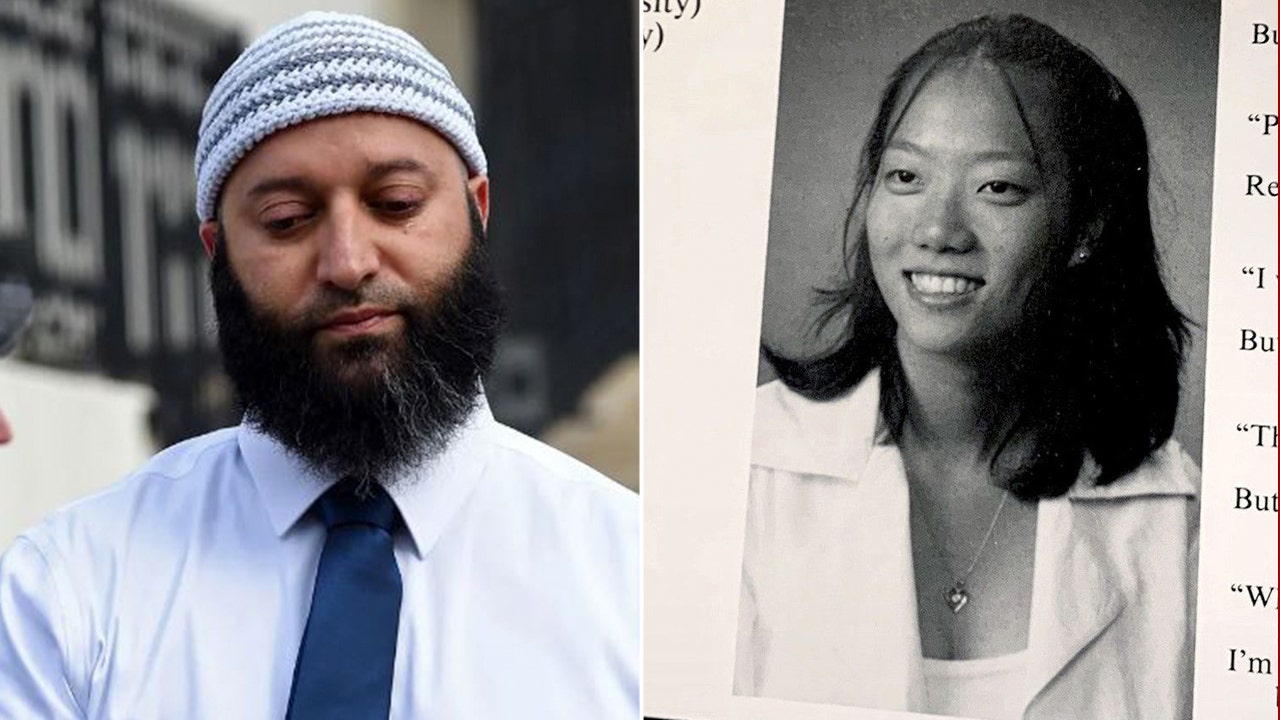
Adnan Syed gets emotional as he speaks to reporters outside the Robert C. Murphy Courts of Appeal building after a hearing Feb. 2, 2023, in Annapolis, Md.(Barbara Haddock Taylor/The Baltimore Sun via AP, File)
The panel of seven judges wrote in its ruling that Lee’s family had a right to participate in the 2022 hearing, saying that the victim’s brother Young Lee, was not given reasonable notice and, therefore, not treated with “dignity, respect and sensitivity.”
Advertisement
“In an effort to remedy what they perceived to be an injustice to Mr. Syed, the prosecutor and the circuit court worked an injustice against Mr. Lee,” the justices wrote in their decision.
SIGN UP TO GET TRUE CRIME NEWSLETTER
The panel said Syed, who was 17 when he was arrested and is now 43, can remain free as the case heads to a new lower court judge to determine again whether his conviction can be tossed out.
The Lee family must be given notice of the new hearing “sufficient to provide Mr. Lee with a reasonable opportunity to attend such a hearing in person” and speak out if he chooses.
FORMER BALTIMORE PROSECUTOR ATTENDS BARBECUE HELD IN HER HONOR WHILE ON HOME DETENTION
Advertisement
Adnan Syed was convicted and sentenced to life in prison in 2000 for the 1999 murder of Hae Min Lee when he was 17 years old.(AP Photo/Courtesy of Yusuf Syed)
David Sanford, an attorney who represents Lee’s family, told The Associated Press the higher court’s ruling “acknowledges what Hae Min Lee’s family has argued: Crime victims have a right to be heard in court.”
But Syed’s lawyer, Erica Suter, argued that the state did meet its obligation and invited Young Lee to participate in the hearing via video conference.
The ruling is the latest twist in Syed’s long legal battle. In 2019, a court ruled 4-3 to deny the accused killer another trial. A lower court had ordered a retrial in 2015 on the grounds Syed’s attorney, Cristina Gutierrez, didn’t contact an alibi witness and therefore did not provide effective counsel, according to the AP.
Advertisement
The U.S. Supreme Court declined to review the court’s decision.
ADNAN SYED CHARGES DROPPED AS BALTIMORE PROSECUTORS ABANDON CASE AGAINST ‘SERIAL’ PODCAST SUBJECT
A tribute to Hae Min Lee, Class of 1999, in a Woodlawn High School yearbook. Lee was abducted and killed in 1999, and classmate Adnan Syed was convicted of her murder in 2000. (Getty Images)
Prosecutors chose to vacate Syed’s sentence in 2022 after reviewing evidence in his case under a Maryland law that targeted “juvenile lifers” because he was under 18 when Hae Min Lee’s body was found.
GET REAL TIME UPDATES DIRECTLY ON THE TRUE CRIME HUB
Advertisement
They said they used “advanced DNA” testing to determine that Syed was not responsible for Hae’s murder and pointed to other potential suspects, including one who had allegedly threatened Hae and another linked to an address where her car was later discovered.
“The state no longer has confidence in the integrity of the conviction,” prosecutors said at the time.
Syed has maintained his innocence, often expressing concern for the victim’s family, according to the AP.
In this June 29, 2014, file photo, former Massachusetts congressman Barney Frank, right, waves while riding with his husband James Ready, left, during the 44th annual San Francisco Gay Pride parade in San Francisco. (Eric Risberg/Associated Press)
Barney Frank, a champion of liberal causes who spent more than 30 years representing Massachusetts in the U.S. House of Representatives, has entered hospice care at his home in Ogunquit as he deals with congestive heart failure, according to Politico.
Frank, 86, represented Massachusetts’ 4th Congressional District from 1981 to 2013, and was the first member of Congress to voluntarily come out as gay, in 1987.
An advocate for civil rights and affordable housing, Frank is also known for sponsoring sweeping financial regulation reforms in the Dodd-Frank Act of 2010.
Advertisement
He moved to Ogunquit with his husband, Jim Ready, after retiring from Congress.
According to Politico, Frank is supporting Gov. Janet Mills over political newcomer Graham Platner in Maine’s Democratic primary for U.S. Senate.
“I worry a little bit about the tendency on the Democratic side to fall for the flavor of the month,” he told the outlet. “There is this flirtation or this attraction of people who are new and who are very good at articulating a response to the anger, but without talking about what you do about it.”
Advertisement
Rachel covers state government and politics for the Portland Press Herald. It’s her third beat at the paper after stints covering City Hall and education. Prior to her arrival at the Press Herald in…
More by Rachel Ohm
Minogue would be wise to focus on state politics, not Trump policies
By Abdallah Fayyad
Moderate Republicans have become a rare breed in Massachusetts. President Trump and his politics loom large in the state, and his polarizing actions have only strengthened the Democrats’ grip on power. Since former governor Charlie Baker, a Republican, left office, the GOP has been effectively locked out of state government, and there’s little reason to believe that’s going to change anytime soon.
The Massachusetts Republican Party has now endorsed Mike Minogue, a former biotech executive, as its candidate for governor. Mike Kennealy, who served as the secretary of housing and economic development under Baker, was viewed as the more moderate candidate. But the state party resoundingly rejected him: 70 percent of the party’s delegates at the nominating convention chose Minogue over Kennealy and Brian Shortsleeve, a former MBTA general manager. While Shortsleeve will still be on the primary ballot in September, Kennealy was eliminated, since he did not clear the 15 percent threshold required to make the ballot.
Advertisement
Minogue, who has poured some $12.5 million into his campaign, is a prolific Republican donor, and he even hosted Vice President JD Vance at a fund-raiser last year. Regardless of how much he tries to court moderate voters across the state, it will be extremely difficult for him to meaningfully distance himself from Trump between now and November.
It’s not just a matter of optics. Minogue has wasted no time making his priorities known, and he’s aligned himself with several key Trump policies, promising to get “criminal illegal immigrants off our streets” and declaring that “girls need fair and safe sports.” That sort of politics may have helped Trump win the presidency in 2024, but it won’t help Minogue in a state where Trump got only 36 percent of the vote.
If Minogue wants to have any shot at all at winning the governor’s race, he would be wise to just focus on state politics. He drew raucous applause from the convention crowd, for example, when he pledged that he would repeal the MBTA Communities Act, which encourages building denser and transit-oriented housing and was signed into law by Baker. While I think that law is important in combating Massachusetts’ housing crisis, it’s proved to be controversial and has generated substantial backlash, even in liberal parts of the state.
A talented politician could use issues like that to make Governor Maura Healey, a Democrat, worry. But as long as the Massachusetts GOP keeps aligning itself with Trump — and as long as Trump is still president — Healey will cruise to reelection without breaking a sweat.
A Mike Minogue supporter outside the Massachusetts GOP convention on April 25.Jonathan Wiggs/Globe Staff
Mike Minogue’s kiss of death
Advertisement
By Joan Vennochi
Mike Minogue made his money and mark in business selling pumps for artificial hearts.
Now, as the Massachusetts Republican Party’s endorsed candidate for governor, he must win over enough voters’ hearts to defeat Governor Maura Healey, a Democrat.
That’s a tough sell for Minogue, who last year hosted Vice President JD Vance at a fund-raiser and donated to President Trump’s re-election bid and the Republican National Committee.
In a recent WBUR profile, the former head of Abiomed also said, “I am pro-life. I support a culture of compassion and life. I spent a career in the medical device industry helping to save lives, young and old, and I also think that we can do more to help people in a time of crisis.”
Advertisement
Nicely put, but still a kiss of death with the state’s liberal voters.
Within the tiny universe of Republican activists who attended last weekend’s convention, Minogue had four advantages: private-sector success, a military background (he’s a West Point graduate and served in Iraq), no other big races to be voted on, and lots of his own money to spend on organizing.
Of the three candidates seeking the party’s endorsement, Minogue was also the most politically conservative. But what made him attractive to the Trumpian base that now controls the Massachusetts GOP makes him a very challenging sell as a statewide candidate.
Out of the state’s 5.5 million registered voters, only 420,000 are Republicans. To have any chance at beating Healey, he has to do what every successful Republican gubernatorial candidate has done — tap into the 3.25 million voters who are registered as unenrolled or independent, and who make up the largest voter pool.
To woo them, Minogue will likely try to focus on management and fiscal issues. According to a recent UNH Survey Center poll, 49 percent of Massachusetts residents approve of Healey’s handling of the job, 45 percent disapprove, and 6 percent don’t know or are undecided. She gets her worst ratings on her handling of taxes, the economy, housing, and the cost of living.
Advertisement
While that might seem like an opening, Massachusetts Democrats will surely do everything they can to hang Trump around Minogue’s neck. He also has a primary fight with Brian Shortsleeve, the other Republican who won enough votes at the convention to get on the ballot.
That GOP primary fight could push the candidates even further to the right. If it does, the GOP can forget about beating Healey.
Even if it doesn’t, I still think the woebegone Red Sox have a better chance at winning the World Series than any Massachusetts Republican has at winning the governor’s office.
The issues that could sink Healey (if only Trump weren’t president)
By Charles Chieppo
Advertisement
The Republican convention that endorsed Mike Minogue to be the GOP standard-bearer for governor was a low-turnout affair, as is too often the case with Republican politics in Massachusetts.
At the convention, only about 1,800 out of more than 4,000 eligible delegates cast a vote. Next comes the primary on Sept. 1, when Minogue will face venture capitalist and former MBTA chief Brian Shortsleeve, who finished a distant second at the convention. Chances are good that that race will be closer.
Gubernatorial candidate Brian Shortsleeve at the Massachusetts GOP convention on April 25.Jonathan Wiggs/Globe Staff
Like recent Republican governors in Massachusetts, both candidates promise to make the Commonwealth more affordable and business-friendly, and both pledge to control state spending. But unlike their predecessors, they also warn about the high cost of illegal immigration. Neither is critical of the Republican president. And while they share many positions — both running primarily on pocketbook issues — Minogue calls himself a “born-again Catholic” and is anti-abortion, while Shortsleeve is largely silent on the issue.
History teaches us that the eventual nominee is likely to move to the center during the general election. But does that mean the eventual Republican nominee will at some point criticize President Trump? Hard to say.
The two candidates have no shortage of ammunition to use against the almost certain Democratic candidate, Governor Maura Healey. For a decade beginning in 2010, Massachusetts had the second highest rate of business formation among the states, but between January 2020 and September 2024, we had the lowest net rate of any state. Today Massachusetts is one of just four states to have fewer private-sector jobs than in 2020. Outmigration has risen dramatically since 2012.
Housing, health care, and energy costs are through the roof, and taxes are high compared to other states. A key reason is that Massachusetts spends too much. Since 2010, median household income has grown by 13 percent, but real state spending is up 28 percent.
Advertisement
Healey has taken steps to address the housing shortage by limiting the power of municipalities to stop development and making surplus state land available for housing. But she has shown little stomach for challenging her party and its interest groups by reining in state government and cutting high costs that are eroding the Commonwealth’s competitiveness.
As is usually true, the case against one-party government is strong. Nonetheless, there’s a simple reason why the outlook remains grim for Massachusetts Republicans this November: Trump.
Trump’s tariffs have exacerbated the affordability problem he pledged to fix. Rather than addressing the nearly $38 trillion national debt that looms over our children, the United States spends $2 billion a day fighting Iran – precisely the kind of “forever war” he promised to avoid.
Many Trump policies hit Massachusetts especially hard. His war on immigration extends to highly educated immigrants on whom Massachusetts depends to make up for losses to outmigration, and cuts to university and medical research strike at the heart of the state economy.
Absent Trump, this fall’s election might be a real opportunity for the Massachusetts Republican Party. But anti-Trump fervor is likely to drive turnout among Democrats and independents eager to register their disdain.
Advertisement
Charles Chieppo is the principal of Chieppo Strategies, a public policy communication firm, and a senior fellow at Pioneer Institute, a Boston-based public policy think tank.
This is an excerpt from Globe Opinion’s weekly politics newsletter Right, Left, and Center. Sign up here to get it delivered directly to your inbox.
Abdallah Fayyad can be reached at abdallah.fayyad@globe.com. Follow him @abdallah_fayyad. Joan Vennochi is a Globe columnist. She can be reached at joan.vennochi@globe.com. Follow her @joan_vennochi.
New Hampshire residents are being encouraged to check their voter registration status ahead of upcoming elections, according to information provided by the League of Women Voters of New Hampshire.
Any U.S. citizen who is at least 18 years old and resides in the state has the constitutional right to vote. However, residents who have moved, changed their name or not voted recently may need to re-register. Even those who believe they are registered are advised to confirm their status, as voters can occasionally be removed from rolls without notice.
Voters can check their registration by visiting their local town or city clerk’s office or by using the New Hampshire Secretary of State’s online voter information lookup tool.
Advertisement
Under updated procedures effective June 2, 2026, residents may register to vote either in advance at their clerk’s office or on Election Day at their polling place. New Hampshire does not offer online voter registration.
To register, voters must provide proof of identity, age, residency and citizenship, such as a driver’s license, passport, utility bill or birth certificate.
When voting in person, a government-issued photo ID is required. Absentee voting remains available for those unable to appear at the polls due to illness, disability, work obligations, travel or religious reasons, though additional identification requirements for absentee ballots have been in place since 2025.
The League of Women Voters encourages residents to verify their registration early to avoid delays or complications on Election Day.