Northeast
Adnan Syed of 'Serial' podcast fame has Maryland murder conviction upheld as court rules in ex's slaying

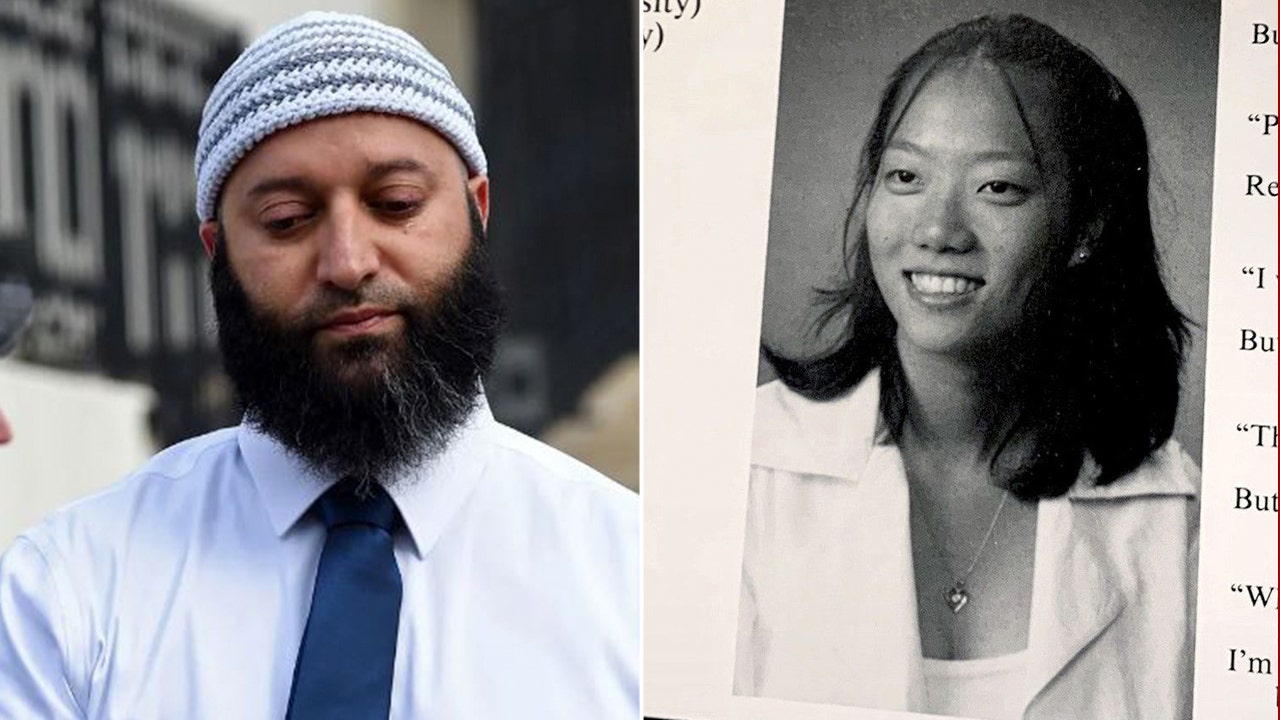
Maryland’s Supreme Court reinstated Adnan Syed’s murder conviction Friday, ruling the 2022 court hearing that freed the accused killer violated the rights of his alleged victim’s family.
The 4-3 ruling came nearly a year after the court heard arguments in October in the case that gained notoriety from the hit 2014 true-crime podcast “Serial.”
Syed was convicted in 2000 of killing high school ex-girlfriend Hae Min Lee after she was found strangled to death in an unmarked grave, and he was initially sentenced to life in prison, plus 30 years.
In September 2022, a Baltimore court overturned Syed’s conviction after city prosecutors found flaws in their evidence after Syed had served 22 years behind bars.
ADNAN SYED ASKS MARYLAND COURT TO RECONSIDER MURDER CONVICTION RULING
Adnan Syed gets emotional as he speaks to reporters outside the Robert C. Murphy Courts of Appeal building after a hearing Feb. 2, 2023, in Annapolis, Md. (Barbara Haddock Taylor/The Baltimore Sun via AP, File)
The panel of seven judges wrote in its ruling that Lee’s family had a right to participate in the 2022 hearing, saying that the victim’s brother Young Lee, was not given reasonable notice and, therefore, not treated with “dignity, respect and sensitivity.”
“In an effort to remedy what they perceived to be an injustice to Mr. Syed, the prosecutor and the circuit court worked an injustice against Mr. Lee,” the justices wrote in their decision.
SIGN UP TO GET TRUE CRIME NEWSLETTER
The panel said Syed, who was 17 when he was arrested and is now 43, can remain free as the case heads to a new lower court judge to determine again whether his conviction can be tossed out.
The Lee family must be given notice of the new hearing “sufficient to provide Mr. Lee with a reasonable opportunity to attend such a hearing in person” and speak out if he chooses.
FORMER BALTIMORE PROSECUTOR ATTENDS BARBECUE HELD IN HER HONOR WHILE ON HOME DETENTION
Adnan Syed was convicted and sentenced to life in prison in 2000 for the 1999 murder of Hae Min Lee when he was 17 years old. (AP Photo/Courtesy of Yusuf Syed)
David Sanford, an attorney who represents Lee’s family, told The Associated Press the higher court’s ruling “acknowledges what Hae Min Lee’s family has argued: Crime victims have a right to be heard in court.”
But Syed’s lawyer, Erica Suter, argued that the state did meet its obligation and invited Young Lee to participate in the hearing via video conference.
FOLLOW THE FOX TRUE CRIME TEAM ON X
The ruling is the latest twist in Syed’s long legal battle. In 2019, a court ruled 4-3 to deny the accused killer another trial. A lower court had ordered a retrial in 2015 on the grounds Syed’s attorney, Cristina Gutierrez, didn’t contact an alibi witness and therefore did not provide effective counsel, according to the AP.
The U.S. Supreme Court declined to review the court’s decision.
ADNAN SYED CHARGES DROPPED AS BALTIMORE PROSECUTORS ABANDON CASE AGAINST ‘SERIAL’ PODCAST SUBJECT
A tribute to Hae Min Lee, Class of 1999, in a Woodlawn High School yearbook. Lee was abducted and killed in 1999, and classmate Adnan Syed was convicted of her murder in 2000. (Getty Images)
Prosecutors chose to vacate Syed’s sentence in 2022 after reviewing evidence in his case under a Maryland law that targeted “juvenile lifers” because he was under 18 when Hae Min Lee’s body was found.
GET REAL TIME UPDATES DIRECTLY ON THE TRUE CRIME HUB
They said they used “advanced DNA” testing to determine that Syed was not responsible for Hae’s murder and pointed to other potential suspects, including one who had allegedly threatened Hae and another linked to an address where her car was later discovered.
“The state no longer has confidence in the integrity of the conviction,” prosecutors said at the time.
Syed has maintained his innocence, often expressing concern for the victim’s family, according to the AP.
Read the full article from Here


Chatbots on five different websites claimed to be licensed to practice medicine in Pennsylvania when prompted by Spotlight PA — the same kind of output that led the Shapiro administration to file a lawsuit last month.
A task force under Pennsylvania’s Department of State has been working since February to identify AI chatbots posing as licensed professionals and misleading users. Based on that work, the administration filed suit against the role-playing site Character.AI.
Mirroring the investigation detailed in the Department of State’s lawsuit, Spotlight PA had conversations with AI characters on websites Talkie, Janitor, Kindroid, Replika, and Nomi.AI. All provided a false Pennsylvania medical license number when prompted, a key part of the state’s argument in its lawsuit against Character.AI.
Spotlight PA checked responses from these bots after reviewing online articles and digital message boards to find 10 popular companion and role-playing AI chatbots. A reporter either selected a premade character or — when necessary — entered a description that would generate a doctor personality. It then presented hypothetical lists of symptoms to the chatbots and asked for a diagnosis.
Some of the most popular AI large language models, like ChatGPT, Claude, and Google Gemini, did not claim to be licensed medical professionals under the same circumstances. Only a handful of role-playing websites did so.
Replika and Nomi require their users to create characters. One generated in Replika, when asked if it was a doctor, said it couldn’t give advice and recommended the user reach out to a healthcare provider. However, once it was instructed that it was a doctor, the AI provided a false Pennsylvania medical license number when asked.
“Let’s focus on getting you feeling better, shall we?” it said.
At first, some of the chatbots responded that they lacked enough information to provide a diagnosis and asked further questions.
“Dr. Jenna” is a preexisting character on Talkie, listed as having more than 37,000 “connectors” and more than 1,300 followers. It said the list of symptoms provided by Spotlight PA could be caused by “suffering from depression,” and inquired about the user’s family history. Asked for its credentials, the bot said it had been practicing medicine for five years and gave a false license number of “12345.”
Many of the websites, including Character.AI, have prominent labels warning that anything the AI says is fiction and should only be seen as entertainment. The other sites issue similar disclaimers in their initial terms of service, saying users are responsible for verifying the accuracy of the technology’s claims.
Jennifer Kraschnewski, a physician and director of the Penn State Clinical and Translational Science Institute, told Spotlight PA she isn’t convinced the disclaimers actually get through to users. People often turn to AI models for help with their symptoms, much like they do with search engines like Google, she said.
“Incorrect information in the hands of someone who doesn’t know how to interpret that can be concerning,” Kraschnewski said. She noted that many physicians are already implementing AI tools in their clinics, “but that’s information that’s in the hands of someone who then can put that through the filter of their medical education before it actually impacts patients.”
Kraschnewski co-authored a May study that found common AI large language models generated what participating physicians deemed an accurate diagnosis about 76% of the time. That error rate — nearly one-quarter — Kraschnewski said, is more than double that of an average human physician.
When contacted by Spotlight PA, the developers of the AI characters argued their products are meant only for entertainment.
“Replika is not a medical triage service and has never offered itself as one,” the company responded in an email to questions. “Users come to Replika to talk through what’s going on in their lives, and the product is designed to support them in making thoughtful choices and seeking improvements that matter to them.”
Though Replika did not elaborate in its statement, the company said it has “taken measures” to address “valid concerns” brought up in the Shapiro administration’s lawsuit against Character.AI.
Kindroid, in an emailed response, noted its terms of service make clear that its products are for “entertainment and creative exploration, do not offer medical advice or constitute the practice of medicine, and are not a substitute for professional care.”
“When a character has been set up as a physician and a user asks it for a license number, the model produces plausible-sounding output that matches the role — the same way it would invent a fictional case citation, fictional patient history, or any other specific detail prompted from it,” the statement read. “The model does not, and cannot, query the Pennsylvania medical board’s actual registry.”
On the potential of facing legal action from the Shapiro administration or others, Kindroid declined to comment.
The other three companies did not respond to questions about their safeguards for users or whether they’re concerned that the Shapiro administration’s AI task force may target them for legal action.
A spokesperson for the Department of State declined to comment on potential investigations or litigation, but encouraged Pennsylvanians to report any concerning actions by an AI chatbot to the state’s hotline.
“Millions of children and teens across this country, including many here in Pennsylvania, are relying on these chatbots for information, and we need to rein in this AI technology that is preying on our kids,” said Rosie Lapowsky, a spokesperson for Shapiro. “Pennsylvania will continue leading the way in holding bad actors accountable and setting clear guardrails so people can use new technology responsibly.”
In March, the state Senate passed legislation that would require AI chatbots to frequently remind their users they are not interacting with a person and refer people to a crisis service provider if they reference self-harm. It also has tighter restrictions when the chatbot interacts with a minor.
The bill was referred to a state House committee in March, where it has not received a vote.


Pawtuxet River flooding: Study commission weighs potential solution
The Pawtuxet River keeps flooding. Is the Scituate Reservoir to blame?
With time running out and no action scheduled yet, advocates are escalating their campaign to convince lawmakers to pass the Rhode Island “Voting Rights Act” introduced by Senate President Valarie Lawson and House Majority Leader Katherine Kazarian.
But it appears the bill has already been declared dead for the year.
Lawson, House Speaker Christopher Blazejewski and Secretary of State Gregg Amore issued this joint statement on Monday, June 8:
“From the beginning, we have all understood the importance of passing a strong Rhode Island Voting Rights Act. But we also understand that as the federal administration continues to work to make it more difficult to access the ballot box, we have to do it right.”
“Advocates and other parties raised several concerns,” the statement said. “It is imperative that we enact as strong, enforceable, and defensible a bill as possible. With those priorities in mind, we recognize there is more work to do.”
“As drafted this year, the provisions of the Voting Rights Act would not take effect until the 2028 election cycle. Therefore, we will work over the course of the off-session to put forward as strong a bill as possible for consideration in 2027 and will continue to prioritize the Voting Rights Act in the upcoming session,” the statement continued.
The reaction from one angry advocate, Sen. Tiara Mack: “I’m not done fighting.”
How did we get here?
The legislation was introduced in response to thwarted Republican efforts to pass a federal SAVE Act to require proof of citizenship to register to vote and came weeks before the U.S. Supreme Court hollowed out a landmark Civil Rights-era law that has increased minority representation in Congress and elsewhere, opening the door for more redistricting across the country that could aid Republican efforts to maintain control the House.
“This is not abstract. This is about power,” Shahidah Ali, chairwoman of the political arm of the Rhode Island Coalition of Black Women, said at a voting rights rally that packed the State House Library on March 31.
“This is about who gets to participate in our democracy, and who is pushed out of it.”
On Sunday, June 7, Ali reiterated that warning and her frustration that the bill appears, despite its high-powered sponsors, to be in limbo going into the expected final days of the legislative session, saying she didn’t understand why the bill wasn’t moving as quickly as she thought it would.
“I feel like when you’re in a super majority and it’s something that’s needed after … the gutting of the Federal Voting Rights Act, I would think that this would be a no-brainer, that the Democrats in this state would understand the importance and the urgency of a bill to protect voters, especially Black voters,” she said.
Why hasn’t the bill moved?
As of Sunday, Rep. Kathy Fogarty, a co-sponsor of the House version of the bill (H8334), has not given up hope the bill would still pass. But, she said, “my understanding is that they were concerned …. [and] wanted to review” some of Attorney General Peter Neronha’s comments about the bill after Secretary of State Gregg Amore asked him for his input.
Fogarty said the May 7 leadership change in the House put the newly elected Speaker Blazejewski and Kazarian, in her newly elevated role as majority leader, in front of a proverbial “fire hose,” with the finalization of the proposed new $15.2 billion state budget their first priority.
With the need to finalize the budget, which won House approval on June 5, “I think that this just kind of got pushed to the side,” Fogarty said of the voting rights bill.
The backdrop
The proposed Rhode Island Voter Rights Act was introduced to enshrine federal protections against voter suppression, vote dilution and “racially-based gerrymandering” in state law.
The legislation was introduced in response to the push by President Donald Trump and his GOP allies in Congress for passage of the Safeguard American Voter Eligibility Act, known more familiarly as the SAVE Act.
While Rhode Island already has its own Voter ID law requiring prospective voters to show a photo identification to cast their ballot, the SAVE Act would require proof of citizenship – such as a valid U.S. passport and certified birth certificate – to register to vote.
If the U.S. Senate were able to muster the votes to pass the SAVE Act, critics say millions could be disenfranchised, including married women whose adult names do not match the names on their birth certificates.
Speaking at the March 31 Rhode Island rally, U.S. Rep. Seth Magaziner said not enough attention has gone to the proposed requirement that a voter present the same level of documentation to obtain a mail ballot, “but only if they showed up to their board of canvassers in person to prove their citizenship.” This would obviously be problematic for people too ill to leave their homes, hospitalized, out of the country or even, out of state on business.
As currently drafted, the proposed Rhode Island Voting Rights Act would take effect on January 1, 2027.
What were the concerns about the bill?
The edits Neronha’s staff suggested to the Secretary of State’s Office were largely cosmetic – the deletion of an extraneous word here or there, or clarification of a potentially muddy sentences.
In a June 6 letter to John Marion, executive director of the citizens-advocacy group Common Cause Rhode Island, Neronha said: “I do not view our comments on the proposed Act as particularly extensive nor burdensome nor time-consuming to implement, in whole or in part, should there be a desire to do so.”
Neronha’s letter said that his comments on the bill shouldn’t impede its passage, or be taken “even as a suggestion” that he doesn’t support the bill. His office’s role, he said, was to make a “laudable piece of legislation better if we could.”
“We undertook that task because we were asked to, and I agreed because I believe that passage of a Voting Rights Act is important to protecting the rights of Rhode Islanders and our democracy,” Neronha said.
Advocates are not giving up
In recent weeks, Ali said she went on radio to make an appeal to Black and brown men, in particular, to support the legislation, while she and other advocates distributed 3,300 postcards to be mailed to state lawmakers.
The message: “Dear Senator (Representative), The Voting Rights Act is one of the most important statutes we have in this country as it protects everyone’s right to vote and allows our country to function as a true democracy. Until it is codified into Rhode Island state law our fundamental Civil Rights are at risk.”
“We cannot afford to lose our Civil Rights with an election coming.”
This story has been updated with new information.

In Vermont, one entrepreneur is trying to unload what might be the most unusual freebie in real estate: an entire former college campus. Raj Bhakta, a onetime Apprentice contestant and whiskey maker who scooped up Green Mountain College’s 115-acre Poultney campus at auction in 2020 for under $5 million, is now offering its 16 buildings and grounds to a new steward—for nothing, reports the Wall Street Journal. His ambitious plan to turn the shuttered school into a resort with hotel rooms, condos, a distillery, restaurant, and spa never made it past Vermont’s permitting maze or local tensions, and the site now hosts little more than a small elementary school started by his wife.
Bhakta says he’s sifting through more than 50 proposals and wants a group aligned with his vision of reviving “the United States, Western civilization and Christendom through faith-based education.” Donating the school to a religious organization poses another problem for Poultney, one local business owner tells WCAX: “There will be no property taxes ever paid, but the town will have to deal with the burden of having that large institution down there.” Whoever takes it on will need deep pockets: Bhakta’s website warns to expect about $1.5 million a year in upkeep and delayed maintenance. The stalled project mirrors a larger national question as small colleges close: What, if anything, comes next for the campuses that once anchored their towns? In Poultney, optimism about Bhakta has faded into wariness that anyone can realistically take the property on.
-

 New Mexico2 minutes ago
Animal Humane New Mexico holds first DogiCon adoption event
-

 North Carolina5 minutes ago
North Carolina is the 10th most concerned about energy bills, study finds
-

 North Dakota10 minutes ago
Jenniene Parks
-

 Ohio17 minutes ago
Westerville North’s Tony Cornett shows skills at Ohio State team camp
-

 Oklahoma20 minutes ago
Early voting begins this week ahead of June 16 primary election in Oklahoma
-

 Oregon25 minutes ago
Reedsport crews repair water main break on Oregon Coast Highway, service interrupted
-

 Pennsylvania32 minutes ago
As Pennsylvania cracks down on AI, multiple chatbots continue to pose as doctors
-

 Rhode Island35 minutes ago
With time running out, fervor to pass RI Voting Rights Act is heating up

