Three major pharmaceutical companies and their national lobbying organization are suing Missouri to block enforcement of a new state law requiring them to give medical providers unlimited access to discounted drugs for their pharmacies.
In four federal lawsuits filed over the past month, Novartis, AstraZeneca, Abbvie and PhRMA, the lobbying arm of the pharmaceutical industry, argue that Missouri lawmakers unconstitutionally intruded into interstate commerce with the bill passed this year.
Under the bill, drugmakers must accept orders to deliver medications to providers eligible for discounts under the 340B program, named for the section of law where it is authorized. The bill allows eligible providers to have an unlimited number of contracts with pharmacies to dispense their prescriptions of drugs purchased under the program.
“Under the Supremacy Clause of the United States Constitution, Missouri has no authority to define who has access to 340B-priced drugs,” states the lawsuit filed last week by PhRMA in the Western District of Missouri.
Advertisement
The law takes effect on Wednesday. The plaintiffs in each case have asked for a preliminary injunction to block enforcement, but no hearings on the requests have been scheduled and only one case, filed Aug. 2 by Novartis, has had enough activity for the judge to schedule any proceedings.
Abbvie went first, filing its lawsuit July 22 in the Eastern District — 10 days after Gov. Mike Parson declined to sign the bill and instead allowed it to become law despite his misgivings. The other three cases are filed with the Western District, which includes Jefferson City.
The lawsuits name Attorney General Andrew Bailey and members of the state Board of Pharmacy, which is responsible for enforcing the law. The board is given authority to investigate violations of the law and the attorney general has enforcement powers through the state Merchandising Practices Act.
“It is difficult to convincingly argue that doing what a federal program requires is an irreparable harm,” Maria Lanahan, deputy solicitor general in the attorney general’s office, wrote in a filing arguing against a preliminary injunction in the Novartis lawsuit. “To the contrary, when Novartis complies with S.B. 751, it is helping covered entities that serve vulnerable populations.”
Bailey’s office did not respond to an email seeking comment on the cases.
Advertisement
The board is relying on Bailey to respond to the lawsuit. The law is self-enforcing and while the board could write rules about how it is to be followed, Executive Director Kimberly Brinston said.
“The board does not have a timeline to promulgate rules and has not made a decision on whether rules would be promulgated,” she said.
The Missouri Hospital Association and the Missouri Primary Care Association have asked to intervene in the Novartis lawsuit and will likely seek to join the other three, hospital association spokesman Dave Dillon said Monday.
“We are evaluating each case and intend to reinforce the work done by the General Assembly on behalf of Missouri’s hospitals, other providers and the communities they serve,” Dillon said.
The 340B program was created in 1992. It had two components — drug manufacturers had to deliver their products at a discount to eligible providers and eligible providers could only use the program to provide prescriptions to patients they treated directly.
Advertisement
Eligible providers included children’s hospitals, as well as hospitals that were sole providers in their community or designated “critical access hospitals” by providing care that would otherwise be absent, and those serving large numbers of indigent patients known as “disproportionate share hospitals.”
Other qualifying providers include federally qualified health care centers — clinics that receive grants to support operations so they can base charges on ability to pay — as well as clinics that serve AIDS patients, black lung victims and other debilitating diseases.
The use of contract pharmacies started in 1996, when the U.S. Department of Health and Human Services began allowing one contractor per provider as recognition that many providers did not have in-house pharmacies. But a change to allow unlimited contracting increased the number of contract pharmacies from 2,321 in 2010 to 205,340 in 2024, according to data from PhRMA provided to The Independent in June.
Nationally, pharmaceutical manufacturers sold nearly $100 billion in discounted drugs in 2021 and 2022. Discounts averaged 60% from regular wholesale prices, the lobbying organization stated.
The pharmaceutical companies focus their criticism on the disproportionate share hospitals, who often contract with for-profit pharmacies to dispense the drugs. Those hospitals account for about 80% of all drugs purchased through the 340B program, $41.8 billion in 2022 and $34.3 billion the year before.
Advertisement
Pharmaceutical companies complain that the discounts are rarely passed on to patients. Instead, insurance companies and consumers pay retail prices and the extra profit is often split between the pharmacy and the provider.
“Make no mistake, the boom in contract pharmacies has been fueled by the prospect of outsized profit margins on 340B-discounted drugs,” AstraZeneca’s lawyers wrote in the complaint filed last week. “In short, the widespread proliferation of contract pharmacy arrangements since 2010 has transformed the 340B program from one intended to assist vulnerable patients into a multi-billion-dollar arbitrage scheme.”
The drugmakers have fought the expansion of contract pharmacies in a variety of ways. When Novartis sought in 2020 to limit the contracts to pharmacies within 40 miles of an eligible provider, the U.S. Department of Health and Human Services issued a notice that it considered the limit a violation of the program’s rules.
An advisory opinion on contracting, later withdrawn, said the 340B program required delivery to a pharmacy on “the lunar surface, low-earth orbit, or a neighborhood…”
The 3rd U.S. Circuit Court of Appeals in Pennsylvania ruled in January 2023 in a case against the federal agency that pharmaceutical companies could impose limits on the number of pharmacies they would allow to purchase the discounted drugs.
Advertisement
After the 2023 ruling, Novartis tightened its rules to allow only one contracted pharmacy per covered provider, but only if the provider did not have an in-house pharmacy. Other manufacturers have imposed variations on the Novartis policies.
State efforts to counter the limits have ramped up in the past two years. Missouri is one of eight states to pass laws requiring drugmakers to deliver discounted medications to contract pharmacies.
Arkansas was one of the first. In March, the 8th Circuit Court of Appeals in St. Louis upheld the Arkansas law requiring drugmakers to allow covered providers to have an unlimited number of contract pharmacies.
In the motion to dismiss the Novartis lawsuit, the Missouri attorney general’s office relied heavily on that ruling, writing that it shows federal law does not prevent Missouri from passing a similar law.
The four lawsuits use a variety of legal theories to assail Missouri’s new law. Along with allegations of interfering with interstate commerce and regulating in an area reserved for federal action, the Abbvie lawsuit argues that its property rights are being violated.
Advertisement
“These abuses of the federal 340B program raise obvious concerns because the U.S. Constitution prohibits the government from forcing the transfer of property at confiscatory prices to private parties for their own private benefit,” the lawsuit states.
In the filing seeking to intervene in the Novartis case, the hospitals and primary care associations argued that the revenue from profits on 340B medications are essential support for their operations.
“Reducing access to those savings,” the filing states, “means hospitals are unable to underwrite critical but under-reimbursed services lines.”
Missouri Farm Bureau’s 2026 Agritourism Conference will be held Sunday through Tuesday in Hermann, bringing together agritourism stakeholders to explore opportunities in Missouri’s growing agritourism sector.
The conference usually draws 60-70 attendees annually, said Janet Adkison, director of public affairs and advocacy with Missouri Farm Bureau. This includes farmers, agribusiness leaders, tourism professionals and local economic development partners.
At the conference, participants will see firsthand how farms, wineries, orchards and other value-added agriculture business and rural destinations are connecting tourists and consumers with the state’s agriculture scene, while diversifying revenue streams for farm families and rural communities.
“Whenever folks think of agritourism, they think of a pumpkin patch or a flower farm,” Adkison said. “But agritourism is really anything that gets folks to connect with the agriculture industry. So from your Airbnbs that are out in rural Missouri to the wineries that you see across the countryside, to even a tree farm or just a simple orchard, those are all part of Missouri’s agritourism industry.”
Advertisement
The conference kicks off Sunday with welcome remarks by Missouri Farm Bureau president Garrett Hawkins and a dinner at Hermann Farm Store Barn. Participants will spend the nights at The Inn at Hermannhof.
Monday will include an agritourism bus tour, with stops at Thierbach Orchard, Heritage Valley Tree Farm, White Mule Winery & BNB and Cool Cow Cheese, where participants have the opportunity to speak to business owners.
It will be followed by a farm-to-table, wine-pairing dinner at Hermannhof Winery Court with the Missouri Wine & Grape Board.
“If you are somebody who’s interested in agritourism, you get to hear from somebody who’s been there and done that, and some of the hurdles that they may have experienced along the way,” Adkison said. “You’ll have that exposure both on the tour and also during the programs that they’ll provide on Tuesday.”
On the final day of the conference, participants will attend educational workshops and network with other vendors at Hermannhof Festhalle. Topics discussed in the workshops include marketing, risk management, USDA Rural Development resources for agricultural businesses.
Advertisement
“You’ll hear from some folks as far as the missteps or wins that they had while trying to market and get those crowds to come to the farm, and sometimes something might work, (or) something surprises you and it doesn’t work,” Adkison said.
The conference location rotates around the state each year — past stops have included northeast and west central Missouri, which Adkison said gives the conference a chance to showcase how agritourism looks based on the terrain and agricultural strength of each region.
Find out more about the event or register for it at mofb.org/event/2026-agritourism.
Former Missouri Gov. Jeremiah “Jay” Nixon followed in his ancestor’s footsteps, 250 years to the day.
On July 8, 1776, Colonel John Nixon was the first person to publicly read the Declaration of Independence from the steps of the Pennsylvania State House, now Independence Hall.
Jay Nixon, along with other Missouri officials from local, state and national offices, participated in a semiquincentennial celebration at the Historical Greene County Courthouse on July 8, 2026.
“As we commemorate 250 years of American independence, may we remember not only the courage of those who signed the declaration, but also our responsibility to preserve the freedoms they declare,” said Connie Yen, director of the Greene County Archives and Records Center.
Advertisement
While the reading of the Declaration of Independence was the main event, patriotic music from the Salvation Army Band, Springfield Sound, the Patriotic Chorale — as well as the national anthem sung by former U.S. Attorney John Ashcroft and former judge and representative Max Bacon — rang throughout the courthouse’s rotunda, which was packed with people. The music itself, Ashcroft said, was a metaphor for the nation.
“There is something charming about America that doesn’t require that we be uniform. There’s a difference between unity and uniformity. As a matter of fact, you can’t have harmony if you only have one note. You have to sing different notes for things to be harmonic and it’s much more beautiful,” he said. “Maybe America is America not because of uniformity or everybody being in unison, but America may be America because we have disparity, but we’re in harmony. We believe in unity, not uniformity.”
Before reading the Declaration of Independence, Nixon shared part of a speech he gave at Fulton’s Westminster College in August 2025, where he encouraged people to “resist apathy with action” through involvement with civic and faith organizations, and by voting. Like others, he emphasized diversity as the strength of America.
More: Vietnam veterans welcomed home to Springfield after Honor Flight
Advertisement
“(We’re) a nation of immigrants. Many of our ancestors fled poverty, injustice and tyranny to build something better. We are the great-great-great-grandchildren of slaves, and those who enslaved them; the first families who inhabited these lands, and those who drove them from it,” Nixon said. “A nation of scrappy strivers stitched together by our ideals, marked by original sins, but redeemed by the courage and sacrifice that saved us from fascism and unleashed freedom and prosperity — the envy of the world. That is the true story we all need to tell, the promise we made to each other that we work every day to keep.”
The reading was followed by an ice cream social, co-hosted by the Greene County Democratic and Republican women’s clubs.
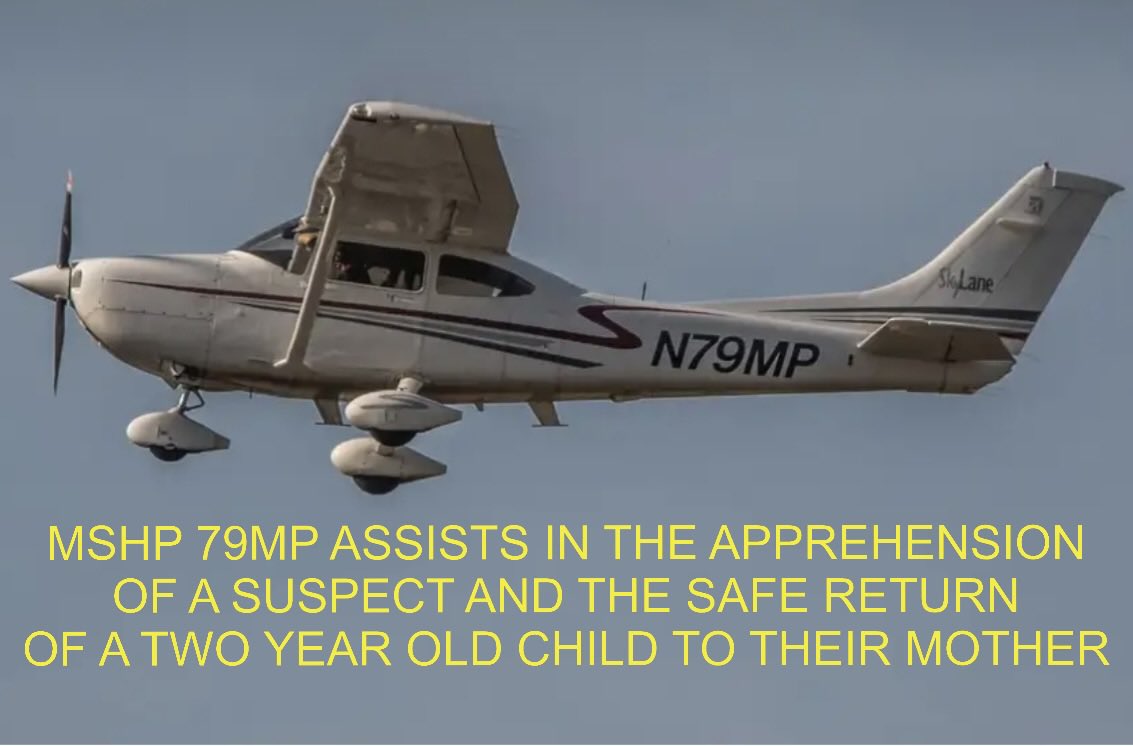
The Missouri State Highway Patrol says one of its planes played a key role in Tuesday morning’s capture on I-70 near Columbia of a Kansas suspect wanted for child endangerment.
Missouri state troopers say they were on patrol near a rest area on eastbound I-70 in Cooper County, when they located a Dodge Durango wanted for an alleged incident in Topeka. Troopers say the suspect drove off after seeing troopers and that the Patrol plane was used to avoid a pursuit.
Troopers say they were able to get in position after the plane’s pilot located the vehicle and that the Patrol deployed stop sticks and safely deflated the suspect’s tires.
A Missouri State Highway Patrol aircraft played a key role in Tuesday morning’s capture in mid-Missouri (July 2026 graphic courtesy of Highway Patrol Twitter)
The Highway Patrol says the suspect was captured without incident and that the two-year-old child, who was unharmed, has been reunited with their mother.