Sign up for the Today newsletter
Get everything you need to know to start your day, delivered right to your inbox every morning.

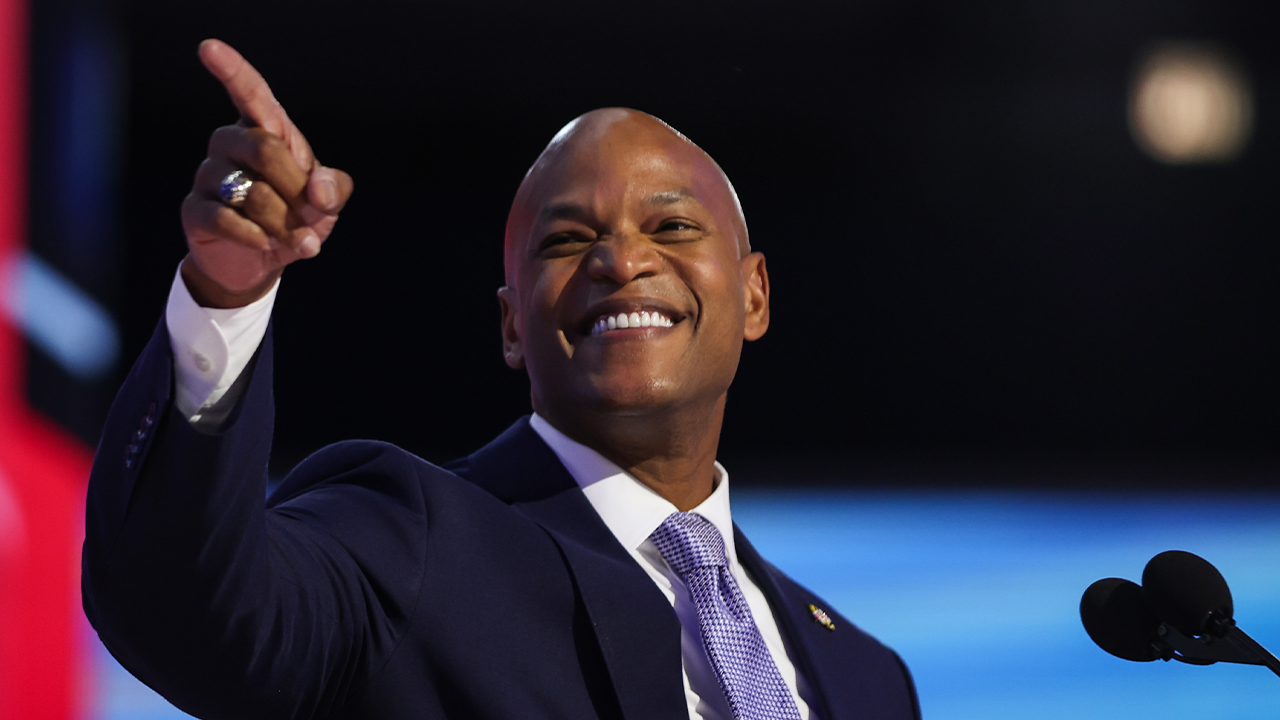
CHICAGO – Maryland Gov. Wes Moore, during his Democratic National Convention speech Wednesday, praised Minnesota Gov. Tim Walz’s military career and for completing the “mission,” despite ongoing criticism over Walz retiring from the Army National Guard before his unit deployed to Iraq.
“My fellow veteran, my brother and the next vice president of the United States, Tim Walz,” the Maryland Democrat said from the Chicago stage at the United Center Wednesday evening.
“Tim knows that in the military, you count the days towards mission completion,” Moore, an Army veteran, continued. “So guess what, y’all? We have got 75 days and a wake up until Election Day. Seventy-five days and a wake up for us to prove what Americans can do when the pressure is on.”
VETERANS INCREASINGLY CALLING OUT WALZ’S MILITARY RECORD: ‘SHAMEFUL’
Maryland Gov. Wes Moore speaks on stage during the third day of the Democratic National Convention at the United Center on Aug. 21, 2024 in Chicago. Delegates, politicians, and Democratic Party supporters are in Chicago for the convention, concluding with current Vice President Kamala Harris accepting her party’s presidential nomination. (Photo by Justin Sullivan/Getty Images)
“Patriots do not whine and complain. We put our heads down, and we get to work.”
Walz served 24 years in the Army National Guard before retiring in 2005, when he launched a successful congressional campaign and served as a member of the U.S. House representing Minnesota from 2007 until 2019. Walz left the House upon his 2018 election as the Gopher State’s governor.
WALZ ACCUSATIONS OF ‘STOLEN VALOR’ PROMPT BATTLE BETWEEN HOUSE VETERANS
Democratic vice presidential candidate Minnesota Gov. Tim Walz greets second gentleman Doug Emhoff during Day 1 of the Democratic National Convention at the United Center in Chicago on Aug. 19, 2024. (REUTERS/Brendan Mcdermid)
Criticisms have mounted that Walz retired just months before his battalion deployed to Iraq as war raged in the Middle East following the 9/11 attacks. Walz put in his papers for retirement at least five months before his battalion received deployment orders, according to the Minnesota National Guard.
FORMER LEADER OF WALZ’S BATTALION PUBLISHES SCATHING MESSAGE AIMED AT GOVERNOR’S MILITARY CAREER: REPORT
The campaign bus for Vice President Kamala Harris and Minnesota Gov. Tim Walz waits ahead of a kickoff bus trip at Pittsburgh International Airport in Pittsburgh on Aug. 19, 2024. (Fox News – Paul Steinhauser)
“He subverted the chain of command, and he went around the chain of command. The brigade [sergeant] major had no clue. These are all important facts, and he did it to continually feather his own bed… That was the shameful part of it,” retired Command Sgt. Maj. Paul Herr told Fox News earlier this month.
Following Harris naming him as her running mate, Walz has been slammed by a number of veterans for allegedly misrepresenting his service in the military, including identifying himself to the public as a retired “Command Sergeant Major.”
Walz was promoted to the command sergeant major rank following a deployment to Italy in 2004, but he did not complete coursework with the U.S. Army Sergeants Major Academy to retain the rank in retirement. Walz instead retired as a master sergeant, one pay grade below command sergeant major.
Democratic Minnesota Gov. Tim Walz’s military career has been scrutinized since he was announced as Vice President Kamala Harris’ running mate. (Glen Stubbe/Star Tribune via Getty Images)
“For 20 years, they let this guy go by with a lie that he deployed to Iraq, which he didn’t, and that he retired as a command sergeant major, which he did not. I mean, that’s just blatant lies,” Republican Virginia Senate candidate Hung Cao, a retired Navy captain, told The New York Post this month of Walz.
Walz also took the DNC stage on Thursday evening, when he spoke to the arena about his small town roots in the Midwest and his career as a teacher before diving into politics in the early 2000s.
“I grew up in Butte, Nebraska, a town of 400 people. I had 24 kids in my high school class, and none of them went to Yale. But I’ll tell you what. Growing up in a small town like that, you’ll learn how to take care of each other. That that family down the road, they may not think like you do. They may not pray like you do. They may not love like you do. But they’re your neighbors. And you look out for them, and they look out for you. Everybody belongs and everybody has a responsibility to contribute,” he said.
Vice President Kamala Harris will deliver her acceptance speech before the DNC on Thursday evening, following three nights of other high-profile Democrats such as former President Barack Obama, President Biden and former Secretary of State Hillary Clinton celebrating her candidacy.
Get the latest updates from the 2024 campaign trail, exclusive interviews and more at our Fox News Digital election hub.
Read the full article from Here


A boil water advisory has been issued for parts of Montgomery County on Monday, according to Pennsylvania American Water.
The advisory was issued on Monday, July 6 after there was a reported loss of “positive pressure in the distribution system due to an equipment failure,” a company spokesperson explained.
This failure could mean that the water has been contaminated.
The advisory has been issued for residents living in the Municipality of Norristown and Plymouth Township who get their water from Pennsylvania American Water.
The company said it will inform impacted customers when the advisory has been lifted.
For more information, click here.
When under a boil water advisory, do not use water for anything unless it has been boiled first.
The steps include:
Failing to boil water properly could lead to health issues including nausea, cramps, diarrhea or headaches.

Local News
Taylor Swift and Travis Kelce made a $1 million donation to the Rhode Island Community Food Bank ahead of the couple’s wedding at New York City’s Madison Square Garden, the nonprofit organization announced.
The Rhode Island Community Food Bank — which acts as the primary food distribution center for a network of 137 member agencies across the state — intends to use the contributions to purchase additional food for local families and to provide further support to its member agencies, the food bank said in a press release.
“We are incredibly grateful to Taylor Swift and Travis Kelce for their extraordinarily generous and unexpected gift,” CEO Melissa Cherney said in the release. “As the need across our communities continues to grow, this $1 million donation will go a long way in helping us purchase and distribute the nutritious, culturally appropriate food that Rhode Islanders deserve.”
The food bank thanked the couple in social media posts Friday, a day before Swift and Kelce’s wedding.
“We were THRILLED to learn of this unexpected gift,” the organization wrote, “which comes at a time when the need for food assistance in our state is at an all-time high.”
The food bank said the gift is particularly valuable during the summer, which typically means slower food donations.
“Gifts like this are a powerful reminder of the good we can do with the support of our community,” Cherney said. “This act of generosity shows that, together, we can meet this moment and truly eliminate hunger in our state.”
The $1 million gift is one of several donations the couple made prior to their wedding. Swift and Kelce donated to other northeast charities, including nine in New York and Helping Harvest, a food bank in Pennsylvania, Variety reported.
Rhode Island Community Food Bank noted other large donations made to charities — Feeding America, one of the largest food banks in the U.S., and Harvesters, a regional food bank serving Northeast Kansas and Northwest Missouri.
Feeding America received a $2 million donation, while Harvesters were given $1 million, according to social media posts from the organizations thanking the couple.
“I hope their gift inspires others,” Cherney added. “It has certainly inspired us.”
Get everything you need to know to start your day, delivered right to your inbox every morning.
Powerball, Mega Millions jackpots: What to know in case you win
Here’s what to know in case you win the Powerball or Mega Millions jackpot.
Just the FAQs, USA TODAY
The Vermont Lottery offers several draw games for those willing to make a bet to win big.
Those who want to play can enter the MegaBucks and Lucky for Life games as well as the national Powerball and Mega Millions games. Vermont also partners with New Hampshire and Maine for the Tri-State Lottery, which includes the Mega Bucks, Gimme 5 as well as the Pick 3 and Pick 4.
Drawings are held at regular days and times, check the end of this story to see the schedule.
Here’s a look at July 6, 2026, results for each game:
17-44-63-66-67, Powerball: 04, Power Play: 2
Check Powerball payouts and previous drawings here.
04-12-30-34-38
Check Gimme 5 payouts and previous drawings here.
Day: 5-7-2
Evening: 5-7-8
Check Pick 3 payouts and previous drawings here.
Day: 7-9-1-6
Evening: 9-8-4-1
Check Pick 4 payouts and previous drawings here.
01-06-24-32-37, Megaball: 04
Check Megabucks Plus payouts and previous drawings here.
02-08-32-54-56, Bonus: 03
Check Millionaire for Life payouts and previous drawings here.
Feeling lucky? Explore the latest lottery news & results
For Vermont Lottery prizes up to $499, winners can claim their prize at any authorized Vermont Lottery retailer or at the Vermont Lottery Headquarters by presenting the signed winning ticket for validation. Prizes between $500 and $5,000 can be claimed at any M&T Bank location in Vermont during the Vermont Lottery Office’s business hours, which are 8a.m.-4p.m. Monday through Friday, except state holidays.
For prizes over $5,000, claims must be made in person at the Vermont Lottery headquarters. In addition to signing your ticket, you will need to bring a government-issued photo ID, and a completed claim form.
All prize claims must be submitted within one year of the drawing date. For more information on prize claims or to download a Vermont Lottery Claim Form, visit the Vermont Lottery’s FAQ page or contact their customer service line at (802) 479-5686.
Vermont Lottery Headquarters
1311 US Route 302, Suite 100
Barre, VT
05641
Vermont’s 2nd Chance lottery lets players enter eligible non-winning instant scratch tickets into a drawing to win cash and/or other prizes. Players must register through the state’s official Lottery website or app. The drawings are held quarterly or are part of an additional promotion, and are done at Pollard Banknote Limited in Winnipeg, MB, Canada.
This results page was generated automatically using information from TinBu and a template written and reviewed by a Vermont editor. You can send feedback using this form.


Boil water advisory in effect for some residents in Montgomery County


R.I. food bank thanks Taylor Swift, Travis Kelce for pre-wedding donation


South Carolina Lottery Powerball, Pick 3 results for July 6, 2026
SD Lottery Powerball, Lotto America winning numbers for July 6, 2026
TN Lottery Powerball, Lotto America winning numbers for July 6, 2026


Supreme Court won’t block Texas from enforcing a law requiring age verification for app downloads


Memphis Grizzlies vs Utah Jazz Jul 6, 2026 Game Summary
VT Lottery Powerball, Gimme 5 results for July 6, 2026

