Politics
In search for younger voters, Harris courts influencers at DNC

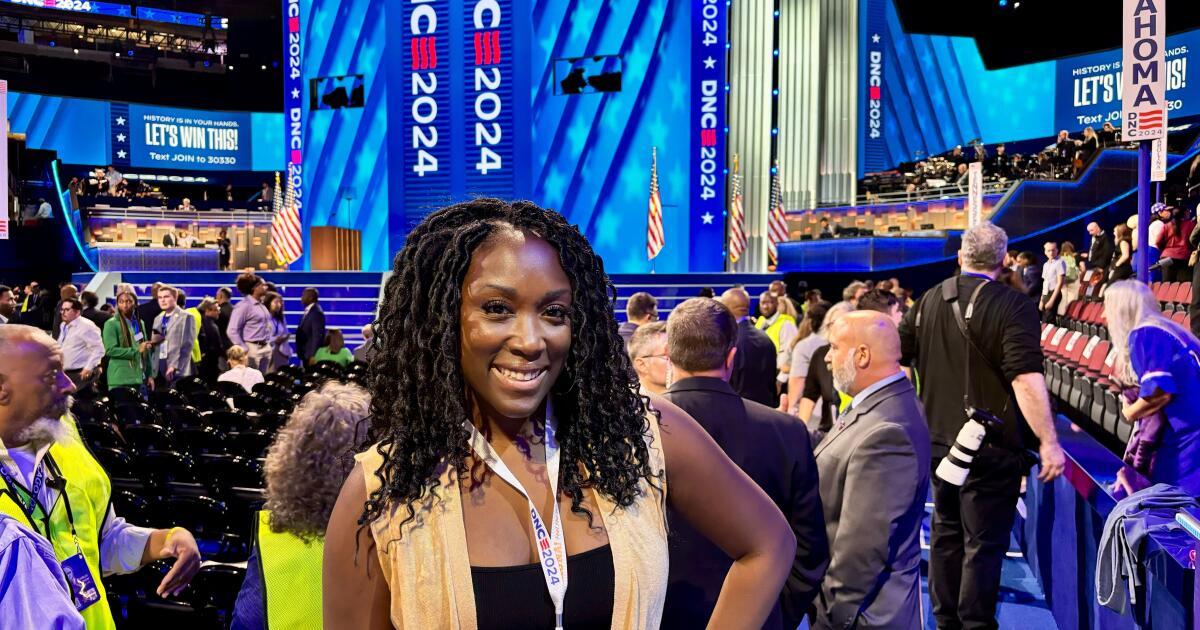
Malynda Hale angled her iPhone toward her face and filmed a quick selfie video as she headed over to the first day of the Democratic National Convention.
“I’m already annoyed and it’s not even 8:30. Nobody knows anything and this is very confusing,” the 38-year-old influencer says in the clip, which she immediately uploaded to her 53,000 Instagram followers. “I’m gonna give you the real, unfiltered version of what it’s like to be at the DNC.”
Hale, a singer and actress from Northridge, is one of more than 200 social media influencers who received credentials — a first for the DNC — to attend the four-day convention. In granting digital content creators access to delegates, studio space and events, Kamala Harris’ campaign hopes they will use their vast online followings to promote the party’s message and galvanize young voters, who showed deep apathy about President Biden’s bid for reelection.
“They obviously view us as a direct line to this demographic, because a lot of them are bypassing traditional media to see what the influencers and the public figures and creators that they follow are saying about political events,” Hale said in an interview with The Times. “It’s a great idea to kind of use us as, like, a democratic liaison to certain generations.”
Malynda Hale grew her social media following during the pandemic when she began speaking about social justice issues. Her trip to the DNC was sponsored by Stand Up America, which paid for flights for her family and an Airbnb in Chicago.
(Malynda Hale)
Since arriving in Chicago over the weekend, Hale has been unleashing a quick-fire barrage of Instagram stories, reels, grid photos and TikTok videos, capturing the glam and grind of being a chosen influencer.
In more than 50 posts uploaded to her social channels on Monday alone, she chronicled her difficulties picking up her badge, the scene at the creator lounge at the United Center and her view from the arena floor before the evening’s speakers took the stage (“Our actual seats are in the nosebleeds,” she says into the camera).
The trip to Chicago for Hale, whose following swelled during the pandemic when she began speaking out about social justice issues, was sponsored by Stand Up America; the nonprofit organization paid for flights for her and four family members and covered the cost of their Airbnb.
It’s a great idea to kind of use us as, like, a democratic liaison to certain generations.
— Malynda Hale, a social media influencer from Northridge
As Harris has kept her distance from the mainstream news media, the decision to open the door to influencers is a reflection of her campaign’s belief that social media creators are an important conduit for getting its message to voters.
A few were even invited to make speeches to rally support for Harris, sharing the same spotlight reserved for her and her running mate Tim Walz, as well as powerful Democrats including Barack and Michelle Obama, Nancy Pelosi, and Bill and Hillary Clinton.
On the sidelines of the convention Monday, influencers were provided a special pavilion and luxury box. Democratic aides brought officials over to a “blue carpet” to be interviewed by the social media stars. In the convention hall, some had positioned ring lights to better capture themselves during the more marquee events.
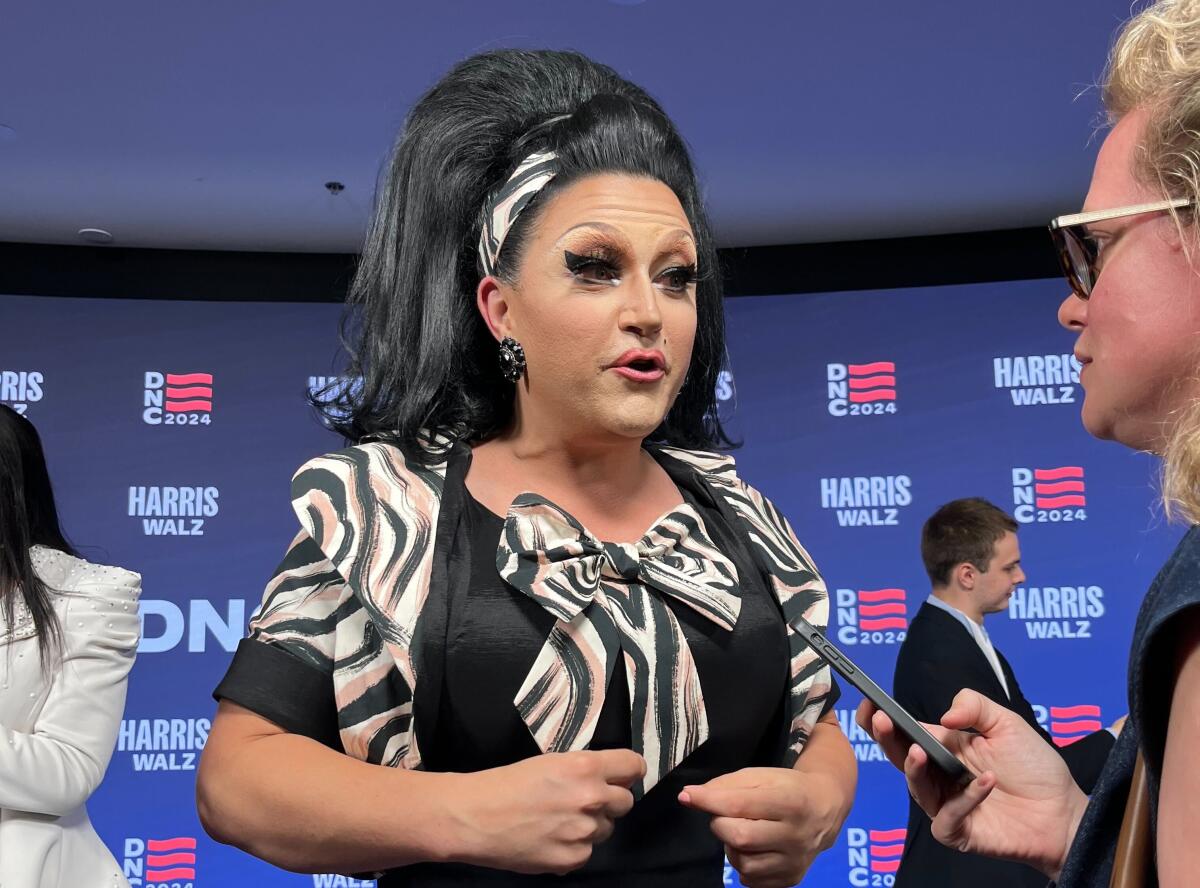
L.A. drag queen and social media influencer BenDeLaCreme at the United Center on Monday.
(Noah Bierman / Los Angeles Times)
One of the most recognizable social media personalities on the blue carpet was drag queen BenDeLaCreme. “You see how I come dressed for the DNC? Very demure, very mindful,” she said in an Instagram reel, giving her 1.1 million followers a close-up look at her towering bouffant, dramatic makeup and swirly black, white and pink dress.
BenDeLaCreme, who lives in Los Angeles, came to the convention with Drag PAC. The political action committee was founded by drag queens “to bring awareness to Gen Z voters of how important their voice really is, and try to engage more of Gen Z in this year’s election,” she said in an interview with The Times.
Creators have been able to democratize the idea of celebrity and influence, so it’s only natural that the White House wants to strengthen their connections to this important community.
— Loren Piretra, an influencer and the chief marketing officer of creator platform Fanfix
And appearing at the DNC was an opportunity to draw attention to the personal causes she supports.
“The drag community is also here to protect our trans siblings,” said BenDeLaCreme, who spoke on a panel hosted by the LGBTQ+ Caucus earlier in the day. “We in the queer community know that we can’t go anywhere without protecting reproductive rights, without protecting people of color.”

Actress Charlize Theron, left, and activist Deja Foxx at the Global Citizen Festival at Central Park in New York last year. Foxx was one of the influencers invited to speak at the DNC this week.
(Yuki Iwamura / Associated Press)
The DNC’s speaker lineup on Monday night featured 24-year-old Deja Foxx, a Columbia University graduate who spoke about reproductive rights, an issue that has given Democrats ammunition against the Republicans after the Supreme Court’s conservative majority overturned federal abortion protections.
“For young people, this is a fight for our future,” said Foxx, who has more than 141,000 followers on TikTok and 54,000 on Instagram.
The party’s outreach to prominent influencers extends beyond the DNC.
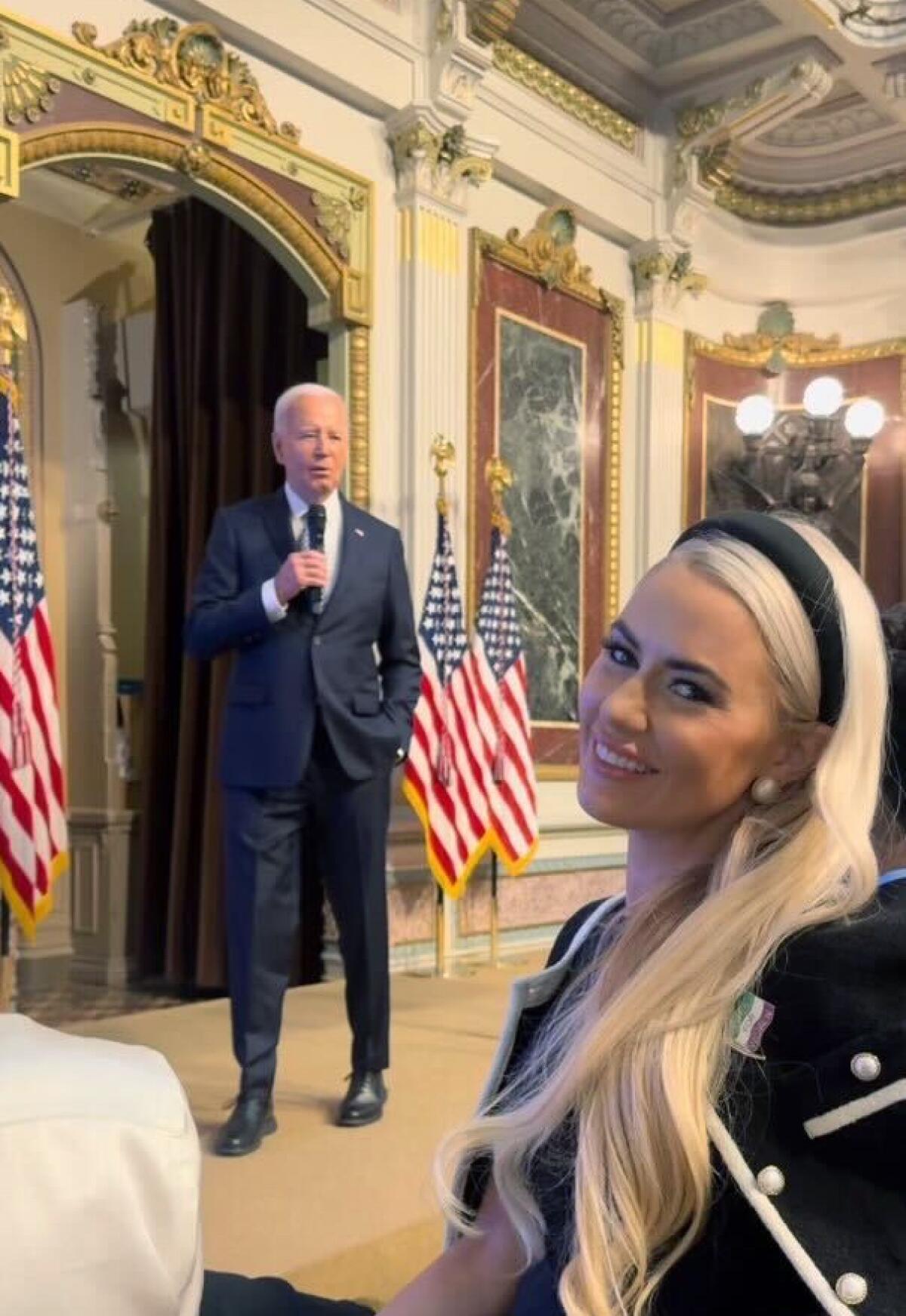
Loren Piretra, an influencer from Brentwood and chief marketing officer of creator platform Fanfix, at last week’s White House Creator Economy Conference in Washington.
(Loren Piretra)
President Biden’s administration last week hosted the first White House Creator Economy Conference in Washington. The one-day gathering brought together a group of digital creators and industry professionals to discuss pressing issues within the creator economy, including privacy, AI and mental health.
Loren Piretra, an influencer from Brentwood, was among those invited to attend the conference, which included time with President Biden.
“This is a massive industry, and it’s time that it’s taken seriously,” said Piretra, who is also chief marketing officer of Los Angeles creator platform Fanfix. “Creators have been able to democratize the idea of celebrity and influence, so it’s only natural that the White House wants to strengthen their connections to this important community.”
Times staff writer Noah Bierman in Chicago and Bloomberg contributed to this report.

Politics
DOJ launches grand jury probe into Marxist mogul Neville Roy Singham’s funding of leftist groups

NEWYou can now listen to Fox News articles!
FIRST ON FOX: A federal grand jury is investigating alleged financial crimes by Neville Roy Singham, the China-based tech tycoon whose fortune has funded a sprawling network of socialist, communist and Marxist organizations across the U.S. over the last decade.
According to sources familiar with the matter, the grand jury in Manhattan has issued subpoenas as part of a probe launched by U.S. Attorney Jay Clayton for the Southern District of New York, one of the country’s most powerful districts for federal prosecutions. Acting U.S. Attorney General Todd Blanche authorized the investigation as the Trump administration seeks to crack down on fraud, money laundering and other financial crimes in the multibillion-dollar nonprofit industry.
The grand jury action follows a Fox News Digital investigation published in mid-March, documenting how Singham pumped $285 million from his base in Shanghai into a Goldman Sachs philanthropy fund and two shell corporations that then fed the money into a constellation of nonprofit organizations, media operations and activist groups pushing sectarian division, identity politics and support for socialist politicians.
The investigation is examining the movement of the money in Singham’s financial network and attempting to determine if Singham, the organizations he funded or their leaders committed wire fraud, bank fraud, money laundering or other financial crimes, according to sources familiar with the matter.
HOUSE OF SINGHAM: READ FOX NEWS DIGITAL’S 5-PART INVESTIGATION
On Feb. 14, 2018, Jodie Evans, co-founder founder of CodePink, and Neville Roy Singham, founder of Thoughtworks, attend V20: The Red Party, a 20th anniversary celebration of V-Day and The Vagina Monologues, featuring a performance by playwright Eve Ensler and an after-party at Carnegie Hall in New York City. (Dave Kotinsky/Getty Images)
Prosecutors have presented evidence to the grand jury, which has issued subpoenas seeking bank records and other financial documents from organizations in Singham’s network. Federal prosecutors use grand jury subpoenas as an investigative tool to compel the production of documents and testimony as they determine whether sufficient evidence exists to pursue criminal charges.
Nicholas Biase, spokesman for the U.S. Attorney’s Office for the Southern District of New York, declined to comment.
Showdown with Goldman Sachs
According to sources, Treasury Secretary Scott Bessent traveled to New York City earlier this year for a meeting with Goldman Sachs Chairman and CEO David Solomon. The men discussed the role of a Goldman Sachs philanthropic arm — GS Donor Advised Philanthropy Fund For Wealth Management Inc. — that facilitated the movement by Singham of millions of dollars into a network of U.S. nonprofits.
A Treasury Department spokesman declined to comment. A person familiar with the meeting confirmed that it occurred, saying that Bessent has regular meetings with business leaders, and declined to comment further on the substance of the meeting.
At that meeting, sources said, Bessent delivered a blunt ultimatum: Goldman Sachs could face scrutiny for alleged conspiracy in the funneling of the Singham money and urged Solomon to cooperate with federal investigators.
Like many U.S. companies, Goldman Sachs has had a long business relationship with the Chinese Communist Party, with Solomon participating in a meeting, for example, on Nov. 4, 2025, with He Lifeng, a member of the Political Bureau of the Communist Party of China Central Committee and director of the Office of the Central Commission for Financial and Economic Affairs.
Solomon pledged his cooperation, according to sources.
WALL STREET BANKS HELPED CHINESE MILITARY-LINKED FIRM RAISE BILLIONS DESPITE RED FLAGS, LAWMAKERS FIND
By mid-May, with the Southern District of New York investigation in full throttle, Solomon joined a delegation of powerful American business leaders who accompanied President Donald Trump, Bessent and other administration officials to China to meet with Chinese President Xi Jinping and other leaders of the Chinese Communist Party.
On Nov. 4, 2025, He Lifeng, a member of the Political Bureau of the Communist Party of China Central Committee and director of the Office of the Central Commission for Financial and Economic Affairs, meets in Beijing with David Solomon, chairman and CEO of Goldman Sachs Group. (Cai Yang/Xinhua News Agency via Getty Images)
In a five-part investigative series published earlier this year, Fox News Digital unearthed a four-minute-13-second speech in which Singham stood on a stage at the Golden Tulip Hotel on Nov. 13, 2025, for a conference of the “Global South Academic Forum,” coincidentally just days after the Goldman Sachs’ chief was in Beijing. Tricontinental Ltd., a Singham-funded nonprofit, co-sponsored the event with academic institutions administered by the Chinese Communist Party.
On stage, Singham openly supported a “new world order” promoted by Chinese President Jinping and the Chinese Communist Party. During the speech, he called the United States a “fascist” nation, echoing the propaganda of the Chinese Communist Party now also parroted on the streets by communist, socialist and Democratic Party activists.
WATCH THE NOVEMBER 2025 SINGHAM SPEECH:
The series revealed a 172-page report in which Singham outlined his theory of change, invoking 20th century Chinese communist leader Mao Zedong’s battle plan to wage a “people’s war” to spread communism. Mao was inspired by communist leaders Karl Marx and Vladimir Lenin.
LAWMAKERS RAISE ALARM OVER NEVILLE ROY SINGHAM’S $278M NETWORK SPREADING CCP PROPAGANDA IN THE U.S.
Singham’s rise as a global political financier accelerated after his February 2017 marriage to Jodie Evans, the co-founder of Code Pink, a far-left activist group that has aligned itself with authoritarian regimes including the Islamic Republic of Iran, the Communist Party of Cuba and the Chinese Communist Party. According to sources, Evans is also a target of the investigation, emerging as a board member in the U.S. on many of the organizations that Singham funded.
That same year, Singham sold his company, ThoughtWorks, for an estimated $785 million to a London-based private equity firm, Apax Partners. A spokeswoman for Apax Partners said the company wouldn’t disclose the names of the investors who pumped money into that sale, but sources told Fox News Digital that federal investigators are looking for potential ties to the Chinese Communist Party.
After that sale, Fox News Digital found, Singham began directing large sums of money into a network of organizations that now form part of a broader activist infrastructure in the United States and abroad.
In its investigation, Fox News Digital mapped 223 transactions from 2017 through 2025 that moved $591 million across five continents through 67 core groups in the Singham network. They partner with hundreds of groups worldwide, resulting in a network of about 2,000 groups, amplifying anti-U.S., pro-China messages.
Of that money, Fox News Digital established a documented $278 million flowed directly from Singham into organizations that “sow discord” in the U.S., as House Ways and Means Chair Jason Smith put it earlier this year at a hearing a dynamics called “foreign malign influence.”
Following the Money
In money-laundering investigations, prosecutors typically examine three stages of alleged impropriety called “placement,” “layering” and “integration.” Placement refers to the introduction of funds into the financial system. Layering involves moving money through multiple entities or transactions to allegedly obscure its origin. Integration is the point at which the money reemerges as apparently legitimate funding, grants, payments or organizational support.
Step 1: Alleged Placement
Singham allegedly funneled $278 million from Shanghai into the United States through three key channels — the philanthropic arm of Goldman Sachs and two shell corporations that have since gone defunct.
- $164,040,000 to Mutod LLC, a now-defunct shell corporation established in 2017, based in Chicago.
- $110,376,701 to GS Donor Advised Philanthropy Fund For Wealth Management Inc., a philanthropy arm of Goldman Sachs, based in New York City.
- $3,500,000 to Likewise Conceptions LLC, a now-defunct shell corporation established in 2017, based in Crystal Lake, Ill.
Step. 2: Alleged Layering
The three entities then pumped the $278 million into six nonprofits:
- $167,540,000 to People’s Support Foundation Ltd., a 501(c)(3) nonprofit established with a hotel address in 2017 in Chicago and Singham’s wife, Evans, on the board.
- $68,748,701 to Justice and Education Fund Inc., a 501(c)(3) established with a UPS Store address in 2018 in New York City with self-avowed communists, including Manola De Los Santos, on the board.
- $22,440,000 to People’s Forum Inc., a 501(c)(3) established in 2017 on W. 37th Street in New York City with Evans and De Los Santos on the board.
- $16,760,000 to Tricontinental Ltd., a 501(c)(3) established in North Hampton, Mass., in 2017 by Singham friend and fellow Marxist ideologue Vijay Prashad.
- $1,330,000 to CodePink Women For Peace, a 501(c)(3) established in 2009 in Marina Del Ray, Calif., by Singham’s wife, Evans, and her friend, Susan Medea Benjamin.
- $1,098,000 to Breakthrough BT Media Inc., a 501(c)(3) established in New York City in 2020 at the People’s Forum headquarters with longtime American communist leader Brian Becker’s son, Ben Becker, as editor-in-chief of its pro-communist propaganda outlet, Breakthrough News.
Step 3: Alleged Integration
The six nonprofits then funneled at least $223 million and other forms of support into a global network of organizations including:
- People’s Welfare Association, a 501(c)(4) established in 2019 with the address of a UPS store in Madison, Wisc., today reporting about $12 million in revenues transformed into grants to undisclosed groups around the world.
- Countless unidentified organizations in six regions around the world, including Subsaharan Africa, Central America and even North America, receiving tens of millions of dollars.
- The ANSWER Coalition, a communist organization whose Chicago address has been listed as the location of the Green Mill Restaurant, a regular haunt for 20th century gangster Al Capone, whom federal prosecutor Elliott Ness prosecuted and convicted for tax evasion.
- The Party for Socialism and Liberation, a loosely-structured organization with shared leadership from the House of Singham, like the Becker father-son duo.
FLASHBACK: INSIDE THE POLITICAL MOVEMENT THAT PUT A SOCIALIST IN CHARGE OF NEW YORK CITY
Socialist New York congressional nominees Darializa Avila Chevalier (L), Claire Valdez (C) and Brad Lander. (Michael M. Santiago/Getty Images; Michael Nagle/Bloomberg via Getty Images; Adam Gray/Bloomberg via Getty Images)
Singham and Evans haven’t responded to repeated requests for comment from Fox News Digital. In January, Becker and De Los Santos refused to respond to questions by Fox News Digital outside the People’s Forum headquarters. Benjamin refused to respond to questions during a protest in May.
The ANSWER Coalition, Breakthrough BT Media Inc., CodePink Women for Peace, Justice and Education Fund Inc., Party for Socialism and Liberation, People’s Forum Inc., People’s Welfare Association and Tricontinental Ltd. also haven’t responded to repeated requests for comment. Representatives for Mutod Ltd. and Likewise Conceptions LLC couldn’t be located.
CLICK HERE TO DOWNLOAD THE FOX NEWS APP

WASHINGTON — Licensed gun owners have a right to carry a concealed firearm into stores and other private places unless the owner objects, the Supreme Court ruled Thursday.
The 6-3 decision extends gun rights and strikes down laws in Hawaii, California, New York, New Jersey and Maryland.
Those measures would prohibit carrying guns onto private property that is open to the public unless the owner has expressly authorized them.
“This regime hobbles what the 2nd Amendment protects: the right of Americans to carry arms for self-defense as they go about their daily lives. We hold that the law is unconstitutional,” Justice Samuel A. Alito Jr. said for the court.
The new laws, if upheld, would “impose severe restrictions on the daily activities of residents who have satisfied the state’s rigorous requirements for the issuance of a carry permit. When these permit holders leave home in the morning, … they may also be barred from entering many places that people routinely visit in the course of their daily routines, such as gas stations, convenience stores, restaurants, coffee shops, drug stores, grocery stores, ‘big box’ stores, home improvement stores, barber shops or hair salons, dry cleaners, and laundromats.”
The three liberals dissented, saying the law would protect property owners who don’t want guns in their stores.
“There is no constitutional right to enter private property without the owner’s permission, let alone with a firearm,” said Justice Ketanji Brown Jackson.
Trump administration lawyers had joined a coalition of Hawaii gun owners in urging the court to strike down these blue state laws in the case of Wolford vs. Lopez.
They said the laws, if enforced, would mean “a person carrying a handgun for self-defense commits a crime by entering a mall, a gas station, a convenience store, a supermarket, a restaurant or a coffee shop.”
This litigation is part of much broader debate over where guns may be permitted or prohibited.
Four years ago, the justices ruled that law-abiding persons had a right to obtain a permit to carry a concealed gun when they left home. They also agreed there are “sensitive places” where guns may be prohibited, such as schools, courts and other government buildings.
In response, lawmakers in California and Hawaii adopted their own lists of “sensitive places.” They imposed restrictions on concealed weapons at parks, beaches, playgrounds, places of worship and public transit as well as bars and restaurants that serve alcohol.
Gun owners sued but the 9th Circuit Court refused to block most of those restrictions in a single 83-page opinion covering Hawaii and California. Both states would prohibit carrying guns onto private property open to the public without the owner’s consent.
The 9th Circuit upheld that measure in principle but said California went too far by requiring the owner to post a prominent sign expressly authorizing guns.
“While today’s ruling in Wolford is disappointing, owners still have every right to decide whether firearms are allowed in their stores and businesses,” said Janet Carter, managing director of Second Amendment Litigation at Everytown Law. “The Supreme Court may have changed the default rule, but it cannot take away a private property owner’s authority over their own land.”
The Firearms Policy Coalition said the court had properly protected gun rights and barred states from carving out their “own regional version of the 2nd Amendment.”
“The historical record does not support forcing peaceable people to obtain advance permission before carrying for self-defense in places held open to them,” the group said.
Last week, the court upheld gun rights in a Texas case and said the government may not make it a crime for an “unlawful user” of a drug such as marijuana to own a gun.
Politics
Jacob Frey praises Somali community as Minnesota faces renewed scrutiny over fraud investigations

NEWYou can now listen to Fox News articles!
Minneapolis Mayor Jacob Frey told members of the city’s Somali community over the weekend that they are “our family,” pledging solidarity and praising their contributions to the city during remarks celebrating Somali Independence Day.
Frey’s remarks came as Minnesota continues to face scrutiny over several high-profile fraud investigations and weeks after a Republican-led House Oversight Committee report alleged the Minnesota Governor Tim Walz’s administration failed to act on repeated warnings about widespread fraud in the state’s social services programs.
“Through the most difficult of times and through Operation Metro surge, we all saw that they tried to come for some of us,” Frey told members of the Somali community on Saturday. “And when that happens, we say that you’re coming for all of us.”
BLUE STATE’S ANTI-ICE PLEDGE COLLAPSES AS GOP WARNS OF NEW SANCTUARY ‘CONFEDERACY’
Minneapolis Mayor Jacob Frey speaks during a Somali Independence Day celebration in Minneapolis as attendees stand on stage holding Somali flags. (Credit: Mayor Jacob Frey X Post)
“In Minneapolis, we loved our neighbors. In Minneapolis, we do not see you as immigrants. We see you as our family,” he added. “You are our brothers. You’re our sisters. You have done so much for this incredible city, and for that, we stand with you.”
Frey appeared to reference Operation Metro Surge, the Trump administration’s immigration and public safety initiative in Minnesota.
The operation concluded in February after border czar Tom Homan announced it had resulted in the arrest of more than 4,000 people in the Minneapolis-St. Paul area and had reduced what he described as public safety threats.
BLUE STATE’S ANTI-ICE PLEDGE COLLAPSES AS GOP WARNS OF NEW SANCTUARY ‘CONFEDERACY’
Minneapolis Mayor Jacob Frey speaks to the media at City Hall on Jan. 9. (Aaron Lavinsky/The Minnesota Star Tribune via Getty Images)
Frey shared the video on X, writing, “Happy Somali Independence Day.”
“Here in Minnesota, home to one of the largest Somali communities in the United States, we celebrate the resilience, culture, and leadership that continue to enrich our city and community,” he said.
Earlier this month, a Republican-led House Oversight Committee report alleged Walz’s administration repeatedly failed to act on warnings about fraud involving state social services programs, including the Feeding Our Future scandal.
WALZ ADMINISTRATION IGNORED FRAUD WARNINGS AS BILLIONS VANISHED, HOUSE OVERSIGHT REPORT ALLEGES
Democratic Gov. Tim Walz speaks during a news conference on Tuesday, Jan. 6, 2026, in Minneapolis, Minnesota. (Alex Kormann/Star Tribune via AP)
The committee said more than 110 people have been charged in connection with various fraud schemes in Minnesota, including many defendants identified as members of Minnesota’s Somali immigrant community.
The report also alleged concerns about potential racial discrimination claims contributed to delays in addressing suspected fraud and estimated Minnesota lost roughly $300 million in stolen federal child nutrition funds during the COVID-19 pandemic.
CLICK HERE TO DOWNLOAD THE FOX NEWS APP
Walz administration officials have disputed the committee’s findings.
Fox News Digital’s Adam Pack contributed to this report.
-

 Alabama5 minutes ago
Are fireworks legal in Alabama? 7 explosives that might be allowed
-
 Alaska8 minutes ago
Jesuits say goodbye to Alaska at Bethel ceremony
-

 Arizona13 minutes ago
Series Preview #28: Giants @ Diamondbacks
-

 Arkansas20 minutes ago
Harrell Wilson enters Arkansas Senate District 1 race as Gilmore seat opens
-

 California23 minutes ago
Suspected Northern California library shooter charged with murder, faces life in prison
-
 Connecticut38 minutes ago
New CT laws taking effect July 1: Absentee ballots, zoning, AI
-

 Delaware43 minutes ago
State Police Investigating Shooting in Newark – Delaware State Police – State of Delaware
-

 Florida50 minutes ago
10 places to watch the fireworks in South Florida for 4th of July 2026

