Business
Exhibit, memorial in L.A. re-create terror attack at Israeli music festival

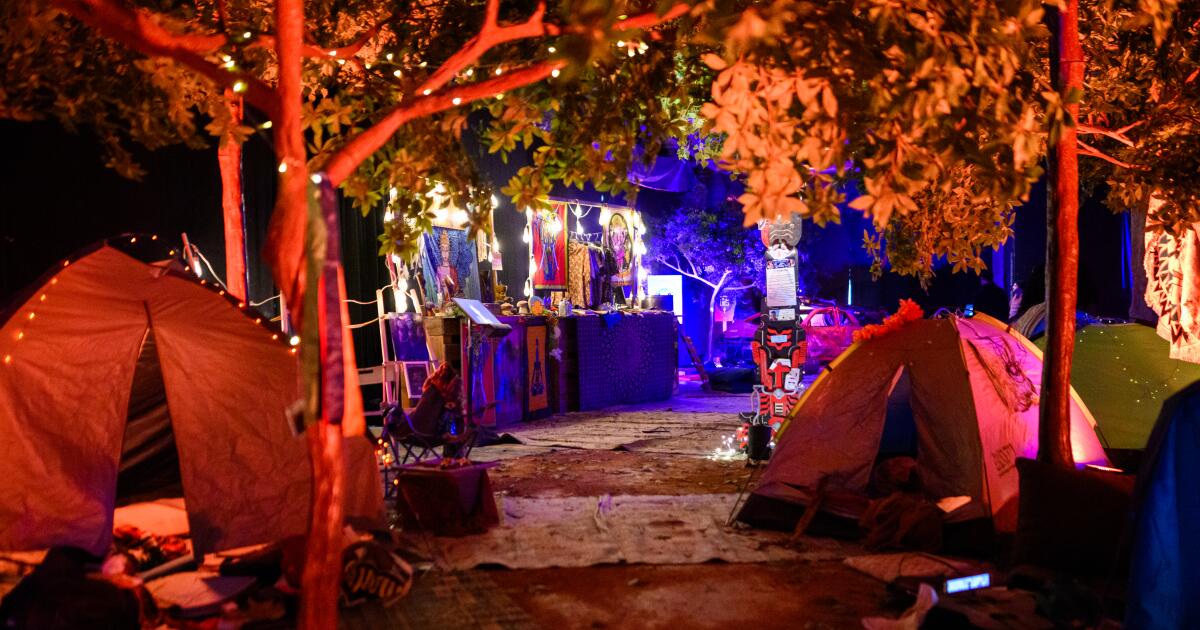
In a cavernous, 50,000-square-foot industrial event space in Culver City stand the charred remnants of six cars destroyed by rocket-propelled grenade fire. There are portable toilet stalls, their doors riddled with bullet holes. There are tents, camping gear, clothes hanging on lines and tables labeled “Lost and Found” filled with rows of everyday items such as shoes, sunglasses, bags, toiletries and keys.
These and hundreds of other items — including a large canopy under which 3,000 partygoers danced — were salvaged after the Hamas-led terror attack on the Nova Music Festival in Israel on Oct. 7.
They are part of the “Nova Music Festival Exhibition: October 7th 06:29 AM — the Moment Music Stood Still,” an immersive memorial that re-creates a sense of the horrors that unfolded early that morning and its aftermath while honoring victims and survivors.
As festivalgoers danced, a barrage of rockets landed and thousands of Hamas gunmen and other insurgents from the Gaza Strip swarmed across the border into southern Israel. The attack killed about 1,200, including 405 Nova attendees, many of whom were ambushed as they attempted to escape in their cars or to hide in bomb shelters and nearby fields. More than 250 were abducted that day; 45 were festival participants — some of whom remain in captivity in Gaza.
Interspersed among the artifacts is harrowing real-time video taken by attendees — unknown to them that they were dancing in the last moments just as the onslaught began — as well as body-cam footage taken by Hamas terrorists, who then posted the contents online.
The burnt remnants of a car hit by rocket-propelled grenades were brought from Israel as part of the installation.
(Alexi Rosenfeld / Getty Images)
“I love everyone. I want to go home. I already miss everyone,” festival survivor Noa Kalash says in phone footage made while she hid during the attack.
In a heartbreaking audio exchange, Meirav Gonen tells her daughter Romi, who is shot and trying to flee, “Romily, you’re not alone. You’re with me, my beautiful one. Everything is OK.” Romi, who turns 24 on Sunday, was taken captive and remains in Gaza.
“Dad, I’m calling you from the phone of a Jew. I just killed her and her husband,” one of the terrorists says in a call broadcast on a video screen.
The exhibition is spread over several rooms and includes video testimonials of survivors, first responders and family members of those still held hostage. Portraits of those who were killed that day line three walls.
Survivors of the festival are on-site to share their experiences.
“I hope that people take out of this place the message of what happened to human beings,” said Millet Ben Haim, 28, who hid for more than six hours in bushes with her friends before being rescued.
“We’re shining a light on these atrocities not to rattle people but to ensure that it doesn’t happen again.”
Also, she said, the goal is to focus on “love, compassion and life rather than on darkness and not to let hatred change our hearts.”
Irish Israelis Emily and Laura Damti want people to know about their younger sister Kim, 22, whom they described as a beautiful, gifted student. She was killed while seeking refuge in a bomb shelter with her friend Omer Wenkert, 23, who was taken hostage in Gaza, where he remains. “She was a radiant presence of positive energy and golden curls,” Emily said.
Scooter Braun, chief executive of entertainment company Hybe America and a music manager whose clients have included Justin Bieber and Ariana Grande, was instrumental in bringing the exhibit to the U.S., as were Omri Sassi and Ofir Amir, co-founders and producers of the Nova Music Festival, creative director Reut Feingold and American partners Joe Teplow and Josh Kadden.
Braun said he was moved to act, angered at what he saw as the music industry’s silence after the massacre.
In 2017, two weeks after a suicide bomber blew himself up and killed 22 people at Grande’s concert in Manchester, England, Braun helped organize the all-star One Love Manchester benefit concert and television special, which raised nearly $3 million to help victims.
“That is what’s so frustrating to me,” he said. “We had no issue stepping forward against an ideology, the same ideology that caused this and demanding that this is not acceptable.”
Braun saw this as an opportunity to coalesce around shared values and humanity.
“I started to speak out and try to make people hear each other. I believe that we aren’t living in the Middle East, and this is a place where people of all shapes, sizes and colors come to find a new life. And I thought, ‘Why are we yelling at each other here but expecting them to have peace there?’ We need to set the example.”
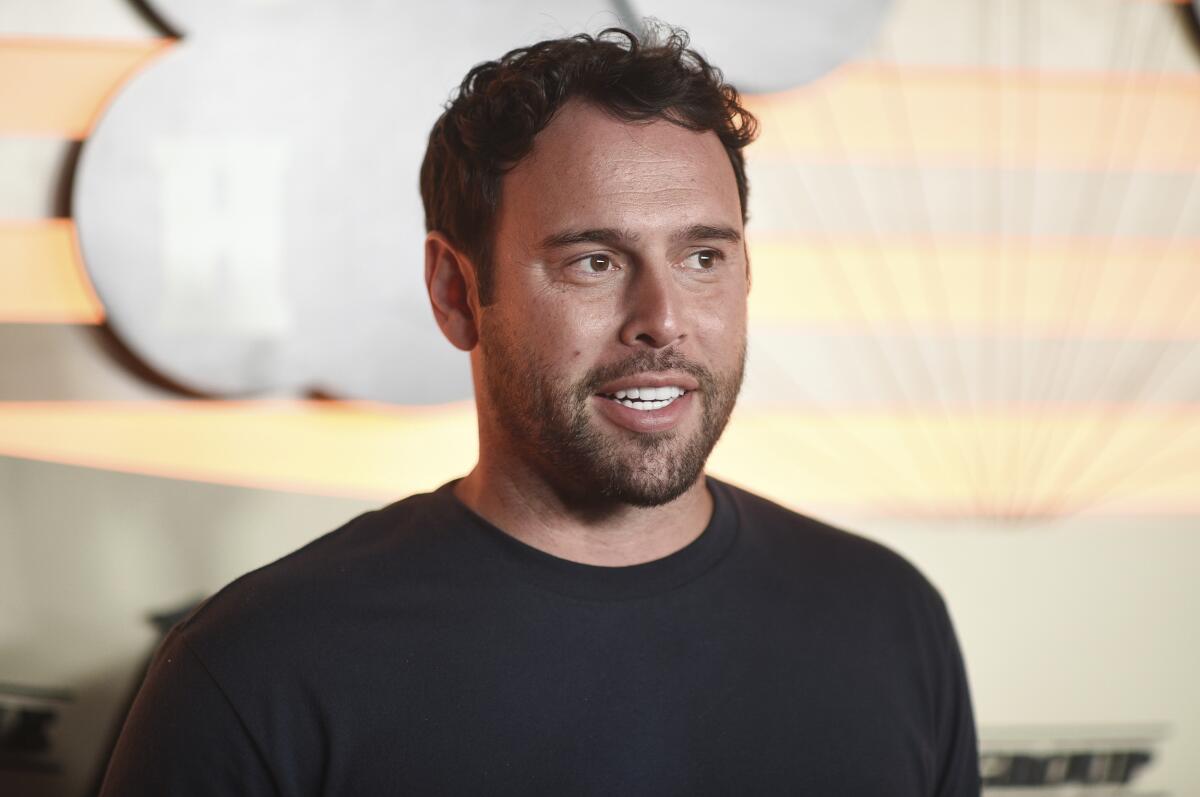
Music manager Scooter Braun was instrumental in bringing the exhibition to the United States.
(Richard Shotwell / Invision / Associated Press)
In December, Braun flew to Israel. He visited Kibbutz Beeri, a community left in ruins by the Hamas-led attacks, where residents were tortured, killed or abducted. He also visited the field where the festival was held. “These people were the hippies of the country. They were peace-loving people who wanted better for everyone. And they were just massacred.”
Braun met with survivors at the Nova Healing Camp who invited him to an exhibition in Tel Aviv. It was a small re-creation of the festival set up in a hangar.
“It was simply a place for people to go and think of their loved ones and everyone who had been affected,” he said.
“When I saw it, I immediately thought to myself, ‘This is what I’ve been looking for to help tell this story because I just want to show people each other’s humanity.’ I think we all love music. So this is a way to show people, step out of the politics and realize what happened here.”
Although the organizers insist the exhibit is neither political theater nor agitprop, it was met with anti-Israel demonstrations in New York in June. Protesters lighted flares, waved banners and shouted slogans such as “Long live the Intifada,” “Israel go to hell” and “The Zionists are not Jews and not humans,” according to videos posted on social media and news reports.
The Oct. 7 attack set off Israel’s campaign in Gaza aimed at destroying Hamas. The death toll among Palestinians has risen to nearly 40,000, according to the health ministry there, whose numbers do not demarcate between civilians and combatants. Much of Gaza’s 2.3-million population has been displaced and large parts of its cities have been reduced to rubble.
Nerdeen Kiswani, a pro-Palestinian activist, called the exhibition “propganda used to justify the genocide in Palestine” on her X account and wrote that the Nova festival was “a rave next to a concentration camp.”
The protest at the exhibition elicited a flood of denunciations, including from the White House, Sen. Chuck Schumer (D-N.Y.) and New York Atty. Gen. Letitia James. U.S. Rep. Alexandria Ocasio-Cortez (D-N.Y.) called the protest “atrocious antisemitism — plain and simple.”
Braun responded to the demonstration by extending the exhibition an additional week.
More than 100,000 people attended the exhibit during its New York run, including Mayor Eric Adams and Gov. Kathy Hochul.
Of the protests, Braun says, “I think free speech was designed to create a dialogue between us. If someone is conscious and they want to protest, then I challenge them to be considerate enough to walk through the exhibit and give it the respect it deserves and maybe see a different point of view. I want everyone to see this. I want everyone to realize that we need to start seeing each other’s humanity and realizing music must be a safe place and see ourselves in this festival.”

Photos of festivalgoers killed and taken captive by Hamas-led militants during their attack on Israel last year populate the field where the Nova festival was held.
(Ohad Zwigenberg / Associated Press)
The exhibition is expected to be in L.A. through mid-October. Braun said organizers will commemorate the anniversary of the attacks on Oct. 7. During the exhibit’s run, educational events are planned with a focus on outreach to different communities in Los Angeles.
The organizers said they hope to bring the exhibition to other locations, including Miami, Toronto and Washington, D.C.
In the final room of the exhibit, a neon sign reads, “We will dance again.”
“That is not just for us,” Braun said. “That is for all people. We want to dance with all people. And I think that that message is what needs to be heard in these times.”
The Nova exhibition opens to the public Saturday. The privately funded exhibit is selling tickets for $8, $18, $36, $72 or $180, and students can attend free of charge; all proceeds go to the Tribe of Nova Foundation, an Israeli nonprofit and an IRS-approved U.S. public charity initiative, earmarked for medical and mental health treatment and other support projects for victims and families of the Oct. 7 attacks.


Los Angeles County saw job gains in May, likely driven in part by rebuilding after the January 2025 wildfires, which destroyed or damaged more than 18,000 structures.
Construction added 2,300 jobs since April, while postings for new jobs in the industry jumped 45% over a year ago —indicating rebuilding in Pacific Palisades, Altadena and nearby is helping boost the local economy, according to a report by the Los Angeles County Economic Development Corp.
“This is consistent with the possibility that wildfire rebuilding activity is increasing construction labor demand in the area,” Max Chomas, an economist at the LAEDC Institute for Applied Economics, said at a presentation this week based on California Employment Development Department and other data.
Motion picture and sound recordings also added 2,800 jobs during the month, despite a deep downturn in Hollywood caused by a reduction in streaming filming, runaway production and other factors. The industry lost 6,700 jobs compared with a year ago.
Still, the job growth since April in construction and Hollywood were among the highlights of a month that saw total county payroll jobs — excluding agriculture and certain other sectors — grow by 9,000 jobs, to 4,618,400. Employment was virtually flat from the same time a year ago.
“May was a relatively good month for employment growth,” Chomas said.
The biggest monthly job gainers were the hotel and restaurant industries, which added 3,700 jobs.
Manufacturing, which has been hit by job losses over recent years, added 400 jobs since April. It also saw a 15% increase in job postings compared with a year ago.
That could reflect the resurgence in Southern California’s aerospace and defense industries, which have seen a sharp rise in startups.
Postings for all new jobs were up 1,134, or 2.4%, since a year ago. Chomas noted that May was only one of five months over the last three years that saw year-over-year growth in job postings.
The gains helped stabilize the county’s unemployment rate at 5.2%, matching April’s rate and down from 5.4% in May 2025.
Still, that is higher than May’s 4.3% national unemployment rate, and it masked some weakness in the local economy.
The rate is calculated by a household survey to determine which members are working, looking for work or no longer seeking employment.
It found 18,000 workers had dropped out of the county labor force in May, artificially driving down the unemployment rate, according the California EDD.
Similarly, California recorded a 5.3% unemployment rate in May, on par with April, despite a drop in the labor force.
That rate is higher than every state other than Delaware. In May, California only added 3,100 non-farm jobs month-over-month — a job growth rate that lags behind the nation, according to an analysis by the Inland Empire Economic Partnership and the Lowe Institute of Political Economy at Claremont McKenna College.
The LAEDC’s report also examined the potential effects the growth in artificial intelligence has been having on L.A. County jobs “exposed” to AI, meaning they are vulnerable to AI replacement.
California has been hit hard by thousands of AI-related layoffs in Silicon Valley as the software has been integrated into the tech workplace — even though there is fierce competition for software engineers with skills and expertise in the field.
The report found that since July 2023, job listings in Los Angeles County for AI-exposed positions — such as clerical and translation positions — have lagged behind other jobs. However, it is unclear whether businesses have replaced or are waiting to replace those workers with AI.
It may be that employers overhired for those positions during the COVID-19 pandemic and are now shedding them, since there is a correlation between AI-exposed positions and those jobs that can be completed from home, Chomas said.
The report also examined macroeconomic trends and policy decisions affecting the national, state and Los Angeles County economies — which have been hit by tariffs, the crackdown on immigrant labor and high energy costs, among other factors.
Nevertheless, consumers continue to spend despite affordability strains, and employers continue to hire selectively amid higher interest rates to battle inflation, said institute economist Shannon Sedgwick.
“During the previous decade, we experienced extraordinarily low inflation, near zero interest rates, relatively stable globalization, and abundant capital. So those conditions may have conditioned us to think that environment was normal,” she said.
“But historically speaking, today’s world of higher rates, greater geopolitical uncertainty and tighter labor markets, they may actually be closer to that long-run average,” Sedgwick noted.

A proposal to build a truck parking lot near the Port of Los Angeles is facing backlash from nearby residents.
Port officials say the parking lot would provide much-needed designated space for cargo trucks waiting to pick up loads from the port, helping to ease congestion in the area.
But some neighborhood groups say the proposed staging area would only increase traffic and air pollution in Wilmington.
Gina Martinez, chair of the executive board of the Wilmington Neighborhood Council, said the land in question provides a vital buffer between port activity and residential communities.
“It’s been a bad deal from the beginning,” Martinez said in an interview. “We want open space because we’ve been promised for decades a clear separation from port activities.”
The Los Angeles Harbor Commission signed off on the project in a meeting on June 11, but it was vetoed by the Los Angeles City Council this week.
The veto does not permanently ban the project, but allows for more time to discuss the implications for stakeholders and the community.
Los Angeles City Councilmember Tim McOsker, who introduced a special motion to halt the truck plans, said he was acting on behalf of community residents. McOsker represents Harbor City, Harbor Gateway, San Pedro, Watts, and Wilmington.
“Generally, folks in the community would say, ‘we don’t want the port industrial properties to creep into neighborhoods. We want them to retract or hold the line,’” McOsker told The Times.
The John S. Gibson Truck & Chassis Parking Lot, which was originally proposed in 2023 by the Port of Los Angeles, would cover 18 acres of privately owned land and include 393 truck and chassis parking stalls.
The land is currently designated as open space, though it’s undeveloped and not available for any recreational use. The completion of the parking lot would require a Port of Los Angeles master plan amendment to switch the land’s designation from open space to maritime support.
Martinez said the land should have never been sold to private developers because it’s included in the California State Lands Commission’s tidelands trust, which says certain land near the ocean must be available for public enjoyment.
Building a truck and chassis waiting lot on that space would increase congestion on the freeways and in Wilmington neighborhoods, add particulate matter into the air and increase already-problematic noise pollution from the port, she said.
“Of all the things Wilmington needs, it is not another parking lot for trucks,” Martinez said at a Los Angeles Harbor Commission meeting earlier this month. “It is not the responsibility of our community to take on every single truck that runs through the port.”
At the same meeting, Noel Gould of the Coastal San Pedro Neighborhood Council said the council is supporting the project after working closely with the developers to reach compromises.
The parking lot would prevent port-bound trucks from idling near schools and parks, he said. The lot would also include landscaping with native coastal plants.
“We didn’t start out in a position of support, but we worked very closely with them to get to a place where we felt it was really something that would benefit the community,” Gould said at the meeting.
In an interview, McOsker said there is already space set aside for trucks to wait to access the port.
At the Los Angeles City Council meeting Wednesday, the council unanimously approved what’s known as a 245 motion, which gives the council authority to temporarily veto certain actions taken by city boards and commissions.
“The 245 gives us the opportunity to meet and confer and see if there are revisions or additions or mitigation that can better protect the full community,” McOsker said.
The motion sends the project proposal back to the Harbor Commission for further review.
Supporters of the parking lot say the land is currently uninhabited and requires consistent police presence to deter criminal activities.
The Port of Los Angeles also clashed with coastal communities last year over the possible raising of the Vincent Thomas Bridge. The bridge was already slated to be redecked by the California Department of Transportation, but Port of Los Angeles executive director Gene Seroka proposed raising the bridge height as well.
Raising the bridge would allow larger cargo ships to pass under its deck, helping create jobs and keep the port relevant, Seroka said at the time. Most painfully for local commuters and businesses, it would mean the bridge will be closed for around 28 months rather than the originally planned 16 months.
Last December, the California State Transportation agency rejected the proposal to raise the bridge.
Business
Commentary: Puncturing the myth of Alan Greenspan, whose policies gave us the Great Recession

Noah Cross, the archvillain of the movie “Chinatown,” had the definitive line on how old age brings respectability. “‘Course I’m respectable,” he tells Jake Gittes. “I’m old. Politicians, ugly buildings and whores all get respectable if they last long enough.”
I wouldn’t necessarily slot former Federal Reserve Chairman Alan Greenspan into any of those categories, but the general reaction to his death Monday at age 100 puts the lie to Cross’ observation.
As much as he was revered during his nearly two decades as Fed chairman for protecting the stock market from a series of crashes and near-crashes, his obituaries take a more measured view. The headline on the Wall Street Journal’s main take on his legacy is: “The Myth of Alan Greenspan as ‘The Maestro.’”
Stripped of its academic jargon, the welfare state is nothing more than a mechanism by which governments confiscate the wealth of the productive members of a society to support a wide variety of welfare schemes.
— Alan Greenspan, writing as an Ayn Rand cultist (1966)
The Journal blames Greenspan for fostering “the great credit mania of the mid-2000s” and observes that “the music stopped in 2008, producing the panic that did so much harm to the free-market economy that Greenspan promoted.” That was the Great Recession, which started with the 2008 crash in the housing market and persisted into 2012.
That is from a publication that was more or less in accord with Greenspan’s goals of less regulation and lower taxes. His contemporary adversaries were harsher. “R.I.P. Alan Greenspan: You were charming, thoughtful, powerful, and wrong,” writes Robert Reich, who served as Bill Clinton’s Labor secretary while Greenspan led the Fed.
The Great Recession, “in which in which millions of Americans lost their jobs, their savings, and even their homes — resulted from the deregulation of Wall Street that Greenspan advocated,” Reich wrote. But he had to admit that Greenspan’s “iron grip” over Fed policy forced Clinton “to do exactly what Greenspan wanted — which was to reduce the federal budget deficit and thereby destroy much of the agenda Clinton ran on.”
It would be unfair to depict Greenspan’s influence as invariably pernicious. Social Security advocates still think highly of his work chairing the so-called Greenspan Commission of 1982-1983, which developed a series of changes in benefits and revenues for that program to address a looming, immediate fiscal crisis.
Greenspan led the bipartisan panel “masterfully,” recalls William J. Arnone, the former chief executive of the National Academy of Social Insurance, who witnessed its deliberations as a consultant to the New York Citizens Committee on Aging.
Before the commission’s formation, “Republicans and Democrats fiercely disagreed over underlying data,” Arnone told me. “Greenspan used his expertise as an economic empiricist to convince both sides to agree on a singular, shared set of actuarial facts. Quite an accomplishment.”
To the public, Greenspan was known for his impenetrably cryptic speaking style and for the relative tranquility in the American economy during his tenure, which has been termed “the great moderation” despite recurrent short-term crises.
Greenspan was the second-longest serving Fed chair. But he may have had the weirdest background. Having grown up in an affluent New York household, he was talented enough on clarinet and saxophone to have sat in with Stan Getz’s band and attended Juilliard for a time.
He began his economics education in 1945 at New York University and got as far as a master’s degree, but by then he was already working on Wall Street, where his skill at financial analysis propelled him toward the top echelons of high finance.
Somewhere along the line he fell in with the arch-libertarian Ayn Rand, becoming part of her inner circle of economic cultists. Referring to his dour mien and predilection for charcoal gray garb, Rand called him her “undertaker.”
Greenspan provided a veneer of rigorous economic analysis for Rand’s ideology, which lionized the rich and described them as fighting a ferocious battle with the lazy and grasping hoi polloi. He contributed three essays to her 1966 anthology “Capitalism: The Unknown Ideal.”
His association with Rand was seldom highlighted during his Fed tenure, but even a casual reading of those essays exposes the Randian underpinnings — and the Randian self-contradictions — of his Fed policies.
One essay defended the gold standard, which had been discredited in the 1930s. Greenspan blamed “welfare-state advocates” for the developed world’s abandonment of the gold standard.
He wrote, “Stripped of its academic jargon, the welfare state is nothing more than a mechanism by which governments confiscate the wealth of the productive members of a society to support a wide variety of welfare schemes…. Gold stands in the way of this insidious process. It stands as a protector of property rights” — language that could have come right out of the text of Rand’s “Atlas Shrugged.”
Another essay called for the dismantling of government regulators such as the Food and Drug Administration and the Securities and Exchange Commission. Greenspan’s argument was that the consumer was adequately protected by the businessman’s profit-seeking, which in turn depended on maintaining a reputation for honesty and fair-dealing.
For drug companies, he wrote, “the loss of reputation through the sale of a shoddy or dangerous product would sharply reduce the market value of the drug company.” The same goes for securities brokers — “The slightest doubt as to the trustworthiness of a broker’s word or commitment would put him out of business overnight.”
One might ask what inspired Greenspan’s faith in, well, the faithfulness of business enterprises, given centuries of proof otherwise. Anyway, he refuted his own argument. “The guiding purpose of the government regulator is to prevent rather than to create something,” he wrote. “He gets no credit if a new miraculous drug is discovered by drug company scientists; he does if he bans thalidomide.”
He didn’t bother to question why his trustworthy drug companies had tried to market as a morning-sickness drug in the U.S. a formulation that already had been shown to produce severe birth defects in the children of mothers who took it overseas. (American families were largely saved from this tragedy by Frances Oldham Kelsey, who blocked its importation as an official of, yes, the FDA.)
To stock market investors, Greenspan’s chief legacy was the “Greenspan Put.” This was an implicit commitment by the Fed to counteract sharp declines in the market by pumping liquidity into the economy through the mass purchase of Treasury bonds.
The term comes from the options market, in which a “put” gives the holder the right to sell the underlying stock at a set price in the future, even if the market price has fallen below that price. In effect, it establishes a floor to the investor’s losses in a downturn.
The Greenspan put first appeared on Oct. 19, 1987, when the stock market suffered its greatest one-day percentage crash ever, 20.47%. Greenspan had been in office for only a few weeks, but his Fed issued a statement promising to inject liquidity into the system and cut interest rates. “We will back you,” he told bankers in a series of phone calls.
In truth, Greenspan had no legal authority to make that pledge. In any event, the market recovered the next day, and the Fed’s image as a willing bulwark against market declines was born.
The problem was that the idea that the Fed would act in a market crisis encouraged ever more flagrant risk-taking on Wall Street.
The harvest was a series of crises, notably the 1998 collapse of the hedge fund Long Term Capital Management, which was founded by Nobel economics laureates to pursue abstruse arbitrage trades. It was brought low by market moves that confounded their projections. LTCM was so deeply embedded in Wall Street trading it had to be saved with a $3.6-billion bailout the Fed orchestrated.
The Greenspan put, like so many other such grand schemes, worked well right up until it stopped working. That moment came in 2008, with a crash and a long, throbbing hangover.
Testifying to Congress in 2008, Greenspan acknowledged that maybe self-regulation, that watchword of his economic worldview, didn’t work.
“I made a mistake in presuming that the self-interest of organizations, specifically banks and others, were such that they were best capable of protecting their own shareholders and their equity in the firms…. Something which looked to be a very solid edifice, and, indeed a critical pillar to market competition and free markets, did break down.”
That, he said, “shocked me.” It was a rare admission of blame by a man who, as my former colleagues Thomas S. Mulligan and Don Lee reported in their Greenspan obituary, had told CNBC a few months earlier that he had “no regrets” about his policies.
-

 Wyoming4 minutes ago
Many Of Wyoming’s Seldom-Seen Snakes Aren’t That Rare, They Just Like To Hide
-

 Crypto11 minutes ago
Lost your crypto access code? Be wary, there‘s a scam for that too
-

 Finance14 minutes ago
From employee perks to asset management: Hitechzone expands into finance | CTech
-

 Fitness19 minutes ago
Foundation Friday: Building bright futures & mental health through fitness
-

 Movie Reviews29 minutes ago
Hollywood Pariah Kevin Spacey Opens in a Straight to Video Movie with 25 Producers, 1 Review, No Theaters, No Press – Showbiz411
-
World41 minutes ago
Rescue Workers and Aid Arrive in Venezuela, Official Says
-
 Lifestyle1 hour ago
This mindset shift can help you get better at using up your leftovers
-

 Technology1 hour ago
TMD’s keyless bike lock is a $280 solution to a $60 problem

