West
Central California farmer shows support for former president, creates large 'TRUMP' sign in field

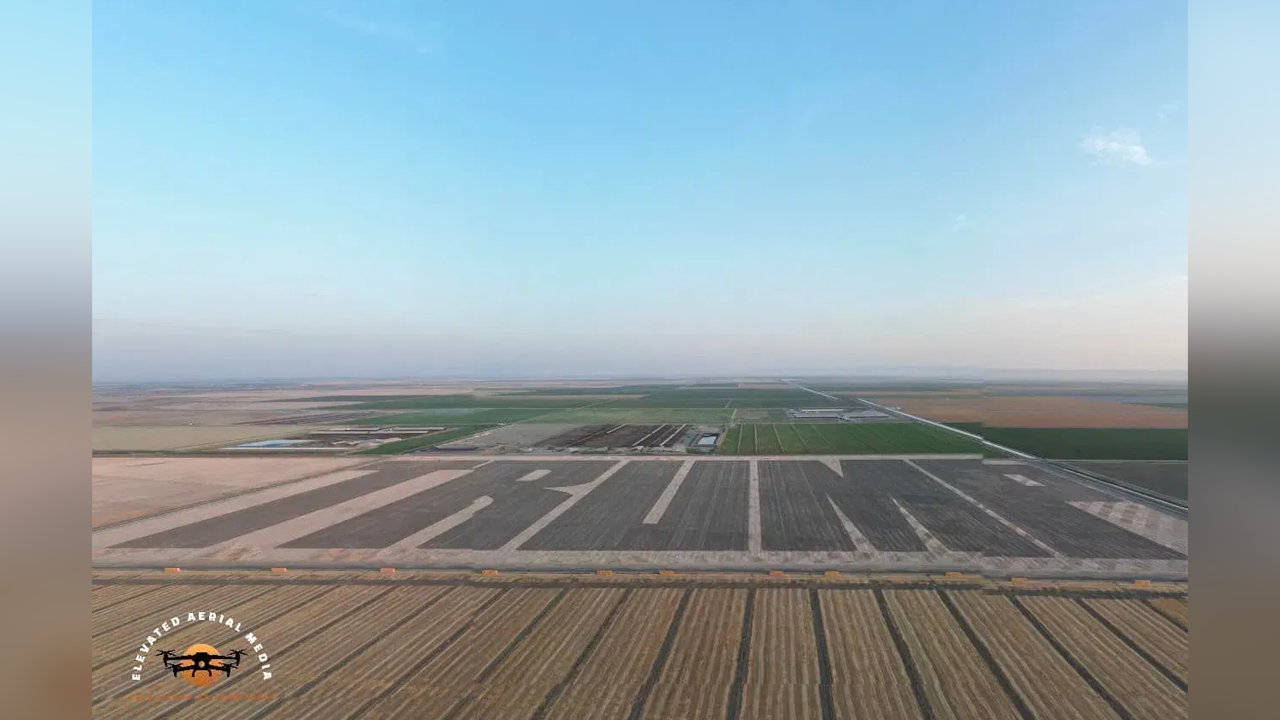
A California farmer planted his endorsement of former President Trump with a mile-long “TRUMP” design in his Central Valley field.
The field, which is located in Kings County just south of Corcoran, started grabbing attention after aerial footage of the massive “TRUMP” sign went viral on social media. The property is owned by Gilkey Farm Inc.
Ralph Gilkey, a third-generation farmer, and his son told KFSN they had spent a day mapping out the design on a computer and outlining the letters on the field.
BUTLER RESIDENTS STILL FURIOUS ABOUT TRUMP ASSASSINATION ATTEMPT, SAY MORE THAN INCOMPETENCE TO BLAME
A farmer in Kings County created a huge mural in a field showing support for former President Trump. (Armando Perez/ Elevated Aerial Media)
Gilkey and his son had been working on the design to show support for the former president and current presidential hopeful for several weeks.
The sign is approximately a mile long by a half-mile wide and each letter is nearly 900 feet wide, Gilkey told KFSN.
Fox News Digital reached out to Gilkey Farm Inc. for comment.
Trump and current Vice President Harris are neck and neck in key swing states, according to a poll released Wednesday.
FUMING POLICE OFFICER SAYS HE TOLD SECRET SERVICE TO SECURE TRUMP SHOOTER BUILDING DAYS BEFORE RALLY: BODYCAM
A Central California farmer and his son created a large mural in a field to show support for former President Trump. (Armando Perez/Elevated Aerial Media)
A survey conducted by Ipsos found the Republican presidential nominee and his Democrat opponent are in a dead-heat struggle for seven swing states: Michigan, Pennsylvania, Wisconsin, Georgia, North Carolina, Arizona and Nevada.
Harris receives 42% of the vote share in the seven swing states compared to Trump’s 40% and independent candidate Robert F. Kennedy’s 5%.
KAMALA HARRIS FINALLY FIELDS QUESTIONS FROM PRESS AFTER DODGING MEDIA FOR 18 DAYS SINCE BECOMING DEM NOMINEE
Former President Trump (Sean Rayford/Getty Images/File)
Ipsos said in its report that the “margin on the ballot is well within the margin of error, indicating a race that is too close to call.”
Last week, Trump told “FOX & Friends” that the media is trying to turn Harris into a liberal version of former British Prime Minister Margaret Thatcher and that the Democrat nominee hasn’t given an interview since President Biden dropped out of the race on July 21.
“I don’t know how she debates. I heard she’s sort of a nasty person but not a good debater, but we’ll see because we’ll be debating her, I guess, in the pretty near future. It’s going to be announced fairly soon, but we’ll be debating her,” Trump said.
Trump previously agreed to debate Harris on Sept. 4 in Pennsylvania with Fox News anchor Bret Baier and Martha MacCallum serving as moderators. Harris has yet to agree to the Sept. 4 debate.
Fox News Digital’s Timothy Nerozzi and Brian Flood contributed to this report.
Read the full article from Here



Golden Gate Bridge fireworks will be a rare patriotic event
This year on July 4th, for the third time in history, an organized fireworks display will be held at San Francisco’s iconic Golden Gate Bridge. This only happned in twice before in 1987 and 2012 for the bridge’s 50th and 75th annivesary. Expect crowds to be massive and public transportation, ride shares and simply walking is highly recommended.
SAN FRANCISCO – San Francisco is preparing for its major July 4th fireworks display on Saturday night, an event expected to draw massive crowds as pyrotechnics are launched directly from the Golden Gate Bridge for only the third time in history.
Will crowds flood Marina?
What we don’t know:
To pull off the event, the Golden Gate Bridge, major roadways, and key parking lots at Marina Green and Crissy Field will be shut down.
Several neighborhood streets will also be blocked off, creating significant traffic hurdles. Officials are strongly advising spectators to utilize public transit due to severely limited parking.
Local residents in the Marina District have expressed concern over the impending chaos as crowds flood the neighborhood.
“I’m a little worried, yeah,” said nearby resident Michael Zoboski. “I think it’s gonna be definitely hectic. I don’t know where people are going to park, it seems like it’s taking up a large amount of the streets up here. I think it’s going to be a little crazy.”
To manage the influx, access to many surrounding neighborhoods will be strictly limited to local residents.
Checking IDs
What we know:
Law enforcement officers will be checking IDs and questioning drivers to verify residency. According to the district supervisor, there will be 10 police officers deployed per block in the Marina.
Road closures will stretch from Baker Street to Van Ness Avenue between 8 p.m. and 11 p.m.
Portions of Fisherman’s Wharf are scheduled to shut down even earlier, starting at 1 p.m. Saturday afternoon, with much of that neighborhood also restricted to local access. The Golden Gate Bridge itself will close to traffic starting at 9 p.m.
Additionally, roads will be closed in the Presidio and Richmond District. To encourage the use of public transportation, Muni is providing special shuttles to help transport spectators to the viewing areas.
The Source: Marina neighbors, Muni, San Francisco city website

There have been many great offensive linemen in Denver Broncos history, so this list is likely going to vary greatly from person to person. In fact, my take might be a little too bold, but I’m sticking with it.
At the top spot, I think Garett Bolles has earned it. Since coming into the league as a first-round pick in 2017, he has grinded through one of the worst periods in Broncos’ history and grown from beleaguered oft-penalized first-round bust into a perennial All-Pro caliber left tackle. Even more, he has stayed a Bronco through his entire career. The rest of my list speaks for itself and is a throwback to Super Bowl greatness.
Here’s where our Mile High Report staff landed on the top five for offensive line:
Scotty Payne: Tom Nalen was the leader of Mike Shanahan’s offensive line, Ryan Clady was a top LT on a Hall of Fame career before injury and Stink was a key member of the Broncos Super Bowl winning OL back in the 90s. I included Bolles and Meinerz since both will be on this list once their successful careers are over with.
Chris Hart: This position group was one of the toughest to come up with a top five. Denver has an incredible history of top-tier offensive lineman. There are several players I left off who were certainly deserving. I posted Tom Nalen as my top guy because he was a stalwart at the pivot for many years for the franchise. We all know what Gary Zimmerman and Mark Schlereth provided on the field and they are both Super Bowl champions. The last two spots go to two recent Broncos, left tackles Garret Bolles and Ryan Clady. Bolles, a decade into his career, continues to play at a high level and Clady was a fantastic blindside protector whose career ended earlier than it should due to injury.
Ian St. Clair: For the first time in Elway’s career, he had a blind-side protector. And Zimmerman is one of the best to ever do it. Same for Nalen, who should be in the HOF. Clady was special. Bishop was the first Broncos offensive lineman in franchise history to get a Pro Bowl invite and provided one of the best in-game quotes ever when he said in Denver’s endzone at old Cleveland Stadium before hiking the ball at the 2-yard line in what would become The Drive, “We got ‘em right right where want ‘em.” And Schlereth helped lock down the left side of the line that was one of the best in league history.
Sadaraine: The top 3 are largely indisputable, other than maybe swapping Schlereth and Zimmerman. Ken Lanier started 178 consecutive games, which is nuts for an OT, and appeared in 3 Super Bowls. Garret Bolles has crafted himself into an all-time great at tackle and may move up the list.
Ross Allen: The Hall-of-Famer Gary Zimmerman was everything you could ever ask for in a left tackle and was a huge reason why John Elway and that 1997 team was so dominant. Schlereth also gets his credit as he was a massive contributor to Denver’s Super Bowl successes. There’s a strong case for Tom Nalen deserving a spot in the Hall of Fame too. And for the past two years I’ve become a huge spouter of Bolles being destined for the Ring of Fame. He’s an incredible talent as has been the cornerstone of this team for a while now. I just hope he gets his Super Bowl.
Joe Mahoney: Top 3 are a no-brainer. Bolles will finish his career with more starts on the OL than any other Bronco. The man he will pass is Ken Lanier. Since stats from Lanier’s era don’t exist we only have starts to go off, but Lanier was an iron man. He started 167 NFL games and 165 were for the Broncos.
There is a bit of variation here, but a general consensus of who should be in the Top 5. I loved the throwback to Keith Bishop who was a big part of the John Elway fourth quarter magic back in the day.
Who gets into your top five offensive lineman list?

SEATTLE — Fireworks are set to light up the sky above Lake Union on Saturday night as Seattle marks America’s 250th birthday on the Fourth of July.
Crews are preparing more than 7,000 pounds of fireworks for the Seafair show over the water, with hundreds of thousands of spectators expected at Gas Works and Lake Union parks.
This year’s festivities come as visitors from around the globe are in Seattle ahead of another World Cup match featuring Team USA on Monday.
One major change for this year’s celebration is that Gas Works Park will be gated off and will require tickets for entry. Seafair organizers say the new system is intended to help manage the expected increased capacity and keep spectators safe.
RELATED | Boom! Here’s where to catch 4th of July fireworks in and around Seattle
Planned activities during the day on Saturday include an interactive Seafair coloring wall and all-American games, where people can compete in a pie-eating contest, sack races, and a water balloon toss. Musical performances are scheduled to start at 5 p.m.
Free parking is available in the surrounding Gas Works Park neighborhood, but finding a spot is expected to be difficult. Organizers are urging people to give themselves extra time and consider rideshare, carpooling, or public transportation.
Fireworks sales and setting off fireworks are illegal in many areas of western Washington, making large public shows a safer option for many people.
Spectators at Gas Works Park will notice some changes this year. The city recently removed ladders, catwalks, and platforms from the structures there after the death of a 14-year-old last summer.
The teen’s family said the city failed to address dangerous conditions around the park’s towers despite years of warnings and several injuries.
BE THE FIRST TO COMMENT
The Lake Union fireworks are expected to start at roughly 10:15 p.m. Saturday.
-

 Movie Reviews6 minutes ago
The Kernel: Freshly popped film reviews — Batch #6 – Excalibur
-

 World18 minutes ago
AI ‘Organisms’ Come Alive in Kuala Lumpur as Dutch Artist Unveils Immersive Show
-

 Health42 minutes ago
Is Skipping Breakfast Bad? The Weight-Loss Truth May Surprise You
-
 Lifestyle56 minutes ago
Nearly half of Americans surveyed don’t know what America 250 commemorates
-

 Technology1 hour ago
Amazon updated 2023’s Fire HD 10 tablet with 4GB of RAM
-

 World1 hour ago
Interpol issues red notice for Ukrainian woman wanted for Monaco apartment bombing targeting oligarch
-

 Politics1 hour ago
Mamdani blasts ICE agents, Elon Musk and ‘supremacy’ in America 250 speech ahead of July 4 weekend
-

 Health1 hour ago
What killed Americans in 1776? The answer is dramatically different from today

