Fitness
What Happens to Your Body When You Do Squats, Push-Ups and Crunches Every Day for 30 Days? | BOXROX


Exercise is a fundamental aspect of maintaining a healthy lifestyle. Among various exercises, squats, push-ups, and crunches are classic moves that engage multiple muscle groups and can be performed without any equipment. These exercises have stood the test of time for their effectiveness and simplicity. But what happens if you commit to doing these exercises every day for 30 days?
That is what you are about to find out in the paragraphs below. We talked about how to do the exercises, how to mitigate possible problems, three different scenarios of how your body could change depending on your body fat percentage and training history, and also overall changes to your physical and mental well-being.
Let’s get it on, shall we?
Benefits of Daily Squats, Push-Ups, and Crunches
Enhanced Muscle Strength and Endurance
One of the most immediate and noticeable benefits of performing squats, push-ups, and crunches daily is the increase in muscle strength and endurance.
Squats
Squats primarily target the quadriceps, hamstrings, glutes, and lower back muscles. As you repeatedly perform squats, these muscles adapt by becoming stronger and more resilient. A study published in the Journal of Strength and Conditioning Research found that individuals who performed lower-body resistance exercises like squats experienced significant increases in muscle strength and endurance over time.
Push-Ups

Push-ups are a compound exercise that engages the pectoral muscles, triceps, deltoids, and core. Regularly performing push-ups enhances upper body strength and improves muscular endurance. Research indicates that push-up performance is a reliable indicator of upper body strength and endurance.
Crunches

Crunches focus on the abdominal muscles, particularly the rectus abdominis. Daily crunches can lead to stronger and more defined abs. A study in the Journal of Sports Science & Medicine found that regular abdominal exercises contribute to improved core strength and stability.
Improved Cardiovascular Health
While squats, push-ups, and crunches are primarily strength-building exercises, they also offer cardiovascular benefits. Engaging in these exercises increases heart rate and promotes better circulation. The cumulative effect of performing these exercises daily can lead to improved cardiovascular health. The American Heart Association notes that regular physical activity strengthens the heart muscle, improves blood flow, and reduces the risk of cardiovascular diseases.
Enhanced Metabolic Rate and Fat Loss
Regular exercise, including bodyweight exercises like squats, push-ups, and crunches, boosts metabolic rate. This increase in metabolism helps burn calories more efficiently, aiding in weight loss and fat reduction. A study published in the International Journal of Obesity found that resistance training exercises significantly enhance resting metabolic rate and promote fat loss.
Better Posture and Flexibility
Performing squats, push-ups, and crunches daily can also improve posture and flexibility.
Squats
Squats enhance the strength of the muscles that support the spine, which can lead to better posture. Additionally, they improve the flexibility of the hips, knees, and ankles.
Push-Ups
Push-ups help in strengthening the muscles of the upper back, shoulders, and core, all of which are essential for maintaining good posture.
Crunches
Strong abdominal muscles contribute to better posture by supporting the spine and reducing the risk of lower back pain.
Mental Health Benefits
Regular exercise has well-documented benefits for mental health. Engaging in daily physical activity can reduce stress, anxiety, and symptoms of depression. A study in the Journal of Psychiatric Research found that consistent exercise positively affects mood and cognitive function.

Potential Risks and How to Mitigate Them
While there are numerous benefits to daily exercise, there are also potential risks, especially when exercises are performed incorrectly or without adequate rest.
Overuse Injuries
Performing the same exercises every day without variation can lead to overuse injuries. Overuse injuries occur when the same muscle groups are repeatedly stressed without sufficient recovery time. This can result in muscle strains, joint pain, and tendonitis.
Mitigation Strategies
- Proper Form: Ensuring that you perform each exercise with correct form is crucial. Poor form can lead to unnecessary strain and injury.
- Variation: Incorporating variations of each exercise can prevent overuse injuries. For example, mixing standard squats with sumo squats or adding inclined push-ups can alter the muscle engagement and reduce repetitive strain.
- Rest: Even though the challenge is to perform these exercises daily, incorporating active rest days where you perform lighter versions or fewer repetitions can help with recovery.
Muscle Imbalance
Focusing solely on squats, push-ups, and crunches can lead to muscle imbalances. For instance, while push-ups strengthen the chest and triceps, they might neglect the back muscles if not complemented with pulling exercises.
Mitigation Strategies
- Balanced Routine: Include exercises that target opposing muscle groups. For example, adding rows or pull-ups can balance the muscle engagement.
- Full-Body Workouts: Incorporate full-body workouts that ensure all major muscle groups are exercised.
Plateau Effect
The body can adapt to the same routine over time, leading to a plateau where progress slows down or stops.
Mitigation Strategies
- Progressive Overload: Gradually increasing the intensity, volume, or resistance of the exercises can help overcome plateaus. For example, adding weights or increasing the number of repetitions can challenge the muscles further.
- Mixing Intensity: Alternating between high-intensity and low-intensity days can keep the body guessing and prevent adaptation.
What To Do If Bodyweight Exercises Become Too Easy For You?
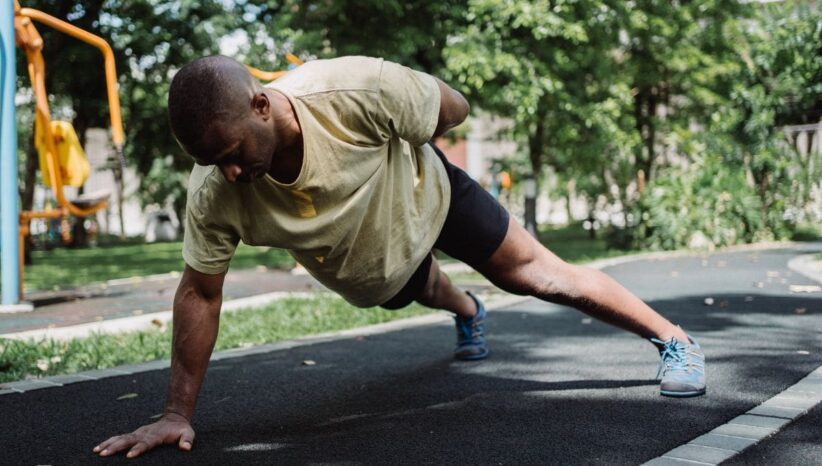
Detailed Analysis of Each Exercise
Squats
Technique
- Starting Position: Stand with feet shoulder-width apart, toes slightly turned out.
- Movement: Lower your body by bending your knees and hips, keeping your back straight and chest up. Go down until your thighs are parallel to the floor, then push through your heels to return to the starting position.
- Common Mistakes: Avoid letting your knees collapse inward or your heels lift off the ground.
Variations
- Sumo Squats: Wider stance with toes pointed outward.
- Bulgarian Split Squats: One foot elevated behind you.
- Jump Squats: Adding a jump at the top of the squat.
Push-Ups
Technique
- Starting Position: Hands placed slightly wider than shoulder-width apart, body in a straight line from head to heels.
- Movement: Lower your body until your chest almost touches the floor, then push back up.
- Common Mistakes: Avoid sagging hips or flared elbows.
Variations
- Incline/Decline Push-Ups: Hands on an elevated surface for incline, feet elevated for decline.
- Diamond Push-Ups: Hands close together under your chest.
- Plyometric Push-Ups: Push off the ground explosively.
Crunches
Technique
- Starting Position: Lie on your back with knees bent, feet flat on the floor, hands behind your head.
- Movement: Lift your upper back off the ground, squeezing your abs, then lower back down.
- Common Mistakes: Avoid pulling on your neck or using momentum.
Variations
- Bicycle Crunches: Alternating elbows to opposite knees.
- Reverse Crunches: Lifting hips off the ground.
- Russian Twists: Rotating torso side to side while seated.
How Much Would Your Body Change?

The extent of bodily changes from performing squats, push-ups, and crunches every day for 30 days varies significantly based on individual factors such as initial body composition, fitness level, and consistency in performing the exercises. Here are three possible scenarios with different individuals to illustrate the range of changes one might expect:
Scenario 1: John – Beginner with High Body Fat Percentage (30%)
Profile:
- Age: 35
- Weight: 95 kg
- Body Fat Percentage: 30%
- Fitness Level: Beginner
- Muscle Mass: Low
Expected Changes:
Muscle Development
John will likely experience significant improvements in muscle strength and endurance. Initially, he may find it challenging to complete the exercises, but with consistency, his muscle mass, particularly in the legs, chest, and core, will increase noticeably.
Fat Loss
Due to his high body fat percentage, John can expect substantial fat loss. The combination of increased muscle mass and elevated metabolic rate from daily exercise will help him burn more calories, leading to a reduction in overall body fat. This will result in a more defined appearance, especially in areas where fat was previously more prominent.
Overall Transformation
By the end of 30 days, John may lose a few kilograms of weight, with a more toned and stronger physique. His cardiovascular health will improve, and he will likely notice better stamina and energy levels.
Scenario 2: Sarah – Intermediate with Moderate Body Fat Percentage (20%)
Profile:
- Age: 28
- Weight: 70 kg
- Body Fat Percentage: 20%
- Fitness Level: Intermediate
- Muscle Mass: Moderate
Expected Changes:
Muscle Development
Sarah already has a decent level of fitness and muscle mass. She will see improvements in muscle definition, particularly in the glutes, thighs, chest, and abs. The daily regimen will enhance her muscle endurance, making her stronger and more capable of handling higher-intensity workouts.
Fat Loss
With a moderate body fat percentage, Sarah will experience a modest reduction in body fat, leading to more visible muscle definition. Her waistline might become slimmer, and her abs more pronounced.
Overall Transformation
After 30 days, Sarah will notice a more sculpted body with improved muscle tone and definition. Her overall fitness level will enhance, and she will likely feel stronger and more agile.
Scenario 3: Mark – Advanced with Low Body Fat Percentage (12%)

Profile:
- Age: 25
- Weight: 80 kg
- Body Fat Percentage: 12%
- Fitness Level: Advanced
- Muscle Mass: High
Expected Changes:
Muscle Development
Mark, being advanced, already has significant muscle mass. The daily exercises will primarily serve to maintain his muscle mass and potentially add slight improvements in muscle endurance and definition. He might not see drastic changes in muscle size but will notice a refinement in muscle tone.
Fat Loss
With a low body fat percentage, Mark’s changes in body fat will be minimal. However, he might achieve a slight reduction, making his muscle definition even more pronounced, with a possible increase in vascularity.
Overall Transformation
Mark’s overall transformation will be subtle but noticeable in terms of muscle definition and endurance. He will maintain his high level of fitness and possibly see slight improvements in performance and aesthetics.
Overall Expected Results After 30 Days
Physical Changes
Increased Muscle Mass
Engaging in these exercises daily can lead to hypertrophy, especially in beginners. Muscle fibres grow in response to consistent stress and adaptation.
Improved Definition
As muscles grow and fat is burned, muscle definition improves. This is especially noticeable in the abs, chest, arms, and legs.
Performance Improvements
Strength Gains
Expect significant improvements in strength, particularly in the targeted muscle groups. This is measured by the ease of performing more repetitions or variations of the exercises.
Enhanced Endurance
Performing high-repetition sets daily enhances muscular endurance, allowing you to sustain activity for longer periods without fatigue.

Health Improvements
Better Cardiovascular Health
Increased heart rate and improved circulation from daily exercise contribute to a healthier cardiovascular system.
Enhanced Flexibility and Mobility
Regularly performing these exercises improves joint health and muscle flexibility, reducing the risk of injuries.
Mental Health Benefits
Reduced Stress and Anxiety
Daily physical activity boosts endorphin levels, leading to improved mood and reduced stress and anxiety levels.
Better Sleep
Exercise helps regulate sleep patterns, leading to better quality sleep.
Conclusion
Committing to a regimen of squats, push-ups, and crunches every day for 30 days can lead to substantial physical and mental health benefits. These exercises improve muscle strength and endurance, enhance cardiovascular health, boost metabolic rate, and improve posture and flexibility. However, it’s essential to perform these exercises with proper form and consider incorporating variations and rest to prevent overuse injuries and muscle imbalances. The journey over these 30 days is not just about physical transformation but also about building discipline and improving overall well-being.
Key Takeaways
| Benefit | Description |
|---|---|
| Muscle Strength | Significant increase in muscle strength and endurance, particularly in the legs, upper body, and core. |
| Cardiovascular Health | Improved heart health and circulation from consistent, daily exercise. |
| Metabolic Rate | Enhanced metabolic rate leading to more efficient calorie burning and fat loss. |
| Posture and Flexibility | Better posture and flexibility from strengthened supporting muscles and increased joint mobility. |
| Mental Health | Reduced stress, anxiety, and improved mood through the release of endorphins. |
| Performance Improvements | Increased ability to perform higher repetitions and variations of exercises, indicating improved strength and endurance. |
| Potential Risks | Overuse injuries and muscle imbalances if proper form, variation, and rest are not incorporated. |
References
- Clark, D. R., Lambert, M. I., & Hunter, A. M. (2017). Muscle activation in the loaded free barbell squat: a brief review. Journal of Strength and Conditioning Research, 31(4), 1142-1149.
- Freitas, D. M., et al. (2017). Muscle activity and strength during push-up variations. Journal of Strength and Conditioning Research, 31(12), 3433-3440.
- Willardson, J. M. (2007). Core stability training: applications to sports conditioning programs. Journal of Sports Science & Medicine, 6(1), 40-50.
- American Heart Association. (2018). The benefits of exercise.
- Hunter, G. R., et al. (2015). Resistance training and intra-abdominal adipose tissue in older adults. International Journal of Obesity, 39(2), 292-298.
- Schuch, F. B., et al. (2016). Exercise as a treatment for depression: a meta-analysis adjusting for publication bias. Journal of Psychiatric Research, 77, 42-51.
Was this article helpful?


Fitness, like anything else, is partial to trends, and at the moment, exercise is portrayed in extremes. “You’ve got to do HIIT training. You’ve got to run marathons. You’ve got to lift heavy.” The actual truth is much less snappy and attention-grabbing: fitness should be balanced and well-rounded. Slow and intentional is better than intense and sloppy.
There’s one functional exercise which is particularly good at challenging us in the ways we often forget, and most of us have never heard of it: the Turkish get-up.
But what is the Turkish get-up, and why is it so good for you?
What is functional movement?
Functional movement is any exercise which mimics and builds on the way we move in everyday life. Rather than aiming for aesthetic results or personal bests, the goal of functional exercise is to feel a little better all the time, in every movement you do, whether that be taking the stairs, lifting heavy boxes, or, if you’re a mum like me, bending down to pick a child up off the floor.
Functional movement incorporates multiple muscle groups, or the entire body, to build strength in a way you’ll actually use, multiple times a day, without even really thinking about it – the best type of exercise. But functional movements aren’t all about building muscle – they also crucially improve coordination, joint stability, shoulder strength, balance, hip mobility, and, perhaps most importantly, core stability and strength.
Over on Strong Like Mum, functional exercise is the name of the game. If you or someone you know is postnatal and ready to start rebuilding core strength, we’ve just released week three of the Strong Like Mum core challenge – all you need is 15 minutes, for a stronger core in just 6 weeks.
Start from week one to start building the vital foundations needed to rehabilitate a strong core. Join the Strong Like Mum core challenge:
What is the Turkish get-up?
See the step-by-step guide below for how to do a Turkish get-up.
The Turkish get-up is an incredibly beneficial, multi-step, multi-joint, full-body exercise targeting every major muscle, which has a simple goal: get from lying down on the floor to standing up, while holding a weight in one hand.
The whole movement is about being balanced, steady, and controlled. It takes an incredible amount of strength to move with intention, rather than trying to go as fast or hard as your body can take. High-impact exercise can be great, but slow and controlled movements can challenge your body in loads of ways, too.
In April of this year, strongman Mike Aidala broke the Guinness World Record for the heaviest Turkish get-up with a whopping 118.6kg
Record breaker
It’s ideal for hitting all the areas we often forget while we’re pushing for a heavier weight or racing to break a personal best. It’s about slow control, brain function, focus, and coordination.
The Turkish get-up is also really easy to replicate if you have children, as it seems more like a fun mobility challenge than an exercise routine. Maybe you could call it a teddy bear get-up: rather than holding a weight, they’ve got to balance their teddy bear in their hand.
How to do a Turkish get-up
Here’s a rundown on how to do a Turkish get-up.

Why is the Turkish get-up so good?
There’s a growing interest in longevity and healthy ageing at the moment. People are starting to think about the long game and what’s going to help create strong foundations for future exercise, in the immediate short-term and into older age.
This is where Strong Like Mum comes in. If you’re postnatal and want to be able to do high-intensity exercise, lift heavy weights, and run marathons, that’s great! But in order to get there, we need to start in the right way. We need to build those strong foundations in order to have longevity with our health. If you want to be able to get the maximum benefit out of this exercise, you’re going to have to do it with the right technique, and that’s where the six-week core program will really help.
For another great full-body workout, check out this video from Strong Like Mum:
If you do this exercise wrong, it can actually cause you all sorts of issues, like back pain or shoulder strain. You have to do it right, and doing it right comes with laying all the foundations that we learn over on Strong Like Mum.
For more evidence-based postnatal recovery advice, pelvic floor education and realistic fitness guidance for women navigating motherhood and midlife, subscribe to Strong Like Mum on YouTube.
Fitness
Business News: Stock and Share Market News, Economy and Finance News, Sensex, Nifty, Global Market, NSE, BSE Live IPO News – Moneycontrol.com

Moneycontrol Pro Panorama | Glitter fades
In this edition of Moneycontrol Pro Panorama: India’s payment ecosystem must prioritise trust alongside scale, family-run companies face complex succession beyond conventional myths, Pakistan’s budget underscores military dominance over national economy, and more

Les Mills, the New Zealand Olympian who opened an Auckland gym in 1968 that grew into an international group fitness brand, has died aged 91, his family confirmed.
Mills, a four-time Olympic athlete and former Auckland mayor, and his wife, Colleen, founded the first Les Mills gym on Victoria Street in central Auckland after a sporting career in which he represented New Zealand in shot put and discus.
More than five decades later, Les Mills workouts are used by clubs around the world.
The business, now run by later generations of the Mills family, became internationally known for choreographed group-exercise classes set to music.
Mills’s son, Phillip, joined the business full-time in 1980, and his partner, Jackie, helped develop the music-driven group-fitness model that became central to its global expansion.
Les Mills became an international fitness brand. (Supplied: Les Mills)
Phillip Mills said in a statement that his father had achieved a great deal in his life, but the common thread was that he always wanted to help others.
“Dad was immensely strong, driven, and always cared deeply for the less advantaged,” he said.
“He left a lasting impression on everyone he met, and his spirit lives on in gym workouts around the world, continuing to help people fall in love with fitness.“
Les Mills was born Leslie Roy Mills in Auckland in 1934.
He competed at four Olympic Games from 1960 to 1972 and won five Commonwealth Games medals, including discus gold at the 1966 British Empire and Commonwealth Games in Kingston, Jamaica.
Move into politics
He later moved into local politics and served as mayor of Auckland from 1990 to 1998.
Juliet Yates served on Auckland Council during his first term.
She told RNZ he brought others together.
“He was a very, very pleasant person to work with,” she said.
“He was really good at bringing people together and achieving things for the benefit of the city,”
she said.
“At the time, I think the achievements of the council he was mayor of were benefiting the whole of the city.”
He also remained active in sport as a coach, helping guide New Zealand discus thrower Beatrice Faumuina to the world title in 1997 and Commonwealth Games gold in 1998.
Les Mills was appointed a Member of the Order of the British Empire in 1973 for services to sport and a Companion of the New Zealand Order of Merit in 2002 for services to local government and sport.
Reuters
-

 San Francisco, CA13 minutes ago
Anza expedition celebrates 250th anniversary in San Francisco
-

 Dallas, TX16 minutes ago
Preston Hollow residents oppose proposed $800 million mixed-use development in Dallas, survey reveals
-

 Miami, FL21 minutes ago
Bradley Beal to Miami Heat rumors draw skepticism
-

 Boston, MA28 minutes ago
Boston Pops surprise travelers at Logan Airport with July 4th preview performance
-

 Denver, CO30 minutes ago
Denver Broncos Crack Top 10 in NFL Uniform Rankings
-

 Seattle, WA36 minutes ago
PHOTOS: Visiting all 12 stops during this year’s West Seattle Garden Tour
-

 Milwaukee, WI46 minutes ago
Milwaukee Barbecue: A Legacy of Smoke
-

 Atlanta, GA51 minutes ago
Georgia Haitian communities face sudden July 27 deportation deadline

