Entertainment
'Game of Thrones' director accidentally lied to Obama about Jon Snow's fate


In “Inside the Episode,” writers and directors reflect on the making of their Emmy-winning episodes.
David Nutter carried out a lot of death sentences in the nine episodes of “Game of Thrones” that he directed.
He helmed Season 3’s “The Rains of Castamere,” which is more commonly known as the Red Wedding because it featured the bloody end of beloved characters Robb Stark (Richard Madden) and his mother, Catelyn (Michelle Fairley). He saw Kerry Ingram’s Shireen Baratheon, a child, burned at the stake in Season 5’s “The Dance of Dragons,” and in Season 8, he had Missandei (Nathalie Emmanuel) beheaded as she utters her final word: “dracarys” (“dragonfire” in High Valyrian or “burn it down” in modern English).
But he’s also noteworthy for a character he didn’t really kill after all: Kit Harington’s heart-of-gold Jon Snow. Although Jon seemed to be brought down in a Julius Caesar-like mutiny in Nutter’s Emmy-winning “Mother’s Mercy,” the HBO drama’s Season 5 finale, the next season’s premiere taught us that he was only mostly dead.
But Jon’s stabbing is just one of many, many things that happened in that jam-packed 2015 episode. Other highlights include Cersei’s (Lena Headey) literal walk of shame; Arya (Maisie Williams) going blind because she misuses a power; and Sansa (Sophie Turner) and Theon (Alfie Allen), two abused victims of the psychotic Ramsay Bolton (Iwan Rheon), joining forces.
And because this is “Game of Thrones,” there were also lots of character deaths.
Before departing for his daughter’s wedding earlier this summer, which he promised would be a lot more chill than anything he’d directed, Nutter discussed making what became one of prestige TV’s most divisive episodes.
David Nutter accepts the directing award for the “Mother’s Mercy” episode of “Game Of Thrones” at the Primetime Emmys in 2015.
(Phil McCarten)
What’s the first thing you do when you get an episode with this much happening?
Scream. (Laughs)
You know, it was the finale of the season and it was my big chance to show what I got.
There was the shame walk that we had to do when Lena was six months pregnant. So I had to find an actress who could actually do this walk like her and carry the same gravitas and weight. That was probably the toughest job I’ve ever had because I had to be a psychiatrist. I talked to all of these actresses that auditioned for the role, and I’d say to them, “You know that you could possibly be trending on the internet all over the world if someone snaps a picture of you on the first day of shooting?”

Lena Headey had a body double who performed Cersei’s walk-of-shame scene.
(HBO)
A lot of women auditioned on tape and did the walk of shame naked. But there was one woman who auditioned on tape and did it in her undergarments. But she had a great head and shoulders, and Lena had a very similar [look]. And she was this great actress named Rebecca Van Cleave. She was from Virginia and lived in London and studied acting. She really wanted to be a good actress, and she was just phenomenal. I’ll never forget. There’s a side shot where you can’t even tell if it’s Lena or Rebecca.
That scene also features (a fully clothed) Hannah Waddingham as a religious zealot, yelling “shame” as she guides Cersei through town. She was then an unknown actor, but she’d soon become a breakout star of Apple TV+’s “Ted Lasso.” Do you remember casting her?
[Creators] David [Benioff] and Dan [Weiss] cast her. We wanted someone who was overpowering, and her whole presence was overpowering. Her voice was strong.
There’s also the big secret of Jon Snow’s seeming murder. Did you know when you shot this episode that he would be resurrected in the next season?
I never wanted to read past where I was in the story. Right after the season ended, there was a big political event with Barack Obama, and we were at Chuck Lorre’s house. Obama was a huge fan of “Game of Thrones.” I took a picture with Barack. He grabbed me and shook my hand, and he put his [other] hand on my shoulder and whispered, “You didn’t kill Jon Snow, did you?” I said, “Sir, he’s dead. He’s deader than dead.”
Did not knowing yourself make it easier for you as a director?
Yeah, much easier.
You want to give it the gravitas it needs.
I also wanted to do it kind of quick and not make it a long, drawn-out thing. So I used one camera as he steps through the crowd … and then the last shot was of Jon Snow [on the ground] with a [camera] up in a crane. I’d done enough gore with the Red Wedding that this needed to be almost peaceful.
The audience had questions about another death in this episode: Stephen Dillane’s Stannis Baratheon. The audience sees him wounded after battle, and Brienne of Tarth (Gwendoline Christie) raises her sword over her head as if to strike him down for good. But we don’t actually see the body. How did that shot come about?
That was David and Dan twisting the screws tighter and tighter.
There’s also a death that encapsulates the show’s ethos of having something kind of good immediately followed by something really bad: Myrcella Baratheon (Nell Tiger Free) dies by poisoning after she tells her uncle, Jaime Lannister (Nikolaj Coster-Waldau), that she knows he’s her biological father and that she’s cool with it.
This is a love scene between a daughter and a father. You know, “You sacrificed yourself for [this family]. But everything you did is for a purpose.” And then the daughter was willing to help her father any way that she could.
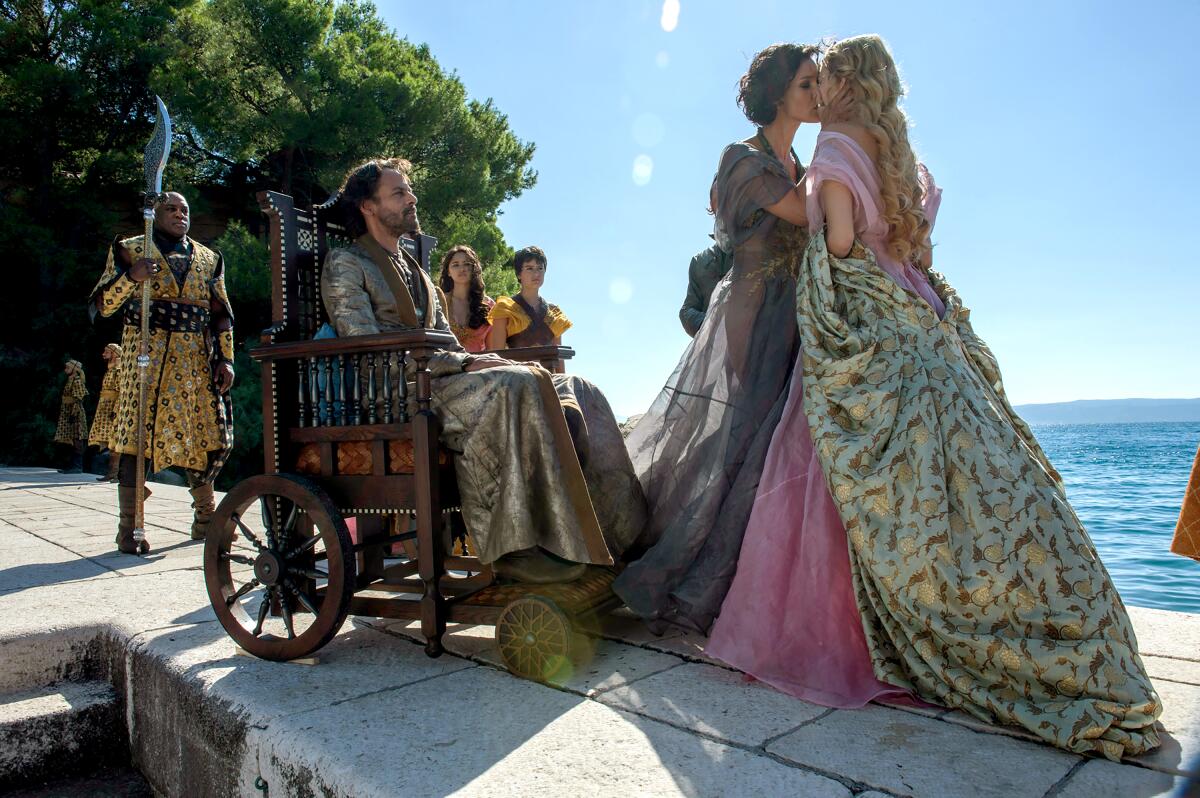
Indira Varma’s Ellaria Sand gives Nell Tiger Free’s Myrcella Baratheon a fatal kiss.
(HBO)
Toward the end of the episode, we see Daenerys Targaryen (Emilia Clarke) slowly, and then suddenly, surrounded by Dothraki warriors — members of her late husband’s people. But neither she nor the audience are clear if they’re happy to see her. How did you accomplish this?
We wanted it to be something where it evolved. She’s on top of the hill and she sees a storm coming in a way. It’s almost like they enveloped her. It’s a hurricane of Dothraki that she’s in the middle of.
It was important to play to the stature of her. Like they’re almost in awe of her.

Movie Reviews
Hollywood Pariah Kevin Spacey Opens in a Straight to Video Movie with 25 Producers, 1 Review, No Theaters, No Press – Showbiz411

As we know, Kevin Spacey is a pariah in Hollywood.
He’s in a rare club with Mel Gibson, Armie Hammer, Nate Parker, Jonathan Majors, and James Franco.
Spacey has managed to avoid jail time by reaching settlements with various accusers of sexual malfeasance, all men.
His film career — which included two Oscars and a Tony Award — has been destroyed.
Spacey has been reduced to appearing in straight to video films, made for whatever reason the various producers involved know only to themselves.
On Friday, a new Spacey movie surfaced against its will, but not in theaters. It also went straight to video. “1780” is a period piece set during the Revolutionary War. Spacey plays a toothless Pennsylvania country trapper.
There is no rating on Rotten Tomatoes, largely because there is only one review. The review by Alan Ng of Film Threat is positive. Ng recently reviewed “World War Bigfoot,” which he also liked. He seems to specialize in reviewing films no one has heard of.
“1780” does boast 25 producers who will probably not see a return on their investment. But they can say they made a movie with Kevin Spacey.
Donate to Showbiz411.com
Showbiz411 is now in its 13th year of providing breaking and exclusive entertainment news. This is an independent site, unlike the many Hollywood trades that are owned by one company. To continue providing news that takes a fresh look at what’s going on in movies, music, theater, etc, advertising is our basis. Reader donations would be greatly appreciated, too. They are just another facet of keeping fact based journalism alive.
Thank you

When David Jacks published a biography of Peter Asher in 2022, the veteran record producer and manager expressed surprise that anyone would have deemed his life worthy of the treatment. Four years later, he’s no less baffled to have become the subject of a new documentary, “Peter Asher: Everywhere Man,” directed by the filmmakers Dan Geller and Dayna Goldfine.
“It just seemed to me,” he says, “that I wouldn’t be that fascinating.”
The movie, in theaters now, argues otherwise: A child actor alongside his two younger sisters, the bespectacled Asher became an unlikely pop star during the British invasion as half of the duo Peter & Gordon, whose debut single, “A World Without Love” — written by Paul McCartney — hit No. 1 on Billboard’s Hot 100 in 1964. (McCartney offered the song to Asher while the Beatle was dating Asher’s sister Jane.) In 1968, the Beatles made Asher head of A&R at Apple Records, where he signed James Taylor; the two soon moved to Los Angeles and turned Taylor into music’s biggest heartthrob folkie.
Asher went on to shepherd Linda Ronstadt to stardom and to produce records by Diana Ross, Cher, Bonnie Raitt, Randy Newman, Neil Diamond and 10,000 Maniacs, among many others. And at 82 he’s still at it: Last year he produced Barbra Streisand’s latest duets album — they’re due to start work on a new Streisand solo LP, he says — and he’ll perform a show of his own July 19 at the Grammy Museum. Asher, who broke his leg in a recent fall, spoke about it all the other morning at his home in Malibu, where he walked into the kitchen using a cane before sitting down at a table set with pastries and several of the day’s newspapers.
What unites the jobs of musician, producer, executive, manager? What’s the through line?
Love of music and admiration for the people who do it. They’re very different jobs, and I came at them from very different perspectives. Record production was something I set out to do once I understood what a record producer did. Hire musicians much better than yourself and tell them what to do? That’s a cool job — how do I get in on that racket? Whereas I never had any ambitions to be a manager. It’s just that when James and I decided to go out on our own and try to put a career together, we didn’t know who we trusted to do it, so I kind of went, I’ll do it.
What’d you discover about the job of management?
The ingredients are common sense, not being a crook and having a great client.
Which is the hardest of those three?
The last one. I got to induct the first managers inducted into the Rock & Roll Hall of Fame: Brian Epstein and Andrew Loog Oldham — the Beatles and the Stones. That’s the hard part. The only thing that would tempt me back into management would be lightning striking for a third time — to see James, to see Linda, then to see somebody comparably brilliant, which I occasionally do. But usually they have a manager already.
What’s the last new act that knocked you out?
Ed Sheeran.
Was that just because he looks like he could be your grandson?
That certainly crossed my mind.
As a producer, your records helped define the sound of rock in the ’70s.
The so-called California sound.
Then the zeitgeist shifted.
One became aware of that. Pop music got very electronic, which I loved.
Was there a place for you in that style?
I didn’t consciously try to make records in that style because I don’t think I could have — not as well as they were being made anyway.
What’s a record from the early ’80s that made you think that?
“Sweet Dreams (Are Made of This).” I couldn’t do that.
Back to the ’70s: The doc is filled with pictures of James looking —
Like a movie star. With the cover of “JT,” I finally went all the way and said, “We’re doing the the glamour shot.” Then we did “Flag,” which everyone hated.
With the maritime flag. A truly perverse album cover.
I loved it. James loved it. Everyone thought we were crazy.
How crucial do you think James’ good looks were to his whole proposition?
I don’t know.
Oh, come on.
I really don’t. I mean, how would you gauge that? There’s probably girls who fell in love with him without listening to the record.
I think you just gauged it.
If he was ugly, would he be as big a star? Probably not.

(Evan Mulling / For The Times)
Same applies to Linda, right?
When I first saw Linda, it was stages of realization. Someone said to me, “You’ve got to go down and see this girl at the Bitter End.” I walk in and she’s singing so well — unspeakably good. Then she looks incredibly great — barefoot, short-shorts. Oh, my God, my heart. Then you meet her, and it turns out she’s a remarkably brilliant woman — extremely well read. You just kind of go, “All these things together — how can it be?” It’s the same thing talking about the Beatles: If you cast it like the Spice Girls, you still couldn’t have gotten four to fit together so perfectly.
Did you like the Spice Girls?
Terrific. “Tell me what you want / What you really, really want” — it’s a smash. And yet none of them are particularly good singers, which is kind of the point.
I went to an event not long ago where Paul McCartney played his new album for a small group of fans. It was fascinating to see the spell McCartney casts over people.
He’s had to get used to it — to admit to himself that he can’t meet people who aren’t amazed that they’re meeting him. Even as someone who’s known him off and on for a long time, you still get the wave of: Holy s—.
You’re still amazed to be around him?
Of course. I get it less — I’m ready for it. But you can’t pretend he’s not Paul McCartney. And he’s gotta live with that his whole life.
You grew up a member of the upper crust, I think it’s fair to say.
I don’t think we were that crusty. But upper, probably, yes.
I wondered how that situated you to live and work among artistic types.
If anything, the upper crust have more time to be artistic — less preoccupied with getting a job and making a living. But my parents worked incredibly hard — we weren’t upper crust in the sense of inherited wealth. My father was a doctor, my mother was a professor of music. But I never struggled, to be honest. I had a comfortable allowance, and then I went to school and worked hard. Everyone talks about sharing a flat with a million people, living on borrowed sandwiches — I skipped that phase.
Did that shape you in any meaningful way?
I don’t know. But I think when people do struggle, it becomes a meaningful part of their lives to get away from it. With someone like James, the struggle was a struggle with drugs. Now he says the worst thing about drugs is they’re a complete waste of time — you waste time doing nothing except looking for drugs. And I think that made him anxious to succeed and to be taken seriously.
I’m sure you saw the New York Times’ list of the 30 greatest living American songwriters.
You knew it was gonna be silly. Randy Newman, for God’s sake — you just cannot not include him.
No Neil Diamond either.
Insane.
And no Billy Joel.
[Shrugs].
How’s your health?
High blood pressure, high cholesterol, need to work out more — old man stuff. Other than that and a broken leg, great.
You’re OK with the cane?
It’s a considerable upgrade from the wheelchair. I like the cane — it’s kind of elegant.
What seems scarier: the body going or the mind going?
The mind going. And it is, slightly. I had a stroke, and bits of my brain aren’t quite working right. But compared to other people I know, I’m fine.
We’re at a moment when a lot of foundational rock ’n’ roll figures —
Are dying. It’s all the rage.
What’s it feel like to see your friends and colleagues go?
Better them than me.
Couple more for you: You managed Courtney Love for a spell.
I met her here in Malibu. I also managed Pamela Anderson for a while because she was a neighbor and asked me to help.
What, you put a shingle out?
“Manager for hire.” I’m trying to remember how I first met Courtney — I think Merck Mercuriadis was talking to her about publishing and Kurt stuff. I liked her. Very smart. I like smart women.
She’s easy to work with? Hard to work with?
Impossible to work with.
What’s James Taylor’s best album?
“JT,” maybe.
What’s Linda Ronstadt’s best album?
“Heart Like a Wheel.” With Linda, it’s unfair because they’re so radically different. How do you compare that to a mariachi record and then to Nelson Riddle?
Working with Riddle on those albums must have been a thrill.
He told us all these incredible stories about Frank Sinatra, who he didn’t like although he admired him enormously. It was John David Souther who originally suggested Nelson. Linda had tried doing the album a different way — did some versions with Jerry Wexler and it didn’t work out. So we had a meeting with Nelson: Would he consider doing a couple of arrangements for us? He went, “No.” We said, “What?” He said, “I’ll do an album, though.”
“A World Without Love” was one of eight songs to top the chart in 1964 with “love” in the title. What’s that say about pop music in the mid-’60s?
Same thing it says about pop music of all time: It’s either “I love you” or “She loves you” or “Why don’t you love me?” Weird Al pointed out to me that when you’re looking for a parody of a song, any song that has “love” in the title, substitute “lunch” and it’s funny. “A World Without Lunch” — I mean, who would want to live in such a place?
Movie Reviews
‘House of Criticism’ Review: A Pensive and Touching Portrait of Married Art Critics Jerry Saltz and Roberta Smith (It Is Only, at Moments, a True-Life Christopher Guest Movie)

If you wanted to be funny about it, you could say that Jerry Saltz and Roberta Smith, who occupy the center of the documentary “House of Criticism,” are like characters out of a Christopher Guest movie. Both are venerable New York art critics — but the thing is, they’re married New York art critics, whose lives revolve entirely around art and art criticism and talking about art and art criticism. They eat, breathe, sleep and dream it. In the Guest mockumentary of my imagination, the two would be played by Bob Balaban and Parker Posey, and they would be blissfully cracked egghead eccentrics who think that art is the most important thing in the world because it’s the most important thing in the world to them.
At moments, “House of Criticism” does throw off unintentional comic sparks of art-world insularity. But I’m kidding, ultimately, since underneath that it’s a pensive and touching documentary, and it happens to be about two writers I greatly admire. Roberta Smith, the co-chief art critic of the New York Times, and Jerry Saltz, the art critic of New York magazine, are writers of sway, elegance, legend. They’re two of the last powerful legacy critics in America, and both are fantastic writers. For them, the love of art is a mission, at once sophisticated and childlike. Roberta calls art “the most advanced operating system that our species has devised to explore consciousness, the seen and the unseeable.” The way art connects (and saves) these two on a daily basis is its own rarefied story, and it speaks to a certain vanishing culture of passionate New York literary brainiacs that used to be thought of as almost the essence of the city.
Early on, Jerry stands before Picasso’s epochal Les Demoiselles d’Avignon at the Museum of Modern Art and does a head-spinning riff on it, describing how 500 years of art history collapsed in the late 19th century (through Manet, the Impressionists, Van Gogh, Cezanne), leaving the blank slate for Picasso to fill. He compares the way the painting remade the world to the cataclysm of 9/11 (“When we believed in one course of history, and obviously there was another course of history, and they shattered”). Now that’s criticism.
As “House of Criticism” shows us, Jerry Saltz and Roberta Smith are luminaries and survivors who enjoy an idealized life together. Roberta is something of a contradiction, both the haughtier and more vulnerable of the two. She can be imperious in that Timesian way, but there’s a tremulous insecurity about her. Beneath a certain Midwestern patrician rigor, she’s full of self-doubt about her writing and is in constant need of encouragement, which Jerry is more than happy to provide. He’s blustery and big picture-oriented, while her insights are more delicate and intimate, blooming out of her holy communion with the work.
Jerry is a contradiction as well, a man who writes like a demon and looks like a dentist. But don’t let his fubsy aura fool you — he’s the social butterfly and loose cannon, plugged into social media (which he plays like a violin), and the audacious thoughts pour out of him. The most telling aspect of their relationship is that as writers they should be competitors, but instead they’re spiritual collaborators; they turn what could be a competition into a romance. They help each other on word choices, and even when they’re reviewing the same show, they’re really competing with themselves, with their own cultivated and highly different ideas of perfectionism.
Their relationship is built, to a large degree, around Jerry’s belief that Roberta is the superior critic — but this, for Jerry, is a form of chivalry, the flower of their love story. “Your writing is so condensed, right on the object, focused,” he says. He’s intensely supportive, but Jerry, who won the Pulitzer Prize for criticism in 2018, is arguably the greater writer (his poetic showmanship flies higher), and it’s my reading that deep down he knows it. It’s his perpetual self-deprecation and devotion that keeps the marriage balanced.
The two have no children and no apparent hobbies outside of their unrelenting obsession with art. They slip in and out of gallery openings, where they’re treated like royalty, and they attend 20 to 30 shows a week. By all rights, they should have a social calendar that rivals Andy Warhol’s in the ’70s. But here’s the joke: They adore their life together but are so devoted to their work, so monastic about it, that they never go out. Jerry calls them “happy losers” and describes their spacious apartment off Fifth Avenue in Greenwich Village as “the house that criticism built.”
In the morning, he pours deli coffee over ice into a 7-11 Big Gulp cup, and he’ll consume three of those a day. It’s fuel, as is the food he eats. When his friend Adam Platt, the New York magazine restaurant critic, asks Jerry what his favorite food is, Jerry replies: the grilled chicken at Gristede’s (a slightly downscale New York supermarket). “That’s the life of the mind!” says Platt. “You’re as happy with prison food.” He’s not kidding. I live in the same neighborhood and use Gristede’s as a convenience store, and I would never consider buying the grilled chicken there. But as Jerry explains, popping a bag of spinach into the microwave, he and Roberta are so consumed with work that they subsist on this drone food. The two barely go to restaurants (though we see them having breakfast at their favorite diner). Do they drink? If I was them, I’d need a cocktail by the end of the day, but the movie never says.
“House of Criticism,” directed by Alison Chernick, has a sketchy but rather controlled vantage. There’s a lot you don’t learn (I would have liked to see more about the politics of the New York art world), and plenty you do — like the fact that Lena Dunham is their goddaughter. Late in the movie, she comes over to visit them and provokes a penetrating exchange on the subject of why they never had kids.
People don’t often think of critics in humanistic terms, but these two invest criticism with soul, and there’s something disarming about how they were both damaged people who came together by seeing, in each other, a mirror image. She was born in New York and raised in Kansas, moving back to Manhattan in her early twenties to be part of the art scene (her mentor was the artist and critic Donald Judd). She found her way to criticism as a role in life, yet there was something metaphysically lonely about her.
It’s Jerry who comes from trauma. His mother, who committed suicide when he was 10, was erased out of his life (she was never spoken of again). He tells a haunting story about how she dropped him off for a solo visit to the Art Institute of Chicago just two weeks before her death, and it was there, on that visit, that the art lightbulb went off: He realized that every painting is a story. He wanted to be a painter, and tried (he had some talent), but thought that he lacked the proper schooling. What he really lacked was confidence. In photographs from the time, Jerry looks like he could be Richard Dreyfuss’s sad-sack brother. He wound up becoming a long-distance trucker, driving 10-wheelers full of paintings (he did this for 10 years), and he confesses that at moments he would go back into the truck and stomp on paintings and damage them. That is seriously sick behavior (his self-hatred was off the charts), and it’s amazing that he became the menschy person he did.
These two have thrived as critics by evolving. Jerry says of critics, “We have to adapt to the times, or we’re bullies and geezers.” He’s right. The film culminates in Roberta’s ultimate evolution — her decision to retire from the New York Times. The time feels right, but the question hovers: Without that job, what will her identity be? In a moving moment, she tells Jerry, “You’re my infrastructure.” “You’re mine,” he says. (That’s the critic version of “You complete me.”) And seeing each other through the prism of art is both of their infrastructure. These two are standard-bearers for the glory of a culture that once was. It’s a culture where criticism is about judging things, but more than that it’s about exploring things — experiencing things, bringing you closer to life.
-

 Minneapolis, MN1 minute ago
Minneapolis shooting leaves 1 injured near Penn Avenue
-

 Indianapolis, IN4 minutes ago
Storms fade with dangerous heat building through midweek | June 27, 2026
-

 Pittsburg, PA9 minutes ago
Two dead in early morning crash on Pennsylvania Turnpike
-

 Augusta, GA16 minutes ago
Augusta CSRA Habitat for Humanity hosts third annual Build the Band benefit
-

 Washington, D.C19 minutes ago
Kirstin Downey: Hawaiʻi Is Rock Solid At This New Display In DC
-

 Cleveland, OH24 minutes ago
The Cleveland Cavaliers Announce Their Summer League Schedule
-

 Austin, TX31 minutes ago
Texas Ex Jahdae Barron empowers Austin youth at first annual football camp
-

 Alabama34 minutes ago
83-year-old man killed in Alabama boat crash | WKRG.com

