Tuner, now playing in theaters throughout Israel, is an offbeat, interesting drama and crime caper, with some funny moments.
Entertainment
Koe Wetzel on Nashville, getting arrested and his 'therapy session' of a new album

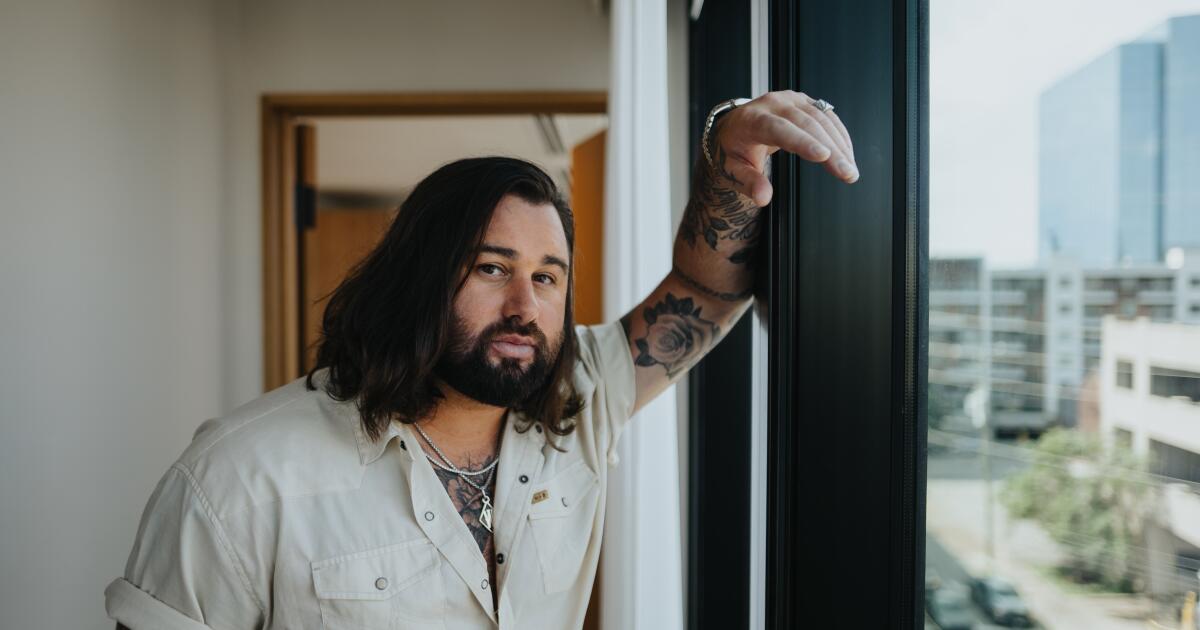
Koe Wetzel is calling from Nashville, two nights into a recent visit to “a two-night town,” as this lifelong Texan describes country music’s capital.
“It’s like my new Vegas, bro,” says the singer and songwriter, last night’s festivities still audible in the weary scrape of his voice over the phone. “I’ve been here since Tuesday, and I’m ready to get the f— out.”
Wetzel, 32, made his name on social media as a larger-than-life purveyor of rowdy post-grunge country songs like “Drunk Driving,” “Something to Talk About” — “I could rob a bank in an old Mustang,” he sings, “I could fight the cops with my two bare hands” — and “February 28, 2016,” which proudly recounts the time he was arrested for public intoxication and spent a few days behind bars in Stephenville, Texas. (Fans now celebrate Feb. 28 as Koe Wetzel Day.)
Yet his stirring new album, “9 Lives,” reveals an older, slightly wiser hell-raiser: In “High Road” he’s a guy in a broken relationship opting not to buy “a ticket to your s— show,” while “Damn Near Normal” takes a hard look at the numbing excess of life on the road.
Produced primarily by Gabe Simon, known for his work on Noah Kahan’s double-platinum “Stick Season,” “9 Lives” is more polished than Wetzel’s five previous LPs, with nods to R&B and ’70s soft rock amid the echoes of Waylon Jennings and Puddle of Mudd; the tunecraft is sturdier too, thanks in part to Wetzel’s recruitment of such industry pros as Laura Veltz and Amy Allen, the latter of whom co-wrote Sabrina Carpenter’s 2024 pop smashes “Espresso” and “Please Please Please.”
As a vocalist, though, Wetzel finds new emotional depths in songs like “Sweet Dreams,” about his tendency to ruin a good thing, and a yearning rendition of “Reconsider” by the country songwriter Keith Gattis, who died last year. Another highlight is Wetzel’s bare-bones take on “Depression & Obsession” by the late emo-rap star XXXTentacion.
“I’m poisoned, and I don’t feel well,” he murmurs against a strummed acoustic guitar, the quiet confessions of one tough talker bringing a bleak kind of comfort to another.
“I just got a little tired of people thinking they know me based on stories they’d heard or from what they saw on Instagram,” Wetzel says from Nashville, where’s he touched down to promote his album between tour dates. “I wanted to show them exactly who I am — like, ‘Hey, this is me, take it or leave it.’”
So far, listeners are taking it. “Sweet Dreams” and “Damn Near Normal” have both racked up tens of millions of streams on Spotify and YouTube; “High Road,” a duet with the 19-year-old pop-country singer Jessie Murph, even cracked Billboard’s Country Airplay chart — a first for Wetzel, who until now seemed to operate at arm’s length from the mainstream country industry, establishing his fanbase on the road rather than pumping out a steady stream of would-be radio hits.
The way he sees it, country music has grown and diversified so much in the past few years — “You got rock, alternative, bluegrass, indie…,” he says — that “there’s no longer a stereotype of what the machine wants somebody to be.” (The ascent of Jelly Roll, a face-tattooed former rapper, suggests he’s right.) “The music being put out right now, it’s all over the place,” says Wetzel, who’s set to open for Nashville’s biggest star, Morgan Wallen, on Friday night at AT&T Stadium near Dallas. “I don’t even know if you can call country a genre anymore.”
Yet “9 Lives” reflects certain trends in the style, not least the embrace of the aggro rock of the late ’90s and early 2000s — behold the Shinedown revival — as heard in the work of Hardy and Warren Zeiders and Bailey Zimmerman. Wetzel in these songs also shares something with Zach Bryan, a fellow Nashville outsider who’s built a massive audience (and begun making inroads at country radio) by writing about his most intimate vulnerabilities.
Says Wetzel of making “9 Lives”: “It was like a therapy session.” Has he been to real therapy? “Not as much I should,” he replies with a laugh. “I grew up in a hard-working family in East Texas — kind of a men-are-men environment where you just take it on the chin and keep going. But getting older, you step back and realize it’s all right to talk about this s—.”
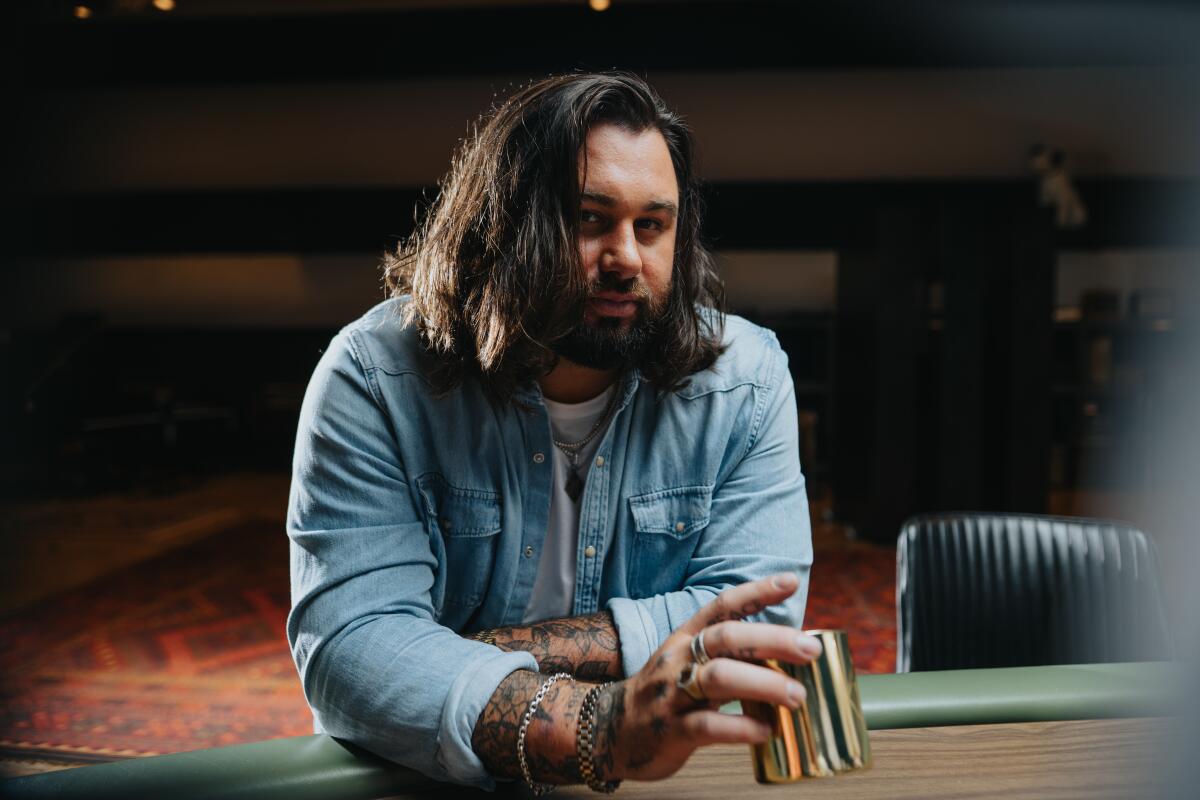
Koe Wetzel
(Hunter Hart / For The Times)
Born in tiny Pittsburg, Texas — and named in honor of the outlaw country fixture David Allan Coe — Wetzel played football in college but turned his focus to music following a series of injuries. His success as a live act eventually drew the interest of Columbia Records, which released his first major-label LP in 2020. (He called it “Sellout.”)
Ben Maddahi, the singer’s A&R rep at Columbia, says the label’s chairman, Ron Perry, knew Wetzel was primed for a breakthrough even if Wetzel himself seemed unsure. “There’s a joke in here that Ron wanted a hit out of the country music star on the label and so he sent the Persian Jew from Beverly Hills to go down there and do it with him,” says Maddahi, who’s also worked with Wiz Khalifa and Pitbull.
Maddahi connected Wetzel and Simon for a songwriting retreat at Sonic Ranch, a studio near El Paso, where the producer “just sat there on the ground with Koe and my journal, and I asked him questions about his life.” The tunes came quickly, Simon says — several over two or three days at Sonic Ranch, then another several over two or three days in Nashville.
Not everything they wrote was as unguarded as “Sweet Dreams” or “High Road”: In the very funny “Leigh,” which plays like a riff on George Strait’s classic “All My Ex’s Live in Texas,” Wetzel considers moving to Memphis to avoid getting mixed up with women whose names end in “-leigh.”
But Simon evokes “Star Wars” to describe Wetzel’s mindset as they worked together. “You know when they’re on the Death Star and they’re like, ‘Use the Force, Luke,’ to shoot those torpedoes down? We had this little window before Koe’s armor was gonna come back up again.”
Some fans of Wetzel’s earlier, harder-edged material have responded with suspicion to the softer emotional terrain he explores on “9 Lives.” This month, Murph said on TikTok that she’d been called “a rat” for joining Wetzel on “High Road” and noted cheerfully that he’d dropped a version of the song without her vocals.
“His solo version is out now go get ur duis!!!” she wrote. (Murph’s representative said she was unavailable to comment.)
Yet Wetzel seems generally unbothered by the prospect of having turned anyone against him. Asked about his current attitude toward police, years after his last arrest, he laughs. “I’ve got a lot of friends that are on the police force — state troopers and stuff,” he says. “Whenever they’re not putting me in the back of a cop car, I back the blue.”

Movie Reviews
Film review: ‘Tuner’ mixes classical music, crime, and Dustin Hoffman | The Jerusalem Post

It co-stars Dustin Hoffman in a story of a young piano tuner, Niki (Leo Woodall), a former music prodigy with perfect pitch who suffers from hyperacusis, a condition that makes him extraordinarily sensitive to loud noises.
In a series of events that are a bit improbable but that seem quite credible while you’re watching, Niki discovers his finely tuned hearing gives him a great talent for safecracking, which brings him to the attention of a crime gang.
It features a clever, often surprising screenplay, co-written by its director, Daniel Roher (who won an Oscar for the documentary, Navalny) and Robert Ramsey. There are also wonderful performances from the cast, which also includes distinguished actress Tovah Feldshuh of Nobody Wants This and Fauda star Lior Raz.
The characters have a nice, funny raport
When Tuner opens, Niki is working in a piano-tuning business in New York with a former musician, Harry Horowitz (Hoffman).
The beefy, laconic, young man treats the garrulous, wisecracking Harry with respect, listening patiently to all his jokes and stories about the good old days when he worked with jazz greats.
These two have a nice rapport, as Niki drives Harry all over the New York area in an old van and eats in diners with him.
Niki does the work while Harry sits on a sofa, critiquing him.
The two stick out like sore thumbs in the many mansions where they work on spectacular pianos that haven’t been played in decades, for clients who ask them if they can also repair toilets and modems.
Harry, who never made much of a living despite his talent, has fallen on hard times, and he and his wife, Marla (Feldshuh), are barely scraping by. Niki is also broke.
Recognizing what a great musician Niki is, Harry tries to cajole him into playing again, but the younger man refuses, living an isolated life and trying not to draw attention to himself.
The three incidents that set the plot in motion
Harry has forgotten the combination to his safe and needs to open it. When Niki goes on YouTube to look at a video on how to do it, he discovers that his sensitive hearing makes him a genius at safecracking.
Harry becomes ill and, due to a mess with Medicare, suddenly falls into a huge debt; and Niki meets Ruthie (Havana Rose Liu), an extremely ambitious pianist and composing student, who is astounded by his perfect pitch.
Soon, Niki’s talent for safecracking draws the attention of Uri (Lior Raz), an Israeli who runs a bogus security company, where he uses his knowledge of his client’s homes and passwords to steal what he contends are minor trinkets, but which add up to big money for his gang, much like Jon Hamm’s character in the Apple TV series, Your Friends and Neighbors.
Raz hams it up as a character who fits the stereotype of the obnoxious Israeli in the US, and lords it over his supposedly bright accomplice, Yoni (Gil Frank), and his much dimmer nephew, Benny (Nissan Sakira).
Much of the comedy in the movie comes from Uri browbeating the two, and if you can understand the Hebrew, it’s even funnier than the subtitles.
Criticisms of Tuner
Niki’s romance with Ruthie, which develops quickly, feels a little convenient at times, though the screenplay paints a realistic picture of the competitive world of high-level music students. You know, for most of the movie, that eventually Niki will reveal to her that he was once a great pianist, and when it comes, it’s something of an anti-climax.
After Hoffman’s character gets sick, he disappears from the rest of the movie except for a couple of scenes, and that’s too bad. It’s great to see Hoffman having fun as Harry, and the scenes where he and Niki banter help humanize the younger man, making him more likable and less self-centered.
Woodall is one of the most in-demand young actors. He played a hunky love interest in both Bridget Jones: Mad About the Boy and the Netflix series Vladimir; he also appeared in the second season of The White Lotus.
He has a buff body and conventional leading-man good looks, and generally plays confident, happy-go-lucky guys, which means he is cast against type here.
Niki is the kind of role that might seem better suited for actors like Josh O’Connor, Jeremy Allen White, or Timothée Chalamet. Woodall has to work hard to convince us he is withdrawn and feels out of place in all the mansions where he tunes pianos, but his charm wins out, and soon, you come to accept him in the role.
Mixed music and mixed genres
The soundtrack features a mix of classical music and jazz, and it’s clear it was made by a director who appreciates both.
Tuner settles neatly into a mini-genre of movies that feature plot lines that combine piano-playing characters and crime, that include James Toback’s Fingers with Harvey Keitel, and Jacques Audiard’s remake of it, The Beat that My Heart Skipped with Romain Duris; Francois Truffaut’s Shoot the Piano Player with Charles Aznavour; and Eugenio Mira’s Grand Piano with Elijah Wood. It also recalls the spirit of Bob Rafelson’s Five Easy Pieces, which features Jack Nicholson in one of his best performances; here as a piano prodigy who has rejected his oppressive family and become an oil field worker.
Tuner shares some of the bleakness typical of 1970s films, like Fingers and Five Easy Pieces. At times, the movie moves jarringly between brooding, almost noir-like darkness and scenes with the chatty Harry or the bumbling gangsters.
It might have been a stronger film if Roher had gone in one direction instead of mixing genres, but it would likely have been less entertaining.

Tom Sandoval’s girlfriend Victoria Lee Robinson was arrested after the two had an altercation that involved her father being pushed into a lit fire pit.
Sandoval, known for the cheating “Scandoval” that erupted on the reality television series “Vanderpump Rules,” filed a restraining order against the model and her father J. Will Robinson (who goes by Will) over a June 3 incident that was partially caught on video. He was granted a temporary restraining order and a subsequent hearing was set for July 16.
According to court documents obtained by The Times, the altercation involving Sandoval, Victoria Robinson and J. Will Robinson happened in the early morning hours after the couple returned home from a night out at a bar. Sandoval claimed in the petition that since the two became a couple in February 2024, Victoria Lee Robinson has been violent and attacked him physically, as well as changing the passwords on his phone and social media and tracking him using Airtags.
“The most recent physical incident occurred on June 3 when [she] punched my face and injured my neck and ear. During this same incident, Mr. Robinson, grabbed me and punched an approximately 12-inch hole in the door of my spare bedroom where I was barricading myself,” reads the petition.
In a video, obtained by TMZ, that captured part of the June 3 incident, Victoria Robinson and Will Robinson are seen sitting next to a lit fire pit on the patio when Sandoval and Will Robinson begin arguing. Sandoval is heard yelling at Will Robinson before he asks Victoria Robinson if she is recording and approaches her. Will Robinson stands and wraps his arms around Sandoval, seemingly to get him to back away from Victoria Robinson, and Sandoval turns and pushes Will Robinson, who falls backward into the lit fire pit.
After Will Robinson gets back up, he rushes after Sandoval into the home while Victoria Robinson screams for the men to stop.
According to the petition, the fight escalated, and Will Robinson phoned the police while Sandoval hid inside a spare bedroom. When police arrived, the petition claims that they initially put Sandoval in handcuffs, but after reviewing footage, Victoria Robinson was arrested for intimate partner battery with physical violence.
Robinson bonded out and was released the same day. The Los Angeles Police Department was not able to confirm the reason for Victoria Robinson’s arrest.
Representatives for Sandoval did not immediately respond to The Times’ request for comment. Victoria Robinson could not be reached for comment.
According to the petition, both Victoria Robinson and her father have lived in the Los Angeles rental home with Sandoval. According to the filing, the reality star hopped between hotels and friends’ houses after the June 3 incident.
Will Robinson told TMZ, “The DA did not file the case for a reason. I lifted Tom off of my daughter because he was overpowering and twisting her arm and trying to take her phone aggressively after yelling at us in a very aggressive and threatening manner.”
“This is my daughter’s home and we just want Tom as far away from us as possible and to keep his lies and drunken abuse away,” Robinson said.

“Who lives, who dies, who tells your story?” This is one of the culminating lines from Lin-Manuel Miranda’s smash hit 2015 musical “Hamilton,” but it’s also the animating force behind Michael Sarnoski’s “The Death of Robin Hood,” starring Hugh Jackman in the title role. This legendary figure of English folklore has a specific meaning attached to his name, which is synonymous with the altruistic impulse to redistribute wealth. But in his take on the tale, focusing on the end of his life, Sarnoski suggests that perhaps Robin Hood wasn’t such a good guy, even if he was robbing from the rich to give to the poor. It all depends on who’s telling the story, right?
Sarnoski burst onto the scene in 2021 with his debut feature “Pig,” in which he outfitted Nicolas Cage with a long gray wig and sent him on a dangerous quest (to find his beloved, valuable pet). He does something similar in “The Death of Robin Hood,” outfitting Jackman in a long gray wig and sending him on a quest (to achieve some kind of salvation).
But first, Sarnoski has to establish that this Robin Hood isn’t the one we remember from the movies — he’s not the dashing cartoon Disney fox, or Errol Flynn, or Kevin Costner, or Cary Elwes, or Russell Crowe, or even Taron Egerton. No, this Robin Hood is much worse, sleeping in matted filth on the moors, reduced to a feral life of constant vigilance against murderous revenge-seekers for the years of evil deeds he’s carried out with his compatriot, Little John (Bill Skarsgård).
Now called Edward, Little John has achieved some measure of domesticity, but still, he and Robin go a-murdering once again, resulting in a yet another vengeful attack from a relative of their victims. A wounded Robin ends up in an idyllic priory on a coastal island, tended to by a healer, Brigid (Jodie Comer), learning the ropes from the local leper (Murray Bartlett). In this oasis, Robin’s identity is unknown, and he finds the space to embrace a gentler side of himself, particularly with Little John/Edward’s daughter, Little Margaret (Faith Delaney).
Set on the misty outlying islands of the North Atlantic, with its blend of bloody, brutal violence, primitive spirituality and meditative tone, “The Death of Robin Hood” is situated in the realm of films like David Lowery’s “The Green Knight” and Robert Eggers’ “The Northman.” Cinematographer Pat Scola pulls some arresting images out of the fire and fog, and the score of largely traditional Celtic music by Jim Ghedi is easily one of the best of the year. The film is a fine showcase for a different kind of performance from Jackman, and Comer is always a compelling screen presence.
But “The Death of Robin Hood” isn’t as hallucinatory or weird as it could — or should — be. Sarnoski gestures at bleakness but feints from full existential crisis; he tries and fails to be witchy. Despite all the mud and blood, nothing about this film is particularly earthy or embodied. It ends up as this profoundly dull and utterly pointless commentary on the concept of narrative and mythology. “What if Robin Hood was a bad guy?” OK, what of it? The best concept that Sarnoski presents here is the hell of living in an endless cycle of vengeance, but he allows his anti-hero to escape that all too cleanly and conveniently. This Robin Hood is just an old, tired man who ultimately finds some peace at the end of his life, even if it’s unearned.
As an audience, we’re left wondering what all of this is for, and who it’s for. Why trouble the Robin Hood myth at all, and why now? One can’t help but cynically wonder if the inspiration for this project was merely the convenience of recognizable intellectual property and available financing from Screen Ireland. This theory might be creatively pessimistic, but it is a nagging question, especially when the ones posed by the film are already so stale and tired. Expect no revelations from “The Death of Robin Hood” except the one that’s announced in the title.
‘The Death of Robin Hood’
2 stars (out of 4)
MPA rating: R (for strong bloody violence)
Running time: 2:03
How to watch: In theaters June 19
-

 Minneapolis, MN3 minutes ago
Man, 19, hospitalized after shooting in north Minneapolis; no arrests
-

 Indianapolis, IN15 minutes ago
Man’s body found in White River in downtown Indianapolis
-

 Pittsburg, PA18 minutes ago
South Side Street Fest adds more metal detectors and ID scanner to speed up lines
-

 Augusta, GA23 minutes ago
Augusta Pride celebration moves to fairgrounds amid Broad Street construction
-

 Washington, D.C30 minutes ago
States show their stuff: The Great American State Fair opens in D.C.
-

 Cleveland, OH33 minutes ago
Colt Emerson Leads Mariners Past Guardians In Return to Ohio – WHIZ – Fox 5 / Marquee Broadcasting
-

 Austin, TX37 minutes ago
Paxton says Austin energy code breaks state law
-

 Alabama45 minutes ago
2019 Alabama Prison Escapee Now Facing Florida Charges For Walnut Hill Machete Carjacking : NorthEscambia.com

