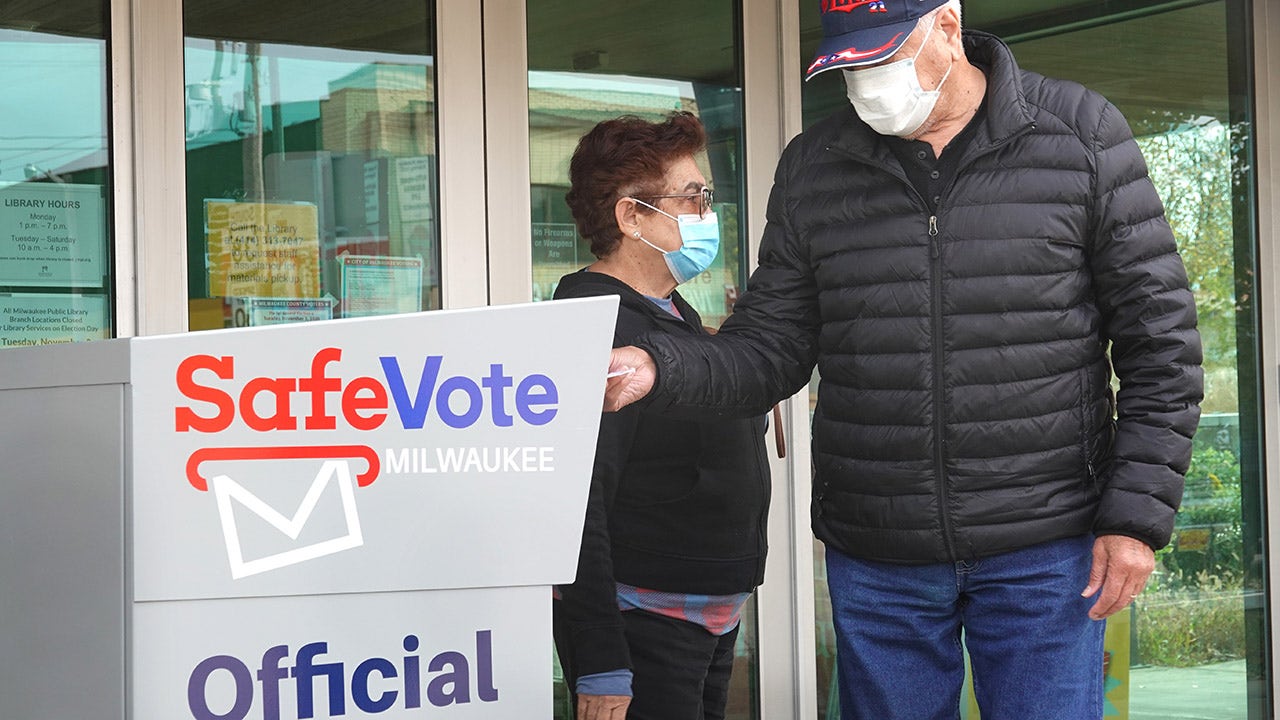
The Wisconsin Supreme Court’s new liberal majority reversed a ruling that banned most ballot drop boxes, opening the door for election officials to reinstate their use in the swing state before November.
In July 2022, the state Supreme Court, then under a conservative majority, held that absentee ballot drop boxes, which were used widely during the 2020 election, were not authorized under state statute and, therefore, the Wisconsin Elections Commission (WEC) guidance encouraging their use was unlawful.
That case, known as Teigen v. Wisconsin Elections Commission, centered on a state statute that requires an absentee ballot be returned “to the municipal clerk” by one of two ways: by the elector mailing in the envelope or by the elector delivering the ballot in person to the municipal clerk. It upheld that state statute does not allow offsite, unattended drop boxes, and drop boxes could only be placed in local election clerks’ offices and no one other than the voter could return a ballot in person.
In a 4-3 ruling on Friday, the state’s high court reversed course.
ARIZONA ELECTION WORKER CHARGED IN SECURITY-RELATED THEFTS SEEN WITH DEMOCRAT POLITICIANS IN RESURFACED PHOTOS
Advertisement
Poll workers sort out early and absentee ballots at the Kenosha Municipal Building on Election Day, Nov. 3, 2020, in Kenosha, Wisconsin.(AP Photo/Wong Maye-E, File)
Writing for the majority, Justice Anna Walsh Bradley, one of the court’s four liberal justices, argued that the state statute does not make a distinction between whether ballots can be delivered to inanimate objects, such as drop boxes, whose locations are determined by municipal clerks, or to the municipal clerks themselves.
“Given this, the question then becomes whether delivery to a drop box constitutes delivery ‘to the municipal clerk’ within the meaning of Wis. Stat. § 6.87(4)(b)1,” the majority wrote. “We conclude that it does. A drop box is set up, maintained, secured, and emptied by the municipal clerk. This is the case even if the drop box is in a location other than the municipal clerk’s office. As analyzed, the statute does not specify a location to which a ballot must be returned and requires only that the ballot be delivered to a location the municipal clerk, within his or her discretion, designates.”
All three conservative justices dissented Friday, accusing the majority of politically motivated “activism.”
“Intense partisan politics saturate our nation, exacerbated by a lack of institutional trust,” Justice Rebecca Bradley, who wrote for the minority, said. “The legitimacy of elections continues to be questioned, each side accusing the other of ‘election interference’ and ‘threatening democracy’ or even the very foundation of our constitutional republic. The majority’s decision in this case will only fuel the fires of suspicion.”
Advertisement
“Whatever can be said of the majority’s decision, it ‘is not the product of neutral, principled judging,’” the dissenters said. “Although the majority attempts to package its disagreements with Teigen as legal, the truth is obvious: The majority disagrees with the decision as a matter of policy and politics, not law.”
Residents drop mail-in ballots in an official ballot box outside the Tippecanoe branch library on Oct. 20, 2020, in Milwaukee.(Scott Olson/Getty Images)
“The members of the majority believe using drop boxes is good policy, and one they hope will aid their preferred political party,” the minority continued. “Teigen upheld the historical meaning of Wis. Stat. § 6.87(4)(b)1., which bars the use of offsite, unmanned drop boxes. The majority in this case overrules Teigen not because it is legally erroneous, but because the majority finds it politically inconvenient. The majority’s activism marks another triumph of political power over legal principle in this court.”
ELECTION OFFICIALS IN ALL 50 STATES URGED TO SEEK INFO FROM BIDEN ADMIN TO PREVENT NONCITIZENS FROM VOTING
In April 2023, Democratic-backed candidate Janet Protaswiecz’s victory flipped the Wisconsin state Supreme Court to liberal control under a 4-3 majority. Seeing an opening, Priorities USA, a progressive voter mobilization group, asked the court in February to revisit the July 2022 decision. The justices announced in March they would review the ban on drop boxes but would not consider any other parts of the case.
Advertisement
The move drew the ire of the court’s conservatives, who accused the liberals of trying to give Democrats an advantage this fall. Democratic Wisconsin Gov. Tony Evers in April urged the court to again allow drop boxes. Republicans who control the Wisconsin Legislature also intervened in the case, arguing that the justices should leave the 2022 ruling alone.
Wisconsin again figures to be a crucial swing state after President Biden barely won it in 2020 and Donald Trump narrowly took it in 2016.
An election worker drops a completed ballot into a ballot box inside City Hall on the first day of in-person early voting in Kenosha, Wisconsin, on Oct. 20, 2020.(Kamil Krzaczynski/AFP via Getty Images)
Trump and Republicans have alleged that drop boxes facilitated cheating. Republican National Committee (RNC) Chairman Michael Whatley weighed in on Friday’s ruling, arguing in a statement that the “new liberal majority on the Supreme Court overturned this recent precedent and opened the floodgates for drop boxes across the state just months before the presidential election.”
“The Court did this after unnecessarily fast-tracking the case to issue this decision before the election,” Whatley said. “Make no mistake: this partisan decision handed down by a partisan Court gives Democrats a green light to dismantle election security safeguards and invite election fraud. The RNC’s unprecedented election integrity operation will continue fighting to ensure drop box safeguards are adopted and implemented.”
Advertisement
Dane County Clerk Scott McDonell, who administers elections in Wisconsin’s most Democratic county, argued drop boxes make the election process more convenient and easier for rural and disabled voters and help reduce the number of ballots that arrive after Election Day too late to be counted.
“Secure drop boxes provide a convenient alternative to mailing absentee ballots or returning them in person to an elections clerk,” McDonell said in a statement. “Drop boxes are a common sense tool that Dane County utilized safely and securely for many years prior to the 2022 ban.”
“Having drop boxes in place for the 2024 elections in August and November will encourage civic participation in our democracy,” he added.
The Associated Press contributed to this report.
Advertisement
Danielle Wallace is a reporter for Fox News Digital covering politics, crime, police and more. Story tips can be sent to danielle.wallace@fox.com and on Twitter: @danimwallace.
The Detroit Fire Department said no injuries have been reported
DETROIT – Firefighters are battling a large fire at a vacant apartment complex on Detroit’s west side.
The fire was reported on Fenton Street, just off Grand River Avenue near Telegraph Road on Tuesday (July 7).
The Detroit Fire Department said no injuries have been reported.
Advertisement
Officials also said the fire appears to be under control.
The cause of the fire has not been released, and it was not immediately clear how long crews expect to remain at the scene.
This is a developing story and will be updated as more information becomes available.
Copyright 2026 by WDIV ClickOnDetroit – All rights reserved.
About the Author
Brandon Carr headshot
Brandon Carr
Brandon Carr is a digital content producer for ClickOnDetroit and has been with WDIV Local 4 since November 2021. Brandon is the 2015 Solomon Kinloch Humanitarian award recipient for Community Service.
by Henry Tyson, Milwaukee Neighborhood News Service July 7, 2026
Milwaukee Neighborhood News Service invites community members to submit opinion pieces of 500-800 words on topics of interest to central city Milwaukee. To send a submission for consideration, please email info@milwaukeenns.org. The views expressed are solely those of the authors.
A few years ago, I had a conversation with one of our first-grade teachers that stayed with me.
We were talking about an idea she had for improving reading instruction. She wasn’t looking for recognition. She simply saw an opportunity to help students through a project that could benefit not only her own classroom, but classrooms across our school.
Advertisement
Then she told me what she was doing that summer; she was taking on a side gig at a local business. Here was a brilliant educator who had more to give, yet there was no meaningful way for her to spend part of her summer strengthening her classroom or our school.
Shortly after, I had a similar conversation with one of our second-grade teachers. She had just spent the summer developing research-based spelling resources. The following school year, a new teacher used those materials consistently, and the results were clear. One student began the year unable to spell a simple word like “cat.” By the end of the year, that student was spelling words like “train” and “stream.”
Those two moments stayed with me—one showing what’s lost when ideas stall, the other what’s possible when teachers have the time to bring them to life and share with their colleagues. It reinforced a simple truth: meaningful outcomes at St. Marcus are driven by educators who invest in their students every day.
Henry Tyson (Photo provided by Henry Tyson)
However, it also highlights the reality we are living in: the ideas don’t run out. The time does.
Creating dedicated time
During the school year, for instance, teachers are planning, grading, communicating with families, and responding to countless needs. There simply aren’t enough hours.
That’s why creating dedicated time for this work matters so much. It’s also where partnerships with organizations like the Northwestern Mutual Foundation are helping make a difference—giving educators the opportunity to bring those ideas to life through funding that provides time, resources and support to develop and strengthen their work.
Advertisement
We have exceptional educators, but until recently, many haven’t had the time or support to bring those ideas forward. That’s a gap we’re beginning to close. Since 2022, the Northwestern Mutual Summer Teacher Grants have supported nearly 200 teacher-led projects, including 11 at St. Marcus, with more than $925,000 in funding—expanding what’s possible for educators across schools like ours.
Across our school, these projects have ranged from curriculum development to hands-on STEM and student support initiatives. These efforts are shaped by school leaders and educators who identify and prioritize the needs of their students, with support from partners helping bring as many of those ideas to life as possible.
I’ve spent the past 24 years at St. Marcus, and in that time, I’ve seen our school grow from about 100 students to nearly 1,300 across three campuses—growth driven by one constant: our teachers.
Priorities
When I became superintendent in 2010, I focused on two priorities: building an exceptional school and expanding access for more students.
We serve a diverse community of students and families, and understand the educational challenges across Milwaukee, but we’ve never believed those challenges define our students. Our goal has always been clear: create a school where children thrive academically, feel safe, and grow in character while building confidence to succeed.
Advertisement
As a Lutheran school, we also believe that every child is created by God with immeasurable worth and potential, and that belief shapes how we invest in both our students and the educators who serve them. We also measure ourselves against the statewide average because we believe our students deserve the same opportunities and outcomes as any child in Wisconsin.Today, our eighth-grade math proficiency exceeds the statewide average, while our eighth-grade reading performance continues to narrow the gap with the state.
Demand has steadily grown, with families seeking schools where their children are known, supported and challenged. Each time we’ve been able to welcome more students, we have done so with purpose, knowing there are more children who deserve that opportunity.
But neither priority becomes reality without outstanding teachers. That’s why I have grown increasingly convinced that one of the most underused resources in education is not a new curriculum or initiative, but the expertise our teachers already bring to the work.
Every educator I know is constantly thinking about how to improve—whether supporting a struggling student or making lessons more engaging. Years ago, before formal programs existed to support this kind of work, we began creating those opportunities at St. Marcus. If a teacher wanted to spend the summer developing a third-grade reading intervention or creating instructional materials that could be shared across classrooms, we sought out donors to help make it possible.
The goal was never just to complete another project. It was to create a pathway for teachers to extend their impact beyond their own classroom.
Advertisement
As support from community partners expanded these efforts, more teachers gained the time and opportunity to develop curriculum, strengthen intervention strategies, and create resources to share across classrooms.
That shift mattered. Strong ideas no longer stayed within a single classroom—they could be shared across grade levels and campuses, strengthening instruction and reaching hundreds of students.
The impact extends beyond individual projects. Today, St. Marcus serves nearly 1,300 students across three campuses and earned the state’s highest 5-star accountability rating. Our students consistently outperform schools serving similar populations. Investing in teachers has become one of the most important drivers of that progress.
The precious gift of time
Partners did not provide our teachers with the ideas; they already had them. They helped create the time and financial support to bring more of those ideas to life.
Take the second-grade teacher. Her initiative and dedication represent far more than spelling. Rather, it shows what is possible when teachers have the time to research, refine, and build with intention, instead of squeezing that work into evenings and weekends. When educators are given the opportunity to go above and beyond, students benefit most.
Advertisement
I have seen something else happen, too. Teachers feel seen and valued. Many would do this regardless because they care about their students and take pride in their profession. But it matters to say, “We see your expertise. We believe your ideas matter. We want to invest in them.” It reinforces that their leadership extends beyond the four walls of their classroom.
As Milwaukee works to improve educational outcomes, we should continue conversations about funding, curriculum, and accountability. Those efforts matter. But we should also ask: Are we fully leveraging the talent already inside our schools? In my experience, the answer is no.
Milwaukee is filled with educators who have more to give. They have ideas worth sharing, solutions worth testing, and expertise that can strengthen instruction for hundreds of students, not just those in front of them each day. Often, they simply need the opportunity.
We have been fortunate to partner with families who believe in our mission, leaders who make thoughtful decisions and organizations that are committed to Milwaukee’s children. But it always comes back to the teachers.
I still think about the educator who planned to spend her summer waiting tables instead of building something that could help students learn. She is not the exception—she is the rule. Milwaukee is full of educators just like her: talented, passionate, and ready to do more. If we want better outcomes for students, we cannot keep asking teachers to do this work on the margins. We need to create the time, support and trust for them to lead, share their expertise and expand their impact.
Advertisement
Henry Tyson is the superintendent of St. Marcus Lutheran School in Milwaukee, where he has served for more than two decades. During his tenure, he has helped grow the school into a nationally recognized leader in urban education while advocating for innovative approaches that expand opportunities for students and strengthen the teaching profession.
This <a target=”_blank” href=”https://milwaukeenns.org/2026/07/07/opinion-milwaukee-teachers-have-more-to-give-lets-give-them-the-chance/”>article</a> first appeared on <a target=”_blank” href=”https://milwaukeenns.org”>Milwaukee Neighborhood News Service</a> and is republished here under a <a target=”_blank” href=”https://creativecommons.org/licenses/by-nd/4.0/”>Creative Commons Attribution-NoDerivatives 4.0 International License</a>.<img src=”https://i0.wp.com/milwaukeenns.org/wp-content/uploads/2025/07/cropped-NNS-Favicon.png?resize=150%2C150&ssl=1″ style=”width:1em;height:1em;margin-left:10px;”>
A 26-year-old man was sentenced this week to 2 ½ years in federal prison for robbing a Walgreens in Minneapolis, then a St. Paul bank the next day.
Korey Maurese Hale (Courtesy of the Sherburne County Sheriff’s Office)
Korey Maurese Hale of Minneapolis pleaded guilty in U.S. District Court of Minnesota to one count of armed bank robbery in connection with the June 2024 hold ups.
Hale used the same .22-caliber Mossberg rifle in both robberies, making off with about $200 from Walgreens at Chicago Avenue and 43rd Street and approximately $1,833 from BMO Bank at Snelling and Randolph avenues, according to his January plea agreement. St. Paul police arrested Hale near the bank shortly after the heist.
In an interview with a St. Paul police investigator, Hale said people were trying to kill him and voices in his head made him rob the bank, according to initial charges filed in Ramsey County District Court.
Advertisement
Hale was civilly committed as mentally ill and chemically dependent in September 2024. Eight months later, he was ordered to undergo a federal psychiatric and psychological examination, which found his medication treatment was effective and he was competent to stand trial, Assistant U.S. Attorney Matthew Forbes wrote in a presentencing memo.
Hale’s sentencing Monday at the federal courthouse in St. Paul includes five years of supervised release following incarceration.
“Once released, if Hale continues to take his medications, continues to receive mental health treatment, and stays away from controlled substances, he will dramatically reduce his risk of recidivism,” Forbes wrote in the memo. “A five-year term of supervision will best ensure that the federal crimes in this case are Hale’s last.”