Entertainment
'Who am I?' For 'Fantasmas' star Martine, Vanesja is one part of her persona


In a show that boasts appearances by the likes of Emma Stone, Bowen Yang, Amy Sedaris and Aidy Bryant, Julio Torres’ “Fantasmas” may well make a TV star out of someone who aptly goes by a single name: Martine.
“This is the biggest role I’ve ever had,” Martine, a trans visual and performance artist, says via Zoom. “I’m officially the star of a television show. And it might also be my favorite TV show.”
For anyone who’s watched “Fantasmas,” that endorsement should double as insight into Martine’s own aesthetic and artistic sensibility. Because “Fantasmas” isn’t like any other television show out there.
The six-part urban fairy tale, which premiered June 7 on HBO and drops episodes weekly on Fridays through July 12, imagines a New York City where ExxonMobil builds developments and rideshare apps called Chester — with a driver named Chester — exist alongside mermaid sales reps and rodent nightclubs-turned-CVS pharmacies.
Within that fantastical vision of New York, Torres’ Julio (who was hit by lightning as a child and is allergic to the color yellow) is constantly trying to eke out a living with the help of his robot assistant, Bibo (voiced by Joe Rumrill), and his agent, Vanesja (the “j” is silent), played by Martine.
“The show itself is kind of postgenre,” Martine suggests. “It’s very much a genre-building show. It’s hard to explain what you should expect to see.”
Every set piece in “Fantasmas” — whether it’s a sitcom called “MELF ” that riffs on “ALF ” and features Paul Dano, or a vignette focused on a zealous customer service rep played by “Euphoria’s” Alexa Demie — lays bare its crafted theatricality. It’s always clear that audiences are watching something shot on a set, with painted backdrops and makeshift props. This is a fanciful world that never pretends to be anything more than an absurd and absurdist take on everyday life.
1
2
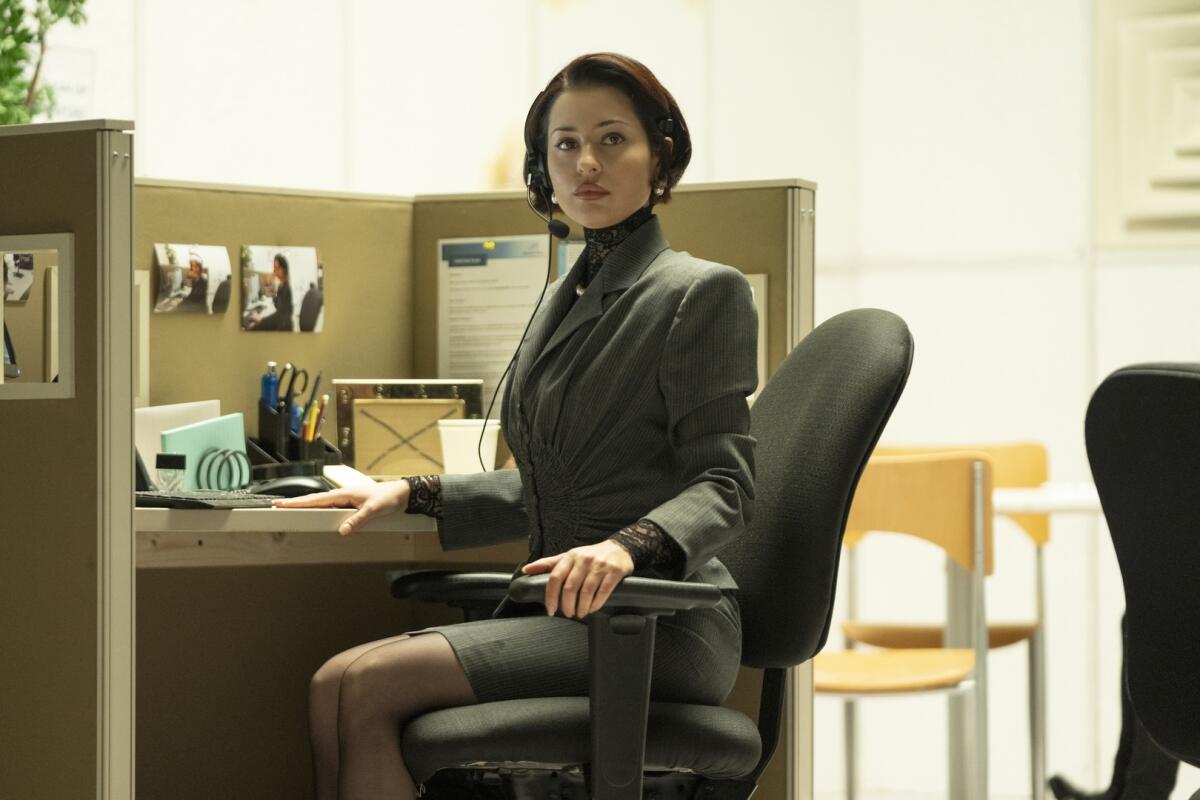
1. Paul Dano, right, is featured in a skit about an “ALF”-like puppet named MELF. (Atsushi Nishijima/HBO) 2. Alexa Demie plays an overzealous customer service rep. (Monica Lek/HBO)
“It felt like theater,” Martine says of working on the show. “It felt like being onstage with an audience. Everything was built inside this one giant soundstage and it was all repurposed: The school becomes the nightclub, the nightclub becomes a rooftop. And the audience was everyone on set.”
Within this funhouse mirror of a show, which blends sketch comedy with a farcical plot that finds Julio wanting to avoid getting an ID that would serve as his “proof of existence,” Martine was similarly encouraged to play with her own identity — as a performer, artist and actor.
“I don’t recognize myself in the show,” she says. “Because it’s Vanesja. And I think Vanesja happened because I was so nervous about my performance. The only way for me to move ahead was to say, ‘You don’t have to be yourself. You can put forward some kind of armor, some kind of stronger, idealized person you want to move through the world as.’”
For Martine, the very idea of being “yourself” is elusive. Questioning the rigidity of our sense of self has long been at the heart of her art, which has been featured in galleries and art museums all over the country — not to mention at the Venice Biennale — and in magazines like Interview and Artforum.
“Who am I?” she wonders aloud. “I think I’m constantly trying to shed that definition. I think I’m constantly throwing it away, discarding the old skin, shedding it, as it were, to move into some wider, broader, stronger, faster model. Or predator or something.”
Such facetious language, which moves from the probing to the preposterous with ease and humor, is arguably why she gets along with Torres. Martine first met the Salvadoran comedian close to a decade ago at an archery championship. “It’s truly an unbelievable story,” she recalls. “Julio was there at the buffet. He’s vegan, and I was kind of pretending to be vegan at the same time.”
They both reached for the last tater tot, and at the moment when their fingers touched and their eyes met, Martine knew she’d found a new friend. Maybe even more. “This is your sister wife,” she remembers thinking. “This is your kindred spirit, and you’re both starving … to be seen.”
What Torres most remembers about his first encounter with Martine was something equally ineffable. “Her ability to subvert her own physicality, to find humor in beauty,” he recalls via email.
Their friendship blossomed in between archery practices and congenial DMs as their careers bloomed in separate if complementary directions. While Torres joined the “Saturday Night Live” writing staff and later premiered his own comedy special (“My Favorite Shapes”), Martine was busy creating art installations that satirized advertising campaigns (Martine Jeans), a publication that similarly critiques glossy high-fashion magazines (Indigenous Woman) and sci-fi-set live performances (“Circle”) that toyed with ideas around gender, femininity and self-expression in equally cheeky and wryly self-serious ways.
Their earlier collaborations — Martine previously played an unimpressed gallerist in Torres’ feature film debut, “Problemista,” and an impaled beauty queen in his Peabody award-winning show “Los Espookys” — feel like playful preambles to their work together on “Fantasmas.” Vanesja is, after all, a performance artist who’s been playing Julio’s talent agent for so long, she’s lost track of whether it’s still a performance.
“Without Martine, there is no Vanesja,” Torres says. “That’s how I work sometimes, in collaboration with a performer to create something tailor-made for them. She first planted the seeds of Vanesja when leaving me cryptic voicemails. Something about closing a big deal and not being able to discuss it. We welcomed each other into our worlds.”
In the surreal world that is “Fantasmas,” Vanesja is a reminder of how we ourselves can often be indistinguishable from the makeshift roles we play.
“I think a lot of the show’s motifs exist in my work too,” Martine says. “I love mannequins. I love asking a lot of questions broadly about identity and using costumes and using personas to try and get to some deeper truth. And it was so refreshing to lean into that with comedy because the art world is so unbearably serious.”
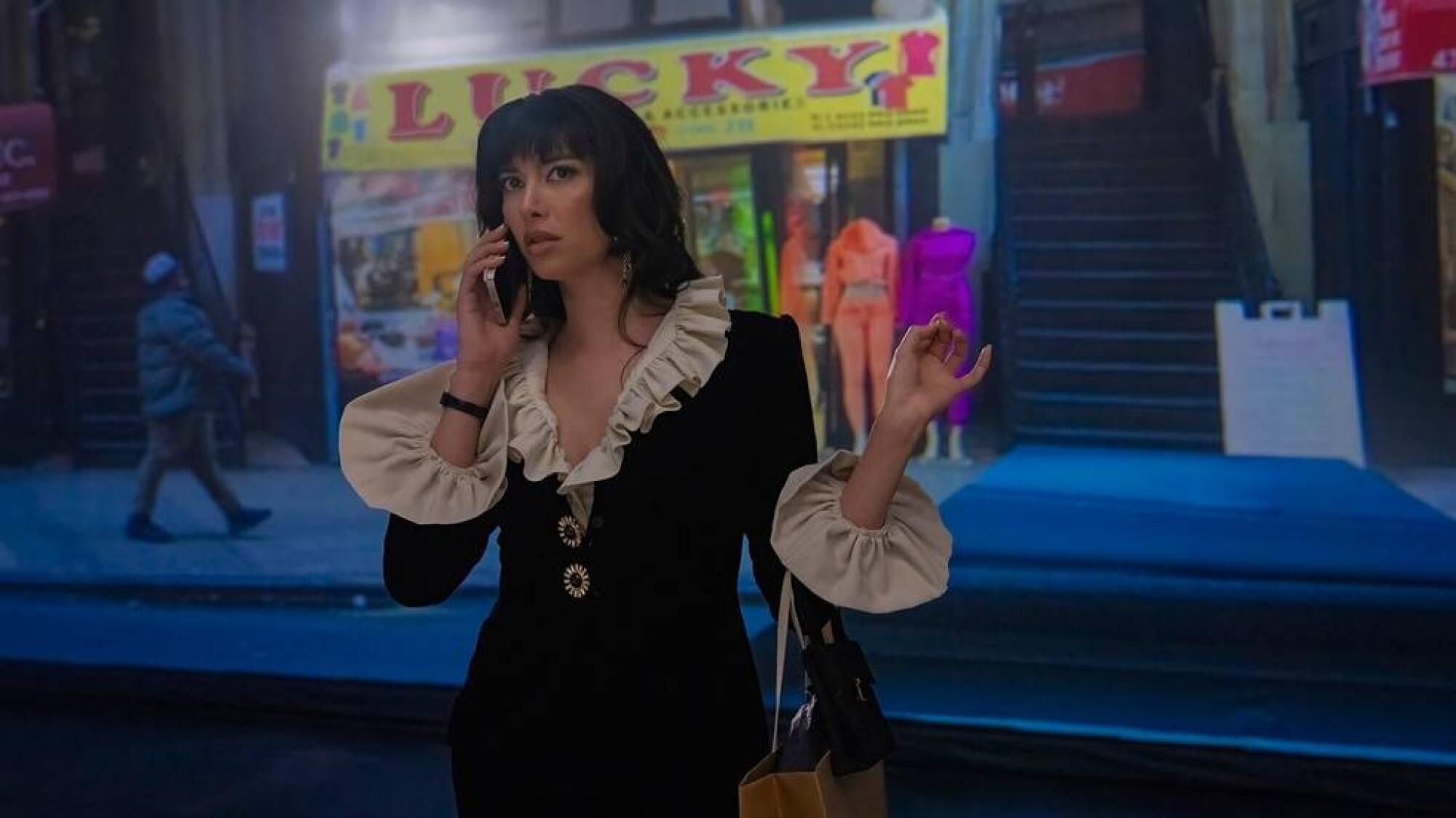
“I love mannequins. I love asking a lot of questions broadly about identity and using costumes and using personas to try and get to some deeper truth,” Martine says.
(Monica Lek / HBO)
With Vanesja, you see Martine reveling in that comedy. With her droll sense of humor intact and Vanesja’s aesthetic aching to be described as “business executive realness,” she’s constructed a dry-witted performance of an artist-cum-agent whose indifference to the world around her is bewitching. There’s her voice, for starters, which is sultry and breathy, marked by a glacial pace that makes Julio and audiences alike become engrossed by her every word. She almost feels plucked from the late 1990s, when the blazers and pencil skirts Vanesja wears were synonymous with a feminine, if not outright feminist, brand of seriousness.
“Vanesja is classically binary,” Martine says. “She has both the charm of a woman and all the strength of a man.”
In working within such a gendered binary, I bluntly ask how she was able to create this entrancing character who seems aloof yet interested, cold yet warmhearted. How did she do it?
“How does she Vanesja?” she asks herself, in between laughter, wanting to clarify my question — knowing, perhaps, that she’s arrived at a key philosophical way of understanding her process and her character alike. “I Vanesja every day. I try to Vanesja at least once a day, just for flexibility and my health, my mental health.”
For Martine, getting a chance to create Vanesja alongside Torres was a joy because it allowed her to unearth parts of herself and her work that exist at the surface yet get at deep-seated ideas about who we are and how we present ourselves. At a purely visual level, though, she had a very simple reference in mind.
“I’m obsessed with Ursula from ‘The Little Mermaid’ when she becomes a cis woman,” she says. “Her name is Vanessa, and I do feel like there is a resemblance between that Vanessa and myself, just like out of drag. This was me trying to implement a villainous persona that I personally feel lives inside me.”
That hint of Disney wasn’t the only personal touch Martine brought to “Fantasmas.” She is to thank for what has already become one of the most talked-about images teased from the show, and seen in Friday’s episode: her scene partner, “Teen Wolf” star Dylan O’Brien, wearing red lacy undergarments, with garters and stockings to match.
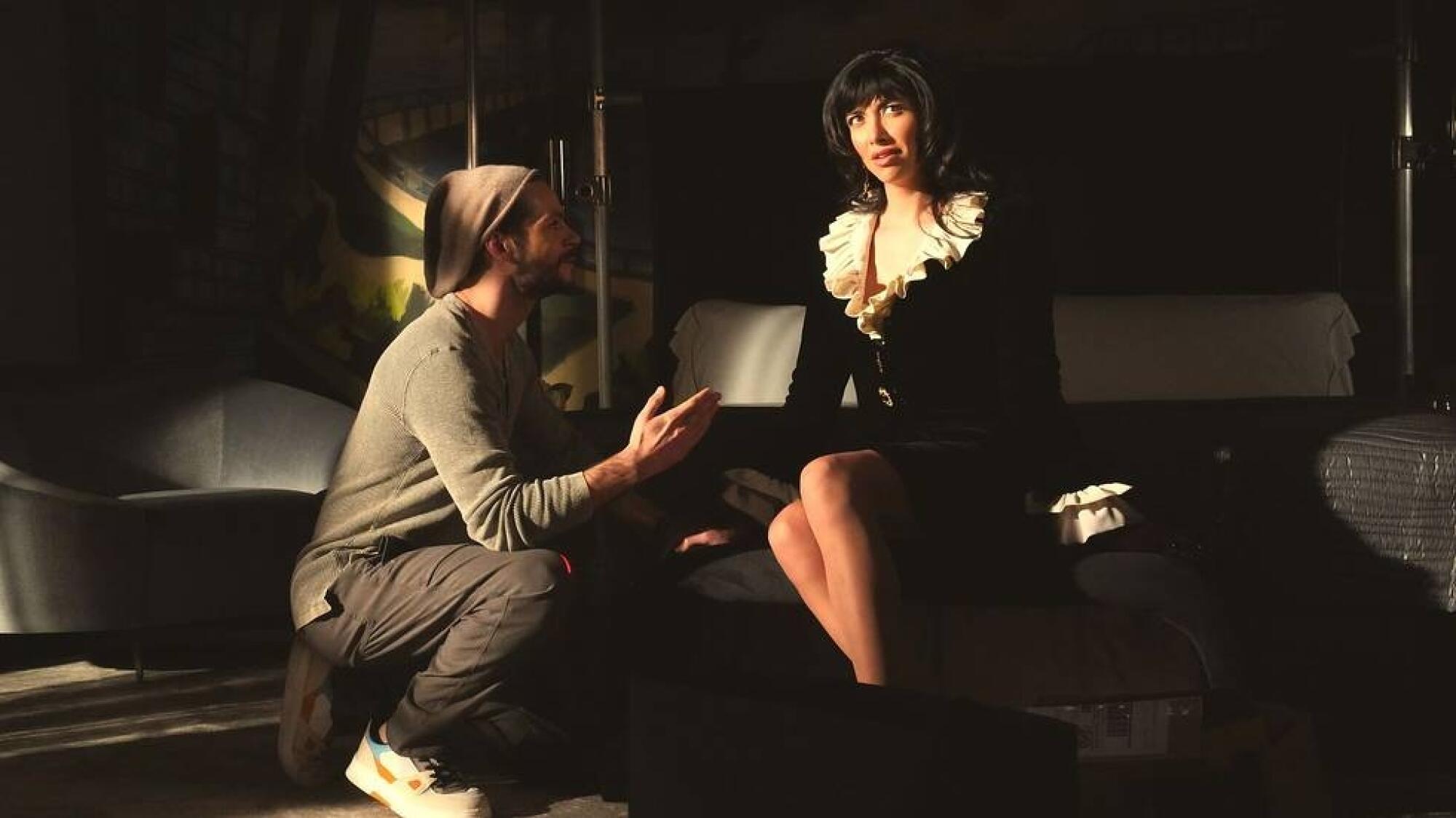
Dylan O’Brien and Martine in “Fantasmas.”
(Monica Lek / HBO)
“That was probably my one contribution, narratively, to the show,” she admits. “It’s a personal taste thing. I think it’s really sexy to see a man in women’s lingerie. Dylan had no problems with it. He was so down. And he looked great.”
Such an incongruous image (in a scene that’s quite melancholy, not really all that steamy, in fact) doesn’t feel out of place in “Fantasmas.” The show, like Vanesja, embraces binaries only to bridge them. Or break them. Or perhaps just toy with them. But it can do so only because the series is fascinated by the personal dramas we all carry within. There’s a push toward empathy for the other that runs through the show, even in its most outlandish moments.
“‘Fantasmas’ is the people who populate it,” as Torres puts it. It’s a show “about characters who, with little screen time, aim to capture the curiosity of the viewers.”
Further echoing those words and in trying to sum up this off-kilter show’s ambitions, Martine is reminded of Jon Brion’s song “Little Person,” which he co-wrote with Charlie Kaufman for the filmmaker’s meta-theatrical opus “Synecdoche, New York.”
That 2008 film is centered on a theater director eager to celebrate the mundanity of real experiences. The only way he knows how is to put on a stage show of his own life and that of everyone he comes into contact with. “I’m just a little person,” Martine sings. “One person in a sea of many little people, who are not aware of me.”
“I feel like that’s everyone in New York,” she says. “And also everyone in ‘Fantasmas.’ You get this everything, everywhere all at once TikTok universe where every story is simultaneous. Where everyone is the lead in their own narrative. Which is kind of the closest thing to reality that you can get.”

Movie Reviews
Movie Review: Travolta’s “Propeller: One-Way Night Coach” is One for the Ages — All Ages

Back in the good ol’days — the ’90s — John Travolta would love to get off the topic of “Michael,” “Pulp Fiction” or “Get Shorty” in interviews with film journalists like me and regale us with how utterly besotted he had been with his first flying experience, how that drove his passion for piloting and buying planes and airfield-adjacent luxury houses.
He didn’t even seem to mind having to move house when this or that development balked at him flying his Boeing 707 out of there on the way to locations.
Travolta would tell any journalist who asked that he was writing a kid-friendly book, “Propeller: One Way Night Coach,” based on his first flights as a child in old propeller driven airliners — cheap red-eye overnight treks with too many connections for your average jet age traveller to tolerate.
I remember picking up the book when it came out later in the ’90s — at an airport gift shop — and thinking “Well, that’s as cute as I figured.”
And now, decades later and trapped in the B-movie hell of his post “Gotti” career, Travolta’s turned that cute book into the most delightful, fanciful and colorful bon bon of a movie.
“One Way Night Coach” is a child’s fantasy of flight and flying the way it used to be — with pristine, uncrowded, futuristic airports, an early ’60s era of jets and prop planes with over-uniformed stewardesses in white gloves, the days “Back before every Joe Sweatsock could wedge himself behind a lunch tray and jet off to Raleigh-Durham,” as Sideshow Bob memorably sneered on “The Simpsons’.”
It’s a fictionalized account of Travolta’s childhood about an only child (at least two Travolta siblings have bit parts in this movie) of a never-made-it/never-will actress/single-mom (Kelly Eviston-Quinnett) who indulges her aviation-obsessed eight-year-old with a cheap cross-country overnight flight.
Little Jeff (Clark Shotwell) will revel in almost every Idlewild to Pittsburgh to Dayton to Chicago to Kansas City to Denver and Los Angeles minute. He strolls into the cockpit to meet pilots, charms the stewardesses and checks out the sleeping bunks on the TWA Lockheed Super Constellation, loving even the delays if not the Chicken Cordon Bleu he’s offered on legs of the journey that offer a meal.
And as he’s an observant child, he comments (Travolta narrates) on his 50ish mother’s vamping and posing, her choice of cigarettes (Newports) and drinks, the solo traveling men whose attention she pursues and earns.
“I was her best audience,” adult Jeff remembers of the mother who’d read him plays as bedtime stories and delusionally hopes that this trip to Los Angeles might be her “big break” even though she’s pushing 50.
“Hollywood called,” she’d explain about their overnight cheap flight arrangements to ticket agents and crew. “They told me to take the next flight!”
At every turn, Jeff meets or sees kindness — stewardesses who indulge his many questions and bump them up to first class on the mostly-empty planes, a captain who fixes his toy model of a Constellation, a mentally ill flyer who flips out but is calmed by a flight attendant who isn’t overworked and frazzled in jet-powered tin-can jammed with Joe and Jane Sweatsocks who think nothing of traveling in their pajamas.
Normally, I cringe at pictures this reliant on voice-over narration. I recoil from stars who populate their picture with Sandler etc. offspring. But “Propeller” is unfailingly sweet and never cloying.
Sure, it’s fictionalized. But if you’ve followed Travolta’s life and career, a lot of him is in this — his raptoruous engagement with flying, an indulged child who developed a taste for fine food and creature comforts, a mother who was his guiding star as an actor.
I get why there are less adoring reviews than mine floating around “Propeller.” It’s unfailingly sweet. Mom’s man-hunting is seriously dated. This TWA tale is decorated with Gershwin’s majestic “Rhapsody in Blue” — United Airlines’ signature tune. And Travolta’s been around long enough for recent generations to come up and not feel a connection to the “Saturday Night Fever/Get Shorty” star whose career has fallen off and life has been visited by too much tragedy.
But I’d hate to be seated next to anybody who doesn’t appreciate this adorable, pristine and nearly perfect aviation fantasy on any flight, much less an overnight one.
Rating: TV-PG
Cast: Clark Shotwell, Kelly Eviston-Quinnett, Ellen Travolta, Ella Beau Travolta, Olga Hoffmann and John Travolta.
Credits: Scripted and directed by John Travolta, based on his book. An Apple TV+ release.
Running time: 1:01

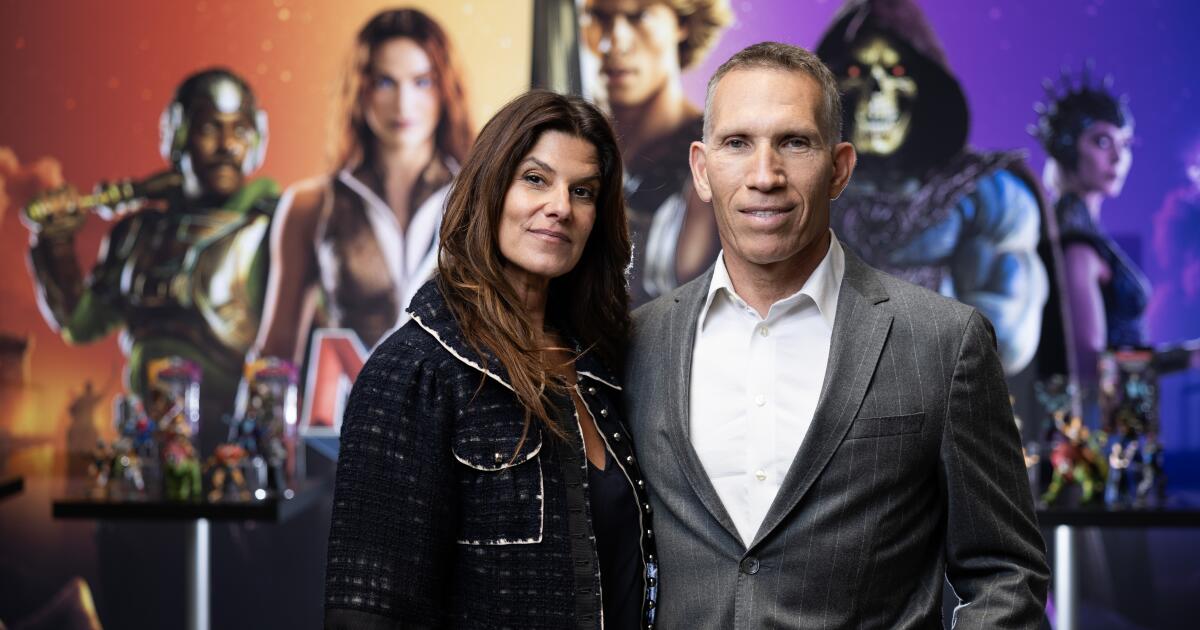
Three years ago, Mattel Inc. struck box-office gold — or rather, pink — with the billion-dollar success of “Barbie.”
In its first return to theaters since the female-forward phenomenon, the El Segundo toymaker is turning to the brawny He-Man for another box-office lift.
Its latest film, “Masters of the Universe,” opens this weekend, as Mattel looks to build on that previous success and continue extending its signature toy brands into the entertainment arena.
“The movie is very much in tune with culture,” said Mattel Chief Executive Ynon Kreiz. “Everything is much more contemporary relative to what was created more than 40 years ago, but it’s still very true to the origin story and to the DNA of the brand.”
The new film arrives at a pivotal time for Mattel, which is facing pressure from investors to grow its business. The maker of Hot Wheels, American Girl and Uno has recently confronted a challenging market for toys, beset by tariffs on goods produced overseas and weaker-than-expected demand for Barbie dolls and Fisher-Price preschool products.
Amid uncertainty in the toy market and the fallout from tariffs, Mattel’s net income dropped 25% to $398 million in 2025. And since the company announced disappointing holiday sales totals in February, its stock has dropped more than 30%, closing at $14.34 on Wednesday.
“Masters of the Universe” toys at Mattel headquarters in El Segundo.
(Myung J. Chun / Los Angeles Times)
The share price slide prompted investor Southeastern Asset Management to send a letter last month to Mattel leadership suggesting the toy maker should sell itself and go private. Southeastern manages about 4% of the company’s stock on behalf of its clients.
“The frustration among investors has been the fact that if you look at the business from 2021 through 2025 and even this year … the business really hasn’t grown,” said Eric Handler, a Roth Capital senior media and entertainment analyst, referring to Mattel. “This is a company that needed something fresh in the portfolio, and there’s a wide range of investments being made, of which ‘Masters of the Universe’ is one part.”
Kreiz pushed back on the idea that the company is not growing. In the fourth quarter of 2025, net sales were up 7% to $1.8 billion, though the result was not as strong as the company expected.
Mattel has spent $1.2 billion in the last three years to buy back shares, with an additional $1.5-billion share repurchase planned for the next three years.
“We’re investing in our own stock because we believe it is undervalued,” he told The Times in an interview at his office, which has floor-to-ceiling windows that give an expansive view of El Segundo. “We absolutely agree that the share price doesn’t reflect the progress that we’ve achieved over the last few years financially, operationally, our place in culture, the strength of our brands, and the continued expansion of the business. And more importantly, the potential that we have down the road.”
“Masters of the Universe” is a key variable in that equation.

Ynon Kreiz, chief executive of Mattel.
(Myung J. Chun / Los Angeles Times)
The movie, which had a budget of roughly $170 million, is expected to bring in $25 million to $35 million in the U.S. and Canada during its debut weekend. That’s a far cry from the $162-million opening haul of “Barbie,” but box-office analysts say that film captured the cultural zeitgeist in a way that’s hard to replicate.
The ‘80s-era “Masters of the Universe” is “a property that was famous with a certain group of fans, but it hasn’t had much of a pop culture presence,” said Shawn Robbins, who directs movie analytics at Fandango and founded the forecasting site Box Office Theory. The movie has notched a respectable 74% approval rating from critics on aggregator Rotten Tomatoes.
“There’s been so many callbacks to nostalgic franchises,” he said. “Some people are always on board for them, and maybe the positive reviews bring people in who were on the fence. But people are also ready for something fresh and new and exciting.”
Kreiz said he’s often asked how the company will match the success of “Barbie.”
“The answer is, we don’t need to match ‘Barbie’s’ success for movies to have a meaningful economic impact on the company,” he said. “Not every movie will be ‘Barbie.’ If we create quality content that people want to watch and create quality experiences that people are engaged with, good things happen, and these brands will resonate and will be here for years to come.”
While theatrical revenue is important, the measure of success for “Masters of the Universe” could also include its eventual reception on streaming platforms and, of course, toy sales, analysts said.
There are hundreds of products tied to the movie, from collectible action figures of Nicholas Galitzine’s He-Man and Camila Mendes’ Teela, to branded Uno decks, Legos, clothing and skateboards.

Skeletor from “Masters of the Universe.”
(Myung J. Chun / Los Angeles Times)
“For us, it’s a huge win already,” said Robbie Brenner, president of Mattel Studios and chief content officer, who also served as a producer on the film. “We have reinvigorated and relaunched this brand that has been around for decades … and done it in a way with just the best-in-class toys. Obviously that’s our bread and butter. And then to have made an epic, incredible movie … is a huge win.”
While Mattel does not yet have sales totals for its “Masters of the Universe” toys, executives said during an earnings call in late April that product sales were “growing double digits” amid strong customer demand, particularly from adults.
When Kreiz was named CEO in 2018, he saw the potential for Mattel to expand beyond toys. In an entertainment landscape dominated by known franchises and intellectual property, the former TV and media executive wanted to leverage the company’s IP in new ways to attract consumers.
Hence, Mattel has expanded into real-world experiences such as a Barbie pop-up at Coachella or a traveling Hot Wheels monster truck show. In February, the company fully acquired Mattel163 mobile game studio after buying out a stake held by Chinese tech firm NetEase. The studio has released games based on Uno, Skip-Bo and other Mattel intellectual property.
And on the film and television front, the Mattel Studios division now has 51 people — most of whom are based in El Segundo — focused on projects across platforms.
After “Masters of the Universe,” Mattel Studios plans to release a “Matchbox” streaming movie in October. The division has more than a dozen films in development that have been announced, including an American Girl movie with Paramount, Polly Pocket with Amazon MGM Studios, as well as a live-action Magic 8 Ball series from M. Night Shyamalan.
“The journey for the company was to evolve from being a toy manufacturer that was making items to become an IP company that is managing franchises,” Kreiz said. “It’s not that we’re not creating toys — it’s obviously a big part of our business — but the opportunity is to expand so much more than the physical product.”
“Masters of the Universe” was in development for years at several different studios before it was picked up by Amazon MGM.
That partnership stemmed from Mattel’s work on the “Barbie” movie with Courtenay Valenti, then president of production and development at Warner Bros. Pictures who is now head of film at Amazon MGM.
“Masters of the Universe” felt like a good property for Mattel to bet on because of its nostalgia factor and deep bench of colorful characters, from the green tiger Battle Cat to the heavily armored Ram Man and ever meme-able Skeletor, which the company hopes will attract new audiences, Brenner said.
The movie is directed by Travis Knight — chief executive of stop-motion studio Laika who also led the 2018 “Transformers” spin-off “Bumblebee” — who Brenner said “nailed” the narrative’s tone. (It didn’t hurt that Knight was already a fan of the franchise and had sported the He-Man haircut as a child.)
“It’s a property that’s kind of out there,” said Brenner, who grew up watching He-Man and his twin sister She-Ra. “It’s got all these crazy characters. But just riding that line between what is funny and kind of irreverent and then kind of heartfelt, that is a very hard thing to put in a blender and to get right.”

Let’s just say that the wedding band has never occupied the most exalted rung of the ladder in music.
Playing “September” and “Celebration” is often what’s most required. As one member of the Bride and the Groove, the band at the center of John Carney’s new film, puts it: They’re not rock stars. They’re human jukeboxes.
But in “Power Ballad,” a wedding band singer and pop star cross paths. For one night, all of the stratification of the music world falls away. “Power Ballad” starts like a fairy tale.
Since 2007’s “Once,” the Irish writer-director has focused his films on the redemptive capacity of music. Carney, who was once a bassist for the Frames, knows from experience. From “Sing Street” to “Flora and Son,” he has made unabashedly earnest tales where a song, or just picking up an instrument, changes lives.
This can, undoubtedly, lead Carney into sentimental territory. Lucky for him, his chosen subject — music — is more worthy of sentiment than almost anything else. Yet the song doesn’t quite remain the same in “Power Ballad,” a movie that begins with the gentle sweetness Carney is known for, but detours into something more discordant.
Rick (Paul Rudd) is an American musician who gave up on his once-promising rock band’s future to instead live with his wife (Marcella Plunkett) and teenage daughter (a spunky, underused Beth Fallon) in Dublin. His former group was called Octagon, a perfect former band name if there ever were one.
But for years, Rick has fronted the Bride and the Groove. It’s an unromantic day job (or rather a night one) that hasn’t entirely sapped his belief in his own songwriting. During an encore at one wedding, he plays an original tune and is mentally transported to an arena full of swaying fans. When he snaps out of it, he’s staring at an empty dance floor and faces that say: That wasn’t Kool & the Gang.
At another wedding at at a castle, the band is asked to let a friend of the newlyweds sit in. They reluctantly agree, and are surprised to see the very popular boy band veteran, Danny (Nick Jonas), step on stage. He sings Stevie Wonder’s “I Wish,” and it’s great. Though Rick had just dismissed Danny’s music as “manufactured content for young, excitable teens,” he discovers Danny is a genuine musician.
But, later that night, something even more remarkable transpires. Rick bumps into Danny, and the two quickly hit it off. They begin jamming together and sharing songs that need work. They are both so jazzed by their unlikely collaboration that they play into the next morning.
The actual moment of artistic creation, and the craft it requires, is something the movies almost always skip over. But capturing collaborative juices flowing is exactly what Carney excels at. You can feel his joy in it. So it’s fitting that one of the unfinished songs Rick plays for Danny, “How to Write a Song (Without You),” is about creative invention.
It’s here when you wonder where “Power Ballad” is headed. Is this, for Rick, the beginning of a beautiful friendship? Will they turn into the next great songwriting duo, lifting Rick out of weddings and proving to the world that Danny is more than a boy-band pretty face?
That is very possibly the movie Carney might have made a decade ago. But “Power Ballad,” which he co-wrote with Peter McDonald (who also co-stars as a band member), shifts six months ahead in time. Rick is standing in a shopping mall when the familiar lyrics of “How to Write a Song” softly float through the stores. He stands dumbfounded in the gleaming halls of commerce, a befuddlement that slowly turns into outrage the bigger and bigger Danny’s smash hit grows.
“Power Ballad” loses some of its steam in its second half, which follows Rick’s struggle for justice. Making things considerably harder is that he can find no recorded demo of the song. His family and his band don’t even really believe him.
But even as the movie struggles to sustain its opening refrain, Carney’s film is always riffing on ideas of authenticity and aspiration in music. That Jonas is, himself, a former boy band star who has at times gone it alone, lends the movie a direct connection to contemporary music, where tussles over authorship are increasingly common.
Jonas has been good in other films (notably the “Jumanji” movies), but this is his most ambitious and convincing performance to date. It’s a testament to the movie that Danny’s theft isn’t a purely villainous act. He gives the song a bridge and the vocal power to take it to another level. He’s under mounting pressure from his label to deliver a hit. An executive (Jack Reynor) wants “Danny 2.0” but has little faith he can supply it.
But it’s an even more well-tailored role for Rudd. He memorably and very goofily played a bassist in the 2009 comedy “I Love You, Man.” But while he sings well, it’s not his musical chops that lift the performance. It’s more that Rick, a contented family man with unrealized rock-star dreams, gives the exceptionally genial Rudd more notes to play as an actor. Rudd makes for a very likeable everyman out to convince the world he is capable of a beautiful song.
And that’s the abiding belief of Carney’s. No matter all the struggles, the artistic injustices, the corporate hegemony, he still believes that if you make something truly soulful, it will break through. It will claw its way to the surface, and move people. It’s undoubtedly gotten harder since “Once,” this movie seems to admit. The world is against you. But what one person can offer, a ballad or otherwise, still has power. Fairy tale or not, that’s worth believing in.
“Power Ballad,” a Lionsgate release in theaters Friday, is rated R by the Motion Picture Association for “language throughout and some drug use.” Running time: 108 minutes. Three stars out of four.
-

 Utah3 minutes ago
Here’s what Utah football player Lance Holtzclaw told U.S. senators about student-athletes’ pay
-

 Vermont6 minutes ago
New UVA Coach Cassese Makes Splash, Hires Feifs as Top Assistant
-

 Virginia11 minutes ago
VSP issues senior alert for missing 63-year-old
-

 Washington18 minutes ago
Washington priest removed as exorcist after linking UFOs to work of demons
-

 Wisconsin21 minutes ago
Free fishing, trails and parks kick off Wisconsin’s summer | Paul A. Smith
-

 West Virginia33 minutes ago
West Virginia High School Football: Huntington-Spring Valley to clash at Marshall university stadium.
-
 Wyoming36 minutes ago
Wyoming reports first rabies case of season in Sheridan County
-

 Crypto41 minutes ago
Vietnam Gov’t seeks Bybit’s support in developing cryptocurrency market – TNGlobal

