Business
Column: With its 'Chevron' ruling, the Supreme Court claims to be smarter than scientific experts

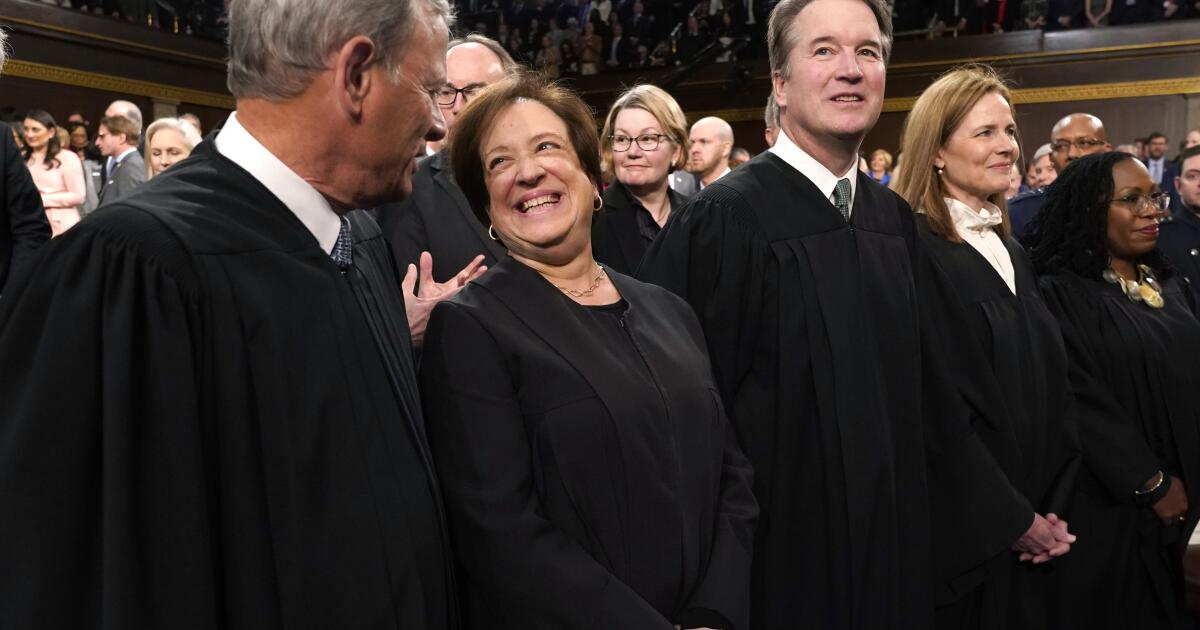
Second only to the Supreme Court’s ruling Monday on when presidents are immune from criminal prosecution, the biggest case of the court’s recently completed session involved the age-old conflict between judges and government regulators.
The case concerned a 40-year-old precedent known as “Chevron deference.” That doctrine held that when a federal law is ambiguous, the courts must defer to the interpretations offered by the agencies the law covers — as long as those interpretations are “reasonable.” On Monday, the court discarded Chevron deference.
This may sound like an abstruse legalistic squabble, but it has massive implications for Americans in all walks of life. It could subject agency decisions on scientifically based issues such as clean air and water regulations and healthcare standards to endless nitpicking by a federal judiciary that already has displayed an alarming willingness to dismiss scientific expertise out of hand, in favor of partisan or religious ideologies.
In one fell swoop, the majority today gives itself exclusive power over every open issue—no matter how expertise-driven or policy-laden.
— Supreme Court Justice Elena Kagan
The ruling amounts to an apogee of arrogance on the part of the Supreme Court’s conservative majority, wrote Justice Elena Kagan in a dissent joined by Justices Sonia Sotomayor and Ketanji Brown Jackson. But it’s not a new development.
“The Court has substituted its own judgment on workplace health for that of the Occupational Safety and Health Administration,” Kagan wrote; “its own judgment on climate change for that of the Environmental Protection Agency; and its own judgment on student loans for that of the Department of Education…. In one fell swoop, the majority today gives itself exclusive power over every open issue — no matter how expertise-driven or policy-laden.”
Chevron deference originated in 1984, when environmentalists were fighting an effort by the EPA under Ronald Reagan to loosen clean air rules at the behest of industrial polluters. As it happens, the environmentalists lost that battle, but over time they won the war against deregulation.
Conservatives have had it in for Chevron deference for a long time; given their current majority on the court, the doctrine’s death has been a foregone conclusion, awaiting only the appearance of a suitable case to use as a bludgeon. Indeed, the majority was so impatient to kill the doctrine that the court’s six conservatives chose to do so by using a case that actually is moot.
That case arose from a lawsuit brought by the herring industry, which objected to a government policy requiring herring boats to pay for government observers placed on board to make sure the boats were complying with their harvesting permits.
The rule was imposed under the Trump administration, but it was canceled in April 2023 by Biden, who repaid the money that had been taken from the boat owners — so there’s nothing left in it for the court to rule on.
Interestingly, Chevron deference was not always seen as a bulwark protecting progressive regulatory policies from right-wing judges, as it’s viewed today. At its inception, it was seen in exactly the opposite way — as giving conservative policies protection from progressive-minded judges.
The Natural Resources Defense Council, which brought the original case in an effort to preserve Clean Air Act regulations that were being overturned by the Reagan administration, counted the 1984 ruling as a severe loss.
At issue then was the definition of a pollution “source.” Past practice defined it as a single building or smokestack; the administration wanted to redefine “source” broadly, as referring to an entire pollution-emitting plant. This wasn’t a trivial difference. The NRDC’s interpretation was more stringent than the government’s, for the latter allowed a polluter essentially to hide law-breaking emissions within an otherwise non-polluting plant.
The original Chevron ruling was 6 to 0 (three justices didn’t participate — two because of illness and the third, Sandra Day O’Connor, recused herself because of a conflict of interest). The ruling stated that when a federal law was ambiguous or silent on a particular issue, judges were bound to defer to the interpretation offered by the agency covered by the law, as long as its interpretation was “reasonable.”
One other thing: The functionary pushing to give industry more freedom to pollute was Reagan’s Environmental Protection Agency administrator, the late Anne Gorsuch. Name sound familiar? Justice Neil M. Gorsuch, who is her son, lined up with the anti-Chevron majority. Curiously, he didn’t mention his family history in his separate concurrence — or perhaps not so curiously, because his mother was on the winning side of the decision that he has now voted to overturn.
In any event, Gorsuch’s words about the case in which his mother triumphed were telling. “Today,” he concluded gleefully, “the Court places a tombstone on Chevron no one can miss.”
The truth is that the Chevron ruling of 1984 and Monday’s ruling both served a goal shared by Anne Gorsuch and her offspring: providing federal judges all the leeway they might need to see things the way Big Business prefers.
Forty years ago, when the Reagan White House was pulling down a regulatory edifice that industry resented, the Supreme Court was happy to have judges defer to the agencies participating in that project, including Anne Gorsuch’s EPA. Today, when the deregulatory process is opposed by government agencies that take seriously their duty to make life better for the average consumer, the court tells judges that they’re free to ignore agency findings.
In his majority opinion, Chief Justice John G. Roberts Jr. called Chevron “misguided because agencies have no special competence in resolving statutory ambiguities. Courts do.”
This is self-refuting. Chevron deference isn’t about “resolving ambiguities” in the law. It’s about recognizing that sometimes those ambiguities are deliberate — put in place by lawmakers who know they can’t possibly write a law that covers all situations from now to the end of time. The “ambiguities” are there because Congress wishes that the agencies it has charged with fulfilling its goals use their technical and scientific knowledge to meet the challenges of a changing world.
Things have indeed changed. Generally speaking, wrote legal scholar Cass R. Sunstein in 2019, environmentalists and other progressives saw the original decision as “a capitulation to the (insufficiently zealous) administrative state, which was often captured by powerful private interests.” Today, the right wing portrays the “administrative state” as a shadowy cabal bent on thwarting the will of the people (that is, conservative policies). “The right and the left have switched sides,” Sunstein observed.
Chevron deference was very much a product of its time, Sunstein noted. In the 1960s and 1970s, “federal courts had been aggressively reviewing agency action (and inaction), often with the goal of producing greater regulation.” Typically, “the judges were on the political left.”
They had grown up professionally in the atmosphere created by the Warren court, which fostered the notion that the courts existed to protect and extend individual rights. “To their defenders,” Sunstein wrote, “the lower federal courts assumed a kind of heroic stance.”
This was the era that brought us an unprecedented, judicially driven expansion of individual rights, through such decisions as Griswold vs. Connecticut (1965), which established the right of married couples to use contraceptives without state interference; Loving vs. Virginia (1967), which invalidated laws against interracial marriage; and of course Roe vs. Wade (1973), which established the nationwide right to abortion.
The current conservative majority has already begun to roll back this historic approach to individual rights, most notably through the Dobbs decision of 2022, which overturned Roe vs. Wade.
Justice Clarence Thomas has suggested that Griswold should follow Roe vs. Wade into the juridical dumpster, along with Lawrence vs. Hodges (2003), which invalidated state laws against sodomy among consenting adults, and Obergefell vs. Hodges (2005), which legalized same-sex marriages nationwide. The court, Thomas remarked in his concurring opinion in Dobbs, “should reconsider” those rulings.
Those cases were decided on different grounds from Chevron, but liberal judges saw the expansion of individual rights as part of the same principle that prompted them to aggressively examine agency actions that tended to narrow those rights.
As it happens, the Chevron decision didn’t generate much interest when it was handed down. The six justices who ruled unanimously in the EPA’s favor apparently thought they were weighing in on a narrow technicality. One legal scholar has called Chevron an “accidental landmark”; its significance only emerged from subsequent federal rulings and, perhaps most important, its embrace by Justice Antonin Scalia, who joined the Supreme Court two years later.
Scalia wrote in a 1989 law review article that Chevron deference made sense in the modern world: If there was an ambiguity in the law, the reason was either that Congress was sloppy (in which case the courts had the duty to say what a law meant) or that the lawmakers deliberately delegated to agencies the task of responding to changing realities by using their “advancing knowledge.” Over time, to be sure, he grew discontented with the doctrine (as Roberts and Gorsuch took pains to point out.)
Monday’s decision puts the lie to conservatives’ oft-expressed disdain for policies made by “unelected” bureaucrats. “Agencies report to a President, who in turn answers to the public for his policy calls; courts have no such accountability,” Kagan wrote. Calling the decision “a bald assertion of judicial authority, she added: “The majority disdains restraint, and grasps for power.”
That’s not to say that the majority won’t share the power they have now arrogated for themselves. They will walk hand-in-hand with the Big Business leaders and conservative ideologues who put them on the court, and the rest of us will just have to live with the consequences.


Robotaxis could be turning into robocops.
A self-driving Waymo reported two teens to San Mateo, Calif., police on Monday after they were found drinking alcohol and shooting toy guns in the back of the vehicle.
According to a social media post from the San Mateo Police Department, officers detained two 15-year-olds after the Waymo they were riding in contacted the department and stopped in a parking lot until law enforcement arrived.
“Parents do you know where your teens are?” the San Mateo Police Department wrote on Facebook following the incident. “Waymo does!”
Officers removed both teens from the vehicle and determined they were using toy guns to shoot Orbeez out the windows. Orbeez are small, water-absorbing beads sold at toy stores.
“Toy guns, water guns, and BB guns all pose real dangers, especially to an untrained eye,” the Police Department said. “The simple handling of them can cause fear in [passersby].” “
A video posted on Facebook shows at least five officers and a police dog responding to the scene and approaching the Waymo with their weapons raised.
Waymo did not immediately respond to a request for comment.
Waymo vehicles have internal cameras and microphones that may be used in an emergency or to “promote safety and security,” according to Waymo’s online support page.
The cameras are also used to ensure the vehicles are clean and to help find lost items, according to the support page.
The company said it does not use facial recognition or other biometric identification technologies to identify individuals.
“In more urgent circumstances, support may access live video during a trip,” the Waymo page said.
The San Mateo Police Department’s Facebook post has garnered nearly 60 comments, with one user accusing Waymo of “snitching.”
“At least they got a designated driver?!” one user commented.
Business
Commentary: How right-wing anti-transgender attacks led to a Supreme Court ruling upholding sex discrimination
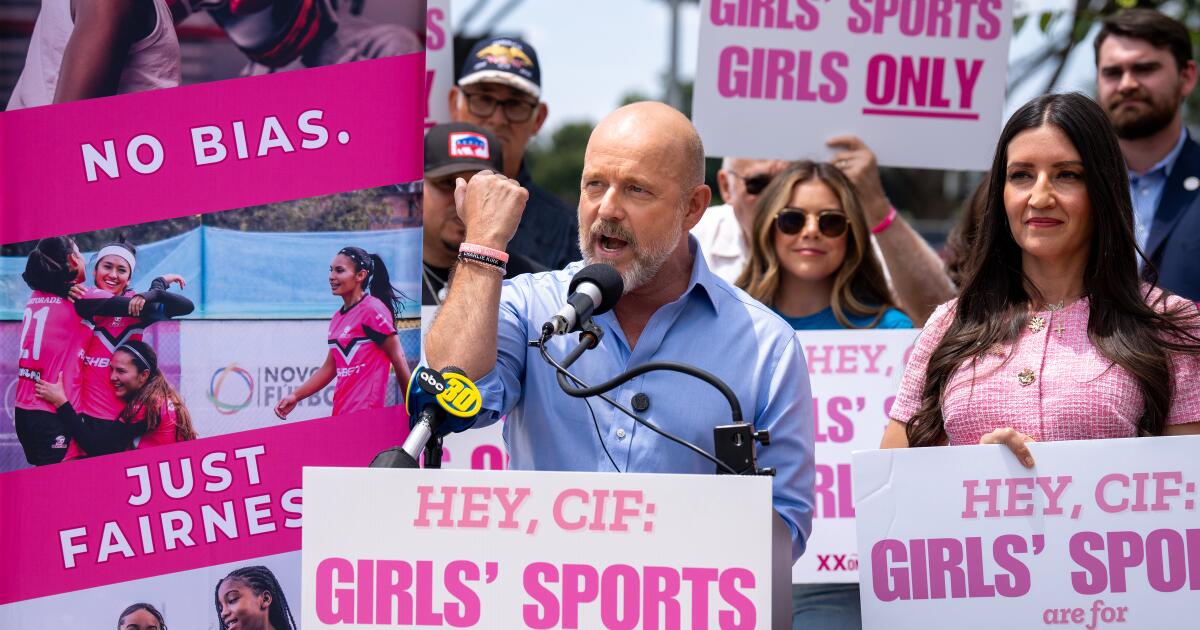
At the Supreme Court, the unfounded fear of boys masquerading as girls in youth sports rolled the clock back on gender equality.
On the surface, the Supreme Court’s June 30 opinion upholding state laws barring transgender girls from women’s and girl’s sports teams looks like a victory for women’s rights.
The 6-3 opinion by Justice Brett M. Kavanaugh certainly presents itself that way. “Females and males have inherent physical differences relevant to athletic performance,” Kavanaugh wrote. “Therefore, in contact sports, forcing female athletes to compete against males can create significant safety risks.” He also asserted that “forcing female athletes to compete against males can undermine competitive fairness.”
The ruling applied to prohibitions enacted in Idaho and West Virginia against “biological” males’ participation on women’s teams in public schools. Federal judges in both states overturned the bans. The Supreme Court majority restored them. The ruling essentially upholds similar bans enacted in 25 other states.
There was no record of any transgender person participating in school sports in the State, let alone any ‘problem’ with transgender students … creating unfair competition or unsafe conditions.
— Justice Sonia Sotomayor, demolishing the Supreme Court’s argument in favor of banning transgender girls from girl’s sports
Kavanaugh, like Donald Trump and others in the anti-transgender camp, maintained that one’s gender is an immutable fact of life, established even before birth.
Anything else, Trump stated in an executive order he issued on inauguration day 2025, could only be the product of “gender ideology extremism.” The U.S., his order stated, recognizes “two sexes, male and female. These sexes are not changeable and are grounded in fundamental and incontrovertible reality.” That’s a “biological truth,” he declared.
In his own version of this overconfident and factually insupportable conclusion, Kavanaugh wrote: “As all agree, females and males have inherent physical differences relevant to athletic performance.”
Science recognizes that some people are “born with sex traits that don’t fit into typical male or female patterns,” to cite a discussion on the Cleveland Clinic web page on the topic “intersex.” The condition “may involve chromosomes, hormones, reproductive organs or genitals.”
From a psychological standpoint, medical science recognizes “gender dysphoria” as a real condition often requiring counseling and medical intervention such as the use of puberty blockers and hormones to stave off the development of secondary sex characteristics until the condition can be resolved.
No one disputes that there are physical differences between the sexes. Few would dispute that on average or even at the median, males may be bigger and more powerful than females, or that in certain contact sports the difference may be telling and on occasion dangerous.
But that’s not the same as asserting that the physical differences between males and females invariably mean that men will invariably prevail over women in all competitions or that their participation will endanger women.
The International Olympic Committee — in a policy statement Kavanaugh cited incompletely — says that in “most running and swimming events,” males have a 10% to 12% advantage over women. That’s a range that would accommodate the full spectrum of outcomes — transgender females win, cisfemales win, they tie. (The “cis” prefix denotes those living consistent with their birth gender.)
West Virginia and Idaho addressed this ambiguity by banning transgender women from all girls’ teams. So under their rules transgender girls can’t play football or soccer with cisgirls. But what’s the argument in favor of banning them from the 100-yard dash, or cross-country track, or diving, or archery?
But something else is going on here. The Supreme Court’s ruling was almost preordained, given the years-long campaign by conservatives to demonize transgender individuals as if they’re members of an alien species.
It will be recalled that during his presidential campaign, Trump spun a despicable fantasy in which children were kidnapped in school and secretly subjected to sex-change operations.
Trump’s executive order wiped out policies aimed at protecting transgender adults from discrimination. He moved to outlaw gender-affirming medical therapies for anyone under 19 by cutting off federal funding for healthcare institutions that provide such care.
He banned transgender individuals from serving in the military and ordered federal prison officials to move transgender inmates into the general populations consistent with their birth genders, which exposes them to physical assault. (Federal Judge Royce Lamberth of Washington, D.C., has blocked the government from transferring three transgender women into the male prison population or terminating their hormone treatments.)
I wrote during Trump’s first term, when his anti-transgender policies were still gestating, that the goal was to show that “one can target any community, as long as it doesn’t have a strong political voice or political power. These are the actions of bullies and cowards, pretending to be strong.”
Last year, the Supreme Court struck its first blow against transgender rights by upholding a Tennessee law banning transgender care, including puberty blockers and hormone therapy, for minors. Similar laws have been enacted in 25 other states. The majority in that ruling by Chief Justice John G. Roberts Jr. was identical to the one in the June 30 ruling — Roberts, Kavanaugh, and Justices Clarence Thomas, Samuel A. Alito Jr., Neil M. Gorsuch and Amy Coney Barrett.
Who are the targets of this ideological campaign? They number only about 1.6 million U.S. adults, or one-half of 1% of the U.S. population. About 300,000 adolescents ages 13 to 17, or 1.4%, identify as transgender, according to a study by UCLA School of Law.
In West Virginia, as Justice Sonia Sotomayor observed in her dissenting opinion, “there was no record of any transgender person participating in school sports in the State, let along any ‘problem’ with transgender students … creating unfair competition or unsafe conditions.”
In endorsing the flat bans directed at transgender women in Idaho and West Virginia, Kavanaugh argued that any attempt to implement case-by-case judgments of students’ requests to join sports teams inconsistent with their biological gender would create “an enormous practical and administrability problem.”
Is that so? That wasn’t the case in Maine, where the annual K-12 population is more than 170,000. There, a committee was charged with determining whether a student’s participation in a sport consistent with their gender identity but inconsistent with their biological sex would “result in an unfair athletic advantage” or present a risk of injury to others. The committee held 56 hearings from 2013 through 2021, or an average of seven per year. During the entire time span, only four involved transgender girls. (The outcome of those hearings couldn’t be learned.)
It was Maine’s policy, one might recall, that provoked a confrontation between Trump and Maine Gov. Janet Mills at the White House last year, when Trump threatened to withhold federal funding from the state unless it barred transgender students from competing on women’s sports teams. “We’ll see you in court,” Mills snapped.
Whether the Idaho and West Virginia laws genuinely protect girls from unfair competition is questionable. (The Idaho law is styled the “Fairness in Women’s Sports Act.”) In practice, the laws may subject women in public schools to “invasive sex verification procedures,” as educational expert George Theoharis of Syracuse University wrote after the court ruling.
They’re also based on a retrograde view of women as fragile creatures needing men’s protection, Theoharis wrote — “the same logic that has historically been used to justify excluding women from making their own healthcare decisions and girls from rigorous math and science; that physically demanding work is simply beyond them.” (There don’t appear to be any state laws barring transgender women from competing in men’s sports.)
Becky Pepper-Jackson, the plaintiff in the West Virginia case, in which she is identified only as B.P.J., is the only transgender girl who sought to join girl’s teams — track and cross-country — in the state. That was in 2021, just after West Virginia passed its law and she was about to enter sixth grade. She didn’t appear to pose any competitive risk to others on the track and cross-country teams she applied to join — her lawyers told the Supreme Court that on those no-cut teams, she “came in near the back.”
Anyway, she had not gone through male puberty, which theoretically might have endowed her with a competitive advantage, because she had been taking puberty blockers and female hormones.
Thanks to the court’s ruling, Sotomayor observed in a dissent joined by Justices Elena Kagan and Ketanji Brown Jackson, West Virginia can deny Becky access to school sports “because it thinks they have an inherent athletic advantage, even if the facts show that they do not.”
B.P.J., Sotomayor wrote, “cannot practice on girls’ teams, even if she would not take anyone’s spot in an eventual competition, even if everyone who tries out for the team makes it, and even if having the chance to participate could aid immensely in treating B. P. J.’s gender dysphoria.”
So whose interest was really protected by the Supreme Court?

An Orange County real estate investor accused of criminally defrauding an Arizona bank of nearly $100 million pleaded not guilty Monday and remains in custody.
Mahender Makhijani, 44, of Corona del Mar — who also was ordered by an arbitrator to pay $1.34 billion in a separate civil fraud case — was arraigned in Santa Ana federal court on two charges.
He is accused of bank fraud and making a false statement to a bank in a June 8 case involving a $100 million real estate loan made by Phoenix-based Western Alliance Bank. He was taken into custody on June 10.
Makhijani is accused of providing bogus collateral for the October 2024 loan now in default. In a civil lawsuit, Western Alliance said the outstanding balance as nearly $99 million.
Prosecutors say he falsified title insurance policies that showed the bank would have a first lien on the underlying collateral if the loan went bad, when in fact it did not.
A trial was set for August 11 before U.S. District Judge David O. Carter in Santa Ana.
Michael Schachter, his criminal defense attorney, did not respond to messages seeking comment.
In the civil case, an arbitrator in May ordered Makhijani to pay Laguna Beach real estate mogul Mohammad Honarkar $1.34 billion after ruling he had fraudulently induced him into a 2021 joint venture — and then wrested control and lost to creditors more than two dozen properties Honarkar had owned.
Makhijani has not been criminally charged in that case, but prosecutors alleged in an affidavit in support of the bank fraud charges that he used “force and threats” in his dealings with Honarkar and others — including taking over the landmark Hotel Laguna in 2023 that Honarkar was renovating.
Prosecutors sought to hold Makhijani without bail after his arrest.
The affidavit noted he is a legal Indian immigrant with a home and bank accounts in that country, has access to private jets and threatened to “run away” if caught in a difficult situation.
The request was denied and he was granted $500,000 bail.
However, Makhijani remains in custody after a hearing sought by prosecutors last month before Magistrate Judge Autumn Spaeth.
The judge declined to accept a $450,000 cashier’s check submitted by a Makhijani associate for the bail, finding insufficient proof the source of the funds was legitimate, according to court records.
Makhijani is not prominent outside Orange County real estate circles, but he established a thriving distressed-assets business over the last decade that attracted prominent Southern California real estate investors.
Prosecutors said it paid for a lifestyle that included two multimillion-dollar homes in Corona del Mar, a luxury apartment in Newport Beach and various luxury vehicles.
As of last month, prosecutors had not fully traced his assets, which they believe are not held in his name and some of which may be in India.
The businessman employed an array of shell companies and strawmen to sign documents on his behalf, and to stand in for him as operators of his companies, according to the affidavit.
Makhijani told an associate he took extra precautions because wanted to insulate himself from litigation and that “they were sharks in the distressed world who took advantage of people,” the affidavit stated.
-

 Denver, CO2 minutes ago
City of Denver says images of piling waste a case of illegal dumping
-

 Seattle, WA7 minutes ago
14-year-old dies in electric motorcycle crash at Seattle bike park
-

 San Diego, CA14 minutes ago
Serial sex abuser sentenced to over 300 years for crimes against young relatives
-

 Milwaukee, WI17 minutes ago
13 Things to Do in Milwaukee This Weekend: July 9-12
-

 Atlanta, GA22 minutes ago
Atlanta City Council member proposes citywide heat safety plan as temperatures climb
-

 Minneapolis, MN29 minutes ago
I-394 traffic shift between Minneapolis and St. Louis Park starts on Wednesday
-
 Indianapolis, IN32 minutes ago
Indiana officials call for action after 2 children die in retention ponds
-

 Pittsburg, PA37 minutes ago
Fayette County man facing 1,000+ charges related to animal cruelty, neglect

