Midwest
Why won’t the Homeland Security secretary say if DHS funded a terrorist’s travel to Minnesota?

NEWYou can now listen to Fox News articles!
Is your money funding the transportation of foreign terrorists to Minnesota? Department of Homeland Security (DHS) Secretary Alejandro Mayorkas won’t answer that question.
In January, reporting revealed that DHS allowed a known terrorist to roam freely throughout the country for almost a year before being arrested in Minnesota after U.S. Customs and Border Protection (CBP) released him into the United States at our southern border.
This case raised fundamental questions about the Biden administration’s potential use of taxpayer money to transport illegal aliens who pose a threat to national security into communities across the United States.
DHS, led by Secretary Alejandro Mayorkas, has failed to produce a single document in response to a basic FOIA request.
The American people deserve to know if DHS spent taxpayer dollars to transport a known terrorist across the country – but President Biden’s DHS has refused to answer simple questions about the situation for months.
TOP SENATE REPUBLICANS DEMAND ANSWERS FROM MAYORKAS AFTER SUSPECTED ISIS TERRORISTS RELEASED INTO US AT BORDER
Here’s what we do know, despite stonewalling from Mayorkas: DHS encountered a Somali man at the southern border on March 13, 2023. According to the current administration’s practice, he was promptly released into the United States and somehow made his way to Minnesota.
On Jan. 18, 2024, after the individual had been in the country for more than 10 months, he was deemed “a confirmed member of al-Shabaab,” a designated Foreign Terrorist Organization in Somalia. He was finally arrested two days later in Minneapolis.
In early February, members of Minnesota’s Republican congressional delegation sent a letter directly to Mayorkas seeking answers on how exactly Biden’s DHS allowed a terrorist to enter and remain in the homeland for almost a year. To date, it has gone unanswered.
How was a terrorist who entered the United States as an illegal immigrant able to get to Minnesota, and how was he able to support himself while there?
MAYORKAS FORCED TO ADMIT MORE MIGRANTS HAVE CROSSED US BORDER UNDER BIDEN THAN TRUMP: ‘SEVERAL MILLION PEOPLE’
According to research published in March by The Heritage Foundation, he may well have been provided a plane ticket and other support by the American taxpayer.
Since 2021, the Biden administration has been using a program called the Emergency Food and Shelter Program-Humanitarian (EFSP-H) to provide long-range transportation, legal services and more to illegal aliens encountered at the southern border.
The money is appropriated to the Federal Emergency Management Agency (FEMA), which, in turn, hands it over to non-governmental organizations (NGOs) to provide for illegal aliens. These NGOs have received billions of taxpayer dollars since Biden took office – exploiting our open border to fill their own coffers.
The only clear eligibility requirement for illegal aliens to benefit from the government’s program is that they were encountered and released by DHS at the southern border – meaning that the Somali terrorist arrested in Minnesota was likely eligible.
ABC HOST TELLS SECRETARY MAYORKAS IT’S ‘VERY HARD’ TO CALL BIDEN’S ACTIONS AT THE BORDER A ‘SUCCESS’
According to Heritage’s estimate, as many as two million illegal aliens, some undoubtedly dangerous criminals, may have gained access to long-range transportation through Biden’s EFSP-H program.
The Heritage Foundation’s Oversight Project submitted a FOIA request for records of travel expenses incurred by the program. Such documentation is required by law.
FEMA, however, responded to the FOIA request by claiming that it was not responsible for holding those documents and did not have any – implying that hundreds of millions of taxpayer dollars going toward plane tickets and more for illegal aliens, like that Somali terrorist, were not even being monitored by DHS.
Still seeking answers, members of Minnesota’s Republican congressional delegation again sent a letter to Mayorkas in early April. They hoped the secretary would provide clarity on whether DHS had evidence on how the terrorist traveled to Minnesota, as well as whether an NGO aided in that travel, and if that NGO received federal funding.
That letter was dated April 2, with a request for response by April 17. It has also gone unanswered.
CLICK HERE FOR MORE FOX NEWS OPINION
Not only has the Biden administration failed to answer basic questions about the EFSP-H program, but they’ve also doubled-down by creating the Shelter and Services Program (SSP), which will replace EFSP-H and “facilitate more effective support of CBP efforts to efficiently process and humanely treat noncitizens.” In their proposed budget for fiscal year 2025, DHS requested an additional $1.4 billion for the SSP.
Taxpayer dollars have gone to supporting unvetted illegal aliens and transporting as many as two million of them across the country. Among them may have been a known terrorist.
DHS failed to produce a single document in response to a basic FOIA request. They have flatly ignored two letters from Congress. And they expect more of your money – without oversight.
DHS’ abuse of taxpayer dollars while failing to protect the homeland from known terrorists cannot stand. Congress can and must use the power of the purse to defund the SSP and stop hardworking Americans from being forced to foot the bill for President Biden’s unprecedented crisis at our southern border.
Meanwhile, the Biden administration owes it to the American people to provide answers on the dangers it has welcomed to the country.
CLICK HERE TO READ MORE FROM LORA RIES
Lora Ries is the director of The Heritage Foundation’s Border Security and Immigration Center.
Read the full article from Here



Meet the 3 New Jersey contestants on ‘Big Brother’ 28
Three New Jersey contestants are joining ‘Big Brother’ Season 28. Meet the Maplewood, Washington Township and Monroe Township houseguests.
Doors will to the “Big Brother” house will open soon, as season 28 premieres this week — and the cast list includes one guest from northern Michigan.
At 8 p.m. on Thursday, July 9, “Big Brother” season 28 will premiere on CBS to introduce the new guests in a 90-minute episode.
“This season’s cast includes an MMA fighter, rocket scientist, game show host, daughter of an ’80s pop star, and a DRAG RACE All Star, among others,” CBS said in a July 7 announcement. “This new group of Houseguests is stepping into a summer where nothing is as it seems, where every twist rewrites the rules, and where time becomes the ultimate twist.”
There is one Michigan guest, Rome Seymour, 28, who works as a professional pickleball coach from Traverse City.
“I would describe myself as bashful, extroverted and extremely excitable. To be on ‘Big Brother’ is a dream. I’ve never felt anything as exiting as this before,” Seymour said in the “Big Brother” July 7 live cast announcement video.
Seymour said he will use his inner nerdiness to befriend and protect guests who are perhaps similar.
“I see myself as hero, but I think a lot of people in the house are going to see me as a villain just because I’m so competitive that I want to win,” Seymour said.
After the 14 guests were revealed by CBS, the cast was said to be joined by long-time “Survivor” contestant Rick Devens, according to a July 7 Entertainment Weekly article.
Here’s more on the cast and how to tune in this week:
What is ‘Big Brother’ about? What is the theme for season 28?
“Big Brother,” is a reality TV show that follows a group of people living in a large house surrounded by 112 cameras and 113 microphones as an unfiltered 24-hour live feed to capture every interaction, strategic move and challenge.
A guest will be voted off each week, and the last remaining guest will win the grand prize of $750,000, according to CBS.
The theme for season 28 is called, “Time Trip,” according to Sneak Peak from Paramount+.
Is anyone from Michigan on ‘Big Brother’ season 28?
Yes. There is one guest from Michigan on season 28 of “Big Brother:” Rome Seymour, 28, is a professional pickleball coach from Traverse City, located in the northwest Lower Peninsula.
Full ‘Big Brother’ season 28 cast list
Here is the full guest list for “Big Brother” season 28:
- Rick Devens, 42: TV journalist and long-time “Survivor” contestant from Blacksburg, Virginia.
- Jason De Puy, 35: Drag Queen and “RuPaul’s Drag Race” alum from San Francisco, California.
- Ashley Trail, 24: Bartender from Alton, Illinois.
- Barrett Pfeiffer, 27: Jumbotron Engineer from Benton, Arkansas.
- Chuk Anyanwu, 27: Supply Chain Analyst from Dallas, Texas.
- Drew Campbell, 22: Surgical Dental Assistant from Temecula, California.
- Haley Thogmartin, 29: Telemedicine Executive from Neosho, Missouri.
- Rome Seymour, 28: Pickleball Coach from Traverse City, Michigan.
- Kamuela “Kamu” Kirk, 32: MMA Fighter from Phoenix, Arizona.
- LaTrice Verrett, 57: Boutique Salesperson from Kankakee, Illinois.
- Lyric Medeiros, 25: Attorney from Honolulu, Hawaii.
- Mallory Aurichio, 24: Rocket Scientist from Township of Washington, New Jersey.
- Melody Morris, 24: Corporate Game Show Host from Thornton, Colorado.
- Taylor Brown, 27: Elementary School Counselor from Deerfield Beach, Florida.
- Yash Patel, 24: Financial Analyst from Monroe Township, New Jersey.
What time does ‘Big Brother’ season 28 premiere?
The 90-minute “Big Brother” season 28 premiere is set to air at 8 p.m. ET on Thursday, July 9.
“Big Brother: Unlocked,” will air at 8 p.m. ET on Friday, July 10, and a 90-minute episode will air at 8 p.m. ET on Sunday, July 12.
Where can I stream the ‘Big Brother’ premiere this week?
“Big Brother” Season 28 will air on CBS and will be available on Paramount+ Premium, priced at $13.99 per month.
Paramount+ Essential subscribers will be able to catch the episode the day after it airs.
Following the season premiere this week, the series will air Wednesdays at 8 p.m. ET, followed by hour-long shows on Thursdays, featuring live evictions, and Sundays at 8 p.m. ET.
USA TODAY contributed.
Contact Sarah Moore @ smoore@lsj.com

The National Weather Service (NWS) has confirmed that the tornado that struck the Detroit Lakes area of northwestern Minnesota on July 6 was rated EF2, with estimated peak winds of 185 km/h (115 mph).
The tornado touched down at 19:47 local time (LT), approximately 3 km (2 miles) south-southwest of Westbury, according to the NWS.
It remained on the ground for about 10 minutes. The tornado had a path length of 10.93 km (6.79 miles) and reached a maximum width of more than 730 m (2 400 feet). It dissipated approximately 6 km (4 miles) northeast of Detroit Lakes at 19:57 LT.
The Becker County Sheriff’s Office (BCSO) said deputies and other emergency responders began monitoring the severe weather around 19:30 LT after receiving reports of a possible funnel cloud north of Lake Park.
At approximately 20:14 LT, the Sheriff’s Office received a report of a tornado near the Oakland Beach area, where it caused extensive damage to homes, buildings, and trees.
The NWS confirmed two injuries associated with the event, one of which was directly caused by the tornado.
“1 injury can be directly attributed to the tornado, as a homeowner was injured in their home when their roof was removed by the tornado. The second injury was after the tornado during the cleanup stage and could be due to shock or trauma, according to the county emergency manager,” the NWS reported.
“Responders went from home to home looking for residents and checking for the injured. Two individuals were transported to Essentia St. Mary’s Hospital with non-life-threatening injuries. One other patient went to the hospital by private vehicle,” the BCSO said.
-

Tornado damage in Detroit Lakes, Minnesota on July 6, 2026. Credit: Becker County Sheriff’s Office
-
Tornado damage in Detroit Lakes, Minnesota on July 6, 2026. Credit: Becker County Sheriff’s Office
-
Tornado damage in Detroit Lakes, Minnesota on July 6, 2026. Credit: Becker County Sheriff’s Office
-
Tornado damage in Detroit Lakes, Minnesota on July 6, 2026. Credit: Becker County Sheriff’s Office
-
Tornado damage in Detroit Lakes, Minnesota on July 6, 2026. Credit: Becker County Sheriff’s Office
-
Tornado damage in Detroit Lakes, Minnesota on July 6, 2026. Credit: Becker County Sheriff’s Office
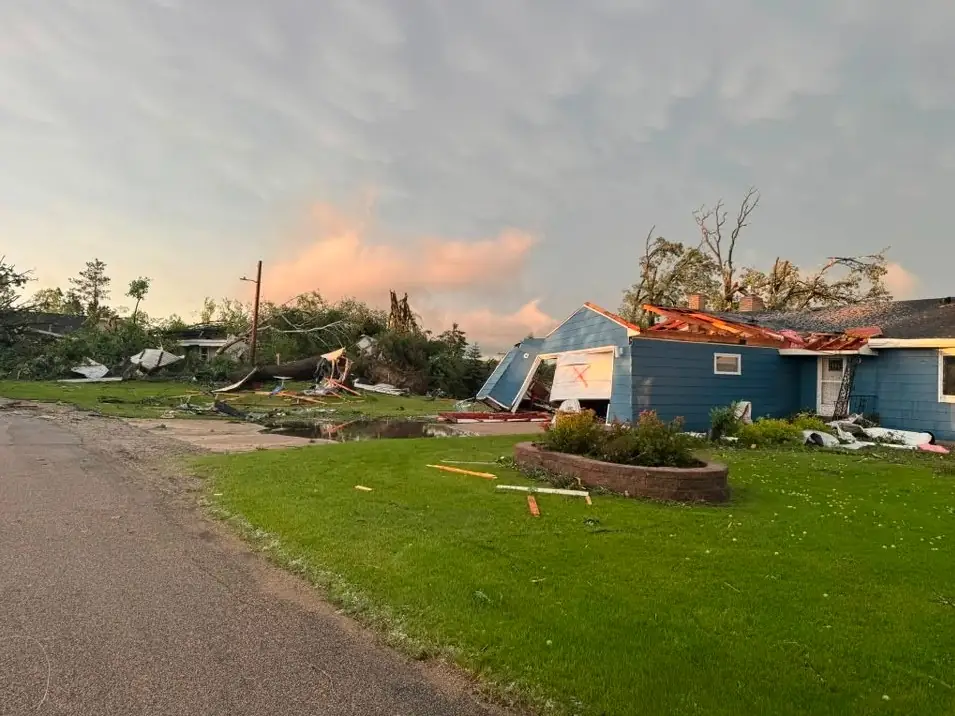
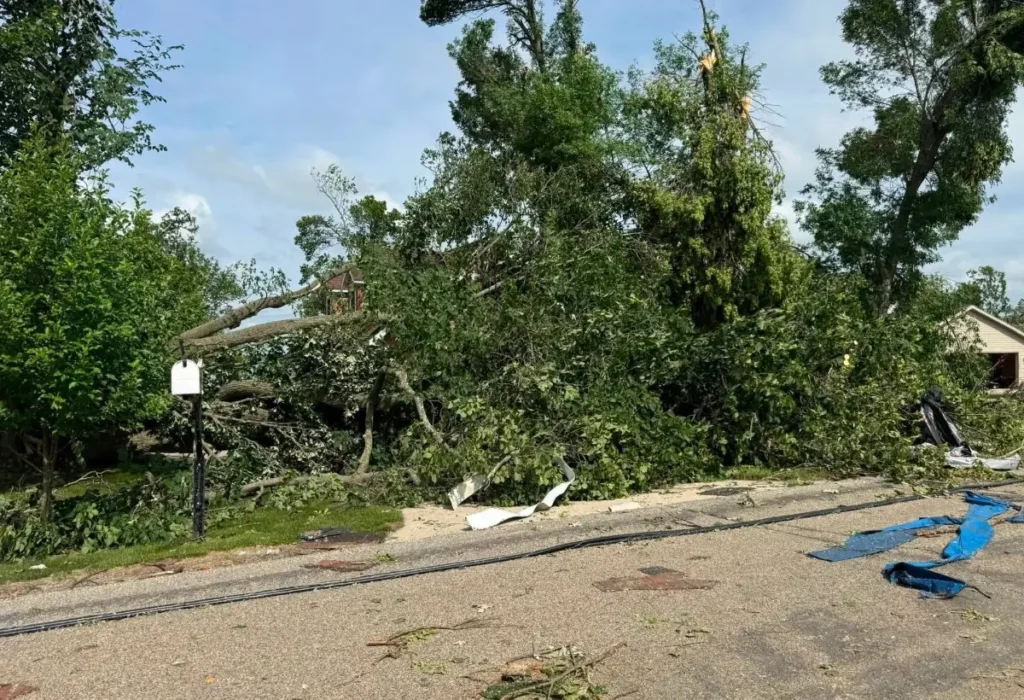
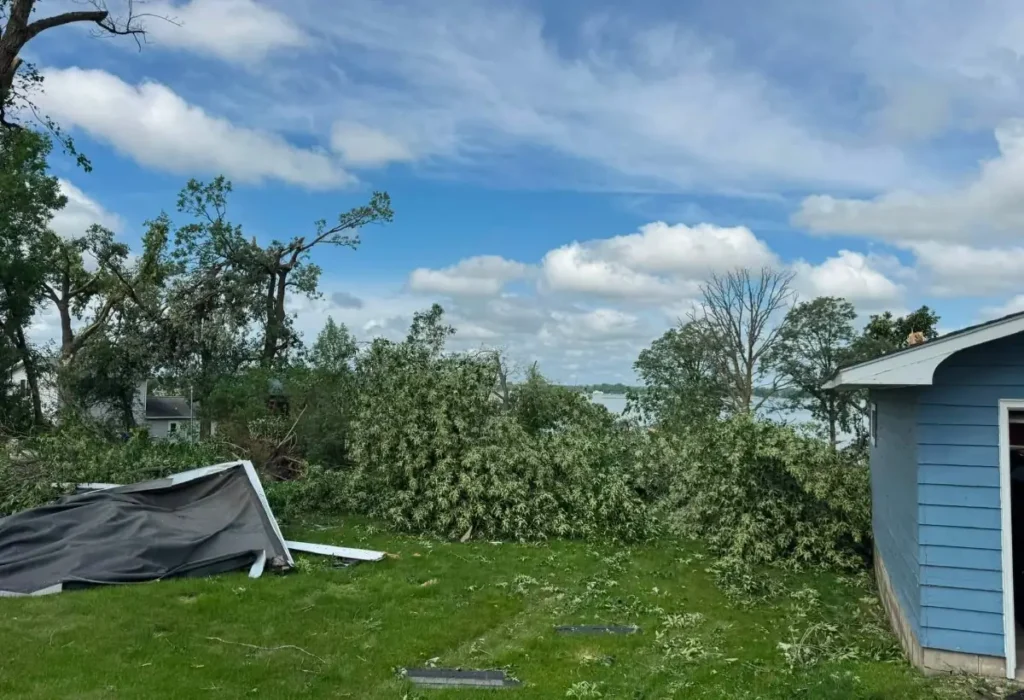
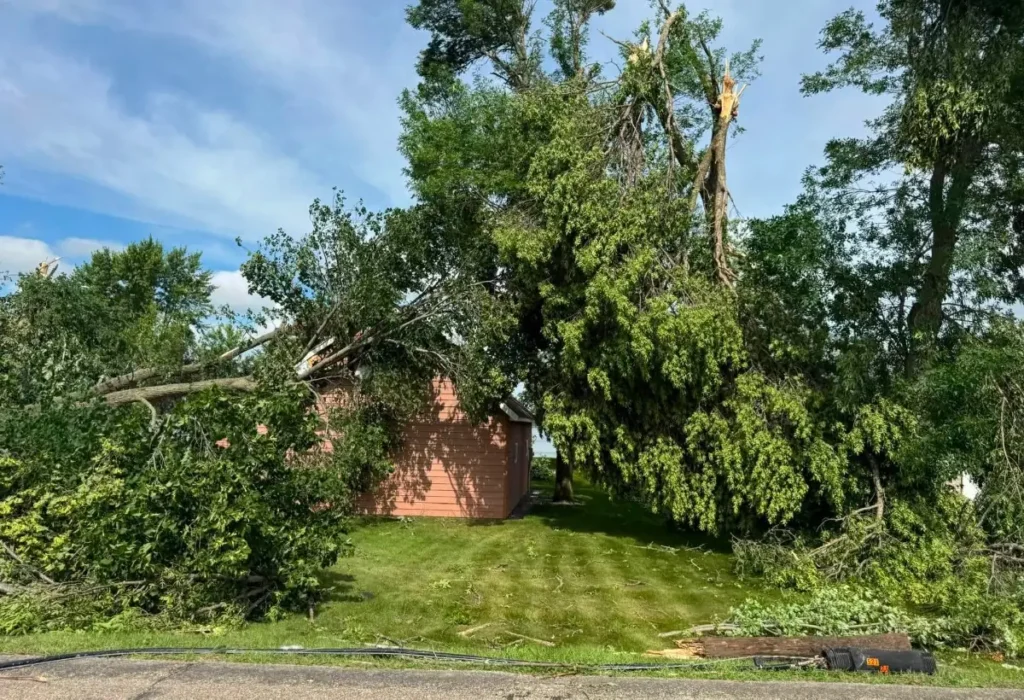
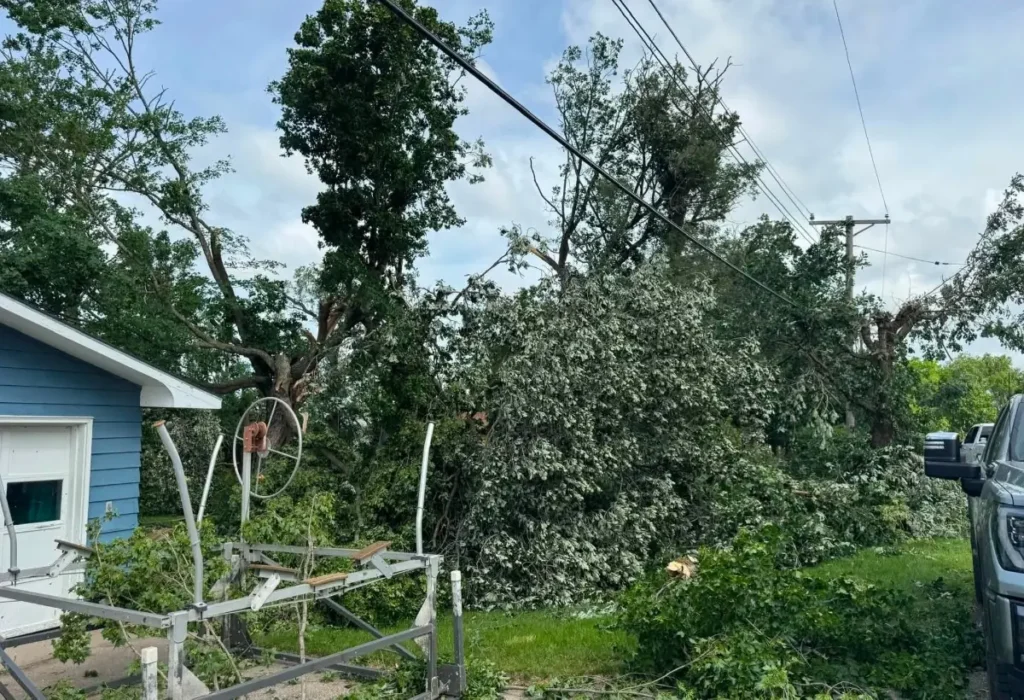
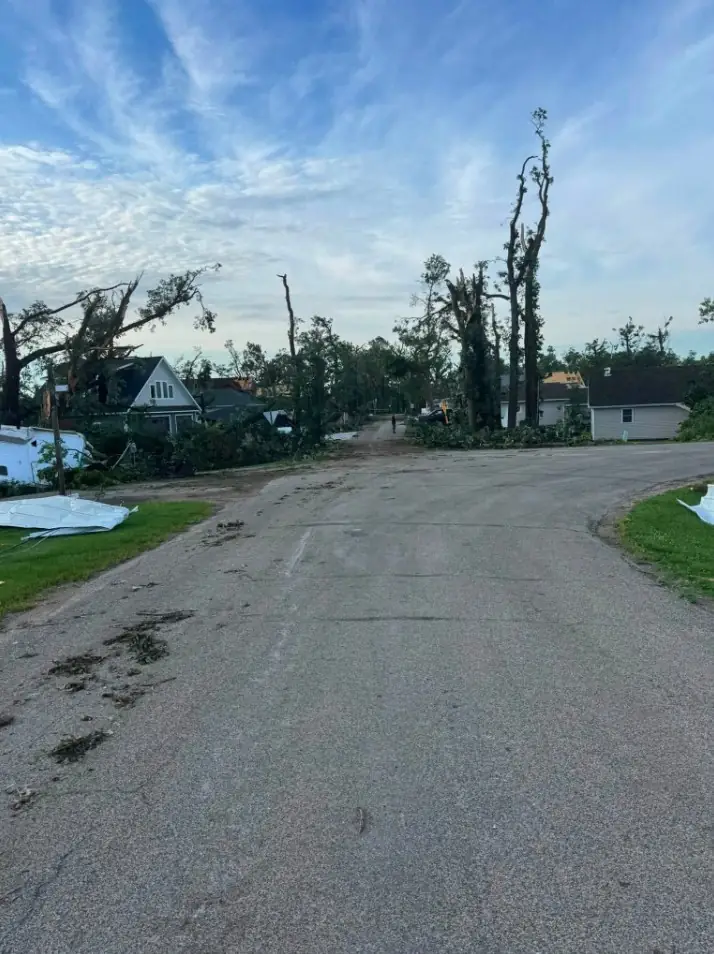
The tornado began about 2 km (1 mile) northwest of Wheeler Lake before crossing the lake, where it damaged the roofs of several homes and snapped the trunks of large oak and poplar trees.
It reached its maximum width near the western shore of Big Floyd Lake, with the Oakland Beach neighborhood sustaining the most severe damage.
Multiple garages and lighter outbuildings were swept away, while widespread roof and tree damage was reported. A 2 x 4 m (6 x 12-foot) horse trailer was lofted and carried about 200 m (656 feet) before the tornado crossed Big Floyd Lake and continued east. The last visible damage was identified near the intersection of County Highway 25 and Anchor Road.
More than 500 customers lost power as a result of the storms, according to Detroit Lakes Public Utility.
As the storm tracked east-southeast, strong winds, hail, and heavy rain affected areas north of Audubon before a tornado warning was issued for the Callaway and Rochert areas. Reports of downed trees, power lines, and debris soon followed from Detroit Township between U.S. Highway 59 and County Highway 21.
References:
1 Public Information Statement – NWS – July 7, 2026
Missouri
UPDATE: Suspect wanted in Kansas captured near Columbia; Missouri State Highway Patrol aircraft plays key role | 93.9 The Eagle

The Missouri State Highway Patrol says one of its planes played a key role in Tuesday morning’s capture on I-70 near Columbia of a Kansas suspect wanted for child endangerment.
Missouri state troopers say they were on patrol near a rest area on eastbound I-70 in Cooper County, when they located a Dodge Durango wanted for an alleged incident in Topeka. Troopers say the suspect drove off after seeing troopers and that the Patrol plane was used to avoid a pursuit.
Troopers say they were able to get in position after the plane’s pilot located the vehicle and that the Patrol deployed stop sticks and safely deflated the suspect’s tires.

The Highway Patrol says the suspect was captured without incident and that the two-year-old child, who was unharmed, has been reunited with their mother.
-

 Kentucky6 minutes ago
Kentuckians deserve honesty about McConnell’s health | Letters
-

 Louisiana9 minutes ago
Leadership Louisiana Health Fellows Welcomes Inaugural Class – Leaders for a Better Louisiana
-

 Maine14 minutes ago
A hard lesson for Democrats in Maine. Plus, we have some news about Ed Markey. – The Boston Globe
-

 Maryland21 minutes ago
Governor Moore Announces Awardees for $1.23 Million Investment to Help Maryland Workers Thrive in a Changing Economy
-

 Michigan24 minutes ago
‘Big Brother’ season 28 to premiere this week. One guest from Michigan
-

 Massachusetts24 minutes ago
Cool off this summer at these 10 splash pads in central Massachusetts
-

 Minnesota36 minutes ago
EF2 tornado injures two, damages homes near Detroit Lakes, Minnesota
-

 Mississippi39 minutes ago
Mississippi’s first Dutch Bros now open in Pearl

