Entertainment
She made an honest movie about Poland's migrant crisis. That's when her problems began

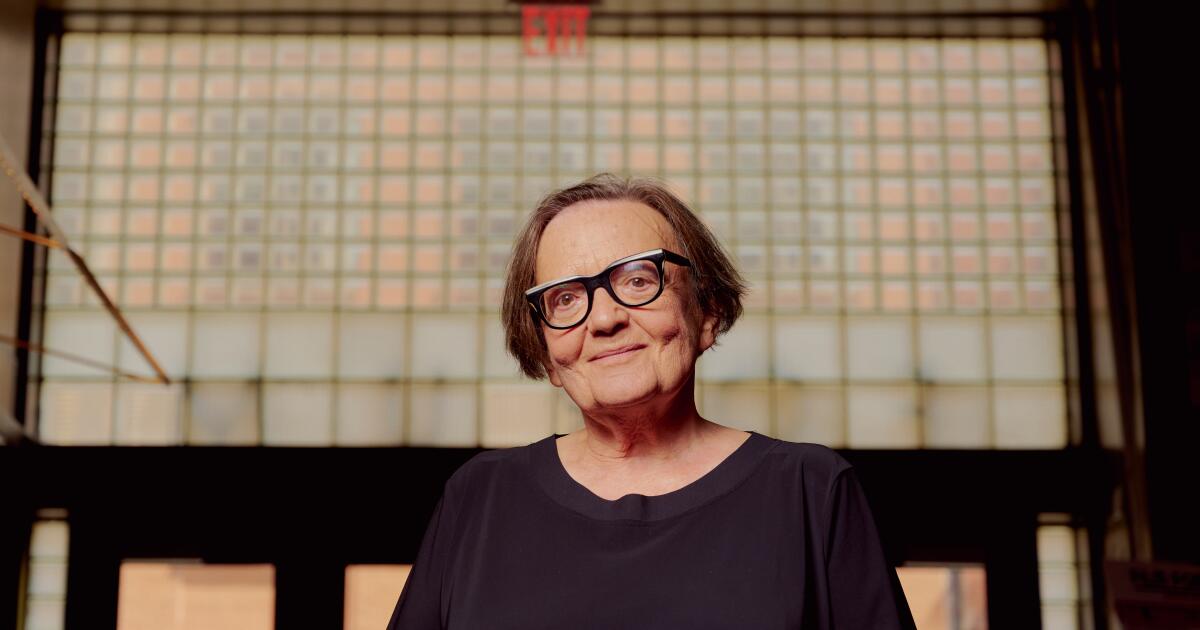
It is 10 p.m. in Berlin and Polish director Agnieszka Holland, just back from a long day on the set to take part in a Zoom interview, is too exhausted to care that she’s inadvertently sitting in front of a cut-out of Mary Poppins, of all people, in her Hollywood-themed hotel room.
Holland is visibly tired, and no wonder, given the tight production schedule on her still-shooting feature, “Franz,” which she calls “kind of an experimental biography of Franz Kafka — fragments to touch the mystery.” But the longer she talks about her extraordinary latest film, “Green Border,” set to open Friday in Los Angeles, the more her passion for the project takes over and the fatigue almost magically fades away.
A stunning refugee story, “Green Border” is both an extension of frequent themes for the writer-director (whose credits range from 1990’s “Europa Europa,” the best known of her trio of Oscar nominations, to three episodes of HBO’s landmark “The Wire”) and something that feels completely new. It also proved to be controversial even for Holland, calling forth a level of hostility in her native land that the 75-year-old filmmaker said was without parallel in her decades-long experience of uncompromising work.
“It created a lot of hate in Poland coming from the Polish government,” she remembers. “In my quite long life I’ve had very difficult experiences, but the hate campaign coming from officials was unprecedented. It was unpleasant for me, I had a lot of threats,” so much so that she found it necessary to employ full-time bodyguards.
A scene from Agnieszka Holland’s “Green Border.”
(Agata Kubis)
The criticism started at the top, from Jaroslaw Karczynski, head of Poland’s then-ruling Law and Justice Party, who in 2023 called the film “shameful, repulsive and disgusting.” Top Polish ministers labeled “Green Border” “intellectually dishonest and morally shameful,” compared it to Nazi propaganda films and Holland to top Third Reich functionary Joseph Goebbels, and in one case concluded that the director had forfeited the right to call herself Polish.
The government went further, denying “Green Border” a best international film Oscar entry, and mandating that theaters precede their showings of the film with a two-minute short putting forth the official point of view. “The government made some propaganda clips, showing how wonderful the Polish state was,” Holland relates. “Some cinema owners refused to show it, which was very courageous, and one government-supported cinema that had been blackmailed into showing it said, ‘We will show it, but with a caption saying all money from the showing will be given to activist groups.’”
Ironically, Holland says of the threats, “though it was unpleasant for me, they were so violent, so aggressive, by the end they overdid it and helped the movie at the box office,” making “Green Border” one of the year’s top grossers in Poland. “And afterwards, I never had such long and important discussions with the audience, people staying for hours after the screening. Our courage to speak openly gave courage to many people. It was very touching to see this.”
The film behind the fuss, winner of a special jury prize in Venice, is closely based on a real-life situation that is, appropriately enough, uncannily Kafkaesque. Starting in 2021, Aleksandr Lukashenko, longtime ruler of Poland’s neighbor Belarus and close ally of Russia’s Vladimir Putin, made it surprisingly easy for Middle East refugees to fly to his country. Once they arrived, they were taken straight to the border and literally pushed into Poland.
Except it wasn’t the Poland they might have expected. It was the Green Border, a heavily forested area described by the New York Times as “a two-mile-wide exclusion zone around the border” which featured “a 116-mile-long, 18-foot-high barbed wire fence” that was heavily patrolled by numerous Polish border guards. They rounded up the refugees and pushed them back into Belarus, from which they were pushed back into Poland. This back and forth and back was repeated, sometimes ad infinitum, with beatings, robberies and deaths thrown into the mix.
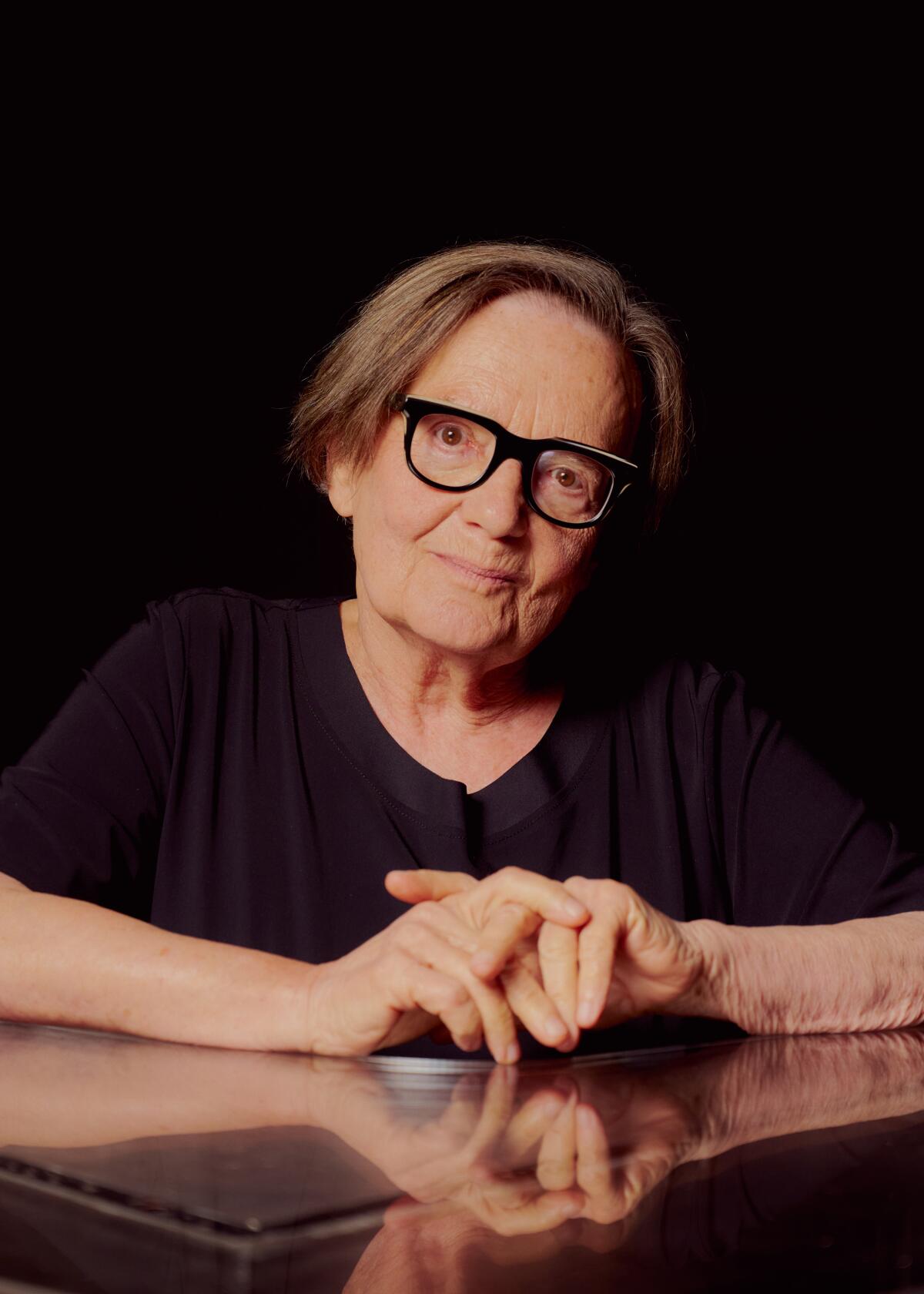
“The past which was never healed is frankly still present,” says Holland, photographed at New York’s Film Forum in June.
(Evelyn Freja / For The Times)
Holland, who is deeply versed in the dynamics of the situation, says things began with the Syrian civil war of 2015. “Europe is deadly afraid of the arrival of people where the color of the skin, the religion and culture are different,” she says. “And that was immediately used by populist right-wing governments to create an atmosphere of fear and danger.”
Lukashenko (with Putin’s likely support) opted to make things worse, opening that corridor for refugees “to destabilize Poland and Europe, to prove that the Europe of democracy and human rights is bull—,” the director continues.
Moreover, Holland relates, “the Polish government forbade access to humanitarian organizations and all media. That meant it was not only impossible to help these people lost in the forest but also to document the cruelty of the border guards.
“Karczynski, the main political force in Poland, said something that was relevatory to me. ‘Americans lost the war in Vietnam when they allowed the media to go there and send back pictures of children burnt by napalm. We will not allow images to go out.’ So I felt it’s my responsibility to try to tell that story while it was still going on.”
Not only that, Holland was determined “to tell the story from the human perspective. It’s important to me, the feeling of reality.” Holland and her two co-screenwriters, Gabriela Lazarkiewicz-Sieczko and Maciej Pisuk, “spent hours and hours talking to different people. We finally succeeded to speak secretly to border guards, so they could share their experience, their point of view.”
Because of the controversial nature of the film, the aspect of it which took the longest was the raising of funds, which took an entire year and even included money from an American producer, Fred Bernstein. “Green Border” ended up being a Polish-French-Czech-Belgian co-production, and Holland, who for the first time served as a producer as well, said the experience gave her a renewed appreciation of the complexity of European film production.
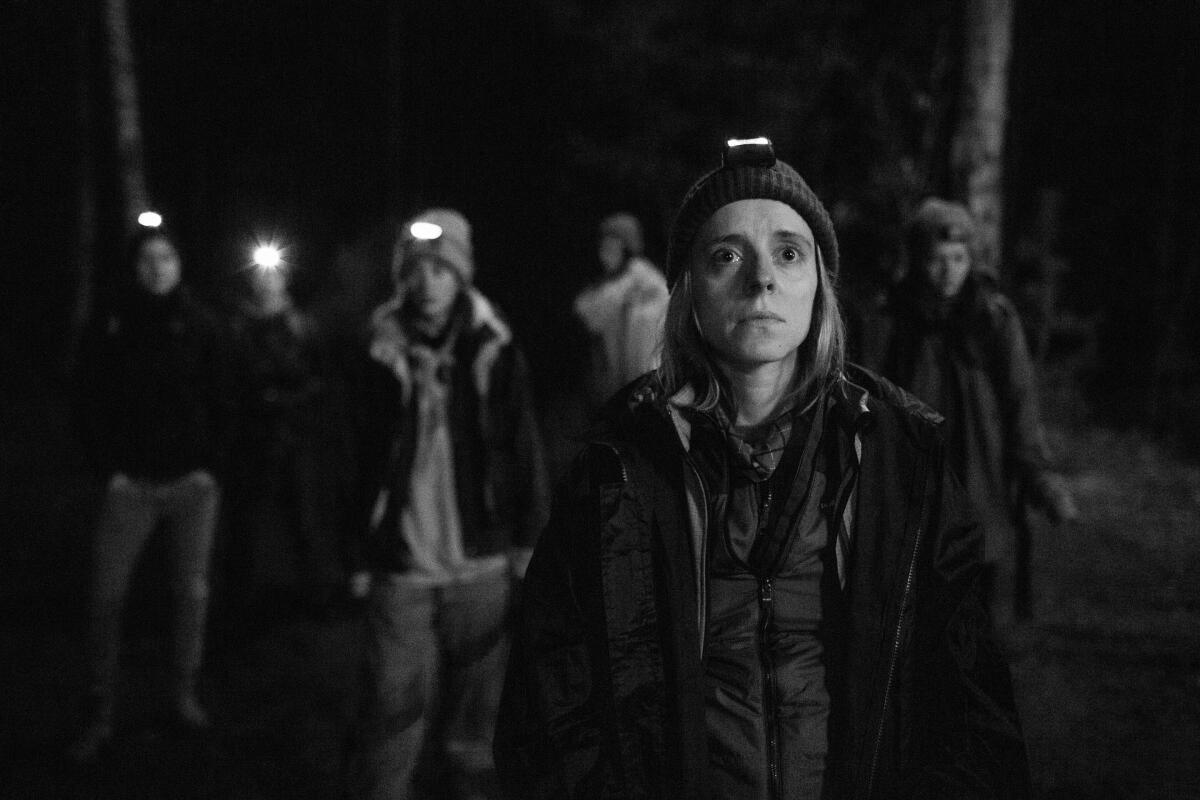
A scene from the movie “Green Border.”
(Agata Kubis)
The resulting movie tells the story from the vantage point of three distinct groups. Introduced first is a family of refugees from Syria, hoping to eventually join a relative in Sweden. Then there is a Polish border guard who wants to be doing the right thing but is not sure what that is. Finally there is a therapist who gradually takes on an activist role in her border town. Adding to the drama is a coda showing how Poland’s reaction changed when it faced another influx of refugees, this time from racially similar Catholic Ukraine.
Because Holland was so concerned about verisimilitude, she took special care with the casting. “The actors were professional actors but also real Syrian refugees,” she explains. “They did not have to imagine how the Syrians felt, they knew what it meant.” And for the local activist, Holland chose Polish actress Maja Ostaszewska, who in her off-screen life “was helping at the border with human rights activities.”
Shot in only 24 days in luminous black and white by cinematographer Tomasz Naumiuk, “Green Border” teems with urgency and immediacy. “It was a very special kind of work, very collective,” Holland recalls. “Some days we worked with two parallel units, with two young Polish women as directors. We did it in secret from the Polish government but we found a unity.”
Besides her “Europa Europa,” Holland has made several films dealing with Holocaust scenarios, and she admits to at one time believing that “the experience of the Holocaust, the horror humanity faced in seeing themselves capable of such things, created some kind of a vaccine against nationalism. But since Sept. 11, the vaccine doesn’t work anymore, that immunity evaporated. Slowly old habits, old demons are coming back.”
Adding to that feeling for Holland is the coincidence that the Green Border area is quite close to the former location of Sobibor, a World War II German death camp that was the site of a famous prisoner rebellion and escape. “When they escaped, the people from that camp looked exactly like these refugees did,” she notes, “and they escaped exactly to that forest.”
The possibility of the world backsliding to a horrific past is very much on the mind of both “Green Border” and its director. “It’s like when a tooth is sick, it gets worse and worse,” she explains. “If you don’t treat it early enough you are going to lose it. The past which was never healed is frankly still present.”


Entertainment
Justin Baldoni and wife break silence after ‘It Ends With Us’ legal battle with Blake Lively

Justin Baldoni has broken his silence after reaching a settlement in a lengthy and highly publicized legal dispute with Blake Lively.
Baldoni and his wife, Emily Baldoni, presented a united front in an Instagram video the couple shared Wednesday that began, “So we have not spoken publicly for the better part of the last two years, and it’s not because we haven’t had anything to say, because Lord knows we have.”
The “It Ends With Us” actor and director said that although they’d wanted to address the debacle that involved dueling lawsuits with Lively, nearly two years of tit-for-tat fodder and culminated in a confidential settlement, “something was telling us not to.”
The couple said they prayed about when to make a public statement. “This feels like the moment,” Emily said.
“What does feel important,” she continued, “is that we can genuinely say that we are sitting here today feeling immense gratitude for so many things and so many people and so many things that have happened to us.”
“Gratitude has saved us,” Justin added.
“I also feel that it’s important as we say that — in that gratitude — it doesn’t negate the injustice and the pain that we have also felt in the last few years, and we’ve had to wrestle with so many things and try to understand so many things,” Emily said. “How could something like this even happen? Let alone disguised as a fight for women. So much to unpack. And the truth is, reality is, is that there’s been a lot of trauma for us to move through as a family, which also makes it hard to speak.”
“We don’t even know this is the right thing to say, but we just know we need to share something,” Justin said. “What I will say is that there have been so many painful things that have been spoken into existence — “
“Untruthful,” Emily broke in.
“We didn’t want to add to the noise, so we just wanted to let the justice system run its course,” he said.
“And the truth and the facts have spoken for themselves,” Emily said.
The couple’s statement comes a year and a half after Lively filed a bombshell lawsuit against Baldoni alleging sexual harassment, retaliation and several other charges on the heels of a messy “It Ends With Us” summer release and press tour that fueled rumors of on-set turmoil.
Less than a month after the allegations against Baldoni rallied Hollywood against him, he countersued Lively, her publicist Leslie Sloane and her husband, Ryan Reynolds, for $400 million in damages, claiming they’d smeared his name in the press and wrestled away his control of the film. His suit was later dismissed.
In May, two weeks ahead of the trial, Lively and Baldoni reached an agreement to resolve their legal dispute, bringing an abrupt end to the contentious battle.
“The parties in the Blake Lively and Wayfarer Studios litigation have reached an agreement to resolve the matters,” lawyers for both sides said in a joint statement.
“The end product — the movie ‘It Ends With Us’ — is a source of pride to all of us who worked to bring it to life. Raising awareness, and making a meaningful impact in the lives of domestic violence survivors — and all survivors — is a goal that we stand behind. We acknowledge the process presented challenges and recognize concerns raised by Ms. Lively deserved to be heard. We remain firmly committed to workplaces free of improprieties and unproductive environments. It is our sincere hope that this brings closure and allows all involved to move forward constructively and in peace, including a respectful environment online.”
In June, a federal judge ordered Baldoni and his production company to pay Lively’s attorney fees related to his unsuccessful defamation lawsuit against her, but rejected her bid for additional damages.
“So, how are we doing?” the filmmaker said in the Instagram video. “We are healing, and if you’ve ever been through something traumatic, you know that healing isn’t linear. It lives different every day, and we have had to rethink for ourselves what is real. What matters, and it’s this. It’s our family. It’s our friends. It’s our community. It’s our faith.”
Times staff writer Josh Rottenberg contributed to this report.
Movie Reviews
‘The Guest’ Review: Trine Dyrholm Gives a Scorcher of a Performance in a Gutsy Danish Party-Gone-Wrong Drama

A family and friends gather for a naming-day ceremony at a Danish seaside hotel, but an unexpected appearance by one uninvited attendee (Trine Dyrholm) ruptures the veil of bland, happy-clappy familial unity in director Mads Mengel’s gutsy, well-wrought debut feature, The Guest.
The most audacious move here may be Mengel and co-screenwriter Christian Bengtson’s choice to write something that will inevitably invite comparisons with Festen (The Celebration), arguably the most notorious Danish-language film of the last 30 years, which similarly revolved around a bougie gathering disrupted by angry revelations. But there’s a savvy 2026 vibe about the way the film refuses to create florid melodrama out of quotidian crisis, and instead observes with generosity as the characters grope awkwardly toward emotional détente and mutual forgiveness.
The Guest
The Bottom Line When wetting the baby’s head goes too far.
Venue: Karlovy Vary Film Festival
Cast: Simon Bennebjerg, Trine Dyrholm, Josephine Park, Peter Gantzler, Petrine Agger, Mette Klakstein Wiberg, Kristine Kujath Thorp, Buster Lund Luscher
Director: Mads Mengel
Screenwriter: Christian Bengtson, Mads Mengel
1 hour 40 minutes
Festen-alumnus Dyrholm, having a bit of a career moment with outstanding performances both here and in the recent The Girl With the Needle among others, leads a uniformly excellent cast in a work that deserves celebration on the festival circuit and beyond.
Dyrholm’s Vibeke is technically the first person we meet, although she’s seen only in shadow at first as she smokes and drives while her unattached seatbelt, caught outside by a closed door, clatters on the road. This is the kind of unsafe driving her son Karl (Simon Bennebjerg) so deplores, a point of contention later on in the story when he will steal her car keys in interest of her own safety and that of others.
But well before we get to that flashpoint, the film introduces Karl, effectively the film’s protagonist, as he arrives at the swanky resort with his wife Emilie (Mette Klakstein Wiberg) and their infant son Elliot (Buster Lund Luscher). The young family, who’ve chosen this new, secular tradition instead of a christening to welcome their child to the world, are there a day before the ceremony to meet up with core family members.
As this advance party settles down for dinner, a table that includes Karl’s sister Rikke (Josephine Park) and Emilie’s parents Frank (Peter Gantzler) and Kirsten (Petrine Agger), there’s a surprise: Vibeke is coming, courtesy of Rikke’s invitation. Karl is quietly furious and seems determined to turn her away, even when she shows up minutes later. Poor Frank and Kirsten look on confused, determinedly polite in their insistence that all family members should be welcome.
Bengtson and Mengel’s economical script carefully dripfeeds backstory as the film unfolds to explain that Karl hasn’t spoken to his mother in years, that Rikke has taken over all the daily mom management and that she’s very worn out by it. Even so, she insists Vibeke is regularly taking her medication and isn’t a problem these days, although to Karl every weird anecdote and moment of emotional intensity is an augur of impending chaos. Rikke counters that their mother is just “big, that’s her personality not her condition.”
Interestingly, that specific condition is never named throughout, although armchair diagnosticians might spot many of the signs of bipolar disorder. But the film’s emotional focus on the person and her actions rather than the label is also very contemporary, reflecting a more holistic, inclusive mindset and approach to dealing with mental health issues.
Which is all fine and dandy, until Vibeke duly does skip a dosage and starts getting manic. One of the first signs of chemical imbalance arrives during the ceremony on the beach, when Vibeke carries little Elliot much further away from the shore than anyone wants, creating a panic. From there it just gets worse as Vibeke picks up on the censorious feeling emerging from the other party guests, who had found her so charming the night before when she’d led everyone to the casino to play roulette and diverted a bunch of partying teenagers from the room next to Karl and Emilie so they could get some sleep. When the toasts at the formal dinner begin, Vibeke’s mood darkens much further, and if we’ve all learned one thing from Festen, it’s be very afraid when a Dane gets up to make a toast.
Cinematographer David Bauer’s nimble-footed lensing and use of natural light does indeed hark back considerably to the look of those Dogme 95 movies back in the day, as does the naturalistic editing style deployed by Louis Emil Ramm Seeberg. But there are plenty of sins against the rules of cinematic chastity that marked that movement, such as the ample space made for Lasse Aagaard’s affecting, low-key score that amps up the anxiety as Vibeke starts to spiral.
That said, Mengel keeps things simple in sonic terms when it really counts, letting the musicality of Dyrholm’s deep, sonorous voice ring out on its own in the big monologue scenes. She is, as ever, utterly mesmerizing but the performance is made even more powerful by the muted, expressive reactions of the rest of the cast as they look on, frozen like deer in the headlights of the car crash of pseudo-christening. Moments of levity puncture the gloom, but the final feeling is one of numbed sorrow and pity for all these kind, fallible people, just trying to do their best.
Entertainment
Rhea Seehorn celebrates her ‘Pluribus’ Emmy nomination as she waits to hear about Carol and the atom bomb
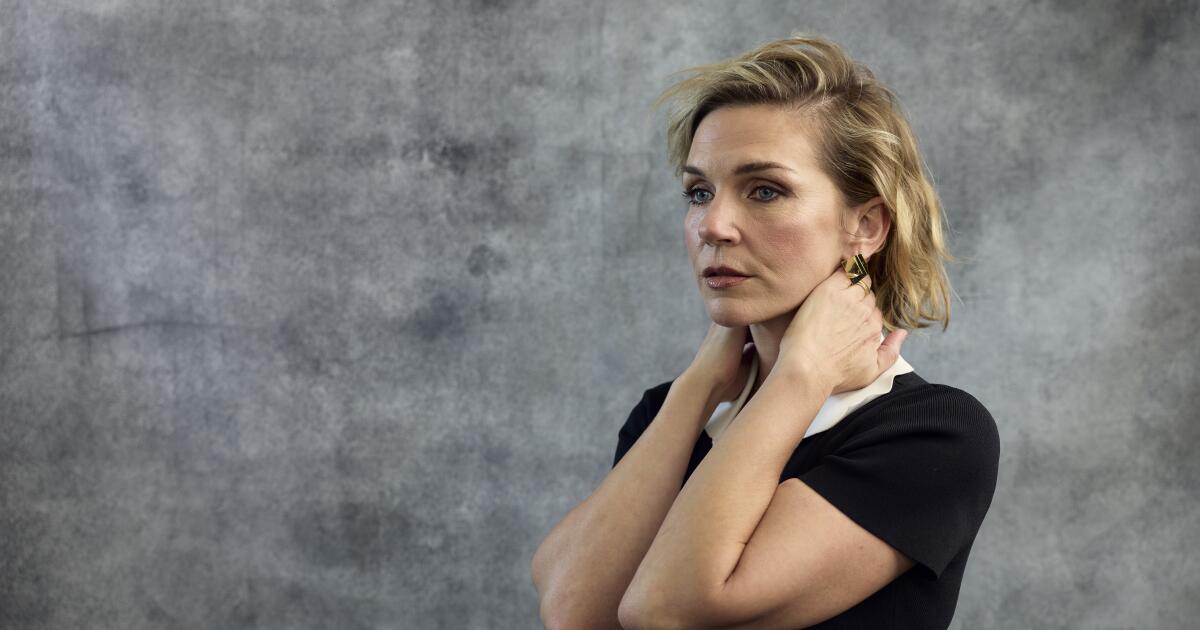
Rhea Seehorn was nervous about whether “Pluribus” would be recognized by Emmy voters Wednesday when nominations were announced. So she was jubilant when she and the surreal sci-series on Apple TV scored 18 nominations, the most for a first-year drama.
“I’m just so grateful,” the actor said in a phone interview. “People were like, ‘Why were you nervous?’ Honestly, you never actually know. I’m just so thrilled for the show, my co-stars, the production design, the editing, the writing, the music, the sound. I haven’t moved from my couch since they first announced everything because I’m still trying to call everybody on the show.”
Seehorn received a nomination for lead actress in a drama series for her portrayal of cynical Carol Sturka, a fantasy romance author who finds herself in a mystifying situation after a virus seems to have wiped out most of Earth’s population. The series was created by Vince Gilligan, who created the acclaimed series “Breaking Bad” and co-created its spinoff “Better Call Saul,” which also featured Seehorn.
The actor compared her experience of being nominated for “Pluribus” to “Better Call Saul,” which earned her two supporting actress nominations: “ ‘Better Call Saul’ was such a family that supported and cheered each other on, and I’m so grateful I have that environment again. People could not be happier for each other, and we get to celebrate the show together.”
She added, “The only part that feels different is that it’s my first nomination as a lead. It’s the process of Vince writing this for me and seeing the mountain which he wanted me to climb and going through that process. The whole thing has been its own journey, so ending up with awards and nominations, and being so well received by critics and fans is not lost on me.”
The series has been applauded for its mix of drama, comedy and strangeness in its portrait of a woman coming to terms to what seems like an impossible dilemma.
“I love the storytelling, how much Vince and I would drill down on making this as authentic as we could in terms of an everyman who has to deal with an insane situation,” Seehorn said. “Most of us are just not heroic or leaping off the couch to go save the world. And Carol is dealing with immense grief and confusion in an utter dystopian crisis. I love the humor and the drama that comes out of us being as realistic as we can with her amidst an unrealistic event.”
Fans of “Pluribus” have been relentlessly curious since the finale in December about when the second season will launch.
“I don’t know anything about that,” Seehorn said. “I don’t have to keep secrets because I’m not great at keeping them, and I know nothing. I don’t know what I’m doing with an atom bomb in the driveway. I can’t wait to find out. The writers want to have the same quality and reward the intelligence of the fans and never phone a single thing in. So their process is their process.”
-

 Technology2 minutes ago
Meta is reportedly working on smart glasses that would be recording all the time
-

 World9 minutes ago
Trump says ‘Iran lies and cheats’ as IRGC emerges as dominant force in negotiations with US
-

 Politics12 minutes ago
Who is Valli Geiger? Meet the Maine Dem that Platner urged to run for Senate
-

 Health17 minutes ago
Deadly Legionnaires’ disease outbreak sparks concern in major US city: Know the symptoms
-

 Sports24 minutes ago
Caitlin Clark’s return falls flat after Fever coach limits her in loss to shorthanded Sparks
-
Business32 minutes ago
Commentary: Trump wants to let companies make fewer disclosures, thus keeping investors in the dark
-
Entertainment39 minutes ago
Justin Baldoni and wife break silence after ‘It Ends With Us’ legal battle with Blake Lively
-
 Lifestyle42 minutes ago
A meal with an animated Mona Lisa? Immersive dining goes high tech — but will L.A. eat it up?

