Connect with us

News

Viktor Orbán’s ‘Cardinal Richelieu’ takes hit from premier’s new rival

Published

on

Viktor Orbán’s ‘Cardinal Richelieu’ takes hit from premier’s new rival

For more than a decade, Viktor Orbán’s “illiberal” rule in Hungary has seemed ironclad. But recent European elections have shown that the Hungarian prime minister and his right-hand man are struggling to contain an unlikely challenger from within.

Antal Rogán, who has been by the premier’s side for three decades and is dubbed his “Cardinal Richelieu” by opponents, is currently in charge of the government’s media strategy. His wide-ranging ministerial portfolio includes secret services and checks on foreign funding received by opposition politicians, independent outlets and rights groups.

In his first interview with international media, Rogán sought to downplay his party’s setback in the European parliament vote, in which the ruling Fidesz party received 45 per cent, its lowest vote share since Hungary joined the EU in 2004.

“You can’t always be in a winning position in government,” Rogán told the Financial Times. “Very often someone else communicates more powerfully.”

Rogán was referring to a former Fidesz member-turned-rival, Péter Magyar, who joined a small party called Tisza this year and propelled it to 30 per cent at the ballot boxes, a first indication that the Orbán base is fracturing.

Advertisement
© Laszlo Balogh/FT

Magyar was never a prominent member of Fidesz, but his former wife Judit Varga was Orbán’s justice minister. They divorced in 2023. Magyar quit Fidesz this year on the day Varga was forced to resign as the party’s lead candidate for the European parliament amidst a child abuse scandal.

Rogán dismissed the idea that Magyar posed a serious challenge to Orbán. He expressed confidence that the prime minister, who is Europe’s longest-serving premier after taking office 14 years ago, would stay in power after the next general elections in 2026.

But Rogán himself, who is not as popular as the PM, could turn into a liability for Orbán. Magyar has accused the premier’s éminence grise of corruption and toxic disinformation campaigns, including about the west’s role in aiding Ukraine.

“This is Waterloo for Fidesz,” Magyar said after the EU election results came out on June 9. “All the billions wasted on propaganda, the war psychosis that the prime minister tried to build with Antal Rogán . . . this is the beginning of the end for Fidesz.”

Magyar, 43, told the FT that he would not pull any punches with Rogán, who “lost his appeal as a politician” and “is unaccountable . . . a Richelieu”, in reference to the 17th-century political mastermind who served as chief minister to Louis XIII, king of France.

Advertisement
© Akos Stiller/Bloomberg

Little known outside Hungary, Rogán has stayed out of the limelight, running what he calls the “government back office”. But he has gradually amassed power in the media and public administration, influencing sectors such as banking and information technology.

His National Information Centre, an umbrella organisation for intelligence and counter-intelligence agencies, was founded in 2022. Rogán’s secret services could also feed an investigation into foreign funding allegedly received by Magyar, which Rogán described as “a question that must be answered soon”. Magyar has called the probe a joke.

“Secret services are politicised and subjugated to propaganda,” said Márta Pardavi, co-chair of the Hungarian Helsinki Committee, a rights group, calling the practice “outrageous”.

An economist by training, the 52-year-old Rogán defended the National Information Centre’s work and said reorganisation of the Hungarian intelligence services had been prompted by the war in neighbouring Ukraine. “The prime minister wanted more direct control over them and reintegrated intelligence and counter-intelligence,” he said.

Rogán denied the corruption allegations Magyar and others had levelled against him, noting that no charges stuck in court. He also disputed being shielded of prosecution under Orbán. “Nobody is indispensable in this government,” he said, “not even me.”

Despite the bruising EU election result, Orbán has stood by his longtime ally. “Rogán has an uncanny ability to make others depend on him, and Orbán is no exception,” said a person familiar with the situation. “He is convinced replacing Rogán would be like shooting himself in . . . both feet.”

Advertisement

Another person who knows Rogán well said that the Richelieu parallel was “spot on” as the Hungarian minister had amassed power and wealth by making himself indispensable to Orbán.

Rogán rejected the Richelieu comparison because the French minister was a mentor to the king, whereas he is nine years younger than Orbán. “I saw a man who could renew conservative politics, and he did,” Rogán said of his first meeting with Orbán in the early 1990s.

Rogán grew up near Hungary’s western border with Slovenia in a Slovenian-speaking family. Described by peers as sharp, bookish and intensely political, he became chief domestic political adviser when Orbán first won the premiership in 1998.

After spending a few years as a Budapest district mayor, Rogán returned to parliament in 2010 to lead the Fidesz majority. Among the first bills he drew up was a media law as one of the initial steps towards Orbán’s illiberal state — and which set Budapest on a collision course with the EU.

The government was alleged to have allocated €3.5bn to public events and communications since Rogán became propaganda minister in 2015, according to local media outlet G7. “It is a money pump,” said Gábor Polyák, chair of media studies at Budapest’s Eötvös Loránd University. “A completely opaque system of random sums spent with dubious efficiency.”

Advertisement

Rogán said the ministry had struck tenders worth only €1.8bn on communications and events, including major international sporting events— an amount that, over nine years, was “defensible when we compare it to our predecessors’ spending”.

Magyar’s success is in part due to the fallout from a child sex abuse scandal in a village next to Orbán’s hometown — and the failure of Rogán’s propaganda machine in attempting to sweep the affair under the carpet.

“This is the deepest crisis Fidesz has yet faced,” one person with knowledge of the events said. “And the same goes for Rogán.”

Magyar said Rogán would be one of his early targets if he won power in 2026 and, on the campaign trail, suggested that the Orbán aide “find a country with no extradition treaty with Hungary”.

Rogán declined to discuss the child sex abuse scandal but acknowledged that his political career was tied to Orbán’s tenure.

Advertisement

“I will be in the political field as long as Viktor Orbán is the prime minister,” he said.
News

In Nevada, Trump’s policies are making things tough for Republican Gov. Joe Lombardo

Published

on

In Nevada, Trump’s policies are making things tough for Republican Gov. Joe Lombardo

Democratic Attorney General Aaron Ford, left, will face Republican Gov. Joe Lombardo, right, in Nevada’s race for governor this November.

Charles Krupa/AP, Ethan Miller/Getty Images

hide caption

toggle caption

Advertisement

Charles Krupa/AP, Ethan Miller/Getty Images

RENO, Nev. — The stage is set for what could be one of the most closely watched gubernatorial elections in the country. According to a race call by The Associated Press, Democratic voters in Nevada have selected two-time state Attorney General Aaron Ford as their party’s nominee to challenge incumbent Republican Gov. Joe Lombardo.

Ford, who was elected as the state’s AG in 2018, defeated five other Democrats to claim the nomination. He focused his primary campaign on Lombardo, pointing to the rising cost of groceries, gas, housing and healthcare as failures of the one-term governor.

He’s also done everything he can to tie Lombardo to President Trump, who endorsed Lombardo and who has seen his popularity decline since winning the state by 3 points two years ago. That’s setting up a tough race for Lombardo. The Cook Political Report, which tracks elections, rates the race a toss-up.

Advertisement

Lombardo faced six primary challengers of his own, but sailed to victory Tuesday night. That was thanks in part to his relative success in the state legislature, despite Democratic majorities in both chambers. Among his top accomplishments are a bipartisan bill that looked to hold school districts more accountable, tightening criminal justice reforms enacted after George Floyd’s killing in 2020, and efforts to make housing more attainable. He also helped secure a public financing deal for a new stadium for Major League Baseball’s A’s, formerly of Oakland.

The governor has secured a sizeable war chest heading into the general election, but money alone isn’t enough to carry an election in the Silver State. Messaging and voter contact matter, and that’s where Ford may have an advantage. The state’s incredibly powerful Culinary Union, which represents hospitality workers across Nevada, officially endorsed Ford last month. The union, which claims as many as 60,000 members in Nevada alone, has become a voter turnout machine. It has integrated polling sites into casinos and resorts dedicated to hospitality workers.

Continue Reading

News

A warm World Cup welcome? U.S. immigration policies have chilling effect

Published

on

A warm World Cup welcome? U.S. immigration policies have chilling effect

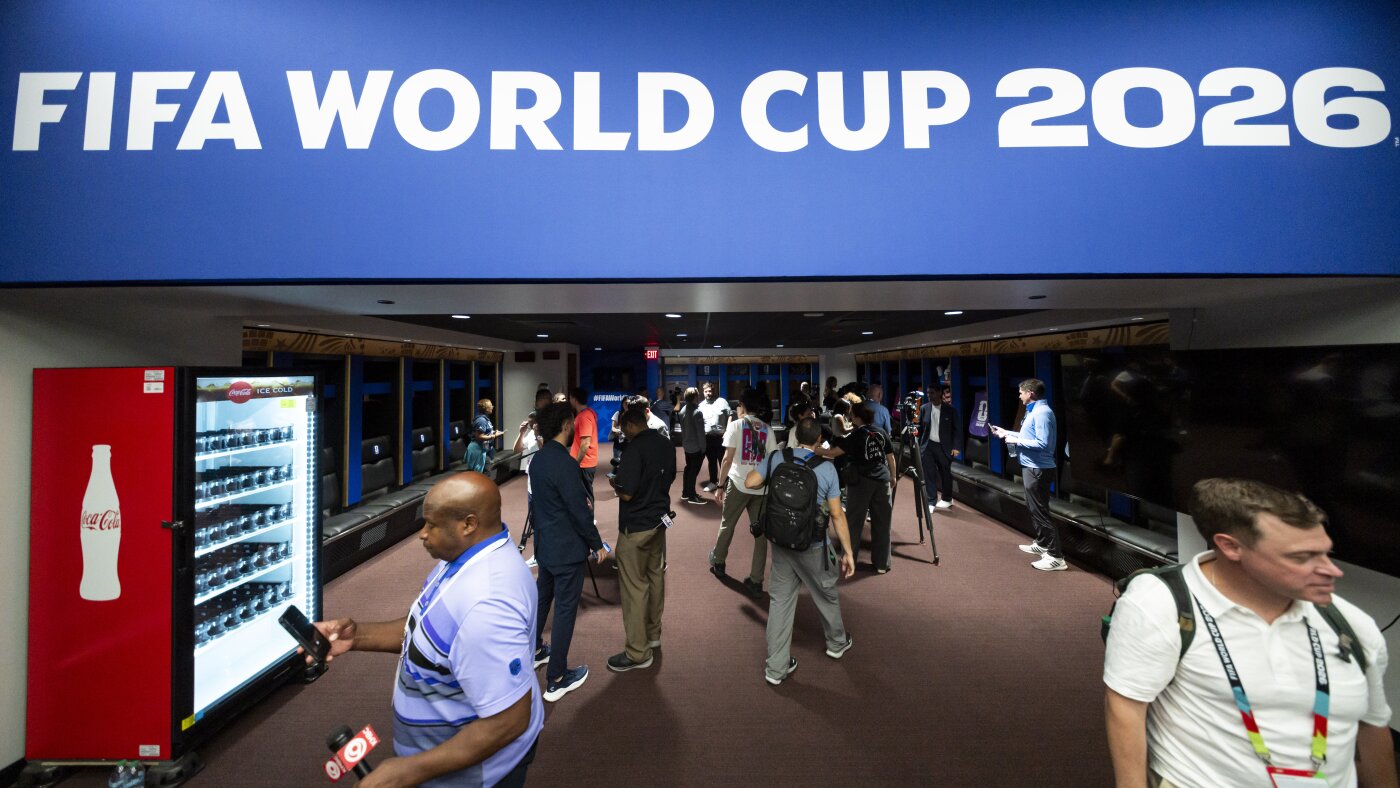
Media members tour the locker rooms at Kansas City Stadium ahead of the FIFA World Cup 2026 on June 8 in Kansas City, Mo.

Jay Biggerstaff/Getty Images


hide caption

toggle caption

Advertisement

Jay Biggerstaff/Getty Images

President Trump’s restrictive immigration policies are already impacting this year’s 2026 FIFA World Cup.

At least one referee from Somalia and one Iraqi team staff member were denied entry at U.S. airports in recent days, and dozens of fans from countries such as Morocco have been denied travel visas, despite being ticket holders.

“I view the 2026 World Cup as a massive paradox,” said Jules Boykoff, a professor and the author of Red Card: The 2026 World Cup, Sportswashing and the FIFA Greed Machine. “On one hand, it has more teams than ever participating. On the other hand, because of the policies of the Trump administration, it looks more like a World Cup of exclusion than inclusion.”

Advertisement

Boykoff, who is also a former professional soccer player, told NPR he worries the restrictive immigration policies also will shape the experience of fans in the U.S., who might be anxious about potential tense interactions with immigration agents outside of stadiums.

Boykoff’s concerns echo those of other policy experts and soccer fans who for months have warned about the influence of President Trump’s immigration policies on the tournament.

The White House did not respond to NPR’s request for comment.

In a statement to NPR, Customs and Border Protection said “all travelers seeking entry into the United States, including athletes, coaches, and staff, are subject to CBP inspection and vetting.”

The agency said “admissibility determinations are made on a case-by-case basis using law enforcement, national security, and immigration information available at the time of inspection.”

Advertisement

Denied entry to the U.S.

There are 39 countries who are under either a full or partial U.S. travel ban. For 19 of those countries, the State Department has suspended issuing all visas. The Trump administration has said the move is to “ensure that individuals approved for a visa do not endanger national security or public safety.”

Four countries in those lists — Iran, Haiti, Côte d’Ivoire, and Senegal — are expected to play in the World Cup.

On Saturday, decorated FIFA World Cup referee Omar Abdulkadir Artan, of Somalia, was denied entry to the U.S. after landing at the Miami International Airport.

In a statement, CBP said Artan was “determined to be inadmissible due to vetting concerns and was denied entry.” CBP did not say what concerns were.

Andrew Giuliani, the executive director of the White House Task Force for the World Cup, said Tuesday the denial was “for very good reasons,” but he didn’t provide any further explanation.

Advertisement

Artan did not respond to NPR’s request for comment.

Meanwhile, a player for Team Iraq was questioned for hours at Chicago O’Hare International Airport. He was allowed into the U.S., but a photographer for the team was denied entry due to “vetting concerns,” CBP said.

David Niven, a University of Cincinnati professor who teaches a course on sports and politics, told NPR these immigration issues are a self-inflicted wound.

“When you insert politics into the competition, it’s no longer the competition it was,” Niven said. “In some ways (it’s) very tangibly when a referee is missing or a player is delayed.”

The team from Iran — a country at war with the U.S. and Israel — was forced to relocate its lodging to Mexico after the U.S. government said players and staff were banned from staying overnight.

Advertisement

Visas for team members were approved last week, but more than a dozen support staff did not get approval, including Mehdi Taj, the president of the Iranian football federation.

In response to a social media post by U.S. Ambassador to Turkey Tom Barrack, the Iranian Embassy in Turkey said the U.S.’s conduct “violates FIFA regulations and breaches the United States’ host obligations.”

The Iranians also accused the U.S. of “politically biased interference in sport.”

“The U.S. government in practice is depriving Iran’s national team of its right to play in the World Cup under normal conditions and without undue pressure and stress,” the post on X said.

Fans face travel restrictions

Fans come from all over the world to attend the World Cup and cheer on their teams. Their chants and songs add to the excitement and vibrancy of the games.

Advertisement

But some fans and policy experts worry this year’s tournament may lose some of that exuberance because of U.S. visa denials.

According to the Moroccan news website Hespress, more than 40 members of multiple Moroccan football team supporter associations have been denied visas to attend the tournament. Many had tickets to the games and hotel bookings.

Gianni Infantino, FIFA’s president, in 2025 pushed against what he called “misconceptions” and said “everyone will be welcome in Canada, Mexico and the United States for the FIFA World Cup next year,” and that the U.S. was committed to a smooth travel process, so fans from all over the world will be welcome.”

But in response to Artan being denied entry to the U.S., a spokesperson for FIFA distanced the organization from the immigration issues. “FIFA is not involved in host country immigration processes, including visa adjudications, and has been informed by authorities that Mr. Artan’s status will not be changed at present,” FIFA said in a statement to NPR. “In line with previous FIFA events, a host government ultimately determines who receives a visa and who is admitted into their country.

Niven called FIFA’s new position “striking.”

Advertisement

“FIFA has raised the surrender flag on this question,” Niven said. “They’ve taken this situation and basically deferred to the United States and said the United States can do as they see fit.”

Continue Reading

News

Maine’s Senate race and much more. Here are the primary contests to watch today

Published

on

Maine’s Senate race and much more. Here are the primary contests to watch today

Voting stickers are displayed on a table at a polling place inside City Hall, Tuesday, Nov. 5, 2024, in Las Vegas.

John Locher/AP Photo


hide caption

toggle caption

Advertisement

John Locher/AP Photo

Today’s primary contests stretch from Maine to North Dakota, South Carolina and Nevada, where voters will decide on races for the U.S. Senate, House, governor and more.

A lot is riding on the Senate race in Maine, where political newcomer Graham Platner, facing a series of controversies, is the presumptive Democratic nominee to take on Republican Sen. Susan Collins, who has had the job for 30 years.

Another Republican incumbent, Nevada’s Gov. Joe Lombardo, is facing a tough challenge in November.

Advertisement

And in a field of MAGA-devoted Republicans in South Carolina, Lt. Gov. Pamela Evette was the one to grab President Trump’s endorsement in the race for governor.

Here, reporters from the NPR network tell us about the key races to watch.

Maine U.S. Senate seat | Maine’s 2nd Congressional District | Maine governor | Nevada governor | South Carolina governor

You can also check out voter resources for the June 9 primaries from the NPR network.

Maine’s primary winners will set up crucial November races

Kevin Miller and Steve Mistler, Maine Public 

Advertisement

Maine’s U.S. Senate seat

If Democrats want control of the U.S. come November, they almost certainly need to take five-term Republican Sen. Collins’ seat in Maine.

The outcome of the pivotal race could hinge on whether voters value Collins’ clout and ability to secure federal dollars over Democratic insurgent Platner’s call to upend a political system he says is rigged against working-class Americans.

The first-time Democratic candidate has so far run a barnstorming campaign that’s already pushed his Democratic rival, Gov. Janet Mills, out of the race.

After recent accusations published by The New York Times that he was physically threatening in a past relationship, and previous revelations that he sexted with several women early in his marriage, some are wondering if he still has enough support to flip the seat in November. In an interview with Maine Public, Platner denied the accusations.

Maine’s 2nd Congressional District

In a district that has voted for Trump three times, four Democrats are vying to replace retiring Democratic Rep. Jared Golden. Whoever wins the primary will face former Republican Gov. Paul LePage in the fall.

Advertisement

The Democratic nominee in this congressional district will offer a sense of what kind of candidates primary voters think can succeed in hard-to-win seats.

Maine’s governor

The race to replace term-limited Democratic Gov. Janet Mills is likely to go to a Democrat, according to an analysis by the Cook Political Report, but it’s still a question of who. There is a five-way Democratic race for the nomination, seven active candidates on the GOP side and both races have the potential to go to a ranked-choice runoff.

The affordable housing crisis, rising property taxes, access to health care and standing up to President Donald Trump have emerged as central themes in the primary contest.

Recent polls show former Maine CDC Director Dr. Nirav Shah in the lead, though former Maine Senate President Troy Jackson appears to be surging in popularity ahead of the ranked-choice primary election.

The presumptive frontrunner in the GOP contest is Bobby Charles, an attorney and former Navy intelligence officer.

Advertisement

In November, State Sen. Rick Bennett will also be on the ballot running as an independent.

Nevada’s GOP governor faces a tough November

Paul Boger, Nevada Public Radio

Trump’s economic policies are so unpopular in Nevada that the incumbent governor, Republican Joe Lombardo, is facing what could be a tough November election. Cook rates the race as a toss-up, and the candidate who may have the best shot against Lombardo, former Clark County Sheriff, is the state’s top cop, Democratic Attorney General Aaron Ford.

With a sizeable war chest, Lombardo should sail through the primary. Still, it may not be enough in November to assuage Nevadans worried about increasing costs in a tourism-based economy that is welcoming fewer domestic and international visitors every month.

Ford’s path to the Democratic nomination isn’t guaranteed. He’s drawn criticism from Republicans for his extensive domestic and international travel as attorney general. And from his main Democratic opponent in the primary, Washoe County Commissioner Alexis Hill, for Ford’s support of data centers, which are an existential concern in the country’s driest state.

Advertisement

The governor’s race in South Carolina tests Trump’s endorsement power

Gavin Jackson, South Carolina Public Radio

The crowded race for governor in South Carolina doesn’t have a clear frontrunner, even though the president has endorsed Republican Lt. Gov. Pamela Evette, a longtime supporter of his, in Tuesday’s primary.

Evette’s biggest challenger is another Trump enthusiast, four-term Attorney General Alan Wilson. Congresswoman Nancy Mace, who claims her vote for more transparency of the Epstein files cost her Trump’s endorsement, is also on the ballot. The race is widely expected to go to a runoff.

Three Democrats are vying for their party’s nomination: Columbia state Rep. Jermaine Johnson, Charleston lawyer Mullins McLeod and Greenville businessman Billy Webster.

After Trump lost his first primary endorsement race last week in Iowa, political watchers are sure to have a close eye on how votes shake out in South Carolina.

Advertisement

Voter resources for the June 9 primaries from the NPR Network

Maine | Nevada | North Dakota | South Carolina

Continue Reading
Advertisement

Trending