Lifestyle
Modern death cafes are very much alive in L.A. Inside the radical movement

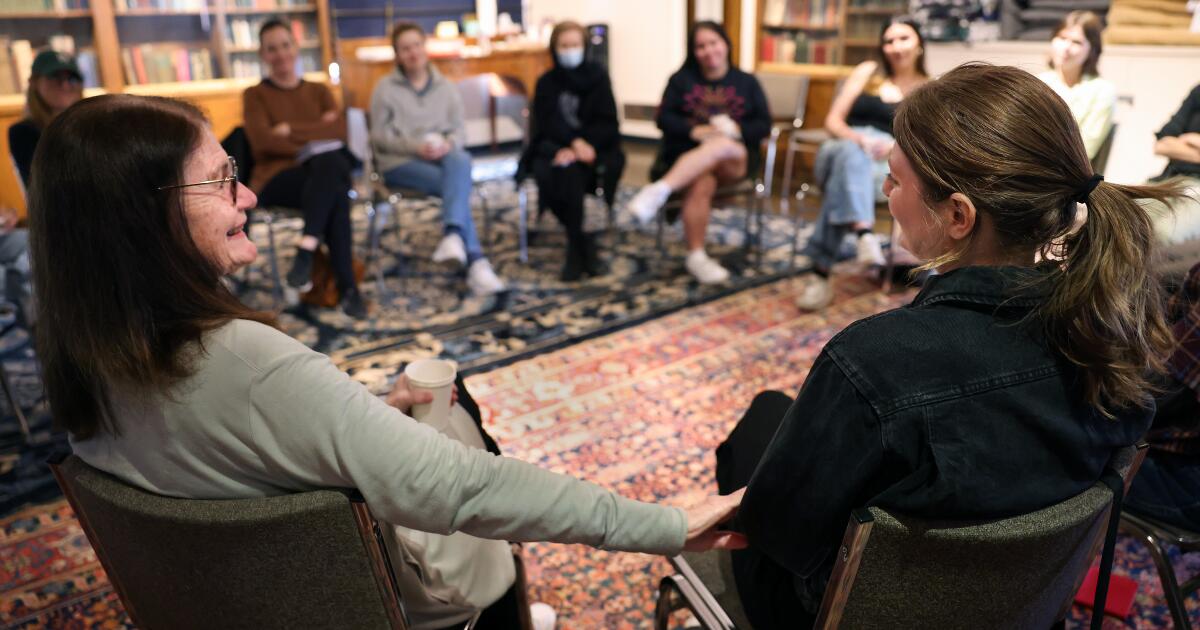
In a second-story room in Los Feliz’s Philosophical Research Society, about a dozen people sit in a circle. Many of them are here for the first time and not entirely sure what to expect. The sandwich board sign in the courtyard below offers only a cryptic hint: “Welcome! Death cafe meeting upstairs.”
As the group settles in on this Thursday afternoon in May, organizer Elizabeth Gill Lui lays out the only two directives: “have tea and cake, and talk about death.”
Lui, a 73-year-old artist who wears chunky jewelry and bold glasses, starts by reading a passage from the musician Nick Cave’s recent memoir. It’s about how, in the face of staggering grief, speaking and listening can be a form of healing — which is ultimately what Lui hopes will transpire over the next couple of hours, in this room decorated with patterned carpets and tall bookcases.
“The tradition in Southern California has long been about the journey. Making the most of the journey creatively, playfully, intellectually. That’s what I also like about the death cafe.”
— Elizabeth Lui, artist and organizer of a twice-monthly death cafe at the Philosophical Research Society
To initiate the exchange, she instructs the group to “go around in a circle and say what brought you to death cafe.” It’s a simple enough question, but one that elicits complex, deeply personal responses. Some attendees say they’ve come because they’re struggling with how to care for aging parents, or because they lost a loved one during the pandemic. Others have recently been through a life transition — a move back home, a college graduation, recovery from an illness. Or they’re wrestling with anxieties about their mortality. No matter the reason, everyone seems to be seeking some form of comfort, connection and community.
Reading material suggested by Elizabeth Lui, who hosted a death cafe at the Philosophical Research Society.
“The tradition in Southern California has long been about the journey. Making the most of the journey creatively, playfully, intellectually,” Lui tells me in the Philosophical Research Society’s regal library. “That’s what I also like about the death cafe. It has this edge of humor to it. If you’re at a dinner party and it’s boring, you can just say, ‘Have I told you about the death cafe I go to?’ and everybody just laughs. It’s such a great entree to the conversation.”
Lui’s twice-monthly gathering is one of several death cafes that have sprung up over the past two years in Los Angeles. Heavy Manners Library, an art space and lending library specializing in independent books and zines, holds one every other month. Its organizer, Emily Yacina, has made a habit of bringing donuts for the mostly 20- and-30-something tattooed crowd. Artist Ailene deVries held a death cafe in April at Gorky, an Eastside feminist collective that hosts workshops and pop-up events. North Figueroa Bookshop in Highland Park announced its first death cafe last summer, led by death doula Hazel Angell. A collaged flier for the meeting showed a skeleton hand clutching a butterfly above a succinct description written in gothic font: “A group discussion of death with no agenda, objectives or themes.”
The agenda-less ethos of the death cafe was developed in 2011 by Jon Underwood. The then 38-year-old Buddhist student and former government worker is widely credited for hosting the first modern death cafe at his home in East London. He was inspired to organize it after reading about Swiss “cafe mortels,” gatherings designed by the late sociologist Bernard Crettaz in 2004 to break the stigma around talking about death.
Underwood died unexpectedly in 2017 due to complications from leukemia, but the movement he kickstarted remains very much alive. A website maintained by Underwood’s mother and sister includes a how-to guide for those looking to start their own death cafe, and a directory that lists more than 18,000 death cafes around the world.
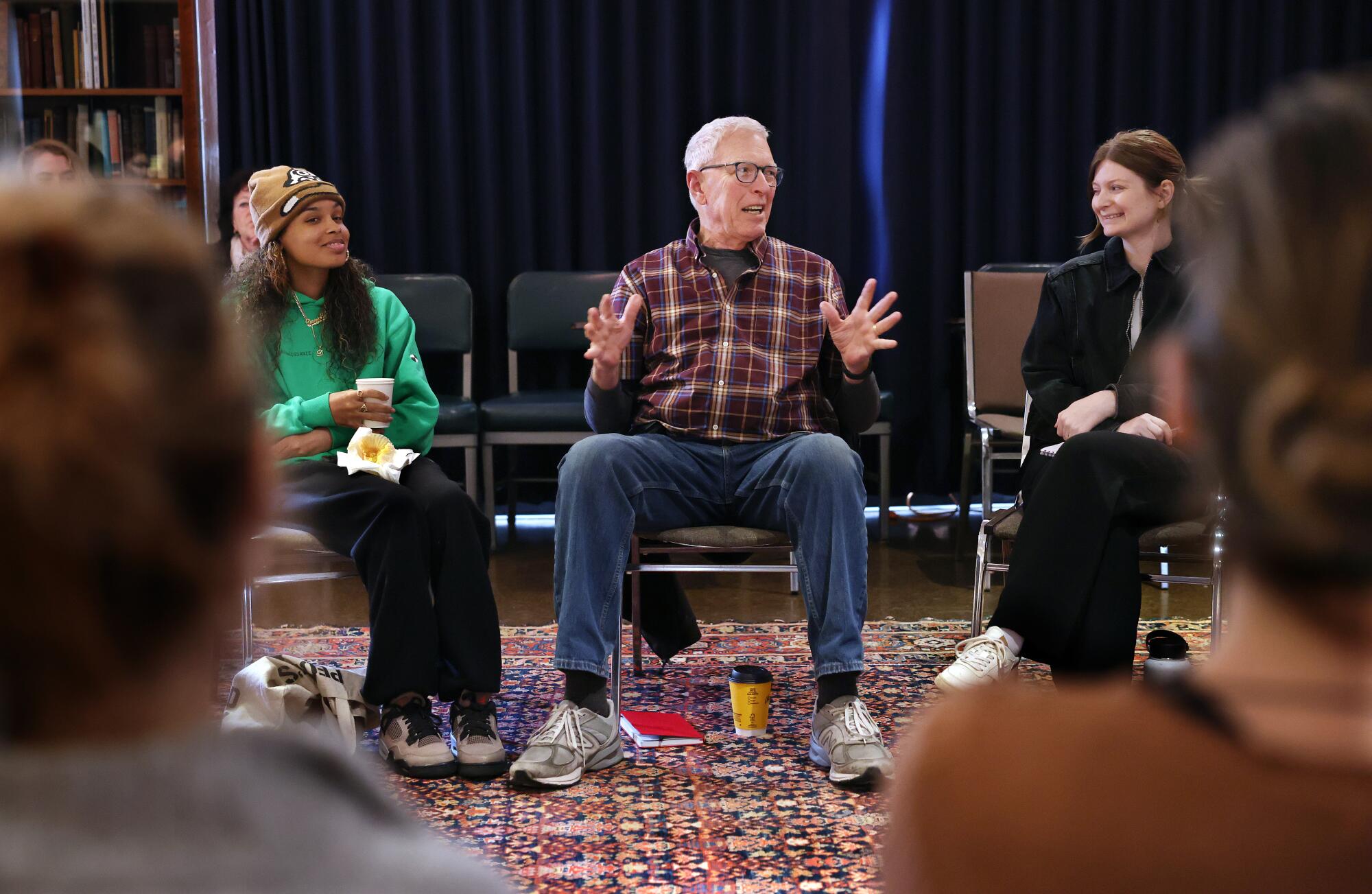
Greg Golden, 73, center, shares his experience beside fellow death cafe participants Danielle Tyas, 23, left, and Haley Twist, 32, right, at the Philosophical Research Society.
Megan Mooney, a clinical and medical social worker who serves as a volunteer spokesperson for Underwood’s umbrella organization, says she’s seen an increase in death cafe listings since 2020.
“COVID really made people have to face their own mortality,” she said in a Facebook message. “There was no escaping it …There was a huge demand for people wanting to talk about death for the first time.”
That was certainly true for Lui, who says the “pervasiveness of death” during the first couple years of the pandemic led her to get certified as an end-of-life doula in March 2022.
“I really was alarmed by the fact that we couldn’t form a consensus on how to deal with the pandemic and deal with the widespread phenomenon of this many deaths,” she said. “I don’t think the seriousness of it was something that we were even able to grasp because we avoid this topic at all costs.”
Though Lui’s death cafe may be the most frequently held one in Los Angeles, it’s not the county’s first. Hospice social worker Betsy Trapasso claims that distinction, after having launched a death cafe from her home in Topanga Canyon in 2013.
“It’s not a support group. It’s not a grief group,” Trapasso told The Times that year. “My whole thing is to get people talking about [death] so they’re not afraid when the time comes.”
During the event, Trapasso asked the group of aging professionals to inhale some lavender oil to relax at the start of the session. (Though she no longer hosts a death cafe, she maintains a Facebook page where she posts articles and events related to aging, grief and end-of-life care.)
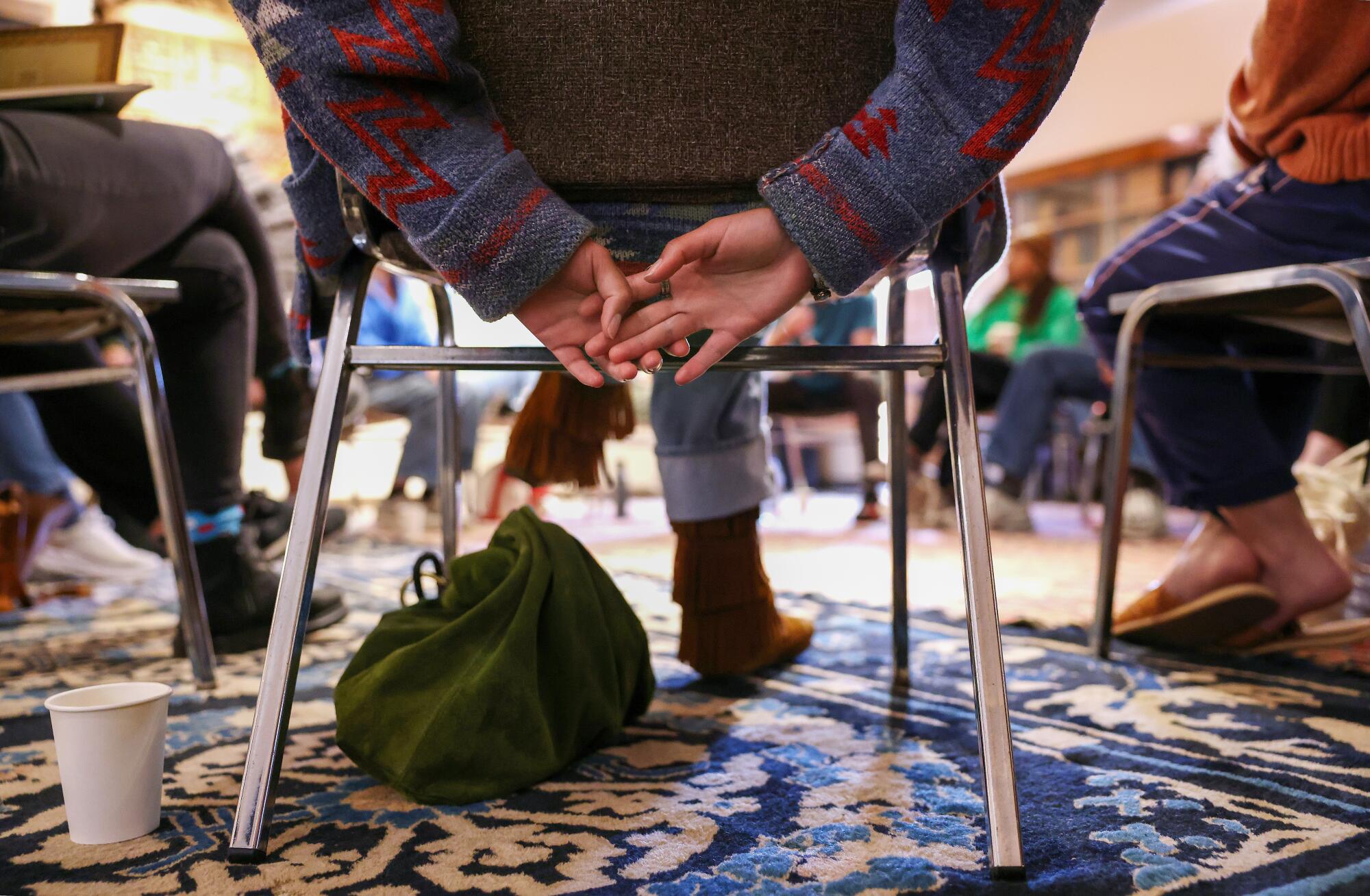
Participants sit in a circle at the death cafe.
More than a decade later, there are no bongos or essential oils at L.A.’s latest wave of death cafes and, most noticeably, their attendees skew younger. At the Thursday and Saturday sessions I attended at the Philosophical Research Society, most people were in their 20s, 30s and early 40s. At Heavy Manners Library on a Tuesday night, the group would not have looked out of place at a music show at the Echoplex down the street.
Lui sees the attendance of the millennials and zoomers at her death cafes as evidence of an unfortunate reality: that younger generations are experiencing the loss of loved ones. Some of them have cited suicide, alcoholism and drug overdoses as the cause.
“Young people are being exposed to friends dying, and more often than I think people realize,” she said.
Yacina, who leads the death cafe at Heavy Manners Library, is one of them. The 28-year-old indie rock musician says a good friend of hers died during her sophomore year of college, and she found the experience isolating, profound and “identity-forming.” Then, in 2021, she mourned the death of yet another friend, whom she later wrote a song about. Yacina said she realized “there’s no escape to people dying, and in fact, it’s actually the one true thing that we all can count on.” It led her to wonder: “Why don’t we talk about it more?”
Upcoming L.A. death cafes
She organized the Echo Park death cafe in June 2022, just a few months before Lui started one in Los Feliz. Like Lui, Yacina had recently gotten certified as an end-of-life doula, and the pandemic had planted the idea of death more firmly in her consciousness. In a phone interview, she recalled worrying that she could lose her parents to COVID-19.
“It was such a scary feeling, but the truth is, you could lose anyone at any time,” she said.
It’s a truth that deVries, the 27-year-old artist who recently held a death cafe at Gorky and plans to hold another in Long Beach this summer, had to learn the hard way.
“When I was 18, my partner just suddenly passed in a very traumatic way, so I wasn’t really sure where to put the conversation,” she said. “I think the death cafe was the first time that I felt I had a container to express my interest.”
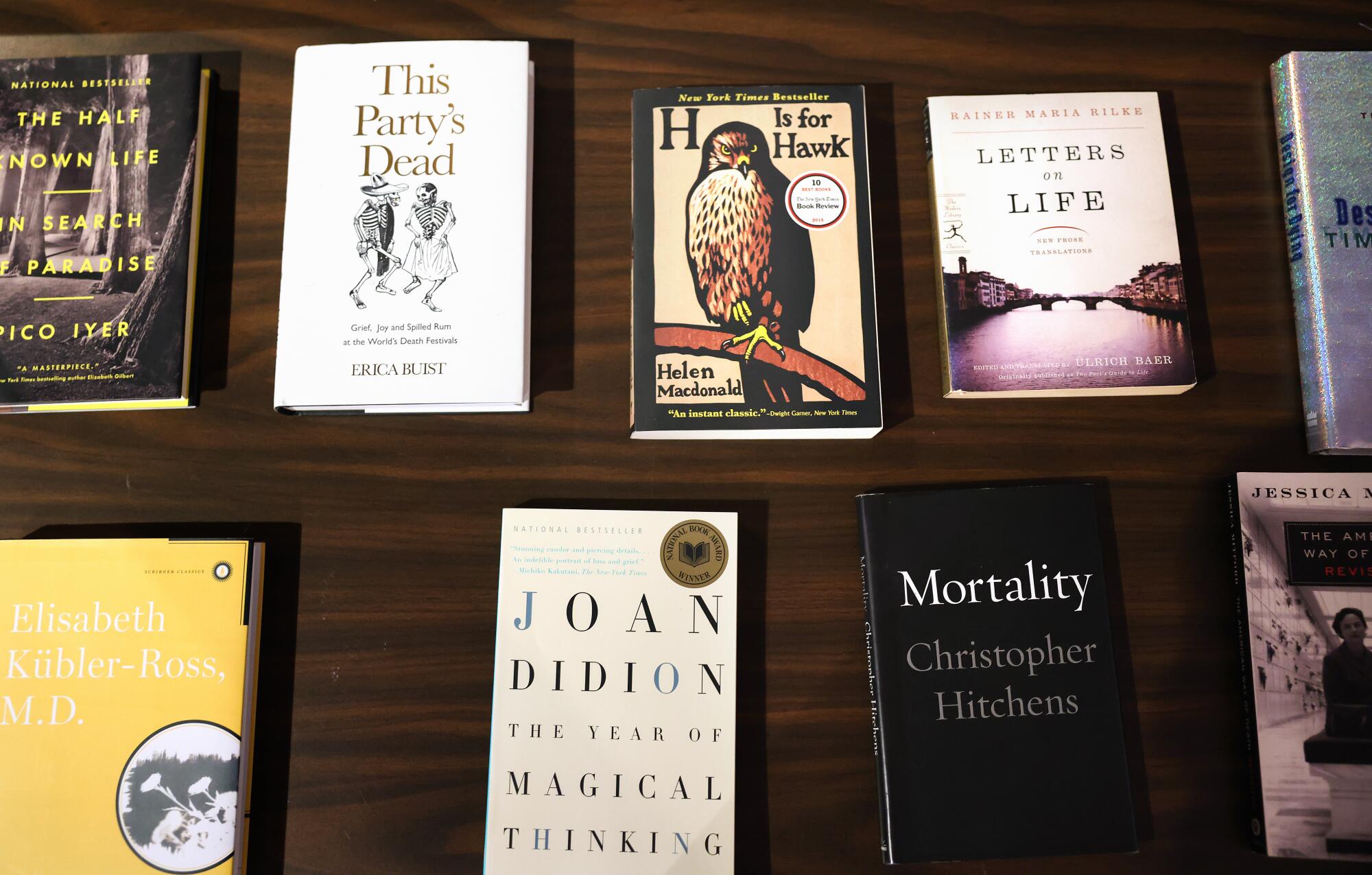
Reading material suggested by Elizabeth Lui.
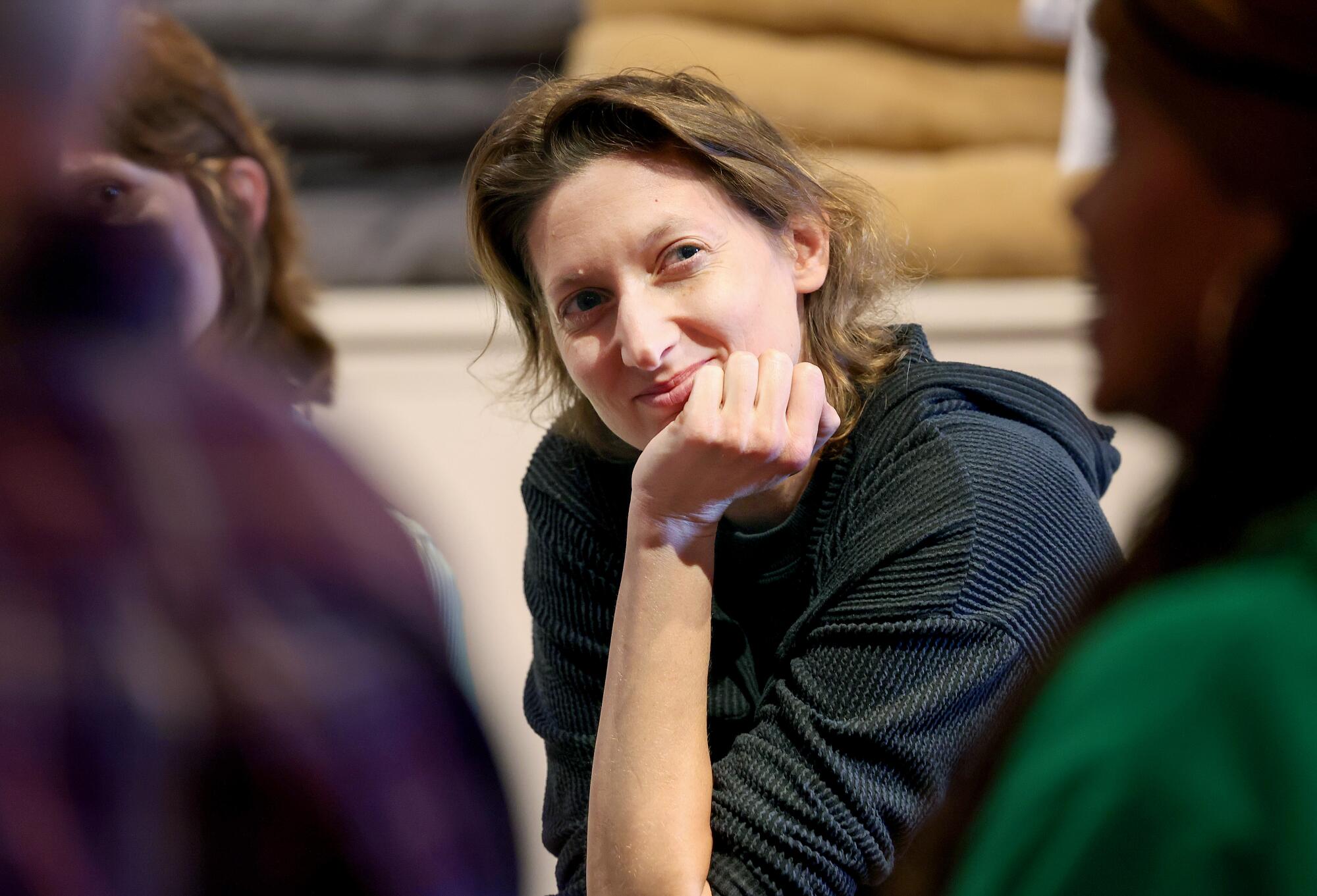
Sara Alessandrini, 35, listens closely as another participant shares during the death cafe.
Not everyone who attends these events has experienced a death in their family or community. Some attendees instead see death as a potent metaphor for life’s big changes and all the grief that comes along with them.
“It also helped me with living life in the moment and letting go of certain things,” said Sara Alessandrini, a 35-year-old filmmaker who attends Lui’s death cafe at the Philosophical Research Society.
When it’s her turn to share her reason for coming to the Thursday afternoon group, Alessandrini announces to the group that she wants to reflect not on the death of a person, but of her childhood. She talks about boundaries and healing. It prompts others to chime in, openly sharing stories about their upbringings. When the conversation comes to a pause, Lui offers some warm advice to Alessandrini: “I think you need to protect yourself even better than you think you’re protecting yourself.”
Lui often takes on a maternal role in the group. During one of my visits, she asks for an attendee’s phone number so she can text them a message of support on a day they say they’re dreading. At a separate session, she gets up from her chair to console someone in emotional distress. After the meetings, she emails death-themed book and movie recommendations to newcomers, who often comprise the majority of attendees. Timothy Leary’s “Design for Dying,” the Oscar-winning Japanese drama “Departures,” and the Sundance-winning documentary “How to Die in Oregon,” are all on her list.
Since many of her attendees are artists themselves, she sends out invites to their events, which often intersect with ideas about death. Recent examples include an online radio program featuring songs for funerals and a solo show about grief debuting at the Hollywood Fringe festival this month.
Lui sometimes signs her emails: “Hope to see you when it fits.” She wants attendees to know there’s no obligation to return to her death cafe. Even still, the group can sometimes get large and unwieldy. At one recent death cafe, Lui recalled, there were 30 people, “and that was a little too much.”
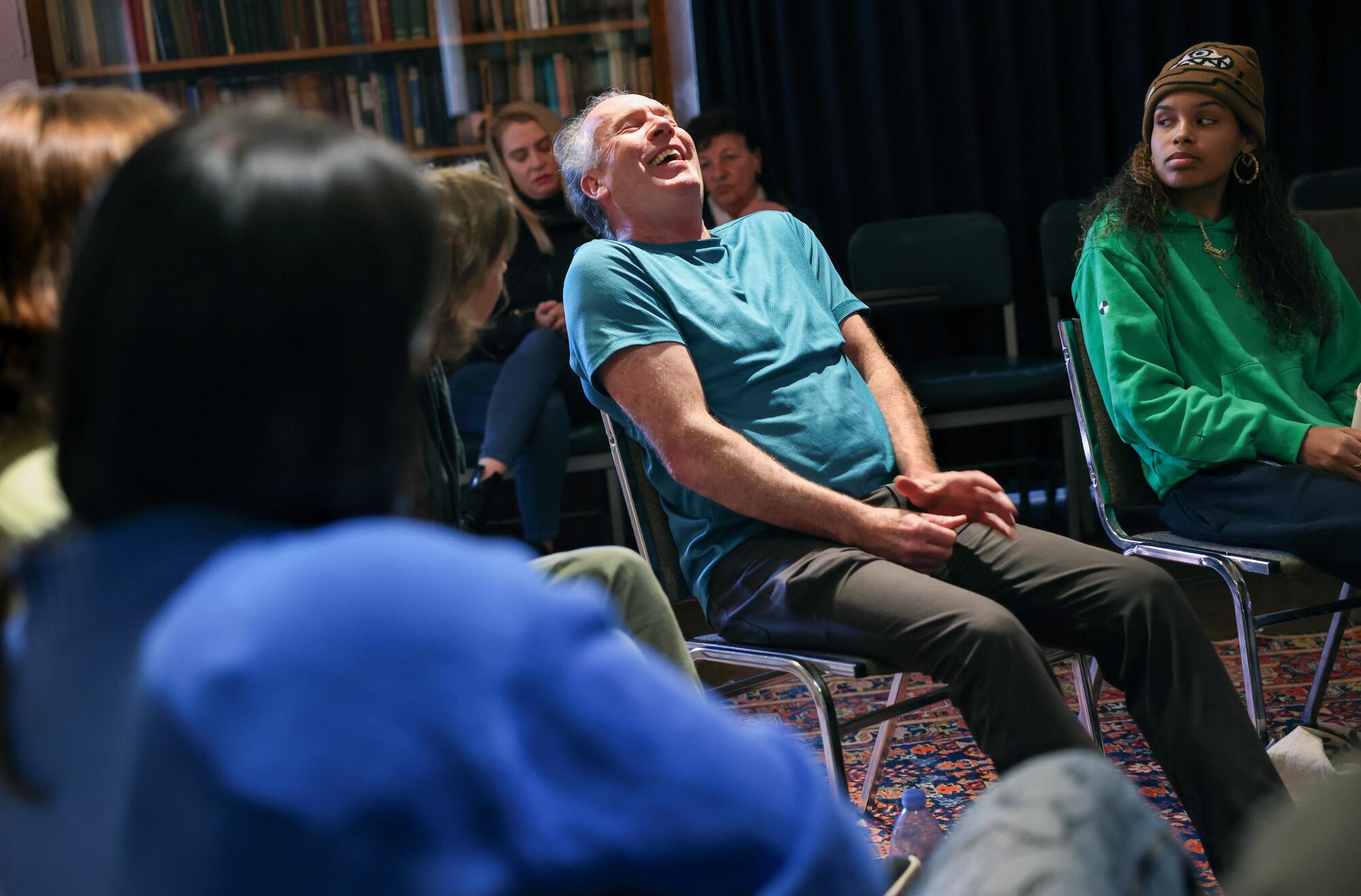
Michael Allison, 62, laughs a little while sharing with the group of participants in the death cafe.
The death cafe can sometimes feel like group therapy. But Lui makes no claims of being a therapist. “I think in a good way, we’re not therapists,” she told me. “Because we’re not just nodding and listening and letting them figure out their own truth. We actually have some ideas about where you find meaning in your life.”
At the Thursday afternoon death cafe at the Philosophical Research Society, everyone has so much to say that the conversation stretches for hours. Toward the end, it becomes loose and playful, resembling a late-night heart-to-heart. Between bouts of tears and laughter, someone asks: Do you think you know that you’re dead after you’ve died? Another poses a question: Is it just me, or has anyone else ever wondered if your dead parent can see you when you’re having sex? The room giggles, and it reminds one attendee to share her own story about her deceased mother.
At some point, Lui asks whether anyone knows the time. It’s 6 p.m. — meaning the death cafe has stretched on for four hours, twice as long as scheduled. Lui frantically apologizes, but nobody seems to mind. They hang around, talking and eating cupcakes.
“Maybe we need a weekend retreat or something?” Lui suggests. But even a few days wouldn’t be enough to contain everyone’s questions about one of life’s greatest mysteries. For now, her cafe will have to suffice.


Laverne Cox says that even from a young age, there was “always music in my head.” Her new memoir is called Transcendent. She’s shown above in New York in April 2026.
Dimitrios Kambouris/Getty Images
hide caption
toggle caption
Dimitrios Kambouris/Getty Images
For more than a decade, Laverne Cox has been one of the most visible trans women in America. But the Orange Is the New Black star says she spent most of her childhood in Mobile, Ala., keeping herself hidden.
A turning point came when she was in third grade, on a church field trip to Six Flags. She bought a paper fan to cool herself, and caught the attention of her teacher.
“I was having a Scarlett O’Hara moment, fanning myself,” Cox says. “And then later that day, my mother comes in and tells me she had gotten a call from the school … and [my teacher] said that I would end up in New Orleans wearing a dress if we didn’t get me into therapy right away.”

When she was 8 or 9, Cox was sent to conversion therapy, where, she says, a therapist suggested injecting her with testosterone. “The idea was that that was supposed to make me more masculine,” she says. “My mother, thank God, said no to that.” But Cox knew she needed to leave Mobile.
In her new memoir, Transcendent, Cox writes about her journey from Mobile to show business. She remembers being bullied mercilessly by other children at school — a situation made worse by her mother’s reaction: “My mother … instead of having an impulse to protect me or care for me or ask if I was OK, she made it my fault,” she says.
In the 1990s, she moved to New York City and began auditioning for roles, first as a dancer and then as an actor. She also started experimenting with gender norms; she began her medical transition in 1998, at the age of 26.

For Cox, writing her memoir is an act of resistance and healing: “After 2023, it became very clear to me that we, that trans people had lost the culture,” she says. “I knew this was the beginning of a disaster in terms of policy. … The dehumanization was so clear to me, and so I think I also thought maybe one more human story out there can help.”
Interview highlights

On the anger she still feels about being bullied as a child
As an adult, I’m angry at the boys. I am angry at my mother. I want to protect that little child. I’m just so angry. I’m so hurt. … There’s also like the anger [about] all the kids that I’ve met who are trans or queer who are still experiencing this, and the anger of knowing that in states that have passed anti-trans laws that the percentage of bullying has skyrocketed in those states. … There’s the rhetorical piece that happens in the media that is dehumanizing and stigmatizing trans people. And it creates a permission structure. If, like your governor and your state legislators are doing [it], if your teachers and pundits on TV are doing it, then of course kids are emboldened to do it. And that makes me so angry.
On beginning to wear skirts and dresses in college
I had internalized so much transphobia. Like, ending up “in New Orleans wearing a dress” was presented to me as the absolute worst thing that could happen to me. In my young mind I imagined I would be on the street and I would be homeless and a person who needed to like do unfortunate things to survive. So it just was presented as something that was the absolute opposite of the straight A student that I was, the human being that I was, who was determined to be successful. So I didn’t wear skirts and dresses until college … but I did start wearing girls’ clothes that I would purchase from the thrift stores in Mobile and in Birmingham. And it was such a fun, wonderful exploration. … In high school I read about Oscar Wilde. He talked about creating yourself as a work of art, and I loved that as a concept.
On being drawn to show business

There was always music in my head, which is such a wonderful gift. From the second I was walking, I was dancing, and I danced everywhere. And it just took me away. … [It was] like a character. There was a person that I could play. So I was in a character and then I was in a new setting. And so all the times we would be at the supermarket in the grocery store, I just loved pushing the grocery cart and then dancing with the grocery cart as if it was like a partner. … Finally in third grade, I got to start studying dance. And that really, that was the best thing ever for me.
On growing up with a twin brother

There’s a closeness now. It’s healthier now than it’s ever been with my brother. But … we were not a touchy feely family. We weren’t a family that said, “I love you.” We weren’t a family that hugged. There was no affection. So my brother and I, so we didn’t do that. … But we bonded most around music, art. There were periods when I would be in dance class and he would come and watch and critique and he’d give me his notes.
On her twin brother playing her pre-transition character in Orange Is the New Black
It was my character’s back story. And the initial idea was that they needed to hire another actor to play me pre-transition. … [And I] asked my brother if he’d be open to it. And he said, “How much does it pay?” And then he ended up going in for the audition, but he had an advantage because he kind of looks a little bit like me. … So he booked it and did it and he had regrets about it for a while because he has his own work and his own life and he wants to be defined by his work and not mine.
Ann Marie Baldonado and Susan Nyakundi produced and edited this interview for broadcast. Bridget Bentz, Molly Seavy-Nesper and Beth Novey adapted it for the web.


For my 50th birthday, I bought a Toyota Corolla. Wait. Is my midlife crisis car really a Corolla, the best selling and most boring model of all time?
Well, yes. And no.
I have “modded” it, or in layman’s terms, modified the stock components and tuned the engine. This is not your aunt’s Corolla. When I hit the gas, the car pulls hard and the engine buzzes as if it’s powered by a hive of killer bees.
I get thumbs-ups from Mustang drivers and cool head nods from Challenger owners. My favorite is when kids at red lights ask me to rev the engine like I’m F1 driver Lewis Hamilton.
Probably a lot of my drive-by admirers are fans of the movie “The Fast and the Furious,” which was released 25 years ago this month. Fans of modified Japanese import cars, like me, have a love-hate relationship with the $7 billion “Fast and Furious” franchise. On one hand, the movies helped popularize modified Japanese cars. People all over the world fell in love with them and the import car culture they publicized.
On the other hand, the movies left out so, so much of the story.
In Southern California in the mid-1990s and early 2000s, people lived, for the most part, phone-free. The internet was nascent — a repository for flyers and ’zines — and most websites looked like Tetris.
The fashion was baggy everything for guys and short shorts, midriffs and little backpacks for girls. The hair was outrageous. And the cars, especially Japanese import cars, had reached the pinnacle of automotive engineering.
During this era, I was in college at UCLA. I saved up and bought a red 1989 Honda CRX Si. It also had a slick five-speed manual transmission, peppy engine and nimble steering. That car got me to work and through college, and from the mountains of California to the border of Oregon. It probably helped me get girlfriends. It consoled me through breakups. It helped me move to the San Francisco Bay Area for my first grown-up job.
And then, stupidly, I sold it, and all the precious memories it carried.
Now when I hit a loopy freeway interchange at night and my GR Corolla carves through the turns, it’s 1996 and I’m cruising in my CRX, getting pho in San Gabriel or rushing to a flyer party at Naga in Long Beach. That’s the magic of certain cars. A regular car takes you from place to place. A special car takes you back in time.
To be completely honest, I bought the CRX to fit in.
The ’90s import car scene was as diverse as Southern California. But there’s no doubt it started with Asian Americans (specifically Japanese Americans in the South Bay city of Gardena) who were influenced by modified car culture in Japan. Soon, Asian American kids all over the region were taking their inexpensive, underpowered four-cylinder, front-wheel-drive Honda Civics (our parents preferred Japanese reliability over American muscle) and turning them into street rockets.
Not only were they building race cars from scratch, they were also building one of my first experiences with a collective Asian American identity: one that wasn’t overtly about politics and activism, or immigration and assimilation. It was about Asian American joy. It was Chinese, Japanese, Korean, Filipino and Vietnamese Americans building cool-looking, fast cars. It was kids stereotyped as nerds going to parties where the awful stereotype of Long Duk Dong from “Sixteen Candles” was shredded into rubber and obliterated by exhaust blasts.
At the time, the Asian Americans we saw in the mainstream media were negligible or offensive, especially for Vietnamese Americans like me. But in import car culture, I saw, for maybe the first time, Asian guys and Asian girls in a centered and even glamorous light.
We made our own cars and our own car shows. We raced each other and then got fast (with turbos, superchargers and nitrous oxide) and raced others. And we won. We published our own magazines, built our own automotive businesses and, for good and bad, promoted our own outlaw street racer image and our own beauty standard. In those 1990s clubs and car shows, you could see and feel that Asian Americans weren’t assimilating culture. We were creating it.
“The Fast and the Furious” picked up on that. Based on a 1998 Vibe magazine article about street racing import cars in New York, the film was transplanted to Southern California. But it got so many details glaringly wrong. Its street races looked like street raves on major, four-wide roads packed with pedestrians. The races of our scene were clandestine, underground events in industrial, under-policed areas, where cars faced off two at a time.
But the most egregious and inexcusable Hollywood crime to me is that “The Fast and the Furious” whitewashed Asian Americans, the creators of this world, out of starring roles. The Korean American actor Rick Yune appears in the movie, sure — but he plays the villain, Johnny Tran, a guy who hates Vin Diesel’s Dominic Toretto for a crime deal gone bad (understandable) and for sleeping with his sister (ditto). Of course, in a tradition that goes back to “Madame Butterfly” and “Miss Saigon,” Tran dies at the end, shot dead by the blond-haired, blue-eyed hero, Paul Walker’s Brian O’Conner.
A few months ago, seeking a mechanic to mod my Corolla, I was referred to an auto shop in Garden Grove aka Little Saigon. The guy who sent me asked me, “Do you even know who’s working on your car?”
“No,” I replied.
He told me the name, and I Googled it.
Apparently, back in the ’90s, this Vietnamese American mechanic from Orange County had one of the fastest Honda Civics in the world. A true OG of the import car scene modified my car with his own hands. What an honor, and what a connection to the past.
This import car story ends in a full poetic justice circle. As a pioneer and legend of the real-life import car scene, my mechanic wasn’t the villain. He was the hero. He was the fastest, and his car was the most furious.
That’s the heart of my GR Corolla journey. Asian Americans created import car culture. We all deserve to be the hero of our own story.
Ky-Phong Tran is a Vietnamese American writer from Long Beach. He is a professional artist fellow with the Arts Council for Long Beach. This article was produced in partnership with Zócalo Public Square.

Buzz Lightyear (Tim Allen) and Woody (Tom Hanks) in Toy Story.
Pixar/Disney/Maximum Film/Alamy
hide caption
toggle caption
Pixar/Disney/Maximum Film/Alamy
Toy Story 5 just hit theaters, so it seemed like a good time to revisit our episode from last summer where we discussed YOUR picks for the greatest Pixar films of all time. Thousands of you voted, and we’ve got the results.
If you want to hear about other Pixar films we loved, listen to our episodes about:
Nature needs a little help in the inventive Pixar movie ‘Hoppers’
‘Turning Red’ paints teenage feelings in rich, vibrant colors
‘Inside Out 2’ is a Pixar sequel worth celebrating
Connect with Pop Culture Happy Hour:
Letterboxd / Facebook
Our weekly newsletter
Support Pop Culture Happy Hour+
-

 New York20 minutes ago
Video: Historic Brooklyn Church Destroyed in Fire
-

 Los Angeles, Ca25 minutes ago
2 killed in high-speed crash on Mulholland Highway
-

 Detroit, MI47 minutes ago
Man armed with gun shot by police in downtown Detroit ahead of fireworks show, police say
-

 San Francisco, CA53 minutes ago
San Francisco home with a history of squatters hits the market for $1.3 million
-

 Miami, FL1 hour ago
Miami Heat slip behind Boston Celtics in Giannis Antetokounmpo race
-

 Dallas, TX1 hour ago
1 Dallas Cowboys Training Camp Battle That Could Make Or Break 2026 Season
-

 Boston, MA1 hour ago
With Columbia Threadneedle out, Boston Triathlon director is looking for a new sponsor – The Boston Globe
-

 Denver, CO1 hour ago
Denver transfers $3 million from its contingency fund to pay out settlements

