The wait is almost over for former Arizona star freshmen Brayden Burries and Koa Peat. After leading the Wildcats to their first Final Four in 25 years, the duo are less than 48 hours away from achieving their dreams of joining the NBA.
Arizona
How Arizona's monsoon is changing

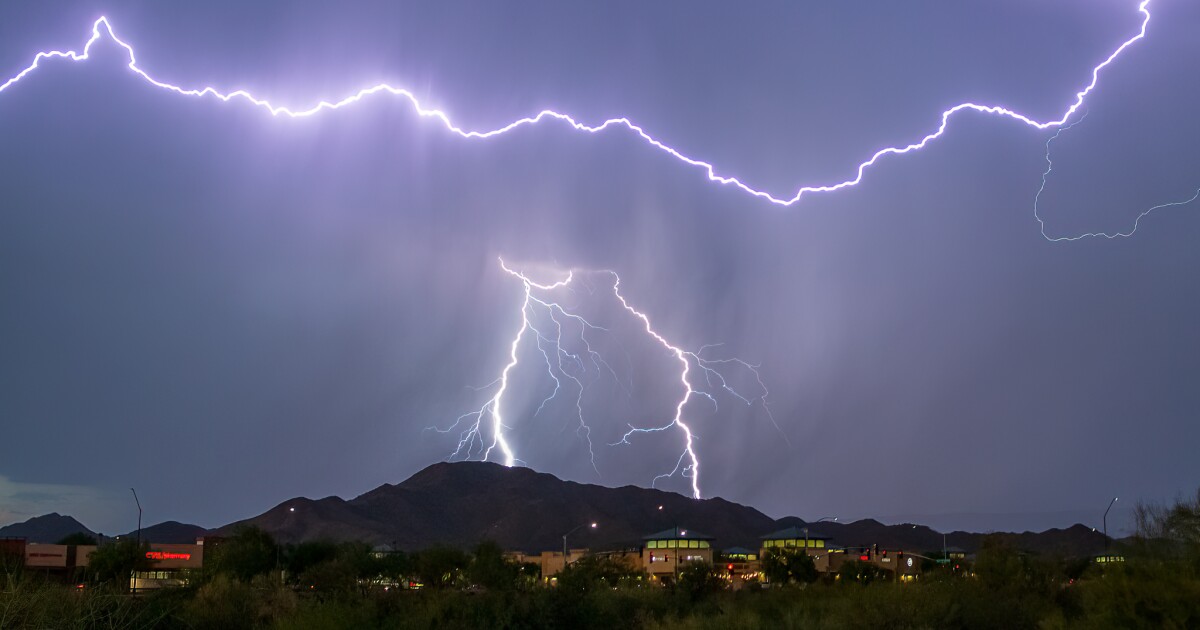
PHOENIX — Each summer, thunderstorms tower in our otherwise sunny Arizona sky. Winds shift out of the south and southeast, bringing moisture in all the way from the Gulf of Mexico. That moisture rises and forms thunderstorms in the heat of the day. This is our monsoon.
Much of Arizona typically receives 30 to 50 percent of its annual rainfall during the monsoon months of June, July, August, and September, which helps replenish our dry land and diminish wildfire threats.
UA
But, the monsoon as we know it is changing. As our atmosphere gets hotter with climate change, it’s able to essentially hold more water vapor and that’s altering how our monsoon behaves.
“We don’t get as many storms, but when they do come, they’re tending to produce higher rainfall amounts, more intense rainfall, and more intense winds,” says Dr. Christopher Castro with the Hydrology and Atmospheric Sciences Department at the University of Arizona.
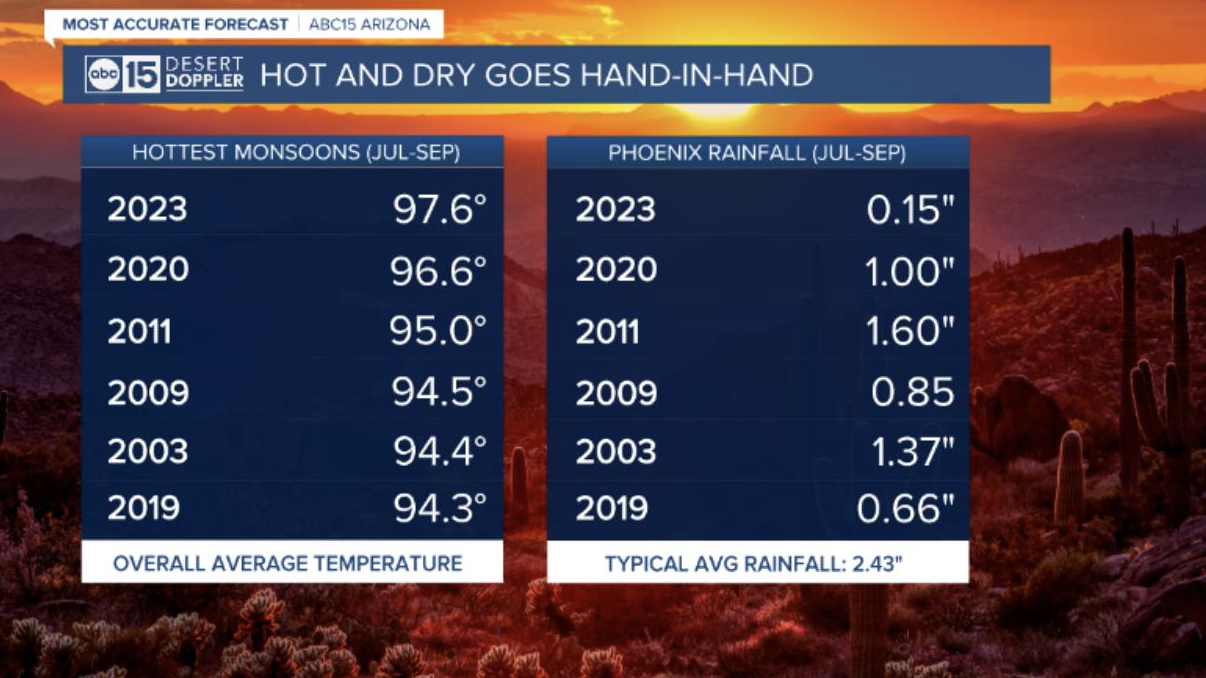
That’s exactly what we saw play out here in Phoenix last summer. It was our hottest and driest monsoon on record. Sky Harbor only received 0.15 inches of rain. That’s more than 2 inches below normal.
But, what is considered a “normal” amount of monsoon rain has changed a lot in the past 50 years.
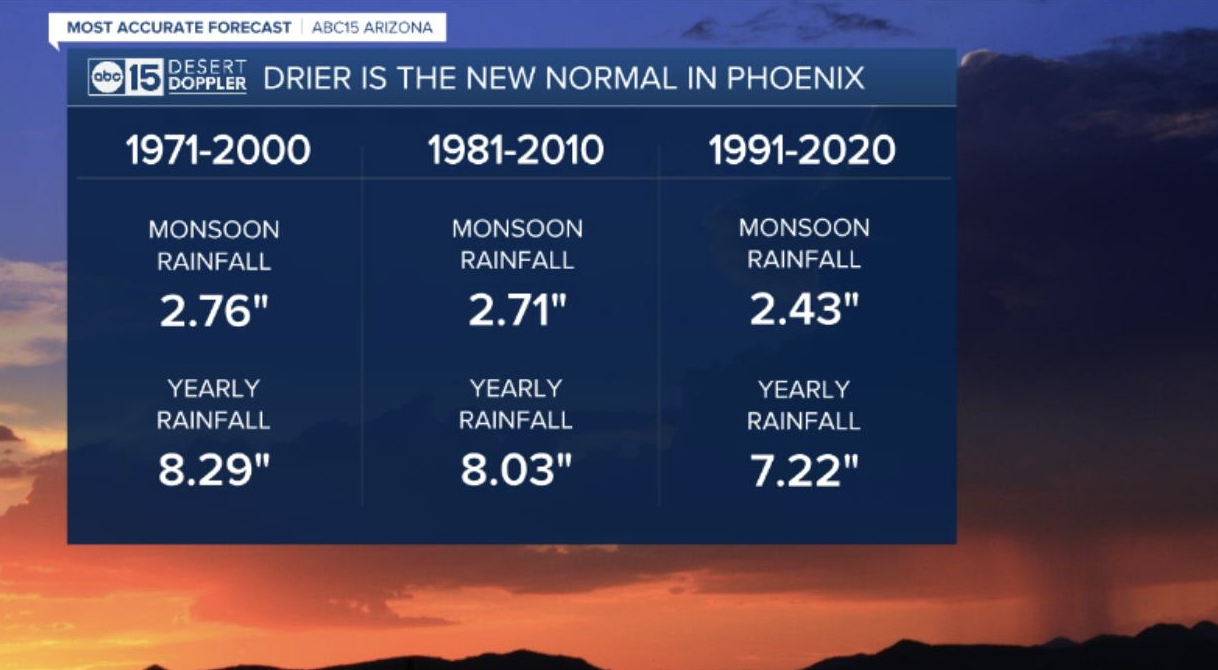
Every 10 years, new normals are calculated based on a rolling 30-year average. Our latest update came in 2021, giving us a new average that is based on rainfall data from 1991 to 2020.
This new normal showed an average rainfall in Phoenix for the monsoon season of 2.43 inches of rain. That’s more than a quarter of an inch drier than the previous average, which is a big difference here in the desert!
KNXV
Castro and his team at the University of Arizona are leading the way when it comes to research on how climate change is impacting our monsoon. Although not yet published in scientific peer-reviewed journals, they have run experiments simulating how storms move down into the Valley.
They have discovered that a greater number of green spaces, like parks, golf courses, and green landscaping, are leading to fewer storms making it down into the city.
“The presence of all these watered areas is suppressing the amount of instability in the atmosphere. So, it’s harder to initiate storms from the outflow boundaries,” he says.
So, as storms try to move down off of the Mogollon Rim, they are now often getting diverted around the periphery of the Phoenix metro instead of rolling right through it like they used to.
Scientists like Castro have also seen a broadening of our monsoon ridge, which is impacting our monsoon, too.
KNXV
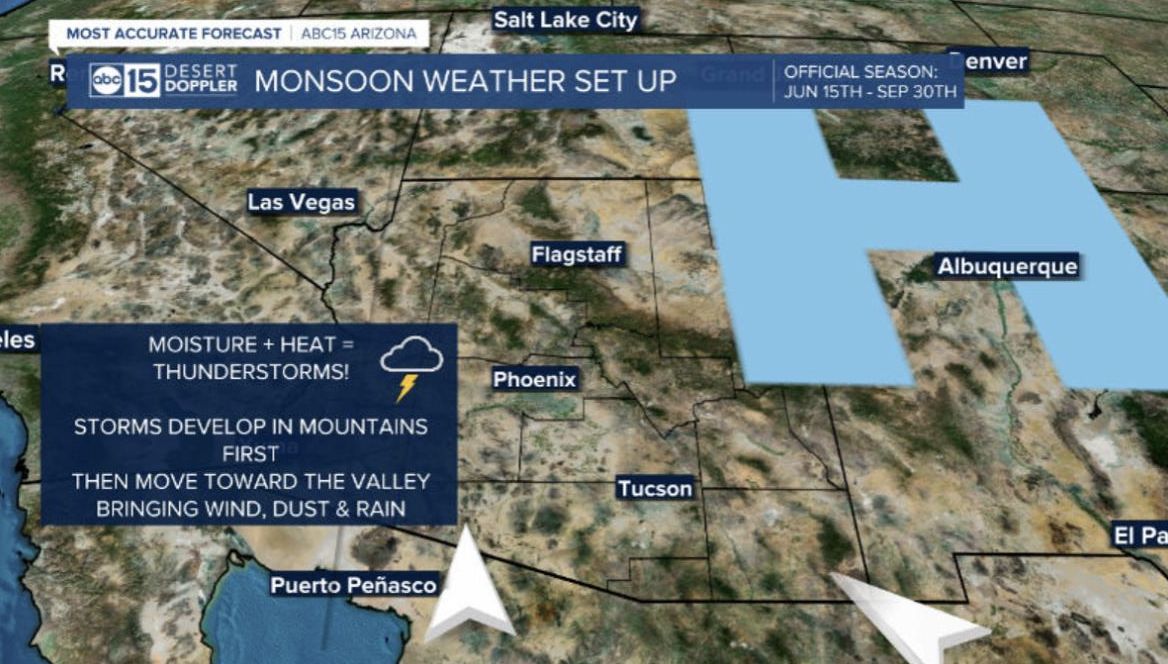
It’s the ridge of high pressure, which sets up near the Four Corners during the summer, that allows monsoon moisture to flow in.
“What we’ve observed in the last 20 years or so, is that the monsoon ridge is growing more intense and more spatially expansive. The bigger and more expansive that ridge is, the more propensity there is for the air to sink from the upper atmosphere. So. it suppresses the atmospheric instability and it makes storms harder to form,” Castro says.
That’s exactly what happened last year. As that ridge of high pressure sat over Arizona, it suppressed storm formation and made it much hotter. Our 2023 monsoon season was the hottest and driest on record in Phoenix.
KNXV
2020 was also a so-called “non-soon” with only 2 days of measurable rain in Phoenix. That year, we received 90% of our monsoon rain (0.90 inches) in just 2 hours with one particularly bad storm the night of August 20, 2020.
Castro says that’s the fingerprint of climate change in the desert.
“It’s really about the extremes. The monsoon is, generally all the way around, getting more extreme. So, when we get our heat waves now those are more intense than they used to be and when it rains, it may not rain as frequently as it used to, but it tends to be more intense,” Castro says.
That intensity makes it harder for us to adapt.
When it’s extreme heat, we see more heat-related deaths. We had 987 heat-related deaths across Arizona last year. 645 of those happened in Maricopa County, mostly during the hottest and driest monsoon on record.
When it’s extreme rainfall, we see more flash flooding and complete destruction near wildfire burn scars since the charred ground can no longer absorb water.
“From the water supply perspective, it’s bad news for recharge of the groundwater table. If you’re drying out the soils and then realizing your precipitation with only a few intense events, more of that precipitation is likely to run off. There’s also a greater danger for wildfires to happen and that totally changes the characteristics of the permeability of the soil. Then, when it rains, that water will immediately wash off very similar to a landslide,” Castro says.
A bigger, broader monsoon ridge also deflects atmospheric disturbances, known as inverted troughs, from tracking through Arizona.
Those disturbances often serve as triggers to get widespread rain and thunderstorm activity going during the monsoon.
“The expanded monsoon ridge is suppressing the path of those inverted troughs more to the south, so the number of inverted troughs is decreasing. So, the frequency of big precipitation events is decreasing. But when they do occur, they’re occurring in a more moist environment that is favorable for heavier amounts of precipitation,” says Castro.
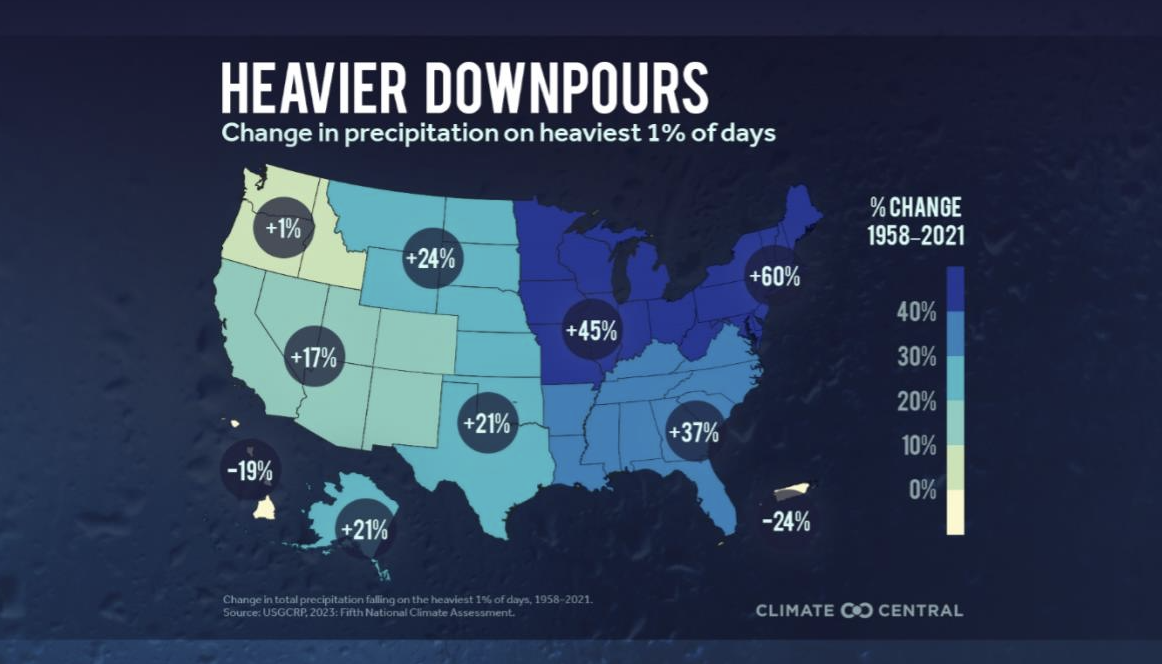
We’re seeing similar impacts across the country as the number of heavy downpours increases in this warming world.
KNXV
While downpours are increasing, periods of drought are increasing too.
Climate Central
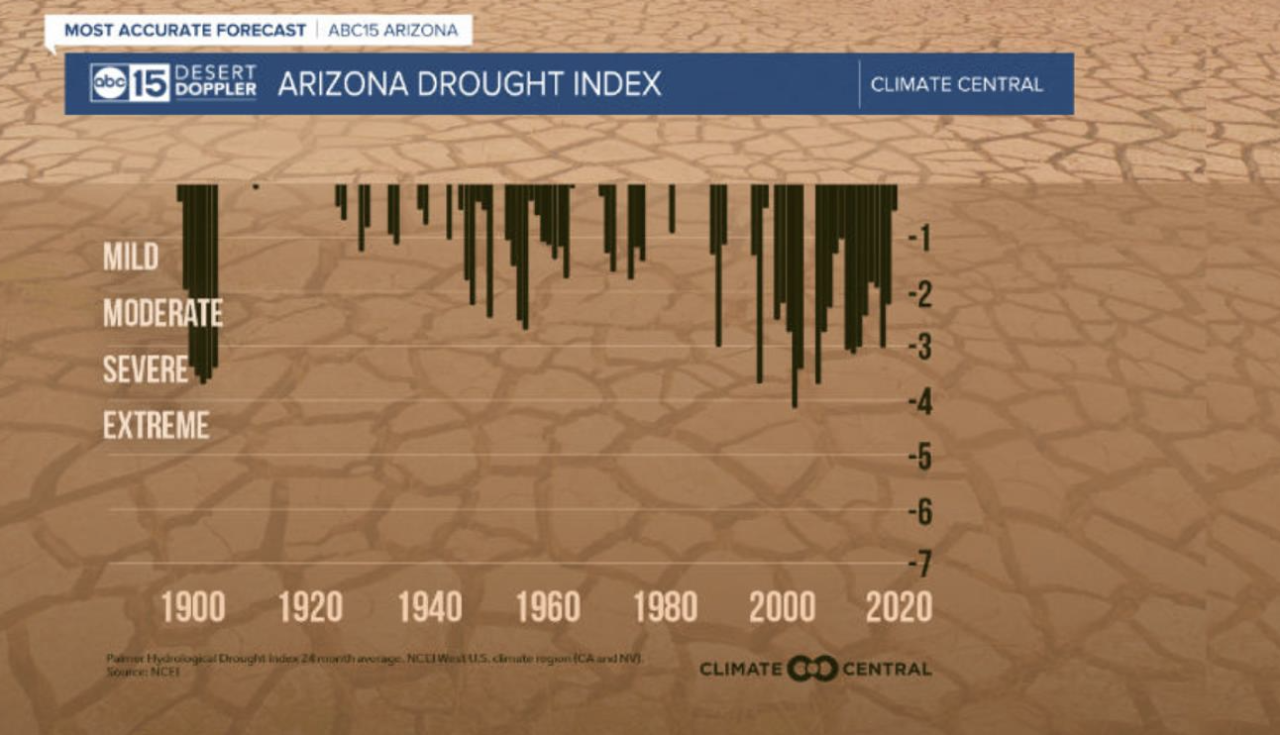
So we are increasing both of these extremes as our climate changes.
Castro says, “We’re going into a world where we have these more dramatic swings in climate variability, whether it’s winter or summer. There’s been this term coined climate whiplash, you go from one extreme to another, either between seasons or within a season. This is devastating from the standpoint of climate and our resiliency to the natural climate because if we’re exceeding the ranges of which our natural and human systems can cope with these whiplash swings, you’re going to go from one year where a dam nearly fails because it’s flooded to a year of devastating wildfires and the ecosystem cannot recover.”


Investigators are analyzing two ransom notes sent after Nancy Guthrie vanished, as a retired FBI agent questions whether the latest message is real. A new development in Nancy Guthrie’s disappearance centers on two ransom notes sent to her family after she vanished. Investigators believe the messages may have come from the same person or group, possibly from the same computer IP address. The first note demanded billions in bitcoin, while the second claimed Guthrie had died and offered an apology. Retired FBI agent John Iannarelli says he is skeptical of the second note and questions why the sender has not provided credible information about her location. The case remains active as detectives continue following any reliable leads.

CAMP VERDE, AZ (AZFamily) — An Arizona wildlife park is asking visitors to follow its rules after a visitor discarded a lit cigarette in the park, sparking a fire.
Park officials said Saturday a visitor ignored the no-smoking policy and threw a lit cigarette on the ground near the Tiger Splash Arena, causing the fire.
“If you are not willing to respect our policies, we understand that our park may not be the right destination for you,” Out of Africa Wildlife Park and Sanctuary said in a social media post.
Copper Canyon Fire and Medical District firefighters put out the fire before it could spread or threaten any animals, park officials said.
“Every policy we have in place exists for a reason, even if it may seem inconvenient to some visitors,” park officials said. “The outcome could have been devastating for the animals. We respectfully ask all visitors to follow the rules that are in place for everyone’s safety.”
Park officials said the safety of the animals, guests and staff is the highest priority.
See a spelling or grammatical error in our story? Please click here to report it.
Do you have a photo or video of a breaking news story? Send it to us here with a brief description.
Copyright 2026 KTVK/KPHO. All rights reserved.

The 2026 NBA Draft takes place in New York City this week, with the first round being held on Tuesday and the second round on Wednesday. Burries and Peat are both locks to hear their names called. Three more Wildcats from this year’s team could be taken in the second round: Jaden Bradley, Tobe Awaka and Anthony Dell’Orso.
Burries, a projected lottery pick, could be one of the first dozen players taken on Tuesday, while Peat is slated to go as a mid-to-late first rounder. Here’s where the final NBA mock drafts have Burries and Peat going. Some mocks also include Bradley and Awaka.
Summaries of mock selections are italicized where provided.
Burries: No. 9 to the Mavericks
Burries has drawn a good amount of interest inside the top 10 but has not scheduled many workouts, appearing comfortable with his potential landing spots, including the Clippers, Hawks, Mavericks and Warriors. His predraft process has largely been under the radar. Any of those teams would give him an opportunity to contribute in a role in a competitive context right away.
The Mavericks are another team that appears open to moving back in the draft and have cast a wide net with first-round workouts, with Masai Ujiri taking over in May, and Dallas keeping its options open as it builds around Cooper Flagg.
Peat: No. 26 to the Nuggets
After opting to stay in the draft rather than return to Arizona, Peat seems to be trending toward the 20s, with teams continuing to express concern about his jump shot. His physicality and defensive versatility might appeal to a team like Denver, which has been able to creatively fit different skill sets around Nikola Jokic and needs to get more athletic along the frontline.
The Nuggets should be taking a best-available approach as they work to improve their depth. They are working with cap constraints as Peyton Watson hits restricted free agency, a situation that could lead to Denver moving a veteran player to enable added flexibility.
Bradley: No. 47 to the Suns
Awaka: No. 50 to the Raptors
Burries: No. 9 to the Mavericks
There’s not much new information out of Dallas since my previous mock draft. The Mavericks continue to conjure a lot of speculation among sources. They’ve explored trading this selection and are considering several different players and positions, from lead guards like Flemings, Wagler, Brown, Acuff and Christian Anderson to Ament to Yaxel Lendeborg.
Burries is the name I hear the most with Dallas, though, with sources around the lottery trying to determine why he’s not working out in as many places as you’d expect. There’s a lot of enthusiasm for Burries among teams who want to try to win next season, as he’s seen as a tough guard who can dribble, pass and shoot who will also defend at a high level with physicality.
Peat: No. 22 to the 76ers
Sources around the league are still trying to figure out what new head of basketball operations Mike Gansey’s type will be. So this pick might just be me wish-casting, but I can’t imagine a better fit for both Peat and an organization. With Joel Embiid playing more consistently on the perimeter, Peat could use his athleticism and strength to crash along the baseline and make smart plays while also providing tough defensive energy. The 76ers desperately need a four with some power to his game, and Peat brings that in a big way.
I have Peat higher than this on my personal board, but sources across the league are unsure where he slots into the class. His range seems to be quite wide, starting somewhere post-lottery and stretching into the back half of the first round.
Bradley: No. 51 to the Wizards
Burries: No. 8 to the Hawks
Burries has not scheduled many workouts, and it appears his range starts with the Clippers with the fifth pick, as I reported a few weeks ago, and ends with the Warriors at the 11th pick. Burries drops smack in the middle of that range in this mock with Atlanta. Burries arrived at Arizona as a top-10 recruit, started slow, and then erupted once conference play began, helping lead his team to the Final Four. He’s a physical, versatile scorer who can beat you from all three levels, rebounds like a forward, and competes hard on defense. But he’s a methodical creator rather than an explosive one, and his shooting history before Arizona gives scouts reason to wonder whether the efficiency is real or a blip.
Peat: No. 24 to the Knicks
Congratulations to Knicks fans for winning the championship! Mitchell Robinson grabbed a clutch offensive rebound in the closing moments of the game, but he’s a free agent this offseason so the Knicks may need to replace him. Peat’s bloodline is so loaded with offensive linemen that it’s almost funny he ended up playing basketball. His father played nine NFL seasons. His uncle was a Pro Bowl tackle. Two brothers played college ball on the line. And you can absolutely see it in how he plays: powerful, physical, relentless, and it genuinely takes something special to stop him from getting to where he wants to go. He opened the season with a 30-point game against defending champion Florida and backed it up as one of Arizona’s best players all year on its way to the Final Four. Since Peat can’t shoot yet, it’ll be important that he’s paired with a floor-spacing center like Karl-Anthony Towns. Or he could serve as a small-ball center in switchable lineups. So even though Peat entered the year with top-10 hopes, it might be a blessing in disguise for him to fall to the end of the first round.
Bradley: No. 45 to the Kings
Bradley is a combo guard with a strong frame, a calm demeanor, and a knack for clutch moments. After arriving in college as a McDonald’s All-American, he lost his starting spot as a freshman at Alabama then transferred to Arizona, where he got better every year and became the team’s trusted leader. As a senior, he won Big 12 Player of the Year, Big 12 Tournament MVP, and led the Wildcats to their first Final Four since 2001. There are questions about whether he can be a lead guard at the next level, but his connective passing, improved shooting, and gritty defense all give him the potential to play big minutes.
Awaka: No. 51 to the Wizards
Awaka was college basketball’s best rebounder and helped energize Arizona’s bully-ball style over the past two years. At 6-8 with a brickhouse frame and an unrelenting style of play, he set a tone off the bench and earned Big 12 Sixth Man of the Year. The problem is everything else. He doesn’t shoot. He doesn’t pass. And he doesn’t have a clearly defined position on defense. The team that drafts him is betting it can find enough of a defensive role to keep that elite rebounding and relentless motor on the floor.
Burries: No. 9 to the Mavericks
There are reports that Burries is trying to land in Dallas to play next to Cooper Flagg. I like the vision even if I’m a bit skeptical Burries has the shot-creation upside to eventually be a star. The Arizona guard is a well-rounded player who defends and rebounds better than your average two-guard, and he’s a really good three-point shooter. Flagg would have to stay in more of a shot-creator role if Burries is the pick, but maybe that’s what Dallas wants. I personally wouldn’t have him as the best player available in this scenario, but Burries’ lack of a glaring weakness makes him a malleable guard who should be able to hang in the playoffs. It’s easy to understand the appeal of that with the No. 9 pick.
Peat: No. 26 to the Nuggets
Peat had the toughest decision of the withdrawal deadline to make, but I actually think he made the right choice by staying in the draft. His money surely would have been bigger at Arizona for a hypothetical sophomore season, but he risked falling off the NBA radar completely if he didn’t improve in important areas. There should still be room for him at the end of the first round with much of the depth in this class getting drained by NIL dollars. His intersection of weight, passing, and offensive rebounding will be interesting even if his shot is completely busted right now.
Burries: No. 9 to the Mavericks
There’s a growing belief that this could be a scenario that both Burries and Dallas would be excited about, and even some speculation that’s why Burries is not working out for more teams. He is a strong and aggressive two-way guard who can get downhill with force, provide a formidable three-point shooter, and defend his position, all with an NBA ready frame, all of which would make him a nice complement to Cooper Flagg for the foreseeable future.
Peat: No. 22 to the 76ers
Peat is higher than this on the CBS Big Board, but his glaring lack of shooting is going to require a specific fit. The Sixers lack a long-term solution at the four, can get their floor-spacing from Embiid’s face-up skill set, and could benefit from Peat’s strength, physicality, intangibles, winning pedigree, and ability to get downhill.
Bradley: No. 48 to the Mavericks
The Big 12 Player of the Year is a downhill force, quality defender, and improved shooter. This could also reunite him with his former Arizona backcourt mate Brayden Burries.
-

 New Mexico6 minutes ago
Bear Fire Update for June 23, 2026
-

 North Dakota16 minutes ago
Timothy Paul Ganyo
-

 Ohio21 minutes ago
GALLERY: Photos of former Ohio State football coach Jim Tressel
-

 Oklahoma28 minutes ago
OHP remembers K-9 for protecting countless lives during career
-

 Oregon31 minutes ago
Fireworks on sale in Oregon until July 6
-

 Pennsylvania36 minutes ago
Pennsylvania company builds goals for US Soccer, FIFA World Cup matches
-

 Rhode Island43 minutes ago
Ethics Commission denies Shekarchi’s motion to dismiss high court bid ethics complaint
-

 South-Carolina46 minutes ago
Inside TCMU’s new SC 250 exhibit

