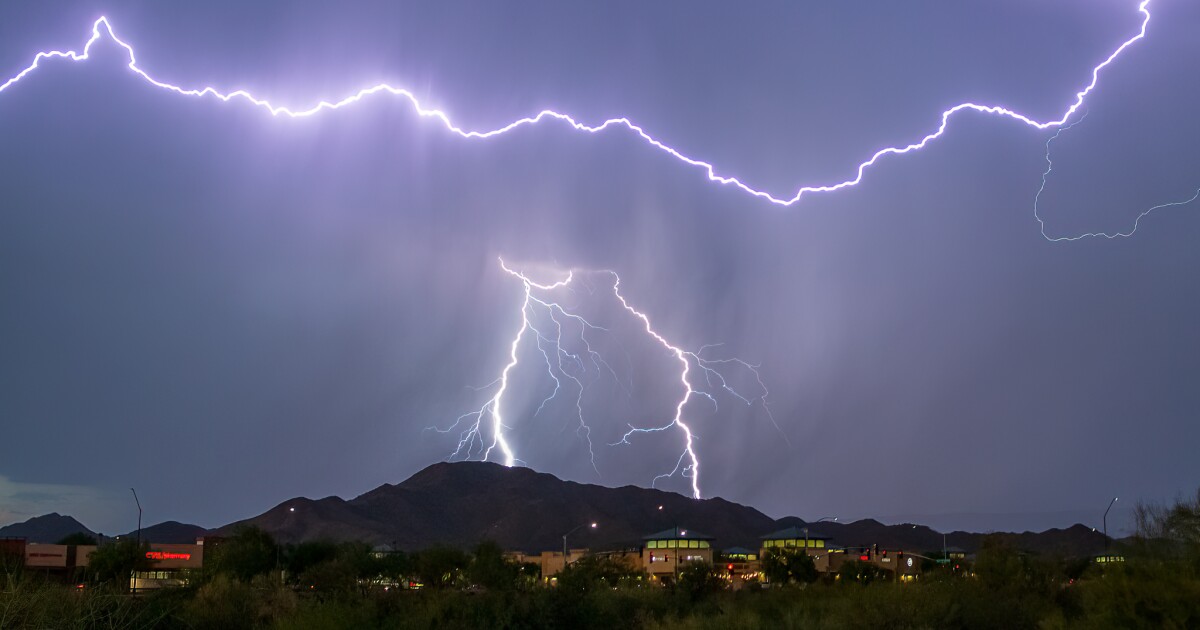
PHOENIX — Each summer, thunderstorms tower in our otherwise sunny Arizona sky. Winds shift out of the south and southeast, bringing moisture in all the way from the Gulf of Mexico. That moisture rises and forms thunderstorms in the heat of the day. This is our monsoon.
Much of Arizona typically receives 30 to 50 percent of its annual rainfall during the monsoon months of June, July, August, and September, which helps replenish our dry land and diminish wildfire threats.
UA
But, the monsoon as we know it is changing. As our atmosphere gets hotter with climate change, it’s able to essentially hold more water vapor and that’s altering how our monsoon behaves.
Advertisement
“We don’t get as many storms, but when they do come, they’re tending to produce higher rainfall amounts, more intense rainfall, and more intense winds,” says Dr. Christopher Castro with the Hydrology and Atmospheric Sciences Department at the University of Arizona.
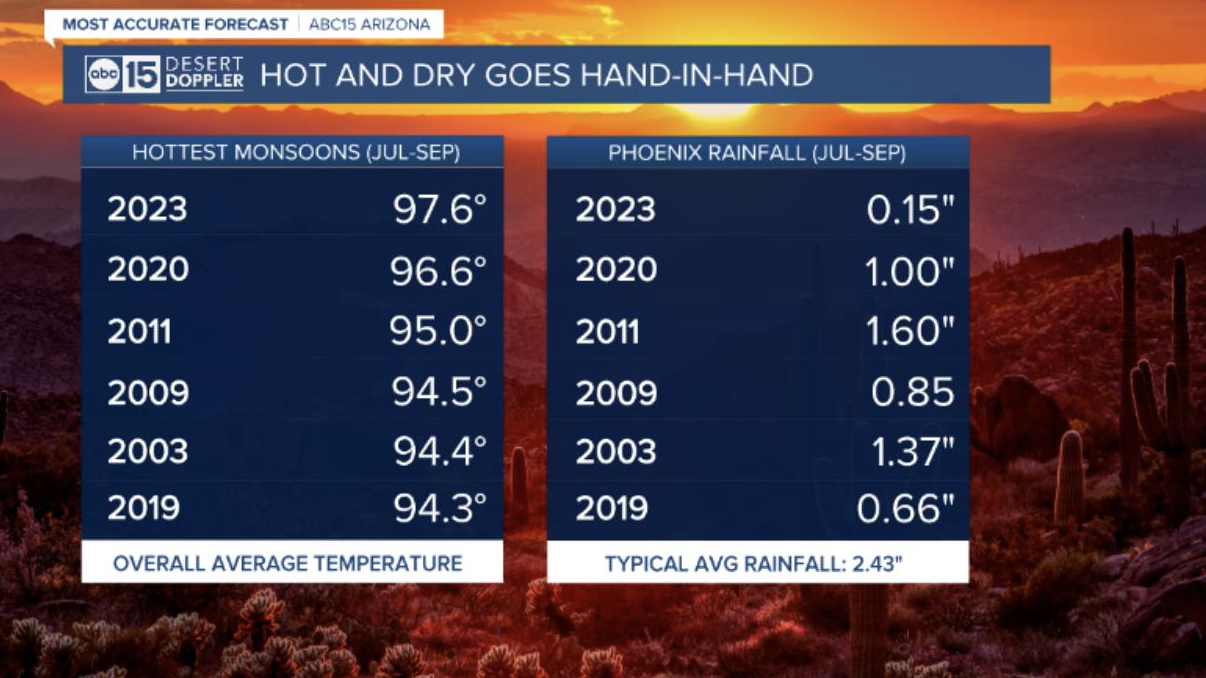
That’s exactly what we saw play out here in Phoenix last summer. It was our hottest and driest monsoon on record. Sky Harbor only received 0.15 inches of rain. That’s more than 2 inches below normal.
But, what is considered a “normal” amount of monsoon rain has changed a lot in the past 50 years.
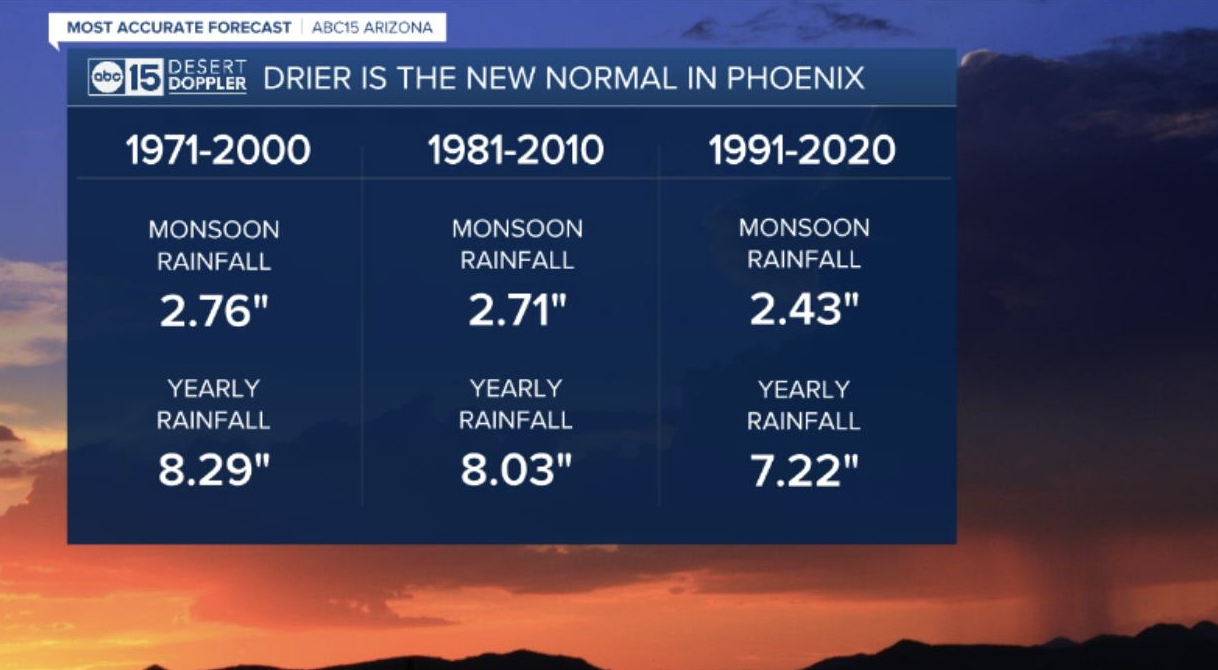
Every 10 years, new normals are calculated based on a rolling 30-year average. Our latest update came in 2021, giving us a new average that is based on rainfall data from 1991 to 2020.
This new normal showed an average rainfall in Phoenix for the monsoon season of 2.43 inches of rain. That’s more than a quarter of an inch drier than the previous average, which is a big difference here in the desert!
Advertisement
KNXV
Castro and his team at the University of Arizona are leading the way when it comes to research on how climate change is impacting our monsoon. Although not yet published in scientific peer-reviewed journals, they have run experiments simulating how storms move down into the Valley.
They have discovered that a greater number of green spaces, like parks, golf courses, and green landscaping, are leading to fewer storms making it down into the city.
“The presence of all these watered areas is suppressing the amount of instability in the atmosphere. So, it’s harder to initiate storms from the outflow boundaries,” he says.
So, as storms try to move down off of the Mogollon Rim, they are now often getting diverted around the periphery of the Phoenix metro instead of rolling right through it like they used to.
Advertisement
Scientists like Castro have also seen a broadening of our monsoon ridge, which is impacting our monsoon, too.
KNXV
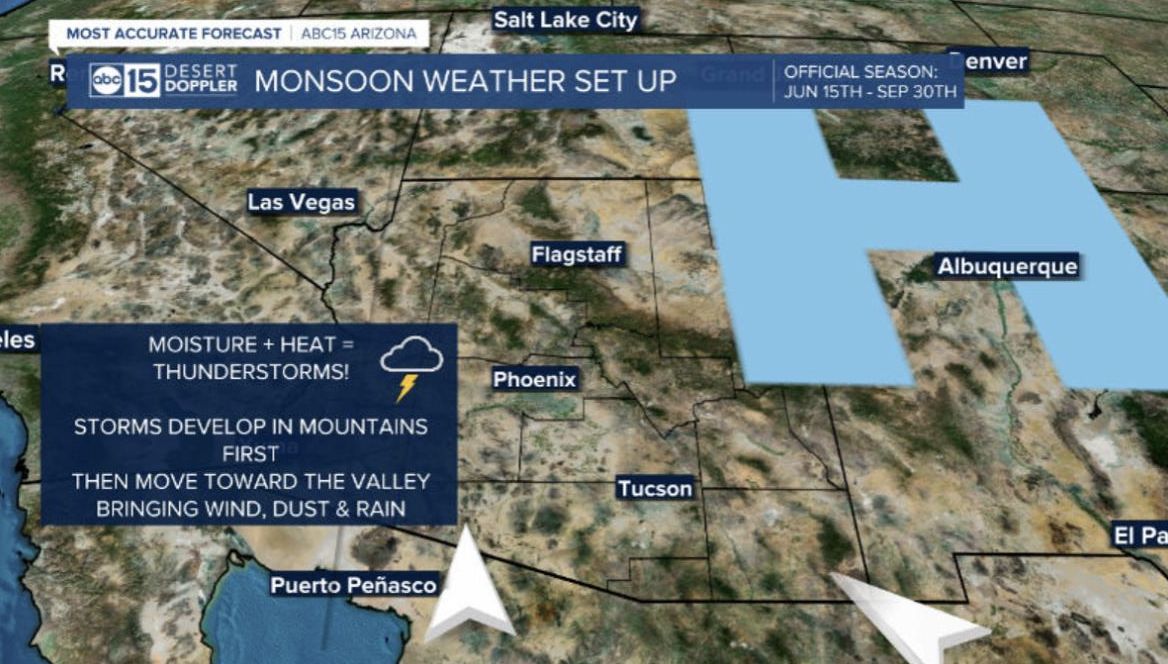
It’s the ridge of high pressure, which sets up near the Four Corners during the summer, that allows monsoon moisture to flow in.
“What we’ve observed in the last 20 years or so, is that the monsoon ridge is growing more intense and more spatially expansive. The bigger and more expansive that ridge is, the more propensity there is for the air to sink from the upper atmosphere. So. it suppresses the atmospheric instability and it makes storms harder to form,” Castro says.
That’s exactly what happened last year. As that ridge of high pressure sat over Arizona, it suppressed storm formation and made it much hotter. Our 2023 monsoon season was the hottest and driest on record in Phoenix.
Advertisement
KNXV
2020 was also a so-called “non-soon” with only 2 days of measurable rain in Phoenix. That year, we received 90% of our monsoon rain (0.90 inches) in just 2 hours with one particularly bad storm the night of August 20, 2020.
Castro says that’s the fingerprint of climate change in the desert.
“It’s really about the extremes. The monsoon is, generally all the way around, getting more extreme. So, when we get our heat waves now those are more intense than they used to be and when it rains, it may not rain as frequently as it used to, but it tends to be more intense,” Castro says.
That intensity makes it harder for us to adapt.
Advertisement
When it’s extreme heat, we see more heat-related deaths. We had 987 heat-related deaths across Arizona last year. 645 of those happened in Maricopa County, mostly during the hottest and driest monsoon on record.
When it’s extreme rainfall, we see more flash flooding and complete destruction near wildfire burn scars since the charred ground can no longer absorb water.
“From the water supply perspective, it’s bad news for recharge of the groundwater table. If you’re drying out the soils and then realizing your precipitation with only a few intense events, more of that precipitation is likely to run off. There’s also a greater danger for wildfires to happen and that totally changes the characteristics of the permeability of the soil. Then, when it rains, that water will immediately wash off very similar to a landslide,” Castro says.
A bigger, broader monsoon ridge also deflects atmospheric disturbances, known as inverted troughs, from tracking through Arizona.
Those disturbances often serve as triggers to get widespread rain and thunderstorm activity going during the monsoon.
Advertisement
“The expanded monsoon ridge is suppressing the path of those inverted troughs more to the south, so the number of inverted troughs is decreasing. So, the frequency of big precipitation events is decreasing. But when they do occur, they’re occurring in a more moist environment that is favorable for heavier amounts of precipitation,” says Castro.
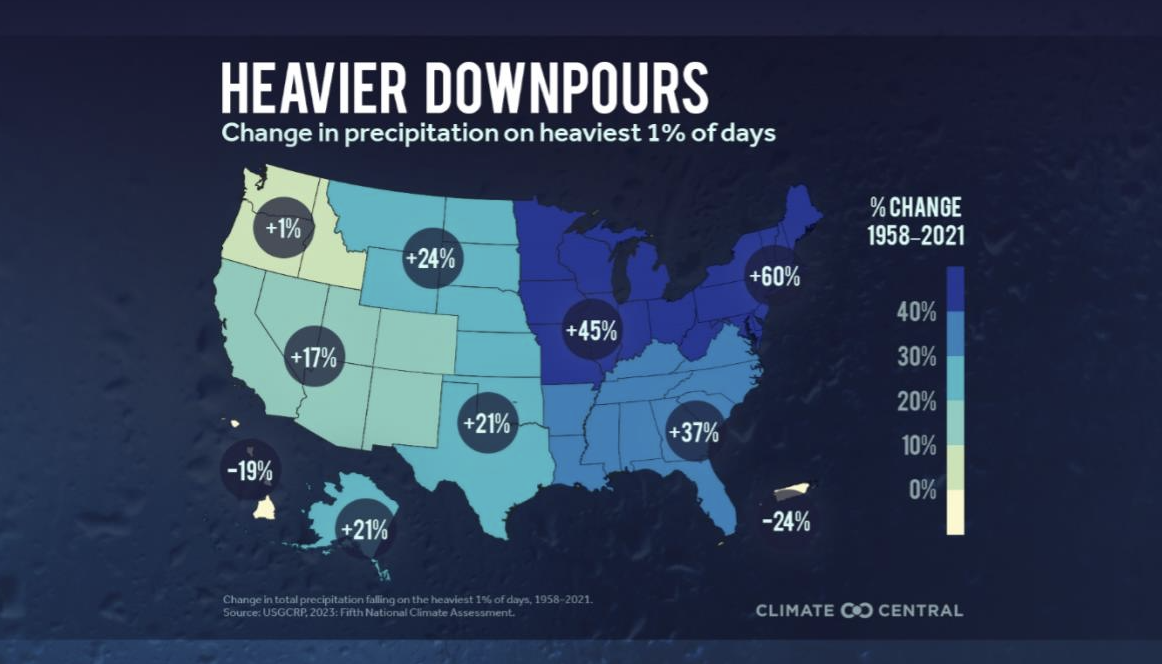
We’re seeing similar impacts across the country as the number of heavy downpours increases in this warming world.
KNXV
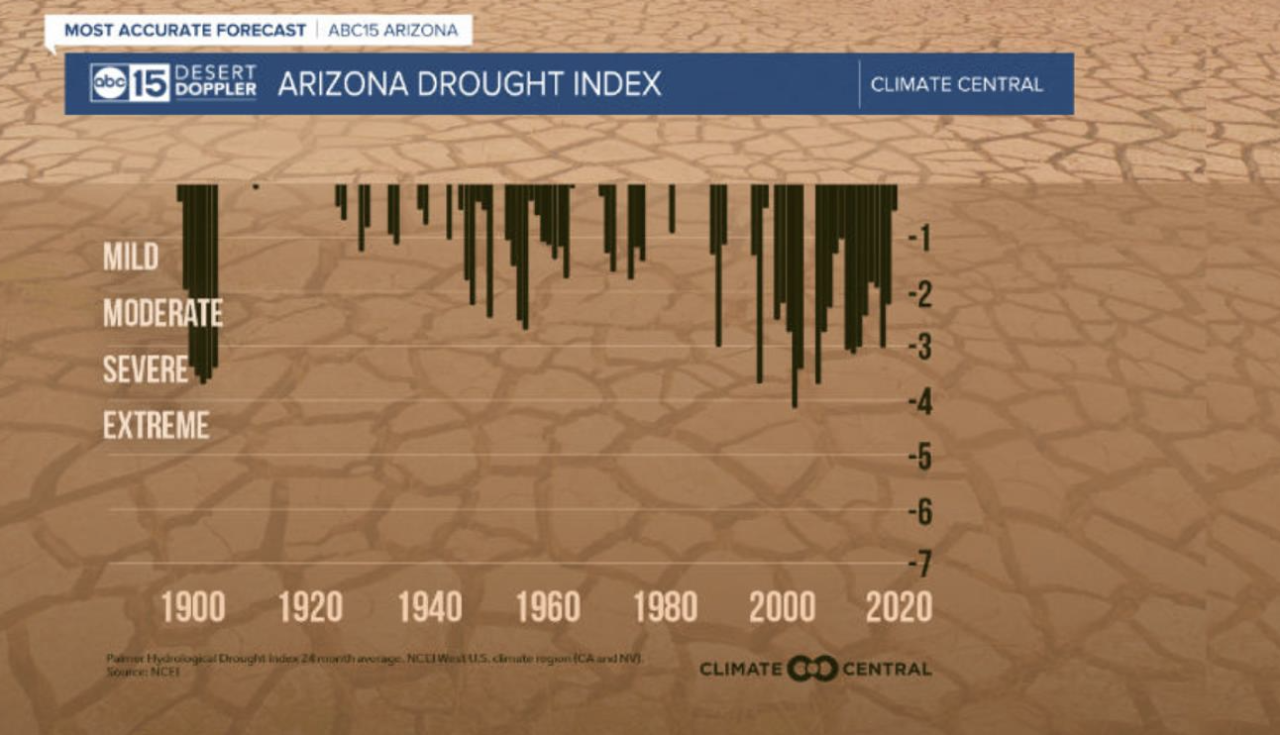
While downpours are increasing, periods of drought are increasing too.
Climate Central
Advertisement
So we are increasing both of these extremes as our climate changes.
Castro says, “We’re going into a world where we have these more dramatic swings in climate variability, whether it’s winter or summer. There’s been this term coined climate whiplash, you go from one extreme to another, either between seasons or within a season. This is devastating from the standpoint of climate and our resiliency to the natural climate because if we’re exceeding the ranges of which our natural and human systems can cope with these whiplash swings, you’re going to go from one year where a dam nearly fails because it’s flooded to a year of devastating wildfires and the ecosystem cannot recover.”
VIDEO: Hundreds of loved ones and first responders gathered Saturday to celebrate the life of Nicholas Hutcherson, an Arizona wildland firefighter killed late last month while battling a wildfire in Colorado.
Hutcherson was part of a Helitack crew trained to respond to remote areas and contain wildfires before they spread.
He was one of three wildland firefighters killed June 27.
His father, Ron Hutcherson, said his son sent him a text message the morning he died, saying he was on his way to a fire and would try to call that evening.
Advertisement
“The text included a picture from inside his Helitack helicopter,” Ron Hutcherson said. “One of his crew members had a Snoopy on their helmet — he knew how much me and my wife loved Snoopy.”
That evening, a call came — but not from Nicholas.
Saturday, Ron Hutcherson read a letter addressed to his son, recounting their shared memories — including the moment a young Nicholas fell in love with the fire department.
In most cases, the number of players drafted is a strong indication of how good a college baseball team was the previous season. Arizona had nine draftees last year after reaching the College World Series, but following a disastrous 2026 campaign only two Wildcats heard their names called in the 2026 MLB Draft.
Right-handed pitcher Owen Kramkowski was selected by the Tampa Bay Rays in the 5th round, while fellow righty Collin McKinney went in the 9th round to the Baltimore Orioles.
Kramkowski was taken with the No. 145 picks, which has a bonus slot value of $506,100. McKinney’s bonus slot at No. 260 is $213,300. Players chosen in the 11th round or later can sign for up to $150,000 without it impacting a team’s bonus pool.
The two draft picks for Arizona is its fewest since 2022, when catcher Daniel Susac went in the 1st round and outfielder Tanner O’Tremba went in the 15th round. It was also the first time since 2014 the UA did not have a player taken in the first four rounds.
Advertisement
While the loss of existing UA players to the MLB Draft was minimal, the same can’t be said for future Wildcats. Two members of Arizona’s 2026 recruiting class as well as three transfers signed this summer were drafted Sunday.
Incoming freshman catcher Francisco Rivero, from Canyon del Oro High School in Oro Valley, went in the 15th round to the Washington Nationals while righty Garrett Ahern—a transfer from GCU—went in the 16th round to the New York Yankees. The 17th round then saw righties McCartyEnglish (Southern Miss) and Collin Cobb (Williston State JC) and New Mexico prep righty Jack Byers all get picked.
Each has until July 27 to sign a pro contract or they’ll join the Wildcats this fall for the 2027 season.
The 6-foot-3 Kramkowski, who grew up in Sahuarita, is the fifth player recruited to the UA out of high school by Chip Hale and his staff to get drafted. He spent three seasons with the Wildcats and was part of the weekend rotation the last two years, starting the opening game of the College World Series. In 2025 he wen 9-6 with a 5.48 ERA, striking out 90 batters in 92 innings, but struggled as a junior with a 1-8 record and 6.13 ERA.
In 35 career appearances, Kramkowski walked only 38 batters in 165.1 innings against 165 strikeouts.
Advertisement
The 6-foot-5 McKinney spent the last two seasons at the UA after beginning his career at Baylor. He was the Wildcats’ Friday night starter for most of 2025 before getting moved to the bullpen, and this past spring spent time in the rotation and as a reliever. He struck out 109 in 91.2 innings with Arizona.
McKinney had entered the NCAA transfer portal last month and committed to Houston but is expected to sign.
Arizona’s lack of draft picks from its roster was indicative of a team that went 19-34, its worst record since 1994, and finished 9-21 in the Big 12 after winning the conference tournament title the previous year. The same can’t be said for ASU, which failed to advance beyond the NCAA regionals despite having 10 draft picks on the roster.
Ceremonial procession for fallen firefighter Nick Hutcherson
A ceremonial procession for Nick Hutcherson, a local firefighter who died fighting a Colorado wildfire, arrives at Dream City Church in Phoenix.
Fallen firefighter Nick Hutcherson was remembered as courageous, intelligent, and lighthearted during a memorial service in Phoenix.
Hutcherson, 27, and two other firefighters died on June 27 while battling what became the Snyder Fire in Colorado.
Friends and family recalled his wisdom, unique laugh, and his favorite phrase, “easy day.”
A Snoopy sticker on a fellow firefighter’s helmet became part of the last photo fallen firefighter Nick Hutcherson texted to his father, capturing one of their final shared moments.
“I smiled when I saw the picture and texted him back, ‘Thank you and be safe out there.’ And he replied, ‘Will do.’ That evening, I did get a call, but it wasn’t from Nick,” said Ron Hutcherson through tears during his son’s memorial service on the afternoon of July 11 at Dream City Church in north Phoenix.
Advertisement
The brief exchange between father and son happened June 27, when the 27-year-old Nick Hutcherson and two fellow firefighters died as they took on what became the sprawling Snyder Fire in western Colorado.
The “Peanuts” character anecdote offered a glimpse into the man by those who eulogized Hutcherson, remembering him as courageous and intelligent, yet never one to lose his lighthearted spirit.
“Nick could pull all of these facts and quotes out like they were common knowledge. He was incredibly smart, but he didn’t let that get in the way of being goofy and funny. He was so unapologetically himself that you couldn’t help but to like him and get drawn into whatever subject he was talking about,” said Cantene Coker, his friend and crew member.
Wise words, laughter marked memories
Hutcherson served as a firefighter on the Kaibab National Forest after joining the profession in July 2021, according to those who spoke at the service. He was also pursuing a degree in physical therapy with the goal of one day becoming a doctor.
Advertisement
Before becoming a firefighter, Hutcherson served in the U.S. Navy. His father said he enlisted after the U.S. Marine Corps declined to accept him because of his high arches.
“A lot of people would have taken that as a sign to give up, but not you. Instead of continuing to wait, you made up your mind to go and walk through the door of the Navy. You weren’t looking for the easiest path. You were looking for a way to serve. And you did,” Ron Hutcherson said.
The grieving father recalled how he sat his son down to apologize for any shortcomings as a father.
“You explained how you understood there was no road map for being a parent, no blueprint, and that people make mistakes. You expressed you held no resentment towards me, not then and not ever,” Ron Hutcherson said. “For a moment it felt like our worlds had been reversed. I was the child and you were the parent, teaching me one of the most important lessons in life. And I want to thank you for that.”
Advertisement
Brandon Smith remembered Nick Hutcherson before he achieved that level of maturity.
“He was super awkward in his younger years, but then he developed into a man who was incredible,” said Smith as he and Hallie Costa walked to the church.
The two, both 28, had known Hutcherson since they all attended Desert Sage Elementary School in Glendale, where the future firefighter and Flagstaff resident grew up.
“He had a super cute laugh,” Smith added as Costa gave a light chuckle.
Advertisement
Prior ceremonies celebrated life
Many who knew him remembered the amateur Muay Thai practitioner as “a warrior in all respects of the word.”
Those who spoke at a July 5 memorial service in Grand Junction, Colorado, also remembered Hutcherson’s generosity. The service also honored the firefighters who died alongside Hutcherson: Emily Barker, 38, of Michigan; and Sydney Watson, 26, of Alabama.
Hutcherson would try and teach fellow crew members American Sign Language, said Travis Nichols, a unit aviation officer in the Upper Colorado River Interagency Fire Management Unit.
Brian Fennessy, director and fire chief of the United States Wildland Fire Service, said one of Hutcherson’s most valued qualities was his “uncommon ability to face hard things with optimism, humility and a smile.”
His favorite phrase, “easy day,” was emblematic of this, Fennessy said.
Advertisement
Hutcherson’s remains were brought July 2 to Arizona.
“This is the community thanking him for what he did, the sacrifice that he made. The fire service is one big family,” said Phoenix Fire Capt. Rob McDade as Hutcherson’s casket arrived at Deer Valley Airport.
Flags were flown at half-staff on July 11 in accordance with an order from Gov. Katie Hobbs, who attended the memorial service at Dream City Church.
A GoFundMe to benefit Hutcherson’s family had amassed a little more than $84,000 of a $100,000 goal as of July 11.
The Knowles Fire, which claimed the three firefighters’ lives and reportedly injured two others, merged with three fires into the Snyder Fire. Spanning 30,202 acres, the Snyder Fire was 98% contained as of July 8, according to inciweb.gov.
Advertisement
Republic reporters Stacey Barchenger and Christian Cervantes contributed to this article.
What to know: Blaze destroys Phoenix firefighter’s home, spurring wave of donations