Business
LeBron Inc.: The collective that's bigger than basketball

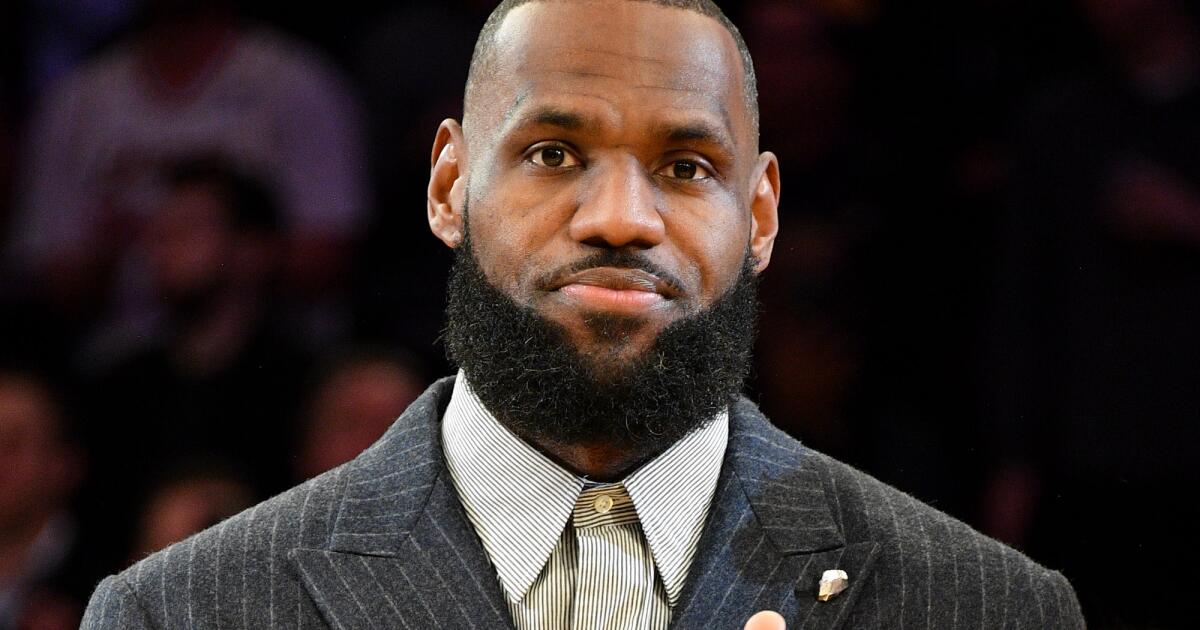
LeBron James at Crypto.com Arena in L.A. on Feb. 9, 2023.
(Allen Berezovsky / Getty Images)
Back in November, a few days after Thanksgiving, LeBron James had left Los Angeles for a visit to his hometown of Akron, Ohio, in part to show a group of reporters around his childhood home.
Well, a replica of his childhood home.
“Go ahead,” he said, nodding toward a green door, an exhibit at the new LeBron James Home Court museum made to look like the entrance to Apartment 602. “Look around.”
Inside, the walls were covered in taped-up posters, 1990s teenager style. There was Shaquille O’Neal rushing toward the basket. Earvin “Magic” Johnson angling for a layup. Kobe Bryant floating in for a dunk.

Discover the change-makers who are shaping every cultural corner of Los Angeles. This week we bring you The Connectors, who understand that power doesn’t travel in a straight line and know how to connect the dots. Come back each Sunday for another installment.
In many ways, these men — these legendary Lakers who long ago hung up the purple and gold — remain more synonymous with Los Angeles than James, who still wears the uniform. But if this bothers the 39-year-old, who is playing some of the best basketball of his 21-year career, it doesn’t show much.
Indeed, while fans and pundits have been busying themselves with speculation about the depths of his team loyalty and his future, James has been busy building an economic empire tying himself more fully to Los Angeles. And unlike in Ohio, where he’s mostly known as a one-man savior of civic life, opening not just a museum, but a transformative school, a housing complex and a community center, what he’s doing in Southern California is a team effort.
Think of it as a collective. Or maybe a solar system.
In the middle of LeBron Inc. there’s James — the global star and the center of gravity. And then there are his brothers from different mothers, the three men most associated with James, who’ve spent decades shining in his orbit, always aligned in one way or another.
There’s Rich Paul, who founded the powerful Beverly Hills-based talent agency Klutch Sports Group and hired James as his first client not long after they met by chance in an airport in 2001 and struck up a conversation about a vintage football jersey.
Maverick Carter, who met James when they were both in grade school, was the first to move to L.A. and is chief executive of the TV and film studio they co-founded, the SpringHill Co.
And Randy Mims, who also has been friends with James since they were kids and today is his chief of staff.
Mentioned less often, but also very much in the mix are Fara Leff, the chief operating officer of Klutch Sports Group, and Adam Mendelsohn, James’ media advisor, and Paul Wachter, founder and chief executive of Main Street Advisors.
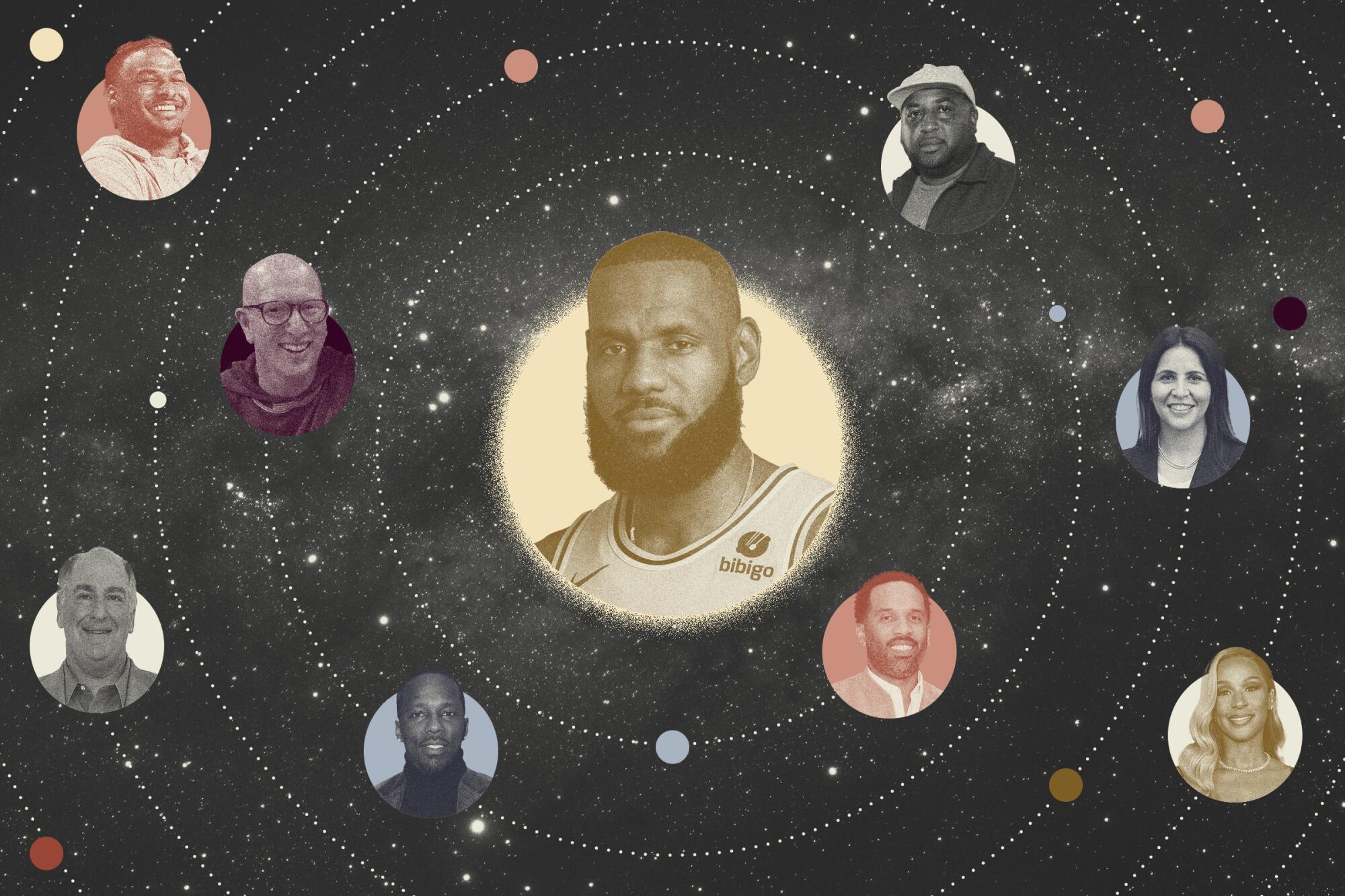
Global star LeBron James, center, has tapped a core group of friends and family to build an economic empire rooted in Los Angeles. On the left, from top to bottom, are Bronny James, Adam Mendelsohn, Paul Wachter and Rich Paul. On the right, from top, are Randy Mims, Fara Leff, Maverick Carter and Savannah James.
(Zipeng Zhu / For The Times)
Even James’ son, Bronny James, is a star in his own right, declaring for the NBA draft after a year playing basketball at USC, while his wife, Savannah James, is an entrepreneur and investor who has started building a very-L.A. empire of her own.
The influence of James and his collective on Los Angeles — particularly the parts of it that revolve around media and entertainment — is palpable.
Klutch, for example, is one of the top agencies in the world, growing from just four clients in 2012 to more than 400 today, including the NBA’s Anthony Davis and Trae Young, and the NFL’s Jalen Hurts and Odell Beckham Jr. In 2019, Klutch agreed to a pivotal partnership with United Talent Agency that has given its clients even more avenues into Hollywood, including in film, television and podcasting.
Leff, who was around in the early days of Klutch, said she and Paul wanted to “break the mold of what the typical agent-to-player relationship was. You know, you signed a contract and then you see them at your next contract. Ours was how do we grow young men, professional athletes, professional businessmen, fathers and sons.”
These are themes that Paul echoed in his memoir, “Lucky Me,” with a foreword written by James.
“Rich helped me find my strength in that chaos, a chaos that he knew all too well. Rich never asked me for anything. He didn’t care whether I was a future pro or the kid across the street. He just knew I needed his help, and he gave me what I needed most — the space to be vulnerable,” James wrote.
Meanwhile, the SpringHill Co. — named after the building in Akron that housed James’ real Apartment 602 — has released a long list of acclaimed shows, movies and documentaries, including “What’s My Name: Muhammad Ali,” HBO’s “The Shop,” “Self Made: Inspired by the Life of Madam C.J. Walker” and, of course, “Space Jam: A New Legacy.”
Sports is no longer just sports. It’s culture, it’s business, it’s music and more — all ripe for investment.
In addition, the company over the years has brought in new investors, including RedBird Capital, Nike, Fenway Sports Group and Epic Games, to fund an international expansion. And it has inked deals with Netflix, ABC Studios and Universal Studios, further solidifying a place in the Hollywood firmament.
What’s often forgotten is that James and Carter, in many ways, pioneered the idea of a working professional athlete becoming part of the media ecosystem. Not just being covered by journalists and subject to outside narratives, but running a media company and creating a narrative of one’s own.
This has become common. Think Kevin Durant’s Thirty Five Ventures or Naomi Osaka’s Hana Kuma. And that’s because sports is no longer just sports. It’s culture, it’s business, it’s music and more — all ripe for investment.
“The world has changed a lot in the last 20 years,” said Wachter, who has long managed James’ investments, from Cannondale bikes to Lobos 1707 tequila to Beats by Dre. “Now athletes are much more tuned into business, but that was just very unusual.”
In fact, Wachter uses the word “unusual” a lot when he talks about how James, Carter, Paul and Mims became so powerful. He was one of their first contacts in Los Angeles in 2005, when the LeBron Inc. collective was still based in Akron and nearby Cleveland, where James played for the Cavaliers.
“They were kids. I was not a kid,” Wachter said. “I was just amazed that they had, at that age, taken the trouble — and it wasn’t their mom or their dad or their sister, their cousin — to find someone who clearly wasn’t from their world and … to do research to say, who might be good for us.”
They hired him. And Wachter and his then-teenage daughter took LeBron and Savannah James house hunting.
“And here we are almost 20 years later,” Wachter said. “He came here and he’s made his home here.”
Or homes. James and his family are building their dream home from the ground up on what had been the site of their $37-million mansion in Beverly Hills.
“He chose to be here. He didn’t get traded,” Wachter said. “You basically took what was basically a Cleveland operation. Now, it’s an L.A. operation.”
More from L.A. Influential


San José tech company Cisco plans to cut 471 workers in three Bay Area offices, according to layoff notices filed to a state agency.
The company, which provides networking devices along with other services including video conferencing and cybersecurity, told employees in May that it was going to cut fewer than 4,000 jobs or less than 5% of its workforce.
The notices, processed by the California Employment Development Department this week, provide more details about what jobs Cisco will cut in California.
The artificial-intelligence boom has fueled more investments in data centers, commercial real estate and other areas. But advancements in AI tools have also been reshaping jobs, especially in Silicon Valley, the epicenter of the tech industry.
Cisco’s layoffs in California impacted workers in its San José, Milpitas and San Francisco offices. The company cut a variety of roles in software engineering, product management, design, business operations and other areas, the notices show.
Cisco said it didn’t have anything additional to share beyond what it published in May about its restructuring plans.
Tech companies have been citing various reasons for layoffs including prioritizing investments in artificial intelligence. As workers use AI-powered tools to generate code, words and other content, some executives have said they don’t need as many employees. There’s also skepticism, though, about how big a role AI is playing at companies with a large amount of workers globally.
From January to May, U.S. technology companies announced 123,653 cuts, up 66% from the same period in 2025, according to a June report from global outplacement and executive coaching firm Challenger, Gray & Christmas. The firm said that AI was the leading reason companies cited for cuts but it still isn’t the “jobpocalypse some predicted.”
Meta, Snap, Block, Oracle and Amazon are among tech companies that have announced mass layoffs this year.
Cisco markets itself as a company that “provides critical infrastructure for the AI era” and has benefited from the AI boom, reaching a record revenue of $15.8 billion in the third quarter this year. The company’s net income grew 35% to $3.4 billion year-over-year during that quarter.
Cisco Chief Executive Chuck Robbins told employees in May it’s cutting costs in certain areas while prioritizing other investments. That includes employee use of AI across the company.
He said Cisco will be among winners in the AI era, but that means “making hard decisions — about where we invest, how we’re organized, and how our cost structure reflects the opportunity in front of us.”
As of July 2025, Cisco had roughly 86,200 employees, according to its annual report.

Social media company Snap is being sued by the parents of a girl who was raped when she was 12 years old by a man she met on disappearing messaging app Snapchat.
The 111-page lawsuit, filed this week in a Missouri Circuit Court, alleges that Santa Monica-based Snap “enabled and facilitated the grooming, exploitation, and sexual abuse” of the minor who is referred to as “J.F.”
The company failed to disable or warn users about “dangerous” features that predators use on the app to find and abuse their victims, according to the lawsuit.
Missouri resident Gabriel Joel Valentin-Rios, who was 25 years old at the time, raped the girl in September 2021 after she sneaked out of her house, the lawsuit alleges. The parents are also suing the attacker, who pleaded guilty to sexually assaulting the girl and is serving 18 years in prison, according to the Social Media Victims Law Center.
The center and the Holland Law Firm announced Thursday they filed the lawsuit on behalf on the victim’s family.
“This assault did not happen in a vacuum — it happened because Snapchat’s product design made it easy for a predator to reach and manipulate an unsuspecting child,” said Matthew Bergman, founding attorney of the Social Media Victims Law Center, in a statement. “Snap executives have long known that their features create a perfect environment for predators to exploit children, yet they have repeatedly failed to make the platform safe.”
A Snap spokesperson said in a statement the company cares “deeply about the safety and well-being of all Snapchatters.”
“Our teams have worked for years to build safeguards, launch safety tutorials, partner with experts, and work with law enforcement to help prevent the misuse of our platform,” the spokesperson said in a statement.
The lawsuit is the latest legal hurdle facing Snap. Multiple parents who lost their children have previously sued the company, alleging that Snap failed to provide enough safeguards on the messaging app. Parents and child safety groups have voice concerns about how the app can be used to connect young people with drug dealers and child predators.
Other tech companies such as gaming platform Roblox, Google-owned YouTube and Facebook parent company Meta have also faced lawsuits over safety and mental health issues.
In March, a Los Angeles jury found that Meta-owned Instagram and YouTube were liable for the suffering of a California woman who alleged the platforms were built to addict young users. Snap settled that lawsuit before the trial started.
The latest lawsuit against Snap highlights safety concerns surrounding several features on the messaging app including “Quick Add,” which suggests users to connect with on Snapchat. Valentin-Rios used that feature to connect with the girl along with others to disguise his identity and groom her into sending explicit photos, the lawsuit said. The company’s “Snap Maps” feature allowed him to find the girl’s home address. And he used a cartoon avatar known as Bitmoji on Snapchat to conceal his age and present himself as a “a young, innocuous, and friendly looking boy.”
Families have faced challenges holding tech companies accountable for safety issues because a U.S. law shields platforms from being held liable for content posted by its users.
The lawsuit against Snap, though, says that it seeks to hold the company liable for the design and marketing of “unreasonably dangerous social media products.” It alleges that Snap co-created content such as Bitmojis abused by child predators and it designed the app to entice users to spend more time messaging others.
The lawsuit accused Snap of consistently turning a “blind eye” to underage users of its app. Snapchat requires users be at least 13 years old to sign up for an account, but J.F. started using the app when she was 11 years old. Snapchat was popular among her peers and friends so J.F. downloaded the app, which was presented as lighthearted and entertaining platform, without her parents’ knowledge or consent. The company failed to warn users about potential dangers, verify the ages of minors and lacks adequate parental controls, the lawsuit alleges.
Snapchat has a “family center” where parents can see their teen’s friends, view time spent and other insights about how their children are using the app. But the lawsuit said it isn’t enough because parents can’t restrict teens from sending private messages and children can create accounts without their parents’ knowledge.
The plaintiffs’ counsel also tested Snap’s “Quick Add” feature in 2023 and found that many of the usernames “generated by Snap’s recommendation algorithm appeared on their face to belong to predatory users,” the lawsuit said.
Valentin-Rios was also able to create a second Snapchat account with the username “Nocits21g” to connect with J.F. and to conceal the activity from his girlfriend, according to the lawsuit.
The rape victim, who was diagnosed with PTSD, anxiety and depression, started to engage in self-harm and expressed suicidal thoughts, the lawsuit states.
The lawsuit seeks a jury trial and financial damages for the harm allegedly caused by the company to the family.
“J.F. feels embarrassed and ashamed, but she is also angry that Snap facilitated this by design, and angrier still that Snap continues to operate its platform in the same manner today,” the lawsuit said.

Gov. Gavin Newsom signed a law Thursday to crack down on inflated profits stemming from car crash lawsuits, blessing a hard-fought compromise between Uber and the state’s trial attorneys that averts a November showdown between two of California’s most powerful and moneyed lobbying forces.
The deal, the fruit of months of negotiations, takes aim at the lucrative way doctors can charge for procedures on patients referred to them by personal injury lawyers.
If a law firm has a client who was hurt in a car accident, the lawyer will often send them to a doctor who will perform surgery on a “lien” basis, meaning the doctor will be paid from money that comes from a lawsuit settlement rather than through insurance.
Uber contends this arrangement has created an incentive for doctors and attorneys to collude to dramatically inflate medical bills. The more expensive the bill, they say, the bigger the resulting payout.
The law, SB 623, caps how much these doctors can charge when their patient is involved in a lawsuit against a ride-share company, which are frequent targets of litigation due to their top-of-the-line insurance policies. The new law will also require Uber to ramp up background checks of its drivers.
“We’re going to have a much safer state both for medical patients and passengers in Ubers,” said Nicholas Rowley, a prominent Texas attorney who helped bankroll the fight and took a leading role in the negotiations.
The law only applies to cases that involve ride-share accidents that take place after Jan. 1, 2027.
“This legislation puts meaningful guardrails in place to better protect accident victims, increase transparency and accountability in the medical lien system and strengthen safety,” said Ramona Prieto, Uber’s head of public policy for the Western U.S., in a statement.
For months, Uber and lawyers from across the state poured tens of millions into dueling ballot measures that threatened to devastate the profits of whichever side lost.
Uber fired the first shot with a ballot measure that sought to cap how much attorneys can earn in lawsuits involving auto accidents. The company argued attorneys were swindling their own clients, inflating medical bills of car crash victims to increase the value of the settlement and then pocketing a hefty chunk of the payouts.
The state’s trial attorneys countered that the fee cap would make small or difficult cases a money-losing endeavor and block scores of accident victims from the courts. They shot back with their own ballot measure that would increase legal liability for ride-share companies if a passenger or driver is sexually assaulted while on a ride, seizing on investigative reporting that highlighted assaults in Ubers.
“They were waiting for us to blink and we didn’t,” said Douglas Saeltzer, the head of the Consumer Attorneys of California, the lawyer trade group that pushed for the measure against Uber. “Their starting place, I don’t believe, was in the interest of protecting victims — it was in the interest of protecting Uber.”
With the passage of Thursday’s law, both sides have agreed to pull their respective measures from the November ballot, halting campaigns that had both parties amassing tens of millions in funding and blanketing the airwaves with ads.
“Now we can stop seeing all the commercials,” said Assemblymember Blanca Pancheo (D-Downey) at a Tuesday hearing.
The law, put forward by Assemblymember Diane Papan (D-San Mateo) and Sen. Thomas Umberg (D-Santa Ana), also caps the amount that can be earned by third-party investors who buy out a doctor’s lien in a personal injury case. These companies will purchase a doctor’s stake in the case at a reduced rate, then pocket a share of the payout if the case settles.
“Private equity and hedge funds buy them at a steep discount, then turn around and collect the full inflated amount,” Saeltzer said at a Tuesday hearing on the bill. “That’s money flowing to Wall Street investors, not patients.”
The law will require annual background checks for ride-share drivers and expand the list of offenses that disqualify someone from the job.
In addition to the ballot battle, has Uber sued two of LA’s most well-known personal injury firms — the Law Offices of Jacob Emrani and Downtown L.A. Law Group — accusing them of inflating medical bills and forcing clients to undergo needless and expensive surgeries to inflate the value of the claim. The firms asked the judge to dismiss the case Wednesday, arguing Uber had failed to prove fraud. Both firms have vehemently denied wrongdoing.
The lawsuit, filed last year, has put the plaintiff lawyers in the unusual position of playing defense. Listening in the audience at Wednesday’s hearings were the partners of Downtown L.A. Law Group and Jacob Emrani.
“Let’s be clear about what this Uber case really is,” said John Hueston, outside counsel for Emrani. “It’s brought by a $150 billion dollar company … to intimidate the plaintiff’s bar, exhaust its resources and chill the suits that hold Uber accountable.”
Michael Huston, one of the lawyers who represents Uber, countered that the case is “not an attack on the plaintiff’s bar.”
“We have brought suit against the two in this state … that are engaged in naked fraud,” he said.
-

 Technology4 minutes ago
Prime Day’s final hours bring rare discounts on Philips Hue smart lights
-

 World7 minutes ago
Video shows gaping hole after small plane crashes into towering skyscraper
-

 Politics12 minutes ago
Warren tells Trump to ‘sign the damn bill’ as bipartisan housing package remains stalled in Washington
-

 Health19 minutes ago
Common food preservatives may raise blood pressure and heart risks, study suggests
-

 Sports21 minutes ago
Who is Alyssa Thomas? WNBA star suspended for punching Caitlin Clark in the throat
-

 Technology27 minutes ago
Fox News AI Newsletter: Waymo’s robotaxi recall
-
Business34 minutes ago
Cisco to lay off more than 400 workers in California
-
 Entertainment37 minutes ago
Tom Sandoval’s girlfriend Victoria Robinson arrested after patio fire pit altercation

