Lifestyle
Artists priced out of Los Angeles head to this creative hub in the high desert

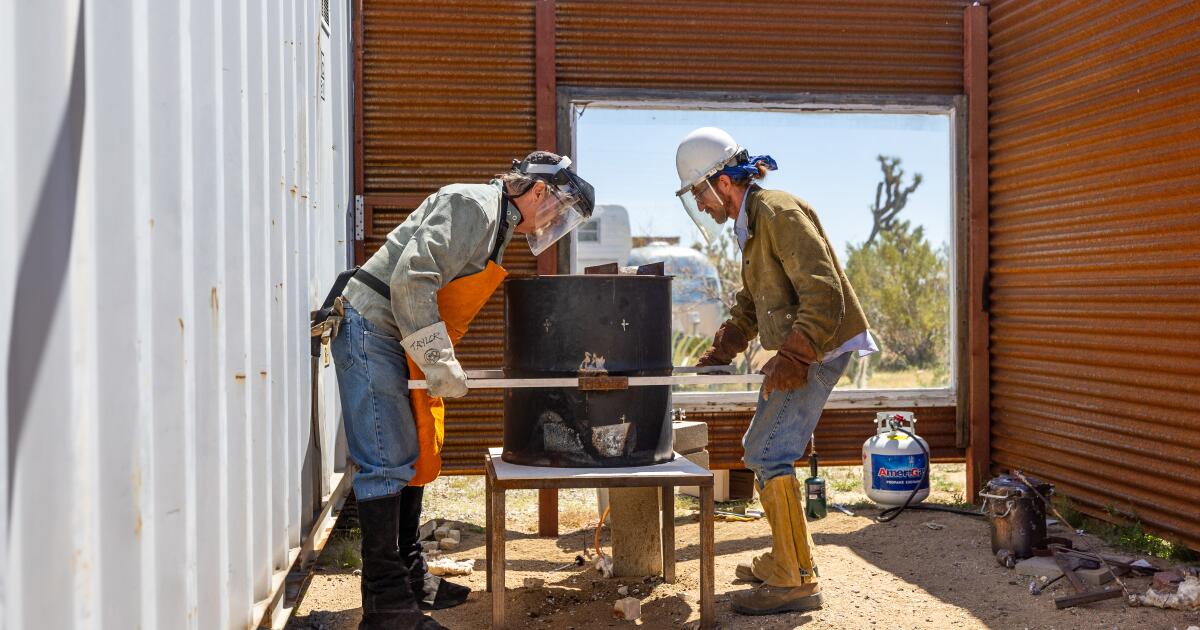
At high noon on a Saturday, the last aluminum pour of the day is about to commence at the Yucca Valley Material Lab.
Heidi Schwegler, founder of the Lab, has crawled up to the roof to get the best vantage point for a video. Schwegler has a hard stance on safety while still allowing for wild experimentation — it’s this attitude that makes the compound, with its art and recording studios, gallery, retrofitted campers and workshops like foundry and glass casting — a place of inspiration and community that pulls in people from all over the nation, but especially Angelenos looking for a reprieve from city life.
Owner Heidi Schwegler at Yucca Valley Material Lab in Yucca Valley.
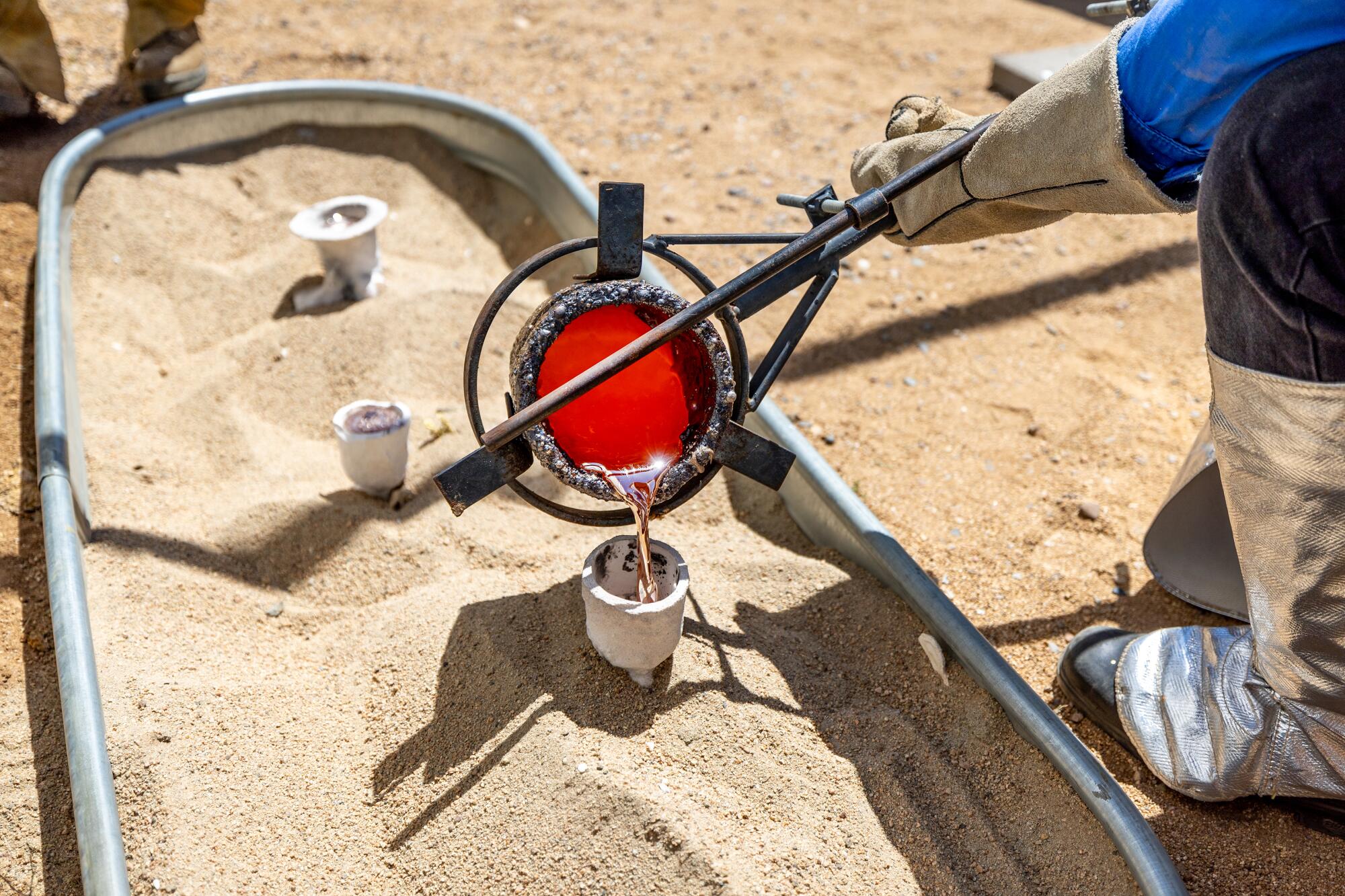
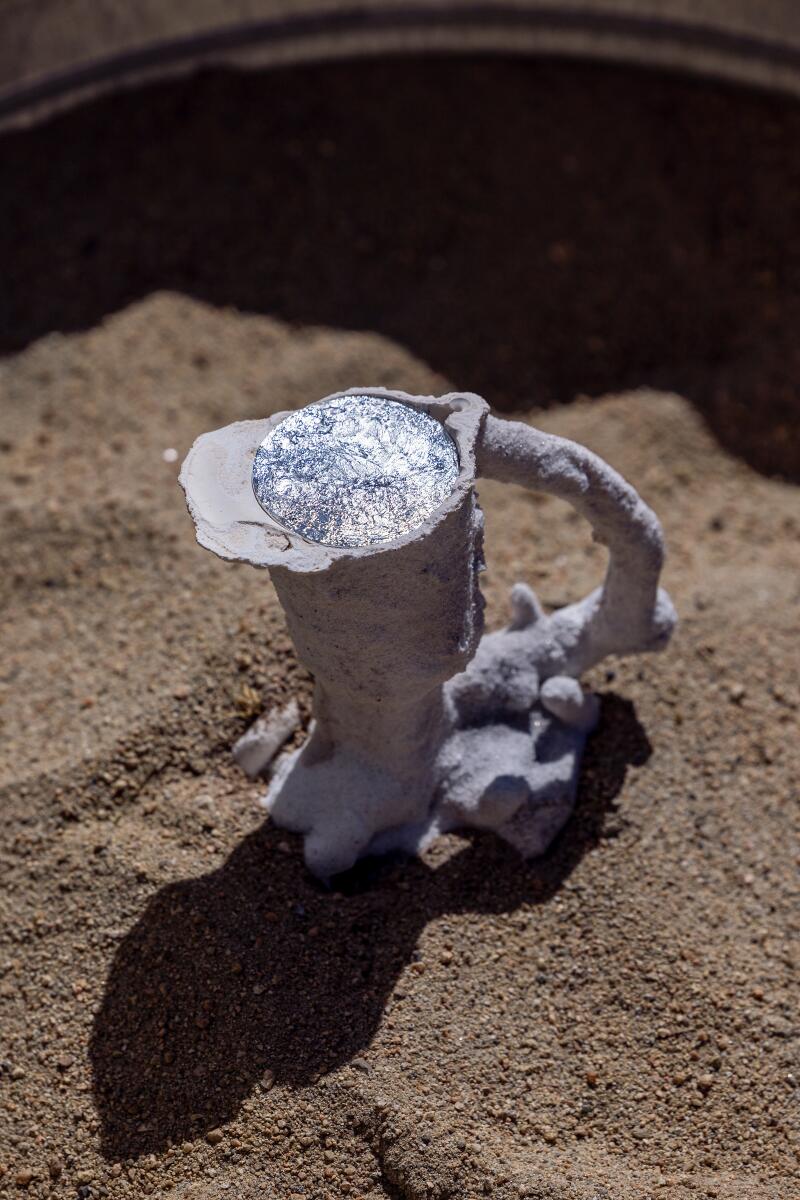
Jodie Cavalier, an interdisciplinary artist, pours molten aluminum into molds made earlier in the week.
(Allen J. Schaben / Los Angeles Times)
“This is the closest Derek and I could get to L.A. and afford it,” said Schwegler, referring to her partner, Derek Monypeny, who works with musicians. “And I think if you ask a lot of artists out here, they’ll say the same thing. It’s as close as you can get and be a really decent place to live and have a huge studio and still be within driving distance of an art center.”
It’s this passion and energy that pull artists east. Every workshop sells out, attracting hot-shot artists and retired high school teachers alike. “It’s really amazing to see my art and pedagogical practice come together outside of myself — in the form of a curved metal building plopped in the Mojave Desert,” Schwegler said. “Never would I have imagined this when we bought this property in 2018.”
The Lab has become a landing place for out-of-town artists and people looking for a way to plug into the desert scene. Many artists in Yucca Valley moved there on a whim after visiting for a weekend, much like Schwegler.
“I built this program because I was really afraid I would become a total recluse out here, because I didn’t think anybody was out here,” Schwegler said. “Come to find out, it’s just like that saying: ‘If you build it, they will come.’”
An artist and self-proclaimed materials junkie, Schwegler has pulled together funding from various sources, including AHA Projects, a nonprofit organization that supports creators, to cover residency and workshop costs, including airfare for teachers and housing for artists. Schwegler also often works with artists from the desert and Los Angeles for trade.
The Lab’s growing community has been cited as a reason why L.A. artists stay in the high desert — being able to see familiar faces at one or two cultural events a weekend is a balm after the smorgasbord and sprawl of the Southland.
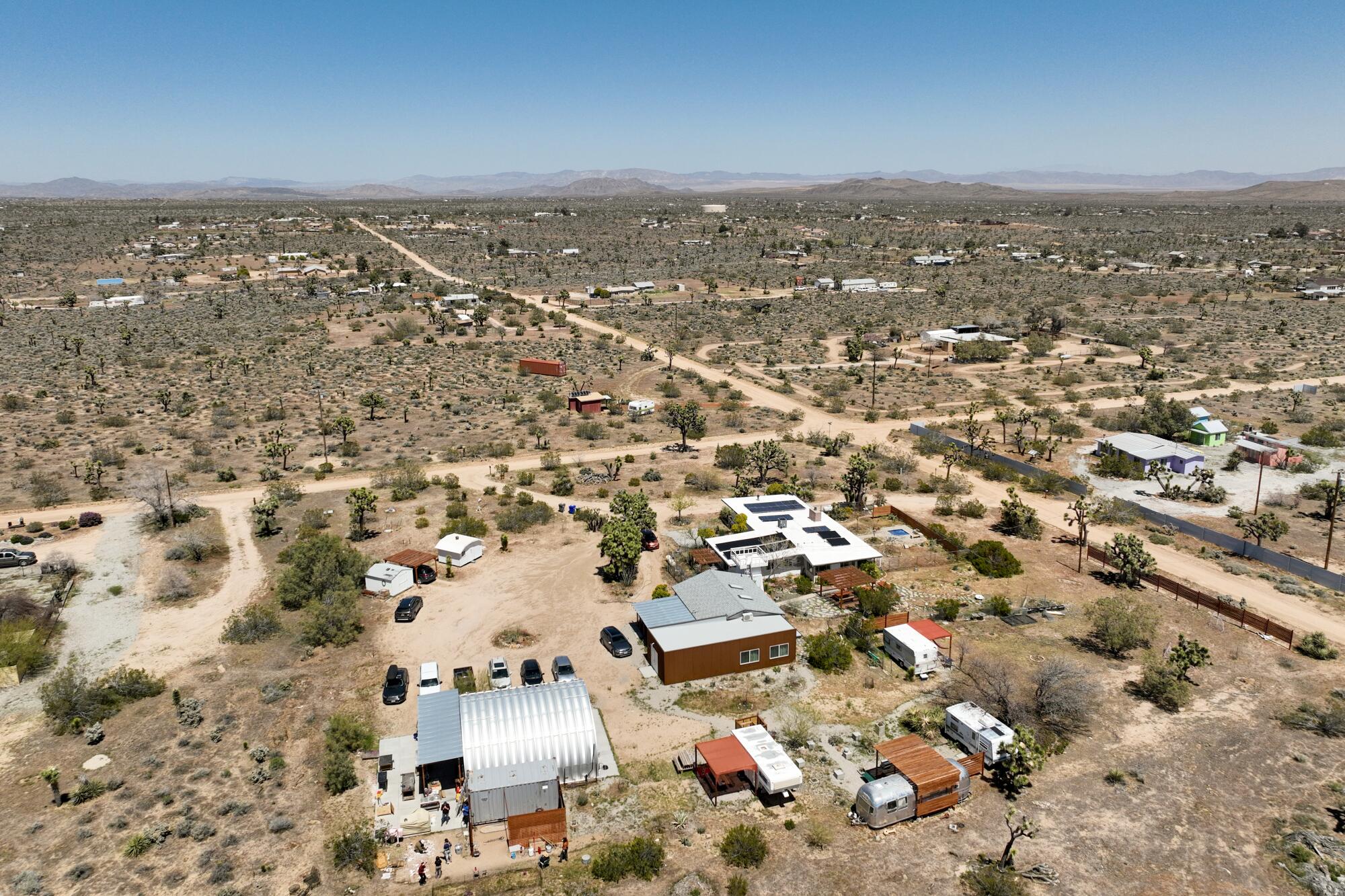
The Yucca Valley Material Lab, as seen from above.
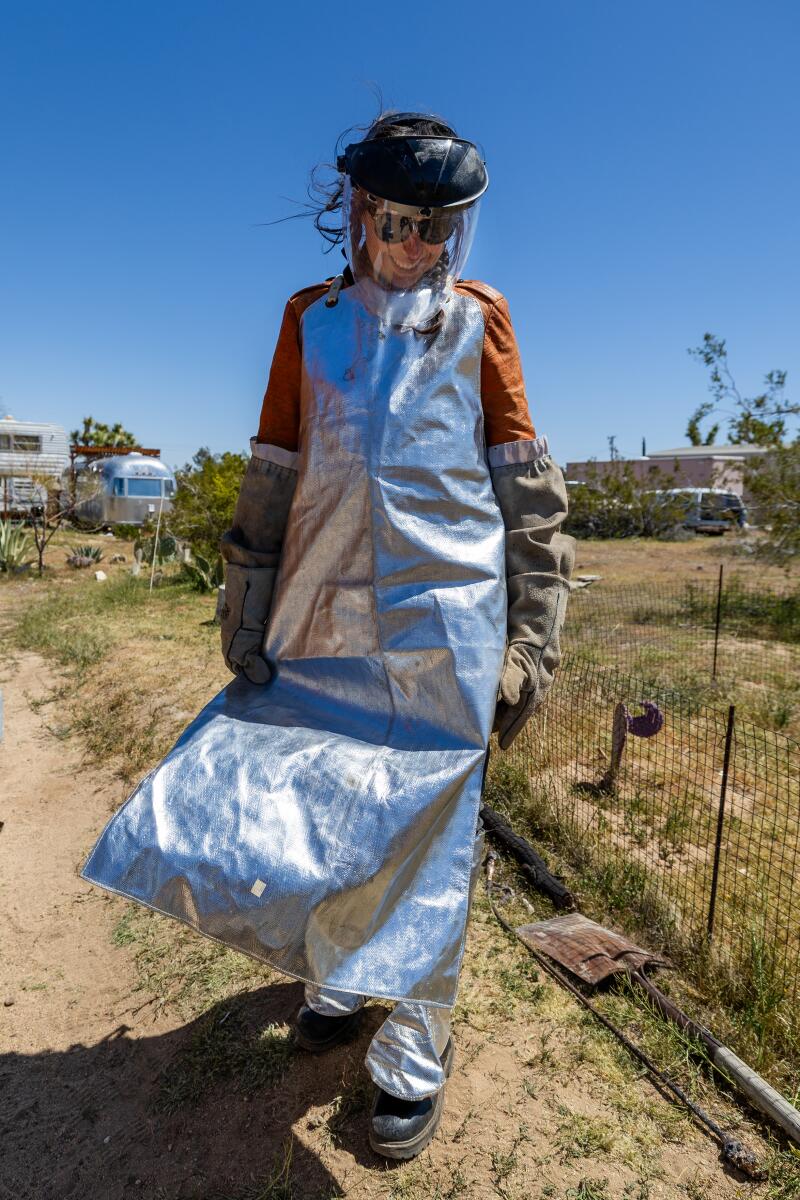
Haydeé Jiménez, an artist in residence at Yucca Valley Material Lab, wears a protective Kevlar apron during a bronze and aluminum workshop.
Students in the foundry casting in bronze and aluminum workshop pour molten aluminum into molds that were made earlier in the week.
In 2016, artists Ry Rocklen and Carolyn Pennypacker Riggs realized that a mortgage in the desert would be cheaper than a storage unit in Los Angeles. “I had a bunch of my ‘Trophy Modern’ furniture in storage and realized we could decorate our house with it and have a place to visit on the weekends,” said Rocklen, of a series of sculptures he made for an exhibit.
After having a child in 2020 and spending more time in nearby Joshua Tree, they moved full-time and converted their garage into studio space. “It was such a strange time, with so many different things going on, adjusting was not really on my mind. It was kind of a blur between our new baby, the pandemic and the move,” said Rocklen, who runs the gallery space Quality Coins in Yucca Valley. “The landscape, however, was our saving grace, as we were able to go on walks through the beautiful rocky hills.”
Back at the metal workshop, the roaring sound of the kiln — which is used in the process of turning molten bronze and aluminum into objects — fills the quiet desert mesa with an ambient soundtrack.
During a metals workshop, students made molds and learned to pour bronze and aluminum at the foundry.
Haydeé Jiménez, a recent artist in residence who splits her time between Los Angeles and Tijuana, crouched outside the metals workshop observation window wearing headphones and sunglasses, with her microphone wind-screened by a cardboard box. Amid the Joshua trees and creosote bushes, she recorded the sounds of the makeshift foundry.
Jiménez, who describes her art practice as revolving around “sound, music and vibrational sound healing,” said she was excited to work with new materials.
“When I first got the invitation to join [the Lab] for a residency, I hoped to work with glass and create little resonant objects for the development of a sort of acoustic ASMR experience,” said Jiménez, referring to Autonomous Sensory Meridian Response, which is when one is soothed by sounds like whispers and taps. Later in the weekend, she’d layer the foundry recording over sounds made using bronze objects from the workshop in a performance with gong-master Tatsuya Nakatani at the Firehouse, a Joshua Tree venue.
Any given weekend at the compound can be action-packed; that Saturday, Lazy Eye Gallery opened Michelle Ross’ “Before Pictures,” a show of sculptural paintings inside the nave of a water tower converted into a small funnel of a gallery space with a ladder to the roof that affords a view of the mesa.
But as the artists’ community grows, so has interest in real estate in Yucca Valley, Joshua Tree and Twentynine Palms, once considered more affordable areas. Housing prices in Yucca Valley have grown 80% since 2019, according to Zillow, although the steep pandemic rush has since cooled.
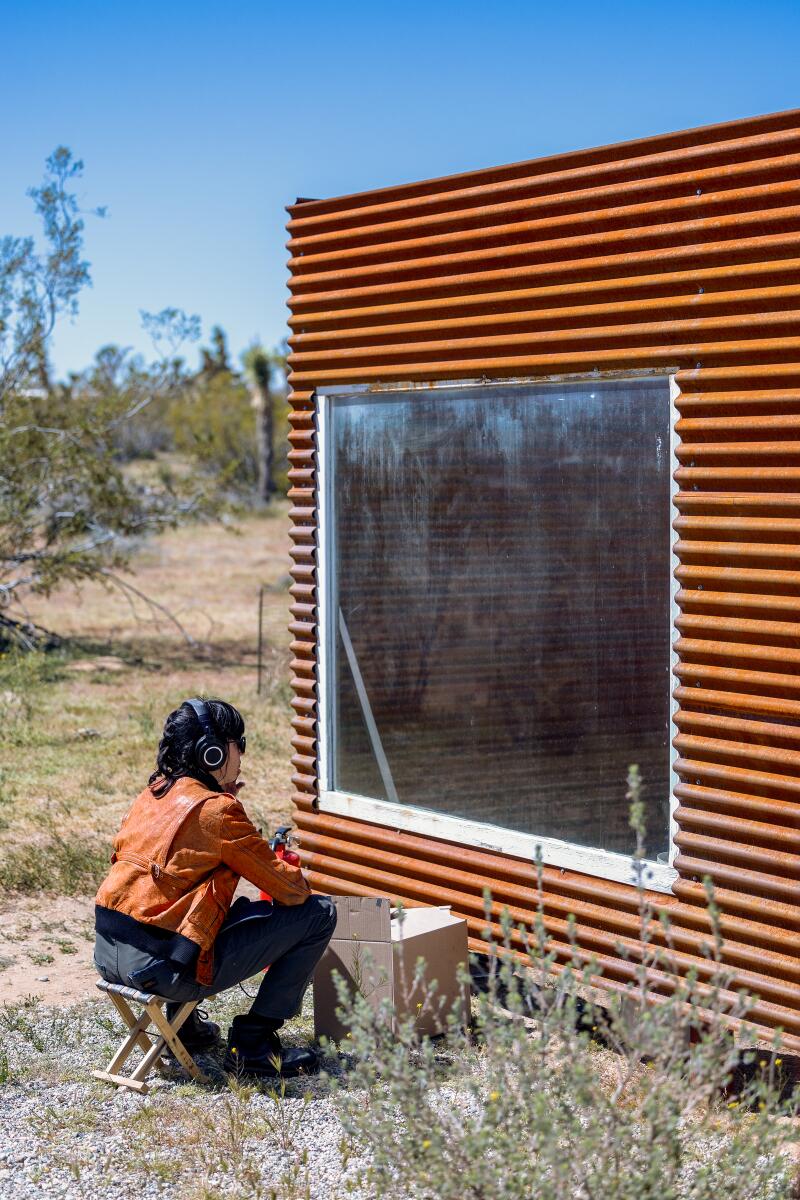
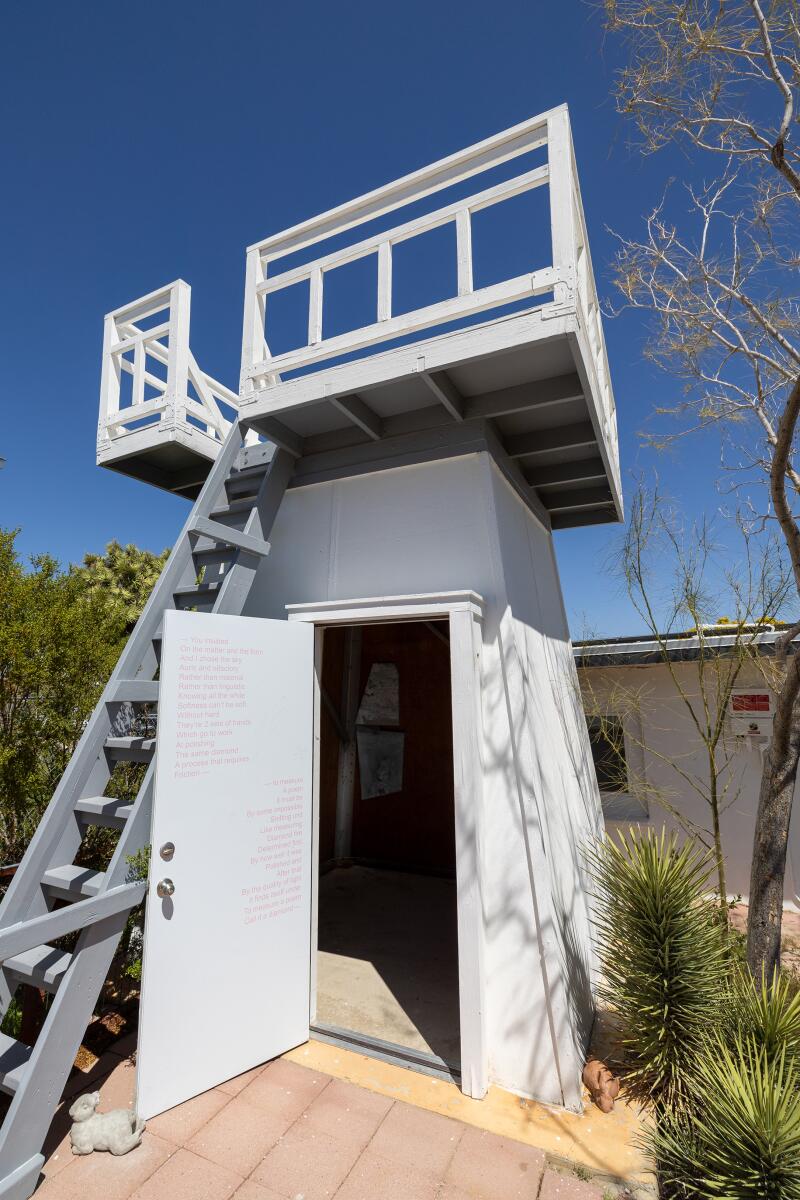
Haydeé Jiménez, an artist in residence at Yucca Valley Material Lab, records sounds of students in the foundry pouring molten aluminum into molds. A view of the Lazy Eye gallery at the Yucca Valley Material Lab.
“The presence of Airbnbs is corrosive,” said Riggs, observing that interested buyers have grown beyond “Silver Lake hipsters with a getaway cabin.” Last year, Yucca Valley capped short-term rentals at 10% of its housing stock. According to Redfin, most people searching to buy Yucca Valley homes today are in San Francisco.
Between the expansive landscape, cheaper-than-L.A. studio space and the small-town feel, the desert offers the experience of slow time — which can help some artists tap into a flow state without the day-to-day distraction of city living. But all that free time and space can be intimidating.
Ceramic artist and designer Mansi Shah left Los Angeles in 2020 after another artist friend told her about a house for rent in Yucca Valley; she packed up and headed to the desert within a few weeks. “There was 500 feet of open desert between me and my nearest neighbor. I remember those first few months, I was terrified of everything. The wind, the quiet, the desert critters,” said Shah.
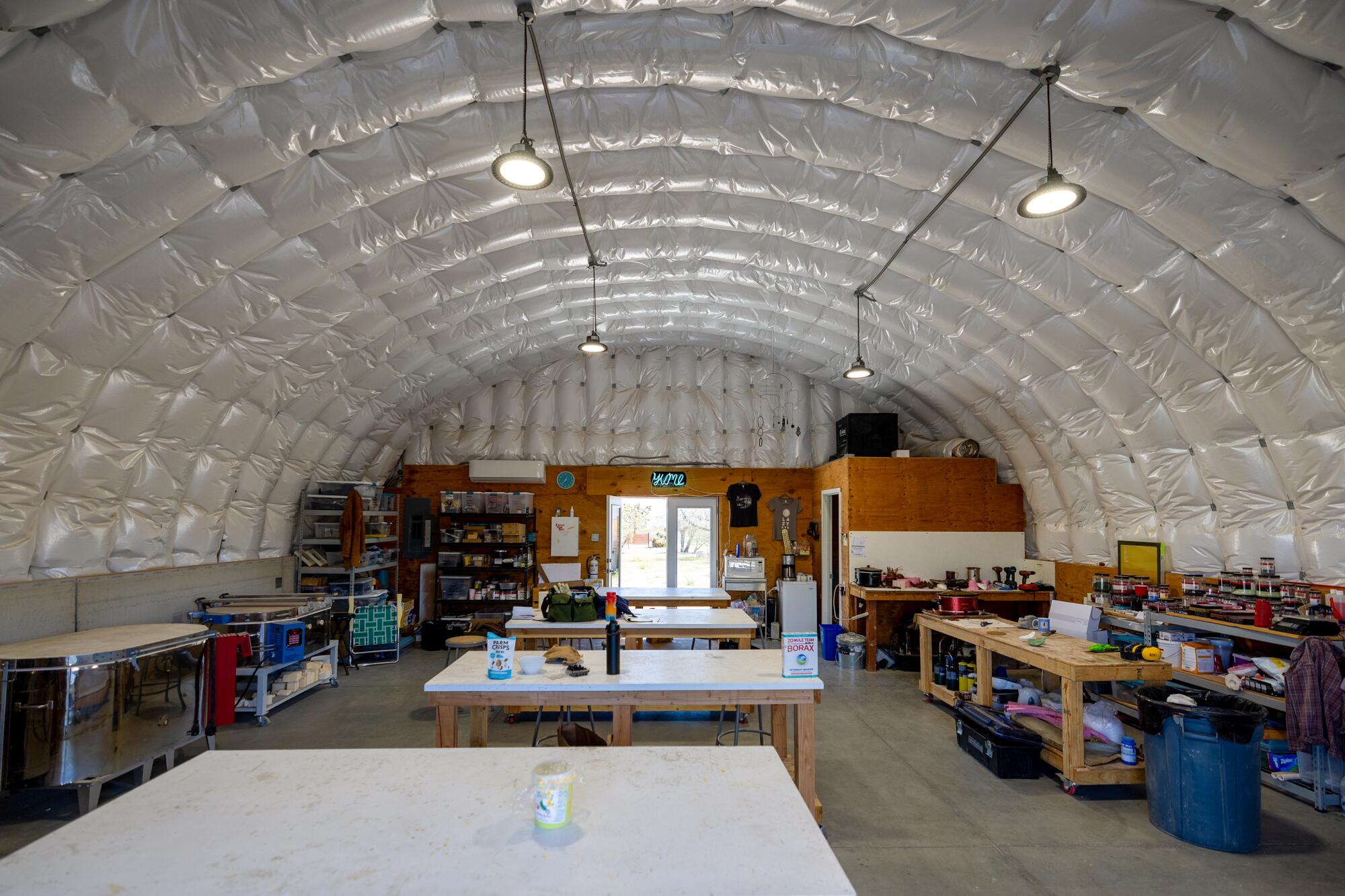
A view of the work lab in a Quonset structure built by a student at the Yucca Valley Material Lab.
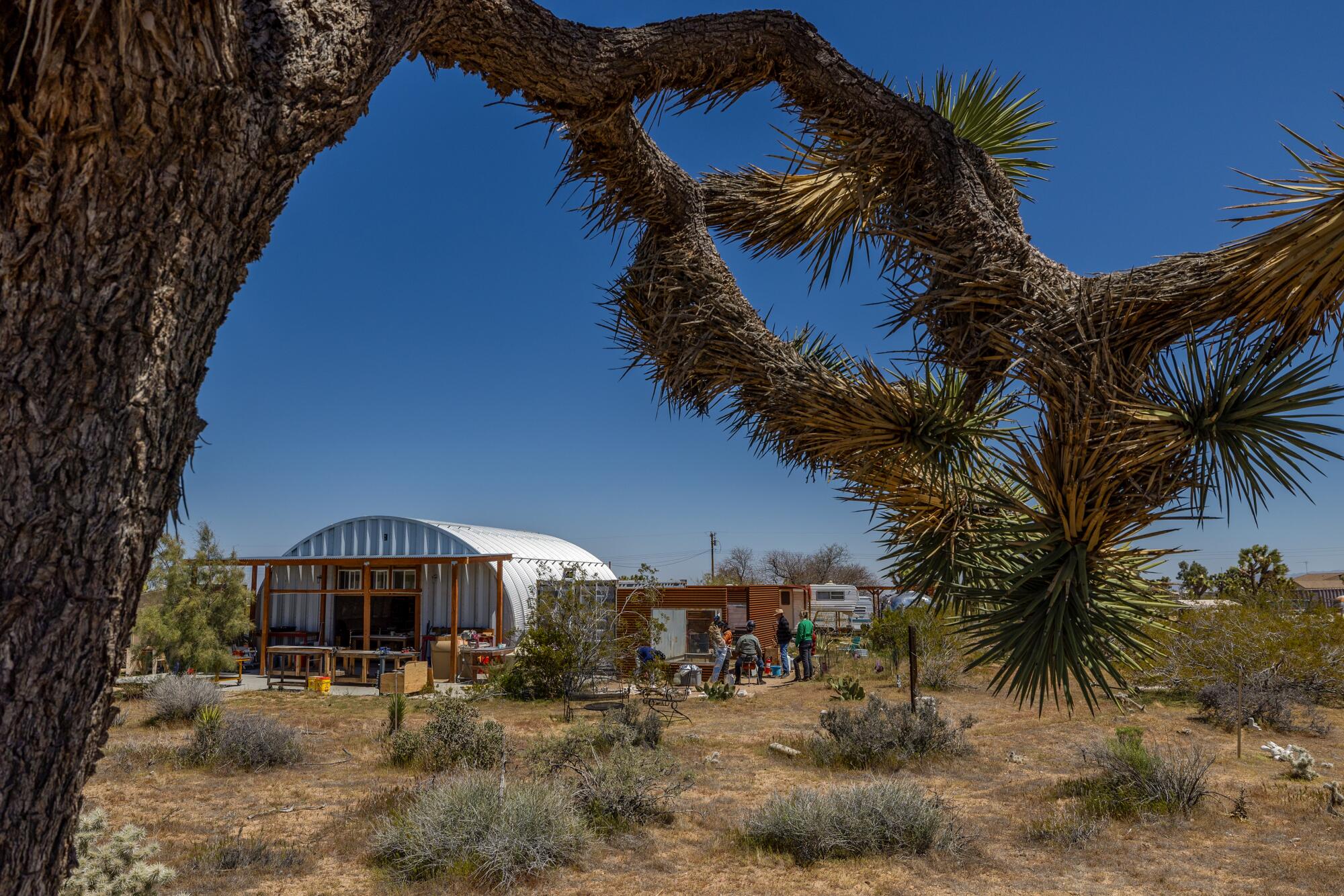
A Joshua tree frames students in the foundry.
“My introduction to life in America was the desert,” said Shah. She grew up in Palm Springs with her hotel manager father after her family emigrated from India. But later, she’d lived in Los Angeles, then New York and then returned to Los Angeles. “Now moving back here to the high desert, setting up my home and studio, it feels I’ve come back full circle.”
When she moved to L.A. in 2017, she realized that it had radically changed — most noticeably, the rent prices.
“But every exploding colorful sunset, every jackrabbit, every coyote sighting changed my brain chemistry,” said Shah. “I began to soften and ease into the different pace of life here. There’s a reverence for nature here that I hadn’t experienced before.”
In the summer months, the average temperature is 95 degrees Fahrenheit. “My studio schedule revolves around outside temperatures,” said Shah. “I tend to work early mornings and nights in the summer and run the kiln overnight.”
Workshops at the Lab are about to wind down for the summer, making the last bronze pour of the day bittersweet.
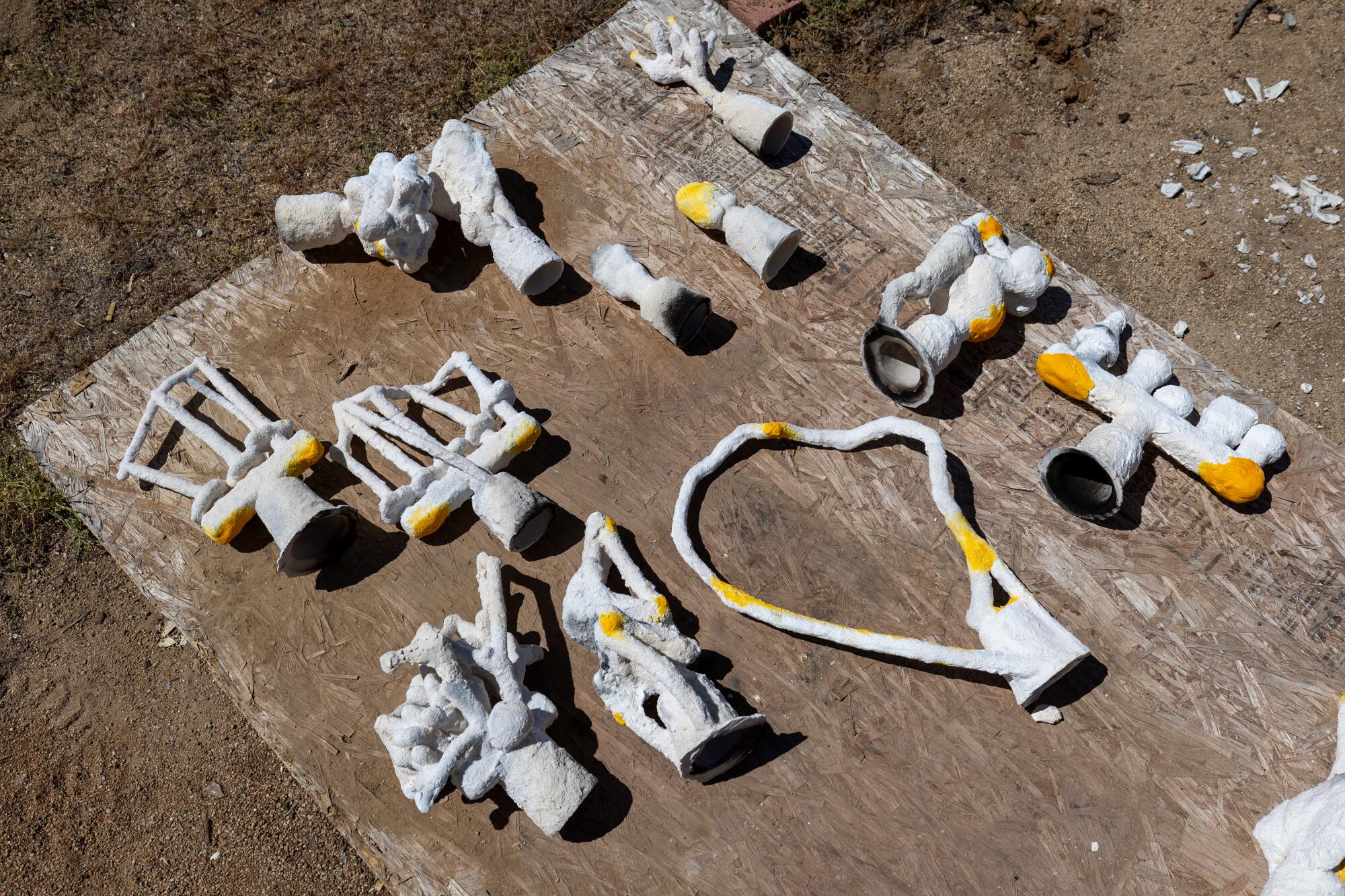
After pouring hot aluminum into one of her stick-shaped molds and letting it cool in a pile of dirt, a participant took a ball-peen hammer and cracked open the rough silicate mold, like a geode.
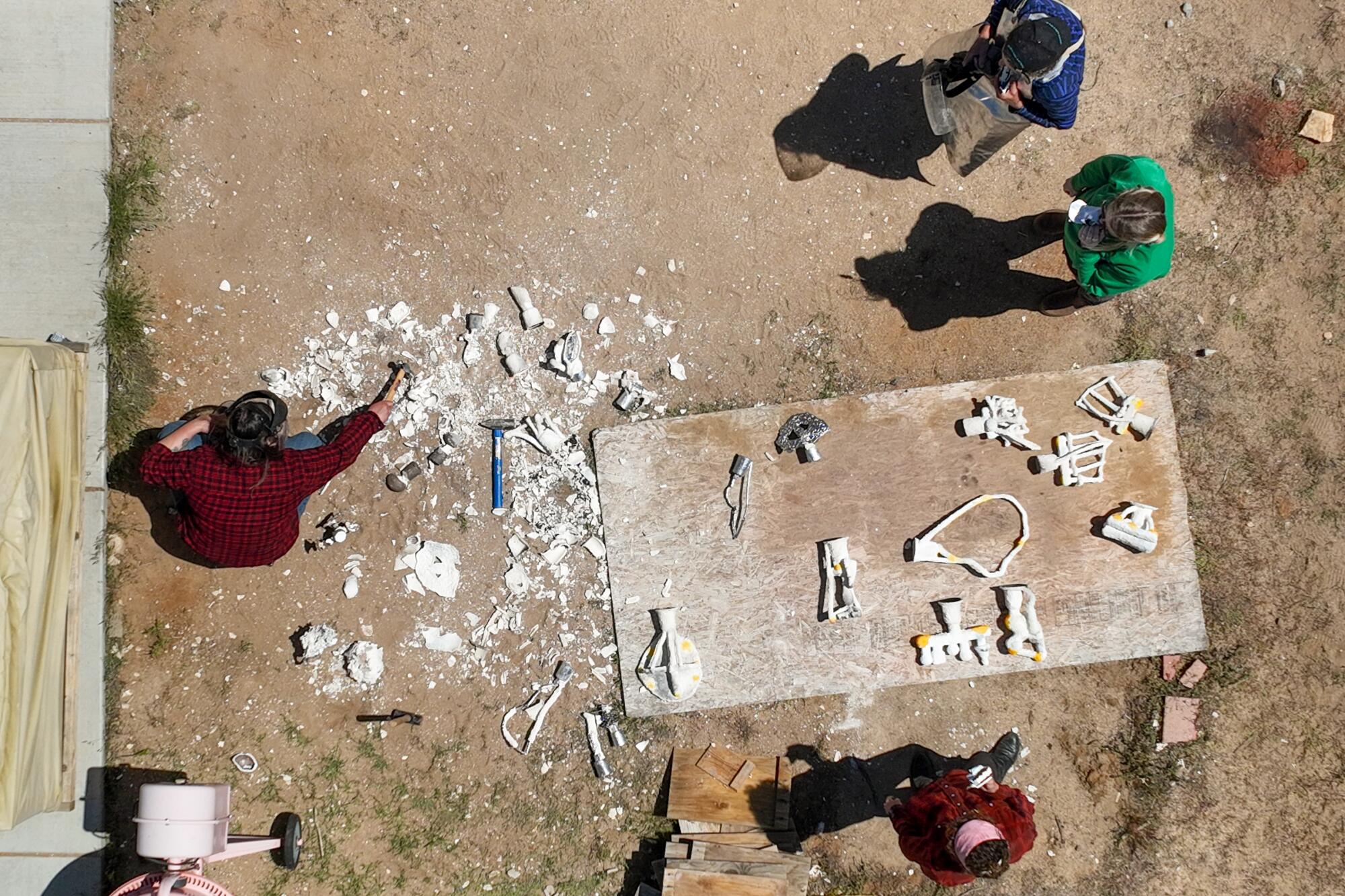
An aerial view of students in the foundry knocking plaster off molds with a ball-peen hammer.
The next day, participants buffed their objects and applied chemical solvents to create patinas and finishes before heading back to the city. After the last pour finished, the crucible was set aside to cool.
“That’s a wrap,” said Schwegler, while everyone clapped.


The Kennedy Center, the facade of which remains covered with a tarp, is seen in Washington, DC, on June 28, 2026. A US federal judge asked on June 24 for an explanation for why a tarpaulin continues to cover the facade of the Kennedy Center where President Donald Trump’s name was recently removed. District Judge Christopher Cooper gave the board of trustees of the performing arts venue until the end of July to explain “the purpose for and status of the tarp and scaffolding that Defendants have erected on the front portico of the Center.”
ALEX WROBLEWSKI/AFP via Getty Images
hide caption
toggle caption
ALEX WROBLEWSKI/AFP via Getty Images
More than two weeks ago, President Trump’s name was removed from the Kennedy Center facade though it is still covered by a tarp and the legal battle continues.
On Monday, a U.S. Department of Justice filing on behalf of the Kennedy Center included some surprises. The document was submitted in response to issues raised by lawyers for ex-officio board member Rep. Joyce Beatty of Ohio who is suing to remove President Trump’s name from the center and stop its closure for renovations.
Among the revelations, the Kennedy Center admitted that, during a board meeting on December 18, 2025, Beatty had been “muted and prevented from speaking.” It was at that meeting that the board voted to add President Trump’s name to the center. The filing later acknowledges the congresswoman was “prevented from voicing her opposition.”
The John F. Kennedy Center for the Performing Arts is a living memorial to its namesake. The guidelines for how the theatre complex spends federal dollars are very specific. Among other rules, it states that “no additional memorials or plaques shall be designated or installed.” Beatty argues adding Trump’s name runs afoul of those rules and that any change requires approval from Congress.
According to one of Beatty’s filings, “There was no advance notice in the agenda that the Board would be considering a name change,” a statement the Kennedy Center now does not deny. The center admits that, prior to voting, there was “no discussion about potential risks or downsides of the vote to adopt a secondary name for the Center.” Nor was there a board discussion “about any potential conflict of interest that might result from the vote.”
The center’s lawyers previously contended that if Trump’s name were to be removed, it would “lose money from donors who support” him and “impede the Center’s fundraising efforts.”
Closing for renovations
Earlier this year, Trump announced on social media that the Kennedy Center would close for two years for renovations. He wrote that he made the decision after “a one year review” with “Contractors, Musical Experts, Art Institutions, and other Advisors and Consultants.”
But, according to the center’s lawyers, Trump’s announcement “was made without presenting any plans, analyses, timelines, or funding information to his cotrustees and without any Board vote.”
The Kennedy Center has long denied reporting by The Washington Post that ticket sales plummeted after President Trump became the Center’s board chair. In Monday’s legal filing, the Center admits that, by October 2025, “nearly half of the Center’s tickets were going unsold.”


Paul Tremblay has made a career of pushing the horror genre – and the novel format – in strange and exciting new directions.
In his latest, Dead but Dreaming of Electric Sheep, the author offers an amalgamation of genre elements that can be best described as psychological-dystopian-science-fiction horror. It’s a mouthful, but the narrative does all of that and more in a way that defies categorization.
Julia Flang is a former semiprofessional gamer working two mediocre jobs she dislikes and living in a modest ranch house in a San Fernando Valley suburb with her retired uncle, whom she calls Uncle Fun. Julia likes movies and gaming but there’s little else going on in her life, so when her estranged mother, the CFO of a large tech company, contacts her with a possible job offer – a “once-in-a-lifetime thing” that pays handsomely just for doing the interview – she hesitantly agrees.

The job is relatively simple and perfect for someone with gaming skills: using a controller built into a phone to get a man, who is stuck in a vegetative state, from California to the East Coast. It will require her to learn how to control his body – walking, moving, sitting, standing, using his arms – so she can maneuver him out of the facility where he is located and into cars and planes and through crowded airports. A fan of movies, Julia decides to call the man Bernie – after the movie Weekend at Bernie’s. When the ethics of the job start to bother her, Julia realizes it’s too late and she must go through with it. However, she’s soon contacted by people interested in sabotaging the whole thing, people who, like her, don’t align with the shady interests of conglomerates and those set to make “gobs of money” from this new, somewhat inhuman technology.

As with every Tremblay novel, any synopsis barely scratches the surface. The novel’s chapters alternate between Julia and you (yes, you). Julia’s chapters are “normal” in the sense that they obey a chronological order and have action, basic descriptions of movement and places, and dialogue. The chapters in second person are like fever dreams from a shadow world; the desperate experiences of a man trapped inside his own body with no control of it, no clue what’s happening to him, and only a few fragmented memories of his life. Also, Tremblay uses a similarly fragmented style of storytelling (including words and sentences trapped in boxes and/or “moving” on the page) to keep things interesting but also confusing and creepy.
This novel operates on several different levels and – planes of existence? Bernie has a head full of AI that controls his body, but his consciousness is still there and struggling to regain control, struggling to remember things. There are monsters, leeches, mysterious rabbits, and eerie shadows in his world, but the true horror comes from the lack of control, from being moved around against his will and having no clue what comes next. Bernie is the embodiment of losing control to AI, and when taken together with the commentary of creativity and AI and the meta interludes in which the author takes a wrecking ball to the fourth wall and addresses readers, this is the best anti-Generative AI story horror has produced so far.
Despite the horror of it, this is a very funny novel. Julia is sarcastic and struggles to keep her comebacks in line, but the conversations she has and messages she writes are always entertaining. However, the humor is far from the crown jewel here. That title belongs to a plethora of big ideas Tremblay juggles. The nature of life, death, and consciousness, the evils of conglomerates, inhuman practices in the name of capitalism, and AI, and even what it means to be human are all explored here: “Is Bernie alive? Is he feeling pain? Is he experiencing everything as a prisoner looking through the bars of his body? Has his consciousness been winnowed to a metaphysical keyhole? Where does consciousness begin or end?” There are no definite answers here, but the way Tremblay infuses humanity, love, the importance of relationships, and humor throughout the narrative provides the kind of answers that can’t and don’t need to be spelled out.
A genre-bender full of big ideas that constantly switches between a world full of real or uncomfortably plausible nightmares and a bizarre hellscape in which loss of self, memory, and autonomy are only the tip of the proverbial iceberg, Dead but Dreaming of Electric Sheep is a horrific and terrifyingly disorienting novel that invites readers to consider a future that already started. Tremblay has always been an innovator, but this beautifully written collection of real and imagined grotesqueries cements him not only as one of the most original and exciting voices in horror but also as one of the smartest, most engaging authors in contemporary fiction.
Gabino Iglesias is an author, book reviewer and professor living in Austin, Texas. Find him on X, formerly Twitter, at @Gabino_Iglesias.

-

 World11 minutes ago
Russian gas imports rise despite EU phase-out
-

 News34 minutes ago
Woman survives falling 1,500 feet down Mount Shasta
-

 Los Angeles, Ca2 hours ago
Man dies after violent solo crash in Sherman Oaks
-

 Detroit, MI2 hours ago
Priority Waste CEO shares progress on plan to fix disruptions, delays across Metro Detroit
-

 San Francisco, CA2 hours ago
The San Francisco Church That Holds America’s Secrets
-

 Dallas, TX2 hours ago
Crews battle large fire at Pilates studio in Uptown Dallas, officials say
-

 Miami, FL2 hours ago
alaïa clads first miami boutique in pink mosaic tiles, from interior to facade
-

 Boston, MA3 hours ago
Looking for a lodging adventure? Beat the heat at a floating B&B. – The Boston Globe

