Entertainment
'Seinfeld' star Michael Richards is more than the worst thing that ever happened to them

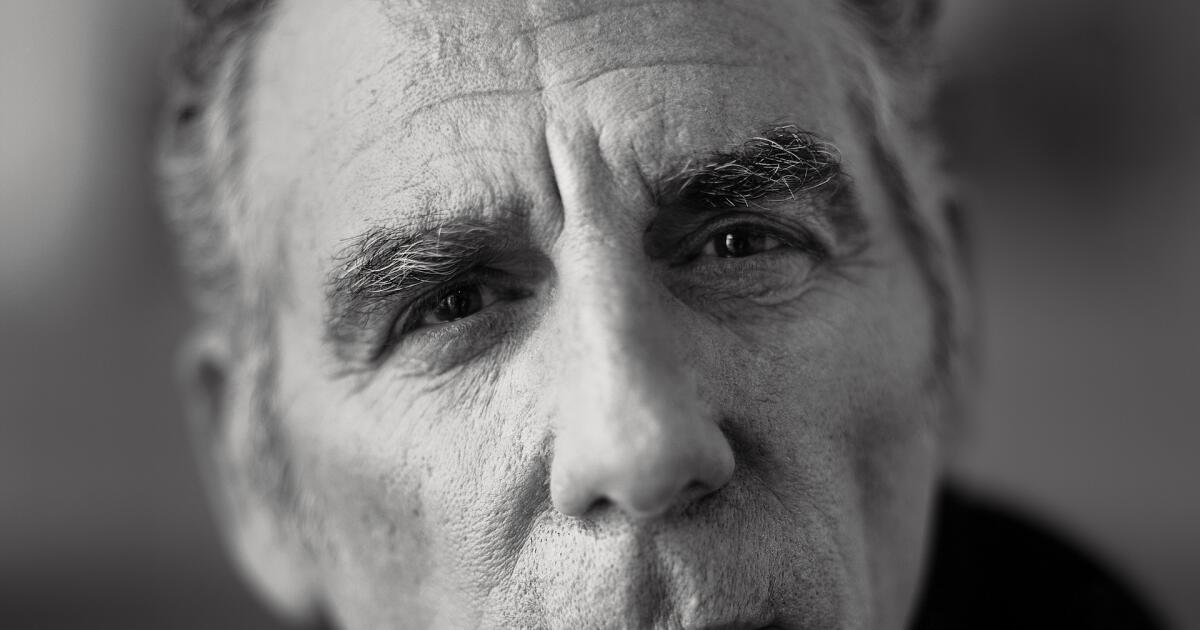
Michael Richards, who shot to fame as Kramer on the hit sitcom “Seinfeld,” is releasing a memoir, “Entrances and Exits.”
(Marcus Ubungen / For The Times)
On the Shelf
Entrances and Exits
By Michael Richards
Permuted Press: 440 pages, $35
If you buy books linked on our site, The Times may earn a commission from Bookshop.org, whose fees support independent bookstores.
Michael Richards entered the cultural consciousness, and the apartment next door, as a force of spontaneity named Cosmo Kramer. He was the rubber-limbed, unchained id of “Seinfeld,” the most popular sitcom of its era and a cultural phenomenon cultish in its fervor but too massive to really be considered a cult. Richards and Kramer worked without a net. The energy, the motion, the kavorka forever verged on chaos. But the chaos had a purpose, and it was tremendously popular. Richards won three Emmys for the role, and regularly earned the show’s biggest laughs.
Then, late one November night in 2006, the chaos tipped over into disaster. Performing a surprise set at the Laugh Factory, a venerable Los Angeles comedy club, Richards responded to some hecklers with a viciously ugly tirade. He hurled the N-word about, over and over, turning a night of uncomfortable comedy into the kind of incident that destroys careers. This was early in the era of ubiquitous cellphone cameras, when a horrible mistake could instantly be transmitted around the world. Richards quickly pivoted to damage control, making an appearance via satellite to apologize during his friend Jerry Seinfeld’s visit to “The Late Show With David Letterman.” But the damage was done. He was now widely labeled a racist, and worse.
Richards addresses his night of infamy in his new memoir, “Entrances and Exits,” and once again apologizes. The pop culture mulch machine will quickly reduce the book to soundbites: “Michael Richards says he’s not a racist!” But the Laugh Factory incident is but one tendril of Richards’ book, albeit an important one, tying into the dangerous high-wire act of performance in general and stand-up comedy in particular. It’s the story of a very lonely kid, raised by a working mother, a schizophrenic grandmother and the streets of Southern California; an army veteran who found his life’s purpose on the stage, poured everything into his craft, rose to the height of his profession, never learned to control his rage, flamed out in horrific fashion — and set about slowly rebuilding himself.
It’s also a reminder that everyone is more than the worst thing that ever happened to them — and that stability and comedy don’t always get along.
“It’s what I call the irrational,” Richards, 74, said in a telephone interview from his L.A. home. “We’re constantly being challenged … and anger’s in the midst of it. So it’s always an ongoing endeavor with me. We strive to be persistently rational, but there’s always the irrational, there’s always the mistake, there’s always the pratfall.”

“Public condemnation and humiliation are forms of justice,” Michael Richards writes in his memoir about the response to his racist Laugh Factory rant.
(Marcus Ubungen / For The Times)
Before Kramer, before public shame, there was a child wandering around Baldwin Hills, wondering who his father was and what might have happened to him. The kid soon discovered he liked to perform in drama class. It gave him a way to release the confusion and anxiety inside, and to make people laugh. But the kid still had a restless spirit. He studied acting at the California Institute of the Arts, created an absurdist, highly physical comedy act with his friend Ed Begley Jr. and was drafted into the army in 1970. Stationed in West Germany, he joined the V Corps Training Road Show; he took on the role of a colonel for that theater company. He stayed in character 24/7, even obtaining fake official military identification. It was the start of a lifelong obsession with creating and inhabiting a persona.
By 1989, when fellow former “Fridays” writer-cast member Larry David and Seinfeld had him audition for a new series then called “The Seinfeld Chronicles,” Richards was ready to launch. Much of his character, who was originally called Kessler, was on the page. But Richards built him into a rollicking, three-dimensional creation, right down to the clothes on his back.
“What Kramer wore was all hand-picked by me,” Richards said. “I gathered that wardrobe by combing every secondhand store in Southern California looking for shirt packs. All the clothing is out of the ’60s because my character is still pretty much wearing what he wore then. That’s why the pants are short and so forth, because he’s just a little taller. Everything about the character is justified.”
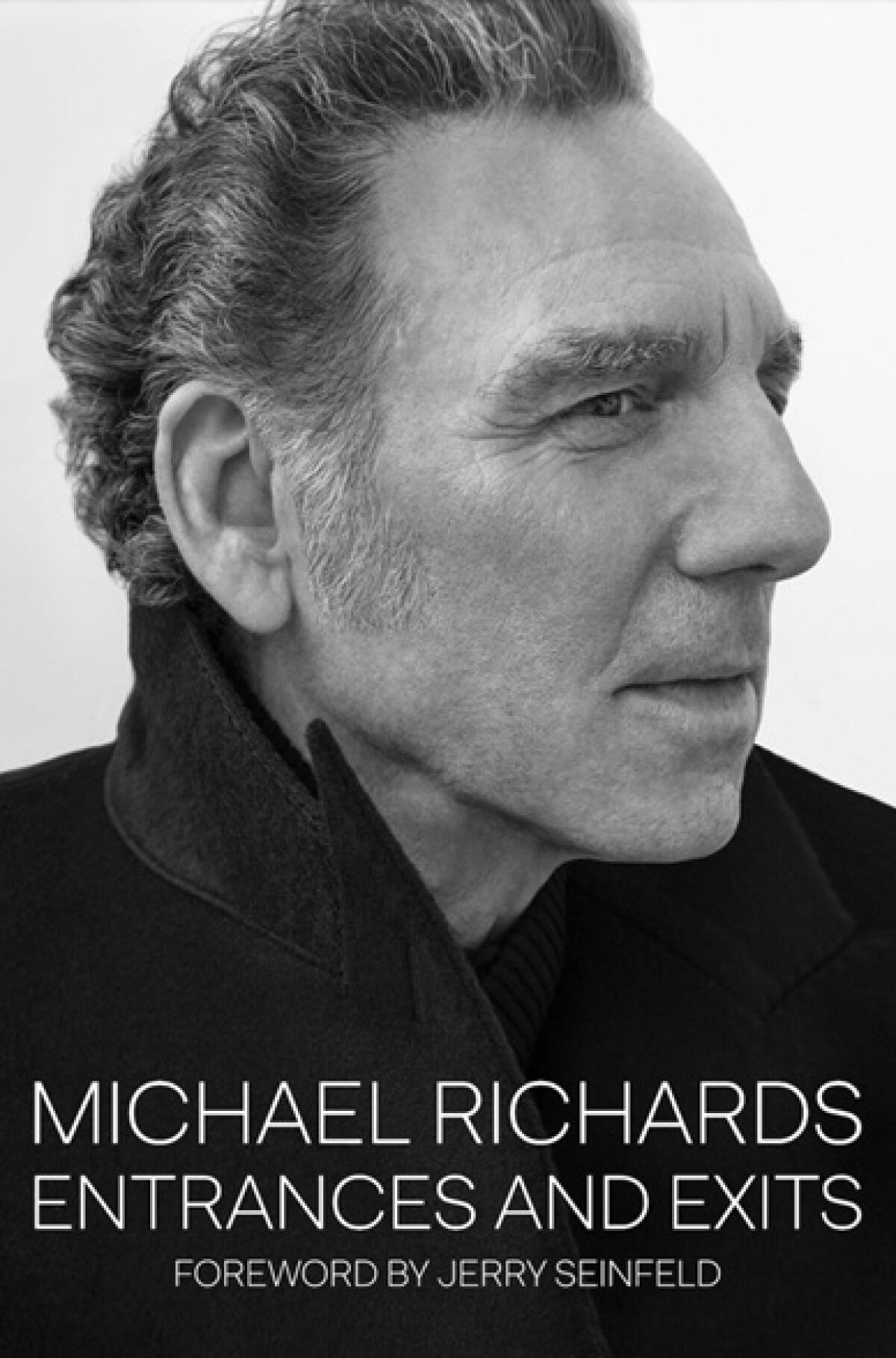
In “Entrances and Exits” Richards writes that he always considered himself more of a character actor or performance artist than a comedian, though he was also a creature of the comedy clubs on and off throughout his career. His act was never scripted and usually wild — falling on tables, walking onto the stage, futzing with the microphone stand and leaving. More than once in the book Richards uses the word “knockabout” to describe his school of comedy. But he also could be quite disciplined: Between seasons of “Seinfeld” he was often off studying acting in New York, trying to hone his craft.
Onstage, Richards generally went where the spirit moved him. And the spirit could get dark and unpredictable. He was friends with Sam Kinison, a comic whose entire act was based in rage, and there were times when Kinison alarmed Richards with the diamond-like purity of his anger. “He scares me,” Richards writes of his early impressions of Kinison. “I think he’s crazy and I’m heading in the same direction.”
By 2006 “Seinfeld” was in the rearview mirror. Richards’ follow-up series, “The Michael Richards Show,” had been swiftly canceled in 2000. He was a little adrift, and dipping his toe back into stand-up. On Nov. 17, 2006, he took the stage at the Laugh Factory later than usual. He was ill at ease, in angry-comedian mode, walking that razor’s edge between volatile performer and unhappy human. Then he heard the voice from the balcony: “We don’t think you’re very funny!”
“Of course, looking back at it, I wish I had just agreed with him,” Richards writes. “‘Okay, I’m not very funny tonight. Is there anything I can do? Wash your car, mow your lawn? I don’t want you leaving dissatisfied.’ Instead, I take his remark pretty hard. A solid punch below the belt.”
And he snapped — loudly, violently, using some of the ugliest language known to man.
Yes, he is sorry. And he accepts the descent into purgatory that followed. “Public condemnation and humiliation are forms of justice,” he writes. And nothing about his personal rehabilitation seems merely performative. Richards has spent his post-Laugh Factory years learning to live with himself away from the stage (although he still welcomes the occasional acting gig). He has studied the Hindu philosophy of Vedanta in Cambodia. He and his second wife, Beth, had a son, with whom he has finally brought himself to enjoy watching “Seinfeld” (for many years he was haunted by thoughts of how much better his performance could have been). He has fought, and, for the time being, defeated prostate cancer.

Michael Richards says these days, “I sit with the natural world, which seems to be behind most of everything we’re up to.” His memoir, “Entrances and Exits,” is out June 4.
(Marcus Ubungen / For The Times)
He is intent to continue doing what he calls “heart work,” figuring out who he really is and what animates the darkness within. Much like the kid who once roamed Baldwin Hills, he takes daily walks in the mountains of Southern California. “I want to get behind the behind, behind the words, the anger, the person, the cultural conditions and so forth,” he said. “So I sit with the natural world, which seems to be behind most of everything we’re up to.”
Pleas for forgiveness can get boring. “Entrances and Exits” is something else: an accounting of a life and the performances that go into it, for better and worse.


In Sender, writer-director Russell Goldman’s high-anxiety debut, the filmmaker expands on his 2022 short Return to Sender, in which Allison Tolman starred as a woman who receives packages she didn’t order. That may not sound like a premise that would result in a paranoid, darkly comedic thriller, much less a feature. But in extending his story from 18 minutes to just over 90, Goldman follows a maddening scenario involving an online retailer called Smirk, a fictionalized Amazon counterpart. More significantly, he captures the frenzied mindset of his protagonist, who grapples with staying sober and several other major life changes—all compounded by a layer of justifiable paranoia brought on by the endless packages. Goldman’s tweaky style and elusive scripting create a peculiar, out-of-whack presentation that destabilizes the viewer, firmly placing us in his main character’s perspective. However, by the end, the journey through this cine-manic headspace doesn’t add up to much, and the potential character study at the center feels somewhat lost in the mechanics of the conspiracy.
Britt Lower (AppleTV’s Severance) stars as Julia, who has just lost her job and moved into a rental home to get her life on track. She is backed financially by her overbearing sister Tatiana (Anna Baryshnikov), who occasionally comes nosing around to verify that Julia doesn’t backslide. And she doesn’t. Julia attends regular Alcoholics Anonymous meetings, where she meets the steely Whitney (Rhea Seehorn), who isn’t interested in being her sponsor. But at home, Julia receives a Smirk package with her brand of lipstick. The problem? She didn’t order it. She calls customer service, and the representative doesn’t help much before telling her, “Be sure to stay alert and aware.” Wait, what? Sender is loaded with nagging, unplaceable details like this. They’re often amusing, intriguing, and exasperating in the same moment. But these pieces don’t complete a whole picture, at least not a narratively satisfying one.
The Smirk packages, delivered by the outwardly helpful, nice-guy driver Charlie (David Dastmalchian), contain a random assortment of objects, from drum kits to protein powder. The squirrelly Julia, already coming apart at the seams from her recent drama, doesn’t know what to make of it. She’s convinced there’s some plot against her, perhaps by someone at Smirk. To what end, she doesn’t know. But Goldman gives us a glimpse of the long-term consequences of her ordeal in the prologue, which features Jamie Lee Curtis (also a producer) as Lisa, a woman in circumstances similar to Julia’s. Lisa’s response to receiving a box of soil with a broken shin pad (with “Can’t Can’t Can” scrawled on it) entails an attempt to suffocate herself with the bubble wrap, only to do far worse with a sharp edge of the shin pad. To show Lisa’s fate, Goldman’s imagery becomes twisted and surreal but also cryptic.
Sender’s disorienting mood is matched by a skewed formal presentation. Cinematographer Gemma Doll-Grossman’s wide-angle lenses and arch angles might feel at home in a Ken Russell or Terry Gilliam feature such as The Devils (1971) or 12 Monkeys (1996). Julia’s half-remembered drinking binges, accented by blurry close-ups, suggest she may have slept with any number of coworkers. She can’t remember, and it embarrasses her. Her rental is dressed in simple if shabby décor, which gives way to Julia’s erratic collage-like overhaul. Melisa Myers’ stuffed production design makes the most of heightened colors and banal, cluttered rooms that lend a normality to the bizarre, ever more disturbing predicament. Nathan Ruyle’s erratic music delivers what must be described as a soundscape rather than a traditional score, with collusive sound effects and tones driving our certainty that Julia is onto something. Along with Marco Rosas’ discordant editing, Goldman’s technical approach effectively reflects Julia’s fragmented, sleep-deprived mind. But his work as a writer hasn’t done enough to justify this level of technique.
After Julia makes a revelatory discovery that small cameras have been embedded in the products from those mysterious packages, the eventual explanation about what has been happening and why strains logic and underwhelms. It also raises even more unanswered questions. Although well-made and acted—Lower and Seehorn should be on track to movie stardom—Goldman’s script could have used another draft to better work through what unfolds. Sender doesn’t give us enough of its characters’ inner lives beyond the situation at hand, so Julia, Charlie, Tatiana, and Whitney feel like devices in a scenario rather than well-drawn human beings. Even so, Goldman fills his film with deeply broken people who try to gain control of their lives by controlling others, exposing and preying on their weaknesses. Despite the material’s potential resonance, Goldman’s style is overpowering. Still, his kernel of an idea and the way he explores it demonstrate his clear skill, and for much of Sender, its sheer oddball energy earns admiration.

“Lethal Weapon” star Danny Glover has revealed he has been living with Alzheimer’s disease for years.
In an interview with NBC’s Lester Holt that aired on the “Today” show on Wednesday, the 79-year-old actor and activist opened up about living with the disease. According to People, he received his diagnosis in 2023, which was not long after he was awarded an honorary Oscar in 2022.
“I could live with it, in a sense,” Glover says of his condition, which has been affecting his movement, speech and memory. “I’m sure as it advances, things are going to be different and changing.”
A neurodegenerative disease, Alzheimer’s is a type of dementia that affects memory, thinking and behavior and worsens over time, according to the Alzheimer’s Assn. Holt reports that more than 7 million Americans over 65 are living with Alzheimer’s, with Black men suffering at a rate double the national average.
Glover and his family say the Hollywood icon is sharing his story now to “have ownership of his life” and to help remove the stigma around the disease.
“They’ve got my back,” Glover says of his family’s support.
Besides his portrayal of L.A. police Det. Roger Murtaugh in the “Lethal Weapon” film series, Glover is known for roles in movies including “Places in the Heart” (1984), “The Color Purple” (1985), “To Sleep With Anger” (1990), “Angels in the Outfield” (1994), “Dreamgirls” (2006) and “The Last Black Man in San Francisco” (2019). He’s also been a vocal advocate for social justice and humanitarian causes both in the U.S. and abroad.
He was the recipient of the Academy of Motion Picture Arts and Sciences’ Jean Hersholt Humanitarian Award in 2022.
“I don’t feel like it’s the end of my life,” he said in his interview with People about living with Alzheimer’s. “There’s work to do.”

Enter your email and we’ll send a secure one-click link to sign in.
WKRN is provided by Nexstar Media Inc., and uses the My Nexstar sign-in, which works across our media network.
Nexstar Media Inc. is a leading, diversified media company that produces and distributes engaging local and national news, sports, and entertainment content across its television and digital platforms. The My Nexstar sign-in works across the Nexstar network—including The CW, NewsNation, The Hill, and more. Learn more at nexstar.tv/privacy-policy.
-

 News1 minute ago
Newsom’s office responds to SCOTUS ruling on women’s sports as California faces ongoing trans athlete wave
-

 Los Angeles, Ca1 hour ago
Family of boy, 8, killed by falling tree branch at Calabasas park to get $14.6M
-

 Detroit, MI2 hours ago
The worst Detroit sports uniform from every pro team
-

 San Francisco, CA2 hours ago
Discovery Bay driver arrested for San Francisco fatal vehicle collision | Contra Costa Herald
-

 Dallas, TX2 hours ago
Erling Haaland’s Dallas Western wear purchase goes viral
-

 Miami, FL2 hours ago
Miami’s FIFA Fan Fest draws thousands to Bayfront Park to watch Team USA win World Cup match against Bosnia
-

 Boston, MA2 hours ago
2026 Yukon Denali Ultimate gets pricey, but tops the charts
-

 Denver, CO2 hours ago
Nuggets Sign Marvin Bagley to 1-Year Deal: What It Means

