New Mexico
New Mexico to receive $18.9M in federal money for ‘forever chemical' detection • Source New Mexico

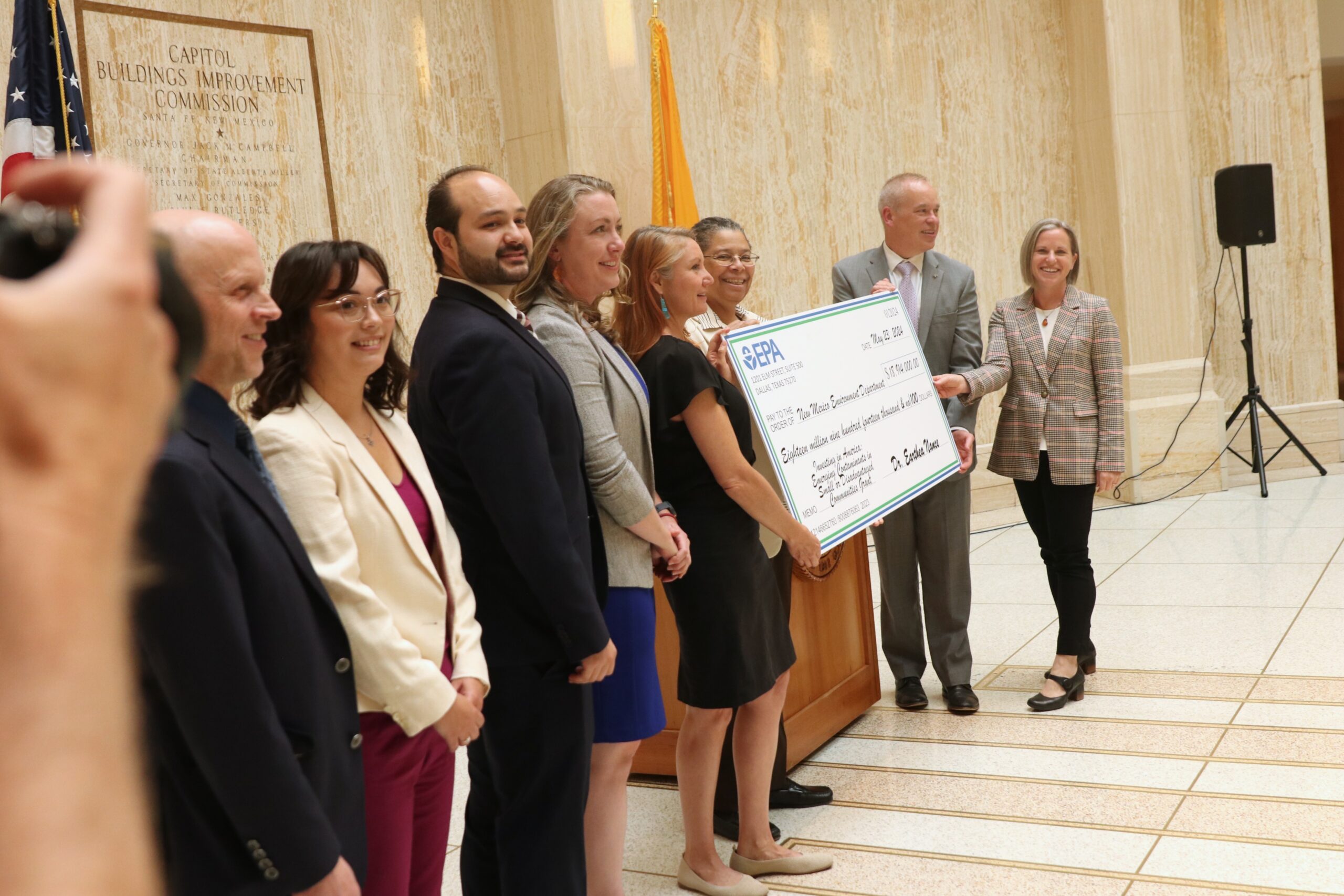
Big check energy at the Roundhouse.
National and state environmental officials celebrated a $18.9 million federal grant for most of New Mexico’s water systems to use over the next two years to detect “forever chemicals,” in the state’s drinking water.
State officials say they hope to pull down a total of $47.2 million in the next five years in additional rounds of federal grants. The first two years will focus on detection and subsequent phases will address removal of Per-and polyfluoroalkyl substance (PFAS for short) in drinking water.
More than 496 systems serving 231,000 New Mexicans are eligible for the funding, state officials said.
A check of this size will help the state “fund its way” out of pollution, said New Mexico Environment Secretary James Kenney from the Roundhouse Rotunda.
“These forever chemicals will not be a forever legacy. We will address these chemicals and New Mexico will be the leader in the way we do that,” he said.
What are PFAS?
This class of synthetic chemicals are ubiquitous, present in the blood of most people in the U.S. They are toxic and extremely hard to break down. There are nearly 15,000 types of these chemicals, according to the U.S. Environmental Protection Agency.
EPA looks to limit toxic ‘forever chemicals.’ Here’s what New Mexicans should know
Their resistance to breaking down in sunlight, water, oil and fire over time makes them useful in fabrics, nonstick cookware, food packaging, in our carpets, clothes and firefighting foam. It also means they build up in our bodies, linked to cancer, heart and liver problems, developmental damage, vaccine resistance and other health issues.
Despite decades of rising concern about the dangers of these chemicals, the EPA only implemented drinking water limits for only the five most-common, releasing the final rule in April 2024.
These drinking water limits for the two most-studied and common chemicals – PFOA and PFOS – is 4 parts per trillion, the lowest limit the EPA believes to be technologically possible. The new rule requires water systems to be compliant by 2029.
The size of the problem will require billions of dollars in spending, with an estimated cost of $1.5 billion to implement the drinking water rules.
And that’s just the low estimate. The U.S. military estimated PFAS clean-up just on military bases and surrounding communities to be at least $31 billion.
New Mexico context
As the nation grapples with the reality of these contaminants’ omnipresence – in rainwater, in our bodies, in animals – New Mexico water systems are already struggling.
In 2021, the environment department found PFAS in at least 15 water systems in New Mexico, according to tests performed with federal assistance.
The most impacted communities are in Curry County and Otero County, according to that data. That’s also where PFAS plumes from firefighting foam infiltrated the groundwater for decades next to military bases. The state tested more than three dozen cities and water systems for 28 compounds. Only five compounds are subject to the proposed limits.
A Clovis dairy had to euthanize more than 3,600 cows after Cannon Air Force base contaminated water sources infiltrated wells on the dairy.
Rep. Melanie Stansbury described hearing about the moment, saying that the disaster made PFAS not just an economic issue, but a personal one for New Mexico.”
“It’s a big day for New Mexico. it’s a big day for families, it’s a big day for ranchers, and it’s a big day in our fight to really tackle the chemical contaminants that affect our communities,” Stansbury said.
Rebecca Roose, acting as the infrastructure czar in the governor’s office said addressing PFAS is part of a larger plan to address water scarcity in the arid state.
“When we talk about our water being polluted and contaminated and not safe, there’s few things we take more seriously than that,” Roose said. “Perhaps right up there with it is protecting the water so that it never becomes polluted, contaminated or unsafe, because there is not a drop of water to spare.”
The federal grant is funded from the 2021 Bipartisan Infrastructure Act, which contained at least $9 billion earmarked for addressing PFAS contamination.
This is the first grant of its kind in the region, said Earthea Nance, who oversees EPA Region 6, which includes Texas, Louisiana, Oklahoma and New Mexico.
Nance said there are no set plans for enforcement for holding PFAS polluters accountable in Region 6, but said that could change with more information.
“I don’t want to say no, because we mean, tomorrow, we could start putting a plan together,” she said.
Nance said the EPA Region 6 office is relying on state officials to help determine how large the enforcement response will be.
“Because we’re giving this money to the state of (New) Mexico, some of that will fall on them in terms of assessing the situation so that we can then figure out how to identify enforcement issues,” Nance said.
How does the program work?
The grant has the unwieldy name; Emerging Contaminants in Small or Disadvantaged Communities Program (EC-SDC). Name aside, it will allow for New Mexico’s environment leaders to spend up to $18.9 million over the next two years.
The program’s first phase will oversee water sampling, creating a statewide database and outreach to water systems, according to environment department officials.
Public water systems with 10,000 or fewer connections, or communities where the median household income falls between $56,828 – $75,770 are eligible to opt in, using this form.
“The great thing about this grant is we will be hiring and controlling a lot of the contract work and actually implementing it, which does take a little bit of a relief off the water systems,” said Kelsey Rader, the deputy division director for Water Protection with the state.
Rader said further federal money, two years from now, would offer more than testing, but also water treatment.
“That’s what’s really special about this grant is that it covers everything from the testing, from the design to the actual remediation, in paying for the necessary upgrades,” she said.
When asked if the $18.9 million is close to addressing the scope of PFAS in New Mexican’s water systems, Rader said the department doesn’t have a date set on when they’ll be able to test every New Mexico system.
“It’s difficult to say when that’s going to happen,” she said.
More work to do
Kenney said the state is still working to address current contamination, noting the environment department recently sent a letter asking for the federal government to commit to clean up water surrounding the Cannon Air Force base, not just beneath it.
A contentious court fight continues on, as the New Mexico Environment Department is still attempting to require the U.S. Air Force to follow state testing and treatment protocols over contamination at Cannon Air Force base. The case has stretched on for years in federal district court and now is in the 10th Circuit Appeals Courts.
Battle between New Mexico and US Air Force to track toxic chemicals drags on
The state is currently in mediation with the U.S. Air Force over the litigation and has been for over a year, said Bruce Baizel, the compliance and enforcement director for the environment department. The parties just extended that mediation period through late June.
The $18.9 million for clean-up would go farther, if people’s contact with PFAS in everyday items were reduced, said Kenney.
“In our legislative session, I’d like to see a bill introduced that bans PFAS but for essential uses, like medical devices,” he said. “But if given the choice of having a toxic chemical in your house that then becomes a toxic chemical in your body, I would choose not to have it in my house, or my body.”
GET THE MORNING HEADLINES DELIVERED TO YOUR INBOX



SANTA FE, N.M. – Santa Fe County and Edgewood approved a new agreement and ordinance that secures ongoing fire and EMS services for Edgewood residents.
According to a joint announcement from the Town of Edgewood and Santa Fe County on June 19, the two governments negotiated and adopted a new Joint Powers Agreement and ordinance to keep the Santa Fe County Fire Department serving the town.
County and town representatives drafted the agreement together. The town adopted the ordinance unanimously at a special meeting on June 16, putting an end to weeks of uncertainty.
Santa Fe County District 3 Commissioner Camilla Bustamante said, “I believe we are all relieved to know that the people of Edgewood will continue to have the fire and EMS services necessary to protect their homes, their families, and their community. This community deserves nothing less.”
The announcement said the ordinance takes effect five days after final publication. The statement also said no further action or approval is needed to guarantee continued fire suppression, fire prevention, and EMS services for Edgewood residents.
Both governments noted the agreement will continue indefinitely unless either side ends it with five years’ notice.


New Mexico leaders are backing a bipartisan bill after 12 confirmed U.S. screwworm cases, including one case in a Lea County dog.
SANTA FE, N.M. – New Mexico leaders are backing a bipartisan bill after 12 confirmed U.S. screwworm cases, including one case in a Lea County dog.
New Mexico State Veterinarian Dr. Samantha Holeck said the parasite has spread to New Mexico, though officials say they have not found any human cases.
“This is also not a political issue this is a nationwide issue that we all need to address because it affects all warm blooded animals including humans,” Holeck said.
U.S. Reps. Gabe Vasquez and Teresa Leger Fernandez support the Protect America’s Herds Act.
The bill would create a grant program to train people to identify, treat, prevent and report screwworm. It would also support more livestock inspections and education for ranchers.
Rep. Teresa Leger Fernandez said she heard concerns from tribal leaders about the cost of protecting cattle herds.
“I spoke with one of our tribal leaders today and they have cattle operation and they’re worried, and they’re talking about how much more money they’re having to pay to go make sure they check on their herds and there are extra costs,” Leger Fernandez said.
Funding would prioritize states and tribal communities most at risk for screwworm outbreaks.
State health officials said screwworm is not a food safety issue. They also said ranchers should stay alert but not alarmed.
-
 Sports27 seconds ago
Shohei Ohtani out of Dodgers’ lineup vs. Orioles for birth of his second child
-

 World13 minutes ago
Lebanese influencer organises World Cup event amid Israel’s attack on Leban
-
 News35 minutes ago
Air Force One, gifted to Trump from Qatar, arrives at Joint Base Andrews
-

 New York2 hours ago
Video: Fans Show Up to the Parade in Their Best Knicks-Themed Attire
-

 Los Angeles, Ca2 hours ago
Victims sought after man allegedly points gun at passing cars in Santa Clarita Valley
-

 Detroit, MI2 hours ago
Best barbershop in Metro Detroit: Finalists for this year’s Vote 4 The Best
-

 San Francisco, CA3 hours ago
How to watch San Francisco Giants vs. Miami Marlins
-

 Dallas, TX3 hours ago
Drivers in North Texas struggle with Friday floods

