South Dakota
Noem hires former Oglala Sioux police chief for state post as another tribe votes to ban her • South Dakota Searchlight


Gov. Kristi Noem appointed a former Oglala Sioux Tribe Department of Public Safety chief to a post in the state’s Department of Tribal Relations on Tuesday, alleging he “found himself without a job” for speaking up about drug cartels on the Pine Ridge Reservation.
The appointment of Algin Young as tribal law enforcement liaison came as another tribe voted to ban the governor from its lands, and as questions arose about the impact of a ban voted on by another South Dakota tribe.
Sixth tribal nation bans Noem for comments on cartels, Native children
The Crow Creek Sioux Tribe voted to ban Noem from its lands Tuesday morning, Chairman Peter Lengkeek told South Dakota Public Broadcasting. The Yankton Sioux Tribe’s Business and Claims Committee, the highest-level elected body for that nation, voted to support a ban last week, though it’s since been pointed out that such a ban would not be final and enforceable without a vote of tribal members. The tribes were the sixth and seventh of the nine tribes in the state to vote in favor of banning the governor so far this year.
The recent spate of conflicts with the state’s tribes began on Jan. 31, when the governor delivered a speech on U.S. border policy to a joint session of the South Dakota Legislature. In it, she described the southern border of the U.S. as a “warzone,” language she repeated in her Tuesday press release on Young’s appointment.
Her speech included language calling out the impact of Mexican drug cartels on the reservations.
Noem has suggested that responses from tribal leaders to her cartel comments, as well as the bans, have come because some of them are “personally benefiting” from a cartel presence on reservations.
She’s also drawn fire for telling audiences in Winner and Mitchell that Native children lack hope, and that “they don’t have parents who show up and help them.”
Young appointment implies firing
Noem has argued that the federal government is failing tribes through a lack of law enforcement funding. The Oglala Sioux Tribe has sued the federal government over that issue, and Noem pledged to support that lawsuit during her Jan. 31 speech.
The governor’s office has not intervened as a party in the tribe’s most recent federal lawsuit, but she has moved to support tribal law enforcement in other ways. Last month, she pledged to fund a special session of the state’s police academy specifically for tribal trainees. Most tribal police train for 13 weeks in New Mexico, and South Dakota’s congressional delegation has lobbied for a regional training facility to encourage recruitment.
In February, Noem penned a letter to the U.S. Senate Committee on Indian Affairs urging more funding for tribal law enforcement in South Dakota.
In Noem’s press release on his appointment, Young said that he looks forward “to serving as an ambassador for the State of South Dakota at the federal level and with the State’s nine tribal nations to facilitate solutions for tribal law enforcement and understand and navigate jurisdictional challenges.”
The release also includes a thinly veiled reference to tribal resistance to Noem’s comments.
The release says that Young “found himself without a job” after “bravely testifying before the U.S. Senate Committee on Indian Affairs on the cartel presence on tribal lands.”
Noem slings accusations about tribes while signing education bills
Young testified before that committee during a listening session about public safety in Indian Country on March 20. His testimony came minutes after the testimony of Oglala Sioux Tribal President Frank Star Comes Out.
Neither mentioned cartels in their verbal comments, which can be viewed in full on the committee’s website.
The Senate committee did collect written testimony until April 12, and that testimony is not available online. There was no immediate response Tuesday to an email to the committee’s press officers asking for any written testimony that may have been submitted by Young or Star Comes Out.
The tribe’s director of public safety job was advertised on the tribe’s Facebook page on April 15. There were no Senate Indian Affairs Committee hearings between March 20 and that date.
Indian Country Today reported that Young’s contract expired on April 20.
Star Comes Out did not return a Searchlight message seeking comment on Young’s appointment.
Representatives with Noem’s office and the Office of Tribal Relations did not offer a date for the “cartel presence” testimony.
Yankton Sioux Tribe ban vote not binding
So far, seven tribes have voted to ban Noem from their lands. The Lower Brule Sioux Tribe and Flandreau Santee Sioux Tribe have yet to pass such a resolution. Lower Brule voted down such a ban earlier this year, but Chairman Clyde Estes told SDPB that it might consider one again in June based on Noem’s comments about Native children.
Noem to lawmakers: Be ready to take action on southern border ‘invasion’
“The children should be left out of any political discussion,” Estes told SDPB’s Lee Strubinger. “To say that they have no hope is wrong and she should not have said that.”
The Yankton Sioux Tribe’s Business and Claims Committee voted to support a ban that would bar the governor from its lands on Friday, but that vote lacks the authority of law, the committee’s secretary said Tuesday.
Such a ban would not be official without a vote from the tribe’s general council, meaning a vote of tribal members at a meeting called by either the committee leadership or a petition from tribal members.
“We don’t have anything scheduled,” said Secretary Courtney Sully. “We don’t even have a resolution.”
The Yankton Sioux Tribe is the only one of the nine tribes in South Dakota that lacks a tribal council-style government with elected representatives to vote on all tribal affairs. Such governments are known as “IRA” governments, named for the Indian Reorganization Act of 1934, which encouraged tribal nations to adopt city council-style authority structures.
The Yankton Sioux Tribe’s Business and Claims Committee, Sully said, aligns more closely with pre-colonial decision-making. The committee is empowered to manage the tribe’s day-to-day affairs, Sully said, but cannot take larger actions without a vote of the people.
“Banning someone isn’t part of our daily business,” said Sully, who said she abstained from the Friday vote. She doesn’t like the governor’s comments, she said, but doesn’t believe they rise to the level of something requiring a ban.
The majority of the committee did vote to endorse a ban, however. A statement from Vice Chair Jason Cooke, sent to Searchlight on Tuesday, reiterated the earlier words of committee member Ryan Cournoyer, who said the vote was a sign of solidarity with other tribes.
The statement calls the governor “anti-tribe.” It references pre-2024 conflicts over pipeline protests, COVID checkpoints, education, and Noem’s lack of response to discrimination against Native Americans by a Rapid City hotel owner. The statement says the governor “now blames tribes for crime in her own cities.”
“Governor Noem, stop the political pandering and get serious about working on these issues with Tribes,” Cooke wrote. “It has been six years of inaction, ineptness, and ignorance from your office on serious policy issues impacting our shared citizens.”
GET THE MORNING HEADLINES DELIVERED TO YOUR INBOX



The South Dakota Lottery offers multiple draw games for those aiming to win big.
Here’s a look at June 22, 2026, results for each game:
Winning Powerball numbers from June 22 drawing
17-19-21-45-48, Powerball: 13, Power Play: 2
Check Powerball payouts and previous drawings here.
Winning Lotto America numbers from June 22 drawing
12-13-35-41-52, Star Ball: 05, ASB: 02
Check Lotto America payouts and previous drawings here.
Winning Millionaire for Life numbers from June 22 drawing
07-08-20-24-42, Bonus: 05
Check Millionaire for Life payouts and previous drawings here.
Feeling lucky? Explore the latest lottery news & results
Are you a winner? Here’s how to claim your prize
- Prizes of $100 or less: Can be claimed at any South Dakota Lottery retailer.
- Prizes of $101 or more: Must be claimed from the Lottery. By mail, send a claim form and a signed winning ticket to the Lottery at 711 E. Wells Avenue, Pierre, SD 57501.
- Any jackpot-winning ticket for Dakota Cash or Lotto America, top prize-winning ticket for Lucky for Life, or for the second prizes for Powerball and Mega Millions must be presented in person at a Lottery office. A jackpot-winning Powerball or Mega Millions ticket must be presented in person at the Lottery office in Pierre.
When are the South Dakota Lottery drawings held?
- Powerball: 9:59 p.m. CT on Monday, Wednesday, and Saturday.
- Mega Millions: 10 p.m. CT on Tuesday and Friday.
- Lucky for Life: 9:38 p.m. CT daily.
- Lotto America: 9:15 p.m. CT on Monday, Wednesday and Saturday.
- Dakota Cash: 9 p.m. CT on Wednesday and Saturday.
- Millionaire for Life: 10:15 p.m. CT daily.
This results page was generated automatically using information from TinBu and a template written and reviewed by a South Dakota editor. You can send feedback using this form.


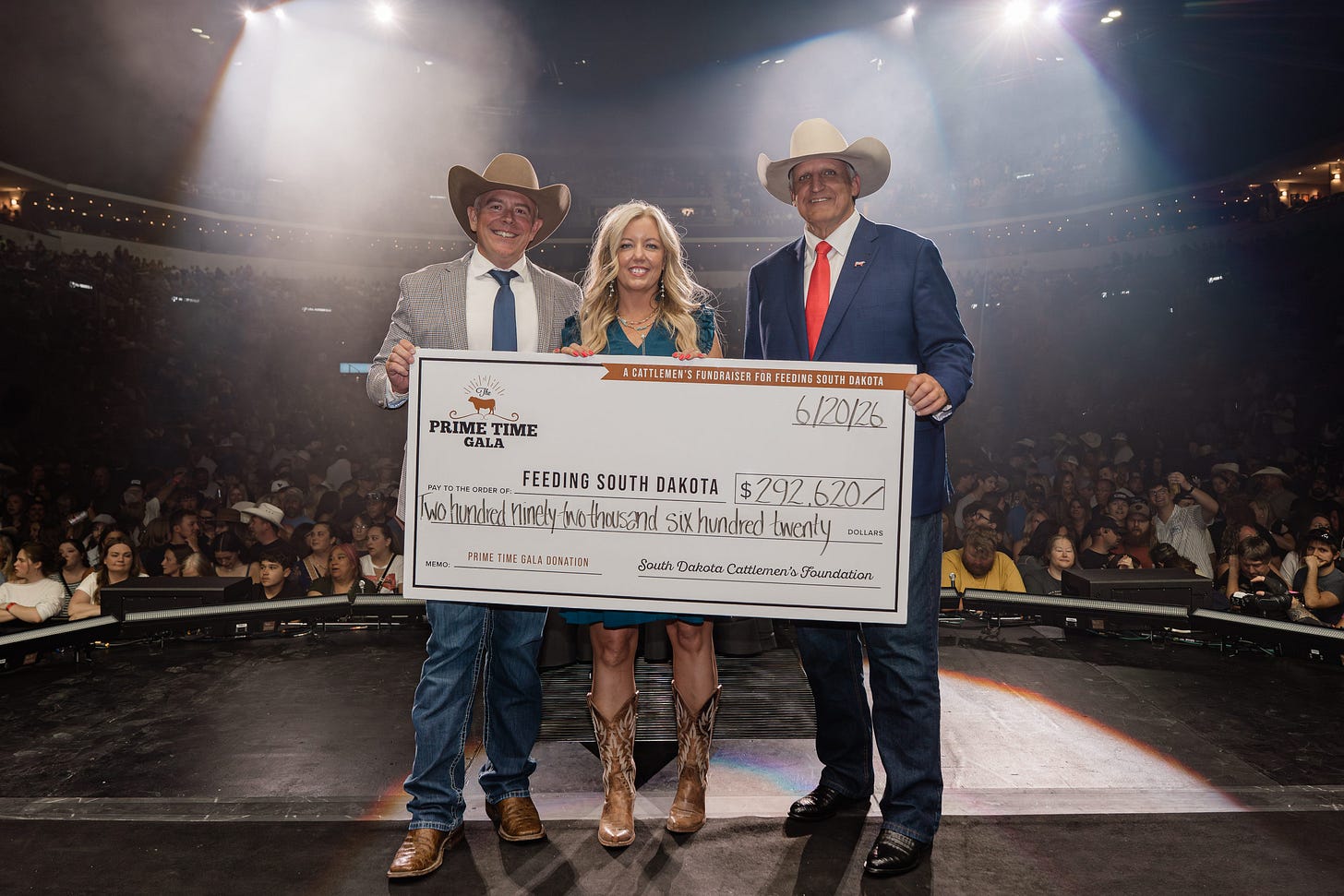
At the South Dakota Cattlemen’s Foundation’s 13th annual Prime Time Gala on Saturday, June 20, 2026, the point of the evening was never far from view: beef, music, scholarships and fundraising all tied back to getting high-quality protein to South Dakotans who need it.
Held at the Sioux Falls Convention Center and Denny Sanford PREMIER Center complex, the Prime Time Gala again brought together cattle producers, agricultural businesses, community supporters and Feeding South Dakota for an upscale dinner, auction program and country concert. The evening opened with a prayer from Ray Larson before moving into the program, awards and live auction.
“Success boils down to one thing, and that’s to all of you who are with us tonight,” foundation leadership told the crowd, framing the event as a collective effort by ranchers, cattle feeders, donors, volunteers and businesses across the state.
Viewpoints
VIEWPOINT | Don’t blame voters for lack of trust in South Dakota politics: Look in mirror

Too much of today’s political conversation revolves around personalities, endorsements and internal political scorekeeping. We argue about who is conservative enough, who is endorsed by the right people, who is supported by the right organizations and who belongs to the right political tribe. While politicians and activists debate those questions, many ordinary voters are simply asking who is focused on solving problems and improving their communities.




See Macy Bryant talk about her cycle, Jefferson softball’s 5-0 start
Sioux Falls Jefferson’s Macy Bryant talks about her cycle against St. Louis Park (MN) and her team’s undefeated start to their state title defense.
The South Dakota High School Activities Association’s fourth year sponsoring softball is in the books, and there were plenty of standout performers during this season.
From Class AA to B, teams made leaps thanks to some top-tier players and were able to place at the state tournament because of them.
Here is the first Argus Leader Starting 9, comprised of athletes from all three classes. They are broken down positionally, with a pitcher, a catcher, four infielders and three outfielders making up the team.
The players are listed in positional order.
Statistical key: IP-innings pitcher, K-strikeouts, ERA-earned run average, WHIP-walks and hits per inning pitched, K/7-strikeouts per seven innings, H/7-hits allowed per seven innings, BB/7-walks allowed per seven innings, AVG-batting average, OBP-on-base percentage, SLG-slugging percentage, OPS-on-base plus slugging, 2B-doubles, 3B-triples, HR-home runs, RBI-runs batted in, R-runs scored, SB-stolen bases
P: Tya Devericks, Jr., Sioux Falls Jefferson
80 IP 112 K 0.88 ERA 0.76 WHIP 9.8 K/7 4.1 H/7 1.3 BB/7
.514 AVG, .590 OBP, 1.000 SLG, 1.590 OPS, 10 2B 3 3B 6 HR 32 RBI 16 R 6 SB
Devericks dominated both in the circle and at the plate, but she put together one of the more impressive pitching seasons imaginable. The South Dakota commit helped Sioux Falls Jefferson allow just 1.2 runs per game, go undefeated and win the Class AA state championship with her dominance, commanding multiple pitches in and around the zone.
“The best part of Tya is her competitive instincts,” Jefferson head coach Ed Whiting said. “This drives everything that she does, and others follow. Outside of being an absolutely dominant pitcher, she is an elite hitter which makes her an outstanding two-way player. Tya has been voted a team captain since her sophomore year. This is due to her strong ability to lead by example on the diamond, in the weight room and in the community.”
C: Claire Loofbourrow, Jr., Freeman/Marion/Freeman Academy
.612 AVG, .634 OBP, 1.328 SLG, 1.962 OPS, 17 2B 2 3B 9 HR 50 RBI 16 R 8 SB
Loofbourrow was one of the top run producers in the state, with her 50 RBIs leading all members of this team. She helped Freeman/Marion/Freeman Academy earn the upset over No. 3 Deuel in the SoDak 16 and finish fifth in the Class B state tournament. She has one more year left in high school, and any more improvement will put her stats in rare air nationally.
“She’s got a pretty good arm for a catcher,” Freeman/Marion/Freeman Academy head coach Kyle Weier said. “But where she’s most beneficial is when she’s got a bat in her hand. She is really solid and always makes contact. She takes a hard swing, so when she makes contact the ball goes and then she’s pretty fast. That’s how it’s always an extra base hit.”
INF: Macy Bryant, Sr., Sioux Falls Jefferson
.784 AVG, .804 OBP, 1.595 SLG, 2.399 OPS, 20 2B 8 3B 8 HR 41 RBI 56 R 16 SB
Bryant put together one of the most special seasons in the nation, with her .784 batting average sitting in the top 10 and her on-base percentage and slugging percentage are both in the top 50. She was also a terrific defender for the unbeaten state champs. Bryant will be going to South Dakota State next year, and she could be a major contributor if this hot stretch continues through the summer and fall.
“Macy is dominant at the plate,” Whiting said. “The problem with pitching to Macy is there is not a pitch that catches a fraction of the plate that she can’t hit hard. The problem with walking her is that other teams have to deal with her aggressive approach on the bases. When on base, which happens eight out of 10 times, she typically ends up touching home. She is a complete player as she has a cannon of an arm and amazing range that makes her hands down the best shortstop in the state.”
INF: Brooklyn Herrera, Sr., Sioux Falls Jefferson
.577 AVG, .595 OBP, .901 SLG, 1.496 OPS, 7 2B 2 3B 4 HR 32 RBI 27 R 7 SB
Herrera was one of the steadiest players in the state on both sides of the ball. She was a middle-of-the-order bat on South Dakota’s best team and was always a threat, even if the power production wasn’t as prolific as others. Add in that Herrera was a very good defender, and she’s more than deserving of making the cut.
“Brooklyn shows up and works downhill at all times,” Whiting said. “Playing the hot corner, her instincts do not let anything get by her. She is a consistent player who rises to the occasion when the stakes are the highest. Whether it’s locking down third base or driving in runs from the cleanup spot, Brooklyn always delivers.”
INF: Kennedy Kokenge, Jr., Harrisburg
.531 AVG, .597 OBP, 1.203 SLG, 1.800 OPS, 4 2B 3 3B 11 HR 37 RBI 28 R 1 SB
Kokenge is one of the most powerful bats in South Dakota, ripping 11 home runs to finish second statewide. The South Dakota State commit provided consistent on-base skills when she wasn’t launching the ball over the fence for the top-scoring offense in Class AA. Kokenge also mixed that with the smoothness to play a quality shortstop for Harrisburg.
“Kennedy Kokenge possesses all the tools of a premier infielder,” Harrisburg head coach Keith Flemmer said. “She has exceptional range, the ability to get to nearly any ball and the arm strength to make throws from anywhere on the field. Combined with one of the quickest and smoothest glove-to-hand transfers I’ve ever seen, she makes difficult double plays look routine. At the plate, Kennedy is equally impressive. She batted .531 this season while tying the team record with 11 home runs. She also struck out just once all year, showing how powerful and consistent she is.”
INF: Kjerstin Kyte, So., Sioux Falls Washington
.535 AVG, .638 OBP, .887 SLG, 1.525 OPS, 6 2B 5 3B 3 HR 28 RBI 43 R 18 SB
Kyte was the engine for a Sioux Falls Washington team that made the Class AA state championship game for the second year in a row. The sophomore had to anchor the offense as the leadoff hitter and the defense as the shortstop. She has two years left to help the Warriors get over the hump and win their first softball state title.
“There are many things that make Kjerstin special,” Washington head coach Kim Bazata said. “For starters, she’s a great competitor. On the rare occasion she makes a mistake in the field, the pitcher better watch out because she is making up for it with her bat. She is constantly stepping up to make things happen for our team. It could be a diving play or an extra base hit. She’s definitely our spark plug. She is very tough to defend at the plate as well. She can hit one over the fence or beat out a bunt. Always a tough out.”
OF: Cydni Kudrna, Jr., Castlewood
.627 AVG, .689 OBP, 1.173 SLG, 1.862 OPS, 10 2B 8 3B 5 HR 37 RBI 36 R 7 SB
Kudrna moved to the leadoff spot for Castlewood this season and flourished as the table-setter. She ripped off 23 extra base hits and helped the Warriors slug their way to the Class B state championship. Kudrna also stepped up as a leader and led Castlewood to its second state title.
“Cydni is a very determined, focused person,” Castlewood head coach Craig Horn said. “We talked with her at the beginning of the year about staying focused throughout the whole game and she increased her batting average by 200 points this year. She clicked all season long. Besides being an incredible talent, she’s a great leader. She would put in the most work at practice and stay after to help the younger kids.”
OF: Kassidy Smith, Jr., Sioux Valley
.537 AVG, .642 OBP, .805 SLG, 1.447 OPS, 7 2B 6 3B 1 HR 26 RBI 43 R 13 SB
Smith spent the first half of the year bouncing around positionally, but she stuck in the outfield in the back half and shined in all phases of the game. She led off and consistently populated the bases for the middle of Sioux Valley’s order, which knocked her in a ton. Smith has one more year to add even more juice to her offensive profile and become one of the top players in the region.
OF: Josalyn Traupel, So., McCook Central/Montrose
.613 AVG, .663 OBP, .838 SLG, 1.501 OPS, 11 2B 2 3B 1 HR 44 RBI 38 R 8 SB
Traupel broke out as a sophomore in a potent McCook Central/Montrose lineup. The Fighting Cougars led Class B in runs scored per game, and a lot of that was because of the sophomore’s ability to deliver with runners on. She, like Smith, can add a little more pop to her bat as she ages to become a truly feared hitter.
“Josalyn has made tremendous strides this season, particularly in the outfield where her confidence and consistency have taken a major leap forward,” McCook Central/Montrose head coach Nick Morrison said. “She approaches every play with confidence, energy and a strong desire to make the next play. Josalyn’s growth, production and competitive mindset have made her an invaluable part of our team. Her ability to impact the game both defensively and offensively sets her apart.”
-

 Wyoming14 seconds ago
Feds advance permit for controversial Seminoe pumped-water project in Wyoming
-

 Finance5 minutes ago
Bangladesh Says $300 Billion Climate Finance Goal Falls Short, Calls for More Support
-
Crypto7 minutes ago
Man arrested for allegedly stealing $50,000 during meeting to purchase cryptocurrency
-

 Fitness15 minutes ago
Angela Rippon, 81, reveals the one exercise she never skips for strong legs: ‘I do it every morning without fail’
-

 Movie Reviews30 minutes ago
‘Mr. Reset And The Society Of Turnbuckle And Bone’ – Movie Review – PopHorror
-

 World40 minutes ago
Paramount+ Sets Tulisa Docuseries About Shamed ‘X Factor’ Judge From Dorothy Street Pictures
-
 Lifestyle1 hour ago
NPR staffers share their favorite fiction reads of 2026 so far
-

 Education2 hours ago
The Itinerant Preacher Who Helped Secure the Separation of Church and State


