Connect with us

News

Buffett lays out expansive role for successor Greg Abel at poignant Berkshire AGM

Published

on

Buffett lays out expansive role for successor Greg Abel at poignant Berkshire AGM

Warren Buffett said Greg Abel should have the final decision on investments at Berkshire Hathaway, making clear that his successor will have authority over not just takeovers but the sprawling conglomerate’s mammoth stock portfolio as well.

At Berkshire’s annual general meeting in Omaha on Saturday, Buffett gave his most direct answer yet on how responsibilities will be doled out among the small executive team that will one day lead the company, handing Abel responsibility for how hundreds of billions of dollars are allocated.

“I think the responsibility ought to be entirely with Greg,” Buffett said from the stage at the CHI Health Center in downtown Omaha. “I used to think differently about how that would be handled, but I think that the responsibility should be that of the CEO.”

He said Berkshire’s board would ultimately make the decision when he dies, although he said “I may try to come back and haunt them if they do it differently”.

Investors had expected that Abel would lead the company’s operating subsidiaries and be the person to do Berkshire’s big game hunting — how Buffett refers to the multibillion-dollar acquisitions on which he has made his name.

Advertisement

But many had anticipated Berkshire’s $336bn stock portfolio would fall to Buffett’s two investment deputies, Todd Combs and Ted Weschler, and that those two men could play a large role in how the company’s $189bn cash pile is deployed.

“I think the chief executive should be somebody that can weigh buying businesses, buying stocks, doing all kinds of things that might come up at a time when nobody else is willing to move,” he said.

Abel has played a large role in Berkshire’s acquisitions, including its takeovers of PacifiCorp in 2006, and Dominion Energy’s pipeline business in 2020. Buffett disclosed during the annual general meeting that Abel had also played a role in Berkshire’s failed bid for technology distributor Tech Data in 2019.

It was unclear if Abel would want to run the common stock portfolio himself, or simply have the investment managers report to him, allowing them to make their own trades.

Last year, Abel told CNBC that Combs and Weschler ran their own portfolios “and that’s the way it’ll always be, and they’ll manage it accordingly”.

Advertisement

“I may ask them: ‘That was really interesting. What triggered your interest?’” Abel said of his conversations with Combs and Weschler over their stock investments. “But that’s the extent of it. And outside of having relationships with both of them, which are important, that’s their portfolio.”

Buffett in recent years has talked about how he shares similar views on capital allocation to Abel, who rose through the company’s utility business and now has oversight over all of its non-insurance operations as vice-chair. He added that his decision was influenced by the sheer size of Berkshire. “We do not want to try and have 200 people around that are managing $1bn each.”

Christopher Rossbach, the chief investment officer of Berkshire shareholder J Stern & Co, said the comment by Buffett was “very significant” as it showed “part of the path forward”. He added that it raised new questions, including how Abel would approach managing the stock portfolio.

Berkshire shareholders line up to take selfies with Greg Abel © AP

“We have not heard much from Greg yet about the public investments,” Rossbach said. “It’s going to be part of this ongoing transition, to learn more about how that business is going to be structured, and then also more about how Greg Abel thinks of it.”

Compared to previous years, Abel took on a larger role at Saturday’s meeting, the first since Buffett’s longtime business partner and Berkshire vice-chair Charlie Munger died in November. Buffett also turned the official portion of the day — when shareholder proposals were voted on — over to Abel to lead, citing trouble with his own voice and eyesight.

Abel spent the day sitting next to Buffett on stage for both the morning and afternoon sessions; vice-chair Ajit Jain, who runs the insurance operations, only joined for the first part of the day. Abel appeared relaxed as he spoke about how the BNSF railroad was performing, how Buffett had approached his investment in Occidental Petroleum, as well as how it was handling litigation over wildfires — including its push to get state laws passed that would limit its liabilities in future catastrophes.

Advertisement

“We don’t want to throw good capital after bad capital,” Abel said of the utility business following the wildfires, repeating a comment Buffett made in his annual letter in February. “We’ll be very disciplined there.”

Investors have seen Abel as a strong operator of Berkshire’s underlying businesses, helping improve margins and profitability at the company, a point Buffett credited him with on Saturday.

“If you have 20 children and you are very rich you’ll have some that will be go-getters anyway and you’ll have some that won’t,” Buffett said. “We are a very, very rich company and we haven’t had a history of being very tough on people that coasted.”

“Greg will do something about it,” he added.

At the start, Buffett mistakenly referred to Abel as “Charlie” when passing a question to him. The packed arena — so full that hundreds of people sat behind the stage, unable to see Buffett in the flesh — broke into a thunderous applause.

Advertisement

“I’m so used to . . . ” he said, before laughing. “I checked myself a couple times already. I’ll slip again.”

Asked what he would do if he had one more day with Munger, Buffett replied: “We had a lot of fun doing anything. We’d play golf together. We’d play tennis together. We did everything together . . . we had as much fun, perhaps even more to some extent, with things that failed because then we really had to work.”

Munger’s death emphasised the fact that there may not be many more meetings featuring Buffett. Dominic Evans, who travelled to Omaha from London, got in line at 4:45am so he could get a good seat. He said he wanted to come to “show his support” for Buffett.

“Bring out the Kleenex for this year because, you know, you’ve lost somebody who’s a great teacher,” he said. “Luckily, so much of his material is already out there . . . but, you know, it’s going to be irreplaceable.”

Buffett acknowledged his mortality several times on Saturday. He told shareholders: “I not only hope you come next year, but I hope I come next year.”

Advertisement

Buffett’s best lines in Omaha in 2024

On Berkshire’s disastrous investment in Paramount

“I think I’m smarter now than I was a year or two ago, but I also think I’m poorer because I acquired the knowledge in the manner I did . . . We lost money on Paramount and I did it all by myself folks.”

On the threat to Treasuries from the rising national debt

“My best speculation is that US debt will be acceptable for a very long time because there’s not much alternative. But it won’t be the quantity. You know, the national debt was nothing to speak of for a long long time.”

On why he’s not deploying more of Berkshire’s $189bn cash pile

Advertisement

“I don’t think anybody sitting at this table has any idea of how to use it effectively and therefore we don’t use it now at 5.4 per cent but we wouldn’t use it if it was at 1 per cent. Don’t tell the Federal Reserve that, we prefer it. We only swing at pitches we like.”

Buffett’s deputies, Greg Abel and Ajit Jain, on the record

Ajit Jain on Tesla’s self-driving cars and the impact on insurance

“The point I want to make in terms of Tesla and the fact that they feel that because of their technology the number of accidents [will] come down. That is certainly provable. But what needs to be factored in as well is the pay cost of each one of these accidents has skyrocketed.”

Greg Abel on maintaining Berkshire’s unique culture

“The culture we have at Berkshire, and that being our shareholders being our partners and our managers of our business having that ownership mentality, that’s never going to change and that will attract the right managers at every level.”

Advertisement

News

Supreme Court blocks redrawing of New York congressional map, dealing a win for GOP

Published

on

Supreme Court blocks redrawing of New York congressional map, dealing a win for GOP

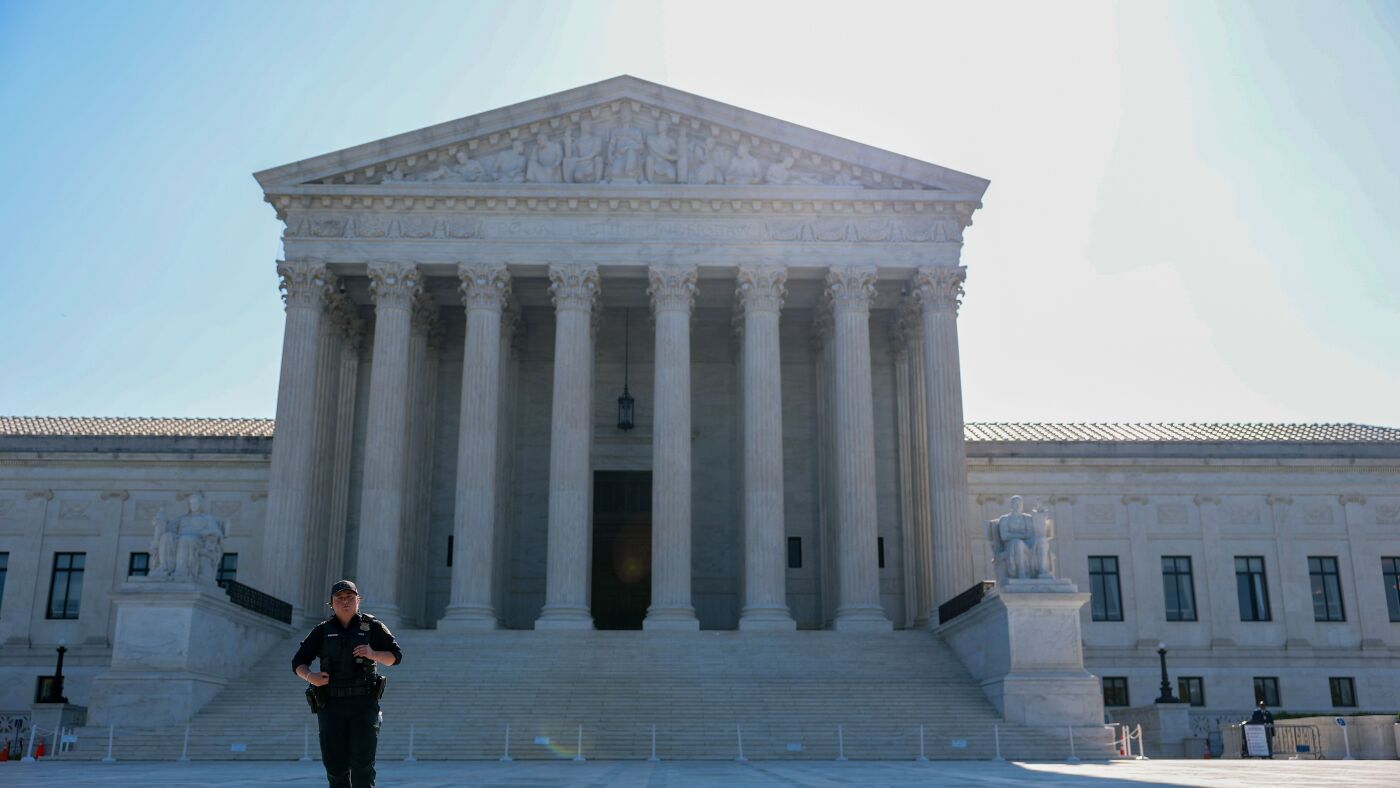
The Supreme Court

Win McNamee/Getty Images


hide caption

toggle caption

Advertisement

Win McNamee/Getty Images

The Supreme Court on Monday intervened in New York’s redistricting process, blocking a lower court decision that would likely have flipped a Republican congressional district into a Democratic district.    
  
At issue is the midterm redrawing of New York’s 11th congressional district, including Staten Island and a small part of Brooklyn. The district is currently held by a Republican, but on Jan. 21, a state Supreme Court judge ruled that the current district dilutes the power of Black and Latino voters in violation of the state constitution.  
  
GOP Rep. Nicole Malliotakis, who represents the district, and the Republican co-chair of the state Board of Elections promptly appealed to the U.S. Supreme Court, asking the justices to block the redrawing as an unconstitutional “racial gerrymander.” New York’s congressional election cycle was set to officially begin Feb. 24, the opening day for candidates to seek placement on the ballot.  
  
As in this year’s prior mid-decade redistricting fights — in Texas and California — the Trump administration backed the Republicans.   
 
Voters and the State of New York contended it’s too soon for the Supreme Court to wade into this dispute. New York’s highest state court has not issued a final judgment, so the voters asserted that if the Supreme Court grants relief now “future stay applicants will see little purpose in waiting for state court rulings before coming to this Court” and “be rewarded for such gamesmanship.” The state argues this is an issue for “New York courts, not federal courts” to resolve, and there is sufficient time for the dispute to be resolved on the merits. 
  
The court majority explained the decision to intervene in 101 words, which the three dissenting liberal justices  summarized as “Rules for thee, but not for me.” 
 
The unsigned majority order does not explain the Court’s rationale. It says only how long the stay will last, until the case moves through the New York State appeals courts. If, however, the losing party petitions and the court agrees to hear the challenge, the stay extends until the final opinion is announced. 
 
Dissenting from the decision were Justices Sonia Sotomayor, Elena Kagan, and Ketanji Brown Jackson. Writing for the three, Sotomayor  said that  if nonfinal decisions of a state trial court can be brought to highest court, “then every decision from any court is now fair game.” More immediately, she noted, “By granting these applications, the Court thrusts itself into the middle of every election-law dispute around the country, even as many States redraw their congressional maps ahead of the 2026 election.” 

Monday’s Supreme Court action deviates from the court’s hands-off pattern in these mid-term redistricting fights this year. In two previous cases — from Texas and California — the court refused to intervene, allowing newly drawn maps to stay in effect.  
  
Requests for Supreme Court intervention on redistricting issues has been a recurring theme this term, a trend that is likely to grow.  Earlier last month  the high court allowed California to use a voter-approved, Democratic-friendly map.  California’s redistricting came in response to a GOP-friendly redistricting plan in Texas that the Supreme Court also permitted to move forward. These redistricting efforts are expected to offset one another.     
   
But the high court itself has yet to rule on a challenge to Louisiana’s voting map, which was drawn by the state legislature after the decennial census in order to create a second majority-Black district.  Since the drawing of that second majority-black district, the state has backed away from that map, hoping to return to a plan that provides for only one majority-minority district.    
     
The Supreme Court’s consideration of the Louisiana case has stretched across two terms. The justices failed to resolve the case last term and chose to order a second round of arguments this term adding a new question: Does the state’s intentional creation of a second majority-minority district violate the constitution’s Fourteenth and Fifteenth Amendments’ guarantee of the right to vote and the authority of Congress to enforce that mandate?    
Following the addition of the new question, the state of Louisiana flipped positions to oppose the map it had just drawn and defended in court. Whether the Supreme Court follows suit remains to be seen. But the tone of the October argument suggested that the court’s conservative supermajority is likely to continue undercutting the 1965 Voting Rights Act.   

Advertisement
Continue Reading

News

Map: Earthquake Shakes Central California

Published

on

Map: Earthquake Shakes Central California

Note: Map shows the area with a shake intensity of 3 or greater, which U.S.G.S. defines as “weak,” though the earthquake may be felt outside the areas shown.  All times on the map are Pacific time. The New York Times

A minor earthquake with a preliminary magnitude of 3.5 struck in Central California on Monday, according to the United States Geological Survey.

The temblor happened at 7:17 a.m. Pacific time about 6 miles northwest of Pinnacles, Calif., data from the agency shows.

As seismologists review available data, they may revise the earthquake’s reported magnitude. Additional information collected about the earthquake may also prompt U.S.G.S. scientists to update the shake-severity map.

Source: United States Geological Survey | Notes: Shaking categories are based on the Modified Mercalli Intensity scale. When aftershock data is available, the corresponding maps and charts include earthquakes within 100 miles and seven days of the initial quake. All times above are Pacific time. Shake data is as of Monday, March 2 at 10:20 a.m. Eastern. Aftershocks data is as of Monday, March 2 at 11:18 a.m. Eastern.

Advertisement
Continue Reading

News

US says Kuwait accidentally shot down 3 American jets

Published

on

US says Kuwait accidentally shot down 3 American jets

The U.S. and Israel have been conducting strikes against targets in Iran since Saturday morning, with the aim of toppling Tehran’s clerical regime. Iran has fired back, with retaliatory assaults featuring missiles and drones targeting several Gulf countries and American bases in the Middle East.

“All six aircrew ejected safely, have been safely recovered, and are in stable condition. Kuwait has acknowledged this incident, and we are grateful for the efforts of the Kuwaiti defense forces and their support in this ongoing operation,” Central Command said.

“The cause of the incident is under investigation. Additional information will be released as it becomes available,” it added.

In a separate statement later Monday, Central Command said that American forces had been killed during combat since the strikes began.

“As of 7:30 am ET, March 2, four U.S. service members have been killed in action. The fourth service member, who was seriously wounded during Iran’s initial attacks, eventually succumbed to their injuries,” it said.

Advertisement

Major combat operations continue and our response effort is ongoing. The identities of the fallen are being withheld until 24 hours after next of kin notification,” Central Command added.

This story has been updated.

Continue Reading

Trending