
Connect with us

Northeast

Columbia University: 'No choice' but to call NYPD, building occupation believed to be led by outside agitators

Published

on

Columbia University: 'No choice' but to call NYPD, building occupation believed to be led by outside agitators

Columbia University says it “regrets” having to call in the New York Police Department to clear out anti-Israel protesters Tuesday night, but they were left with “no choice.”

University administrators released a statement saying it was their belief that non-student agitators led the push to break into and occupy Hamilton Hall. The university then called on the NYPD to take action.

“We regret that protesters have chosen to escalate the situation through their actions. After the University learned overnight that Hamilton Hall had been occupied, vandalized, and blockaded, we were left with no choice,” administrators said in a statement. “Columbia public safety personnel were forced out of the building, and a member of our facilities team was threatened. We will not risk the safety of our community or the potential for further escalation.”

“The leadership team, including the Board of Trustees, met throughout the night and into the early morning, consulting with security experts and law enforcement to determine the best plan to protect our students and the entire Columbia community. We made the decision, early in the morning, that this was a law enforcement matter, and that the NYPD were best positioned to determine and execute an appropriate response,” the statement added.

VIDEO SHOWS ANTI-ISRAEL PROTESTERS BLOCK JEWISH STUDENT FROM GETTING TO CLASS; UCLA RESPONDS

Advertisement

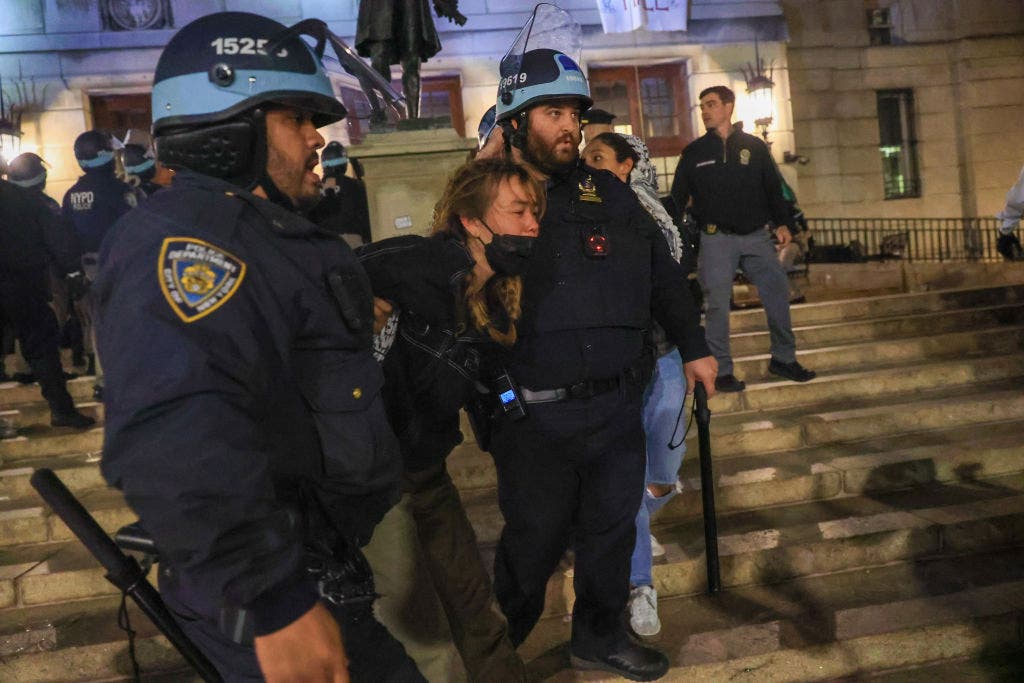
New York Police Department officers enter the Columbia University building and detain anti-Israel demonstrators as they had barricaded themselves to iconic Hamilton Hall building in New York, United States.

The university added that they believe the group that broke into the building was “led by individuals who are not affiliated with the University.”

Administrators lamented the breakdown of communications between the school and protesters. Columbia officials had held a dialogue with protesters last week, which ended in an impasse.

CALIFORNIA UNIVERSITY REVEALS ‘TRUE COST’ OF ANTI-ISRAEL MOB THAT TOOK OVER ACADEMIC BUILDINGS

“The decision to reach out to the NYPD was in response to the actions of the protesters, not the cause they are championing. We have made it clear that the life of campus cannot be endlessly interrupted by protesters who violate the rules and the law,” the school said.

Advertisement

Columbia University and student protesters. (Getty Images)

“Early Tuesday, protesters chose to escalate to an alarming and untenable situation – including by vandalizing property, breaking doors and windows, blockading entrances, and forcing our facilities and public safety workers out – and we are responding appropriately as we have long made clear we would. The safety of our community, especially our students, remains our top priority,” the statement said.

VIDEO SHOWS ANTI-ISRAEL PROTESTERS BLOCK JEWISH STUDENT FROM GETTING TO CLASS; UCLA RESPONDS

NYPD officers in riot gear break into a building at Columbia University, where anti-Israel students were barricaded inside a building and set up an encampment, in New York City. (KENA BETANCUR/AFP via Getty Images)

Advertisement

The protests at Columbia are just one example of anti-Israel demonstrations taking place at campuses across the country. Police were also called in to disband an encampment at the University of California at Los Angeles late Tuesday.

Read the full article from Here

Advertisement
Continue Reading
Click to comment

Leave a Reply

Your email address will not be published. Required fields are marked *

This site uses Akismet to reduce spam. Learn how your comment data is processed.

Maine

How did prices of Maine household essentials change in 2025?

Published

on

How did prices of Maine household essentials change in 2025?


Costs are up. It’s all around.

Nationally, inflation charted 2.7% in November, according to the latest available data from the Bureau of Labor Statistics. That figure was slightly higher in the northeast region, where prices rose about 3.1% in November compared to the same month last year.

The latest inflation numbers were better than some had expected, but many Americans say they still feel the pinch of high prices.

James Myall, an analyst with the Maine Center for Economic Policy, a left-leaning think tank, said that disconnect between “high-level” economic data and consumer sentiment is likely driven by the price of essentials, which carry more weight than other expenses.

Advertisement

“Probably, the things that people are feeling the most are those costs that feel unavoidable: rent, groceries,” Myall said.

Myall noted that the rate of price increases has slowed since its peak during the COVID-19 pandemic, from about 2021 to 2023, but wage growth also appears to be losing steam, which can further weaken Mainers’ spending power in the face of rising prices.

All told, Myall said the economy appears to be on a better trajectory than he expected in early 2025. But Trump administration policies like tariffs and mass deportations, which could shrink the labor pool, still leave things on shaky ground.

“I feel like we’ve gone from a generally strong and growing economy, especially for workers, (a year ago) to one that’s like plateauing and maybe teetering on the edge a little bit,” Myall said.

In preparation for the new year, we reviewed the cost of essentials to see how prices changed in 2025, and where things stand at the beginning of 2026.

Advertisement

Groceries

In January 2025, the average price for a gallon of 2% milk was $4.91, a pound of 80/20 ground beef was $5.70, and a dozen large, brown eggs cost $5.50. That’s according to data collected by Maine Public, which surveyed four grocers across the state.

On Tuesday, the average price of eggs at Whole Foods, Hannaford, Shaw’s and Walmart locations in Greater Portland was $3.03. That marks a 44.9% decrease — though prices were anomalously high at the beginning of last year, driven up by a surge in avian flu.

For a pound of ground beef, the average price was $6.23, a 9.3% rise. And the average milk price was $4.49 — down 8.6% from January.

Vehicles

Overall, Mainers paid less for new cars and more for used cars in 2025 than in 2024, according to data aggregated by Cox Automotive Group, operator of Kelley Blue Book.

Advertisement

The average sale price for a new car in Maine was $46,289 at the beginning of December 2025, down about 5.1% from $48,756 at the same time in 2024.

Maine’s prices were lower than the national average: $49,913 in December 2024 and $47,042 in December 2025, according to preliminary data shared with the Press Herald. Nationally, the average price for new cars hit an all-time record of $50,080 in September, Kelley Blue Book announced.

But it was a different story for used vehicles. The average sale price for used cars in Maine rose about 7.1%, from $28,813 in December 2024 to $30,868 a year later. Nationally, used car sale prices went from $29,570 to $30,383 — a 2.7% increase, according to the Cox data.

The Bureau of Labor Statistics meanwhile reported a 3.6% increase in used car prices from November 2024 to 2025.

Vehicle retailer CarGurus, which also tracks used car prices nationally, reported a smaller change. Its average price was $27,570 at the beginning of December, up about $112 or 0.4% from a year earlier.

Advertisement

But prices rose more sharply for SUVs and crossovers (1.3%), sedans (2.3%) and pickup trucks (3.7%), according to CarGurus.

Gas

The price of a gallon of regular unleaded gasoline fell about 10 cents between the beginning of 2025 and the same time in 2026, according to data aggregated by AAA.

On average, a gallon of gas ran about $2.93 on Friday, a 3.3% drop since the same date in 2025, when the price was about $3.03. Premium gas fell from about $4.01 to $3.97 a gallon, or about 1%.

The price of diesel, however, rose about 5% in that time frame, from about $3.79 to $3.98 per gallon.

Electricity

Energy costs continue to grow faster than the pace of inflation. In the northeast, energy prices rose 6.3% year-over-year in November — more than double the overall rate of inflation, according to the Bureau of Labor Statistics.

Advertisement

In Maine, rising electricity costs are a key concern for ratepayers and public officials. The state’s electricity costs are largely reliant on the price of natural gas, which is used to generate electricity, and customers also have to pay their utility to deliver that power to their homes and businesses.

For customers of Central Maine Power Co., the state’s largest electrical utility, the average bill will be 12.4% higher this month than it was a year prior.

That translates to a charge of $168.41 this month, compared to $149.76 in January 2025 for households using the typical 550 kilowatt-hours, according to the state Department of Energy Resources and Public Utilities Commission. Exact amounts vary based on customers’ usage.

Heating oil

Roughly half of Mainers rely on oil as their primary home heating source — the most of any state.

Statewide, the average cost for a gallon of heating oil was $3.47 last week, according to the latest available data from the Maine Department of Energy Resources.

Advertisement

That’s about eight cents higher, or 2.4%, than it was at the end of 2024, according to an archive of the state’s website. Back then, the statewide average clocked in at $3.39.

During that same window, a gallon of propane fell from $3.32 to $3.29 and the average cost of kerosene rose from $4.18 to $4.40 per gallon. About 16% of Mainers rely on propane and other tank-stored fuels for heat, according to data from the American Community Survey.


Source link

Advertisement
Continue Reading

Massachusetts

Mass. weather: How much snow is expected across the state on Monday

Published

on

Mass. weather: How much snow is expected across the state on Monday


All of Massachusetts is predicted to see some snowfall in the latter half of the day on Monday, with most of the state getting 1 to 2 inches of accumulation, according to the National Weather Service.

Temperatures are expected to dip into the teens overnight on Sunday before rising into the mid to high 20s on Monday, the weather service said. Clouds are predicted to increase throughout the day before the snow begins in the afternoon.

Berkshire County could see some light snow Sunday night and Monday morning, but heavier precipitation is expected to begin by 1 p.m. Monday, according to the weather service. Most of the rest of the state is predicted to start seeing snow between 3 and 6 p.m., first in western Massachusetts, then spreading across the state.

The snowfall is expected to stop between 10 p.m. Monday and 1 a.m. Tuesday in most of Massachusetts, according to the weather service. Much of the state may also experience patchy fog Monday night.

Advertisement

The northwestern half of Worcester County and most of Berkshire County is expected to get the most snow — up to 3 inches, according to the weather service. The Cape, Islands and South Coast are predicted to get less than an inch, and the rest of the state is expected to get 1 to 2 inches.

Most of Massachusetts is predicted to get 1 to 2 inches of snow Monday afternoon and evening, according to the National Weather Service.National Weather Service

Overnight lows on Monday are predicted to drop into the low to mid 20s, according to the weather service. Temperatures on Tuesday are expected to be warmer, reaching the mid 30s to low 40s.

There is a chance of rain in most of Massachusetts Tuesday afternoon, with precipitation more likely after 4 p.m., according to the weather service. Tuesday night is predicted to be rainy across the state, though the precipitation may come down as freezing rain or snow at higher elevations.

Temperatures overnight on Tuesday are expected to dip into the high 20s and low 30s before rising into the mid 40s on Wednesday, according to the weather service. Communities in the central and western parts of the state are predicted to see the rain cease by 10 a.m., while Eastern Massachusetts can expect to experience rain until midday.

Sunny skies are predicted across the state following the rain on Wednesday, according to the weather service.

Advertisement


Source link

Continue Reading

New Hampshire

On This Day, Jan. 5: New Hampshire adopts first state constitution – UPI.com

Published

on

On This Day, Jan. 5: New Hampshire adopts first state constitution – UPI.com


1 of 6 | The New Hampshire State House, completed in 1866, is in the capital of Concord. On January 5, 1776, New Hampshire became the first American state to adopt its own constitution. File Photo by Carol Highsmith/Library of Congress

Jan. 5 (UPI) — On this date in history:

In 1776, New Hampshire became the first American state to adopt its own constitution. The document marked a shift toward representative government and away from top-down British royal rule. The Granite State later replaced the document with its current constitution in 1784.

In 1914, the Ford Motor Co. increased its pay from $2.34 for a 9-hour day to $5 for 8 hours of work. It was a radical move in an attempt to better retain employees after introducing the assembly line.

Advertisement

In 1925, Nellie Tayloe Ross of Wyoming was sworn in as the first woman governor in the United States.

In 1933, construction began on the Golden Gate Bridge over San Francisco Bay.

File Photo by Terry Schmitt/UPI

Advertisement

In 1933, former President Calvin Coolidge died of coronary thrombosis at his Northampton, Mass., home at the age of 60.

In 1948, the first color newsreel, filmed at the Tournament of Roses in Pasadena, Calif., was released by Warner Brothers-Pathe.

In 1982, a series of landslides killed up to 33 people after heavy rain in the San Francisco Bay area.

In 1993, the state of Washington hanged serial child-killer Westley Allan Dodd in the nation’s first gallows execution in 28 years.

Advertisement

In 1996, a U.S. government shutdown ended after 21 days when Congress passed a stopgap spending measure that would allow federal employees to return to work. President Bill Clinton signed the bill the next day.

In 1998, U.S. Rep. Sonny Bono, R-Calif., of Sonny and Cher fame, was killed when he hit a tree while skiing at South Lake Tahoe, Calif.

In 2002, a 15-year-old student pilot, flying alone, was killed in the crash of his single-engine Cessna into the 28th floor of the Bank of America building in Tampa, Fla.

In 2005, Eris was discovered. It was considered the largest known dwarf planet in the solar system until a year later when Pluto was downgraded from being a planet.

In 2008, tribal violence following a disputed Kenya presidential election claimed almost 500 lives, officials said. Turmoil exploded after incumbent President Mwai Kibaki was declared the winner over opposition candidate Raila Odinga, who had a wide early lead.

Advertisement

File Photo by Roger L. Wollenberg/UPI

In 2013, a cold wave that sent temperatures far below average in northern India was blamed for at least 129 deaths. Many of the victims were homeless.

In 2019, Patriarch Bartholomew of Constantinople granted independence to the Orthodox Church in Ukraine, formally separating it from Moscow for the first time since the 17th century.

Advertisement

In 2025, New York City became the first U.S. city to introduce a congestion charge — $9 for Manhattan’s business district. President Donald Trump failed to kill the toll in a lawsuit.

File Photo by John Angelillo/UPI

Advertisement


Source link

Continue Reading

Trending
