Sports
How Freddie Freeman — now back on a hitting streak — worked through early-season slump

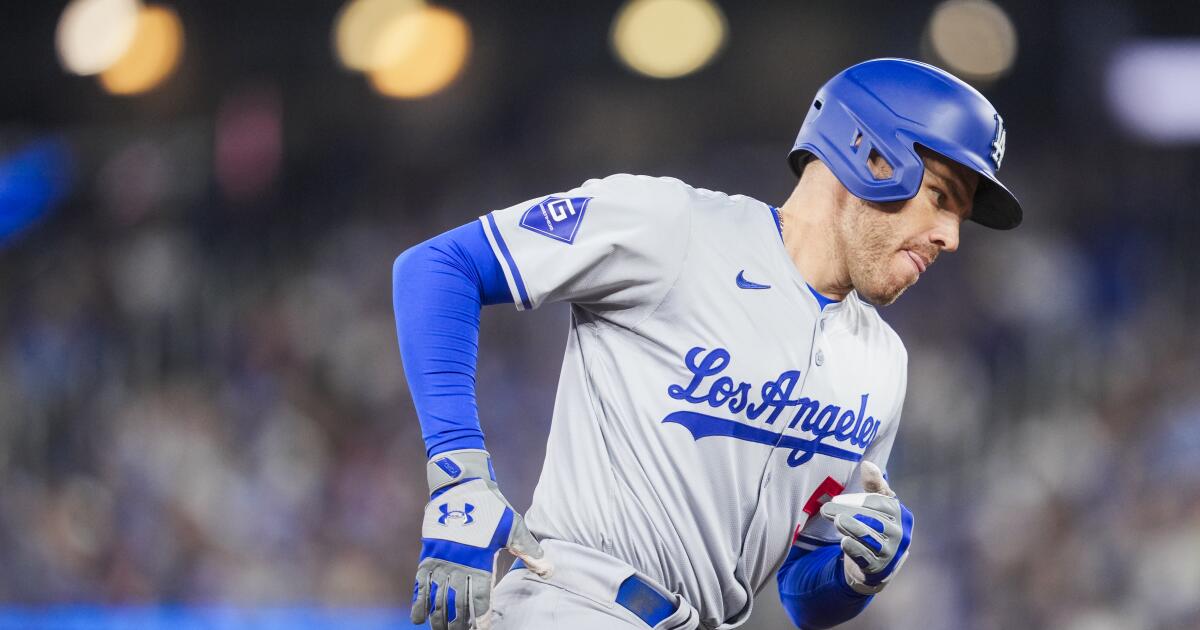
On the surface, it might not have looked like much of a slump.
To star Dodgers slugger Freddie Freeman, however, his performance through much of April was certainly starting to feel like one.
Entering play Monday, Freeman was batting .306 with eight doubles, two home runs and 19 RBIs. He had a .861 on-base-plus-slugging percentage and 142 OPS+ (meaning, essentially, he has been 42% more productive than the average MLB hitter).
Those were drops from his first two seasons in L.A., in which he finished top-five in MVP voting both times.
But a slump? Really?
“I take pride in being consistent,” Freeman said. “And I’m not being consistent right now.”
That, at least, was what Freeman was feeling two weeks ago, in the midst of an eight-for-47 stretch that dropped his batting average to .259.
“I’m not hitting the pitches I’d normally hit,” Freeman said then. “There’s a lot going on up there. Trying to figure it out.”
There are points in every season where Freeman cools off, and his precise swing mechanics get out of whack. Almost always, it’s because his hips rotate too open, and his bat cuts short and across the strike zone — not square and straight through it.
The result: Freeman will stop hitting fastballs for opposite-field line drives, or barrel up breaking pitches into the right-center field gap. Instead, he will hit lazy pop-flys, or yank a ground ball to the pull side, or simply foul off mistake pitches he’d typically clobber.
“I’m not swinging at bad pitches,” Freeman said, at the height of his early-season struggles. “I’m just not hitting them where they should be going.”
The fix: A curated routine of slump-busting pregame techniques; especially a signature “net drill” in which Freeman will set up about an arm’s distance from a batting screen, then try to execute a swing without brushing the barrel against, hoping to recalibrate the inside-out bat path that has long been key to his career .301 batting average.
“I usually only bring it out 5-10 times per year,” Freeman said of the drill, which he has been doing since he was a kid. “That’s usually when things are really off.”
This year, Freeman dusted it off early, one of several notable alterations he has made to his meticulous pregame process.
In recent weeks, the 34-year-old has also started taking almost daily rounds of outdoor batting practice, a rarity during his first two years with the Dodgers (he typically prefers to hit in the clubhouse batting cages).
Overall, he has increased his total amount of pregame swings three-fold, he said, “just to hurry this [process] up.”
Lately, at last, better results have started to follow.
Freeman entered Monday on an eight-game hitting streak, going 12 for his last 27 with 11 RBIs and more extra-base hits (five) than strikeouts (four).
Half of those games have been multi-hits efforts. And in all but one, he has recorded a hit either up the middle or the other way — a telltale sign of synced-up mechanics in his swing.
“Everything’s kind of been working,” Freeman said. “Just been kind of doing really really slow, soft swings in BP, and then let the adrenaline of the game take the swing a little bit harder. Things the last week have been a lot better.”
It’s a welcome sight for the Dodgers, who haven’t often seen their $162 million first baseman struggle since arriving in March 2022.
“He’s gonna come out of it,” manager Dave Roberts said this weekend. “But there’s some sadness when he’s in a dark place.”
Phrases like “sadness” and “dark place” might not square with Freeman’s actual numbers.
Even at his recent low point, when a three-game hitting drought culminated with a three-strikeout performance on April 19, Freeman’s production was still comfortably above league average.
Even as he battled inconsistency at the plate, he still wore a perpetual smile, joking around with coaches and teammates.
“Sometimes players are in a dark spot and they really feel it and mean it,” Roberts said. “But Freddie knows he’s a great hitter … So I think he has some levity with it.”
Indeed, when asked last week if he was being superstitious by changing his hitting routine, Freeman referenced a line from Steve Carell’s character in “The Office,” Michael Scott.
“Just a little stitious,” he responded.
When told, jokingly, this weekend, he must be the worst .300 hitter in baseball, Freeman chuckled and shrugged.
“Feels like it,” he said.
Still, the reason this slump felt different, why the frustration was boiling much closer to the surface, is because it came on the heels of similar struggles last fall.
At the end of the 2023 regular season, Freeman batted just .262 over his final 17 games (a notable drop from his .339 average before then). Then, in the Dodgers’ postseason sweep to the Arizona Diamondbacks, his swing seemed completely off, resulting in a one-for-10 mark that loomed large in the Dodgers’ early elimination.
“That’s why there has been so much frustration,” Freeman said earlier this month. “Because I know what I’m doing wrong. It’s over-rotation with my hips, which causes [other issues]. It’s the same thing every time. But for some reason, I’ve gone through everything about 20 times already and it hasn’t clicked yet. So that’s why, here I am, hitting outside, doing little things differently, [trying to] smile through it.”
Finally, over the last week, it seems like the tide has started to turn.
In addition to his eight-game hitting streak, Freeman snapped another kind of drought on Sunday, hammering his first home run since the Dodgers’ home opener exactly a month earlier.
“No,” Freeman said when asked if he was worried about adding to his home run total, after it’d been stuck at one for 26 games. “If you’re just going for power when you don’t have a good swing already, it’s just never going to happen.”
But now, thanks to a laborious swing progression and trust in his hitting process, the moment offered the latest sign of Freeman’s continued turnaround; that an elongated (for him, at least) slump to start the season finally appears to be largely done.
“There’s still bad swings in there,” Freeman said, “but ultimately there have been a lot more good swings lately.”


NEWYou can now listen to Fox News articles!
Winning two knockout stage games? That means you’re really in the running to win the World Cup.
Let’s check out the updated odds for which countries will make it to the quarterfinals at FanDuel Sportsbook as of July 1.
This page may contain affiliate links to legal sports betting partners. If you sign up or place a wager, FOX Sports may be compensated. Read more about Sports Betting on FOX Sports.
To Reach Quarterfinals
France: -1250 (bet $10 to win $10.80 total)
Argentina: -425 (bet $10 to win $12.35 total)
Morocco: -260 (bet $10 to win $13.85 total)
Brazil: -240 (bet $10 to win $14.17 total)
England: -175 (bet $10 to win $15.71 total)
Spain: -140 (bet $10 to win $17.14 total)
Colombia: -105 (bet $10 to win $19.52 total)
USA: +105 (bet $10 to win $20.50 total)
Mexico: +140 (bet $10 to win $24 total)
Norway: +160 (bet $10 to win $26 total)
Portugal: +175 (bet $10 to win $27.50 total)
Canada: +180 (bet $10 to win $28 total)
Belgium: +185 (bet $10 to win $28.50 total)
Switzerland: +195 (bet $10 to win $29.50 total)
Senegal: +370 (bet $10 to win $47 total)
Algeria: +550 (bet $10 to win $65 total)
Egypt: +650 (bet $10 to win $75 total)
Ghana: +750 (bet $10 to win $85 total)
The USA is currently one of the favorites to reach the World Cup quarterfinals (Getty Images).
Here’s what to know about this oddsboard.
Recent History: The quarterfinals are kinda a given for France, at least in recent years. The French have made it to at least the quarterfinals in five of the last seven World Cups, and they have made the final in four of the last seven years, winning the tournament twice. Les Bleus are now heavy favorites at -1250 to beat Paraguay and get back to the quarterfinals.
The Host Nations: Before this summer, Canada had never won a World Cup match in two tournament appearances. But that has all changed. Canada is through to the Round of 16 after beating South Africa in the Round of 32. As for Mexico, it has recorded four straight scoreless wins to start the tournament for the first time in its nation’s history. El Tri will look to get back to the quarterfinals for the first time in 40 years after dominating Ecuador in the Round of 32. After its win over Ecuador, Mexico jumped from +290 to +140 to make the quarters. The U.S. looks to replicate the other two host nations’ knockout stage performances against Bosnia and Herzegovina on Wednesday.

Dodgers manager Tommy Lasorda celebrates after the Dodgers beat the Montreal Expos to win the NL pennant in 1981.
(Associated Press)
Years as manager: 1976-1996
Record: 1,599-1,439, .526 win pct
After serving as the team’s third base coach for four seasons, Lasorda took over as manager late in the 1976 season when Alston announced his retirement. He led the Dodgers to the National League pennant in his first two full seasons, losing both times to the Yankees in the World Series. He won his first World Series in 1981, knocking off the Yankees, and rallied his team to a surprise title in 1988 in which the Dodgers beat the heavily favored Athletics. Lasorda was inducted into the Baseball Hall of Fame in 1997, his first year of eligibility.
A fiery and vibrant presence who spent 71 years with the Dodgers, Lasorda managed nine players who won the NL rookie of the year award. The Dodgers also opened the Japanese player pipeline on his watch. Hideo Nomo, the first Japanese big leaguer to permanently relocate to the U.S., joined the Dodgers in 1995. Three decades later, the team features Shohei Ohtani and Yoshinobu Yamamoto on its star-studded roster.

NEWYou can now listen to Fox News articles!
Back in January, the odds that King James would retire before the beginning of the 2026-27 season were slightly longer than the odds that he would give it another go.
But as of now, it looks like LeBron will, in fact, give it another go but with a team other than the Lakers.
Here are the latest odds for where James could land next season at DraftKings Sportsbook as of June 30.
This page may contain affiliate links to legal sports betting partners. If you sign up or place a wager, FOX Sports may be compensated. Read more about Sports Betting on FOX Sports.
LeBron James Next Team Odds
Golden State Warriors: -115 (bet $10 to win $18.70 total)
Los Angeles Lakers: +105 (bet $10 to win $20.50 total)
Cleveland Cavaliers: +600 (bet $10 to win $70 total)
Miami Heat: +1000 (bet $10 to win $110 total)
New York Knicks: +3000 (bet $10 to win $310 total)
Detroit Pistons: +3000 (bet $10 to win $310 total)
Dallas Mavericks: +3000 (bet $10 to win $310 total)
San Antonio Spurs: +3500 (bet $10 to win $360 total)
Milwaukee Bucks: +4000 (bet $10 to win $410 total)
Brooklyn Nets: +4000 (bet $10 to win $410 total)
Washington Wizards: +5000 (bet $10 to win $510 total)
NBA free agency begins on June 30 at 6 p.m. ET. However, hours before its official start, LeBron James’ agent, Rich Paul, made a jaw-dropping announcement.
According to ESPN reporting, Paul notified the Lakers that the franchise could move on without LeBron because he plans to play elsewhere for the 2026-27 season.
James played for the organization for eight years — the longest he’s played for any other team. While in L.A., King James broke the all-time scoring record, won an NBA title and earned his fourth NBA Finals MVP.
The imprint he’s left on the league in his more than 20 years has been immeasurable.
Where will LeBron land next season now that his time in Los Angeles is over?
In addition to his tenure in Los Angeles, he’s played for the Cavaliers and the Heat, winning titles with all three franchises. He won Rookie of the Year, has four regular-season MVPs and is a 22-time All-Star.
James has averaged 26.8 points, 7.5 boards and 7.4 assists over the course of his career.
During the 2025-26 season, he helped lead the Lakers to a 53-29 record in the regular season. The team secured the No. 4 seed in the Western Conference and defeated Houston 4-2 in the first round.
Eventually, Los Angeles got bounced by Oklahoma City in the conference semifinals, 4-0, which marked LeBron’s last dance in Hollywood.
-

 Mississippi5 minutes ago
Mississippi Lottery Mississippi Match 5, Cash 3 results for June 30, 2026
-

 Missouri8 minutes ago
Missouri Sports Betting May 2026: $256.4M Handle, Record $21.3M Revenue
-
Montana13 minutes ago
Montana Lottery Mega Millions, Big Sky Bonus results for June 30, 2026
-

 Nebraska20 minutes ago
Erstad joins Nebraska golf program
-

 Nevada23 minutes ago
‘Arrive Alive’ initiative with Nevada Department of Public Safety, FOX5
-

 New Hampshire28 minutes ago
This NH Short Film Festival Returns in July, and Every Film Clocks in at 15 Minutes or Less
-

 New Jersey35 minutes ago
New Jersey’s $60.7 billion budget signed into law by Gov. Mikie Sherrill • The Jersey Vindicator
-

 New Mexico38 minutes ago
Community Champions: New Mexico’s Flo Valdez inducted into NFHS

