Hawaii
New Hellertown Donut Shop Will Reflect 'Aloha Spirit' of Hawaii, Owner Says – Saucon Source


Aloha Jay’s Malasadas is about to introduce Hellertown and beyond to one of Hawaii’s most beloved sweet treats: the malasada donut. The business will open at 1120 Main Street (in a space in front of Rocco’s Pizzeria) on Saturday, May 4 at 8 a.m. In addition to signage, the exterior of the building has been updated to give it a Hawaiian vibe, with artificial palm trees, colorful lighting and tiki torch lanterns. (Credit: Aloha Jay’s Malasadas)
What does Hellertown have in common with Hawaii? If you ask Jay Losagio, after May 4 the obvious answer will hopefully be donuts, or more properly, malasadas.
Losagio is the owner of Aloha Jay’s Malasadas; a new donut shop specializing in the fried-dough delicacy native to Portugal, which thanks to cross-cultural influence has become a beloved culinary staple of the 50th state.
Under development for several years, the concept for Aloha Jay’s was inspired by Losagio’s many trips to the Hawaiian islands, some of which were with his late father, who encouraged him to bring the concept to life back home.
Losagio said his dad was a partner in several well-known Saucon Valley businesses in the 1980s, and the fact that he is now carrying on the family legacy with Aloha Jay’s and the Rita’s Italian Ice franchise he owns next door seems “serendipitous.”
@aloha.jays.malasadas #LehighValley – are you ready? Aloha Jay’s will be opening on Saturday, May 4th at 8am. Whose stopping by for freshly made Hawaiian donut Malasadas and to get Lei’d 🌺 #malasadas #hellertown #bethlehempa #eastonpa #donutshop #donuts #aloha ♬ Love You So – The King Khan & BBQ Show
Interest in Aloha Jay’s opening has been strong since plans were first publicly announced in January, and Losagio said several dozen overeager donut-seekers per day have been coming to his front door, hoping that the store will be open. One woman who said she grew up eating Portuguese malasadas recently drove to Hellertown from Lopatcong Township, N.J., he said, only to discover that the fryers that will soon be operating at full-tilt were still in the process of being tested. Not wanting to disappoint her, Losagio invited her to come back for a sample later that day.
In a video he recorded of her reaction as she bit into a fresh, hot malasada, the woman raved about its authentic taste, clearly delighted that someone will soon be selling malasadas locally.
What is a malasada exactly, and what makes it different from the donuts most Pennsylvanians know and love?
Like other types of donuts, malasadas are generally coated, filled or topped with granulated sugar, icing, sprinkles, custard and/or other sweet additions. There are some differences, however.

A snow cap cream-filled malasada coated with sugar. The snow cap cream filling is a white vanilla cream with a hint of maple. (Credit: Aloha Jay’s Malasadas)
According to the Aloha Jay’s website’s About Us page, “the malasada is airy, light, aromatic, with a moist center inside. Unlike your typical donut, a malasada has no hole, is made with more egg and milk, and has a nice light crisp on the outside.”
The Aloha Jay’s menu will initially feature the following types of malasada: coconut cream; ube, which is filled with purple yam-flavored custard; raspberry-filled; snow cap cream-filled; custard-filled; sugar-coated; cinnamon and sugar-coated; and plain, which won’t have any added sugar.
To wash down their donuts, customers will be able to choose drinks from a beverage menu that includes hot chocolate made with 100 percent cocoa, iced coffee, hot coffee and Aloha Jay’s punch; a red tropical fruit punch with a slightly tangy finish. The coffee selections will include Hawaiian coffee made with a 10 percent Kona bean blend and 100 percent Kona hot coffee, which Losagio said will have a slightly higher price point–$3.89 per 12 ounce cup–due to the high cost of the prized Kona coffee bean, which can retail for around $75 a pound.
Donut and drink sales will officially begin at 8 a.m. Saturday, May 4, which is when the store in a newly-renovated space at the front of 1120 Main Street–home of Rocco’s Pizzeria and Italian Restaurant–will open for business.
Losagio said that Aloha Jay’s first couple of weeks will be a soft opening, with a more limited selection of malasadas available. He said this will help his staff meet customer demand as they introduce them to something that is completely new for the area.
“This is all new to us, too,” he pointed out.
A grand opening and expansion of the malasada lineup to 14 varieties (all of which are pictured and described on the Aloha Jay’s website), along with the launch of an Aloha Jay’s app, will follow later in May. Among the varieties of malasada to look forward to in the future are Lava Cake, with a chocolate lava-like filling; The Sticky, which will be topped with cinnamon bun icing blended with snow cap cream; and the S’mores. Losagio said he hopes to eventually offer a Hawaiian-style breakfast sandwich as part of the menu, which will also feature seasonal malasadas that will be available for a limited time. Those flavors will be in addition to the core menu, and won’t replace what is going to be available on day one.

One of the more exotic malasadas on the Aloha Jay’s menu is the ube, which is filled with a sweet custard made with purple yam; a root vegetable that is a traditional part of the Hawaiian diet. (Credit: Aloha Jay’s Malasadas)
“The custard will always stay. The ube is always going to stay. We’ll have staples, but we’ll (also) have flavors that we’ll do every week,” he said.
And while Aloha Jay’s donuts will be priced a bit higher than some people may be used to paying, Losagio said the quality ingredients used to make them along with their size account for the difference.
“Everything was crafted with attention to detail,” he emphasized. “I want people to have an experience. Have some coffee outside. Enjoy the music. Enjoy the malasadas.”
In the Hawaiian tradition of mahalo–an expression meaning ‘gratitude’ that is painted above a doorway inside Aloha Jay’s–there will be leis handed out to customers to help get them in the “Aloha spirit,” which Losagio said is one that is welcoming, warm and spiritual.
“I want people to really enjoy coming here for something different,” he said.
Aloha Jay’s hours to start will be Monday through Friday, 7 a.m. to 8 p.m., and Saturday and Sunday, 8 a.m. to 8 p.m.
There will be seating available outside under a canopy that was constructed as part of the Aloha Jay’s renovations, which was designed with the same Hawaiian flair that characterizes the interior. In addition to colorful lighting, artificial palm trees and tiki-torch style lanterns help give the outdoor setting a uniquely island vibe. Parking is available in the lot between Rocco’s and Rita’s, and on the street.
For more information, as well as updates, visit AlohaJays.com and follow Aloha Jay’s on TikTok (aloha.jays.malasadas), Facebook and Instagram (@alohajaysmalasadas).
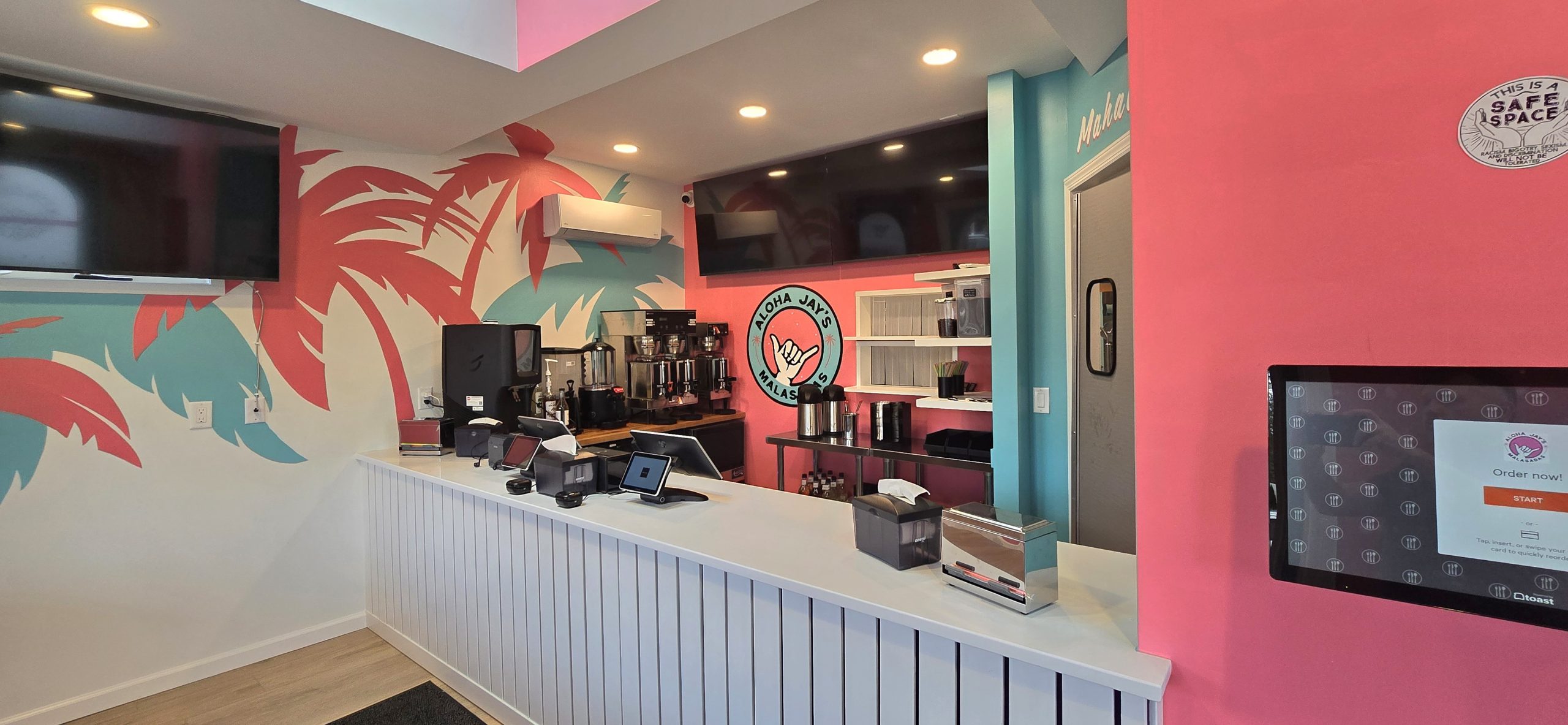
The color scheme and palm trees may be reminiscient of Miami Vice, but that’s where any similarity between Aloha Jay’s and the 1980s ends. Owner Jay Losagio has invested in state-of-the-art technology for his store, which features a touchscreen order kiosk, flatscreen menu displays and other tech. Located at 1120 Main Street, Unit A, in front of Rocco’s Pizzeria in Hellertown, Aloha Jay’s will open to the public on Saturday, May 4 at 8 a.m.

Aloha Jay’s has outdoor seating under a canopy with a view of palm trees that light up green at night. Hawaiian music will also contribute to the welcoming island vibe, owner Jay Losagio said. (Credit: Aloha Jay’s Malasadas)

Aloha Jay’s Malasadas is located in an addition in front of Rocco’s Pizzeria at 1120 Main Street, Hellertown. It is adjacent to a Rita’s Italian Ice franchise namesake Jay Losagio also owns.



The honor of introducing former President Barack Obama at the grand opening of his new presidential library in Chicago Thursday went to Dr. Kaiwipunikauikawēkiu Punihei Lipe of Hawaii.
Hawaii News Now reports that Lipe participated in the inaugural cohort of the Asia-Pacific Leaders Program in 2019 and is currently the principal at Kamehameha Schools Kapālama.
“Where I come from, to introduce someone means we have pilina, a connection. If this man walked into my home, my children would call him uncle because we are both keiki o ka ʻāina, children of Hawaii,” she said in her remarks.
She told those in attendance that the former president and herself are both “children of Hawaii.” Obama lived on the island and attended Punahou School and lived in Hawaii for eight years until his graduation from high school.
Lipe said being children of Hawaii carries with it a “sacred responsibility to care for those who we may never meet.”
She made reference to the resilient Hawaiian shrub, the Like a’ali’i.
“The a’ali’i thrives by being deeply rooted, resilient through storm and drought, and fiercely responsive. That is what ‘yes, we can’ means to my indigenous heart. It demands that we remain unshakably rooted in truth, resilient through trial, and so responsive that just as this plant yields its leaves for medicine, its blooms for beauty, and its timber for protection, we become the healing, the vibrance, and the shelter needed by our communities and by grandmother earth.”
Our Summer Membership Drive is underway. Make a recurring monthly donation of at least $10/month or a donation of any amount and receive an invite for a live Q&A with actor Chris Pang of the new Hulu series, The Season. Help us get to our goal of $10,000 and 10 new monthly recurring members. We’ve raised $2605 so far, 26% of our goal with 10 days to go and need 9 more recurring monthly members. Please donate here.
AsAmNews is published by the non-profit Asian American Media Inc and supported by our readers along with the Robert Wood Johnson Foundation, AARP, The Henri and Tomoye Takahashi Charitable Foundation, The Asian American Foundation & Koo and Patricia Yuen of the Yuen Foundation.
Be sure to take advantage of our free subscription and follow us on Instagram, Bluesky, Facebook, X, Tiktok and YouTube.


HONOLULU (HawaiiNewsNow) – It’s shaping up to be a slower-than-usual summer for Hawaii’s tourism industry, but business leaders hope events that market the islands’ unique local food and products can turn that around.
The state expects total visitor arrivals to grow only about 2 percent this year. Numbers slid half a percent in April from the previous year, with the largest market, West Coast tourists, falling nearly 5 percent. The statewide hotel occupancy rate averaged 76.4 percent.
Economists blame higher airfares, rising inflation, fewer international visitors and uncertainty following the March kona low storms.
State-supported events like the Hawaii Lodging & Tourism Association’s (HLTA) Hawaii Hotel and Restaurant Show and DBEDT’s Hawaii Made Conference aim to boost tourism by promoting products you can only find in Hawaii.
“We’re going to continue to struggle, but we can’t stop promoting. We can’t stop advocating,” said HLTA President/CEO Mufi Hannemann. “If you can travel during these times, you’re going to come and have a wonderful experience in Hawaii whether you’re just coming for sun and surf or you’re coming here to immerse in our culture or to do business, this is the place to come.”
And those who do come are spending more.
At the Hotel and Restaurant Show this week, local food manufacturers hoped to secure more buyers in the hospitality industry.
Many rely on business and leisure visitors trying their products while in Hawaii and taking them back home where they promote it.
“The traceability that you want to know where your food is coming from,” said June Rees, general manager of Kauai Shrimp, which has 40 ponds off the coast of Kekaha. You’ll find their shrimp on many menus across the islands.
“There are a lot of people that heard about us but never tried, so this show gives us exposure to the new restaurant or chef that have heard about the name but never really tried the product.”
But fewer tourists mean less sales and slower business growth and investment.
Jina Wye is the founder of Okonokai, which makes snacks from native seaweed grown off the Kona coast on Hawaii Island.
“It’s like a superfood that everyone should be eating everyday,” she said. “There’s a lot of just missing infrastructure for manufacturing, but that’s something that we’re working on. It’s actually why I’m part of this whole like DBEDT pavilion because the state is really working hard to develop more infrastructure.”
For the family behind Aloha Star Coffee Farm, getting their award-winning premium kona coffee into airports, hotels and restaurants is key.
“Getting the opportunity to find the market niche that we need,” said Karina Rodriguez, co-owner of Aloha Star Coffee. “We are small, that sometimes we don’t have all the resources for marketing and, and going to the biggest stores, and we are working on that.”
Food entrepreneurs will get another chance to promote their products at DBEDT’s Hawaii Made Conference this Tuesday at the Sheraton Waikiki. Click here to register and for more information.
The 16th Hawaii Food & Wine Festival is another event that promotes local chefs and restaurants while promoting tourism. It spans three weekends from Oct. 16 to Nov. 8 across three islands. Find information here.
Copyright 2026 Hawaii News Now. All rights reserved.
-

 San Francisco, CA1 minute ago
How to watch San Francisco Giants vs. Miami Marlins
-

 Dallas, TX6 minutes ago
Drivers in North Texas struggle with Friday floods
-

 Miami, FL13 minutes ago
Three wildfires burn more than 20,000 acres in Miami-Dade, force road closures
-

 Boston, MA16 minutes ago
MBTA, state transportation chief apologizes for ‘insensitive’ employee hair-pulling incident
-

 Denver, CO21 minutes ago
Man arrested on suspicion of murder in Denver shooting near South Park Hill, Hale
-

 Seattle, WA28 minutes ago
Seattle fans pack waterfront hours early as USA defeats Australia, advances in World Cup
-
 San Diego, CA29 minutes ago
NASCAR San Diego weekend revs up at Naval Base Coronado
-
 Milwaukee, WI36 minutes ago
South Milwaukee homeowner fights city order to remove year-round skeleton display

