Science
How L.A. County is trying to remake addiction treatment — no more 'business as usual'


Gary Horejsi wrestled with the decision before him, knowing a life could be in his hands.
It was the third time that the woman had used drugs or alcohol since coming to CRI-Help, which runs a 135-bed residential facility in North Hollywood where people are treated for substance use disorder.
CRI-Help needed to be a safe place for people grappling with their addictions. In the past, others had been removed for less. Horejsi, the clinical director, had the final say on whether she should be discharged.
He perused her file on his computer. The woman was still trying, CRI-Help staffers told him. She hadn’t shared drugs with anyone. And if she were to leave, the risks of an overdose were graver than before.
Horejsi decided to let her stay.
“Things can’t be business as usual anymore,” their chief executive, Brandon Fernandez, later said at a CRI-Help staff meeting. If someone leaves treatment and resumes using drugs the same way they were before, “that could very well look like them dying.”
“So are we going to be willing to do something different?”
“Things can’t be business as usual anymore,” CRI-Help Chief Executive Brandon Fernandez told his staff at a meeting in North Hollywood on April 10.
(Myung J. Chun / Los Angeles Times)
Fernandez had gathered CRI-Help staff in their North Hollywood conference room to talk about a Los Angeles County initiative that could reshape such decisions. It’s called Reaching the 95% — or R95 — and its goal is to engage with more people than the fraction of Angelenos already getting addiction treatment.
Across the country, more than 48 million people had a drug or alcohol use disorder, according to the latest results from the National Survey on Drug Use and Health. Only 13 million received treatment in the previous year. Among those who did not get treatment, roughly 95% said they did not think that they should.
Those numbers have collided with the grim toll of fentanyl, an especially potent opioid that has driven up deaths across the country. In Los Angeles County, the number of overdose deaths tied to fentanyl skyrocketed between 2016 and 2022, soaring from 109 to 1,910, according to a county report.
“We can’t just take the approach that we’ve been taking and kind of assume that everyone wants the services that we offer,” said Dr. Gary Tsai, director of the Substance Abuse Prevention and Control division at the L.A. County Department of Public Health. “That’s just not the reality.”
His department is trying to nudge addiction treatment facilities to change their approach, by offering financial incentives for those that meet R95 requirements. Among them: changing their rules to not automatically eject people who have a “lapse” of drug use.
Fernandez, whose organization is participating in R95, said abstinence is still its aspirational goal — and “we still have the ability to use our own clinical judgment on a case-by-case basis,” such as if people endanger other participants. But “we shouldn’t have blanket policies.”
To get R95 funding, they also cannot require people to be totally abstinent before being admitted. And under R95, treatment programs are also being encouraged to partner with syringe programs rooted in “harm reduction” — a philosophy focused on minimizing the harmful effects of drug use — to address the needs of people who may not want to enter or remain in treatment.
Some treatment providers “view us as the enemy instead of as allies,” said Soma Snakeoil, executive director of the Sidewalk Project, which provides Narcan spray to reverse overdoses and other services on L.A.’s Skid Row.
With R95, she said, “the biggest change is that harm reduction organizations and treatment providers are talking to each other in a way that was not happening before.”
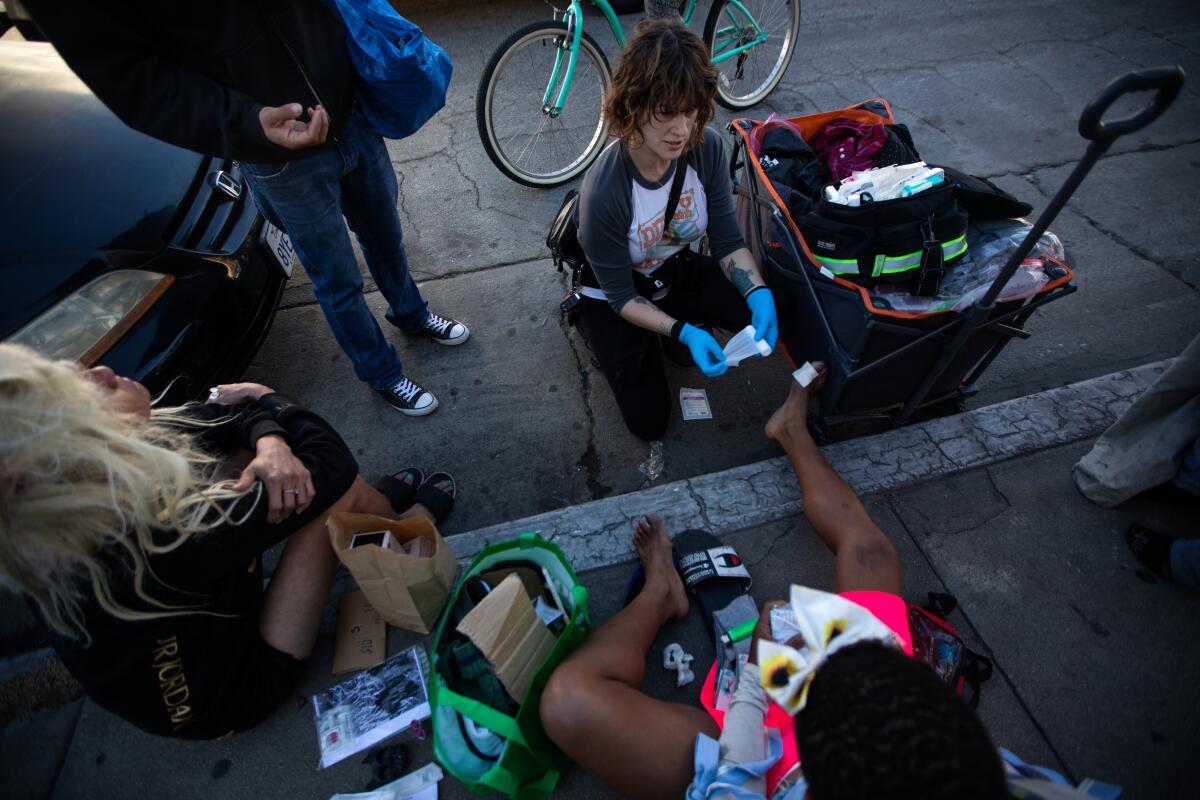
Soma Snakeoil, executive director of the Sidewalk Project, gives first aid to a woman with an open wound on her foot last year in Los Angeles.
(Francine Orr / Los Angeles Times)
The county is also prodding addiction treatment facilities to reexamine whether the way they operate could be turning people away, and look more closely at the “customer experience.” Tsai compared the situation to a restaurant drawing few customers: “How do we get more people in the door?”
Too often, “the drug dealers do a much better job of delivering their product to our patients than we do,” said Dr. Randolph Holmes, chair of government affairs for the California Society of Addiction Medicine.
When Johnny Guerrero decided to get off Skid Row and go into residential treatment in Los Angeles, he was initially turned away because he had arrived “late — maybe 10 minutes late,” the 35-year-old said.
He was only able to get in, he said, because the harm reduction worker who had taken him to the facility let him stay the night at her home, then brought him back the next morning. Even then, “there was so much paperwork. I was so dopesick. There was just hurdle after hurdle after hurdle.”
“They did not make it easy for an addict to get help,” Guerrero said.
In many cases, “the biggest barrier is just being able to get somebody on the phone” with a treatment provider, said Amanda Cowan, executive director of Community Health Project LA, which provides clean syringes and other services to people who use drugs. “When people are ready, they are ready in that moment.”
As of late March, roughly half of the addiction treatment providers that contract with L.A. County were on track to become “R95 Champions,” which could yield hundreds of thousands of dollars each in additional funding.
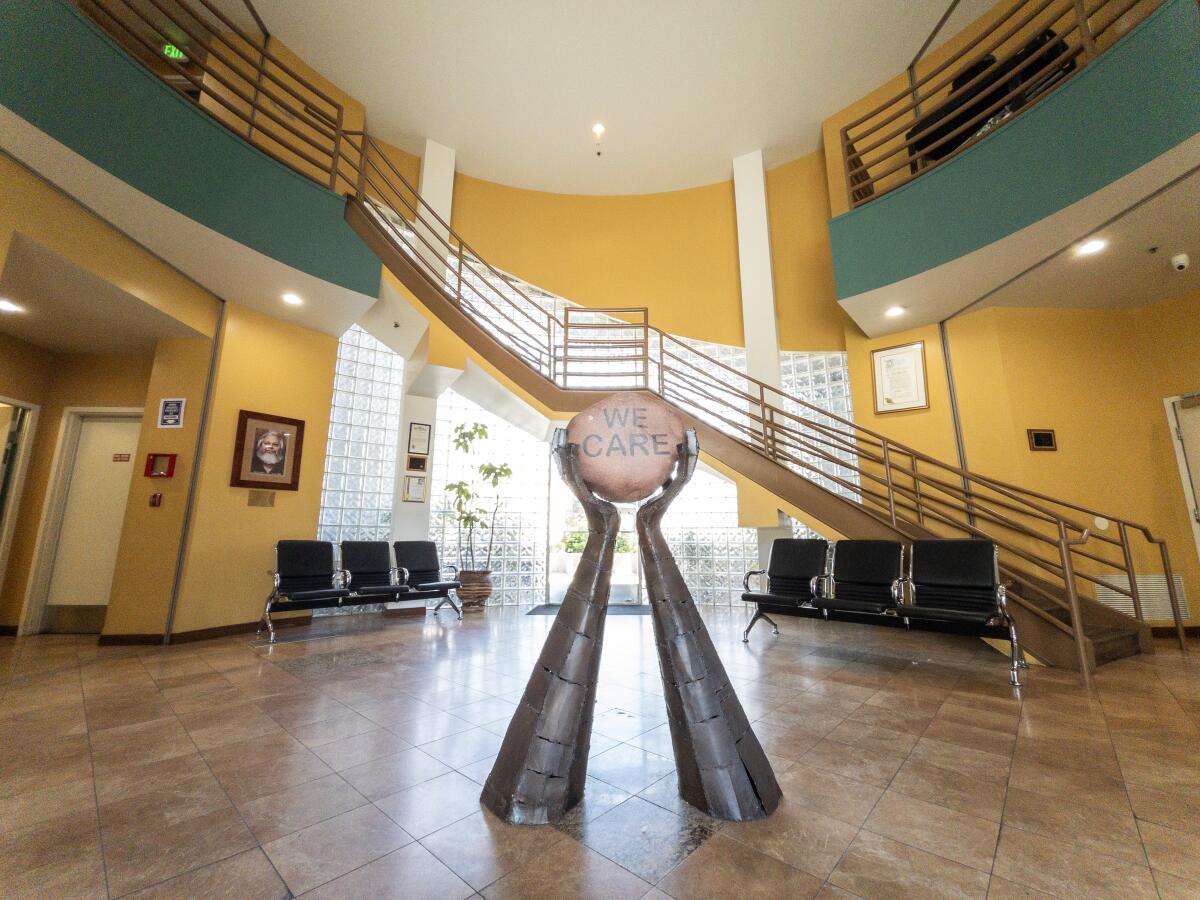
CRI-Help’s George T. Pfleger center in North Hollywood.
(Myung J. Chun / Los Angeles Times)
To get those funds, they must turn in admissions and discharge policies that adhere to the R95 guidelines, as well as an “engagement policy.” They are also supposed to meet R95 requirements in one other area of their choice, which could include a “customer walkthrough” to see what might turn away clients.
CRI-Help, for instance, had decided to change how it asks newcomers to undergo a search. “The last thing we want to do is trigger someone’s trauma history and potentially have them walk out the door,” Fernandez said.
To ensure it was consistently done with sensitivity, CRI-Help drew up a script for staffers, emphasizing that consenting to a search would help maintain a safe facility. The hope is that “they feel they’re doing something as a part of a community — versus being forced to undergo something that’s uncomfortable.”
Staffers also tell them that if they have any drugs to hand over, “there’s not going to be any consequence, you can still come into treatment,” Fernandez said. “And if we find them on you, there still won’t be any negative consequences.”
The L.A. County push comes as state and federal officials have stressed the need for “low barrier” approaches to addiction care. Even cutting back on drug use can have positive results, researchers have found.
But some of the changes can be at odds with long-standing beliefs among treatment providers, many of whom got into the field after successfully battling their own addictions in programs firmly focused on abstinence.
Many in the field think “this is what works” because it did work for them, said Vitka Eisen, chief executive of HealthRight 360, another R95 participant. But “we’re the survivors, and we don’t talk to those who didn’t survive.”
Addiction researchers have long called to reexamine how people are treated for substance use disorders. More than a decade ago, a Columbia University center found that “much of what passes for ‘treatment’ of addiction bears little resemblance to the treatment of other health conditions.”
“This is inexcusable given decades of accumulated scientific evidence attesting to the fact that addiction is a brain disease,” the National Center on Addiction and Substance Abuse lamented in its report.
Experts argue that part of the problem is that addiction treatment has long been separated from the rest of the healthcare system. Richard Rawson, senior advisor to UCLA Integrated Substance Abuse Programs, said a major shift was the emergence of buprenorphine, a medication for opioid addiction that could be prescribed in ordinary clinics just like medicines for other chronic conditions.
But some Southern California treatment providers have viewed using buprenorphine and other such medications as short of sobriety, UC San Diego researchers found — even as California has ushered in requirements for licensed treatment facilities to either offer or help people access such medications.
Addiction is now much more widely understood as a medical condition, but “how much of that philosophy actually gets down to the level of the counselor?” Rawson said. “I think that’s still a work in progress.”
Tsai said a challenge in rolling out R95 is the ingrained idea that “you’re ready or not” for substance use treatment. But “we don’t actually treat any other health condition that way,” he said. “You don’t tell someone with diabetes, ‘Your blood sugar has to be completely under control, and then you’ll be ready for treatment.’”
In North Hollywood, counselors and other CRI-Help employees seated around the conference table studied the R95 goals printed on an L.A. County handout. One staffer said she was struggling with a specific statement, particularly for people in a residential setting: “Requiring abstinence is too high of a bar” for treatment.
Fernandez decided to share his own story. More than a decade ago, he was struggling with drug use, which had worsened after the death of his father. He was unemployed and didn’t have a stable place to live. When an outpatient counselor suggested residential treatment, he initially brushed off the suggestion.

CRI-Help’s staffers had questions and concerns about the changing approach to addiction treatment but ultimately seemed supportive.
(Myung J. Chun / Los Angeles Times)
He changed his mind after a “tough weekend,” but had no intention of abstaining from all drugs in the long term. Fernandez said he was nonetheless welcomed at CRI-Help: “Let’s just help you out for now.”
“I came here begrudgingly with a total attitude that I was going to continue smoking weed when I left treatment. I definitely wasn’t going to stop drinking,” even as he recognized that other things he was doing might be a problem, Fernandez told the CRI-Help employees.
Among those who had gone to treatment, he asked the group, “were you ready for total abstinence on Day One?”
“No. That wasn’t even my plan,” the same staffer replied with a rueful laugh.
Still, she and others were anxious about how they would keep everyone safe if clients used drugs, especially if they tried to bring them into the facility. “That worries me a little bit,” she said.
“It worries me too,” Fernandez said.
What preoccupies CRI-Help staff is how to balance the needs of people who have had a “lapse” into drug use with maintaining a safe environment for other clients grappling with addiction.
Horejsi said in an interview that whenever someone uses — even if they don’t share their drugs — “everyone knows, and that in itself does have an effect on people. Sometimes people will feel less safe.”
But Horejsi stressed to the group that “we’re already not discharging people for using” alone.
When people have relapsed, the North Hollywood center has monitored them one-on-one in its television room until staff are sure they are safe, then decided on their next steps. Some have ultimately been moved to another CRI-Help residential facility to continue getting treatment and have a “fresh start,” he said.
The clinical director also urged his co-workers to look back at the many changes CRI-Help had already undergone, such as starting to offer medication for addiction treatment. He reminded them that years ago, CRI-Help clients could be discharged if a doctor had given them an opioid pill at the hospital.
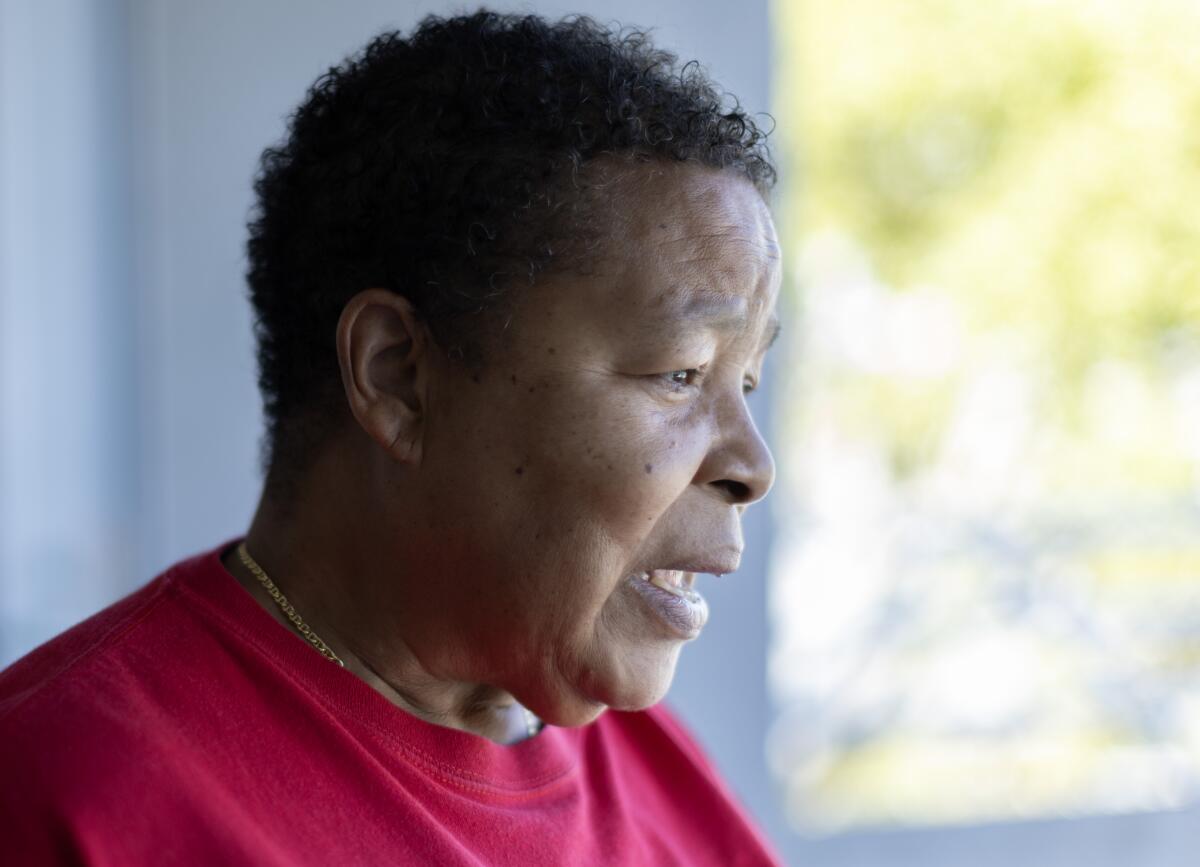
Mary Grayson, a longtime staff member at CRI-Help, spoke positively of the organizations changes over the years.
(Myung J. Chun / Los Angeles Times)
“What about when we discharged people because they talked about getting — they glorified drugs?” said Mary Grayson, a longtime CRI-Help employee.
Leaning forward in her seat, Grayson reminded her co-workers that “CRI-Help is not what it was when I walked through those doors 25 years ago — thank God!”
It started with “two shacks on this property. Two raggedy shacks. And look at where we are now,” she said. “Without us changing and growing, we won’t be able to be who we are.”


new video loaded: NASA Announces Artemis III Crew
transcript
transcript
NASA Announces Artemis III Crew
NASA announced the crew of Artemis III mission, which will fly to low-Earth orbit to test rendezvous and docking maneuvers with one or two lunar landers.
-
“I am excited to welcome you as the next crew in the Artemis journey to successfully return to the moon — this time to stay.” “I’m honored by the role that I’ve been given. I’m also very humbled by the task in front of us. But first and foremost, I’m grateful.” “So with that, the Artemis II crew, comrade, hands you the baton. You got the controls.” “As you know, we had a significant anomaly at our Launch Complex 36A on May 28. We’ve redoubled our efforts and are moving forward.”
By Alisa Shodiyev Kaff
June 9, 2026
Science
Santa Monica Mountains’ last steelhead trout survived the Palisades fire — and even had babies

Scientists feared the Santa Monica Mountains’ last remaining steelhead trout were dead, smothered by debris flows unleashed by the Palisades fire.
But the endangered fish surprised them: A team of biologists recently spotted 30 of the rare trout — and 21 babies — in Topanga Creek.
“There was a lot of happy dancing in the creek,” said Rosi Dagit, principal conservation biologist for the Resource Conservation District of the Santa Monica Mountains, which works with public and private landowners to conserve natural resources.
That’s because the steelhead here are endangered, at both the state and federal levels. Once, they swam in most streams of the Santa Monicas, but their numbers plummeted amid overfishing and coastal development. Increasingly frequent wildfire has further stressed their habitat. Topanga Creek, a biodiversity hot spot, is home to their last known population in the mountains that stretch from the Hollywood Hills to Point Mugu in Ventura County.
The trout that were spotted, including this one, are part of a distinct Southern California population that’s listed as endangered at the state and federal levels.
(RCDSMM Stream Team)
The California Department of Fish and Wildlife spearheaded a complex mission to rescue trout threatened by the Palisades fire that sparked in January 2025.
Time was of the essence. The fire hadn’t yet been fully contained. But rain was on the way, which would sweep massive amounts of sediment from the denuded hillsides into the water. Fish are often killed this way.
Crews stunned the fish with electricity, scooped them up in buckets, trucked them to a hatchery and ultimately moved them to Arroyo Hondo Creek in Santa Barbara County.
Within days, Topanga Creek was choked with mud. Some assumed the fish left behind were goners.
But in March, the conservation district’s team found four. The following month, when water conditions were clearer, they saw more.
“These fish continue to amaze me,” said Kyle Evans, environmental program manager for the state Department of Fish and Wildlife, who had seen the damage to the creek. “I had seen populations get wiped out in similar situations. So when I heard, I was thrilled.”
Evans surmises the fish that survived were in an area of the creek where less charred material and sediment were swept in.
“These fish likely hunkered down, were hiding under some rocks or places to try to get away from the main concentration of flow,” he said. “And luckily they weren’t buried.”
The ones that were spotted were fairly small, around 6 to 14 inches. Rainbow trout and steelhead trout are the same species, but with different lifestyles. If the fish remain in freshwater, they’ll be considered rainbows. However, they can migrate to the ocean and become steelhead, where they typically grow larger before returning to their natal waters to spawn.
Topanga Creek hasn’t fully recovered from the damage it sustained, but scientists say it’s looking better. Surveys last year were “so depressing,” Dagit said, with very few animals, and stretches that were essentially transformed into flat roads from all the sediment buildup. Some of the riparian canopy burned right down to the creek.
Then came 32 inches of rain over the last nine months, scouring out and moving sediment, creating deeper pools. Dagit said they recently found newt egg masses for the first time in years, as well as a few adult newts and many frogs. Plants that provide cover are starting to recover.
She provided photos comparing certain pools last year and this year, some dramatically transformed. In September 2025, the Shrine Pool could have been an overgrown hiking trail. This April, it was filled with shallow water.

The Shrine Pool in September 2025, left, and the same location in April 2026, right, with RCDSMM’s Isaac Yelchin donning a wetsuit.
(RCDSMM Stream Team)
Topanga Creek is home to another endangered fish, the small but hardy northern tidewater goby, often described as cute. Not long before the trout operation, Dagit led a rescue of hundreds of these fish too. Many were repatriated to the lagoon at the mouth of the creek in a moving ceremony last June.
There’s still the matter of what to do with the trout that were moved to Santa Barbara County last year. Evans would like to bring them home to the Santa Monicas at some point, but isn’t sure if it will happen. On one hand, they could bolster the small, genetically isolated surviving population. On the other, they might inadvertently bring in a disease or bacteria. There is some time to decide. Evans estimates the creek still needs to recover for two to three more years.
For now, the fish are functioning fine in their adopted creek. Experts worried the trauma wrought by the move would disrupt their spawning process, but they had babies that spring. This year, they spawned again.

The Pacifica Municipal Pier was shut down and taped off Thursday after city workers noticed cracks running through the landmark structure and concrete chunks falling into the ocean.
It’s just one of many coastal California structures that have recently crumbled under pressure from a rising and relentless ocean.
Officials from the small, beach city south of San Francisco said the pier was closed due to “cracking, separation, and displacement of the concrete walkway and structural elements.”
It will stay closed while structural engineers asses its safety.
Photos taken by city employees show a wide crack that runs from top to bottom and across the structure as well. Other photos show a large horizontal crack under the foundation of a small restaurant on the pier, the Chit Chat Cafe.
The cafe was also shut down.
This is not the first time the 53-year-old pier has shown signs of stress. In 2021, part of it was shut down after handrails along the edge collapsed. And in 2023, after a series of storms pummeled the Central California coast, damaging parts of the pier, the structure was partially closed for more than year.
Those same storms caused extensive damage in Aptos and Capitola, 70 miles south, where piers and waterfront infrastructure were swept away or damaged.
In 2024, a 150- to 180- foot section of the Santa Cruz wharf was ripped off by powerful waves.
At least 10 of the state’s dozens of coastal public piers were closed for part or all of 2024 due to structural damage sustained in winter storms since 2022. At least five others have longer-term upgrades planned to address structural issues.
“These things are costly to maintain,” said Zach Plopper, senior environmental director at Surfrider. “They are a part of our California coastal culture in many ways, but we’re going to need to reckon with, one, the state that they’re in, and two, the continuous and worsening threats they’re going to experience,”
He said most of the piers were constructed in the early 1900s, and they weren’t built to withstand decades of rough seas, storms and rising sea level.
“With this incoming El Niño, which is forecasted to be significant, and this marine heat wave we’re in the midst of, we’re kind of in uncharted waters as far as what this winter could bring in terms of storms and swells to the California coast, and we’re likely going to see a lot more damage,” he said. “Not just piers, but roads and other coastal infrastructure up and down the state.”
There was no storm in Pacifica earlier this week, so no single event could be blamed for the destruction.
However, a 2025 report from an outside engineering firm, GHD, found that several sections of the pier were in “poor” or “serious” condition, and they recommended closure before anticipated storms or events that could “subject the piles to high winds, swells and large waves.”
The firm found several areas of the pier where concrete was missing and rebar was exposed and corroding.
“The pier has continued to experience high winds and large waves in a harsh marine environment,” the engineers wrote in the report, noting that continuous exposure to seawater or marine spray was “detrimental” to the structure.
A 2023 city report estimated it would cost $19 million to repair.
That same year, a state law was enacted to require local governments along the California coast to plan for sea level rise in the coming decades.
Sea level has risen some 8 inches, on average, along the coast in the past 150 years, Plopper said, and researchers anticipate another foot in the next 25 years.
“We’re going to see profound shifts on our coastline, none that we have ever experienced before, and building static structures on the coast just doesn’t work all that well,” he said. “We’re going to have to make some really hard decisions.”
-
 Politics3 minutes ago
Supporters of L.A. County healthcare sales tax declare victory
-
 Sports15 minutes ago
USC freshman linebacker Talanoa Ili joins lawsuit seeking to upend new NIL system
-

 World22 minutes ago
Who has the most and fewest judges in the EU?
-
 News42 minutes ago
In Nevada, Trump’s policies are making things tough for Republican Gov. Joe Lombardo
-

 New York2 hours ago
This Parking Spot Is Free. Should It Be?
-

 Los Angeles, Ca2 hours ago
O.C. Uber customer says driver asleep in Tesla on 405 Freeway
-

 Detroit, MI2 hours ago
One person dead, another in custody following shooting in Detroit, police say
-

 San Francisco, CA3 hours ago
Bay Area artists celebrate Wong Kim Ark’s legacy in San Francisco’s Chinatown

