Sports
Dangerous games: What's next for Mike Brown, Vivek Ranadivé and the Sacramento Kings


NEW ORLEANS — Fresh off a redemptive demolition of the favored Golden State Warriors in a win-or-go-home game — stomping out a rival’s season as bluntly as had been done to them in the same building a year prior — the Sacramento Kings skipped into New Orleans last week with a level of growing confidence.
There was organizational belief they could and should beat the Pelicans, who were playing without the injured Zion Williamson. And, if initial mission was accomplished, they had enough talent to at least threaten the Oklahoma City Thunder in the first round of the NBA playoffs. They had built a winning foundation (94-70) in coach Mike Brown’s two years, snapping in the process an embarrassing 16-year playoff drought that was the longest in North American professional sports at the time.
But those good vibes were extinguished quickly in New Orleans in another loser-go-home game. Kings controlling owner Vivek Ranadivé watched stoically from a courtside seat near the team’s bench as the season faded away. When it was over, he immediately walked into the tunnel and directly out of the arena through the loading dock, trudging into an offseason full of delicate decisions.
An hour later, as players and coaches came to grips with failing to reach the playoffs, one veteran was asked: Despite the tangible step back, is there at least a level of stability developing?
“Yeah,” the veteran said. “Because we’re not gonna let go of our front office and we’re not going to fire our coaching staff. In Sacramento, that’s a pretty big deal.”
Brown signed a four-year contract in the summer of 2022. But the fourth season, according to league sources, is a mutual option. So for practical purposes, next season is the final guaranteed year on his current deal.
That’s typically extension time in the coaching world. Brown desires a longer-term commitment at his market rate, per league sources, and brings a substantial body of work to the table. The Kings have grown in legitimacy since his arrival, both as a basketball and business entity. But a nuanced negotiation awaits.
Success has a price tag. Steve Kerr ($17.5 million annually), Gregg Popovich ($16 million) and Monty Williams ($13 million) have reset the coaching market since Brown signed his deal. He wouldn’t command Kerr or Popovich money, but it’s fair to assume, considering reputation and résumé, the offer would need to reach double-digit million annually.
Will Ranadivé reward Brown for the progress that has been made, focusing on the bigger picture in play here and the need for the kind of coaching stability that evaded the Kings for so long? Or might he hesitate to pay the increased market value, with their playoff absence this season giving him reason to pause?
Team sources say there’s been a wait-and-see approach from the ownership side to this point, with a feeling from those around the franchise that singular results — the huge win over the Warriors, the gut-punch loss to the Pelicans — could weigh heavily in future decision-making.
That’s a dangerous game to play. Ranadivé has not yet approached Brown with an extension offer. Both sides have known for months now that this discussion was nearing, but the outcome of it will set the tone for the next Kings season to come. Without a resolution, it has a chance to become a distraction.
The Kings went 15-8 against six of this season’s eight Western Conference playoff teams. They swept the Lakers in four meetings, finished 3-1 against the Denver Nuggets, 2-1 against the Minnesota Timberwolves and 2-2 against the Oklahoma City Thunder, LA Clippers and Phoenix Suns. They have reason to believe they can compete with the top of the conference.
“I feel like we got better,” Domantas Sabonis said. “We just couldn’t finish some games. We dropped a couple, the West is tougher. We kind of put ourselves in a bad situation.”
Two problems surfaced: They couldn’t solve the Pelicans’ length and shooting. New Orleans went 6-0 against them, a tricky matchup that continually killed them at the wrong time. Then there’s the more debilitating issue. The Kings too often no-showed at the wrong time. Here’s a list of non-playoff teams that beat them: Charlotte Hornets, Detroit Pistons, Houston Rockets, Portland Trail Blazers and Washington Wizards. The Rockets doing so thrice. The Kings won only two fewer games than the season before (48 to 46), but still dropped from third to ninth in the crowded Western Conference standings, ultimately failing to check that playoff box.
“It’s easy to focus on the last two weeks,” Harrison Barnes said, alluding to a stretch in which the Kings went 3-6. “People say: ‘Oh, look at the Dallas games, the back-to-back against the Pelicans and Suns.’”
Those losses came after key players Malik Monk and Kevin Huerter suffered season-ending injuries, bumping the Kings from the fifth or sixth seed (where they sat most of the season) to the ninth seed.
“But I think there’s a lot of games early in the season (to blame),” Barnes said. “We had games we didn’t show up, games where we didn’t have the right approach. Stack those up and you look at where things finish, if we would have had three or four more wins, five more wins, where would we be?”
Four more wins would’ve meant the fifth seed and Game 1 of a playoff series after a week of rest.
“To me, I think that’s where a step has to be taken,” Barnes said. “Look at the six teams that were in the playoffs (prior to the Play-In Tournament). Those teams did a good job of taking care of business against the teams that were below .500. That was the step that we did not take this year.”
Mike Brown and the Kings dropped from third to ninth in the West this season. (Sergio Estrada / USA Today)
No one should be surprised a step backward was not well received by Ranadivé — or any of the Kings, for that matter. He bought the team in 2013 and shuffled through six coaches before Brown, displaying an impulsive streak that was scrutinized all along the way. But the tide had turned some, his once-tattered reputation repaired in NBA circles. Last season’s playoff return was a blissful moment for him and his organization. To get here, he made a series of pivotal hires paramount to the recent success.
Monte McNair, the longtime Houston Rockets executive, was given his first general manager job in September 2020, replacing Vlade Divac after his tumultuous exit. McNair built a respectable front office and sparked the Kings’ resurgence. He drafted Tyrese Haliburton and Keegan Murray, flipped Haliburton for Sabonis and built around the De’Aaron Fox, Sabonis, Murray trio.
Brown was hired in May 2022, plucked from a Warriors organization Ranadivé knows so well, having spent time there as a minority owner. Brown was the first unanimous NBA Coach of the Year in his first season with the franchise. When judged against the backdrop of the Kings’ woeful history, this front office-coach pairing has been an indisputable hit.
Yet, while team sources say Brown will definitely return for next season, the conversation about his value beyond the 2024-25 campaign runs the risk of being complicated and, potentially, uncomfortable if Ranadivé is unwilling to reinvest in this partnership.
It’s about both basketball and business. Not only has Brown led a winning program in his time in Sacramento, but also the team’s ability to remain relevant all season has been a game-changer on the financial front when it comes to keeping fans engaged.
That’s quite a change from the Kings’ days of old, when even their most ardent loyalists would lose interest once the team fell in the standings during the second half of the season. When it comes to the way the Kings are viewed within the league and agent world, the optics have improved greatly since Brown’s arrival. And while the Kings’ offense that was the league’s best two seasons ago regressed, Brown sees long-term promise in that the defense — which has long been an issue in Sacramento — improved from 24th in his first season to 14th in his second. As Brown’s side sees it, the list of reasons justifying a new market-value deal is long.
For Ranadivé, though, there’s surely frustration with the fact that the Dr. Jekyll-and-Mr. Hyde ways of this Kings team ultimately cost it an invitation to the postseason party. The meeting of the minds, if there’s going to be one, will need to be somewhere in between.
About an hour before the season-ender on Friday night in New Orleans, Ranadivé and his daughter, Anjali, posed for a picture on the court. They held up the back of the jean jacket that Anjali wore to the game and posted it on Instagram. It had Monk’s name and number spray-painted onto it.
Luka Dončić fell on Monk’s right knee on March 29. It sprained his MCL. Monk couldn’t make it back, stripping the Kings of their third-most productive player during the stretch run, generating an unanswerable “what if?” about the playoff ceiling of this team.
Now there’s another: What if Monk leaves this summer? In an interview with The Athletic in early March, Monk expressed a desire to return. Ownership, management, coaches and teammates all want him back.
But the Kings are in a financial crunch. CBA rules limit what they can give Monk. The projected max starting salary they can offer is $17.4 million, translating into a four-year, $77.9 million max long-term offer if extended out with maximum allowable raises.
There’s fear that a team with plenty of cap room, knowing these constraints, will swoop in with a similar long-term offer in the $100 million range that could be too lucrative for Monk to decline. He’s 26 and was nearly out of the league a couple years ago.
“Money talks,” Fox said. “You can’t play this game forever. We have such a short window to play basketball. Not everyone is going to be (LeBron James) or (Chris Paul), play 19, 20 years. You have to be able to get paid whenever you can. That’s what Vince Carter told me. He played 21, 22 years. I’d love to have (Malik) back, but I don’t know what the future holds.”
If Monk departs, the Kings can’t use all that money in free agency. They’ll be limited to the midlevel exception, projected at $12.9 million. There should be some rotation players available in that range, but the larger question is whether this team needs a more substantial piece, someone alongside Fox and Sabonis in the pecking order.
That would need to be done via trade. Because they missed the playoffs, the Kings retained their first-round pick in June’s draft. It’ll be either 13th or 14th. They still owe a top-12 protected first-round pick to Atlanta next season for the Huerter deal.
But the draft asset cupboard is still pretty loaded and they have plenty of mid-sized contracts to facilitate deals. Barnes makes $18 million next season. Huerter makes $16.8 million. Trey Lyles makes $8 million.
The Kings front office was protective of Murray in trade talks for Pascal Siakam and others near the trade deadline. It’s difficult to imagine that changing. But McNair, in an interview with The Athletic last summer, did indicate there’d be a time to press fast forward if the opportunity presents: “I think we’re in a spot where if there is an aggressive play out there, we’ll be one of the teams that can knock on that door.”
That’s the rub for these Kings. They’re stuck, for now, on the doorstep of something special.
They have foundational players such as Fox and Sabonis, whose presence raises their collective floor, but lack the sort of dynamic talent (even potentially at the top-end) and depth that would elevate them to true contention. They added Sasha Vezenkov and Chris Duarte last summer, but neither could crack the regular rotation.
They enter the summer with roster flexibility that could lead to real improvements, but more than enough uncertainty on that front to inspire some angst. Do they have the sort of organizational continuity that is so important in times like these? That part remains to be seen.
“There’s something to build off still,” Fox told reporters after the loss to the Pelicans. “The West isn’t getting any easier. It’s a disappointment not being in the playoffs. But it’s something to build off … Obviously there is a lot more stability than there has been in the past. But as a team we have to get better. You never know what can happen.”
(Illustration: Dan Goldfarb / The Athletic; photo courtesy of Rocky Widnern, Kelsey Grant, Jed Jacobsohn /NBAE / Getty Images)



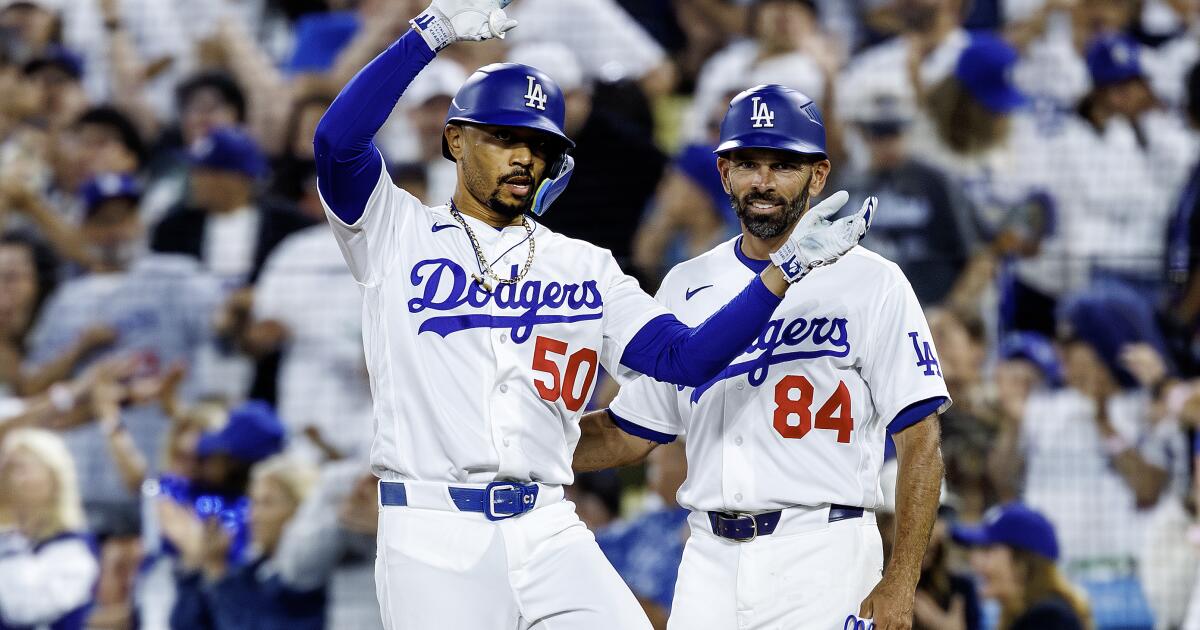
Mookie Betts’ first hit this series against the Rockies couldn’t have come at a more opportune time. With the crack of the ball against his bat, Tommy Edman scored from third, giving the Dodgers the lead.
And as Betts reached first, he pointed to Freddie Freeman, whose single put Edman in scoring position. It had taken a team effort to overcome another middling start from Roki Sasaki, and Betts, who had little to show before his game-winning hit, took the chance to highlight the joint contribution in the Dodgers’ 4-3 rubber-match win over Colorado (38-56).
“It feels great,” Betts said of his nine-pitch battle. “Helping the boys win, that’s really all it is. We play the game to win, and coming through in a big moment is kind of what, when you’re a kid, playing in the backyard, getting that hit is what you always strive to do, and fortunately, I was able to do it.”
Given a three-run lead in the first inning, brought to the Dodgers by a wild pitch and Kyle Tucker’s two-run, line-drive single to left field, Sasaki seemed set up for success.
Still, he gave away the lead as quickly as it came. In the second inning, he left a fastball too far over the plate, and third baseman Kyle Karros drove the ball over the left-center wall. The slider he dealt two batters later to second baseman Edouard Julien also crossed the zone too far over the plate, and Julien rounded the bases with another homer. In the third, a sacrifice fly by Mickey Moniak evened the scored, 3-3.
Sasaki’s troubles this season have been hard to pin down since his last win on May 23, as Sasaki tries to claw back the triple-digit velocity that’s escaped him as of late.
Against the Rockies, his fastball topped out at 99.1 miles per hour before steadily dropping to 98. He had managed five strikeouts in his six innings when manager Dave Roberts replaced him with Jack Dreyer, though the three earned runs couldn’t be ignored.
But Roberts also acknowledged the possibility that the pitcher had been tipping his pitches, possibly since he was playing in Japan, and Sasaki has tried to address it after a three-inning, six-run start last week. Even if he had fully self-corrected, his control issues remain. In the third inning, he walked the tying runner, Brett Sullivan.
“I’ve been working on a lot of things like the tipping stuff,” Sasaki said through interpreter Kensuke Okubo. “Also, I need to make quality pitches.”
Sasaki regained some of his confidence in the fourth when he worked out of a two-base jam with two strikeouts and a flyball to right, something that didn’t go unnoticed by Roberts.
“You can see the demeanor walking off the mound, the confidence,” Roberts said. “For me, it was more of let him end on a high note, feeling good about his outing, and then go from there.”
The Dodgers’ problems were compounded by Alex Call wasting the team’s two challenges in his at-bat in the first inning when the team had already taken the lead. And maybe it would’ve been excusable if Call had driven in the runners on first and second, but instead he ended the inning on a strikeout, stranding both. Roberts called the situation an “outlier” and didn’t feel as though he needed to have a conversation with Call regarding the situation.
After the three-run first, the Dodgers (61-33) remained hitless until Max Muncy laced a double down the right-field line in the sixth, though to little avail. As the innings ticked forward, Colorado’s chances seemed to increase. The Rockies hold the best league batting average (.297) in the eighth and ninth innings (the Dodgers are fourth with .268). And the Dodgers relievers, within the same constraints, have a 3.83 ERA — not bad, but not in the top 10 either.
Third baseman Max Muncy can’t get his glove on a line-drive double by Kyle Karros in the fourth inning.
(Gina Ferazzi/Los Angeles Times)
So when Alex Vesia struggled against the Rockies in the eighth inning and Muncy suffered a throwing error, Colorado seemed in position to score with the bases loaded and one out. Vesia struck out TJ Rumfield and Edgardo Henriquez (4-0), his replacement, retired Karros on a fly ball to right.
After Betts’ single allowed the Dodgers to take the lead, Tanner Scott (13) shut down the Rockies with back-to-back strikeouts, avoiding the team’s eighth series loss of the season.
“Didn’t feel great,” Roberts said. “Fortunately, we won a series, but that’s not the kind of way you want to do it.”
Sports
Justin Verlander announces he will retire after this season: ‘I’ve realized that time has come’

NEWYou can now listen to Fox News articles!
One of the greatest pitchers in the history of baseball will be hanging up his cleats after this season.
Three-time Cy Young Award winner Justin Verlander announced on Wednesday that the 2026 season will be his last.
Amid an injury-riddled season with the Detroit Tigers, Verlander decided it’s time to go.
Detroit Tigers pitcher Justin Verlander watches from the dugout during a game against the Chicago White Sox at Comerica Park in Detroit June 21, 2026. (David Rodriguez-Munoz/USA Today Network via Imagn Images)
“This season has challenged me in ways I haven’t experienced before, both physically and mentally. I’ve always believed that as long as I could compete at the level I expect of myself, I’d keep playing. I never wanted to retire because of a milestone, a number, or a date on the calendar. I wanted the game to tell me when it was time. Over the last several months, I’ve realized that time has come,” Verlander said in a social media post.
“While I’m fully committed to giving my team everything I have for the rest of this season, I’ve decided this will be my last. It’s fitting that I get to finish where it all started – with the Detroit Tigers, the organization that drafted me and gave me my first opportunity.”
Verlander inked a one-year deal with the Tigers, with whom he spent his first 12½ seasons before being traded to the Houston Astros, in the offseason. In Houston, he returned to dominance, winning both of his World Series titles and two of his Cy Young Awards.
“Baseball has given me more than I could have imagined. It taught me discipline, resilience, and the value of continuing to adapt and evolve. I’ve been fortunate to play with and against incredible players, for outstanding organizations, and compete in-front of fans who deeply appreciate the game,” Verlander added in his announcement.
Justin Verlander of the Houston Astros celebrates after the Astros defeated the Philadelphia Phillies in Game 6 of the 2022 World Series at Minute Maid Park Nov. 5, 2022, in Houston, Texas. (Mary DeCicco/MLB Photos via Getty Images)
PHILLIES STAR SAYS ‘BS RULE’ IS KEEPING HIM FROM BEING NAMED ALL-STAR IN FRONT OF HOME CROWD
“To every teammate, coach, player, clubhouse attendant, and fan who has been part of this journey – thank you. It’s been a privilege to share the field with you. To my family, especially my wife Kate, thank you for standing beside me through every season, every rehab, and every high and low. I couldn’t have done this without you. It’s time for the next chapter. But first, I’m excited to finish this season the only way I know how – with everything I’ve got.”
Verlander is the active leader with 3,554 strikeouts, which is good for eighth all-time. He needs 21 to surpass Don Sutton and 87 to pass Tom Seaver.
The 43-year-old made his MLB debut in 2005 and won the American League Rookie of the Year Award the following season in what was just a small glimpse of what was to come.
Verlander was a Cy Young Award finalist on four other occasions, consistently near the top of the leaderboard in just about every pitching stat. MLB Commissioner Rob Manfred gave Verlander a legend’s exemption to this year’s Midsummer Classic, making him a 10-time All-Star.
One could argue that Verlander should have at least one more Cy Young Award on his mantle, but he is on the fast track to Cooperstown and very much in the conversation to join Mariano Rivera as the only player unanimously elected to the Hall of Fame.
Verlander’s best season came in 2022, when he pitched to a career-best 1.75 ERA along with a 0.829 WHIP. However, that came after he missed the entire 2021 season due to Tommy John surgery for an injury he suffered after pitching just one inning in the abbreviated 2020 season.
Houston Astros starting pitcher Justin Verlander throws against the Boston Red Sox during the first inning Aug. 22, 2023, in Houston. (AP Photo/Michael Wyke)
CLICK HERE TO DOWNLOAD THE FOX NEWS APP
He won his first Cy Young Award in 2011, when he was also awarded the MVP Award, and his second in 2019. Verlander’s 11 seasons between his first and final Cy Young Awards are the second-most behind Roger Clemens, who had 18 seasons between his first and seventh.
Verlander led the majors in innings and WHIP four times while recording the most strikeouts in three seasons.
Follow Fox News Digital’s sports coverage on X, and subscribe to the Fox News Sports Huddle newsletter.

The LAPD is considering whether to shut down its police academy for part of 2028 in order to put hundreds of officers back to work on the streets in time for the Olympic and Paralympic Games, according to four department sources.
The sources, who requested anonymity because they were not authorized to publicly discuss internal matters, said the proposal was floated at a senior staff meeting last week. The idea has sparked debate, the sources said, with some officials worried that a pause would set back the department’s efforts to hire more police officers and replenish its dwindling ranks.
The LAPD declined to make any official available for an interview about the proposal. In response to an inquiry from The Times, the department released a short statement that said: “The Olympic Games are two years away. The LAPD will be prepared as always to keep the citizens and visitors of Los Angeles safe. We look forward to a memorable event.”
Much could still change between now and the start of the Olympics. The size of recruit classes are dictated by the department’s annual budget, which is approved by the City Council before each fiscal year.
Recently, the council signed off on a $15-billion city budget for 2026-27, preserving Mayor Karen Bass’ plan to hire 510 officers — only enough cops to replace those who are expected to leave over the next fiscal year.
It’s not uncommon during large events for the department to mobilize officers from specialized units and others who don’t normally work in the field. But the potential cancellation of more than half of the 13 academy classes that the LAPD typically graduates in a given year came as a surprise to some.
Under the proposal, the academy could cease operations for roughly seven months after the January 2028 class, which would let the department temporarily reassign more than 300 officers from its training division. These include instructors who would normally be spending their days teaching the basics of how to handle firearms, pull over speeding motorists, collect evidence at a crime scene and interview victims and suspects.
Sources said the proposed plan calls for increasing academy class sizes before and after the Olympics and Paralympics in order to offset resignations and retirements.
The plan has still been met with deep skepticism in some quarters, with officials pointing to the department’s well-documented recruitment struggles in recent years. Any interruptions in recruiting officers could set the department back, the skeptics argue.
L.A. City Councilmember Tim McOsker said he understood the need for the department to continue its recruitment efforts, but said that putting training officers back to the field felt like a necessary “sacrifice to be able to host the Olympics.”
Late last month, L.A. officials reached a tentative deal with Olympic organizers laying out the process for reimbursing the city for potentially hundreds of millions of dollars for public services, ranging from traffic control to trash pickup. But the question of how the city will pay for police protection remains largely unsettled.
The costs could theoretically be covered by the $1 billion in funding the federal government has allocated for the Games’ costs. However, some elected officials have expressed concern that the money might not materialize once the Games are over. Another funding option is a $270-million contingency fund maintained by LA28 that can be distributed as a surplus if the Games make money or be used to cover any losses in the event of a shortfall.
For months, LAPD Chief Jim McDonnell has warned that public safety will suffer if the city doesn’t hire more officers to not only safeguard Olympic venues, but also continue normal operations over the 66 days between the July 14 start of the Olympic Games and the end of the Paralympic Games. At a budget hearing last year, McDonnell called on the council to fund new hires — while arguing against creating any delays in recruiting and on-boarding more officers.
Some City Council members have pushed back, saying overspending at the LAPD could force city leaders to contemplate cuts to other city jobs, which they oppose.
The Olympics will also be staffed by thousands of officers from agencies from across the state. A bill currently under consideration in the California Legislature would pave the way for the hundreds of officers from other states to help police the 2028 Games. The proposed legislation is opposed by the Peace Officers Research Association of California, the state’s largest law enforcement labor organization, which has argued that bringing in officers who don’t meet statewide training standards could spell disaster.
-
Sports9 seconds ago
Mookie Betts’ eighth-inning single gives Dodgers the win over the Rockies
-
World12 minutes ago
From sewers to swimming sites: how Europe's cities reclaim their rivers
-

 News42 minutes ago
Three more people charged with damaging Reflecting Pool after Trump’s multimillion-dollar restoration | CNN Politics
-

 Los Angeles, Ca2 hours ago
Loved ones search for missing 34-year-old Southern California woman
-

 Detroit, MI2 hours ago
Chickens, geese found at vacant home after nonprofit reports them stolen
-

 San Francisco, CA3 hours ago
What’s next for San Francisco Giants as MLB trade deadline approaches?
-
 Dallas, TX3 hours ago
Dallas millionaire files lawsuit against groundwater district
-

 Miami, FL3 hours ago
7 more women arrested at southwest Miami-Dade massage parlors, accused of prostitution in undercover sting

