West
National Guard delays Alaska staffing changes that threatened national security, civilian rescues


ANCHORAGE, Alaska (AP) — The Air National Guard has delayed its plan to downgrade the status of about 80 members of its Alaska unit, a move that would have threatened national security and civilian rescues in the nation’s most remote state.
The Alaska Air National Guard confirmed the delay in an email to The Associated Press on Friday.
AIR NATIONAL GUARD CHANGES IN ALASKA COULD AFFECT NATIONAL SECURITY, CIVILIAN RESCUES, STAFFERS SAY
Efforts by the state’s politicians and Alaskans “have been instrumental in getting this delay which will allow everyone involved the time to conduct more thorough research and analysis,” wrote Alan Brown, an Alaska guard spokesperson.
The Air National Guard headquarters in Virginia did not respond to emails from the AP seeking comment.
The Air National Guard has delayed personnel changes in Alaska that could have threatened national security and civilian rescue missions. (Fox News)
The changes to balance top-earning positions among the other 53 state and territorial units will still be completed by Oct. 1.
Alaska was slated to convert 80 of the highly paid Active Guard and Reserve members — who are essentially the equivalent of full-time active-duty military — to dual status tech positions, a classification with lower wages, less appealing benefits and different duties.
Many say they will quit rather than accept the changes, which could include seeing their pay cut by more than 50%.
Local guard leaders argued Alaska needed the personnel in the higher classification to fulfill its requirements to conduct national security missions that other units don’t have, such as monitoring for ballistic missile launches from nations such as Russia, North Korea and China.
The Alaska guard also said its ability to fly refueling tankers to accompany U.S. and Canadian fighter jets when they intercept Russian bombers that come close to Alaska or Canada would be greatly curtailed.
The guard also plays a vital role in conducting civilian search-and-rescue missions in Alaska, sending military helicopters and cargo planes through violent storms to rescue people from small Alaska Native villages when weather prevents air ambulances from flying.
Last year, the guard conducted 159 such missions, including flying to an Alaska island just 2 miles from a Russian island to pick up a pregnant woman with abdominal pains. In one recent rescue, two paramedics parachuted into an Alaska Native village because that was the fastest way to reach a critically ill woman with internal bleeding. Another involved flying to a western Alaska village to pick up a pregnant woman who began bleeding when her water broke and delivering her to a hospital in Anchorage, more than 400 miles (644 kilometers) away.
If the staff conversions went through, the guard estimated the number of rescues would drop to about 50 a year.
The downgrades in Alaska have been delayed until Sept. 30, 2025, giving the service more time to study how the changes would affect its Alaska operations and if the changes should be made at all, according to a joint statement from the state’s congressional delegation.
“The strain this uncertainty put on Alaska Air National Guard members –- who Alaskans depend on in the most dire of emergencies –- for them to worry about their jobs, their benefits, their ability to provide for their families, is unacceptable,” U.S. Sen. Lisa Murkowski, a Republican, said in the statement.
“Delaying the implementation of the misguided directives is a win -– but it should never have come to this,” she said.
Read the full article from Here


PHOTOS BY OLIVER HAMLIN FOR WEST SEATTLE BLOG
Hundreds of people spent Sunday admiring and photographing the 12 gardens spotlighted on this year’s West Seattle Garden Tour. Among them was WSB contributing photojournalist Oliver Hamlin, who presents a scene from each garden (including some of the gardeners. First, at Garden A, “A Show of Northwest Natives“:
Charles Anthony, who created Garden B, “Salish Sea Sanctuary,” posed with his Japanese Maple:

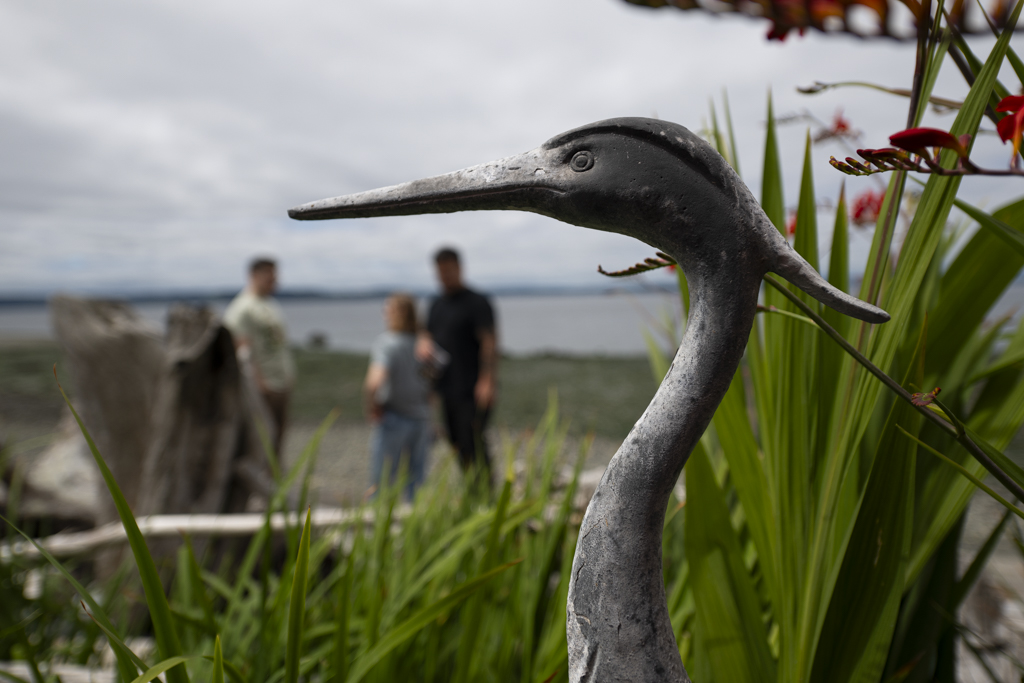
Garden C, “Heron Cove,” has its namesake standing sentinel:
Below are Debra Montgomery and Lee Kelly; she bought the “Heron Cove” house 7 years ago and inherited Lee, who has been the gardener for 40 years. She said the previous homeowners sought out a buyer who wouldn’t tear down the house and would keep caring for the garden, which she and Lee both now do.

Garden D was described as “Small Spaces, Big Moments”:

Below (L-R) are the gardeners behind Garden D, Laird Applegate and Brian Pelzel:

Garden E was “From a Sprawling Lawn and One Tree to …”

Blackberries are often the bane of a gardener’s existence, but in Garden F, “Transformation,” they were beautiful:

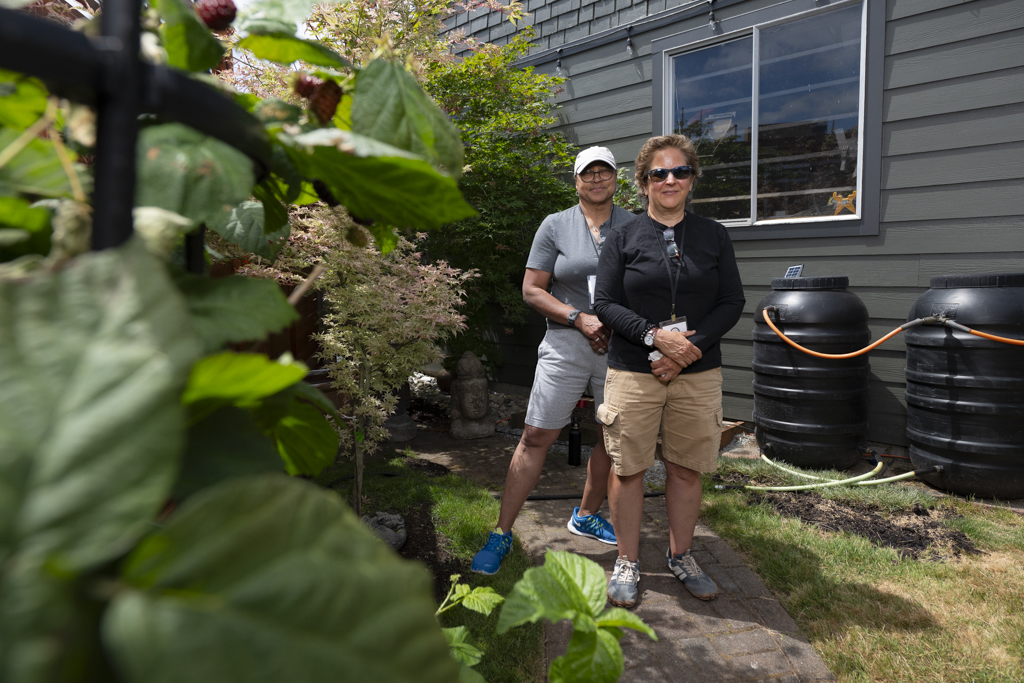
Garden F’s (L-R) Diane Elie and Raquel Gonzalez store water in 60-gallon rainbarrels and told Oliver that it fills most of their irrigation needs:
At Garden G, “Hidden Gem,” Julie Robinson-Jasper and Maple the dog are seen through a mirror surrounded by star jasmine at Garden G, “Hidden Gem”:

Another scene from Garden G:

Garden H, “Behind the Fences,” sported an arch of bittersweet nightshade:

A clawfoot bathtub graced Garden I, “A Fresh Look for A Once-Beloved Garden“:

Garden J, “Garden of Many Rooms,” was conducive to wandering:

Garden K offered onlookers “Plants from Around the World“:
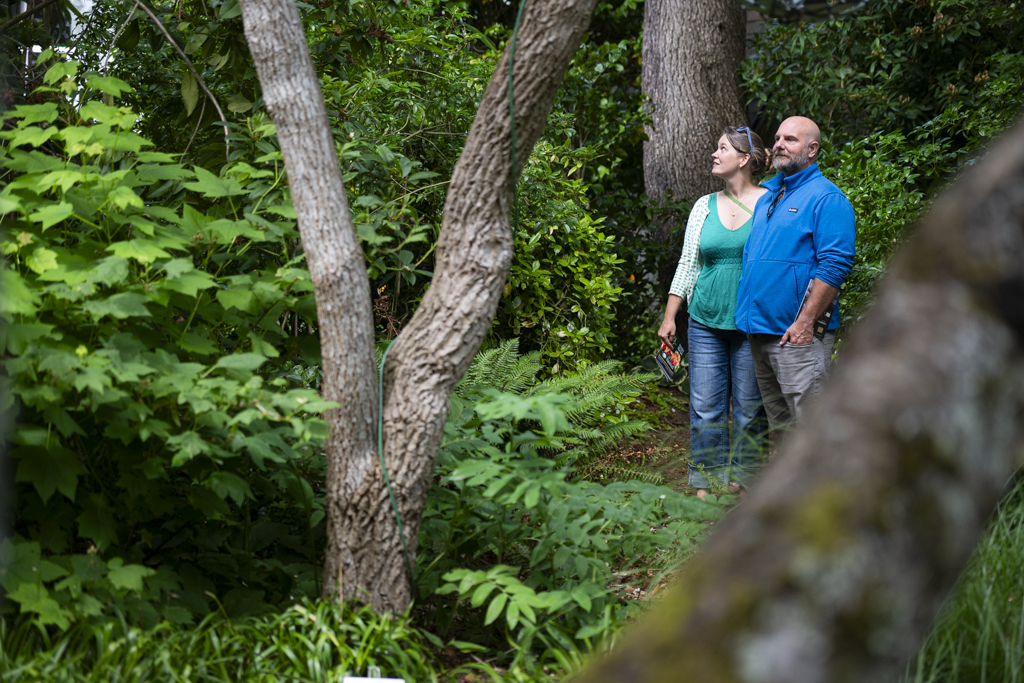
And Garden L, “Conifer Corner,” featured a 75-year-old wisteria:

(Read details of each garden here.) The West Seattle Garden Tour is organized by a nonprofit that uses the proceeds to support other nonprofits – here are this year’s grant recipients; see how to apply for one of next year’s grants by going here (July 15 is the deadline).
Alaska
Man with same name as Alaska Sen. Dan Sullivan can appear on GOP primary ballot, state’s Supreme Court rules

The battle of the Dan Sullivans is on.
The Alaska Supreme Court ruled Monday that a man with the same name as Republican Sen. Dan Sullivan can challenge the sitting lawmaker in the state’s GOP Senate primary in August. The high court upheld a ruling from a lower court judge that cleared the way for Daniel J. Sullivan to appear on the primary ballot, reversing a decision by state officials earlier this month that he was ineligible because he was allegedly trying to confuse voters.
The state Supreme Court directed Alaska’s Division of Elections to decide how Daniel J. Sullivan should be listed on the ballot “within the confines of existing Alaska ballot design law.”
The conflict is taking place in one of the country’s most closely watched Senate elections. The sitting Sen. Sullivan is running for a third term, but former Democratic Rep. Mary Peltola is vying to challenge him, setting up what could be an unusually competitive race in a deep-red state that hasn’t elected a Democrat to the Senate in almost 20 years.
The senator has called his same-name competitor a “sham candidate” and accused him of trying to trick voters and help Democrats flip the seat. Daniel J. Sullivan — a retired teacher and former U.S. Forest Service employee from Petersburg, Alaska — has denied those allegations and insisted he is both qualified and genuinely interested in running for Senate.
About two weeks ago, the Alaska Division of Elections determined that the challenger Sullivan could not appear on the ballot, arguing his paperwork “was not filed in order to declare an actual good-faith candidacy, but was instead filed with a purpose to confuse or mislead.”
In a letter to the candidate, Director Carol Beecher pointed to the fact that Daniel J. Sullivan had initially requested to appear on the ballot as “Dan Sullivan,” the same name format as the senator. She also wrote that he hadn’t previously been affiliated with the state Republican Party, had a website design that “appears to be deliberate[ly]” similar to the senator’s campaign site and had worked with a political consultant with links to Democratic candidates.
Daniel J. Sullivan asked a state court to reverse the decision. On Friday, Judge Thomas Matthews ruled in his favor, finding the non-senator Sullivan met the requirements to run for U.S. Senate and the state didn’t have the authority to exclude him based on “good faith.”
“The court does not minimize the Division’s concern that voters should not be misled,” the judge wrote. But he added that “Alaska election law gives the Division tools to address that concern,” including regulating how candidates appear on the ballot.
With ballots set to be printed this week, the issue was appealed to the Alaska Supreme Court on an expedited basis, with both sides filing court papers over the weekend.
The state Division of Elections asked the high court to overturn Matthews’ ruling, arguing it would “leave Alaska constitutionally required to permit bad-faith ballot access.” The agency said it reached its conclusion about Daniel J. Sullivan after it received a complaint from the National Republican Senatorial Committee “credibly alleging” he was seeking to “cause voter confusion” and made a “bewildering” request to appear on the ballot with the senator’s middle initial.
If Daniel J. Sullivan is permitted to remain on the ballot, the state asked the Alaska Supreme Court to allow it to print his full name and list his party affiliation as “nonpartisan” to “ensure voters are not forced to guess between two nearly identical names.”
The Alaska Republican Party and several GOP-led states filed amicus briefs siding with Alaska.
Daniel J. Sullivan’s lawyers, meanwhile, argued the state “lacked any basis in Alaska law to exclude Mr. Sullivan from the ballot” and didn’t have the power to look into his “private motivations.” They wrote that state law doesn’t give officials the power to keep qualified candidates off the ballot due to potential confusion.
“[All] that Mr. Sullivan asks here is to be listed on the ballot, and the Division is obviously empowered to do so in a non-confusing manner,” his lawyers wrote.
Following oral arguments, the high court sided with Daniel J. Sullivan in a two-page order late Monday, and said it would issue a fuller opinion at a later date.
Jeffrey Robinson, an attorney for Daniel J. Sullivan, told CBS News his legal team is “grateful” for the Alaska Supreme Court’s decision to “affirm Judge Matthews’ well-reasoned, thorough order vacating the Division’s unlawful decision to exclude Mr. Sullivan as a candidate.”
“We expect that the Division will act in full compliance with existing Alaska ballot design law in its preparation of the ballots,” Robinson said in an email.
The senator’s campaign spokesperson, Nate Adams, said: “We’re disappointed in the court’s decision because as the sham candidate Dan J. Sullivan’s lawyers made clear in their legal arguments, the only reason he is running is to deceive voters and manipulate Alaska’s election system.”
“However, we are encouraged by the fact that the Director of the Division of Elections will be able to use her expertise to differentiate between the Petersburg fraud and the incumbent — Senator Dan Sullivan — to the benefit of Alaska voters,” Adams said.


What to know about coming Arizona Medicaid work requirements
Stephanie Innes interviews Meaghan Kramer at the Arizona state Capitol about the coming Arizona Medicaid work requirements.
Not a day goes by without staff at the Valle del Sol health clinic in Phoenix strategizing about the looming date of Jan. 1, 2027, and what it will mean for their low income patients’ health coverage.
“We will absolutely see a spike in uninsured people. My biggest concern is that people who are eligible will be cut because of the administrative burden,” said Mike Renaud, the CEO of Via del Sol, a federally qualified community health center that sees roughly 15,000 patients per year, half of whom are covered by Medicaid, which in Arizona is called the Arizona Health Care Cost Containment System or AHCCCS, pronounced “access.”
“Medicaid is the largest health insurance program for low income people in the United States. It is the largest payor of mental health services in the U.S.”
Jan. 1, 2027 — six months away — is the deadline for Medicaid programs in 43 states across the country, including Arizona, to implement major policy changes that include work requirements and twice-yearly renewals (up from once yearly) for certain enrollees.
In Arizona, the new rules will mark the largest operational change in the history of the AHCCCS program, said Meaghan Kramer, health policy adviser to Gov. Katie Hobbs.
“This is the fastest they’ve ever had to do something that is operationally complex. And this is the most operationally complex thing they’ve ever had to do,” Kramer said. “We’re straining existing systems that are already old and overburdened on the IT side. And we will need much, much more work on the eligibility side than we have now.”
The changes are a result of HR1, the budget reconciliation bill also known as the One Big Beautiful Bill Act, which President Donald Trump signed into law on July 4, 2025.
The law significantly changes both eligibility and financing of Medicaid, which is a government health insurance program primarily for low-income people that has been in place since 1965. Arizona has had a Medicaid program since 1982.
Having only 18 months to prepare for HR1 is an extremely heavy technological lift for states, including Arizona. Arizona’s aggressive implementation of HR1 changes to SNAP, the Supplemental Nutrition Assistance Program once known as food stamps, resulted in the highest rate of loss of SNAP recipients in the country, with about 450,000 dropping from the program from February 2025 to mid-2026.
Recipients and would-be recipients have told The Arizona Republic SNAP benefits are harder to get than ever, with long hold times on the phone and at satellite offices, a dysfunctional website and fewer DES employees to help them.
The new state budget that was recently signed includes a little more than $10 million that will go to technology and to employees who will be handling the increased workload, Kramer said.
Hopefully state officials have learned from the experience with SNAP and “don’t make the same mistake again,” said Will Humble, executive director of the Arizona Public Health Association.
“The computer system needs to improve and the staff needs to be trained,” Humble said. “I’m convinced the majority of people who lose coverage will lose it because of administrative reasons.”
Further complicating the implementation is that the Centers for Medicare & Medicaid Services recently released a 387-page interim final rule with strict new guidelines about Medicaid work requirements. The new guidelines, for example, do not automatically exempt people with cancer and end-stage renal disease, among other conditions, from the work requirements.
“It is written in a way that makes it clear this is going to be a much more challenging task than any state anticipated,” Kramer said of the guidelines. “States are really struggling with what this new guidance means…The new guidance is going to be much more burdensome on the member, the applicant and the Medicaid agency long-term.”
Twenty-four attorneys general, including Arizona Attorney General Kris Mayes, and two governors on June 30 sued the federal government over the document, arguing that it illegally narrows congressional protections of medically frail people enrolled in the program.
AHCCCS as of June 1 provided health insurance to approximately 1.8 million Arizonans, which works out to one in four state residents. About one in four of those AHCCCS enrollees or 400,000 and 500,000 people, are expected to be part of the adult expansion population affected by the work requirements and twice-annual renewals.
At Valle del Sol, Renaud said clinicians and other staff are already educating patients and clearing up misinformation.
“We want to make sure they understand this is not a Medicaid cut. It is increased barriers to maintaining coverage.”
Here are seven things to know about the coming changes to Medicaid in Arizona:
Outreach to AHCCCS enrollees begins in September
AHCCCS will be providing communications to impacted enrollees by Sept. 1. Most enrollees probably don’t know whether they are part of the affected adult expansion population and that’s part of the outreach. People covered by AHCCCS can expect to see communications via mail, text and email.
“The goal will be to make sure we are providing reliable information to everybody to reassure folks that they should continue to fill out paperwork when they are prompted by their health plan or by AHCCCS,” Kramer said.
For now, there is nothing Arizonans need to do, AHCCCS officials say, except to keep their contact information current on Health-e-Arizona Plus; respond if AHCCCS or your health plan reaches out to you; and watch for official updates from AHCCCS, not third parties.
The changes won’t hit all affected enrollees at once
Annual AHCCCS renewals (also known as redeterminations) happen on a rolling basis, and that’s how the twice-annual renewals and work requirements will be handled, too, Kramer said.
“If they were redetermined last Jan. 1 they will get redetermined again the next Jan. 1. And then beginning that year they are getting redetermined every six months,” she said.
The work requirements allow for volunteer work and school
Enrollees who are part of the adult expansion population will need to prove they are working at least 80 hours per month or doing another qualifying activity, like job training or education, to avoid losing coverage.
It’s unclear how enrollees prove they are working, volunteering
State officials are able to verify through pay stubs that some people are already meeting the work requirements, but not for everyone. And at some point “self-attestation” − simply saying you are volunteering or in school − won’t be enough.
“What we know is the rules are more aggressive beginning in year two (2028) and there will be some allowance for self-attestations in the first year,” Kramer said.
“But after the first year, beginning Jan. 1, 2028, self-attestations are only permitted once in a continuous eligibility cycle. So that would place an enormous burden on AHCCCS and DES (the Arizona Department of Economic Security), which plays a large role in Medicaid eligibility determinations.”
Kids, seniors and Native populations won’t be affected
Several categories of Arizona’s Medicaid expansion populations will be exempt from the work requirements, such as but not limited to, pregnant and postpartum women, people who are disabled or medically frail, parents and caretakers of children under 14, caregivers of someone with a disability, American Indians and Alaska Natives, and those already meeting similar requirements under SNAP.
Kramer said that state officials are working to determine on their end who is exempt from the requirements in order to lessen the burden on enrollees.
Arizona will be offering short-term hardship exceptions to the work requirements for people who have recently been hospitalized, who need to travel outside of their community for medical care, who live in a county with high unemployment rates, or who live in a community where a national emergency or disaster has recently been declared, Cordoba, the AHCCCS spokesperson, wrote in an email.
Technology could be a problem in Arizona
AHCCCS relies primarily on two major systems to administer eligibility and benefits and both are old.
PMMIS, the agency’s core Medicaid administration system, was originally implemented in 1991 and is currently undergoing modernization, with the updated platform scheduled to go live in October 2027, Cordoba wrote. HEAplus, Arizona’s eligibility system, was implemented in 2013.
“While both systems have undergone significant upgrades and enhancements over time to support changing federal and state requirements, the PMMIS modernization project will not be complete before the federal requirements in H.R. 1 take effect,” Cordoba wrote.
Health entities are trying to prevent AHCCCS coverage losses
Hospitals, community health centers and health plans already connect people to benefits, including AHCCCS. One of the key goals of those entities statewide is to ensure enrollment specialists are all trained on how to interact with the technology that’s going to be used to implement HR1, Kramer said.
All those entities have an interest in keeping people insured. Without health insurance, people tend to wait until their health problems reach a critical point before seeking care, which can cause personal medical debt, bad debt for hospitals, and increased health costs across the board.
The Health System Alliance of Arizona, which includes major Arizona health systems such as Banner Health and HonorHealth is “extremely concerned about eligible individuals losing Medicaid coverage due to the increased renewals and work requirements passed in HR1,” Brittney Kauffmann, alliance CEO wrote in an email.
“Our systems are assessing all options to ensure Medicaid members are aware of these changes.”
Reach health-care reporter Stephanie Innes at stephanie.innes@usatodayco.com or follow her on X: @stephanieinnes or on Bluesky: @stephanieinnes.bsky.social.
-

 Seattle, WA5 minutes ago
PHOTOS: Visiting all 12 stops during this year’s West Seattle Garden Tour
-

 Milwaukee, WI15 minutes ago
Milwaukee Barbecue: A Legacy of Smoke
-

 Atlanta, GA20 minutes ago
Georgia Haitian communities face sudden July 27 deportation deadline
-

 Minneapolis, MN27 minutes ago
Broken A/C leaves 75-year-old cancer patient sweltering at north Minneapolis apartments
-

 Indianapolis, IN30 minutes ago
Jazz saxophonist Jared Thompson shares journey of self-acceptance and artistry
-

 Pittsburg, PA35 minutes ago
Trash pickup schedules adjusted in Pittsburgh-area communities due to impending heat wave
-

 Washington, D.C40 minutes ago
D.C.’s July 4th fireworks will have “TSA-style” security, won’t start until 11 p.m.
-

 Augusta, GA42 minutes ago
16-year-old wanted in aggravated assault case in Augusta

