Midwest
Instagram blocks nude images in DMs to mitigate 'sextortion' crimes reaching record numbers

This story discusses suicide. If you or someone you know is having thoughts of suicide, please contact the Suicide & Crisis Lifeline at 988 or 1-800-273-TALK (8255).
Instagram recently announced that the photo and video-sharing platform popular among young users will be taking new steps to combat sexual extortion, or sextortion — a crime that continues to victimize more people, including minors, according to the FBI.
Sextortion is a social media crime trend in which bad actors entice or solicit a minor to engage in sexual acts or send blackmail money, according to the FBI, which received more than 13,000 reports of online financial sextortion involving at least 12,600 victims between October 2021 and March 2023.
“Companies have a responsibility to ensure the protection of minors who use their platforms,” John Shehan, senior vice president of National Center for Missing & Exploited Children, (NCMEC) said in a response to Meta’s new features to prevent sextortion on Instagram. “Meta’s proposed device-side safety measures within its encrypted environment is encouraging. We are hopeful these new measures will increase reporting by minors and curb the circulation of online child exploitation.”
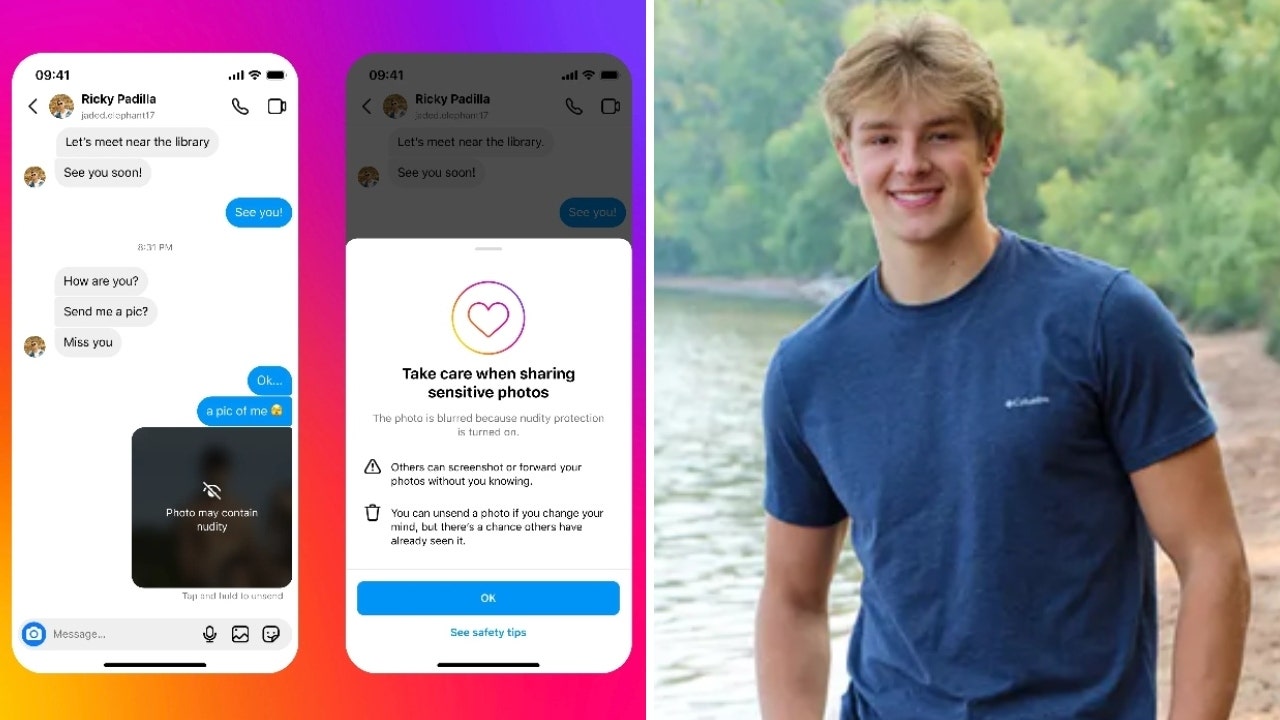
A new Instagram feature called Nudity Protection, which will be turned on by default for users under 18, will blur nude images sent through direct messages (DMs) on the app and will prompt users with messages when the app detects nudity in a user’s DMs.
AFTER MICHIGAN TEEN’S SUICIDE, NIGERIAN BROTHERS PLEAD GUILTY TO PLANNING DEADLY SEXTORTION SCHEME
A new Instagram feature called Nudity Protection, which will be turned on by default for users under 18, will blur nude images sent through direct messages (DMs) on the app and prompt users with messages when the app detects nudity in a user’s DMs. (Meta)
Instagram users with the Nudity Protection feature turned on will also “see a message encouraging them to reconsider” when they try to send a nude photo detected by the app, according to an April 11 press release from Meta.
Additionally, users will get “tips” when they send or receive nude images reminding them that “people may screenshot or forward images without your knowledge, that your relationship to the person may change in the future, and that you should review profiles carefully in case they’re not who they say they are,” the press release states. Instagram will prompt users with a link to various resources curated by experts.
FATHER OF TEEN SEXTORTION VICTIM WARNS OF ‘ALARMING’ FBI REPORT
Instagram users with the Nudity Protection feature turned on will also “see a message encouraging them to reconsider” when they try to send a nude photo detected by the app, according to an April 11 press release from Meta. (Meta)
They also link to a range of resources, including NCMEC’s free service called “Take it Down,” which is meant to help victims of sextortion erase explicit images of victims or get bad actors to stop sharing them online. The tool can be accessed at https://takeitdown.ncmec.org.
Meta’s announcement came the same day two Nigerian nationals, who were extradited to the U.S., pleaded guilty to conspiring to sexually exploit teenage boys through sextortion two years after one such scheme led to a Michigan teenager’s suicide.
MICHIGAN FAMILY SOUNDS ALARM ON SON’S ‘SEXTORTION’ SUICIDE AFTER ARRESTS OF 3 NIGERIAN MEN
Jordan DeMay was 17 years old when Samuel Ogoshi, 22, and his brother, Samson Ogoshi, 20, both of Nigeria, posed as a woman on Instagram using a hacked account and struck up a conversation with the teenager, ultimately blackmailing him into sending money and threatening him for more until he took his own life in March 2022.
Nigerian brothers Samuel and Samson Ogoshi pleaded guilty to conspiring to extort minors. (Economic and Financial Crimes Commission)
“Nothing is a coincidence with them,” Jordan’s father, John DeMay, told Fox News Digital on Instagram’s announcement last week. “Jordan’s case is the first one in history that has been … extradited and prosecuted on the sextortion level. Meta … and other social media companies that are watching this case, and they’re paying attention to what’s happening because it’s the first in history.”
DeMay filed a civil lawsuit against Meta after his son’s death.
FBI WARNS TEEN BOYS INCREASINGLY TARGETED IN ONLINE ‘SEXTORTION’ SCHEMES
“There is responsibility for them … and we’re hoping that other families will follow suit,” he said. “Some of them are and some of them are going to. But there are a lot of protections with social media companies right now, and we’re trying to tear down some of those barriers to be able to allow families that have been victims because of of [the companies’] actions and not actions, and hold them accountable financially, because the only way that they’re going to stop doing it is to hit them in the pocketbook.”
Three Nigerian men were arrested in connection with the sextortion of 100 young men and the 2022 suicide of 17-year-old Jordan DeMay. (Handout)
The same night the Ogoshis started communicating with Jodan through Instagram, the teenager sent an explicit photo of himself to the account that he thought belonged to a woman. Samuel Ogoshi threatened to expose it and make it go “viral” online if Jordan did not immediately send money, prosecutors said. Jordan complied and sent the suspect money, but the crime only escalated from there as Ogoshi demanded more and more money from the 17-year-old.
The exchange went on for hours that evening until Jordan told Samuel Ogoshi that he was going to kill himself.
WARNING SIGNS OF SUICIDE: WHAT TO KNOW ABOUT PREVENTION, RED FLAGS AND HOW TO DEAL WITH THE ISSUE
“Good,” Samuel Ogoshi wrote. “Do that fast. Or I’ll make you do it. I swear to God.”
John DeMay said he would tell Jordan “every single day” if he had “a chance” that threats from the sextortionist were not the end of his life. (Handout)
The Ogoshi brothers face a minimum sentence of 15 years and a maximum of 30 years for each charge of conspiracy to sexually exploit minors. An indictment against the two brothers alleged they were involved in hundreds of similar schemes – many involving minors.
The average age of sextortion victims is between 14 and 17 years old, the FBI said in a press release earlier this year, but the agency noted that any child can become a victim. Offenders of financially motivated sextortion typically originate from African and Southeast Asian countries, according to the FBI. The FBI also saw a 20% increase in sextortion incidents involving minors between October 2022 and March 2023.
GROWING ‘SEXTORTION’ TREND TRICKS BOYS INTO SENDING EXPLICIT IMAGES THROUGH GAMING SITES, EXTORTED FOR MONEY
Sextortion can lead to suicide and self-harm. Between October 2021 and March 2023, the majority of online financial extortion victims were boys. These reports involved at least 20 suicides, the FBI said.
WATCH: John DeMay speaks about son’s sextortion
Christopher Dietzel, research associate on the iMPACTS Project at McGill University, called on Meta to do more to prevent sextortion.
“Automatically blurring nude images in direct messages is not enough, nor does it address the potential for sextortion, since perpetrators can still save, share, and use these images to abuse and exploit their victims,” Dietzel said. “Instagram and other social media companies need to put policies and measures in place that hold perpetrators accountable, address the dissemination and exploitation of non-consensual sexual images, and educate young people about potential harms.”
Melissa Henson, vice president of the Parents Television and Media Council, called on Congress to pass “online child protection legislation like the Kids Online Safety Act, the Children and Teens Online Privacy Protection Act 2.0, the EARN IT Act, among others.”
“[T]here is simply no reason, and no excuse, for Congress not to ensure our children are better protected online,” Henson said. “Our children face an online world that is primarily designed for adults, with little to no protections for them. They are up against powerful algorithms that feed harmful content to them. They can interact with adults who may turn out to be predators and fall victim to sextortion schemes. They can access sexually explicit and graphically violent content with a click of a button. Congress must hold the tech industry accountable for protecting our children.”
Read the full article from Here


Getty
DETROIT, MICHIGAN – MARCH 12: Cade Cunningham #2 of the Detroit Pistons while playing the Philadelphia 76ers at Little Caesars Arena on March 12, 2026 in Detroit, Michigan. NOTE TO USER: User expressly acknowledges and agrees that, by downloading and or using this photograph, User is consenting to the terms and conditions of the Getty Images License Agreement. (Photo by Gregory Shamus/Getty Images)
The 2026 NBA offseason looks to be an interesting one for the Detroit Pistons, who are fresh off a 60-win regular season. The Pistons have had one of the most impressive turnarounds in recent history, going from the hands-down worst team in basketball to the top seed in the Eastern Conference.
Detroit’s future is centered around none other than rising superstar point guard Cade Cunningham, who is coming off an MVP-caliber season and one of the best individual campaigns in franchise history. For Cunningham to continue turning the tide in Detroit and ascending individually, the Pistons will need to land their 24-year-old point guard some help.
Could Pistons Feature Another All-Star Around Cade Cunningham?
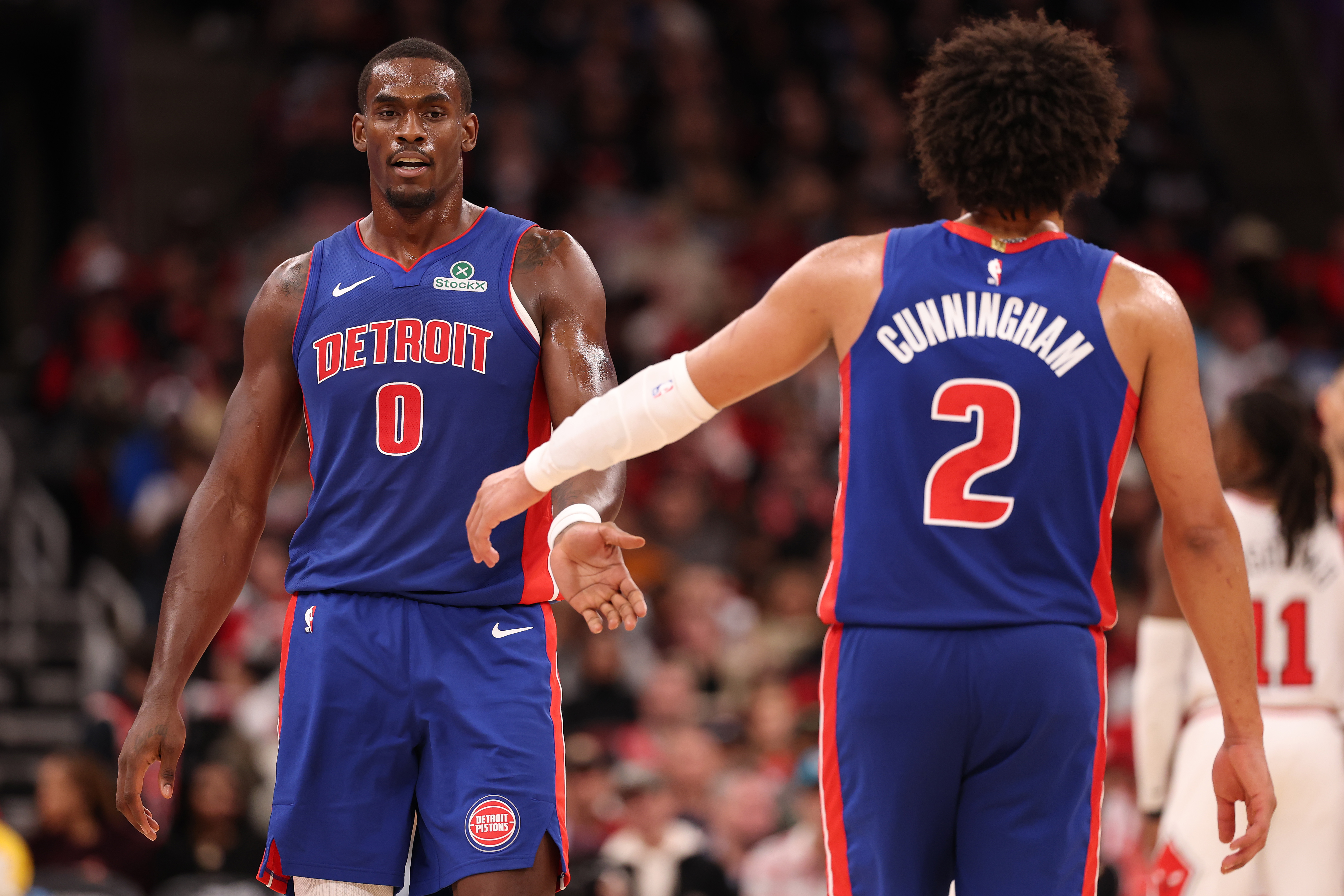
GettyCHICAGO, ILLINOIS – OCTOBER 22: Jalen Duren #0 and Cade Cunningham #2 of the Detroit Pistons high five against the Chicago Bulls during the second half at the United Center on October 22, 2025 in Chicago, Illinois.
While Cunningham is largely responsible for transcending the Pistons’ fortunes, Jalen Duren, the rising 22-year-old big man, is also to thank for the success. But for Detroit to rise into legitimate title contender status, it may need to feature another star.
According to ClutchPoints NBA insider Brett Siegel, the Pistons have their eyes on Kawhi Leonard of the Los Angeles Clippers. Leonard, a seven-time All-Star could be an addition that would take Detroit over the hump.
“Now, if a team approached them with a massive trade offer for the seven-time All-Star, they would have to at least consider the idea of taking a step back and moving on from Leonard, especially since he turns 35 years old on Monday,” Siegel reported. “Multiple teams, including the Warriors, Timberwolves, and Pistons, have contacted the Clippers both at the trade deadline and this offseason to inquire about Leonard’s availability. At no point did Los Angeles show any interest in trading him, sources said.”
While the Clippers have not formally made Leonard available, Siegel reports there is a chance the franchise would look to move the two-time Finals MVP if they receive a worthy package.
Does Detroit have enough in its asset bank to draw up a strong trade package for Leonard? Maybe. Nonetheless, it is a good sign the Pistons are searching for another big fish to slot alongside Cunningham.
Detroit Should Strong Consider a Big Trade; is Leonard Enough to Make a Contender?
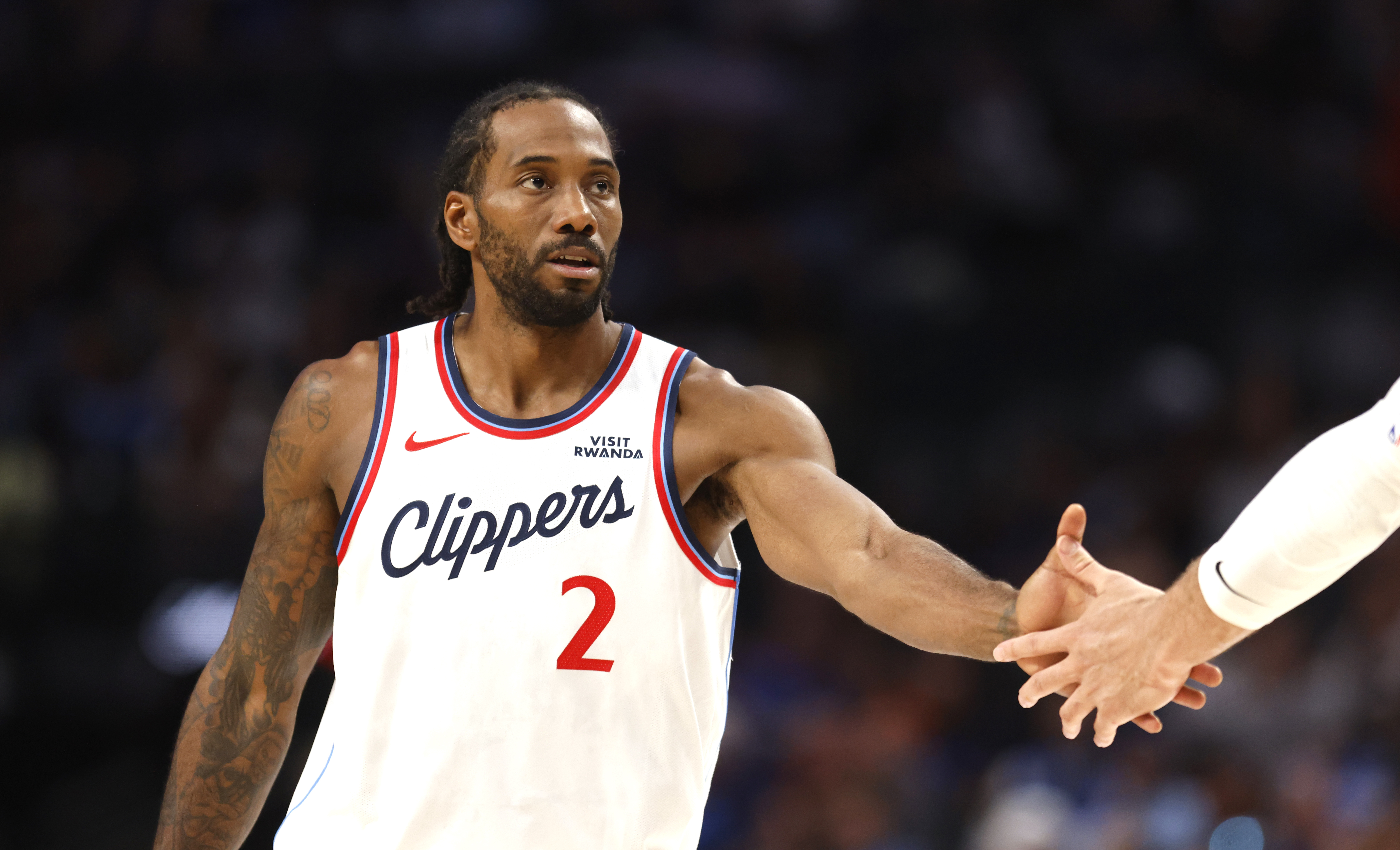
GettyDALLAS, TEXAS – MARCH 21: Kawhi Leonard #2 of the Los Angeles Clippers celebrates with a teammate during the second half against the Dallas Mavericks at American Airlines Center on March 21, 2026 in Dallas, Texas.
Last season, the Pistons blew away expectations. Cunningham arrived as a blossoming superstar, Duren announced himself as a franchise cornerstone and Detroit showed it may just be one major piece away from claiming the Eastern Conference mantle.
Perhaps making an offseason splash is something Pistons president Trajan Langdon needs to strongly consider.
In some ways, Cunningham’s situation mirrors Anthony Edwards’ in Minnesota. Both young, rising superstars on teams that can make noise in the playoffs. The Timberwolves realized they didn’t have enough to compete, so they landed LaMelo Ball from the Charlotte Hornets.
Maybe something similar needs to happen in Detroit. Perhaps star guard or wing next to Cunningham is what it will take to elevate the Pistons from a regular season force to a playoff powerhouse.
Landing Leonard from the Clippers might raise the Pistons to that level. Although he’s 35 years old, Leonard is coming off an All-NBA season after registering a career high 27.6 points per game and doing it on an uber-efficient 51.5% shooting from the floor.
Leonard is a proven winner and multi-time champion. He may be the superstar (and veteran) Detroit needs to put itself on equal footing with the NBA champion New York Knicks.
Adel Ahmad Adel is a writer with over five years of experience covering the NBA. His work has appeared on various media platforms, both national and local. More about Adel Ahmad

A game and a series that started so promising, ended up in an emotional loss for the Milwaukee Brewers as they fall to their rivals, the Chicago Cubs, 4-3 in 10 innings on Sunday afternoon.
Brandon Woodruff was the big positive. In his second start since coming back from the IL, Woodruff shoved once again, allowing just one hit over 5.2 scoreless innings. He was efficient and filled up the strike zone as he usually does. Woodruff ended the day with six strikeouts on his line and protecting a one-run lead.
That one run lead was provided by Gary Sanchez, who took a 1-1 fastball from lefty Ryan Rolison and tattooed it into the second deck in left field. It was Sanchez’s eighth home run of the season.
However, that was all the Brewers offense could really muster off Rolison and then old friend Bryse Wilson, who shut down the Crew’s offense over his 4.1 IP.
The Brewers did have a number of opportunities, though. Runners at the corners in the 3rd with one out, both Chourio and Turang strike out. In the 4th, Andrew Vaughn gets a leadoff triple, no one can even muster a sac fly to bring him home. Runners on first in the 6th, 7th, and 8th, no advancement. In the 9th, the Brewers had runners on 1st and 2nd with one out, a base hit can walk it off, and both Cooper Pratt and Joey Ortiz strike out.
“I think sometimes guy maybe try to do too much, and that’s where we try to preach ‘take what the game gives you and go back to taking pitches and handing it to the next guy’” offense and strategy coordinator Jason Lane said.
Meanwhile the Crew used up their top bullpen arms in those earlier leverage innings. Aaron Ashby spiked a curveball with a runner on 3rd to allow the Cubs to tie the game in the 7th. But then Abner Uribe and Trevor Megill got the jobs done in the 8th and 9th. But with few leverage arms left, the Brewers turned to Joel Kuhnel in the 10th.
Kuhnel was able to get the first two batters out at the bottom of the Cubs order. Then he just lost the strike zone. They intentionally walked Pete Crow-Armstrong, then Kuhnel hits Bregman, then walks Michael Busch to bring in a run. Then Seiya Suzuki rips a single to left to score two more and put the Cubs up 4-1.
The Brewers put together some big chances in the 10th. Christian Yelich singled home Ortiz, then Chourio walked and Turang singled, loading the bases for pinch-hitter Garrett Mitchell. Mitchell worked a walk and the Brewers were within a run, down 4-3, with the bases loaded and nobody out.
That’s exactly when it all went sideways. Jake Bauers, after seeing Mitchell get walked, swung at the first pitch and hit a shallow pop fly into left field that was nowhere near deep enough to score a run. Then Gary Sanchez, who homered in the 2nd, grounded into a tailor-made 5-4-3 double play to end the game.
Milwaukee was 2-for-12 with runners in scoring position and left 10 runners on base. Woodruff pitched well enough to win. The bullpen did well enough to win through nine innings. The offense just couldn’t give them enough.
The Brewers missed way too many opportunities to put this game away when they should have and that leaves them on the short end of this series where they had their top three arms in the rotation going. The lead over the Cubs sits at 5.5 games now and the Brewers will look to turn the page to the Reds series.

One person is dead and eight others are hurt in a string of weekend shootings across Minneapolis.
Police say the first shooting occurred Friday around 5 p.m. near North Humboldt and 26th avenues. A man was outside of his home when shots rang out, leaving him with multiple gunshot wounds.
Around 9:35 p.m. Friday, two men were shot outside in the area of north Lowry and Logan avenues.
Just after 12:30 a.m. Saturday, a man was found shot in an alley near Mortimer’s Bar and Restaurant off South Lyndale and Franklin avenues. He told police he was outside walking when he was hit.
Just before 12:50 a.m. Saturday, police say a man outside was shot near North Penn Avenue, just north of Highway 55, by someone driving by.
Around 1:50 a.m. Saturday, a man suffering from gunshot wounds showed up at Hennepin Healthcare, with police later determining he was shot in the area of North Lyndale and 45th avenues.
Just after 3:30 a.m. Saturday, a man showed up to Children’s Minneapolis hospital with a gunshot wound he said occurred when he was asleep inside his vehicle.
On Sunday around 1 a.m., a man was found laying on the ground near Bloomington Avenue and East 24th Street. He was brought to Hennepin Healthcare where he later died. Police say investigators “located evidence of gunfire, including a firearm recovered next to the man who died.”
On Sunday just before 1:30 a.m., a 15-year-old girl was shot in the area of Hennepin and Laurel avenues in downtown. Two boys, ages 14 and 15, were soon arrested in connection to the shooting.
And just before 1:50 a.m. Sunday, a man was found shot inside a business off Northeast Lowry Avenue and Fourth Street Northeast. Investigators believe the shooting began as an altercation in the business’s parking lot.
With the exception of the shooting of the 15-year-old girl, police say no arrests have been made in any of the cases. All surviving victims have injuries described by police as non-life threatening.
Anyone with information on any of these shootings can submit an anonymous tip online to Crime Stoppers, or call 1-800-222-TIPS (8477).
-

 Politics5 minutes ago
Jacob Frey praises Somali community as Minnesota faces renewed scrutiny over fraud investigations
-

 Sports13 minutes ago
J.T. Poston posts a 12 on a single hole at Travelers Championship in stunning meltdown
-

 Technology20 minutes ago
Midjourney’s wild body scanner scans you in water
-
 Business23 minutes ago
Why tech stocks are getting hammered
-
 Entertainment28 minutes ago
Sigh. Again? ‘Love Island USA’ confirms another contestant fired over apparent use of racial slur
-
 Politics38 minutes ago
Commentary: This California bill is so bad it has me agreeing with a Trump Republican
-
 Sports50 minutes ago
Wife, kids of Dodgers’ Miguel Rojas in Caracas when earthquakes hit Venezuela
-

 World58 minutes ago
Stars, Stripes, VIPs and Protests: Brussels hosts US Independence bash

