Connect with us

Northeast

Bragg’s absurd case against Trump finally gets its undeserved day in court

Published

on

Bragg’s absurd case against Trump finally gets its undeserved day in court
NEWYou can now listen to Fox News articles!

Absent an eleventh-hour reprieve from a higher court, Donald Trump will become the first U.S. president to face a criminal trial when it commences on Monday in New York.  

Let the circus begin.  

The ringmaster of the Big Top clown show is Alvin Bragg, the progressive Manhattan district attorney who campaigned — unethically — on the promise to bring down Trump. Once in office, Bragg inflated a time-barred and nominal misdemeanor into a multitude of dubious felonies by mangling evidence and contorting the law.  

TRUMP REQUEST TO DELAY HUSH-MONEY TRIAL DENIED FOR THIRD TIME

Advertisement

With a wave of his showman’s cane, Bragg transformed a singular transaction into 34 separate charges in what’s known as “count stacking” that no good prosecutor would ever do. It’s a transparent window into an otherwise opaque case.  

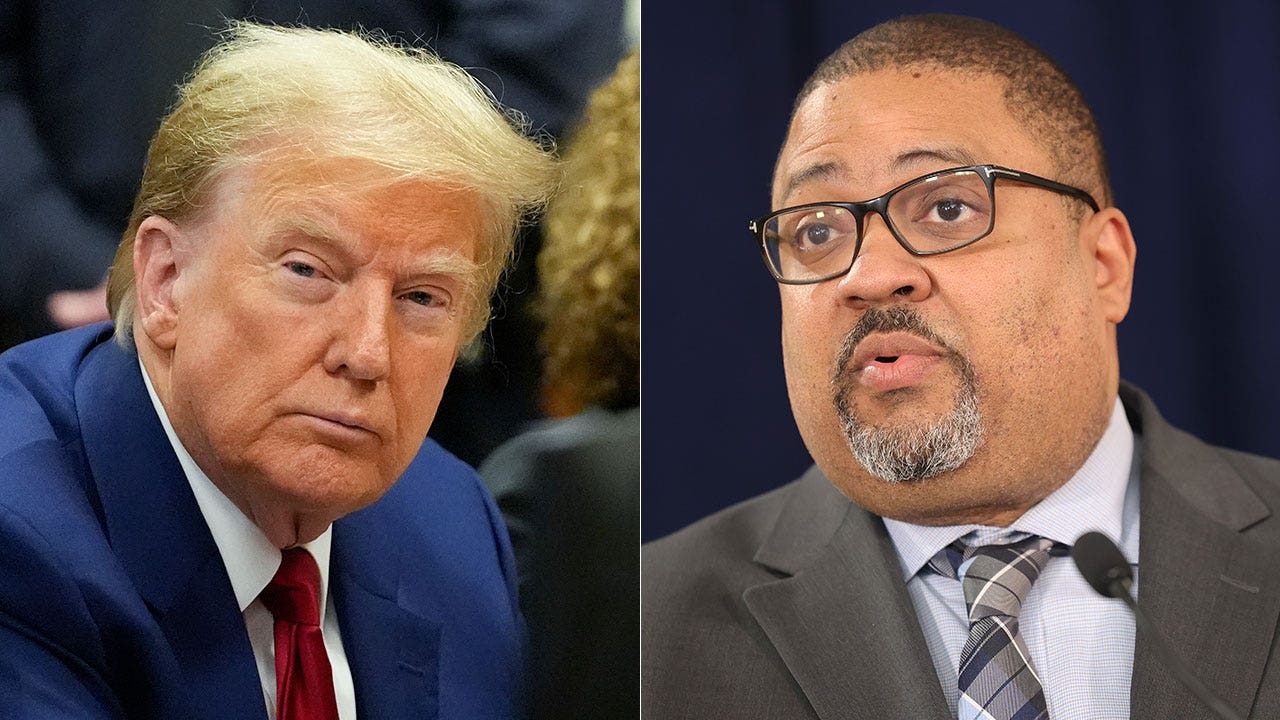
Former President Donald Trump, left, squares off against progressive Manhattan District Attorney Alvin Bragg starting April 15. Photographer: Mary Altaffer/AP/Bloomberg via Getty Images (Getty Images)

The gravamen of the indictment is that in 2016 Trump used his lawyer to pay money to Stephanie Clifford (a.k.a. Stormy Daniels) in exchange for her silence about a purported affair that occurred a decade earlier, that he incorrectly recorded the payments in business records, and that all of it violated election laws, even though it did not.  

Bragg surely knows his case is specious, at best. But it doesn’t matter. He’s counting on the sympathies of a liberal trial judge, Juan Merchan, and the venom of a jury pool destined to be dominated by Trump-hating New Yorkers. The once-respected standard of an “impartial jury” is being treated as a mere inconvenience instead of a constitutional right.  

It is self-evident to many that the charges against the former president would be brought against no one else not named Trump. The fact that he is the leading candidate for president in the upcoming election is the only reason he is being persecuted under the guise of prosecution.  

Advertisement

Even the left-leaning New York Times “could “identify only two other felony cases in Manhattan over the past decade in which defendants were indicted on charges of falsifying business records but no other crime.” This makes the DA’s legal theory not just untested, but absurd. 

It is also an archetype of unequal justice. In the same 2016 election, Hillary Clinton secretly paid for the phony Steele dossier by using a lawyer to funnel the money while misreporting it as “legal expenses.” She was fined by the Federal Election Commission (FEC), but never prosecuted. Trump, however, is a disfavored Republican, so he is treated differently.  

The most curious — and corrupt — aspect of Bragg’s case is that he still has not identified what underlying crime Trump supposedly committed. This, of course, is required under the Sixth Amendment. But no one, least of all Merchan, seems the least bit bothered by it. His honor ruled that Bragg had presented “legally sufficient evidence” to proceed. Okay, but under what law exactly?  

In his malign indictment, the DA vaguely accuses Trump of “violating election laws” without specifying which ones were transgressed. No applicable statutes are set forth. The reason for the masquerade is obvious — in a state case, a local prosecutor has no authority to charge federal crimes allegedly committed during the course of a federal election. Period.  

Stormy Daniels sat down with Piers Morgan for an interview available on Fox Nation (Fox News)

Advertisement

None of that is stopping Bragg or his sycophant judge. The DA asserts that any payments to Daniels were illegal campaign donations. Forget the fact that the FEC investigated Trump and concluded that said payments do not constitute unlawful donations. Never mind that the Department of Justice also studied the same expenditures and decided that no crimes were committed. Even Bragg’s predecessor, Cyrus Vance, chose not to charge Trump at the end of his years-long investigation. 

It is well established that money paid in exchange for non-disclosure agreements (or NDAs, as they’re known) is perfectly legal and quite common. Corporations and individuals do it every day. You can assign the pejorative term of “hush money” if you want. But it is often a normal conclusion to settlement agreements and even encouraged by judges who are motivated to resolve lawsuits that clog their courts. 

However, Bragg is insistent that since Trump’s then-attorney, Michael Cohen, pled guilty to a federal charge of making an illegal campaign contribution, then that somehow makes Trump guilty, too. It does not. There are two reasons for this. First, the plea of one person does not determine the guilt of another. Second, Cohen willingly pled guilty to a non-crime offered up by federal prosecutors to gain leniency in his sentencing for other crimes he committed, including fraud. 

In the end, Cohen was shipped off to the hoosegow for telling so many whoppers that you’d need a calculator to keep track. Yet, Bragg has no reservations in featuring an inveterate and confessed perjurer as his star witness against Trump. The same has been said of Daniels, who peddled inconsistent stories about her putative relationship while preening for cameras in numerous interviews. 

The only credible case that Bragg could bring against Trump is falsely representing an NDA reimbursement as a payment for legal services to Cohen. But even that improbable legal theory (which requires evidence of an “intent to defraud” that is difficult to prove) constitutes a mere misdemeanor.  

Advertisement

Moreover, it is barred by the statute of limitations that expired four years before the indictment. So, to circumvent the extinct statute, Bragg is cleverly twisting the law by attaching the misdemeanor to a felony that has not lapsed, but over which he has no jurisdiction. 

CLICK HERE FOR MORE FOX NEWS OPINION 

A conscientious and able judge would have long ago halted Bragg’s abusive machinations. But Merchan is neither. Instead, he is blithely enabling the district attorney’s illicit scheme to “get Trump” by ignoring fundamental rules of law, as well as his own duty to see that justice is fairly administered.  

The charges against Trump are a prime example of selective prosecution driven by political animus. It is a patently partisan attempt to interfere in a presidential election. Manipulating the legal system by bringing a slew of spurious criminal charges against an opponent to delegitimize his candidacy is reprehensible “lawfare.”

It is self-evident to many that the charges against the former president would be brought against no one else not named Trump. The fact that he is the leading candidate for president in the upcoming election is the only reason he is being persecuted under the guise of prosecution.  

Advertisement

It has gained in popularity, especially among media handmaidens who have happily embraced the righteous cause by declaring Trump guilty in the court of public opinion before any trial has ever begun.  

Will their chicanery work? I doubt it.  

What Biden Democrats and the liberal press underestimate is the intelligence of American voters. They see the dirty tricks of Alvin Bragg, Georgia DA Fani Willis, special counsel Jack Smith, and Attorney General Merrick Garland for exactly what they are — a pernicious attempt to steal an election through an abuse of our legal system. 

Instead of ruining Trump, their antics have fortified his popular support. A growing number of people see the former president not as a villain, but as a victim of unscrupulous political enemies who weaponized the law to destroy him. 

Advertisement

CLICK HERE TO READ MORE FROM GREGG JARRETT

Read the full article from Here

Advertisement
Continue Reading
Click to comment

Leave a Reply

Your email address will not be published. Required fields are marked *

This site uses Akismet to reduce spam. Learn how your comment data is processed.

Vermont

Alison Clarkson’s legacy in Vermont legislature – Valley News

Published

on

Alison Clarkson’s legacy in Vermont legislature – Valley News


WOODSTOCK — Alison Clarkson and Mike Marcotte started in the Vermont Legislature the same year, after winning election in 2004. Beyond that, they would seem at first not to have much in common.

Marcotte, a Republican, grew up in Newport, Vt., near the Canadian border, while Clarkson, a Democrat, grew up in Buffalo, N.Y., in a politically active family, went to Harvard and then produced theater in New York City before moving to Vermont in the 1990s. They’re from opposing parties at a time of growing partisanship, and it’s safe to say that where Marcotte is a steady, no-nonsense Vermonter, Clarkson is more outspoken, a live wire, even.

State Sen. Alison Clarkson, D-Woodstock, greets a group of her supporters from Woodstock, including her campaign treasurer Ann Boyd, foreground, during a recess in the Senate during their visit to the state house in Montpelier, Vt., on Thursday, May 8, 2026 for “Alison In Action Day.” The group toured the building and watched proceedings from the Senate gallery before having lunch with Clarkson. JAMES M. PATTERSON / Valley News

“Alison’s flamboyant, to say the least, but her heart is in the same place mine is,” Marcotte said in a phone interview. She wants to help the people of Vermont and “when you’re working on the subjects that we’re working on, there’s no political divide there,” he said.

Advertisement

And so as chairman of the Vermont House Commerce and Economic Development Committee, Marcotte, R-Coventry, has worked closely with Clarkson, D-Woodstock, who chairs the Senate Committee on Economic Development, Housing and General Affairs.

For example, together with their committees, they developed the state’s new Office of Workforce Strategy and Development, an administrative agency overseen by the governor’s office.

But now after serving in the House for six terms and five terms in the Senate, this term will be Clarkson’s last. She will leave Montpelier after 22 years with a reputation for working doggedly for her constituents and for bridging a previous generation of lawmakers, particularly in the Senate, and a new, younger corps who are picking up the baton.

State Sen. Alison Clarkson, second from right, sings with the Statehouse Singers as the devotional to open the floor meeting of the House in Montpelier, Vt., on Thursday, May 7, 2026. JAMES M. PATTERSON / Valley News

“Building trust and building relationships, that’s how you get things done,” Clarkson said. “You’ve got to take time to get to know each other.”

Marcotte, who also has decided not to seek a new term, has seen this belief, and Clarkson’s work ethic, in action.

Advertisement

“I just think that she’s done the job that she was elected to do, over and above what the expectations were,” Marcotte said.

A varied career

Vermont State Sen. Alison Clarkson watches the bustle of West Windsor Town Meeting as voters cast ballots to decide on a local option tax at Story Memorial Hall in Brownsville, Vt., on Tuesday, March 3, 2026. Clarkson announced on Feb. 28, that she will not seek another term after serving 22 years in the state legislature. JAMES M. PATTERSON / Valley News

Clarkson first ran for the Vermont House seat representing Woodstock and Plymouth in 2004. She was 49 at the time and had two children in school. Her eldest, Ward Goodenough, was in boarding school, and William was at Woodstock Elementary, age 10.

To put the length of her career in the Legislature into perspective, both of her boys got married last summer. Ward is Windsor County State’s Attorney and Will works for Indeed, the job search website, in New York City.

Her career in the Statehouse has been varied, which has kept her going. “There is no same-old, same-old” in the Legislature, she said.

She served on the Judiciary Committee and on Ways and Means, which writes tax policy, in the House, and served two terms as majority leader in the Senate.

Advertisement
State Sen. Alison Clarkson, chair of the Economic Development Committee, right, listens to testimony with, from left, Sen. Thomas Chittenden, Sen. Kesha Ram Hinsdale, and Ted Barnett, of the Joint Legislative Fiscal Office, during debate over a proposed amendment to a bill setting guidelines for the state’s Community and Housing Infrastructure Program at the Vermont State House in Montpelier, Vt., on Thursday, May 7, 2026. After serving two terms as majority leader of the Senate, Clarkson was unseated by Ram Hinsdale in 2024. JAMES M. PATTERSON / Valley News

The Legislature’s achievements during her tenure were groundbreaking, including the 2009 passage of the state’s gay marriage law, and expanding a patient’s choices at the end of life, the so-called “death with dignity” law, which passed in 2013. The state also has tightened gun safety laws.

And much of this work was completed with women leading the Legislature. At one point, all four top legislative positions were held by women, Clarkson noted. She called it “the golden age of women in leadership,” in Vermont.

In recent years, Clarkson has been in the forefront of efforts to pass consumer protection laws, and to improve opportunities for working Vermonters through economic development, by virtue of her committee chairwomanship.

“I love the range of it,” she said of leading the Economic Development, Housing and General Affairs Committee. The “general affairs” part of the title includes regulating alcohol and cannabis, labor issues and consumer protection, including data protection.

The state’s crises

Kate Miller of Woodstock gets a hug after serving Vermont Rep. Alison Clarkson of Woodstock a plate of Gazpacho during a community dinner on the Woodstock green Thursday, September 1, 2011. Volunteers and community members affected by Sunday’s flooding were fed at the dinner usually held weekly at the town’s Unitarian church. JAMES M. PATTERSON / Valley News File

But the list of issues that have resisted solution over the past two decades is long and consequential, topped by the cost of health care, the state’s fragmented education landscape, and the affordability crisis that has priced many young and working people out of the state, despite a desperate need for workers.

Advertisement

The difficulty of addressing these issues stems in part from Vermont’s small size up against global economic forces, Clarkson said. Gov. Phil Scott, a Republican, has run on affordability over the past decade and there hasn’t been much improvement.

“There’s what things cost, that we have little control over,” Clarkson said. “Then there’s what people are earning.” Vermont underpays, she said.

That means residents who work remotely from Vermont at jobs in larger markets out-earn their neighbors who are reliant on the local economy. And housing, in particular, is part of a global market. This, too, is not a new problem.

“People with New York and Boston incomes are coming here and buying homes, which is driving prices higher,” Clarkson told the Valley News in October 2004, during her first campaign for the House.

Now, she said, “I have a son who’s trying to buy a house in the town he grew up in and it’s brutal.” Woodstock could use 300 units of housing right away, “and it would all be full,” she said.

Advertisement
State Sen. Alison Clarkson, chair of the Economic Development Committee, right, listens to Sen. Kesha Ram Hinsdale, middle, during debate over a proposed amendment to a bill setting guidelines for the state’s Community and Housing Infrastructure Program at the Vermont State House in Montpelier, Vt., on Thursday, May 7, 2026. After serving two terms as majority leader of the Senate, Clarkson was unseated by Ram Hinsdale in 2024. From left are Sen. Wendy Harrison, Sen. Thomas Chittenden, Committe Assistant Ciara Mead, back left, and Ted Barnett, of the Joint Legislative Fiscal Office, back right. JAMES M. PATTERSON / Valley News

Through her committee’s work, she has seen how time-consuming it is to encourage housing construction. A new housing law enacted last year, and measures under consideration this year, will take time to bear fruit.

Public education will likely have to undergo a form of regionalization at the middle and high school level, Clarkson said, and she suspects that some of the state’s small elementary schools will close or merge if they are no longer viable.

But she doesn’t see much appetite for a sweeping redrawing of school districts, either among the public or among lawmakers. There’s pressure to cut costs, but it’s also possible that, as high as the price tag may be, the state is spending what it should be spending on education, Clarkson said.

She was the first lawmaker to argue that the state shouldn’t be sending public education money to out-of-state private schools, a practice that was curtailed under Act 73, the sweeping education law enacted last year.

“My concern is that the Legislature could decide to spend less and rein in education spending to the point where it would be punitive,” Clarkson said. “I’m not sure we’ve found the sweet spot yet in the financial model,” she added.

Advertisement

Building trust

State Sen. Alison Clarkson, D-Woodstock, right, passes a note by way of a page to another lawmaker on the floor of the Senate in Montpelier, Vt., on Thursday, May 7, 2026. After 22 years in the legislature, Clarkson is not seeking reelection. JAMES M. PATTERSON / Valley News

As much as she has tried to build relationships in Montpelier, she worries that there isn’t going to be enough trust built up among lawmakers to solve the state’s most pressing problems.

Since she started in the House, fewer lawmakers stay overnight in the capital, and there are fewer events where lawmakers get together, Clarkson said. It’s easier for people who get to know each other to work together and make deals.

“I would say the Legislature has not really made it a priority to build the relationships to move beyond partisanship,” Clarkson said.

Even so, the process still works pretty well, she said. Legislators have to meet in committee and get to know each other there. And everyone hears the same testimony, so they’re working from the same facts.

Being a legislator is a people-focused job, Clarkson said.

Advertisement

“If you aren’t genuinely interested in people and what their needs are, and how we solve the problems they face, you won’t last long in the Legislature,” she said.

While Clarkson is very much a joiner — her husband, law professor Oliver Goodenough, called her “naturally gregarious” — she can also come off as a forceful personality.

State Sen. Alison Clarkson, D-Woodstock, congratulates her fellow Windsor County Senator Joe Major, D-White River Junction, right, after he spoke on the floor of the Senate in Montpelier, Vt., in support of a bill that would ban guns in bars in the state on Thursday, May 8, 2026. JAMES M. PATTERSON / Valley News

When she first met Clarkson, in 2016, state Sen. Becca White, D-Hartford, found her off-putting.

“She was such a starkly different political figure than anyone I had ever met,” White said in a phone interview. Clarkson is a “loud, in-charge type of person,” as White is herself, she acknowledged.

White, then a Hartford Selectboard member barely of legal drinking age, was interested in running for a vacant Windsor District Senate seat. Clarkson invited her up to the Statehouse for lunch.

Advertisement

White was the lunch, pretty much. Clarkson told her, ” ‘I’m going to go out there and I’m going to win it,’ ” White recalled. “I chose, at that point, not to run for Senate.”

She did later run successfully for the House, and for Senate in 2022. For White, and for Sen. Joe Major, who was elected in 2024, Clarkson has been a transitional figure.

Sen. Alison Clarkson, in green, debates language changes to H. 687, a bill that would make changes to Act 250, with then Sen. Mark MacDonald, left, during a joint meeting of the Senate Economic Development and Natural Resources and Energy committees in Montpelier, Vt., on Friday, May 10, 2024. JAMES M. PATTERSON / Valley News File

When she reached the Senate in 2017, Clarkson’s colleagues in the Windsor District delegation were Dick McCormack, who retired last year, and Alice Nitka, two veteran Democrats. Both had been around long enough to cast votes for Act 60, the state’s landmark education finance law, in 1997, shortly before White turned 3.

“Alison is one of my most formative mentors,” White said.

And they’re good friends. Clarkson’s outsize personality makes it easier for White to be “a more authentic version of myself,” she said.

Advertisement

It helps, too, that Clarkson knows everyone in and around the Statehouse.

“She knows exactly who she is, and she works extremely hard,” White said.

With lawmakers like Clarkson, 71, and her collaborator Marcotte, 67, leaving the Statehouse, another generational shift is underway.

“I do see a lot of folks who are exhausted,” White said, particularly in the House.

The biggest change in her 22 years as a legislator, Clarkson said, was the volume of email. Sifting through and responding to it has made the job harder, the days longer.

Advertisement

Looking ahead

Steve Aikenhead, left, gets an enthusiastic greeting from Windsor County Senators Becca White, D-Hartford, second left, and Alison Clarkson, D-Woodstock, second right, and candidate for state representative Mark Yuengling, D-Weathersfield, right, as he arrives to vote and volunteer at the Weathersfield, Vt., polls on Tuesday, Aug. 13, 2024. JAMES M. PATTERSON / Valley News File

Clarkson realized in 2024 that she was facing her last term in Montpelier.

“I got to the end of the campaign and I just knew I didn’t want to have to campaign again, for myself,” she said in an interview at her Woodstock home.

Those last two words are important. While she’s leaving the Legislature after this term, Clarkson plans to stay engaged in politics and public life. She’ll help with other campaigns and stay involved in issues where she feels she has something to offer.

“The gift of this building,” she said in a phone interview from the Statehouse lounge, where she works until 11 or 11:30 most nights, “is you see all the opportunities and all the needs.”

State Sen. Joe Major, D-White River Junction, wears a sticker for “Alison In Action Day,” honoring his fellow Windsor County Senator Alison Clarkson during proceedings at the state house in Montpelier, Vt., on Thursday, May 7, 2026. After 22 years in the legislature, Clarkson is not seeking reelection. JAMES M. PATTERSON / Valley News

Post-Legislature, Clarkson plans to take on one opportunity, establishing a new culinary school in Vermont, and one need, becoming a guardian ad litem.

Advertisement

Vermont is a farm-to-table state, Clarkson said, and has struggled to train people for its vibrant restaurant scene since the closure of the for-profit New England Culinary Institute in 2021.

“When NECI closed, we lost a very important workforce development pipeline,” she said. The school also brought students into the state.

Clarkson first learned of the guardian ad litem, or GAL, program when she was on the House Judiciary Committee. A GAL is a trained volunteer who represents children in court, particularly in cases of abuse or neglect.

Vermont currently has 278 GALs, but needs around 400.

“I think I could be helpful,” she said.

Advertisement
State Sen. Becca White, left, photographs Sen. Alison Clarkson, D-Woodstock, middle, with Tina Miller, of Woodstock, right, at the state house in Montpelier, Vt., on Thursday, May 7, 2026. Miller hosted Clarkson’s first campaign launch event at her home in 2004. JAMES M. PATTERSON / Valley News


Source link

Continue Reading

New York

New York’s Budget Deal Is Still Hazy. Here Are 5 Key Questions.

Published

on

New York’s Budget Deal Is Still Hazy. Here Are 5 Key Questions.

It has become an article of faith in the New York State Capitol that when Gov. Kathy Hochul enters the Red Room on the building’s second floor to announce a budget agreement, the deal is actually far from sealed.

This year was no different.

Despite declaring that “today is the day” to announce an agreement on a $268 billion state budget, Ms. Hochul on Thursday acknowledged that several key initiatives — including a new tax surcharge on multimillion-dollar second homes in New York City — had been agreed on in principle, but that the details still needed work.

Even the top-line figure had not been finalized.

Lawmakers are fond of saying that the devil is in the details. But in the absence of the lengthy budget bills that include those details, which have yet to be printed and voted on, a host of unanswered questions remain.

Advertisement

Here are five of them:

New York’s opaque budget process, which starts in January with the State of the State address and is supposed to be completed by April 1, has become far more than a negotiation over a fiscal document.

Governors have tended to use the budget to wedge in legislative priorities, wielding their leverage over billions of dollars to get their way.

Ms. Hochul has embraced this practice. And, in a re-election year, she wanted to convey to voters that she intended to stand up to President Trump’s immigration crackdown, help out New York City and lower costs for everyday New Yorkers.

She made that case on Thursday at a news conference flanked by several of her top aides. Notably missing were the leaders of the State Assembly and Senate.

Advertisement

Not this week. The Assembly speaker, Carl E. Heastie, said on Thursday that it was “very premature” of the governor to say a deal had been reached. He would not even say that the Legislature had agreed to the $268 billion figure.

He complained about Ms. Hochul’s penchant for jamming nonfiscal policies into the budget and said he would not discuss such matters with his members until he had a better sense of the total amount the state would be spending.

As he spoke, members of the Senate and Assembly, who are currently not being paid, were wrapping up their legislative business for the week in a rush to return to their districts. They will be back in Albany on Monday; it is unclear what bill language, if any, will have been printed and distributed by then.

Mr. Mamdani, the mayor of New York City, campaigned on wresting more than $10 billion in tax increases from the state to pay for his ambitious agenda. That will not happen this year.

Ms. Hochul did accede to a new tax on second homes that targets the city’s richest property owners whose primary residences are outside New York City. The goal is to raise $500 million each year, which will go toward closing the city’s estimated $5.4 billion budget deficit.

Advertisement

But she spurned the mayor’s request to make changes to a tax credit called the Pass Through Entity Tax that is used by some business owners. Mr. Mamdani had said that the measure, which was also backed by the City Council speaker, Julie Menin, could raise up to $1 billion a year in tax revenue.

Aside from tax increases, Mr. Mamdani’s overarching priority has been expanding child care in the city. Ms. Hochul’s budget does just that, with $4.5 billion allotted for child care and prekindergarten programs across the state.

It’s not the whole loaf, or even half. But Mr. Mamdani can point to that funding and say that he is advancing toward his goal of providing free child care for every New York City child under 5. And while the governor rejected his efforts to fund a program to make buses free, she directed more than $1 billion in additional aid to the city that, combined with revenue from the second-home tax and other proposed measures like delays in pension payments, could help Mr. Mamdani work to close its budget gap.

State lawmakers — and just about everyone else — are scratching their heads about the details of this tax surcharge, which Ms. Hochul proposed with great fanfare last month. The New York Times previously reported that one proposal being discussed would apply one tax rate to pieds-à-terre with values between $5 million and $15 million; a higher rate for ones valued between $15 million and $25 million; and an even higher rate for properties valued at $25 million or more, according to three people familiar with the matter.

How much the property owners would pay is still up in the air. Ms. Hochul said on Thursday that more details would be coming in the near future and that the tax would apply to units worth $5 million or more.

Advertisement

Also being sorted out is how, exactly, the value of each co-op or apartment would be determined.

“It’s going to take some time to get to the right number to assess that,” the governor said, noting the city’s complex system for calculating a property’s assessed value.

“We’re looking at the difference between what is currently assessed but what is market value,” she added. “We’re working it out with the city. We have had some really good conversations.”

Facing pressure from the state’s largest public unions, Ms. Hochul has been trying to determine how to restore certain pension benefits that had been cut for public employees hired after 2012.

Any changes could end up costing the state hundreds of millions of dollars, while also saddling local municipalities and school districts with increased spending burdens. Several of the labor groups have prioritized lowering the minimum retirement age to 55 from 63.

Advertisement

Ms. Hochul said on Thursday that the particulars were still being negotiated, but stressed that the cost to the state and local governments would be less than the $1.5 billion that has been requested by the unions.

“We are willing to look at this and make changes, but a much more scaled-back monetary proposal,” she said.

“We will release these numbers as soon as it’s absolutely done,” she added.

Continue Reading

Boston, MA

Where to watch Tampa Bay Rays vs Boston Red Sox: TV channel, start time, streaming for May 8

Published

on

Where to watch Tampa Bay Rays vs Boston Red Sox: TV channel, start time, streaming for May 8


play

Baseball is back and finding what channel your favorite team is playing on has become a little bit more confusing since MLB announced plans to produce and distribute broadcasts for nearly a third of the league.

We’re here to help. Here’s everything you need to know Friday as the Tampa Bay Rays visit the Boston Red Sox.

Advertisement

See USA TODAY’s sortable MLB schedule to filter by team or division.

What time is Tampa Bay Rays vs Boston Red Sox?

First pitch between the Boston Red Sox and Tampa Bay Rays is scheduled for 7:10 p.m. (ET) on Friday, May 8.

How to watch Tampa Bay Rays vs Boston Red Sox on Friday

All times Eastern and accurate as of Friday, May 8, 2026, at 6:33 a.m.

  • Matchup: TB at BOS
  • Date: Friday, May 8
  • Time: 7:10 p.m. (ET)
  • Venue: Fenway Park
  • Location: Boston, Massachusetts
  • TV: NESN, Rays.TV and WMOR
  • Streaming: MLB.TV on Fubo

Watch MLB all season long with Fubo

MLB regional blackout restrictions apply

MLB scores, results

MLB scores for May 8 games are available on usatoday.com . Here’s how to access today’s results:

Advertisement

See scores, results for all of today’s games.


Source link

Continue Reading
Advertisement

Trending
